From the free course AP Biology on Lykke
AP Practice 5
A strong short free-response answer does more than name a biological fact: it connects a claim to specific evidence and explains the biological mechanism linking them.
AP Practice 5
A strong short free-response answer does more than name a biological fact: it connects a claim to specific evidence and explains the biological mechanism linking them. This practice focuses on an original data-analysis task in which you must interpret an experiment, perform a quantitative test, and construct a defensible scientific argument.
Task profile: data-based short free response
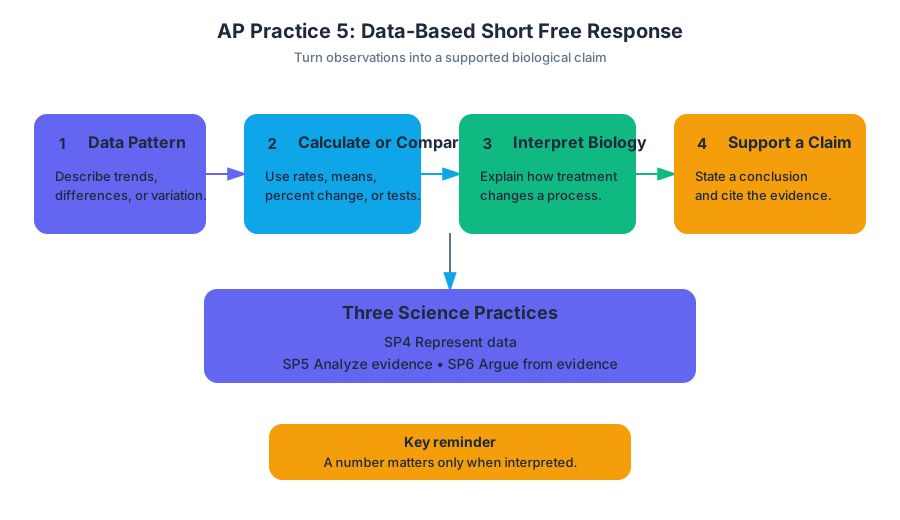
This task most directly exercises Science Practice 4: Representing and Describing Data, Science Practice 5: Statistical Tests and Data Analysis, and Science Practice 6: Argumentation. It may also require Science Practice 1: Concept Explanation when you explain why a treatment changes a biological process.
A useful response chain is:
Data pattern $\rightarrow$ calculation or comparison $\rightarrow$ biological interpretation $\rightarrow$ claim supported by evidence
Do not treat these as separate tasks. A calculation earns little value if you never interpret it, and a conclusion is weak if it does not identify the data that support it.
Original practice prompt
Researchers investigated whether salinity affects the germination of a marsh plant. They placed equal numbers of seeds in solutions containing different sodium chloride concentrations. After $72$ hours, they recorded the number of seeds that germinated.
| Sodium chloride concentration | Germinated seeds | Ungerminated seeds |
|---|---|---|
| $0%$ | $86$ | $14$ |
| $1%$ | $74$ | $26$ |
| $2%$ | $51$ | $49$ |
| $3%$ | $28$ | $72$ |
The researchers repeated the experiment using a second group of seeds. Their predicted numbers under the null hypothesis that salinity has no effect were $60$ germinated and $40$ ungerminated seeds at each concentration.
Answer the following.
-
Describe the relationship between sodium chloride concentration and germination percentage.
-
Calculate the chi-square statistic for the $3%$ treatment using observed values of $28$ germinated and $72$ ungerminated seeds and expected values of $60$ germinated and $40$ ungerminated seeds.
-
Explain how increased salinity could reduce germination.
-
State whether the data support rejecting the null hypothesis for the $3%$ treatment if the critical value is $\chi^2=3.84$.
-
Identify one limitation of the investigation and propose a specific improvement.
Worked reasoning and scoring logic
1. Describe the relationship
First calculate or compare percentages rather than merely repeating raw counts. Because each treatment contains $100$ seeds, the germinated-seed count is also the germination percentage: germination decreases from $86%$ at $0%$ sodium chloride to $28%$ at $3%$ sodium chloride.
Rewardable reasoning: identify the direction of the relationship and support it with at least two values. “Salinity lowers germination” is a claim; “germination falls from $86%$ to $28%$ as salinity rises from $0%$ to $3%$” is an evidence-based description.
2. Calculate chi-square
Use the equation:
$$ \chi^2=\sum\frac{(o-e)^2}{e} $$
For germinated seeds:
$$ \frac{(28-60)^2}{60}
\frac{1024}{60} \approx 17.07 $$
For ungerminated seeds:
$$ \frac{(72-40)^2}{40}
\frac{1024}{40} =25.60 $$
Add the category values:
$$ \chi^2=17.07+25.60=42.67 $$
Rewardable reasoning: show the observed value, expected value, subtraction, squaring, division, and final sum. A calculator result without a setup may not demonstrate that the correct categories were used.
3. Explain the biological mechanism
A concentrated salt solution has lower water potential than the seed cells. Water therefore enters the seed less readily, reducing the hydration needed to activate enzymes, mobilize stored molecules, and begin growth. The explanation must connect salinity to water availability and then to germination; simply saying “salt is harmful” is incomplete.
4. Interpret the statistical test
The calculated value, $\chi^2=42.67$, is greater than the critical value, $\chi^2=3.84$. The researchers should reject the null hypothesis for the $3%$ treatment because the difference between observed and expected outcomes is statistically significant under the stated criterion.
The precise conclusion is not “salinity causes every seed to fail.” It is that the $3%$ treatment produced a germination pattern unlikely under the null hypothesis that salinity has no effect.
5. Evaluate the investigation
One limitation is that the investigation reports only one group of $100$ seeds per concentration, so differences among individual seed batches cannot be separated from the treatment effect. An improvement would be to use several independently prepared groups at each concentration and calculate germination percentages across replicates.
This answer earns the design point because it identifies a concrete limitation and pairs it with a feasible improvement. “Make the experiment better” is not specific enough.
Examiner-style error checks
Misconception: “A larger chi-square value proves the hypothesis.” A large $\chi^2$ indicates a large difference between observed and expected results. It supports rejecting the null hypothesis when compared with the appropriate critical value; it does not automatically prove a particular mechanism.
Misconception: “The expected values are the control-group results.” Expected values are predictions generated by the null hypothesis. They may equal a control pattern in some experiments, but they are conceptually distinct.
Misconception: “Statistical significance proves biological importance.” A statistically significant difference may be small in practical terms, whereas a biologically important pattern may require more evidence to establish statistical significance.
Timing and review routine
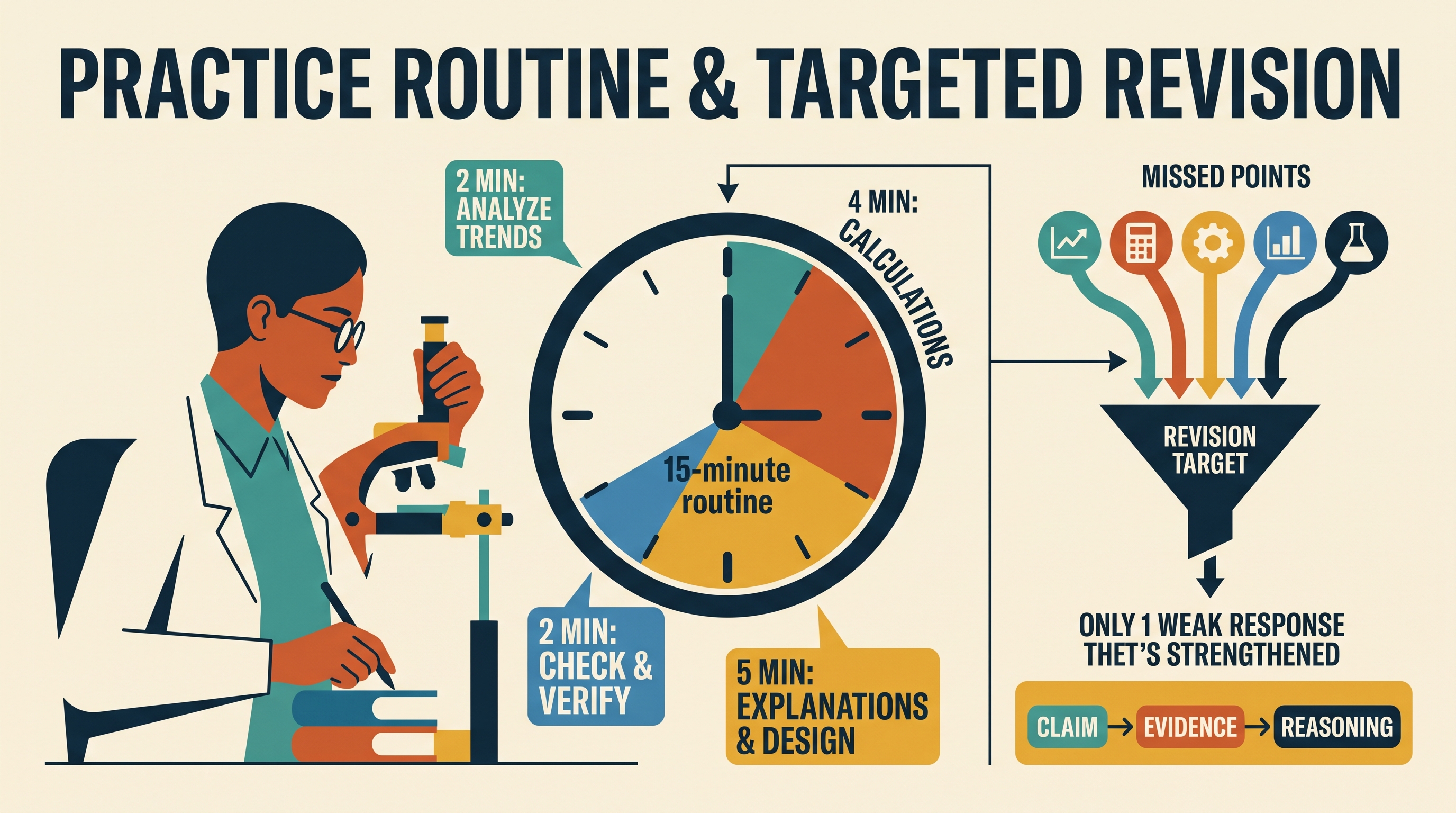
Allow approximately $12$–$15$ minutes: $2$ minutes to identify variables and trends, $4$ minutes for calculations, $5$ minutes for explanations and experimental design, and $2$ minutes to check units, comparisons, and conclusions.
Afterward, label each missed point as data reading, mathematical setup, mechanism, statistical interpretation, or experimental design. Rewrite only the weakest response using the pattern: claim, numerical evidence, biological reasoning. That revision targets the science practices rather than merely memorizing the answer.
Source Materials
- Ap Biology Course And Exam Description
- Ap Biology Course Overview
- Ap Biology Course At A Glance
- Ap Biology Equations And Formulas Sheet
- Chapter 3 Quantitative Skills In Ap Sciences
- Ap Biology Teacher Lab Manual Effective Fall 2019
- Updates 2025 26
- AP Biology Course-AP Central-College Board
- AP Biology-AP Students
- Biology of AP Courses-OpenStax
- AP Biology-Acellus
- AP/College Biology