From the free course AP Biology on Lykke
2.4 Membrane Permeability
Key concepts: Membrane permeability · Dialysis tubing as a selectively permeable membrane · Size-dependent passage of solutes · Ovalbumin permeability · Dissociation of ionic compounds · Non-dissociation of covalent compounds · Osmolarity · Water potential
A membrane can separate two solutions while still allowing some molecules to cross; this property is called selective permeability. In a classic dialysis-tubing experiment, the central question is: Which solutes can pass through the membrane, and how does each solute change water movement?
2.4 Membrane Permeability
A membrane can separate two solutions while still allowing some molecules to cross; this property is called selective permeability. In a classic dialysis-tubing experiment, the central question is: Which solutes can pass through the membrane, and how does each solute change water movement?
Learning Objective 2.4.A: Describe the mechanisms that allow cells to maintain homeostasis.
Essential Knowledge 2.4.A.1: Cell membranes are selectively permeable because of their structure and the properties of the substances crossing them.
A molecular “sieve,” not an open doorway
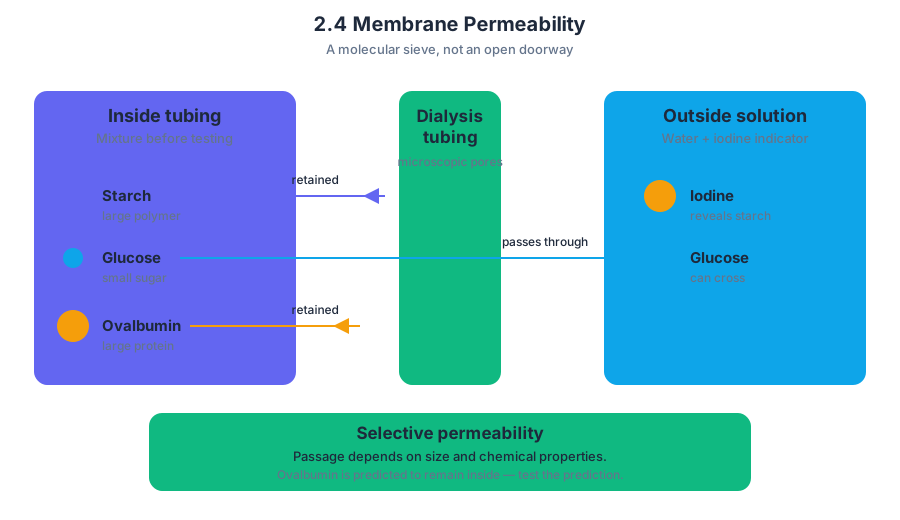
Dialysis tubing acts as a model selectively permeable membrane. Its microscopic pores permit relatively small particles to move through, while larger molecules are retained. Passage therefore depends on a solute’s size and chemical properties—not simply on whether the solute is dissolved.
Imagine filling dialysis tubing with a mixture of starch and glucose, then placing it in water. Glucose molecules are small enough to pass through the tubing; starch molecules are much larger and remain inside. If the outside solution contains iodine that reacts with starch, the color change can reveal whether the larger polymer crossed the membrane.
The same logic applies to ovalbumin, a large protein found in egg white. An experiment using ovalbumin asks whether this protein can pass through dialysis tubing. Because ovalbumin is much larger than small ions or simple sugars, the prediction is that it will remain inside the tubing, although the result must be tested rather than assumed.
Dissociation changes the number of particles
A solute’s effect on a solution depends partly on how many dissolved particles it produces. Dissociation is the separation of an ionic compound into its component ions when it dissolves. Sodium chloride, $NaCl$, is ionic:
$$ NaCl_{(s)} \rightarrow Na^+{(aq)} + Cl^-{(aq)} $$
One formula unit of $NaCl$ therefore produces approximately two dissolved particles. By contrast, sucrose, $C_{12}H_{22}O_{11}$, is a covalent compound. It dissolves as intact molecules:
$$ C_{12}H_{22}O_{11(s)} \rightarrow C_{12}H_{22}O_{11(aq)} $$
Sucrose does not dissociate into ions, so one sucrose molecule remains one dissolved particle. The distinction matters because osmolarity is the total concentration of dissolved particles, measured in osmoles per liter. Equal molar concentrations of $NaCl$ and sucrose do not have equal osmolarities: ideally, $1\ \mathrm{mol,L^{-1}}$ of $NaCl$ contributes about $2\ \mathrm{osmol,L^{-1}}$, whereas $1\ \mathrm{mol,L^{-1}}$ of sucrose contributes about $1\ \mathrm{osmol,L^{-1}}$.
From particle number to water potential
More dissolved particles generally make solute potential, $\Psi_s$, more negative. Water potential is described by:
$$\Psi=\Psi_s+\Psi_p$$
where $\Psi$ is total water potential, $\Psi_s$ is solute potential, and $\Psi_p$ is pressure potential. In an open dialysis-tubing setup, pressure potential is often treated as negligible, so differences in solute concentration strongly influence the direction of water movement.
For an ideal dilute solution, solute potential can be estimated with:
$$\Psi_s=-iCRT$$
Here, $i$ is the van’t Hoff factor—the approximate number of particles produced per dissolved formula unit—$C$ is molar concentration, $R$ is the gas constant, and $T$ is absolute temperature in kelvins. Because $NaCl$ has a larger $i$ than sucrose, the same molar concentration of $NaCl$ produces a more negative $\Psi_s$ and a stronger tendency to draw water across a membrane that retains the solute.
Worked example: interpreting a dialysis experiment
Suppose a dialysis bag containing ovalbumin and dissolved $NaCl$ gains mass after being placed in distilled water. The reasoning chain is:
- The bag contains more dissolved particles than the surrounding water.
- The membrane allows water to cross.
- Ovalbumin is probably too large to leave, while small ions may be able to pass depending on the tubing’s pore size.
- The bag’s lower water potential causes net water entry.
- If the bag’s mass changes from $20.0\ \mathrm{g}$ to $23.0\ \mathrm{g}$, then:
$$%\ \mathrm{change\ in\ mass}=\frac{23.0-20.0}{20.0}\times100=15%$$
The percentage change is more useful than the raw change alone when different bags begin with different masses. A living cell can be analyzed by the same principle: the external solution at which there is no net mass change is approximately isotonic to the cell, allowing an estimate of the cell’s internal solute concentration.
Misconception check
Misconception: “A covalent solute produces no particles in water.” Sucrose does produce dissolved particles—it simply does not split into ions. The correct comparison is one intact sucrose molecule versus multiple ions produced by an ionic compound such as $NaCl$.
Misconception: “If a molecule dissolves, it must cross the membrane.” Dissolving and crossing are different events. Ovalbumin can be suspended or dissolved inside the bag while remaining unable to pass through its pores.
AP Science Practices in action
This investigation develops Science Practice 1: Concept Explanation, especially explaining how dissociation changes osmolarity and water potential; Science Practice 2: Visual Representations, by diagramming solute movement and water movement; Science Practice 3: Questions and Methods, by predicting whether ovalbumin crosses dialysis tubing; Science Practice 4: Representing and Describing Data, by graphing mass or percent change; Science Practice 5: Statistical Tests and Data Analysis, by comparing replicated treatments; and Science Practice 6: Argumentation, by using mass-change evidence to support or reject a permeability claim.
Retrieval check: A dialysis bag contains $0.10\ \mathrm{M}$ sucrose, and another contains $0.10\ \mathrm{M}$ $NaCl$. Assuming ideal behavior and equal pressure, which bag has the more negative solute potential, and why? Explain your answer using dissociation, not merely molar concentration.