From the free course AP Biology on Lykke
2.8 Mechanisms of Transport
Key concepts: Homeostasis · Transport mechanisms in plants · Osmosis · Diffusion · Active transport · Water absorption by plants · Ion absorption by plants · Nutrient absorption by plants · Transport of dissolved nutrients · Maintaining proper balances of water, ions, and nutrients
A plant can lift water from soil to leaves, balance dissolved ions inside its cells, and deliver nutrients throughout its body without a pump running through every root.
2.8 Mechanisms of Transport
A plant can lift water from soil to leaves, balance dissolved ions inside its cells, and deliver nutrients throughout its body without a pump running through every root. It accomplishes this through three linked mechanisms: osmosis, diffusion, and active transport.
CED traceability: Topic 2.8 Mechanisms of Transport; Learning Objective 2.8; Essential Knowledge 2.B.1.
The central biological problem is homeostasis: plants must accumulate sufficient quantities of water, ions, and other nutrients while keeping those materials properly balanced.
The transport problem: gaining materials without losing control
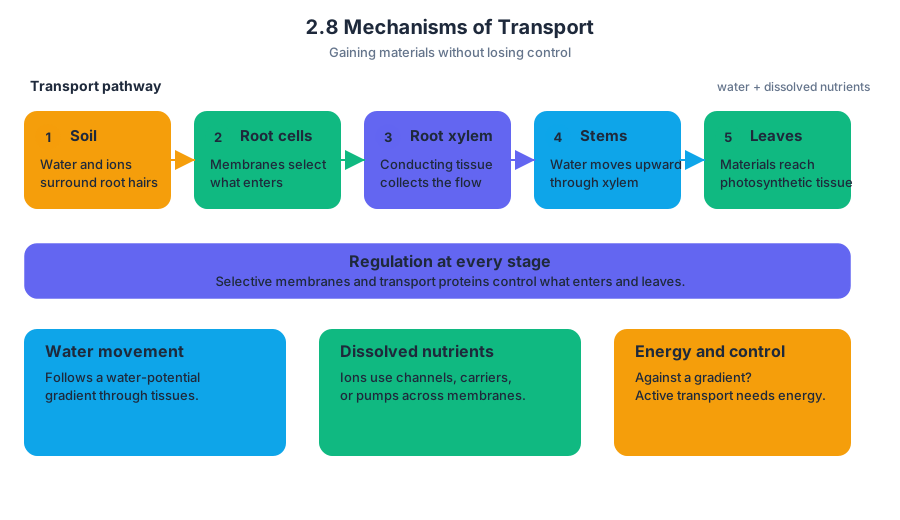
Root cells contact soil, but contact alone does not guarantee absorption. Water and dissolved nutrients must cross selectively permeable cell membranes, move through root tissues, enter the xylem, and travel upward to stems and leaves. At every stage, the plant must regulate the amounts entering and leaving; too little water causes wilting, while excessive loss can damage or kill the plant.
A useful way to visualize the pathway is:
$$ \text{soil} \rightarrow \text{root cells} \rightarrow \text{root xylem} \rightarrow \text{stems} \rightarrow \text{leaves} $$
The transported materials include both water and dissolved nutrients, especially ions. Their movement is not governed by one universal mechanism. The direction and energy requirements depend on the concentration gradient, the water-potential gradient, the membrane proteins present, and whether the cell must move a substance against its gradient.
Osmosis: water follows water potential
Osmosis is the movement of water across a selectively permeable membrane from higher water potential to lower water potential. Water potential describes the tendency of water to move; water with higher free energy and more available water has a higher water potential, whereas water with lower free energy and less available water has a lower water potential.
$$ \text{high water potential} \rightarrow \text{low water potential} $$
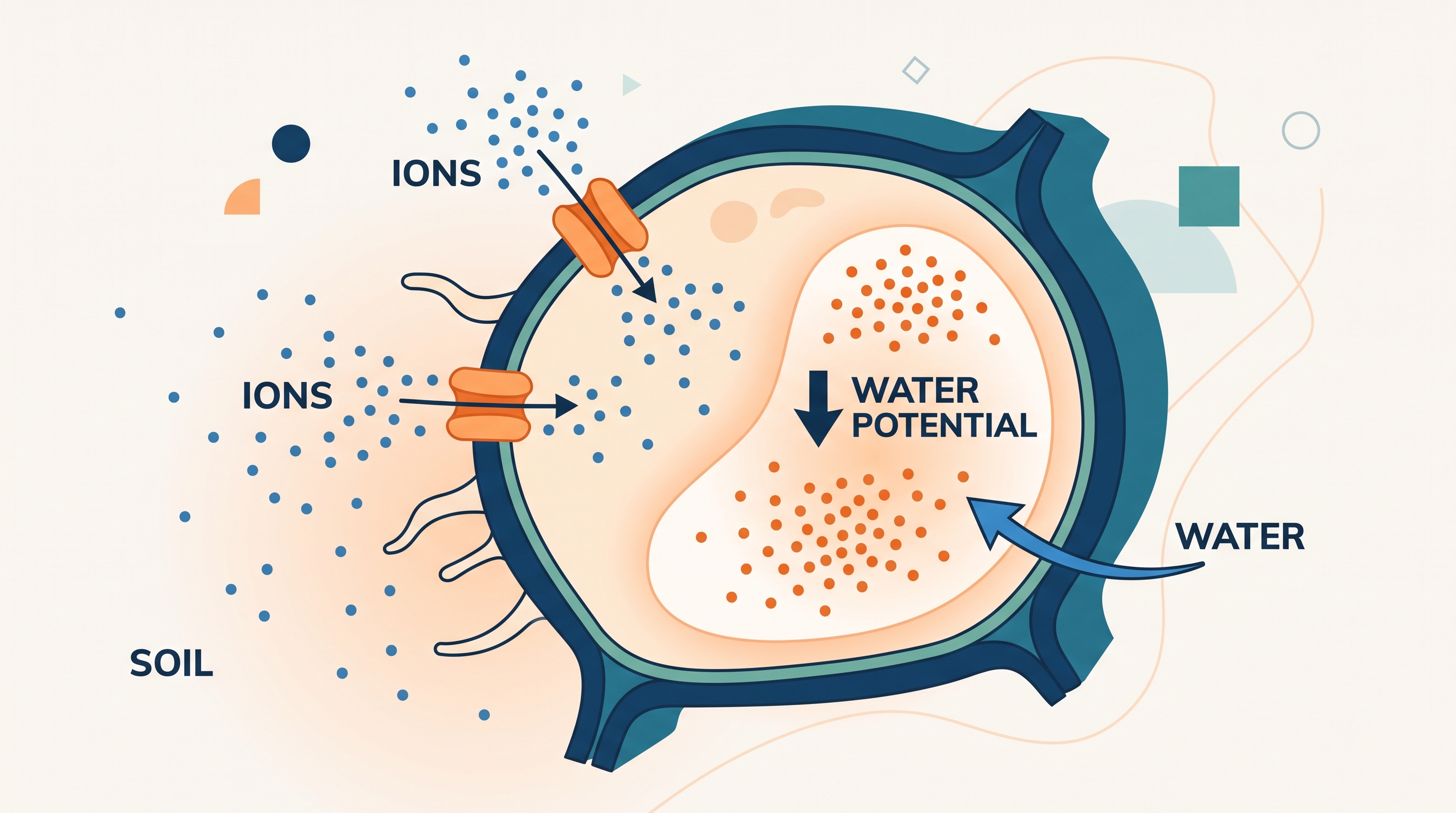
In a root, dissolved ions and other solutes can make the water potential inside root cells lower than that of the surrounding soil solution. Water therefore enters the root by osmosis. The water then moves across successive cells toward the xylem, where the overall water-potential gradient can continue upward toward the leaves.
Worked example: why water enters a root
Suppose the soil solution has a relatively high water potential, while root cells contain accumulated ions that lower their water potential. The membrane allows water to cross more readily than many solutes.
- Water begins outside the root, where its water potential is higher.
- The root-cell interior has lower water potential because it contains more dissolved solute.
- Water moves into the root cells by osmosis.
- As water enters, it can pass from cell to cell toward the xylem.
- Transpiration—the evaporation of water from leaf surfaces—removes water at the shoot, helping maintain the directional gradient through the plant.
The plant is not “pulling” individual water molecules upward with a cellular motor. Instead, evaporation at the leaf and differences in water potential help maintain continuous water movement through the xylem.
Diffusion: particles spread down a gradient
Diffusion is the net movement of particles from a region of higher concentration to a region of lower concentration, caused by random molecular motion. It requires no direct input of cellular energy. Small molecules may cross a membrane directly, while other substances diffuse through membrane proteins; the decisive feature is movement down a concentration or electrochemical gradient.
Diffusion contributes to plant transport when dissolved substances move from areas where they are more concentrated toward areas where they are less concentrated. For example, an ion may diffuse through an appropriate channel if the ion’s electrochemical gradient favors movement into the cell.
Active transport: spending energy to build gradients
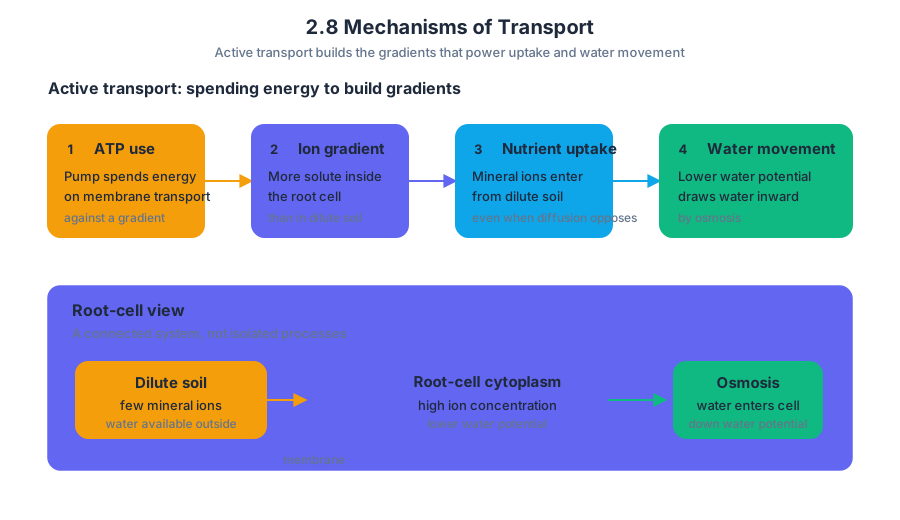
Active transport moves a substance against its concentration or electrochemical gradient and requires energy, usually supplied by ATP. Membrane pumps and transport proteins use this energy to accumulate ions and nutrients inside root cells even when diffusion would move them outward.
Active transport is therefore more than a way to move materials. It creates gradients that make other transport possible:
$$ \text{ATP use} \rightarrow \text{ion gradient} \rightarrow \text{nutrient uptake and water movement} $$
For instance, a root cell can actively transport mineral ions from dilute soil into its cytoplasm. The resulting increase in internal solute concentration can lower the cell’s water potential, encouraging additional water to enter by osmosis. In this way, active transport and osmosis operate as a connected system rather than as isolated processes.
Homeostasis in the whole plant
Homeostasis is the maintenance of a relatively stable internal environment despite external changes. Plant transport supports homeostasis by controlling water, ions, and nutrients: roots absorb materials, xylem distributes water and dissolved nutrients upward, and leaves lose water through transpiration.
A plant facing dry air may lose water from its leaves faster than roots can replace it. If the imbalance becomes severe, cells lose turgor, the plant wilts, and continued water loss can lead to death. Transport mechanisms must therefore maintain both supply and balance.
Misconception check
Misconception: “All plant absorption is passive.”
Correction: osmosis and diffusion are passive, but plants also use active transport to accumulate ions and nutrients against gradients. The energy used for active ion transport can indirectly support water absorption by changing water potential.
AP Biology science practices in this topic
This topic is commonly assessed through Science Practice 1: Concept Explanation, when explaining why a substance moves in a particular direction; Science Practice 2: Visual Representations, when interpreting a root-to-leaf transport diagram; Science Practice 5: Statistical Tests and Data Analysis, when analyzing water-uptake or transpiration data; and Science Practice 6: Argumentation, when using evidence to argue that a treatment changes transport or homeostasis.
Retrieval check
A root cell actively accumulates ions from dilute soil. Predict what happens to the root cell’s water potential and explain why water may subsequently enter. A complete answer states that ion accumulation lowers the cell’s water potential, creating a gradient that favors water movement into the cell by osmosis.