From the free course AP Biology on Lykke
8.4 Effect of Density on Populations
Key concepts: Carrying capacity (K)
A population can grow rapidly when resources are abundant, but competition intensifies as more individuals occupy the same space. Population density is the number of individuals of a species per unit of area or volume; its effects are central to understanding why populations often stop growing rather than expanding…
8.4 Effect of Density on Populations
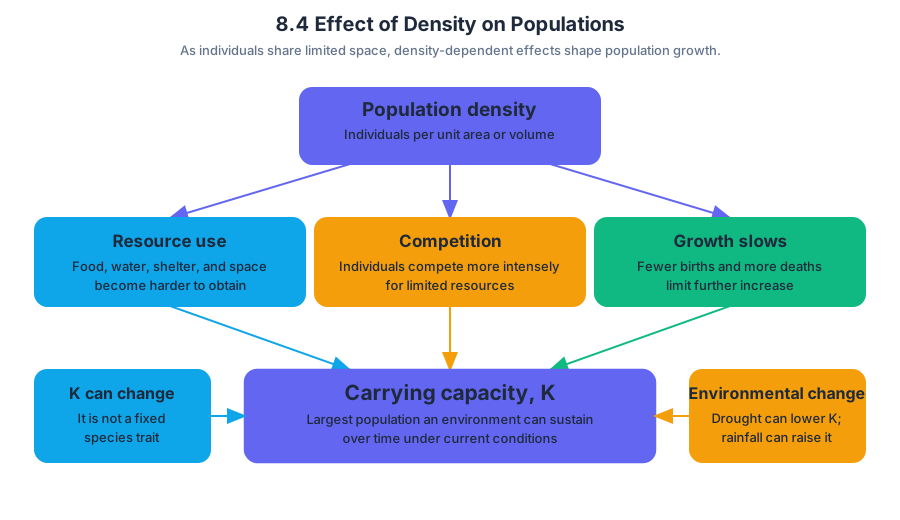
A population can grow rapidly when resources are abundant, but competition intensifies as more individuals occupy the same space. Population density is the number of individuals of a species per unit of area or volume; its effects are central to understanding why populations often stop growing rather than expanding forever.
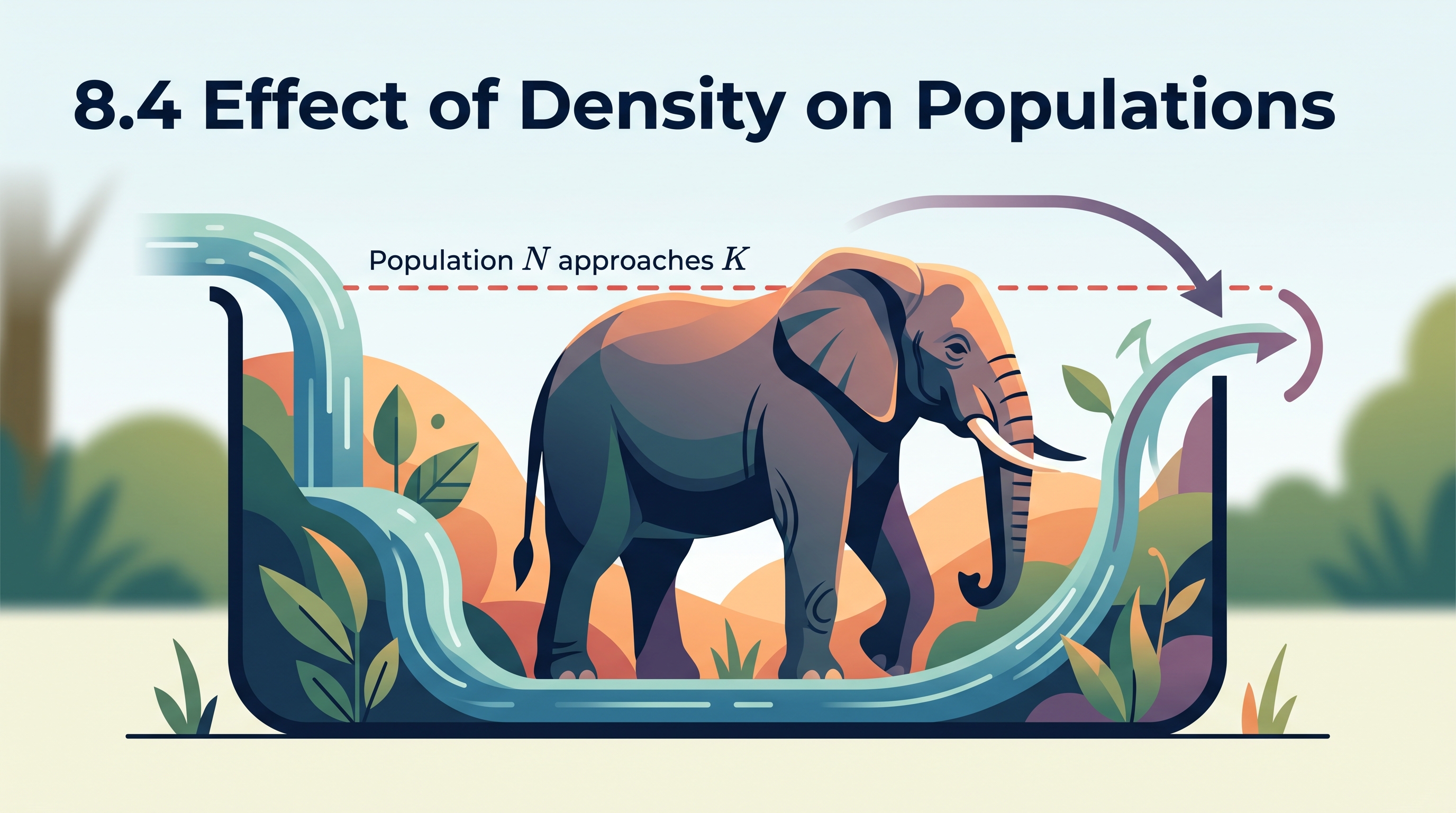
Carrying capacity, represented by $K$, is the largest population size that an environment can sustain over time under its current conditions.
The value of $K$ is not a permanent species trait. It depends on available food, water, shelter, nesting sites, nutrients, disease pressure, predators, and other environmental conditions. If a drought reduces plant growth, the carrying capacity for herbivores may fall. If rainfall returns, $K$ may rise again.
Density-dependent effects
A density-dependent factor has an effect that becomes stronger as population density increases. These factors are often caused by interactions among members of the same species or between organisms in the same community. When individuals are crowded together, each individual has fewer resources available and is more likely to encounter competitors, parasites, or pathogens.
Common density-dependent factors include:
- Competition: Individuals require the same limited food, water, space, light, or mates.
- Predation: A dense prey population may be easier for predators to locate.
- Disease: Pathogens spread more efficiently when infected and uninfected individuals are frequently close together.
- Territoriality: Limited nesting or breeding sites may prevent additional individuals from reproducing.
- Accumulation of waste: Waste products can become harmful when many organisms occupy a small area.
These effects produce negative density dependence: as density rises, the per-capita growth rate generally falls. At low density, individuals may reproduce successfully because resources are plentiful. Near $K$, births and deaths tend to balance, so the population size fluctuates around $K$ rather than increasing indefinitely.
Density-independent effects
A density-independent factor affects populations regardless of how crowded they are. Severe storms, wildfires, floods, freezes, droughts, volcanic eruptions, and other abiotic events can reduce a population at low, intermediate, or high density.
Density independence does not mean that every individual is affected equally. A flood may kill organisms in low-lying areas while sparing others at higher elevations. The key distinction is that the strength of the event is not primarily determined by how many individuals were already present.
The same event can also have both types of effects. A drought is density independent if it reduces water availability across a habitat. However, the competition for the remaining water becomes density dependent because crowded populations experience stronger resource limitation.
Worked example: estimating the effect of crowding
Suppose researchers place the same plant species into identical containers. One group contains $5$ plants per container, and another contains $20$ plants per container. After four weeks, the researchers measure average plant mass and record the number of fungal infections.
| Treatment | Plant density | Mean mass per plant | Infected plants |
|---|---|---|---|
| Low density | $5$ plants/container | $18\ \mathrm{g}$ | $1$ of $20$ |
| High density | $20$ plants/container | $9\ \mathrm{g}$ | $9$ of $20$ |
The high-density plants have lower mean mass, consistent with stronger competition for light, water, or nutrients. They also show more fungal infection, consistent with easier pathogen transmission. To decide whether these differences are unlikely to be caused by random variation, researchers could apply Science Practice 5: Statistical Tests and Data Analysis, using an appropriate statistical test and reporting the associated probability or confidence measure.
A strong conclusion would not claim that density caused every difference automatically. It would identify the manipulated variable, compare the treatment means, consider variation and sample size, and explain whether the statistical evidence supports a density effect. Replicated containers and controlled environmental conditions strengthen the inference.
Carrying capacity in a changing environment
In a logistic-growth model, population growth slows as population size approaches $K$. A compact representation is:
$$ \frac{dN}{dt}=rN\left(\frac{K-N}{K}\right) $$
where $N$ is population size and $r$ is the intrinsic rate of increase. When $N$ is much smaller than $K$, the factor $\frac{K-N}{K}$ is close to $1$, so growth is relatively rapid. When $N$ approaches $K$, that factor approaches $0$, and net growth slows.
Named misconception — “$K$ is the maximum number of organisms that can ever exist.” Not quite. Carrying capacity is an ecological estimate under particular conditions, not an unbreakable ceiling. A population can temporarily exceed $K$, producing overshoot, followed by resource depletion and a decline. Conversely, habitat restoration can increase $K$.
Retrieval check: A rabbit population rises after predators are removed, then levels off near a stable average. Which concept best explains the leveling: density-independent control, density-dependent limitation, or mutation? Explain what happens to resource availability and per-capita growth as the population approaches $K$.