From the free course AP Biology on Lykke
8.2 Energy Flow Through Ecosystems
Key concepts: Energy flow and matter cycling through trophic levels · Effects of energy availability on populations, communities, and ecosystems · Autotrophs as organisms that capture environmental energy · Photosynthesis and primary productivity · Chemosynthesis using small inorganic molecules · Carbon cycling through ecosystems · Nitrogen cycling through ecosystems · Phosphorus cycling through ecosystems · Decomposition and excretion as nutrient-return processes
Energy flows in one direction through an ecosystem, but matter cycles repeatedly between organisms and the nonliving environment. A leaf can capture sunlight, a caterpillar can consume the leaf’s stored chemical energy, and a bird can consume the caterpillar—but the atoms in the leaf do not disappear.
8.2 Energy Flow Through Ecosystems
Energy flows in one direction through an ecosystem, but matter cycles repeatedly between organisms and the nonliving environment. A leaf can capture sunlight, a caterpillar can consume the leaf’s stored chemical energy, and a bird can consume the caterpillar—but the atoms in the leaf do not disappear. Through waste, death, decomposition, and environmental exchange, those atoms return to forms that can be used again.
Learning Objective 8.2.B: Explain how energy flows and matter cycles through trophic levels.
Energy flow versus matter cycling
A trophic level is a feeding position in an ecosystem. Producers occupy the first trophic level; primary consumers eat producers, secondary consumers eat primary consumers, and higher-level consumers may follow. Decomposers and scavengers process organic matter from organisms at every level.
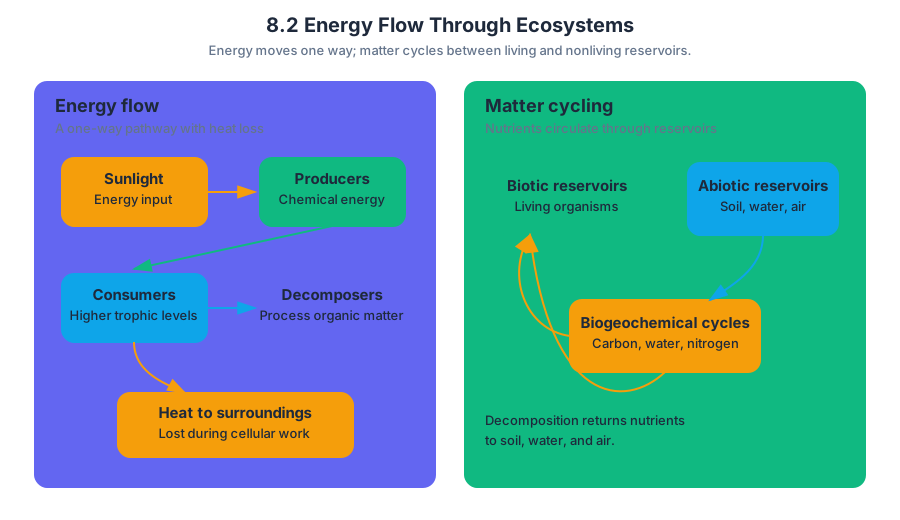
The distinction is easiest to see as two linked pathways:
Energy enters most ecosystems as sunlight, becomes chemical energy in autotrophs, and moves through consumers and decomposers. At each transfer, organisms use some energy for cellular work and release much of it as heat, so energy does not cycle back to the producer.
Matter behaves differently. Carbon, water, phosphorus, nitrogen, and other nutrients move between biotic reservoirs—living organisms—and abiotic reservoirs—soil, water, air, and sediments. These movements form biogeochemical cycles, and the cycles are interdependent: water transports dissolved nutrients, carbon is incorporated into biomass, and decomposition returns materials to the environment.
Autotrophs capture environmental energy
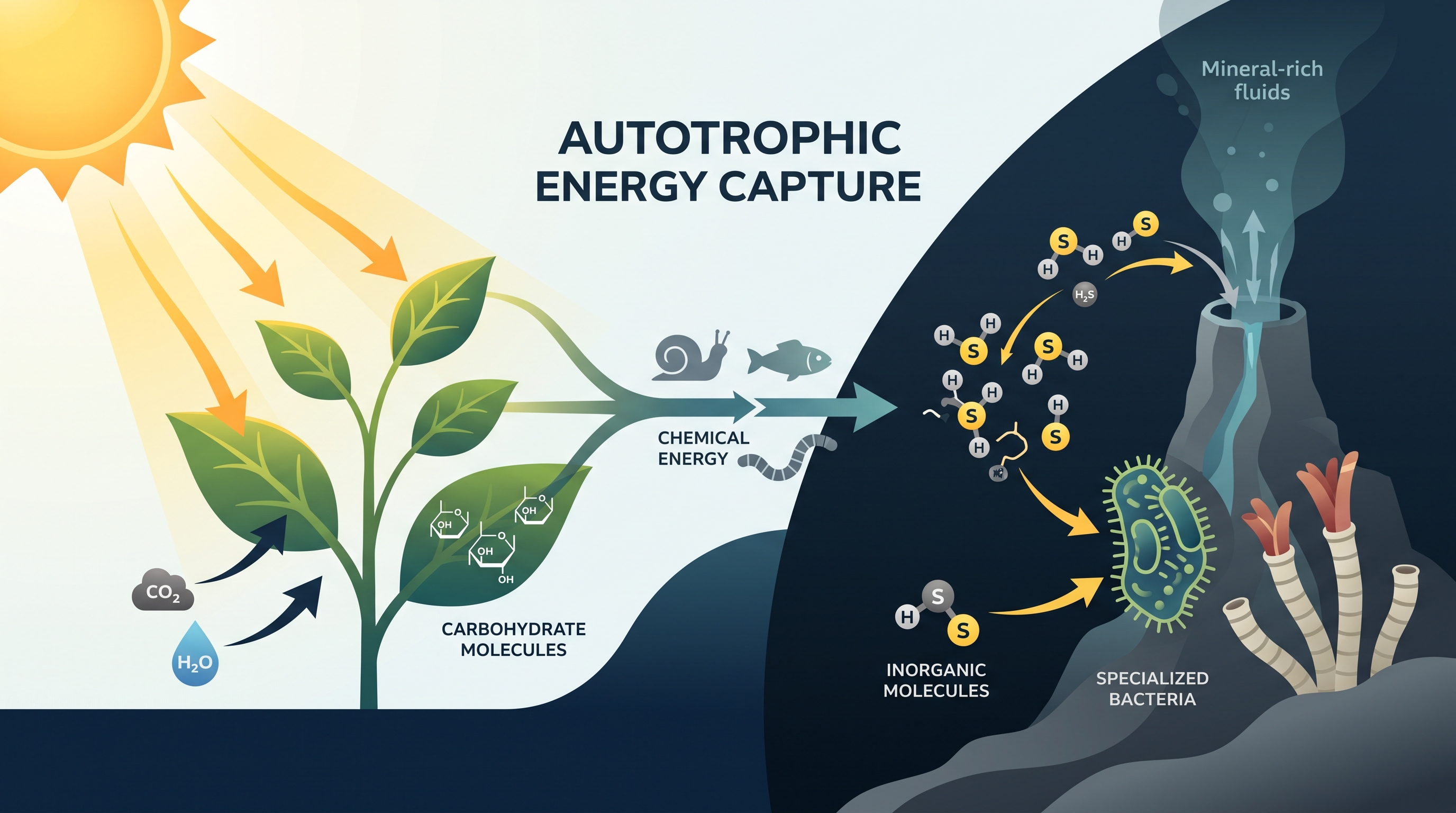
Autotrophs are organisms that make energy-rich organic molecules from inorganic materials by capturing energy from their surroundings. This is the focus of Learning Objective ENE-1.M: Describe the strategies organisms use to acquire and use energy.
Most familiar autotrophs are photosynthetic organisms. Plants, algae, and some bacteria capture energy from sunlight and use it to build carbohydrates from carbon dioxide and water. The rate at which producers capture and store energy as organic matter is called primary productivity. That stored chemical energy supports the consumers and decomposers connected to the producer.
Other autotrophs are chemosynthetic organisms. Instead of using light, they obtain energy by oxidizing small inorganic molecules such as hydrogen sulfide or ammonia. Because these molecules can provide energy without sunlight—and because some chemosynthetic pathways do not require oxygen—chemosynthesis can occur in oxygen-poor or dark environments, including habitats associated with deep-sea vents.
Heterotrophs transfer stored chemical energy
Heterotrophs cannot capture usable energy directly from sunlight or inorganic chemical sources. They obtain energy by consuming organic matter produced by autotrophs or by consuming organisms that previously consumed that organic matter. Carnivores, herbivores, omnivores, decomposers, and scavengers are all heterotrophs.
During metabolism, heterotrophs break down carbohydrates, lipids, and proteins. The released energy powers movement, growth, repair, reproduction, and other life processes; carbon compounds are also incorporated into the consumer’s tissues. When organisms die or release waste, decomposers make additional energy transfers while returning matter to environmental reservoirs.
Nutrients return through decomposition
Phosphorus illustrates matter cycling clearly. Plants absorb phosphate from soil or water and incorporate it into biological molecules. Animals obtain phosphorus by eating plants or other animals. When biomass decomposes or organisms excrete waste, phosphorus returns to the soil; phosphate can also reenter the environment as decaying organic matter is decomposed.
Carbon follows a connected cycle: photosynthetic autotrophs remove carbon dioxide from the environment and incorporate carbon into organic molecules; consumers acquire that carbon by feeding; cellular respiration, waste, and decomposition return carbon dioxide or other carbon-containing compounds to the environment. The carbon atoms cycle, even though the energy that powered their movement is progressively dissipated as heat.
Energy availability reshapes ecosystems
Learning Objective 8.2.C: Explain how changes in energy availability affect populations, communities, and ecosystems. A change in sunlight, producer biomass, or another energy resource can change population size and disrupt the number and size of trophic levels.
Worked example: Suppose prolonged cloud cover reduces light reaching an aquatic producer. Lower photosynthetic productivity means less chemical energy enters the ecosystem. Algal biomass may decline first; zooplankton then face less food, fish populations may decrease, and predators that depend on those fish may also decline. The initial change occurred at the producer level, but its effects propagated through the community.
The same logic applies in reverse. If producer biomass increases because light and nutrients become more available, primary consumers may increase, followed by consumers at higher trophic levels—provided habitat, predation, and other limiting factors do not prevent the response.
Misconception check
Misconception: “Energy is recycled when decomposers break down dead organisms.” Decomposers recycle matter, not energy. They use some chemical energy in dead biomass for metabolism and release much of it as heat; the atoms remain available for future biological use.
Retrieval check
A dark ecosystem contains bacteria that oxidize hydrogen sulfide, mussels that consume the bacteria, and crabs that consume the mussels. Identify the autotroph, explain why the system can function without sunlight, and predict one likely population-level effect if the hydrogen sulfide supply decreases.