From the free course AP Biology on Lykke
2.3 Plasma Membrane
Key concepts: Plasma membrane · Selective permeability · Phospholipid bilayer · Membrane proteins · Diffusion and osmosis · Transport across membranes · Active transport against a concentration gradient · Endocytosis · Homeostasis · Movement of water in nonwalled animal cells
A cell survives by controlling what crosses its boundary. The plasma membrane is the selectively permeable barrier that separates a cell’s internal environment from its surroundings, allowing some substances to enter or leave while restricting others.
2.3 Plasma Membrane
A cell survives by controlling what crosses its boundary. The plasma membrane is the selectively permeable barrier that separates a cell’s internal environment from its surroundings, allowing some substances to enter or leave while restricting others.
Learning Objective 2.3.A: Describe the role of the plasma membrane in maintaining homeostasis.
Essential Knowledge 2.3.A.1: Cellular membranes regulate movement of materials to help maintain homeostasis. The membrane must admit useful materials, remove wastes, preserve concentration gradients, and prevent uncontrolled water movement.
A phospholipid bilayer: a boundary with a built-in filter
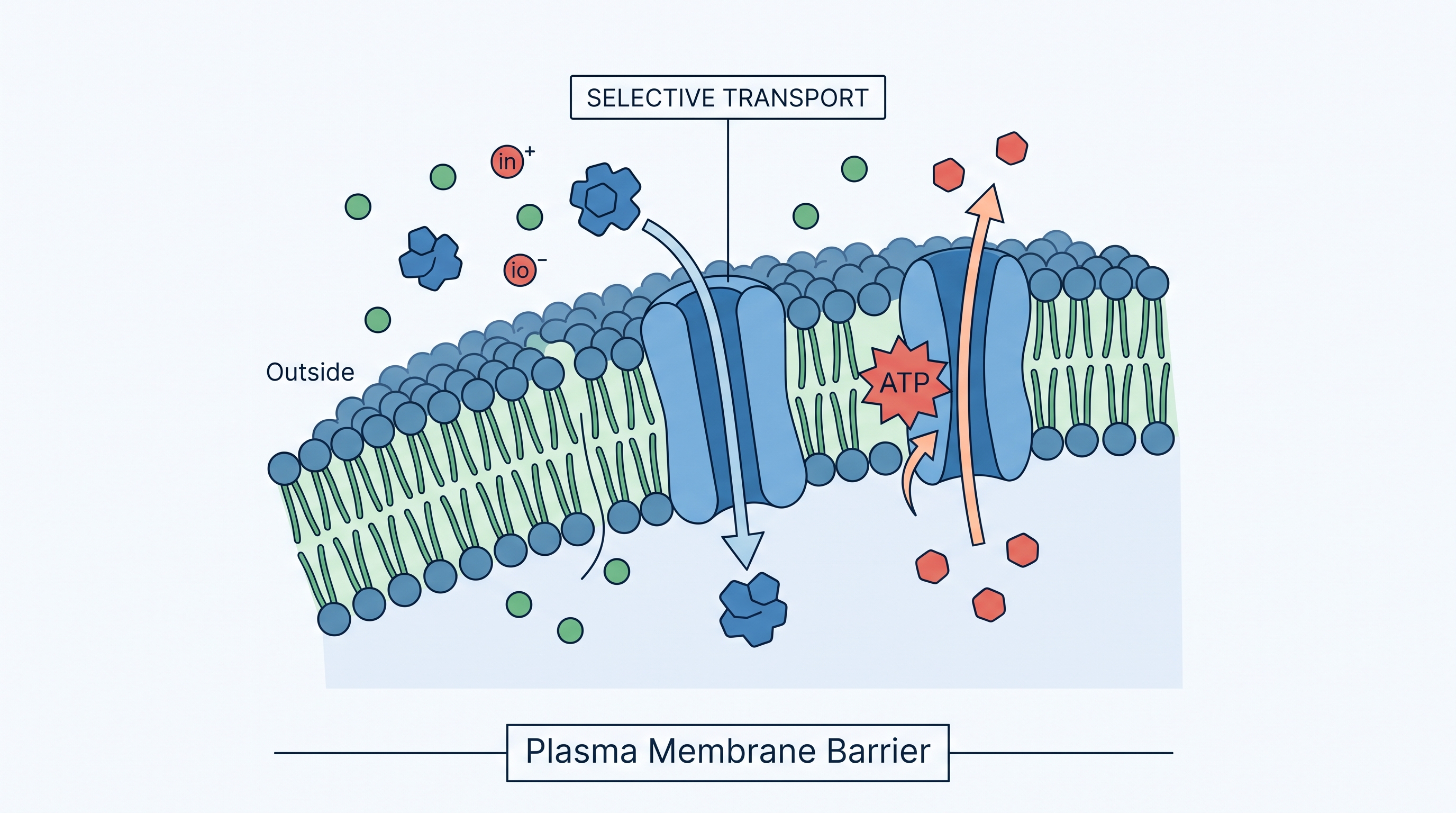
The plasma membrane consists primarily of a phospholipid bilayer—two layers of phospholipid molecules. Each phospholipid has a hydrophilic, or water-attracting, phosphate head and hydrophobic, or water-repelling, fatty-acid tails.
In an aqueous environment, the heads face the cytoplasm and extracellular fluid, while the tails point inward toward one another. This creates a water-compatible surface on both sides and a nonpolar interior that restricts many charged or polar substances.
| Membrane feature | Structural property | Transport consequence |
|---|---|---|
| Phosphate heads | Hydrophilic | Face water on both sides |
| Fatty-acid tails | Hydrophobic | Form a selective internal barrier |
| Embedded proteins | Specific shapes and chemical regions | Provide channels, carriers, receptors, or pumps |
| Vesicles | Membrane-bound compartments | Move very large materials |
The membrane is not a rigid wall. Its phospholipids and many proteins can move laterally, giving the membrane a flexible, dynamic structure. Membrane proteins extend partly or completely through the bilayer, and their amino-acid regions interact differently with the hydrophobic interior and watery environments.
Membrane proteins and transport routes
Membrane proteins make specific forms of transport possible. Protein channels provide hydrophilic passageways for selected ions or molecules. Transport proteins can bind substances and change shape, carrying them across the bilayer. Other proteins act as receptors or pumps, linking membrane transport to cell signaling and energy use.
The plasma membrane is distinct from the membranes surrounding organelles, although both are selectively permeable. Together, these membranes create cellular compartmentalization: different regions of a eukaryotic cell can maintain different chemical conditions and perform specialized functions.
Passive transport, active transport, and vesicles
Diffusion is the net movement of particles from a region of higher concentration to a region of lower concentration, driven by random molecular motion. It does not require cellular energy. Osmosis is the diffusion of water across a selectively permeable membrane.
Active transport moves molecules from regions of low concentration to regions of high concentration. Because this movement is against the concentration gradient, it requires energy, commonly supplied by ATP or by an energy-releasing ion gradient.
Very large molecules or substantial amounts of material cannot pass through an ordinary membrane protein. In endocytosis, the plasma membrane folds inward and pinches off to form a vesicle containing external material. In exocytosis, an internal transport vesicle fuses with the plasma membrane and releases its contents outside the cell.
Worked example: why an animal cell can burst
Place an animal cell in a solution whose solute concentration is lower than the cell’s internal solute concentration. Water moves into the cell by osmosis because the membrane permits water movement, while many solutes cannot cross freely.
The cell swells because it has no cell wall to resist expansion. Continued water entry can cause lysis, or bursting. In contrast, water leaving an animal cell causes it to shrink, a process called crenation. The membrane’s selective permeability therefore directly affects cell survival.
Misconception check
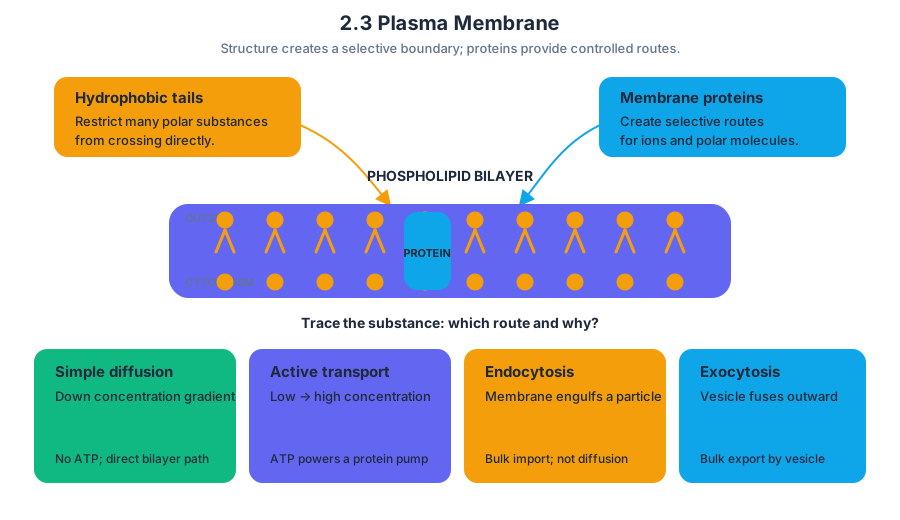
Misconception: “All movement across a membrane is diffusion.” Diffusion is passive movement down a concentration gradient, but active transport moves substances against a gradient and requires energy. Endocytosis and exocytosis move bulk material using vesicles rather than allowing individual molecules to diffuse through the bilayer.
AP skill connection and retrieval check
For Science Practice 1: Concept Explanation, connect structure to function: hydrophobic tails restrict many polar substances, while membrane proteins create selective routes. For Science Practice 2: Visual Representations, trace a substance through a bilayer diagram and identify whether its path represents diffusion, active transport, endocytosis, or exocytosis.
Retrieval check: A cell uses ATP to move an ion from low concentration to high concentration, then engulfs a large particle. Name the two transport mechanisms and explain why neither process is simple diffusion.