From the free course AP Biology on Lykke
5.2 Meiosis and Genetic Diversity
Key concepts: Meiosis as a source of genetic diversity · Crossing over (recombination) between nonsister chromatids of homologous chromosomes · Random assortment of chromosomes during meiosis · Genetic variation produced by meiosis · The role of genetic diversity in population responses to environmental change
A single offspring can receive a chromosome combination that neither parent has ever carried because meiosis reshuffles genetic information before fertilization. This reshuffling is not random damage: it follows recognizable mechanisms that produce genetically varied gametes.
5.2 Meiosis and Genetic Diversity
A single offspring can receive a chromosome combination that neither parent has ever carried because meiosis reshuffles genetic information before fertilization. This reshuffling is not random damage: it follows recognizable mechanisms that produce genetically varied gametes.
Big Idea 3: Information Storage and Transmission applies here because chromosomes store genetic information, and meiosis transmits that information into gametes while generating new combinations. The central learning objective is 5.2.A: Explain how the process of meiosis generates genetic diversity.
5.2.A.1: Correct separation of homologous chromosomes in meiosis I and sister chromatids in meiosis II gives each gamete a haploid set, $1n$, containing an assortment of maternal and paternal chromosomes.
Three sources of variation
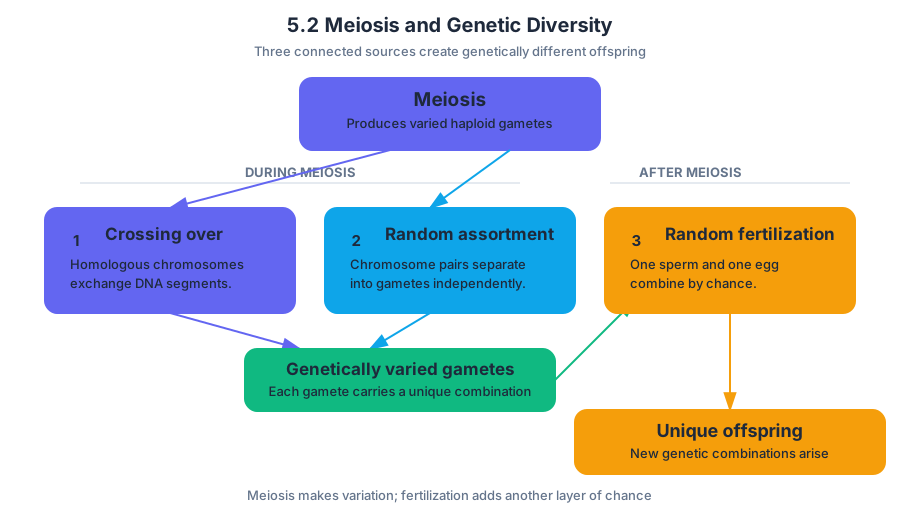
Meiosis creates genetic diversity through three connected mechanisms: crossing over, random assortment of chromosomes, and the later random fertilization of gametes. The first two occur during meiosis; fertilization adds another layer when one sperm and one egg combine.
Crossing over: exchanging segments
During prophase I, homologous chromosomes pair. A homologous pair contains one chromosome inherited through the maternal lineage and one through the paternal lineage; they carry the same kinds of genes, although their versions of those genes may differ.
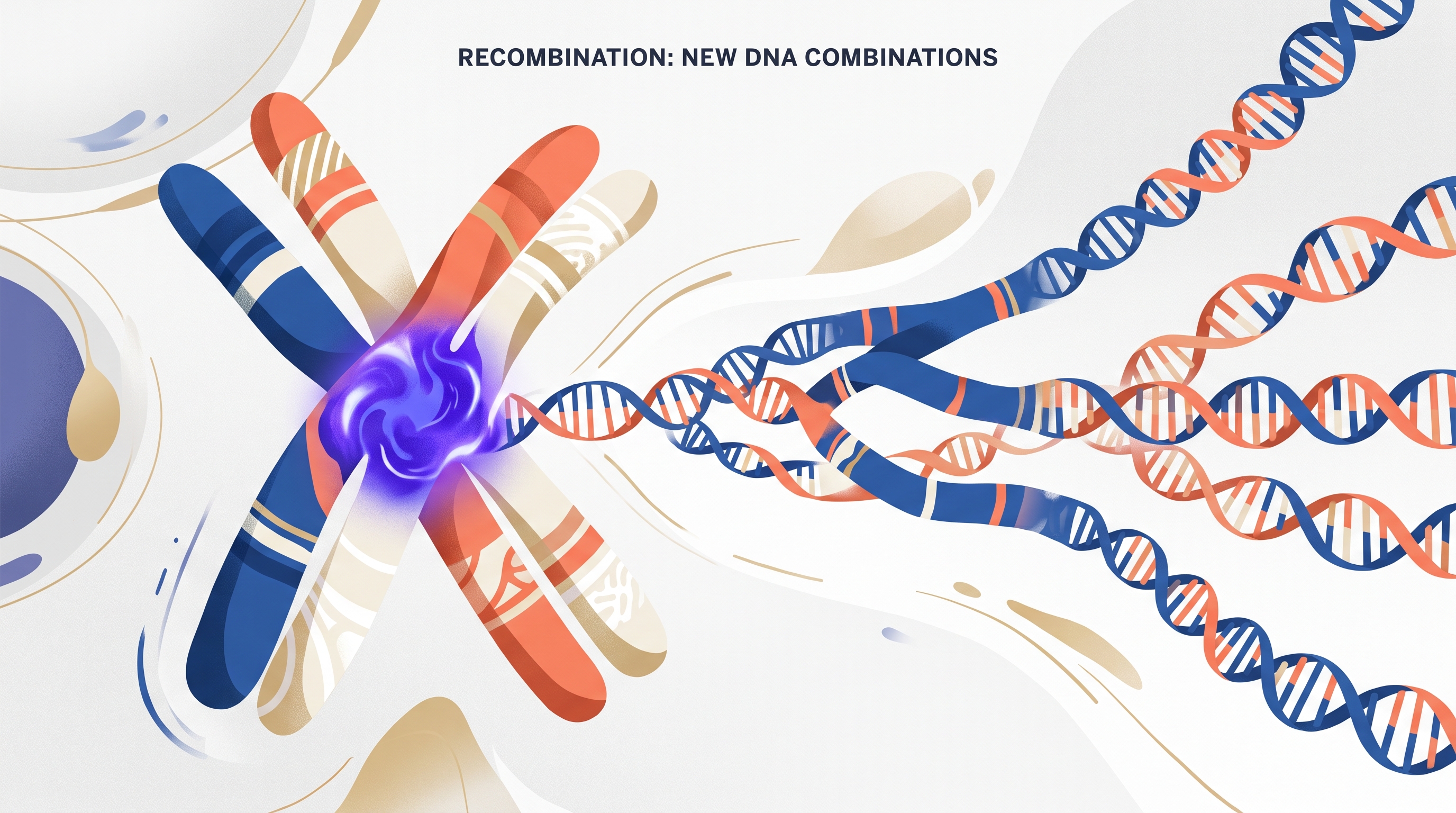
Crossing over, also called recombination, occurs when DNA segments are exchanged between nonsister chromatids of homologous chromosomes. Nonsister chromatids belong to different homologs, not to the identical-copy chromatids of the same duplicated chromosome. The exchange creates chromatids with new combinations of genetic information.
Worked example: Suppose one homolog carries alleles $A$ and $B$ on the same chromatid, while the other carries $a$ and $b$. Before crossing over, the parental combinations are $AB$ and $ab$. If nonsister chromatids exchange a segment between the two genes, recombinant combinations such as $Ab$ and $aB$ can result. The alleles themselves were not necessarily newly created; their arrangement is new.
Misconception check — “Crossing over occurs between sister chromatids.”
Sister chromatids are near-identical copies produced before meiosis. The diversity-producing exchange emphasized in 5.2.A.2 occurs between nonsister chromatids of homologous chromosomes during prophase I.
Random assortment: distributing homologs
At metaphase I, each homologous pair lines up independently of the other pairs. Which homolog faces one pole is not determined by whether it came from the mother or father. As a result, the gamete receives a mixture of maternal- and paternal-origin chromosomes.
For two homologous chromosome pairs, independent orientation can produce four chromosome-origin combinations: maternal–maternal, maternal–paternal, paternal–maternal, and paternal–paternal. With more chromosome pairs, the number of possible combinations increases rapidly. Crossing over makes the chromosomes themselves more varied, while random assortment varies which chromosomes travel together.
5.2.A.3: Sexual reproduction in eukaryotes increases genetic variation through crossing over, random assortment of chromosomes during meiosis, and subsequent fertilization of gametes.
Accurate separation matters
Genetic diversity depends on ordinary chromosome separation working correctly. Homologous chromosomes must separate in meiosis I, and sister chromatids must separate in meiosis II. Nondisjunction—incorrect separation—can produce gametes that are not haploid, so it changes chromosome number rather than serving as the normal mechanism of genetic variety described by crossing over and assortment.
A useful distinction is:
| Mechanism | What changes? | Result |
|---|---|---|
| Crossing over | DNA segments between nonsister chromatids | New combinations within chromosomes |
| Random assortment | Which maternal or paternal homolog enters a gamete | Different chromosome combinations |
| Fertilization | Which gametes unite | A unique offspring combination |
| Nondisjunction | Accuracy of chromosome separation | Gametes with abnormal chromosome number |
Why diversity helps populations
Genetic diversity gives a population a broader set of inherited characteristics. If an environmental pressure changes—such as drought, a new pathogen, or altered temperature—individuals may differ in how well they survive and reproduce. A population containing more variation has a greater chance that some individuals possess combinations suited to the new conditions.
This does not mean that meiosis deliberately produces the trait a population needs. Meiosis generates combinations before the environmental pressure acts; the environment influences which existing variants leave more offspring. In this way, meiotic diversity supplies variation that can affect a population’s response to environmental change.
AP skill connections:
- Science Practice 1: Concept Explanation, especially 1.A, is used to explain how each meiotic mechanism produces variation.
- Science Practice 2: Visual Representations, especially 2.A, is used to interpret chromosome diagrams showing homologs, nonsister chromatids, and recombinant products.
- Science Practice 4: Representing and Describing Data, especially 4.A, is used when comparing the frequency or variety of meiotic outcomes.
- Science Practice 6: Argumentation, especially 6.A, is used to support a claim that genetic diversity can influence population responses to environmental pressures with evidence and biological reasoning.
The AP Biology Lab Manual includes a related Meiosis Lab resource. Models using chromosomes or Sordaria asci can make crossing over visible: track chromosome segments before and after exchange, then ask how many distinct gamete types could result.
Retrieval check
A homologous pair contains one maternal-origin chromosome and one paternal-origin chromosome. If a diagram shows DNA exchanged between two chromatids belonging to different homologs, identify the mechanism and explain in one sentence how it increases diversity. Then distinguish that mechanism from random assortment: does it change DNA combinations within a chromosome, or which chromosomes enter the same gamete?