From the free course AP Biology on Lykke
7.1 Introduction to Natural Selection
Key concepts: Natural selection · Phenotypic variation in populations · Fitness as an organism’s ability to survive and reproduce · Selective pressures · Adaptation · Similar adaptations arising in different populations or species · Evolution as a process driving the diversity and unity of life · Population change across generations · Using investigations and data to study natural selection
A population can change when individuals with different phenotypes—observable characteristics such as body color, height, or the number of leaf hairs—survive and reproduce at different rates.
7.1 Introduction to Natural Selection
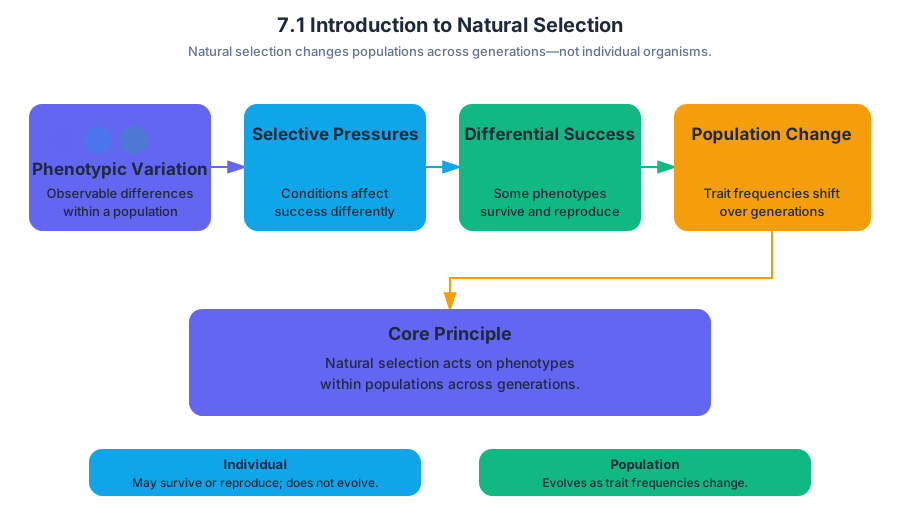
A population can change when individuals with different phenotypes—observable characteristics such as body color, height, or the number of leaf hairs—survive and reproduce at different rates. The environment does not “choose” traits deliberately; instead, environmental conditions create selective pressures that make some heritable phenotypes more successful than others.
Natural selection acts on phenotypic variation within populations, and the population’s characteristics change across generations.
This distinction is essential: an individual organism does not evolve during its lifetime. Individuals may survive, reproduce, or fail to reproduce, but evolution is detected when the frequency or average expression of traits changes in the population over generations.
Phenotypic variation and fitness
Phenotypic variation is the difference in observable traits among individuals in the same population. Variation can arise from differences in inherited information, environmental effects, or an interaction between both. A phenotype matters to natural selection when it changes an organism’s ability to survive and produce offspring in a particular environment.
Fitness means an organism’s relative ability to survive and reproduce. It is not simply physical strength, size, speed, or health. A smaller organism may have greater fitness than a larger one if it survives long enough to leave more viable offspring.
For example, imagine a population of plants with variation in leaf-hair number. If herbivorous insects avoid plants with many leaf hairs, those plants may suffer less damage, produce more seeds, and contribute more offspring to the next generation. In that environment, the high-hair phenotype has greater fitness. If the environment changes so that leaf hairs reduce photosynthesis or attract another consumer, the relative fitness of the same phenotype could decrease.
Misconception check — “The organism develops the trait it needs.” A plant does not grow extra hairs because it anticipates herbivory. Natural selection requires preexisting variation; environmental conditions determine which existing phenotypes leave more descendants.
Selective pressures and adaptation
A selective pressure is an environmental condition that causes some phenotypes to have greater survival or reproductive success than others. Examples include temperature, predation, disease, competition, food availability, and access to mates. The pressure is not automatically beneficial or harmful: its effect depends on the environment and the phenotype.
An adaptation is a heritable population characteristic that becomes common over generations because it improves fitness in a particular environment. The sequence is:
- Individuals in a population vary in phenotype.
- The environment creates a selective pressure.
- Some phenotypes produce more surviving offspring.
- Heritable characteristics associated with those phenotypes become more common.
- The population’s average phenotype or trait distribution changes across generations.
The same logic applies to molecular variation. Differences in the number or types of molecules within cells can improve an organism’s ability to survive and reproduce under particular conditions. For example, variation in cellular proteins may affect resistance to a toxin, while variation in pigments may affect camouflage.
CED traceability: Learning Objective 7.2.A, Essential Knowledge 7.2.A.1, 7.2.A.2, and 7.2.A.3 address phenotypic variation, environmental selective pressures, and changes in fitness. Learning Objective 7.2.B and Essential Knowledge 7.2.B.1 connect molecular variation within cells to organismal fitness.
Investigating selection with population data
A natural-selection investigation compares populations or generations before and after selection. Suppose students select plants with the greatest number of leaf hairs from a first generation and use their seeds to produce a second generation. A useful first comparison is the sample mean:
$$\bar{x}=\frac{1}{n}\sum x_i$$
If the first generation has a mean of $18$ hairs per leaf and the second generation has a mean of $25$, the descriptive result suggests an increase. However, a difference between means does not automatically demonstrate selection. Sampling variation could produce different means even when the populations are not meaningfully different.
To judge the evidence, investigators examine variation using standard deviation or standard error, display means with appropriate error bars, and apply a statistical test when suitable. The standard error is:
$$SE_{\bar{x}}=\frac{s}{\sqrt{n}}$$
A statistical result helps determine whether the observed difference is statistically significant rather than likely to be random sampling variation. The conclusion should identify the evidence, explain the relationship between selection and phenotype, and avoid claiming more than the experiment tested.
AP Science Practices: This investigation uses Science Practice 1: Concept Explanation to connect phenotype, fitness, and adaptation; Science Practice 2: Visual Representations to interpret trait distributions and graphs; Science Practice 3: Questions and Methods to design comparisons between generations; Science Practice 4: Representing and Describing Data to calculate and graph population means; Science Practice 5: Statistical Tests and Data Analysis to evaluate whether differences are statistically significant; and Science Practice 6: Argumentation to support a claim about selection with evidence and reasoning.
Similar pressures, similar adaptations
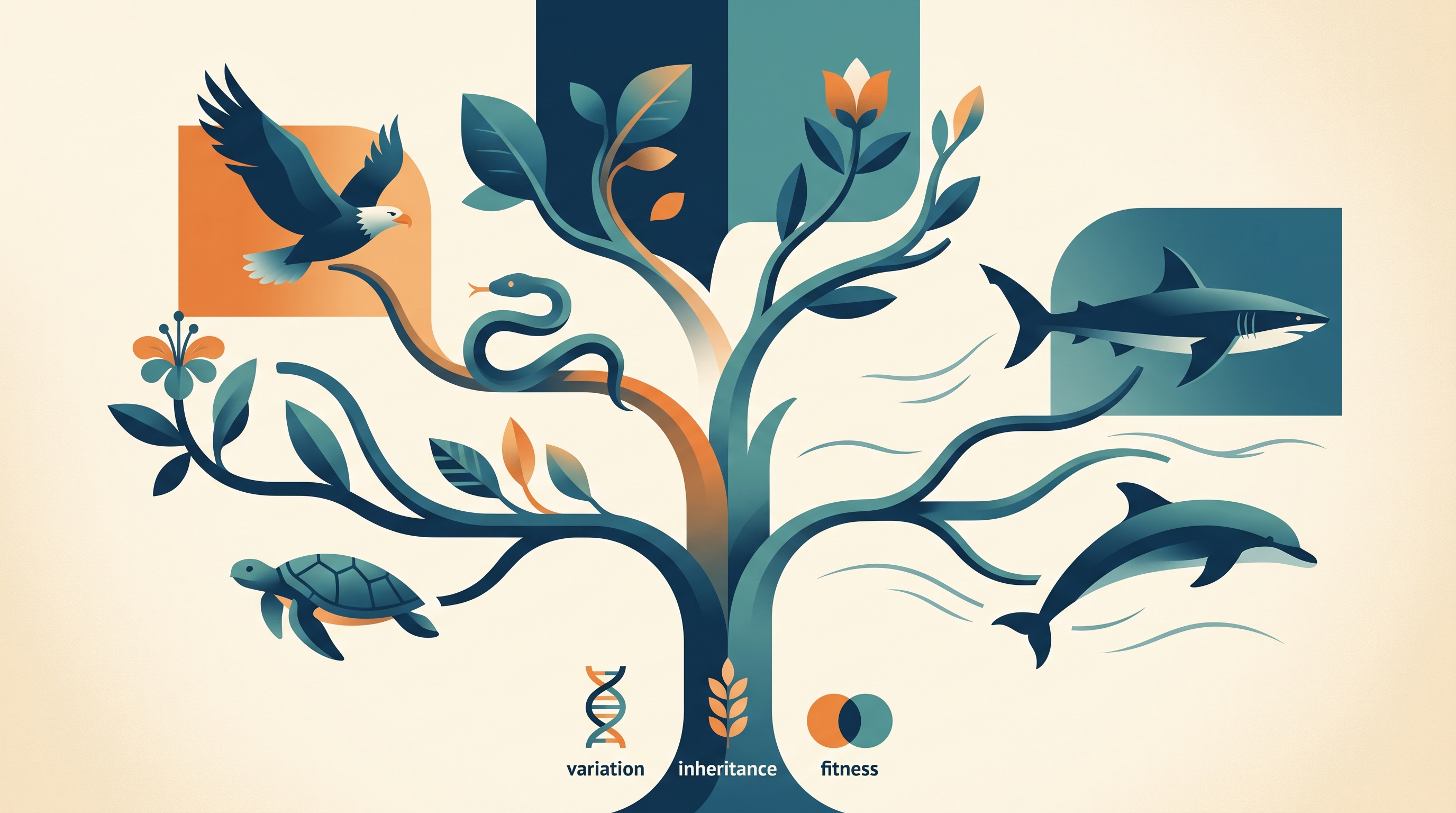
Different populations or species can encounter similar selective pressures and independently evolve similar phenotypic adaptations. This pattern is convergent evolution. Streamlined bodies in sharks and dolphins, for instance, reflect similar selective pressures associated with efficient movement through water, even though these organisms do not share a recent common ancestor with a streamlined body.
Natural selection therefore helps explain both the diversity and unity of life. Populations become different as they respond to different environments, yet similar environmental challenges can produce similar solutions. The underlying mechanism remains the same: variation, differential fitness, inheritance, and change across generations.
Retrieval check: A drought causes plants with deeper roots to produce more seeds than plants with shallow roots. Identify the selective pressure, the phenotype associated with higher fitness, and the population-level change expected after several generations. Why would “the plants evolved deeper roots during the drought” be an imprecise statement?
Flashcard prompt: What does natural selection act on, and what changes as a result?
Answer: Natural selection acts on phenotypic variation among individuals; across generations, the characteristics and trait frequencies of the population change.
Source Materials
- Ap Biology Course And Exam Description
- Ap Biology Course Overview
- Ap Biology Course At A Glance
- Ap Biology Equations And Formulas Sheet
- Chapter 3 Quantitative Skills In Ap Sciences
- Ap Biology Teacher Lab Manual Effective Fall 2019
- Updates 2025 26
- AP Biology Course-AP Central-College Board
- AP Biology-AP Students
- Biology of AP Courses-OpenStax
- AP Biology-Acellus
- AP/College Biology