From the free course AP Biology on Lykke
6.8 Biotechnology
A tiny biological sample can become a readable genetic result through biotechnology: the use of laboratory techniques to manipulate, copy, separate, or analyze DNA and RNA.
6.8 Biotechnology
A tiny biological sample can become a readable genetic result through biotechnology: the use of laboratory techniques to manipulate, copy, separate, or analyze DNA and RNA. The central question is practical and powerful: How can scientists turn an invisible nucleotide sequence into evidence about identity, disease, ancestry, or gene function?
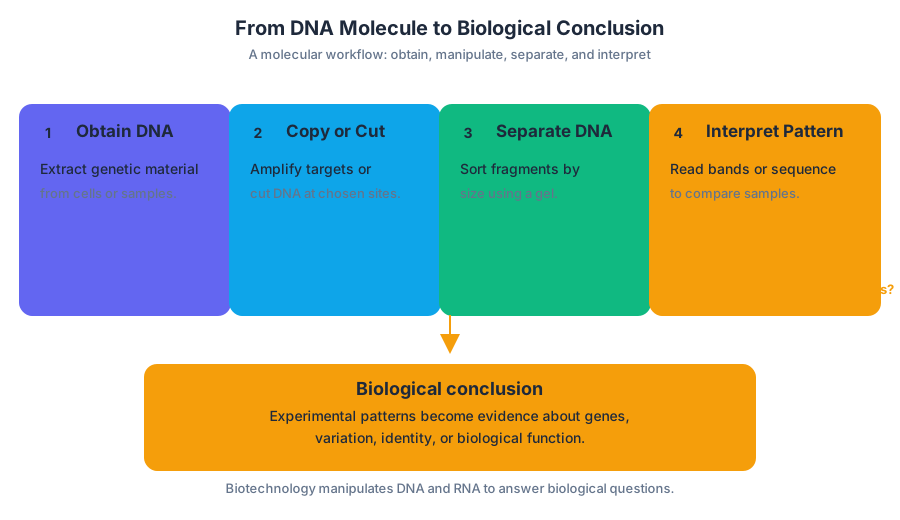
From DNA molecule to biological conclusion
Biotechnology works like a molecular workflow. Scientists first obtain genetic material, selectively copy or cut it, separate the resulting molecules, and then interpret a pattern or sequence. Each step answers a different question: What DNA is present? How much is present? How is it organized? Which sequence differs?
CED alignment — Learning Objective 6.8: Explain the applications of biotechnology.
Essential Knowledge 6.8.A: Biotechnology is used to manipulate DNA and RNA.
Science Practice 6.D — Argumentation: Explain the relationship between experimental results and larger biological concepts, processes, or outcomes.
Core biotechnology tools
| Tool | What it does | What the result can show |
|---|---|---|
| DNA sequencing | Determines the order of nucleotides in a DNA molecule | Whether two sequences match or contain a difference |
| Polymerase chain reaction (PCR) | Produces many copies of a selected DNA region | Whether a target sequence is present and large enough to analyze |
| Gel electrophoresis | Separates DNA fragments primarily by length | Whether samples contain fragments of particular sizes |
| Recombinant DNA technology | Combines DNA sequences from different sources | How a gene or regulatory sequence can be introduced into a biological system |
DNA sequencing: reading the information
DNA sequencing determines the order of bases in a DNA molecule. Because biological information is encoded in nucleotide order, sequencing can reveal whether a gene contains a particular variant, whether two samples are closely related, or whether a microorganism carries a medically important gene.
A sequence comparison must distinguish difference from meaning. Finding one base that differs between two samples is an experimental result; concluding that the difference changes protein function or causes a phenotype requires additional evidence. This distinction is the heart of 6.D — Argumentation: connect a result to a biological claim without claiming more than the evidence supports.
PCR: copying a target sequence
Polymerase chain reaction (PCR) amplifies a selected region of DNA, meaning it makes very many copies of that region. PCR requires template DNA, short primers that define the boundaries of the target, free nucleotides, DNA polymerase, and repeated temperature changes that separate DNA strands, allow primers to bind, and extend new strands.
Worked example: detecting a pathogen sequence
A researcher tests three water samples for a DNA sequence associated with a pathogen.
- The researcher extracts DNA from each water sample.
- Primers are selected to bind only to the pathogen-associated region.
- PCR amplifies that region if it is present in the sample.
- The amplified products are examined using gel electrophoresis.
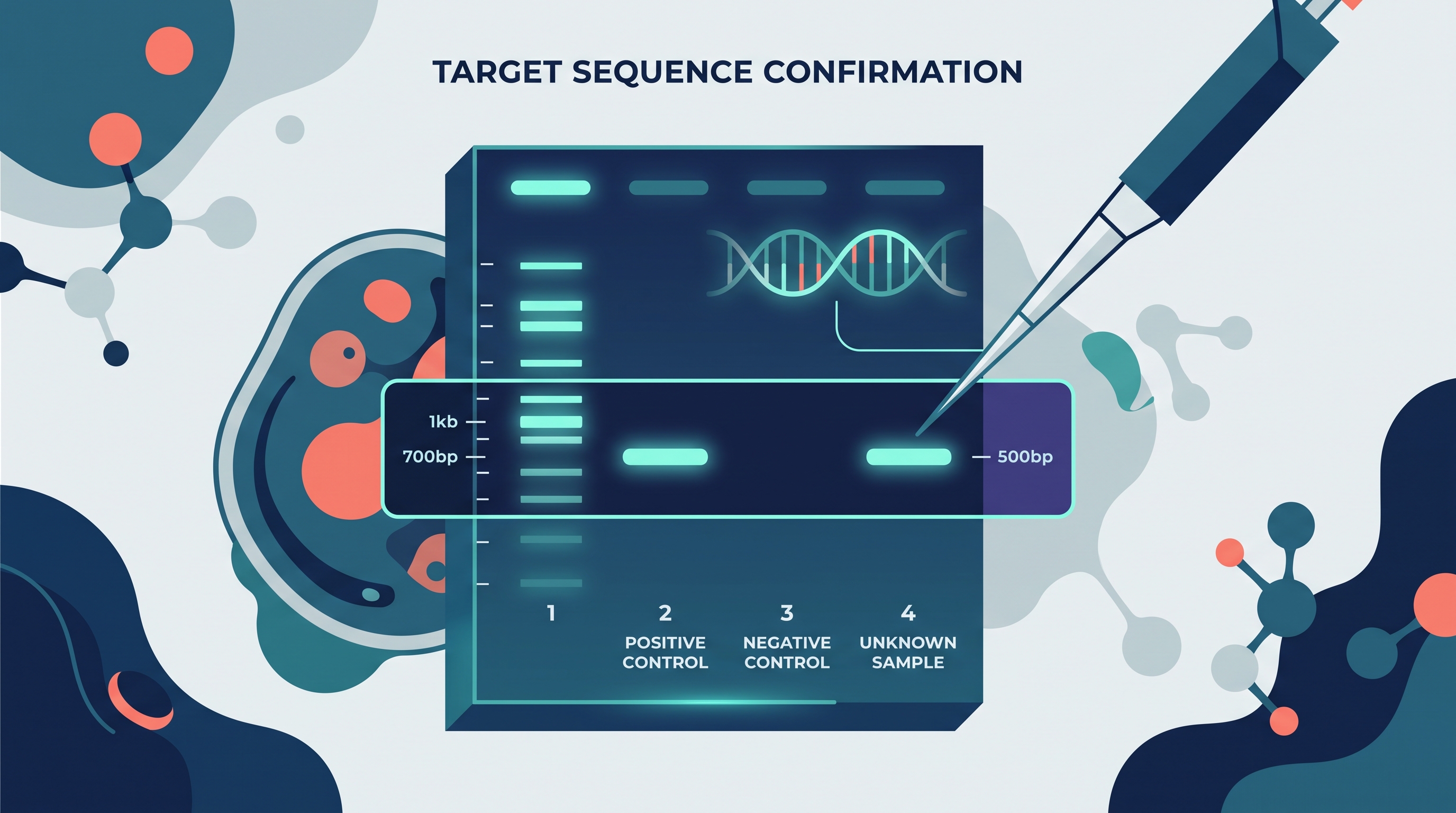
- A band at the expected fragment length supports the claim that the target sequence was present.
The conclusion must include the control results. A positive control should produce the expected band, showing that the PCR reagents and procedure worked. A negative control should lack a band, showing that contamination did not create a false positive. If the unknown sample has the expected band while the negative control does not, the evidence supports—not absolutely proves—the presence of the target sequence.
Gel electrophoresis: separating DNA fragments
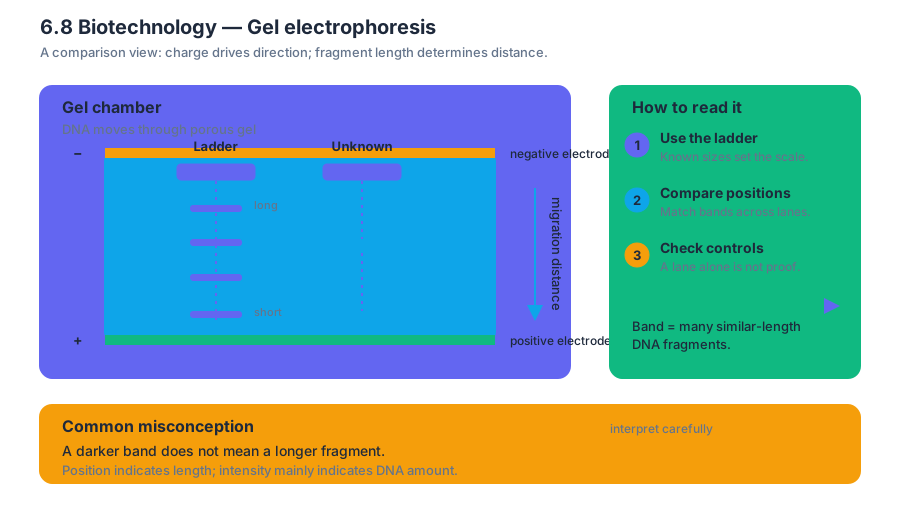
Gel electrophoresis separates DNA fragments as they move through a porous gel in an electric field. DNA has an overall negative charge, so it migrates toward the positive electrode. Shorter fragments move through the gel more easily and therefore travel farther than longer fragments.
A visible band represents many DNA fragments of similar length. A DNA ladder contains fragments with known sizes and provides a comparison scale. To interpret an unknown sample, compare its band positions with the ladder and with appropriate controls; do not identify a fragment merely because it appears in the same lane or has a similar intensity.
Common misconception — “A darker band means a longer DNA fragment.” Band position primarily indicates fragment length, whereas band intensity is more related to the amount of DNA present. A darker band may contain more copies of a fragment, but it is not automatically a longer fragment.
Recombinant DNA and genetic engineering
Recombinant DNA contains DNA joined from two or more sources. In genetic engineering, a desired gene or regulatory sequence can be inserted into a carrier DNA molecule and introduced into a cell. If the inserted sequence is expressed, the cell may produce a new RNA or protein; if it is not expressed, the DNA’s presence alone does not demonstrate that it is functioning.
This is another evidence chain: the inserted sequence is the molecular intervention, RNA or protein production is an intermediate result, and a changed cellular or organismal phenotype is a larger biological outcome. Strong argumentation identifies which link the experiment actually measured.
Retrieval check
A gel contains a DNA ladder, a positive control band at the expected position, no band in the negative control, and an unknown sample band at the same position as the positive control. What is the strongest conclusion?
The unknown sample contains DNA fragments of the expected size, supporting the presence of the target sequence. The controls support the validity of the procedure, but the result does not by itself demonstrate that the sequence is expressed, produces a functional protein, or causes a phenotype.