From the free course AP Biology on Lykke
5.1 Meiosis
Key concepts: Meiosis I · Replication of chromosomes · Homologous chromosomes · Crossing over · Independent assortment of chromosomes · Maternal and paternal chromosome assortment · Deviations from Mendel’s model of inheritance · Non-Mendelian inheritance patterns · Sex determination systems not based on X and Y chromosomes · ZW sex determination
A single diploid cell can produce gametes with half as many chromosomes because meiosis separates homologous chromosome pairs through two successive divisions. The process begins with chromosome replication, includes Meiosis I, and ends with haploid cells whose maternal and paternal chromosomes have been reshuffled.
5.1 Meiosis
A single diploid cell can produce gametes with half as many chromosomes because meiosis separates homologous chromosome pairs through two successive divisions. The process begins with chromosome replication, includes Meiosis I, and ends with haploid cells whose maternal and paternal chromosomes have been reshuffled.
Learning Objective 5.1.A: Explain how meiosis results in the formation of haploid gametes.
Chromosome replication prepares the cell for two divisions
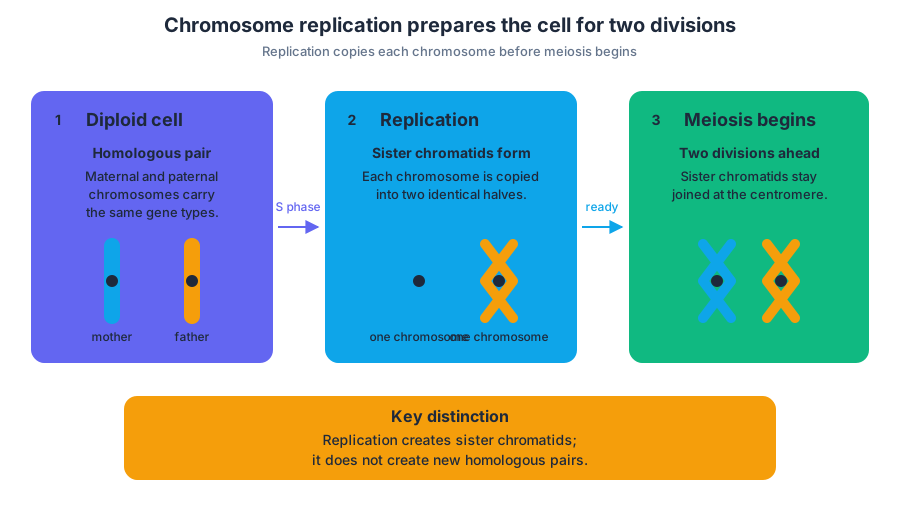
Before meiosis begins, each chromosome is copied during the cell cycle’s synthesis phase. The result is not two separate chromosomes yet, but one replicated chromosome consisting of two identical sister chromatids joined at a centromere.
A diploid cell has homologous pairs: one chromosome of each pair came from the mother and the other from the father. These are homologous chromosomes—chromosomes carrying the same types of genes in corresponding locations, although their alleles may differ. Replication creates sister chromatids, but it does not create new homologous pairs.
Meiosis I separates homologous chromosomes
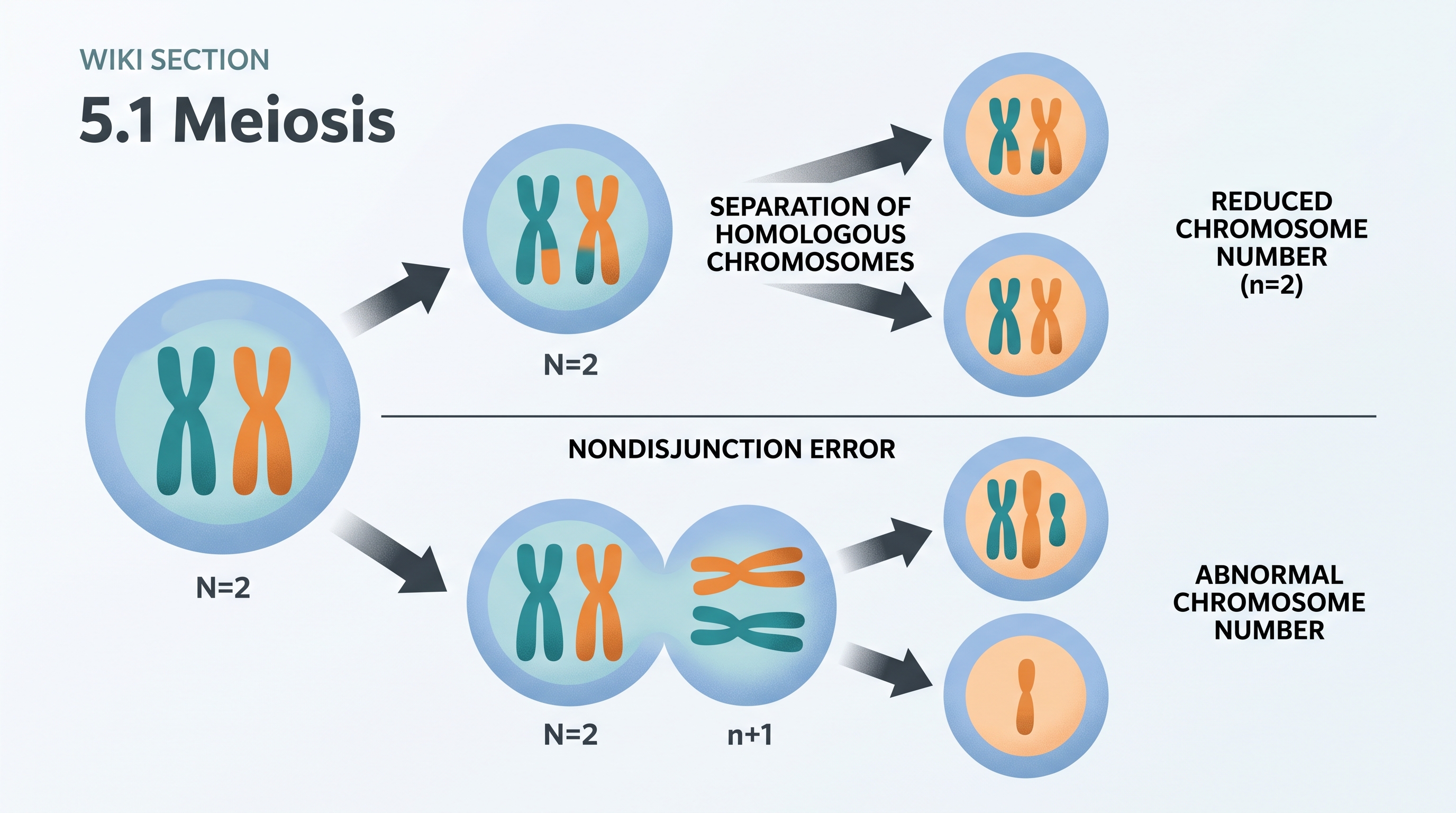
During Meiosis I, homologous chromosomes pair and are then separated into different daughter cells. Sister chromatids remain attached during this first division. Because each daughter cell receives one chromosome from every homologous pair, Meiosis I reduces the chromosome number from diploid to haploid.
During prophase I, homologous chromosomes align closely in a process called synapsis. Non-sister chromatids—one chromatid from the maternal homolog and one from the paternal homolog—can exchange corresponding DNA segments. This exchange is crossing over, and the physical exchange points are called chiasmata.
The key separation rule is therefore:
| Stage | What separates? | Chromosome number |
|---|---|---|
| Before meiosis | Chromosomes replicate; sister chromatids form | Still diploid |
| Meiosis I | Homologous chromosomes separate | Reduced to haploid |
| Meiosis II | Sister chromatids separate | Haploid products remain |
In normal meiosis, homologous chromosomes separate correctly. If both homologs move into the same daughter cell, nondisjunction has occurred. The resulting gametes may contain an extra chromosome or lack one, so they are not correctly haploid.
Maternal and paternal chromosomes assort into different gametes
Each homologous pair aligns independently of the other pairs. This is independent assortment of chromosomes: the maternal or paternal member placed into one daughter cell for one chromosome pair does not determine which member is placed there for another pair.
For example, consider a cell with two homologous pairs, labeled chromosome pair $1$ and chromosome pair $2$. One gamete might receive the maternal copy of pair $1$ and the paternal copy of pair $2$; another might receive the paternal copy of pair $1$ and the maternal copy of pair $2$. This maternal-and-paternal chromosome assortment helps explain why siblings produced by the same parents are genetically different.
Worked example: Suppose a diploid organism has three homologous chromosome pairs. For independent assortment alone, the possible maternal-paternal combinations are $2^3 = 8$. Crossing over creates still more combinations by placing mixtures of maternal and paternal DNA on individual chromosomes.
Why inheritance often departs from simple Mendelian ratios
Mendel’s predicted ratios work best when genes assort independently and each trait is controlled by a simple allele relationship. Many traits do not meet those conditions. Genes located on the same chromosome are genetically linked, so they tend to travel together during meiosis rather than assort independently; crossing over can separate them, and the frequency of separation can be used to estimate map distance.
Other traits are influenced by several genes or by environmental conditions. Quantitative inheritance produces continuously varying phenotypes—such as height or pigment intensity—instead of a few discrete categories. When observed phenotypic ratios differ statistically from predicted ratios, the result may indicate linkage, multiple genes, environmental effects, or another deviation from Mendel’s model.
Misconception check: A trait that does not show a $3:1$ ratio is not automatically “non-genetic.” The ratio may fail because several genes, linked genes, allele interactions, or environmental influences affect the phenotype.
Sex determination is not always based on X and Y chromosomes
Sex-determination systems also demonstrate that inheritance does not follow one universal chromosome pattern. In birds, for example, the ZW system is used: females are typically $ZW$, while males are $ZZ$. The female produces eggs carrying either $Z$ or $W$, whereas the male produces sperm carrying $Z$.
Thus, sex determination need not be based on X and Y chromosomes. Other organisms use different systems, including haplodiploidy in bees, in which chromosome number rather than an X-Y pair helps determine sex.
In-flow retrieval check
A replicated chromosome contains two sister chromatids, but homologous chromosomes are maternal-paternal partners. Which event reduces chromosome number: crossing over, separation of sister chromatids, or separation of homologous chromosomes? Answer: separation of homologous chromosomes during Meiosis I. If both homologs move together, nondisjunction can produce a gamete with an abnormal chromosome number.
Source Materials
- Ap Biology Course And Exam Description
- Ap Biology Course Overview
- Ap Biology Course At A Glance
- Ap Biology Equations And Formulas Sheet
- Chapter 3 Quantitative Skills In Ap Sciences
- Ap Biology Teacher Lab Manual Effective Fall 2019
- Updates 2025 26
- AP Biology Course-AP Central-College Board
- AP Biology-AP Students
- Biology of AP Courses-OpenStax
- AP Biology-Acellus
- AP/College Biology