From the free course AP Biology on Lykke
4.2 Introduction to Signal Transduction
Key concepts: Unit 4: Cell Communication and Cell Cycle · Unit 4 is allocated approximately 12–14 class periods · Unit 4 has an AP Exam weighting of approximately 10–15% · The Unit at a Glance organizes topics and associated skills · Interpreting and Evaluating Experimental Results with Graphing is an assessed FRQ type · Scientific Investigation is an assessed FRQ type · Inquiry-based laboratory work may involve troubleshooting experimental designs · Students may work in small groups and share resources · Repeating procedures can help students obtain results · An inquiry-based laboratory program provides benefits despite implementation challenges
Signal transduction is the process by which a cell converts an outside signal into an internal change. A message may begin at the cell surface, but its consequence can occur deep inside the cell: an enzyme becomes active, a gene is expressed, or the cell begins dividing.
4.2 Introduction to Signal Transduction
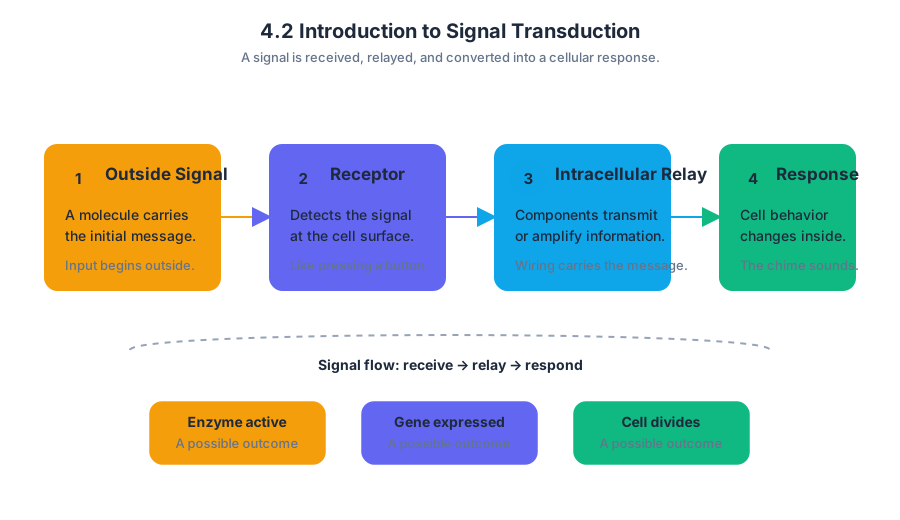
Signal transduction is the process by which a cell converts an outside signal into an internal change. A message may begin at the cell surface, but its consequence can occur deep inside the cell: an enzyme becomes active, a gene is expressed, or the cell begins dividing. The introductory idea is simple: a signal is received, relayed, and converted into a response.
A useful analogy is a doorbell. Pressing the button is not the same event as hearing the sound: the button detects the action, wiring carries the information, and the chime produces the response. In a cell, a signaling molecule provides the initial input, a receptor detects it, and intracellular components transmit or amplify the information. The detailed pathway mechanisms belong to the next topic; here, the essential task is recognizing the overall information flow.
A map of Unit 4
Unit 4 is Cell Communication and Cell Cycle. The Unit at a Glance organizes the unit by pairing each numbered topic with associated AP skills and suggested pacing. Unit 4 is allocated approximately $12$–$14$ class periods and represents approximately $10$–$15%$ of the AP Exam weighting.
| Topic | Associated skill emphasis |
|---|---|
| 4.1 Cell Communication | Skill 1 |
| 4.2 Introduction to Signal Transduction | [1.A] Describe biological concepts and processes |
| 4.3 Signal Transduction Pathways | Skill 6 |
| 4.4 Feedback | Skill 6 |
| 4.5 Cell Cycle | Skills 4 and 5 |
| 4.6 Regulation of Cell Cycle | Skill 6 |
For Topic 4.2, [1.A] Describe biological concepts and processes means that a response must accurately state what signal transduction is and identify its general sequence. A strong description distinguishes the initial signal from the cellular response rather than listing disconnected vocabulary.
Signal transduction: the conversion of information from an external or internal signal into a specific cellular response.
The Unit at a Glance is therefore more than a topic list. It shows that Unit 4 content is practiced through different kinds of reasoning: describing biological processes, interpreting visual and experimental evidence, analyzing data, and evaluating investigations. The associated skill changes as the biology becomes more mechanistic and evidence-based.
From a signal to a testable response
Consider a hypothetical cell exposed to a chemical messenger. The messenger is the stimulus, the receptor is the component that detects it, and the resulting change—such as increased enzyme activity—is the response. If the messenger is removed and the response decreases, that observation supports a connection between the signal and the response, although it does not by itself prove every step in the pathway.
A compact reasoning chain is:
$$ \text{signal} \longrightarrow \text{reception} \longrightarrow \text{intracellular relay} \longrightarrow \text{cellular response} $$
Worked example. Suppose cultured cells are exposed to three concentrations of a messenger. Their measured enzyme activity is $4$, $9$, and $15$ arbitrary units at low, medium, and high concentrations, respectively. The data show a positive association between messenger concentration and enzyme activity. An appropriate description is: As messenger concentration increases, enzyme activity increases under these experimental conditions. That statement describes the observed relationship without claiming that the messenger directly contacts the enzyme or that concentration is the only possible cause.
Inquiry is part of the biology
Signal transduction is especially suited to inquiry-based investigation because the pathway can be treated as an input-output system. Students can vary an experimental condition, measure a response, graph the results, and use the pattern to evaluate a biological explanation.
The laboratory process may not work on the first attempt. Students can work in small groups, share resources, troubleshoot an experimental design, and repeat a procedure several times before obtaining meaningful data. An unsuccessful result is not automatically useless: students should be able to identify nonmeaningful data, explain likely errors, and propose how a repeated experiment would differ.
Inquiry-based laboratory programs involve genuine challenges—limited time, unexpected variation, and procedures that require revision—but they also offer substantial benefits. They let students practice the work of scientists: connecting observations to biological principles, judging evidence, and improving an investigation rather than treating a single unexpected result as a final answer.
How this appears in assessment
Unit 4 assessment includes approximately $24$ multiple-choice questions and two free-response questions in its Progress Check structure. Relevant partial FRQ types include Interpreting and Evaluating Experimental Results with Graphing (partial) and Scientific Investigation (partial); the Unit 4 assessment summary also identifies Analyze Data as an associated demand.
For graphing, students must represent the independent variable and dependent variable appropriately, identify a trend, and connect that trend to the biological question. For scientific investigation, students may need to identify a testable question, describe a controlled procedure, explain why replication matters, or diagnose why an initial design produced nonmeaningful data.
Misconception check — “A failed experiment proves the hypothesis is wrong.” Not necessarily. A failed result may reflect an uncontrolled variable, an unsuitable measurement, insufficient replication, or a procedural error. The scientifically defensible response is to evaluate the design and evidence before deciding whether the biological explanation should be rejected.
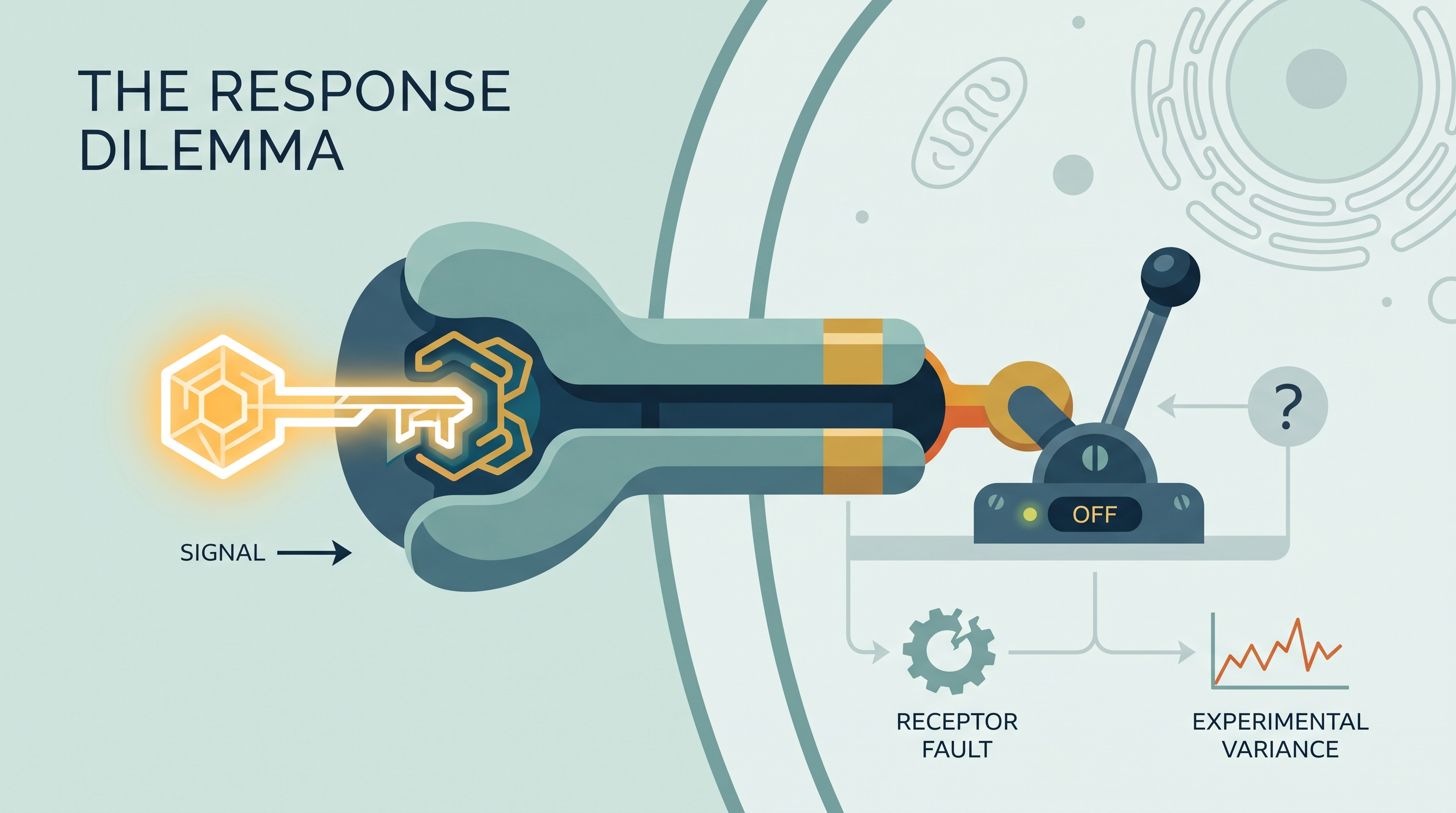
Retrieval check: A cell receives a signal, but no measurable response occurs. Name two broad possibilities: one involving the signaling system and one involving the investigation. A complete answer could identify a defective or absent receptor and, separately, an experimental problem such as an incorrect concentration, poor measurement, or inadequate procedure.
Source Materials
- Ap Biology Course And Exam Description
- Ap Biology Course Overview
- Ap Biology Course At A Glance
- Ap Biology Equations And Formulas Sheet
- Chapter 3 Quantitative Skills In Ap Sciences
- Ap Biology Teacher Lab Manual Effective Fall 2019
- Updates 2025 26
- Students should complete the rubric, and hand this in with their report as a form of self-analysis. You can then complete the rubric, and compare your critique with your students’.