From the free course AP Biology on Lykke
2.9 Cell Compartmentalization
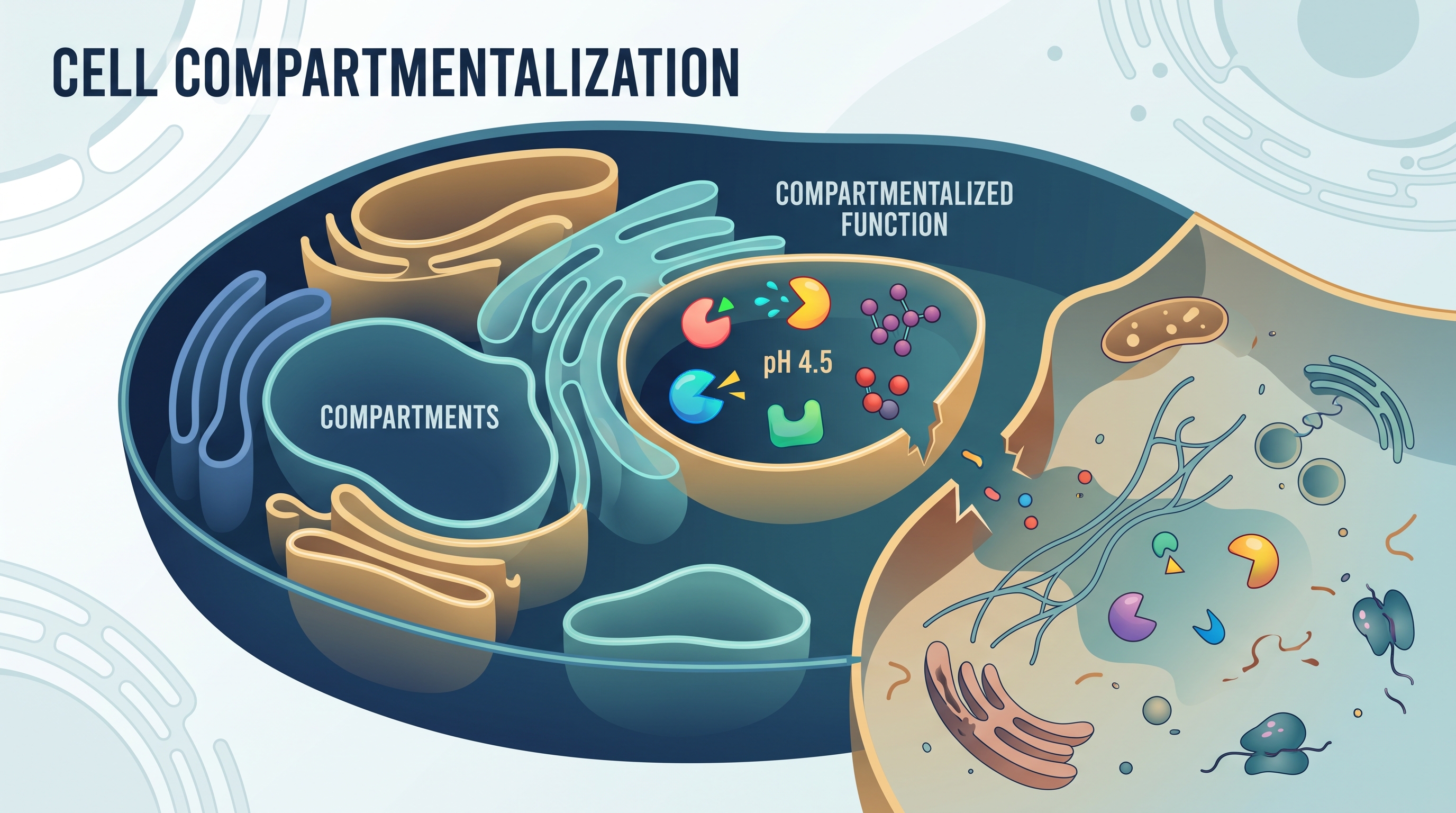
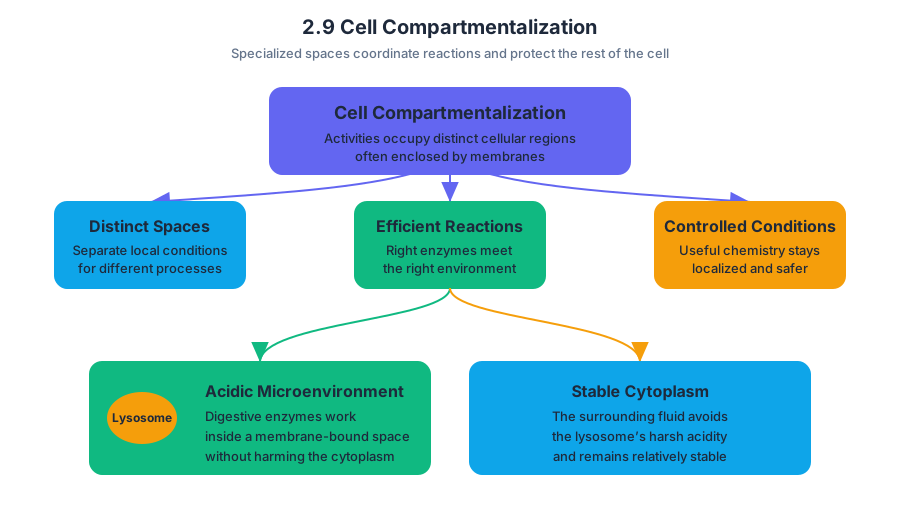
A eukaryotic cell is not a single reaction vessel; it is a coordinated network of specialized spaces. Cell compartmentalization is the organization of cellular activities into distinct regions, often enclosed by membranes, so that different processes can occur efficiently and under different conditions.
A lysosome, for example, contains enzymes that work best in an acidic environment. If those enzymes were freely mixed throughout the cytoplasm, they could damage important cellular components. By enclosing them within a membrane-bound organelle, the cell creates a controlled microenvironment: the lysosome can maintain conditions suitable for digestion while the surrounding cytoplasm remains relatively stable.
Why compartments improve cell function
Internal membranes divide the cell into spaces with different chemical conditions. These spaces can vary in pH, ion concentration, enzymes, substrates, and surface area. Such separation allows incompatible reactions to occur simultaneously and places related steps of a pathway close together.
The major advantages of compartmentalization include:
- Isolation: potentially harmful reactions or substances remain contained.
- Efficiency: enzymes and substrates can be concentrated in the same location.
- Organization: sequential reactions can occur in a particular order.
- Regulation: each compartment can maintain conditions that favor its own processes.
- Surface-area specialization: folded membranes provide extensive surfaces for proteins involved in transport or energy conversion.
The endoplasmic reticulum illustrates this organization. The rough endoplasmic reticulum provides membrane surfaces containing ribosomes, where many proteins destined for secretion or membranes are synthesized. The smooth endoplasmic reticulum has different functions, including lipid synthesis and detoxification. These activities occur in connected membrane regions but are not identical because their structures and associated proteins differ.
Structure and function must be explained together
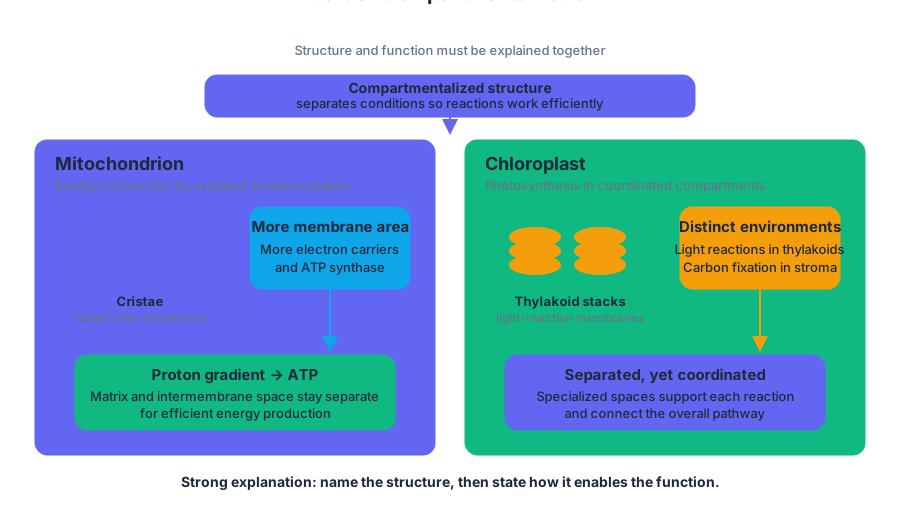
A frequent AP Biology error is to identify an organelle correctly but describe only its name or a vague function. A stronger explanation connects structure to function: the organelle’s physical features make its role possible.
For instance, mitochondria contain an inner membrane folded into cristae. The folds increase membrane surface area, allowing more electron-transport proteins and ATP synthase molecules to operate. The inner membrane also separates the mitochondrial matrix from the intermembrane space, enabling a proton gradient to form. Thus, the mitochondrion’s compartmentalized structure supports efficient ATP production.
Chloroplasts use a comparable organizational principle. Their thylakoid membranes contain the photosynthetic electron-transfer components, while the surrounding stroma contains enzymes involved in carbon fixation. Separating these locations allows light-dependent reactions and carbon-fixation reactions to occur in chemically distinct environments while remaining coordinated.
A worked example: predicting the effect of lost compartmentalization
Suppose a mutation causes the membrane surrounding a lysosome to become highly permeable. Predict the cellular consequences by tracing structure to function:
- Lysosomal enzymes and acidic contents could leak into the cytoplasm.
- The lysosome would lose its specialized internal conditions.
- Degradative reactions could occur in inappropriate locations.
- Cellular macromolecules and organelles could be damaged.
- The cell’s ability to recycle materials would decline.
The key reasoning is not merely “the lysosome stops working.” Loss of the membrane disrupts the compartment’s chemical environment and releases substances that should have remained localized. The result follows from the relationship between membrane boundary, internal conditions, and biochemical function.
Misconception check: “More compartments are always better”
Misconception: Compartmentalization is universally beneficial and has no cost.
Correction: Compartments improve control and efficiency, but they also require energy and coordination. Materials must be transported between organelles, membranes must be maintained, and signals must regulate when substances enter or leave. A compartment that becomes isolated from the rest of the cell cannot contribute effectively to whole-cell function.
This is why cellular organization involves both separation and communication. Organelles do not function as independent “mini-cells”; vesicles, transport proteins, cytoskeletal elements, and signaling systems connect their activities.
AP reasoning focus
Topic 2.9 Cell Compartmentalization is especially suited to Science Practice 1: Concept Explanation, because responses must explain how organelle structures support cellular processes. It also uses Science Practice 2: Visual Representations when interpreting organelle diagrams, and Science Practice 6: Argumentation when defending a claim about compartment function with evidence.
The essential-knowledge identifier 2.9.B emphasizes that internal membranes organize cellular processes. In particular, 2.9.B.1 requires explaining how internal membranes facilitate cellular processes by creating specialized environments. For argumentation, 6.B: Support a claim with evidence from biological principles, concepts, processes, and data means that a claim such as “membrane damage reduces ATP production” must be supported by the relevant structural and biochemical evidence, not by an organelle label alone.
Retrieval check
A cell contains an organelle whose interior must remain acidic for its enzymes to function. Predict two consequences if the organelle’s surrounding membrane loses its ability to maintain a separate internal environment. A complete answer should name both the change in the organelle’s conditions and the effect on the cell’s other components.