From the free course AP Biology on Lykke
6.3 Transcription and RNA Processing
Key concepts: Transcription · RNA processing · mRNA stability · 5′ GTP capping · Ribosomal recognition · Introns · Exons · RNA splicing · Mature mRNA variants · Biological models in theoretical and applied contexts
Transcription is the process of copying information from a DNA sequence into a complementary RNA molecule, while RNA processing converts the initial RNA transcript into a mature messenger RNA, or mRNA, that can be used to direct protein production.
6.3 Transcription and RNA Processing
Transcription is the process of copying information from a DNA sequence into a complementary RNA molecule, while RNA processing converts the initial RNA transcript into a mature messenger RNA, or mRNA, that can be used to direct protein production.
Investigative question: How can one DNA gene produce several mature mRNA molecules, and why must those RNA molecules be chemically modified before they are useful?
CED alignment: 6.3.A and 6.3.A.1
Learning Objective 6.3.A: Describe the mechanisms by which genetic information flows from DNA to RNA to protein.
Essential Knowledge 6.3.A.1: The sequence of the RNA bases, together with the structure of the RNA molecule, determines RNA function.
The RNA base sequence is not merely a temporary copy of DNA. Its sequence determines which codons appear in the mRNA, while its structure and processing determine whether the transcript is stable, recognized by a ribosome, transported, or selectively translated.
Transcription: building the RNA transcript
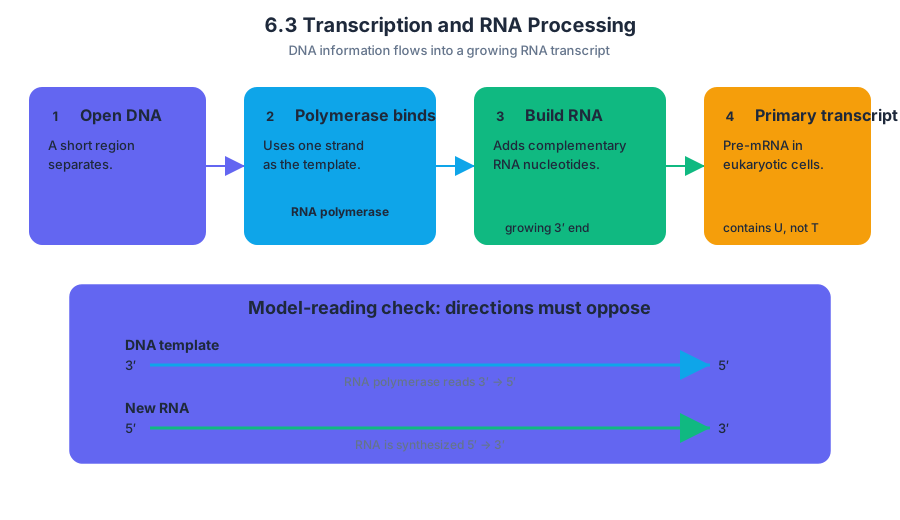
During transcription, the enzyme RNA polymerase separates a short region of DNA and uses one DNA strand as the template. RNA polymerase reads the DNA template in the $3'$ to $5'$ direction and synthesizes the RNA strand in the $5'$ to $3'$ direction by adding complementary RNA nucleotides.
The resulting RNA is initially called a primary transcript, or pre-mRNA in a eukaryotic cell. It contains a sequence complementary to the DNA template strand and, therefore, nearly matches the coding strand of DNA except that RNA uses uracil, $U$, in place of thymine, $T$.
Model-reading check: In a diagram of transcription, locate the growing end of the RNA strand. If RNA polymerase is moving along the DNA template from $3'$ to $5'$, the RNA must grow from $5'$ to $3'$. Reversing either direction changes the predicted RNA sequence.
RNA processing: turning a transcript into usable mRNA
In eukaryotes, the primary transcript is modified before it becomes mature mRNA. Three linked changes are especially important:
| Processing event | What happens | Why it matters |
|---|---|---|
| 5′ GTP capping | A guanosine triphosphate, or GTP, cap is added to the $5'$ end | Helps with ribosomal recognition |
| Poly-A tail addition | A stretch of adenine nucleotides is added to the $3'$ end | Makes the mRNA more stable |
| Splicing | Introns are removed and exons are joined | Produces a mature RNA sequence that can be expressed |
The 5′ GTP cap acts like an identification tag at the front of the mRNA. It helps the ribosome recognize the transcript as an RNA molecule ready to participate in protein production. The cap is not a protein-coding region; its key role here is recognition.
The poly-A tail is added to the opposite, $3'$ end. It increases mRNA stability, helping protect the transcript from degradation and allowing it to remain available longer for gene expression. A longer-lived transcript can potentially be used repeatedly before it is broken down.
Introns, exons, and alternative splicing
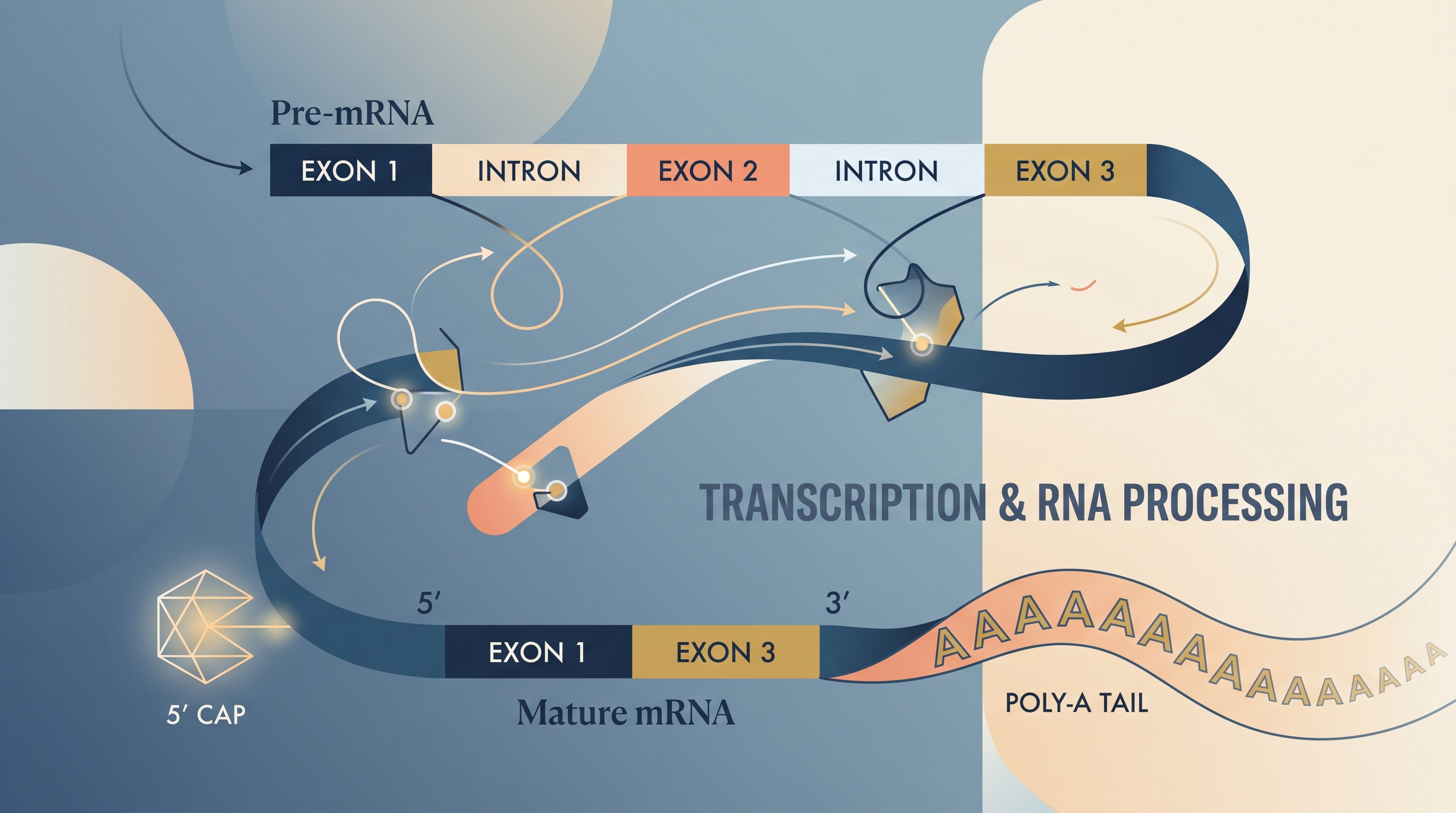
A primary transcript may contain introns, intervening sequences that are excised during processing, and exons, expressed sequences that are retained and spliced together in the mature mRNA.
The important twist is that cells do not always retain exactly the same combination of exons. Alternative splicing produces different versions of a mature mRNA molecule by joining selected exons in different arrangements. Consequently, one gene can contribute to multiple RNA products and, after translation, potentially multiple related proteins.
Primary transcript:
5′ cap — exon 1 — intron A — exon 2 — intron B — exon 3 — poly-A tail

Mature mRNA version 1:
5′ cap — exon 1 — exon 2 — exon 3 — poly-A tail

Mature mRNA version 2:
5′ cap — exon 1 — exon 3 — poly-A tail
In this model, both mature molecules come from the same initial transcript, but they retain different exon combinations. Their different RNA base sequences can produce different protein products or alter how strongly the mRNA is used.
Worked example: predicting the effect of a processing defect
Suppose a mutation prevents a cell from adding the poly-A tail to a newly transcribed mRNA. The transcript may still contain the correct exon sequence, but it is less stable and is more likely to be degraded quickly. The predicted result is reduced mRNA availability and therefore reduced protein production.
Now consider a defect in GTP capping. Even if the transcript is stable, impaired capping can reduce ribosomal recognition. The two defects affect different steps: the poly-A tail primarily supports stability, whereas the GTP cap primarily supports recognition.
Misconception check: “Introns are useless DNA”
Correction: Introns are removed from the primary RNA transcript, but calling them “useless” is inaccurate. For this topic, the essential point is that introns are excised while exons are retained and spliced together; alternative splicing can then generate different mature mRNAs from the same transcript.
AP skill: Science Practice 2, Visual Representations
This topic is especially assessed through Science Practice 2: Visual Representations, including 2.B: Explain relationships between characteristics of biological models in both theoretical and applied contexts. When interpreting a gene-expression diagram, do more than identify labels: explain how the direction of transcription, exon removal, cap addition, and poly-A tail addition changes the final RNA molecule.
Retrieval check
A pre-mRNA contains exons $1$, $2$, and $3$, separated by introns. A mature transcript retains exons $1$ and $3$ but not exon $2$. What process produced this result, and which modification helps stabilize the finished mRNA?
Answer: This is alternative splicing, in which introns are removed and different exon combinations are retained. The poly-A tail helps stabilize the mature mRNA; the 5′ GTP cap helps with ribosomal recognition.