From the free course AP Biology on Lykke
7.2 Natural Selection
Key concepts: Natural selection as a mechanism of evolution · Artificial selection in agricultural crops · Phenotypic variation in populations · Quantitative traits · Environmental factors and differential reproduction · Antibiotic resistance in bacteria as an example of natural selection · Population change over time as evolution · Computer and structured simulations of natural selection · Measuring natural selection experimentally · Variation and selection in natural populations of Arabidopsis thaliana
Natural selection occurs when environmental conditions cause some organisms to reproduce more successfully than others, changing the population’s genetic makeup across generations. The organisms do not change because they “need” to; instead, heritable phenotypic variation already present in the population affects…
7.2 Natural Selection
Natural selection occurs when environmental conditions cause some organisms to reproduce more successfully than others, changing the population’s genetic makeup across generations. The organisms do not change because they “need” to; instead, heritable phenotypic variation already present in the population affects survival and reproduction.
Learning Objective 7.2.A: Explain how natural selection affects populations.
Essential Knowledge 1.A.1: Natural selection is a major mechanism of evolution.
Essential Knowledge 1.A.2: Natural selection acts on phenotypic variations in populations.
From individual differences to population change
A population is a group of organisms of the same species living in the same area. Its members may differ in observable characteristics, or phenotypes, such as height, coloration, growth rate, resistance to disease, or the number of plant hairs called trichomes.
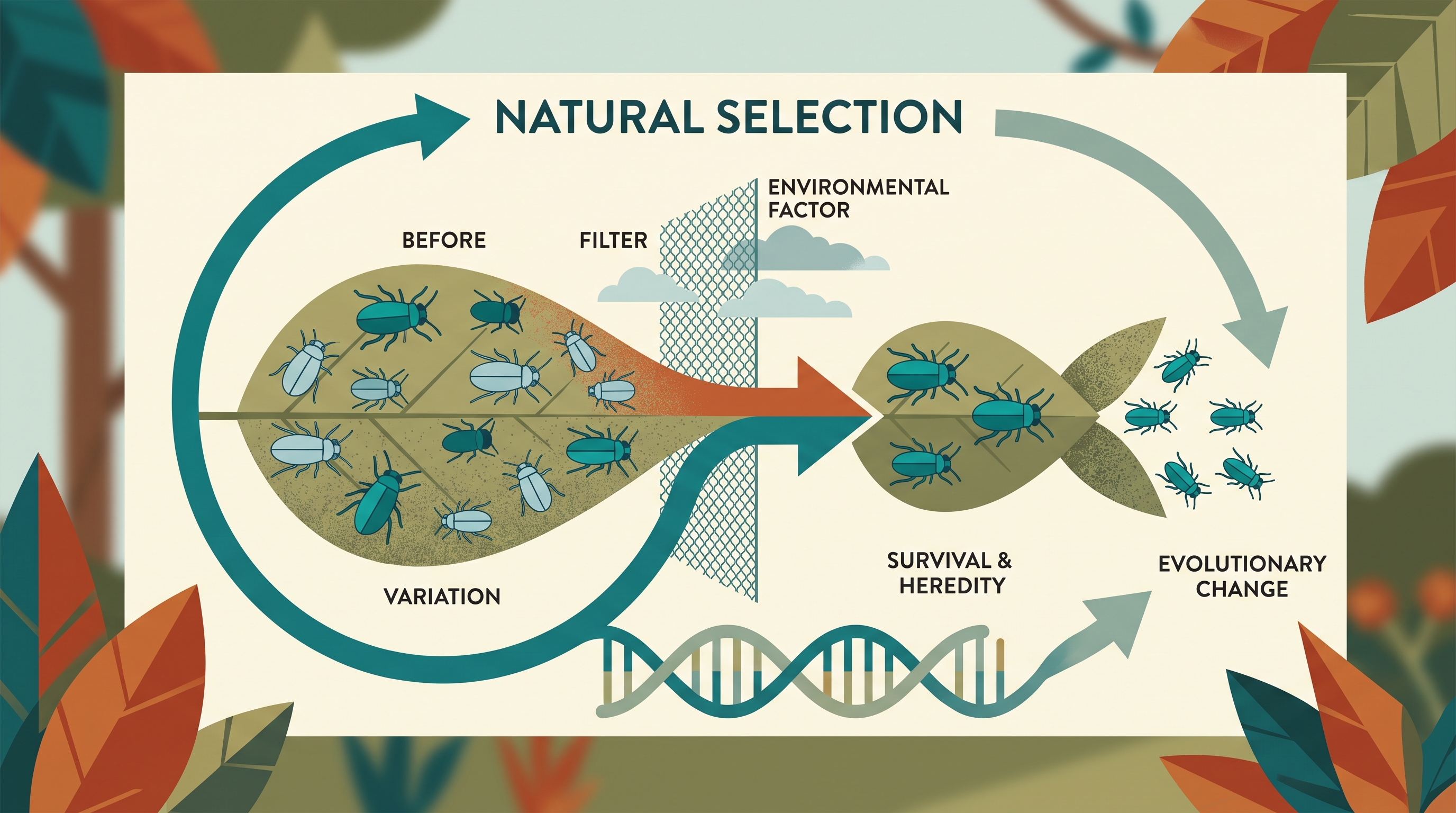
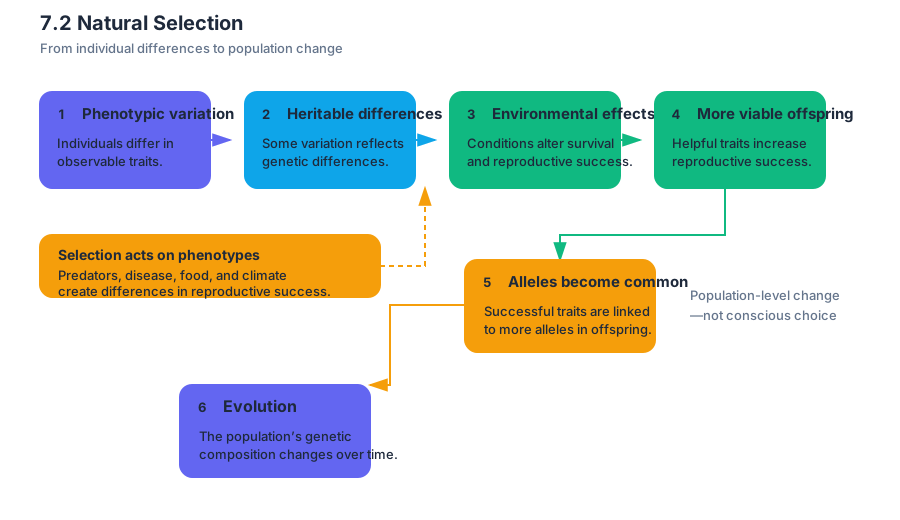
Natural selection follows a causal chain:
- A population contains phenotypic variation.
- Some variation is influenced by genetic differences and can be inherited.
- Environmental factors affect which individuals survive, find mates, or produce viable offspring.
- Individuals with traits that improve reproductive success leave more offspring.
- Alleles associated with those traits become more common in later generations.
- The population changes over time; that population-level change is evolution.
The environment does not select traits directly like a person choosing items from a menu. Temperature, predators, competitors, disease, food availability, and other conditions create differences in reproductive success. Selection therefore acts on phenotypes, while evolution is observed as a change in the genetic composition of the population.
Worked example: trichomes and insect herbivory
Natural populations of Arabidopsis thaliana can vary in trichome density, meaning the number of tiny hairs on a plant’s surface. Suppose a specialist insect herbivore feeds more effectively on plants with few trichomes.
In a population of $100$ plants, plants with many trichomes may experience less tissue damage and produce an average of $12$ viable seeds, while plants with few trichomes produce an average of $5$. If trichome density has a heritable component, the next generation will tend to contain a greater proportion of alleles associated with higher trichome density.
The reasoning is not that individual plants grow extra trichomes because insects attack them. Rather, the original population contained variation, the insect created different reproductive outcomes, and inherited differences were passed to offspring. If the environmental pressure continues, trichome density may increase over generations.
Quantitative traits and experimental selection
A quantitative trait is a measurable characteristic that varies along a continuous scale rather than appearing in only two or three categories. Plant height and trichome number are examples. Such traits are often influenced by multiple genes and by environmental conditions, so a population is best represented by a distribution of values rather than a single “typical” value.
A relatively large population with ample phenotypic variation is useful for investigating selection because it provides more individuals to compare and reduces the chance that unusual results come from random sampling alone. In a classroom investigation using Wisconsin Fast Plants, researchers can measure a trait, select individuals at one extreme, allow only those individuals to reproduce, and compare the next generation with the original population.
For example, if the tallest plants are selected as parents, the mean height of the next generation may increase after one generation. That result supports the claim that extreme selection can change the expression of a quantitative trait, but it does not by itself prove that every change is genetic: light, nutrients, water, and other environmental conditions must also be considered.
Natural selection versus artificial selection
In artificial selection, humans determine which organisms reproduce. In natural selection, environmental conditions determine which individuals tend to leave more offspring. Both processes can produce rapid population change when variation is present and heritable, but artificial selection uses a human choice as the selective pressure.
Agricultural crops provide an introductory example of artificial selection: people repeatedly reproduce plants with preferred characteristics. The detailed crop examples and procedures belong with artificial selection; here, the key connection is that human-directed reproduction can reveal the same population-level logic used to understand natural selection.
Antibiotic resistance: selection in real time
Antibiotic resistance in bacteria is a well-known example of natural selection and evolution. A bacterial population may contain genetic variation, including rare bacteria with mutations that reduce the effect of an antibiotic. When the antibiotic is applied, susceptible bacteria die or stop reproducing, while resistant bacteria survive and reproduce.
The antibiotic does not intentionally create resistance because bacteria need it. It changes the environment so that resistant bacteria have greater differential reproduction. After several generations, the frequency of resistance-associated alleles can rise, making the population harder to treat.
Misconception check
Misconception: “Individuals evolve.” Individual bacteria or plants can grow, acclimate, or survive, but evolution is a change in the genetic makeup of a population over generations. Also, natural selection is not the same as “survival of the strongest”: the relevant question is which phenotype produces the most viable offspring in a particular environment.
Retrieval check
A population of insects contains pesticide-resistant and pesticide-sensitive individuals. After pesticide exposure, resistant insects produce more offspring. Identify the variation, the environmental factor, the differential reproductive outcome, and the population-level evolutionary change. Why would measuring only the surviving adults be insufficient evidence that resistance is heritable?