From the free course AP Biology on Lykke
2.10 Origins of Cell Compartmentalization
Key concepts: Cell size · Plasma membrane · Membrane permeability · Membrane transport · Facilitated diffusion · Visual representations · Statistical tests and data analysis · Questions and methods · Cell transport
Eukaryotic cells may have become complex when one cell began living inside another, transforming separate organisms into a coordinated cellular system. This idea, called the endosymbiotic theory, explains the evolutionary origin of mitochondria and chloroplasts and provides a powerful argument for how internal…
2.10 Origins of Cell Compartmentalization
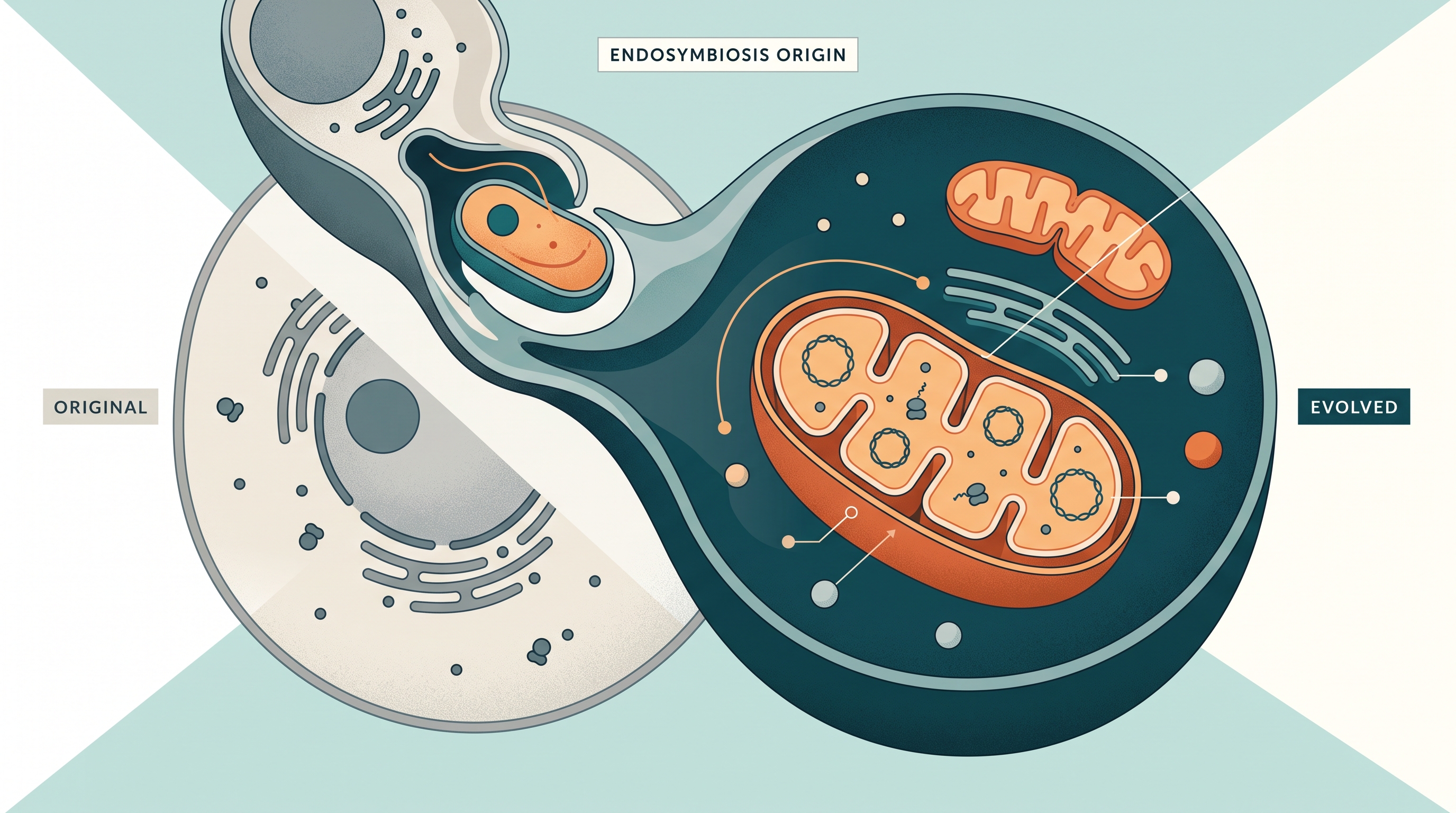
Eukaryotic cells may have become complex when one cell began living inside another, transforming separate organisms into a coordinated cellular system. This idea, called the endosymbiotic theory, explains the evolutionary origin of mitochondria and chloroplasts and provides a powerful argument for how internal compartments arose.
CED alignment: Topic 2.10 Origins of Cell Compartmentalization; Learning Objective 2.10-1; Essential Knowledge 2.A.3; Science Practice 6: Argumentation.
The central idea: endosymbiosis
An endosymbiont is an organism that lives inside another organism and benefits from the relationship. Under the endosymbiotic theory, an ancestral host cell engulfed a free-living bacterium. Instead of digesting it, the host retained it as a permanent internal partner. Over evolutionary time, the bacterium supplied useful metabolic functions while the host supplied protection and access to nutrients.
The most widely accepted model proposes two major events:
- An ancestral host cell incorporated an aerobic bacterium, which evolved into the mitochondrion.
- In some lineages, a eukaryotic cell containing mitochondria incorporated a photosynthetic cyanobacterium, which evolved into the chloroplast.
The result was not merely a larger cell. It was a cell with specialized internal regions: mitochondria could generate ATP through aerobic respiration, chloroplasts could capture light energy, and the surrounding host could coordinate these activities with other cellular processes.
Evidence for an evolutionary origin
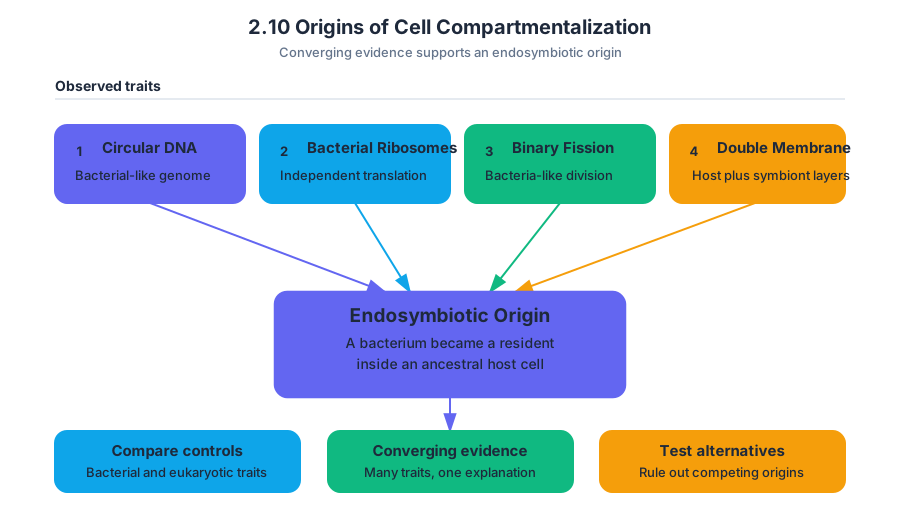
The argument for endosymbiosis depends on several independent lines of evidence. Mitochondria and chloroplasts contain their own small, usually circular DNA; bacteria also commonly possess circular chromosomes. Both organelles contain ribosomes that resemble bacterial ribosomes more closely than the ribosomes found in the eukaryotic cytoplasm.
Their reproduction is another important clue. Mitochondria and chloroplasts divide by a process resembling binary fission, the way many bacteria reproduce. They also possess double membranes: the inner membrane is consistent with the engulfed bacterium’s original membrane, while the outer membrane is consistent with the host cell’s engulfing vesicle.
These observations are stronger together than separately. A circular genome alone does not prove bacterial ancestry, but circular DNA, bacterial-like ribosomes, binary-fission-like division, and double membranes form a converging pattern.
Worked argument: from observation to conclusion
Suppose researchers compare a mitochondrion with a free-living bacterium and find that both have circular DNA, similar ribosomal RNA sequences, and division by constriction. The researchers also observe that the mitochondrion has two surrounding membranes.
A strong Science Practice 6: Argumentation response would connect each observation to the claim:
- Claim: Mitochondria descended from bacteria that entered an ancestral host cell.
- Evidence: Mitochondria share bacterial-like genetic material, ribosomal features, reproductive behavior, and membrane structure.
- Reasoning: These similarities are expected if mitochondria originated from engulfed bacteria, but are less readily explained by the idea that mitochondria formed entirely from the host cell’s internal membranes.
The conclusion should remain appropriately qualified: evidence supports the endosymbiotic theory; it does not show that a modern mitochondrion is simply an unchanged bacterium. Evolution after incorporation produced extensive genetic transfer and dependence between the organelle and host.
Why membranes and transport matter
Compartmentalization works only when membranes create controlled boundaries. The plasma membrane and organelle membranes are selectively permeable, so molecules do not move randomly between every region of the cell. Transport proteins, concentration gradients, and energy-dependent mechanisms allow the cell to control which substances enter, leave, or remain within a compartment.
This arrangement creates local chemical conditions. For example, mitochondria maintain membrane-associated gradients that support ATP production. A compartment can therefore concentrate enzymes and substrates, separate incompatible reactions, and increase the efficiency of linked pathways.
Cell size also matters. As a cell becomes larger, its volume can increase faster than its surface area, making exchange with the environment less efficient. Internal membranes add functional membrane surface and divide the cytoplasm into regions, helping a large eukaryotic cell manage transport and chemical reactions.
Misconception check
Misconception: “Endosymbiosis means the host cell swallowed a bacterium and immediately became a modern eukaryote.”
Correction: Endosymbiosis describes a long evolutionary process. The internal partner and host became increasingly interdependent, and some genes originally located in the endosymbiont were transferred to the host nucleus.
Misconception: “Mitochondria and chloroplasts are independent cells inside cells.”
Correction: They retain some bacterial features but cannot generally survive as fully independent organisms because modern organelles depend on the host cell for many proteins and regulatory functions.
Retrieval and interpretation check
A newly studied organelle contains circular DNA, bacterial-like ribosomes, divides by binary fission, and has a double membrane. Which explanation is best supported, and why?
Answer: The organelle likely originated through endosymbiosis. The conclusion is supported not by one observation, but by the converging evidence of bacterial-like genetic material, translation machinery, reproduction, and membrane structure. A complete argument would compare these traits with appropriate bacterial and eukaryotic controls and evaluate alternative explanations.