From the free course AP Biology on Lykke
7.8 Continuing Evolution
Key concepts: Rapid-cycling populations · Brassica campestris (Brassica rapa) · Artificial selection and plant breeding · Generation time and reproductive cycling · Population-level evolutionary change
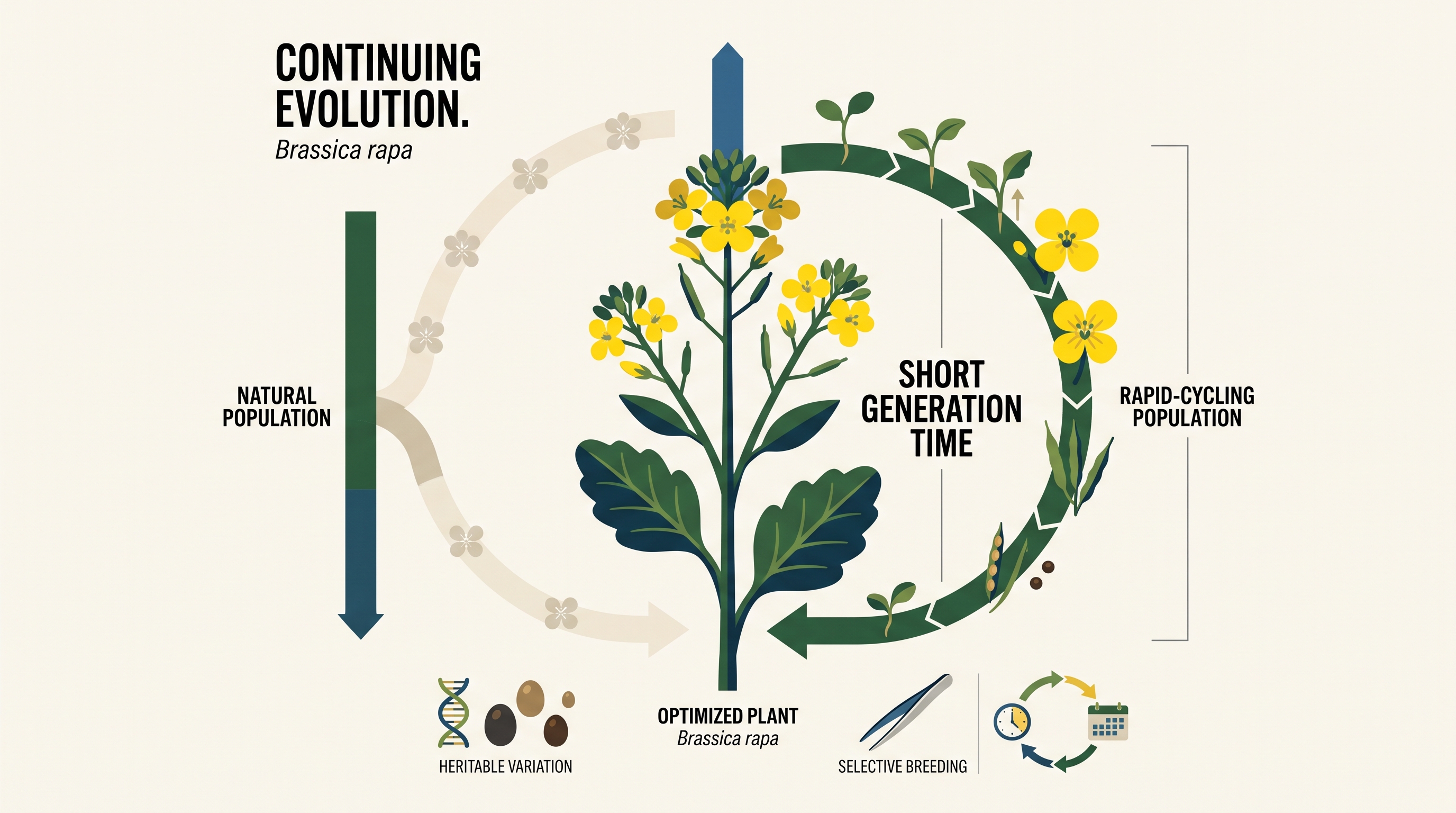
A population can evolve quickly enough for researchers to watch the change occur within a classroom, greenhouse, or laboratory. The key is to combine heritable variation with a short generation time, the interval between the birth of one generation and the birth of its reproductive offspring.
7.8 Continuing Evolution
A population can evolve quickly enough for researchers to watch the change occur within a classroom, greenhouse, or laboratory. The key is to combine heritable variation with a short generation time, the interval between the birth of one generation and the birth of its reproductive offspring.
In 1986, Paul H. Williams and Curtis B. Hill described the development of rapid-cycling populations of Brassica campestris—the species now commonly called Brassica rapa. Their work, published in Science volume $232$, issue $4756$, pages $1385$–$1389$ on June $13$, $1986$, showed how selective breeding could produce plants that completed their reproductive cycle unusually quickly.
Rapid-cycling plants as an evolutionary “fast-forward”
Ordinary plant breeding may require many growing seasons before a breeder can evaluate a trait in descendants. A rapid-cycling population compresses that timeline: plants germinate, grow, flower, produce seeds, and begin the next generation in a much shorter period. Each completed cycle gives selection another opportunity to change the population.
The important word is population. An individual plant does not evolve because it grows faster during its lifetime. Evolution occurs when the frequencies of heritable variants change across generations. If plants with shorter generation times leave more descendants, the genetic variants associated with that trait can become more common in the population.
$$ \text{heritable variation}+\text{differential reproduction}\longrightarrow\text{population-level evolutionary change} $$
How selective breeding shortened generation time
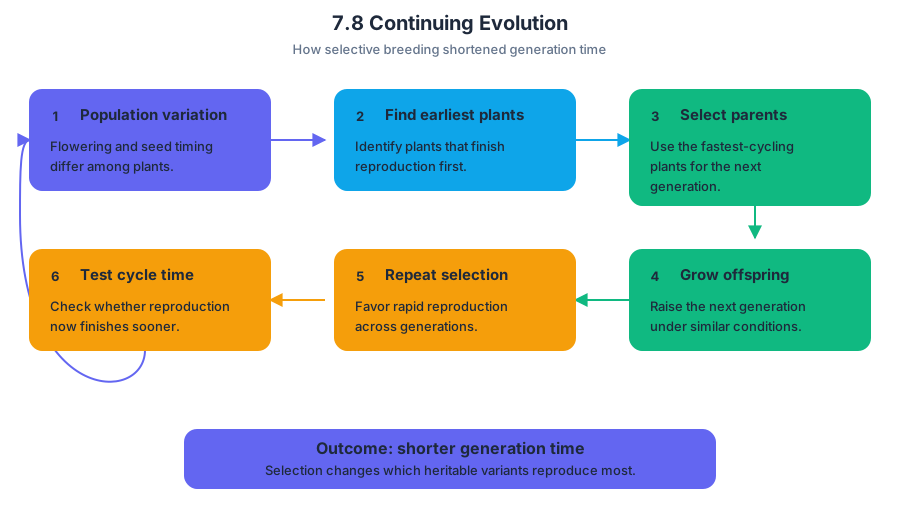
Artificial selection is the deliberate breeding of organisms with traits that humans prefer. Williams and Hill used this process to select plants that reproduced rapidly. Seeds from the fastest-cycling plants were used to establish later generations, so the selected trait was repeatedly favored.
A simplified breeding sequence looks like this:
- Begin with a population containing variation in flowering and seed-production time.
- Identify individuals that complete reproduction earliest.
- Use those individuals as parents for the next generation.
- Grow their offspring under similar conditions.
- Repeat the selection process across generations.
- Test whether the population now completes its cycle more rapidly.
Selection does not create a useful trait because the breeder wants it. Instead, it changes which existing heritable variants contribute most to the next generation. Mutation and recombination provide variation; selection changes its representation in the population.
Why rapid reproduction makes continuing evolution easier to study
A long-lived organism may evolve continuously, but its evolutionary change can be difficult to observe directly because few generations occur during a human research project. Rapid-cycling Brassica populations solve this practical problem. Researchers can observe multiple generations, measure reproductive timing, select parents, and compare descendants with the original population.
This creates a powerful experimental loop:
$$ \text{measure trait}\rightarrow\text{select breeders}\rightarrow\text{produce offspring}\rightarrow\text{measure descendants} $$
If the descendants reproduce earlier than the starting population, that pattern supports the claim that selection changed the population. Strong evidence requires more than a single unusually early-flowering plant: researchers must examine the population across generations and control environmental conditions so that developmental plasticity is not mistaken for inherited evolution.
Population variation supplies the raw material
Plant breeding can improve traits such as rapid flowering, compact growth, or reliable seed production only when individuals differ and at least some of those differences are heritable. If every plant were genetically identical and responded identically to the environment, choosing one plant over another would not produce a lasting change in descendants.
Evolution is a change in the genetic composition of a population across generations, not a change that an individual acquires simply by practice, need, or effort.
The same principle applies outside agriculture. Pesticide resistance, antibiotic resistance, and changes in populations exposed to climate stress all depend on variation among individuals and unequal reproductive success. Artificial selection and natural selection differ in who or what applies the selective pressure, but both can alter population traits over generations.
Misconception check: “The plants evolved because they tried to reproduce faster”
Correction: plants do not consciously adapt, and selection does not manufacture a trait on demand. The population already contained variation in reproductive timing. By repeatedly choosing early-reproducing plants as parents, the breeding process increased the representation of heritable variants associated with rapid cycling.
CED alignment: Learning Objective 7.8 — Explain how evolution is an ongoing process. This topic is anchored in Essential Knowledge 7.C.1, emphasizing that natural selection is an ongoing mechanism that can produce evolutionary change whenever heritable variation affects reproductive success. The rapid-cycling Brassica example demonstrates the same population-level logic through artificial selection.
AP skill connections: Science Practice 1: Concept Explanation, especially 1.B Explain biological concepts and processes, is used when connecting generation time, heritability, and changing trait frequencies. Science Practice 4: Representing and Describing Data, especially 4.A Represent and describe data, applies when comparing reproductive-cycle measurements across generations. Science Practice 6: Argumentation, including 6.A Make a claim and 6.B Support a claim with evidence, applies when deciding whether descendant populations show continuing evolutionary change.
Retrieval check: A breeder selects the earliest-flowering plants each generation, but the offspring do not flower earlier than the original population. What conclusion is most justified? The selection did not produce detectable evolutionary change under those conditions; the trait may have low heritability, the population may lack sufficient genetic variation, or environmental effects may explain the original differences. Selection alone does not guarantee evolution.