From the free course AP Biology on Lykke
4.1 Cell Communication
Key concepts: Cell communication · Signal transduction · Gene expression · Scientific inquiry · Communicating experimental results · Written, verbal, and graphic communication · Relationship among hypotheses, procedures, and results · Laboratory investigations · Scientific practices · AP Biology curriculum connections
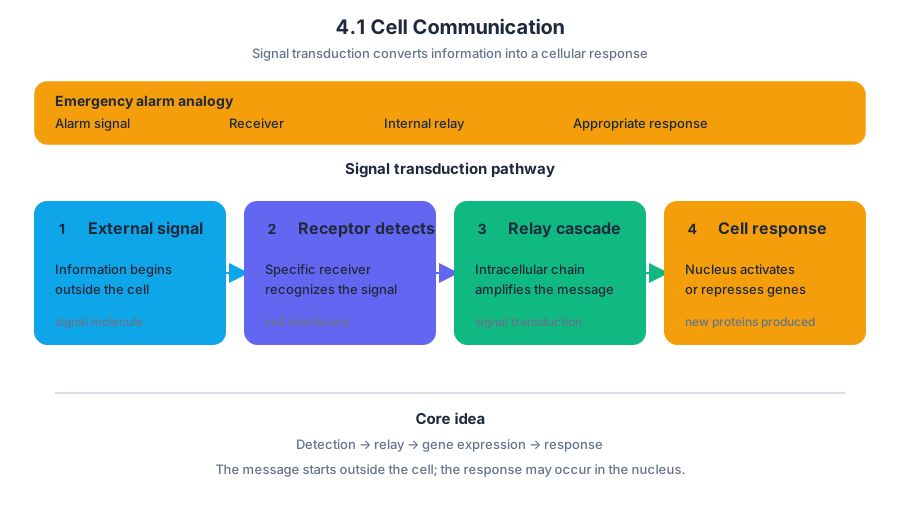
A cell communicates by detecting information and converting it into a response; in one important case, signal transduction—the conversion of an external signal into an intracellular chain of events—can stimulate gene expression, changing which proteins the cell produces.
4.1 Cell Communication
A cell communicates by detecting information and converting it into a response; in one important case, signal transduction—the conversion of an external signal into an intracellular chain of events—can stimulate gene expression, changing which proteins the cell produces.
A useful analogy is a building’s emergency alarm. The alarm signal is detected by a receiver, the receiver activates an internal relay system, and the relay produces an appropriate response. In a cell, the signal may begin outside the cell, but the response can occur inside the nucleus when signal transduction activates or represses genes.
From signal to cellular response
The central relationship is:
$$ \text{signal} \rightarrow \text{cellular detection} \rightarrow \text{signal transduction} \rightarrow \text{cellular response} $$
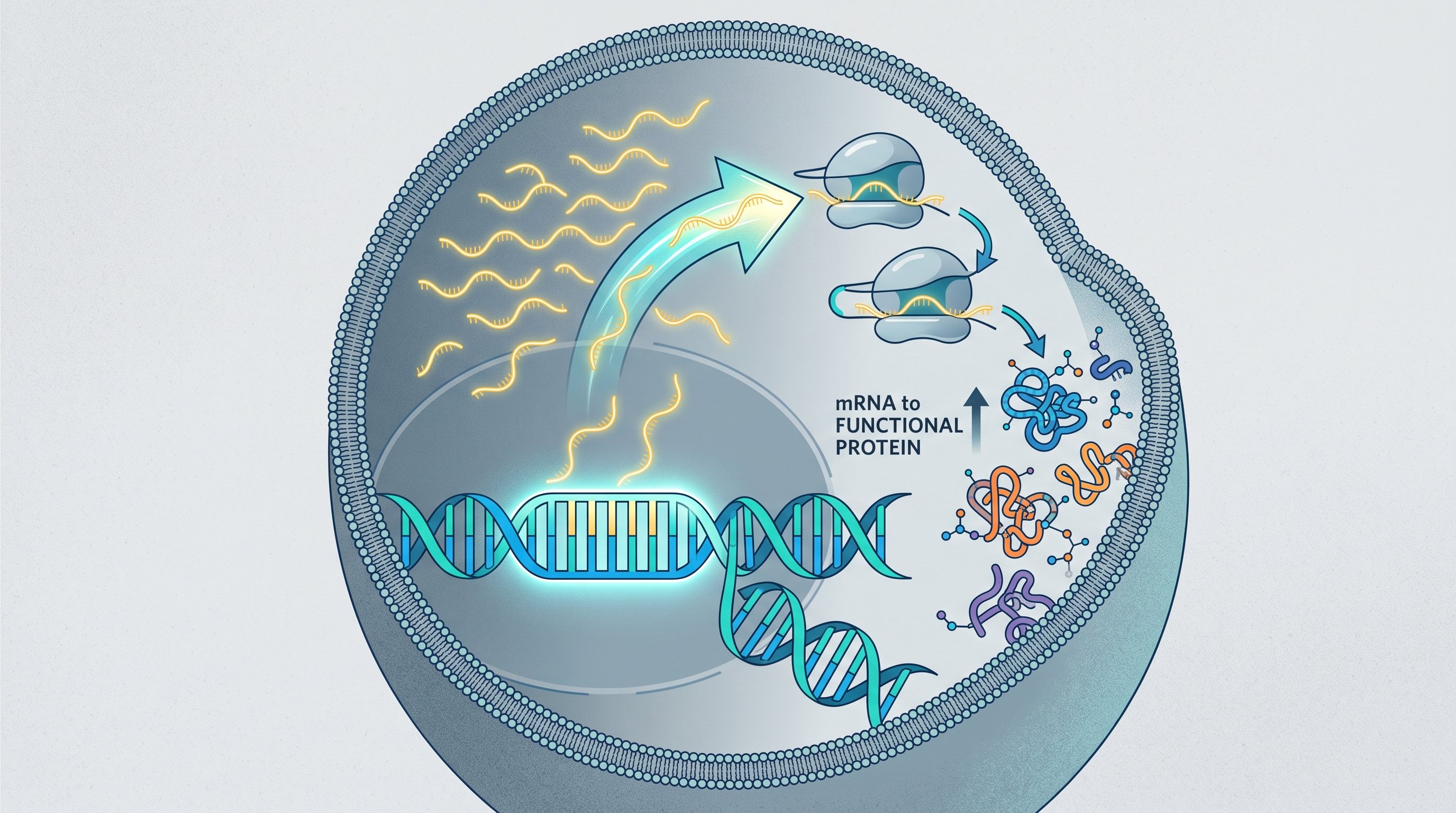
The response may be rapid, such as changing the activity of a protein that already exists, or slower but longer-lasting, such as stimulating gene expression. When gene expression changes, the cell may produce a new protein, alter its behavior, divide, move, or modify its metabolism.
For example, suppose a chemical signal causes a cell to produce an enzyme that was previously absent or present only in small amounts. The signal does not become the enzyme. Instead, the signal initiates a transduction pathway that ultimately affects gene expression; the resulting protein then carries out the response.
Worked interpretation
A researcher observes that cells exposed to a signal contain more of a particular messenger RNA than untreated cells. A careful explanation connects the observations in sequence:
- The treated cells received the signal.
- The signal activated a signal-transduction pathway.
- The pathway increased expression of the relevant gene.
- Increased transcription produced more messenger RNA.
- The increase in messenger RNA supports, but does not by itself prove, an increase in the final protein or cellular function.
The last distinction matters. Gene expression is not identical to protein production or biological effect. A change in messenger RNA can be evidence of altered transcription, while additional measurements would be needed to determine whether translation and protein activity also changed.
Key insight: A signal can change cell behavior without entering the cell, because information can be transmitted through a molecular pathway.
Scientific inquiry is a communication process
Scientific inquiry begins with a question and develops through a hypothesis, a testable explanation or prediction. The hypothesis determines what procedures are appropriate, while the procedures determine what results can legitimately support the conclusion.
Students should repeatedly examine the relationship among their hypothesis, procedures, and results. If a hypothesis predicts that a signal will increase gene expression, the investigation must include a measurable indicator of gene expression, an untreated comparison, and procedures that distinguish the signal’s effect from unrelated variables.
During an informal small-group or class discussion, investigators can identify possible errors, propose changes in methodology, and consider alternative explanations. For instance, if treated cells show greater gene expression, the result might reflect the signal itself—or a difference in cell number, exposure time, temperature, or measurement technique.
Communicating experimental results
Experimental results must be communicated to peers to have value. Communication allows other scientists to inspect the evidence, evaluate the reasoning, identify limitations, and decide whether further investigation is justified. A private result cannot effectively contribute to shared scientific knowledge.
Scientific communication may be written, verbal, or graphic:
| Form | Best use |
|---|---|
| Written report | Explain the question, hypothesis, procedures, results, errors, and conclusion in a permanent record |
| Verbal presentation | Describe findings and respond to questions from peers |
| Graphic communication | Reveal patterns through tables, diagrams, or graphs |
A graph is not decoration. Its axes, units, labels, scale, and caption should make the evidence understandable without guessing. If signal concentration is the independent variable, it belongs on the horizontal axis; if messenger RNA abundance is the dependent variable, it belongs on the vertical axis.
Investigation as a connecting activity
An investigation of cell communication can be conducted while studying many topics throughout the year. It can also serve as a final laboratory activity that connects concepts, Big Ideas, and science practices, including genetics, development, organismal behavior, cell communication, and evolution.
The investigation is therefore more than a single experiment. It is a chance to ask a question, design a procedure, collect and graph data, interpret uncertainty, construct an explanation, and communicate the result to others.
Common misconception check
Misconception: “If a signal stimulates gene expression, the signal directly creates the protein.” The correction is that signal transduction links detection of the signal to regulation of gene expression; the cell’s own transcription and translation machinery produces the protein.
Misconception: “A result is scientifically useful as soon as it is measured.” A measurement becomes useful evidence only when its relationship to the hypothesis and procedures is explained and when the result is communicated clearly enough for peers to evaluate.
Retrieval check
A treatment causes cells to contain more messenger RNA for a gene. Identify the proposed mechanism and one additional measurement needed before concluding that the cells produce more functional protein.
Answer: The treatment may activate signal transduction that stimulates expression of the gene. Measuring the corresponding protein, or measuring its biological activity, would test whether increased messenger RNA produces more functional protein.
Source Materials
- Ap Biology Course And Exam Description
- Ap Biology Course Overview
- Ap Biology Course At A Glance
- Ap Biology Equations And Formulas Sheet
- Chapter 3 Quantitative Skills In Ap Sciences
- Ap Biology Teacher Lab Manual Effective Fall 2019
- Updates 2025 26
- AP Biology Course-AP Central-College Board
- AP Biology-AP Students
- Biology of AP Courses-OpenStax
- AP Biology-Acellus
- AP/College Biology