From the free course AP Biology on Lykke
1.3 Introduction to Macromolecules
Key concepts: Introduction to macromolecules · Communicating investigation results and conclusions · Postlab questions and activities · Extending an investigation · Planning an investigation by identifying what may be inaccurate · Determining which data are important to collect · Defining what the investigation is intended to find out · Using an investigation strategy to help diagnose and address misconceptions · The need for a constant input of energy · The exchange of macromolecules
A biological investigation becomes powerful when it turns a vague curiosity—What happens to macromolecules when cells receive a constant input of energy?—into a testable question, measurable data, and an evidence-based conclusion.
1.3 Introduction to Macromolecules
A biological investigation becomes powerful when it turns a vague curiosity—What happens to macromolecules when cells receive a constant input of energy?—into a testable question, measurable data, and an evidence-based conclusion. Macromolecules are large biological molecules whose structures allow them to build cells, store information, transfer energy, and support chemical reactions. Their functions depend not only on which elements they contain, but also on how their molecular subunits are arranged.
CED traceability: Topic 1.3 Introduction to Macromolecules; Learning Objective 1.3; Essential Knowledge 4.A.1 and 4.A.2. The central reasoning task is to connect molecular structure and interactions with biological function, then support that connection using investigative evidence.
From a biological idea to an investigation
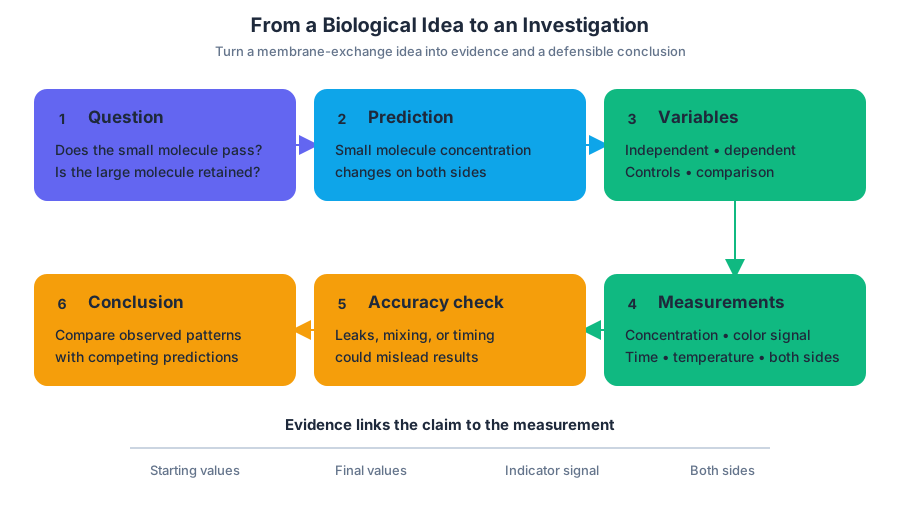
Suppose students investigate the exchange of macromolecules between two solutions separated by a membrane. Before touching equipment, they should identify what they hope to find out. A strong question might be: Does the membrane permit the movement of a small dissolved molecule while retaining a larger macromolecule? This question predicts a measurable change rather than merely asking whether “something happens.”
The investigation strategy should then identify the evidence needed to answer the question. Students might collect the starting and final concentrations of each substance, the color or other indicator signal, the time of exposure, the temperature, and measurements from both sides of the membrane. Data are important when they distinguish among explanations; recording every possible observation is less useful than measuring variables linked directly to the claim.
A useful planning chain is:
- Question: What molecular exchange is being tested?
- Prediction: If the membrane permits passage of the smaller molecule, its concentration should change on both sides.
- Variables: Define the independent variable, dependent variable, controlled variables, and comparison condition.
- Measurements: Decide which concentration, time, and environmental data are necessary.
- Accuracy check: Identify steps that could produce misleading results.
- Conclusion: Compare the observed pattern with competing predictions.
Using investigations to diagnose misconceptions
An investigation strategy is also a diagnostic tool. If a student believes that all macromolecules cross a membrane because molecules are constantly moving, the teacher can make that misconception explicit, predict its consequence, and test it against an alternative explanation: movement may occur, but membrane permeability may depend on molecular size or chemical properties.
The reasoning must be deliberate:
Misconception → predicted result → controlled test → comparison with alternatives → revised explanation
For example, the misconception predicts that both a small molecule and a large macromolecule will appear on the opposite side of the membrane. The alternative predicts that only the smaller molecule will cross. After the experiment, students compare the measured indicators with both predictions. If only the smaller molecule is detected across the membrane, the evidence supports selective exchange rather than unrestricted movement. If both appear, students must investigate other explanations, such as membrane damage, contamination, or an inaccurate detection method.
This process allows a teacher to diagnose and address misconceptions immediately instead of waiting until a final answer reveals confused reasoning. The goal is not simply to obtain the “expected” result; it is to determine which explanation best accounts for the complete data set.
Accuracy, uncertainty, and important data
Before collecting data, students should ask, What aspects of our methods or results may not be accurate? Possible problems include unequal starting volumes, inconsistent timing, temperature changes, a damaged membrane, imprecise volume measurements, or an indicator that cannot detect low concentrations. These are not minor technical details: each could change the apparent rate or direction of macromolecule exchange.
Students should distinguish accuracy, how close a measurement is to the true value, from precision, how consistent repeated measurements are. Repeated trials help reveal variation, but repetition does not automatically correct a systematic error. If every sample is measured with a miscalibrated instrument, the results may be precise yet inaccurate.
Communicating results and extending the investigation
A scientific conclusion must connect evidence to a claim. Instead of writing “the hypothesis was correct,” students should state the observed pattern, identify the data supporting it, and explain the biological mechanism consistent with that pattern. A clear report communicates methods, relevant data, uncertainty, graphical or visual representations, and a conclusion that does not exceed the evidence.
Postlab questions and activities should push students beyond reporting observations. They may ask students to explain unexpected results, identify limitations, distinguish correlation from causation, or propose a better control. An investigation can then be extended by changing one factor—such as membrane composition, temperature, molecular size, or exposure time—while keeping the remaining conditions constant.
AP Biology science practices in action
This topic most directly develops Science Practice 3: Questions and Methods, as students formulate investigable questions and plan controlled procedures; Science Practice 4: Representing and Describing Data, as they organize measurements and communicate patterns; and Science Practice 6: Argumentation, as they use evidence to support, revise, or reject explanations. It also invokes Science Practice 1: Concept Explanation when students connect macromolecule exchange to biological function and Science Practice 2: Visual Representations when they diagram membrane movement or experimental design.
Retrieval check: A result shows no detectable macromolecule exchange. Name two different explanations, identify one measurement that would help distinguish them, and state what result each explanation predicts.


Source Materials
- Ap Biology Course And Exam Description
- Ap Biology Course Overview
- Ap Biology Course At A Glance
- Ap Biology Equations And Formulas Sheet
- Chapter 3 Quantitative Skills In Ap Sciences
- Ap Biology Teacher Lab Manual Effective Fall 2019
- Updates 2025 26
- • Confirmation: Students confirm a principle through an activity in which the results are known in advance.
- equations into arithmetic equations, and (4) generating a calculator or spreadsheet graphic model of the game played over time. Afterward, there are the following summative activities: (1) checking th