From the free course AP Biology on Lykke
1.7 Proteins
Key concepts: Absolute rate of a reaction · Measuring reaction rate over a specific amount of time · Absorbance as a measure of reaction rate · Anabolic reactions · Building sugar molecules in the Calvin cycle of photosynthesis · Baseline in chemical reactions
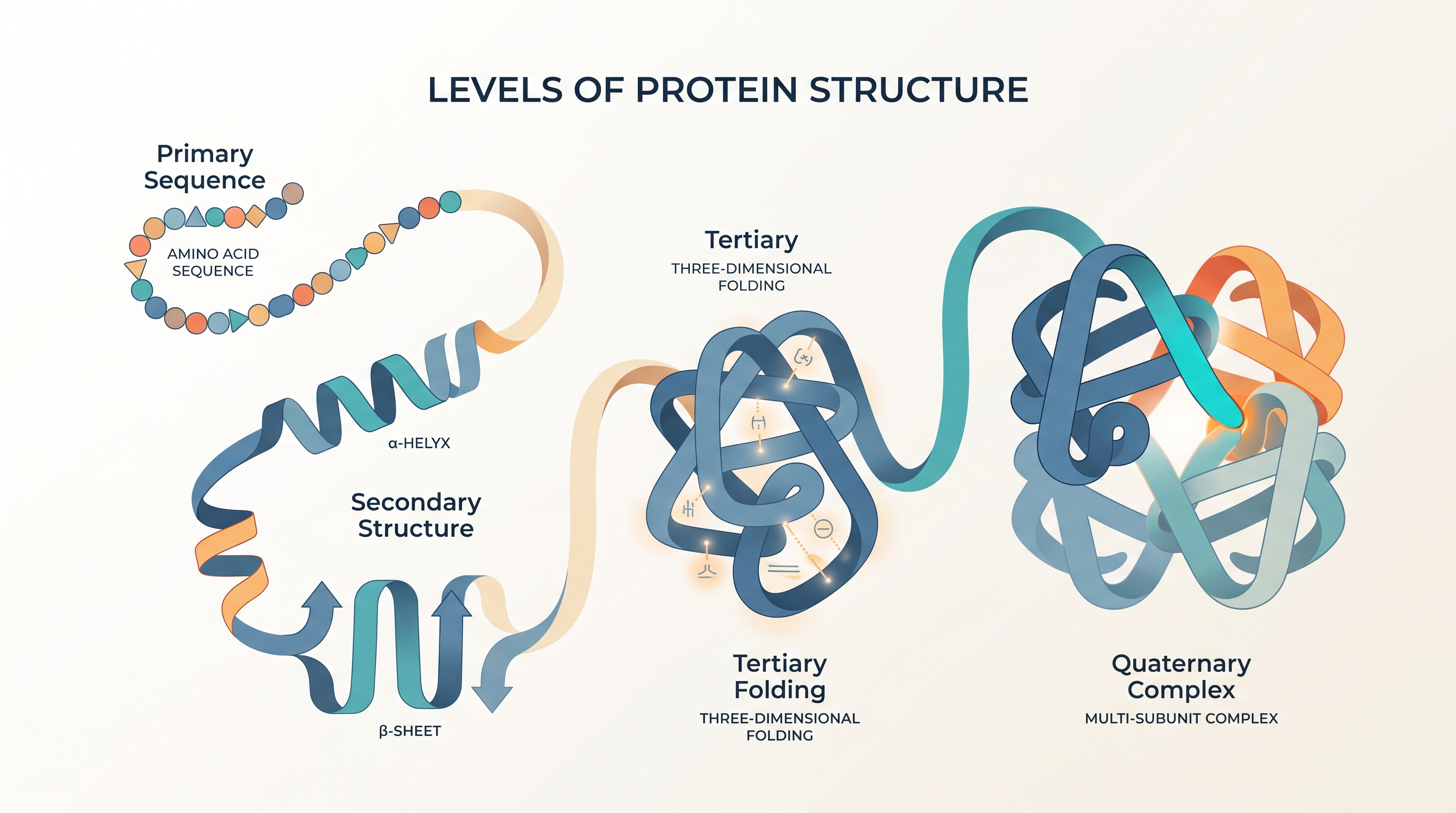
Proteins can act as enzymes that change how quickly chemical reactions occur. A protease, for example, is a protein enzyme that breaks down other proteins; the important experimental question is not merely whether the reaction happens, but how fast it happens.
1.7 Proteins
Proteins can act as enzymes that change how quickly chemical reactions occur. A protease, for example, is a protein enzyme that breaks down other proteins; the important experimental question is not merely whether the reaction happens, but how fast it happens.
CED traceability: Learning Objective LO 1.7-1; Essential Knowledge EK 1.A.3. Protein structure gives proteins specialized functions, including catalytic functions that can be measured quantitatively through reaction rate.
Reaction rate: turning change into a number
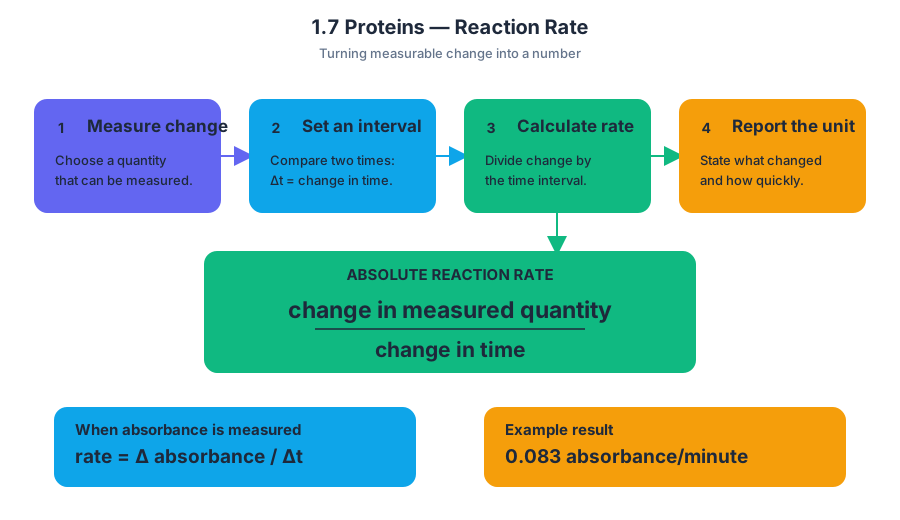
A reaction rate describes how much a measurable quantity changes during a specified interval. If an enzyme causes a colored product to accumulate, the reaction can be followed by measuring the solution’s absorbance, the amount of light absorbed by the sample at a chosen wavelength.
An absolute rate reports the total measured change per unit of time. It is calculated over a specific time interval rather than inferred from a vague statement such as “the reaction became faster.”
$$ \text{absolute reaction rate}=\frac{\text{change in measured quantity}}{\text{change in time}} $$
When absorbance is the measured quantity, the rate may be expressed as:
$$ \text{reaction rate}=\frac{\Delta \text{absorbance}}{\Delta t} $$
For example, a reaction with a rate of $0.083$ absorbance units per minute can be reported as:
$$ 0.083\ \text{absorbance/minute} $$
The unit matters: it tells you both what changed and how quickly it changed.
Worked example: measuring an enzyme reaction
Suppose a protease reaction has an absorbance of $0.20$ at $2$ minutes and $0.53$ at $6$ minutes. The absorbance increased by:
$$ \Delta A=0.53-0.20=0.33 $$
The elapsed time was:
$$ \Delta t=6-2=4\ \text{minutes} $$
Therefore, the absolute rate is:
$$ \frac{\Delta A}{\Delta t}
\frac{0.33}{4}
0.0825\ \text{absorbance/minute} $$
Rounded appropriately, the reaction rate is $0.083$ absorbance/minute.
This calculation does not mean that the absorbance increased by $0.083$ during the entire experiment. It means that, over the selected four-minute interval, the average increase was $0.083$ absorbance units per minute.
Why the baseline matters
A baseline is a standard reference condition used for comparison. In a chemical reaction investigation, the baseline establishes what happens when the experimental factor has not been changed—for example, when the usual enzyme concentration, temperature, or substrate concentration is used.
A baseline helps separate the effect of the manipulated variable from changes caused by the measuring instrument, the reaction mixture, or time itself. If a solution already has an absorbance of $0.20$ before the reaction begins, that starting value should not automatically be interpreted as product formed during the measured interval.
A useful visual model is:
initial absorbance ───────────────► final absorbance
       A_i                                  A_f

             change = A_f - A_i
             rate = (A_f - A_i) / (t_f - t_i)
The baseline is the starting reference, not necessarily zero.
Anabolic reactions and protein enzymes
An anabolic reaction builds a larger molecule from smaller molecules and generally requires an input of energy. In photosynthesis, the Calvin cycle contains anabolic reactions that build sugar molecules from smaller carbon-containing compounds.
This contrasts with the action of proteases, which catalyze breakdown reactions. The distinction is about molecular direction:
| Reaction type | Molecular effect | Example |
|---|---|---|
| Anabolic | Builds larger molecules | Sugar formation in the Calvin cycle |
| Catabolic | Breaks larger molecules into smaller molecules | Protein breakdown by a protease |
The enzyme itself is not consumed as the reaction proceeds. Instead, its protein structure allows it to interact with particular reactants and lower the activation energy required for the reaction. Measuring absorbance over time provides evidence of the enzyme’s activity, while the reaction’s biological context explains what the enzyme is doing.
Misconception check: “A higher absorbance always means a faster reaction”
Misconception: The sample with the greatest final absorbance must have had the fastest reaction.
Correction: Final absorbance measures how much light the sample absorbed at the endpoint; reaction rate measures how rapidly absorbance changed over a defined interval. A sample may finish with a high absorbance because it started high, reacted for longer, or produced more total product—not because its rate was greatest.
To compare rates fairly, use the same time interval or calculate each absolute rate from the relevant initial and final measurements. Also compare experimental values with the baseline before attributing the difference to the enzyme or treatment.
Retrieval check
A reaction’s absorbance changes from $0.14$ to $0.47$ in $5$ minutes. What is its absolute rate, and what does the unit mean?
The calculation is:
$$ \frac{0.47-0.14}{5}
\frac{0.33}{5}
0.066\ \text{absorbance/minute} $$
The value means that absorbance increased by an average of $0.066$ absorbance units per minute during that measured interval.
Source Materials
- Ap Biology Course And Exam Description
- Ap Biology Course Overview
- Ap Biology Course At A Glance
- Ap Biology Equations And Formulas Sheet
- Chapter 3 Quantitative Skills In Ap Sciences
- Ap Biology Teacher Lab Manual Effective Fall 2019
- Updates 2025 26
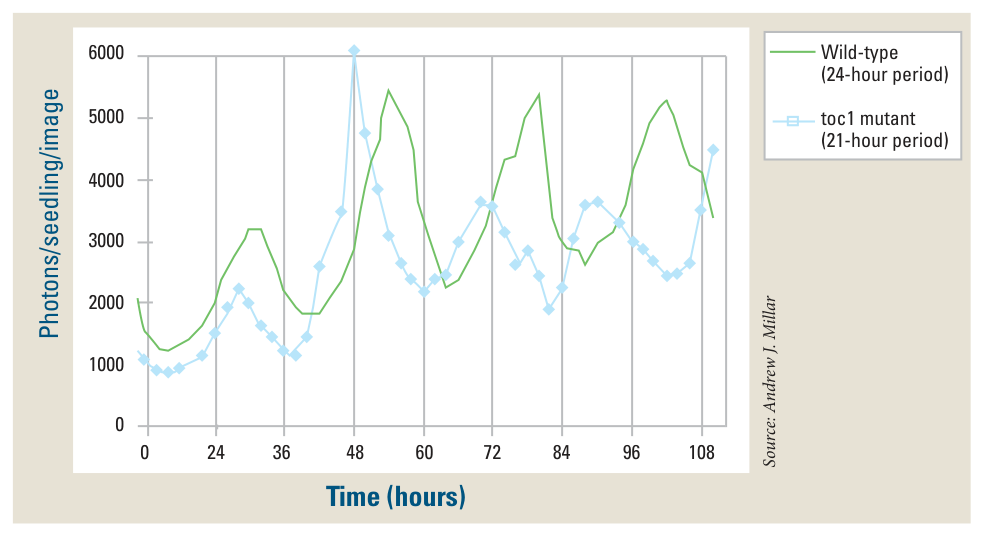
- Figure 4. A graph of circadian rhythms in Arabidopsis (Note the sinusoidal behavior over time.)