From the free course AP Biology on Lykke
7.11 Variations in Populations
Key concepts: Variations in populations · Environmental change · Selective pressures · Population responses to environments · Interactions among biological systems · Ecosystems · Models of complex biological systems · Limitations of models
Populations contain variation, and environmental change determines which of those differences become advantageous, disadvantageous, or effectively neutral. A population is not a collection of identical organisms: individuals may differ in traits, cellular molecules, physiology, behavior, or responses to…
7.11 Variations in Populations
Populations contain variation, and environmental change determines which of those differences become advantageous, disadvantageous, or effectively neutral. A population is not a collection of identical organisms: individuals may differ in traits, cellular molecules, physiology, behavior, or responses to environmental conditions.
Investigative question: When an environment changes, how do variation and interactions among biological systems shape a population’s response?
Variation meets environmental change
Phenotypic variation means observable differences among individuals, such as body color, enzyme activity, drought tolerance, or resistance to a pathogen. Some variation reflects genetic differences, while some results from environmental effects on organisms with similar genetic information. The biological importance of a trait depends on the environment in which the organism lives.
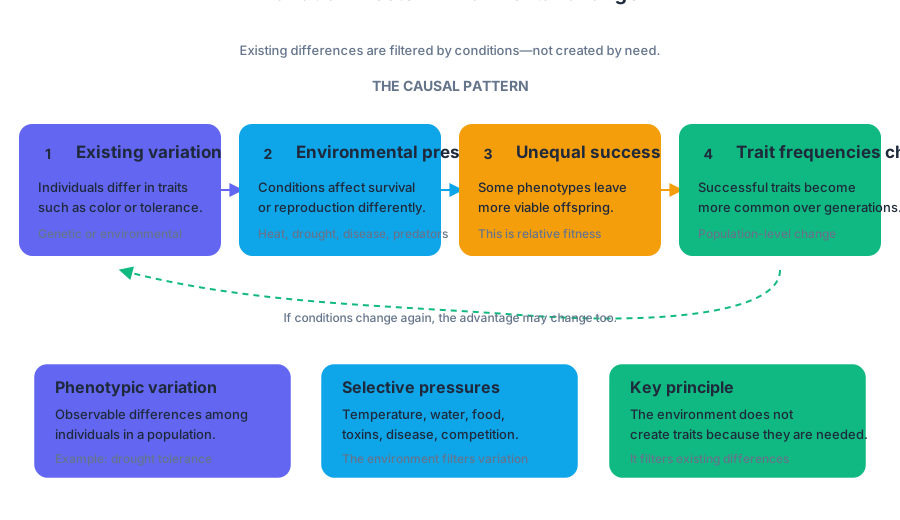
Under 7.2.A.2, environments change and apply selective pressures to populations. A selective pressure is an environmental condition that causes some phenotypes to survive or reproduce more successfully than others. Temperature, water availability, predators, disease, food supply, toxins, and competition can all act as selective pressures.
Under 7.2.A.3, some phenotypic variations can increase or decrease an organism’s fitness in a particular environment. Fitness means an organism’s relative contribution of viable offspring to the next generation—not simply its strength, size, health, or lifespan.
The causal pattern is:
existing variation → environmental pressure → unequal survival or reproduction → changing trait frequencies
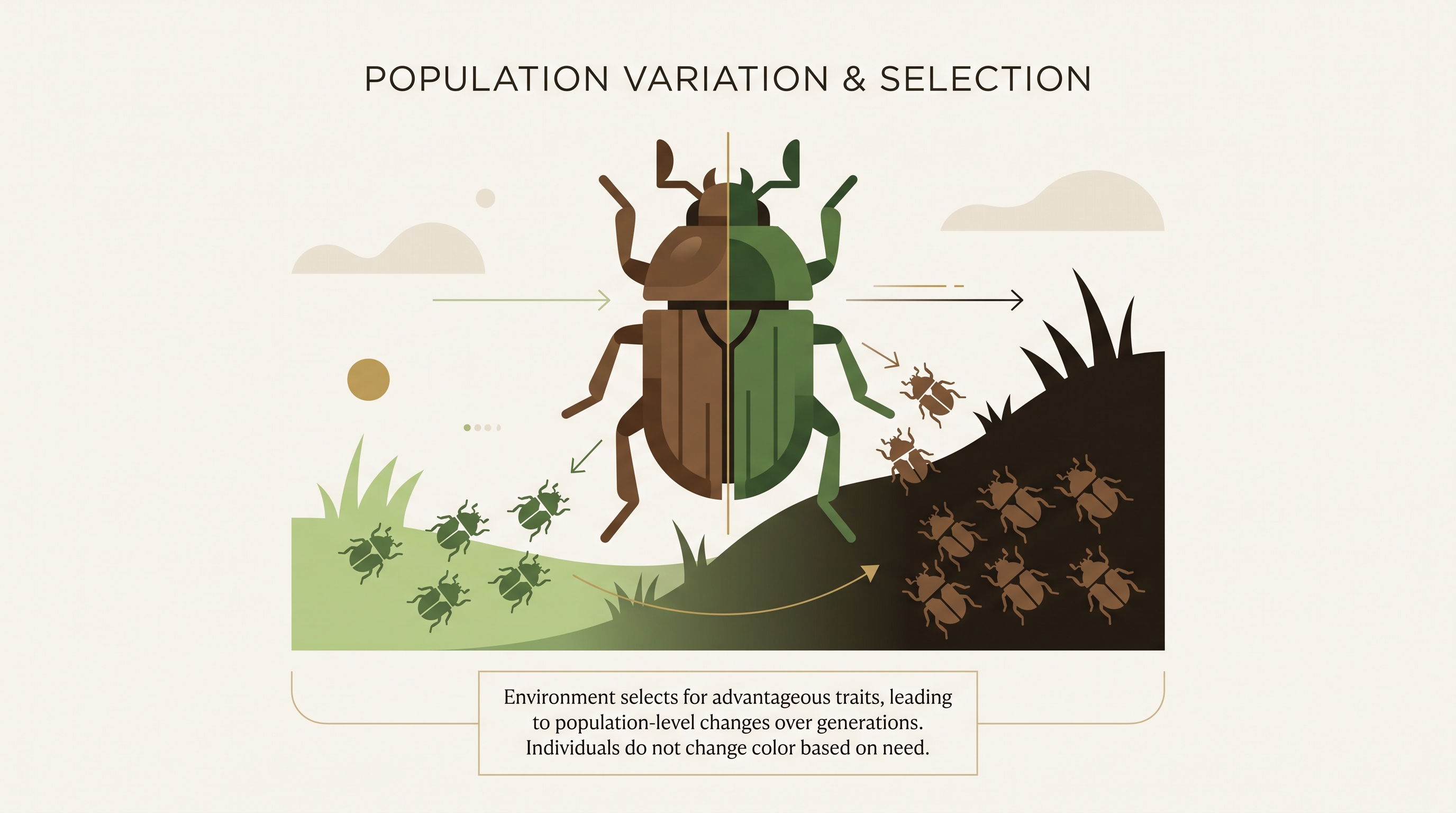
The environment does not “choose” traits because organisms need them. Instead, existing differences are filtered by conditions. If the environment changes again, the same phenotype may no longer provide an advantage.
Worked example: drought and plant populations
Imagine a grass population containing plants with naturally different root depths. During years with regular rainfall, shallow-rooted and deep-rooted plants may produce similar numbers of seeds. A prolonged drought changes the environment: water becomes concentrated deeper in the soil.
Deep-rooted plants now have greater access to water, so they are more likely to survive long enough to reproduce. Shallow-rooted plants may wilt before producing seeds. Over several generations, alleles associated with deeper roots may become more common—not because individual plants deliberately grew deeper roots, but because preexisting variation affected reproductive success under drought.
This example also shows why a population response is measured across generations. Individual plants may acclimate physiologically during their lifetimes, but natural selection changes the frequency of inherited variants in the population.
Variation at the molecular level
7.2.B.1 connects variation in the number and types of molecules within cells to a population’s ability to survive and reproduce in different environments. Individuals may differ in the amount or structure of proteins, pigments, membrane molecules, receptors, or enzymes they produce. Those molecular differences can alter phenotype.
For example, a protein variant that functions efficiently at high temperature may help an organism maintain metabolism during a heat wave. In a cooler environment, that same variant might provide little advantage. The molecular difference matters because it changes a biological function, and the function affects survival or reproduction.
Misconception check: Natural selection does not produce variation because a population “needs” it. Variation must already exist, arise through mutation or recombination, or enter through migration before environmental conditions can filter it.
Populations are interacting biological systems
A population does not respond to climate, resources, or hazards in isolation. Biological systems interact, and those interactions can have complex properties, as emphasized by Systems Interactions. A drought can reduce plant growth, which reduces herbivore food, which changes predator abundance, competition, nutrient cycling, and ecosystem energy flow.
Ecological organization helps locate these interactions:
| Level | What is interacting? | Example response to drought |
|---|---|---|
| Population | Members of one species | More deep-rooted plants survive |
| Community | Multiple populations | Herbivores compete for fewer plants |
| Ecosystem | Organisms plus physical conditions | Reduced plant productivity changes energy flow |
Because effects can move through several levels, population variation should be studied in the context of environmental pressures and system interactions. A trait that benefits one species may alter another species’ resources or predators, producing indirect effects that are difficult to predict from one population alone.
Models: useful, but never reality itself
Models simplify complex biological systems so scientists can identify relationships, generate predictions, and compare possible outcomes. A population model might represent how drought intensity changes survival, or how a trait’s frequency changes when reproduction differs among phenotypes.
Every model has limitations. It may assume constant temperature, random mating, no migration, or independent effects among traits—conditions that rarely hold perfectly in ecosystems. A model should therefore be evaluated by asking: What evidence supports it? Which variables were omitted? What assumptions does it make? Does it successfully predict observations outside the data used to build it?
In-flow retrieval check
A beetle population contains green and brown individuals. After vegetation becomes darker, brown beetles leave more offspring. Identify the selective pressure, the advantageous phenotype, and the population-level change. Then state why the result does not mean that individual green beetles changed color because they needed camouflage.