From the free course AP Biology on Lykke
1.4 Carbohydrates
A plant can build a rigid cell wall, a seed can store chemical energy, and an animal can fuel a sprint using molecules built largely from the same basic units: carbohydrates.
1.4 Carbohydrates
A plant can build a rigid cell wall, a seed can store chemical energy, and an animal can fuel a sprint using molecules built largely from the same basic units: carbohydrates. Their structure—especially the way sugar units are connected—determines whether a carbohydrate acts as a rapidly available fuel, a compact storage molecule, or a strong structural material.
From simple sugars to complex carbohydrates
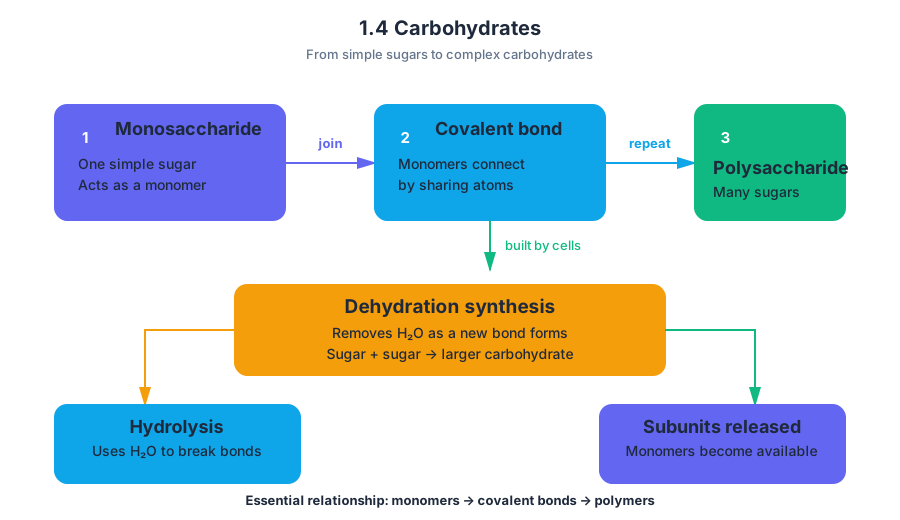
A monosaccharide is a single, simple sugar molecule. It functions as a monomer, meaning a small molecular building block that can be covalently joined to other monomers. A polysaccharide is a large carbohydrate polymer made from many monosaccharides connected by covalent bonds.
The essential relationship is:
When monosaccharides are joined, a dehydration synthesis reaction removes the components of a water molecule as a new covalent bond forms. The reverse process, hydrolysis, uses water to break that bond. These reactions are not merely vocabulary: they explain how cells assemble large carbohydrate molecules and later make their subunits available again.
Essential Knowledge EK 1.4.A.1: Monosaccharides (simple sugars) are the monomers for polysaccharides (complex carbohydrates). These monomers are connected by covalent bonds to form polymers such as complex carbohydrates.
One kind of building block, different biological jobs
Carbohydrates become functionally different because their sugar units can be arranged and connected in different ways. The resulting polymer may be suited for storage, rapid access to energy, or structural reinforcement.
| Carbohydrate | Biological role | Structural idea |
|---|---|---|
| Starch | Energy storage in plants | A polymer that stores many sugar units in a compact form |
| Glycogen | Energy storage in animals and other organisms | A highly accessible storage polymer |
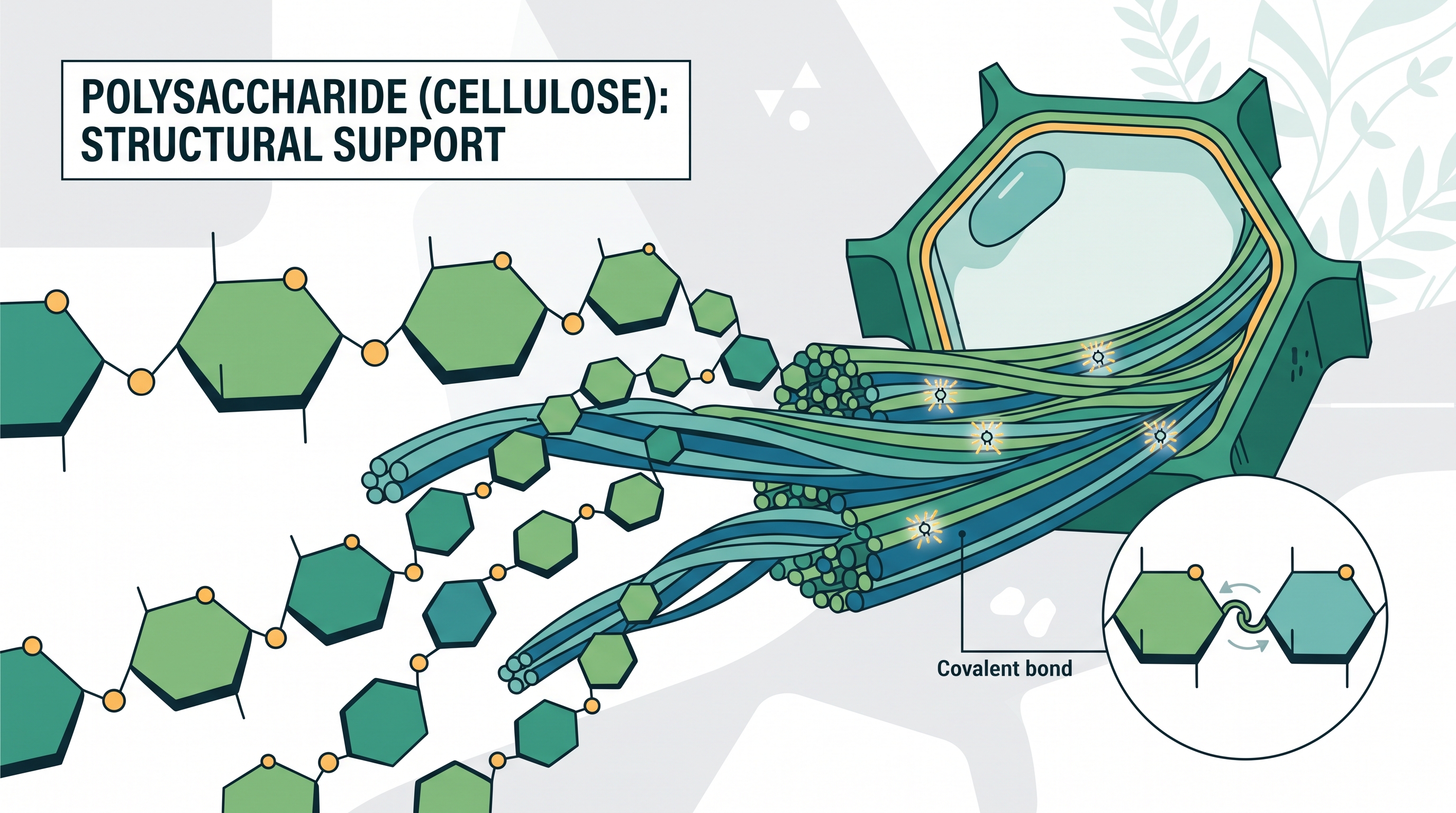
| Cellulose | Structural support in plant cell walls | A strong polymer whose arrangement provides rigidity |
The important reasoning move is to connect structure to function. A storage carbohydrate can hold many sugar units until the organism needs them. A structural carbohydrate must instead resist forces and maintain the shape of tissues. Therefore, identifying a carbohydrate by name is less useful than explaining how its molecular organization supports its role.
Worked example: why a plant cell wall is not an energy reserve
Suppose a researcher compares two plant samples. Sample A contains abundant starch granules inside plant cells. Sample B contains abundant cellulose in cell walls. The researcher asks why both samples can contain carbohydrate polymers but serve different purposes.
Step 1: Identify the common principle. Both starch and cellulose are polysaccharides built from monosaccharide monomers joined by covalent bonds.
Step 2: Identify the different function. Starch is primarily a storage carbohydrate, so it provides a reserve of sugar units that can later support cellular energy demands. Cellulose is primarily structural, so it contributes strength and rigidity to the plant cell wall.
Step 3: Link function to organization. The different arrangement of their covalent connections produces polymers with different physical properties. Starch is organized for storage; cellulose forms strong structural material.
Conclusion: The samples differ not because one contains “real carbohydrate” and the other does not, but because carbohydrate structure allows the same broad class of molecules to perform different biological jobs.
Named misconception check: “All carbohydrates are immediate energy”
Misconception — “Carbohydrates are only quick energy.” Some carbohydrates can be broken down to provide usable sugar molecules, but not all carbohydrates function primarily as immediate fuel. Cellulose is a major structural material, while starch and glycogen are storage molecules. A correct explanation must distinguish chemical class from biological function.
A second misconception is that a polymer is simply a pile of monomers with no new properties. In reality, the way monomers are connected affects the polymer’s shape, strength, accessibility, and function. Covalent bonding creates the chain, but the organization of that chain helps determine what the organism can do with it.
AP skill in action
Science Practice 1 — Concept Explanation, Skill 1.A: “Describe biological concepts and processes.” For Topic 1.4, a strong response does more than define carbohydrate terms. It describes the relationship among monosaccharides, polysaccharides, covalent bonds, and biological function, then applies that relationship to examples such as cellulose, starch, or glycogen.
For example, instead of writing “cellulose is structural,” explain: Cellulose is a polysaccharide made from covalently connected monosaccharides; its molecular organization produces a strong material that supports plant cell walls. That answer identifies the molecule, its construction, and its function.
Retrieval check
A cell links many monosaccharides into a large carbohydrate. What type of molecule has been produced, what kind of bond connects its subunits, and which example—cellulose, starch, or glycogen—would best match structural support in a plant?
Answer: The product is a polysaccharide; its monosaccharides are connected by covalent bonds; and cellulose best matches structural support in a plant.