From the free course AP Biology on Lykke
3.5 Cellular Respiration
Key concepts: Cellular respiration as the oxidation of glucose to release energy · Consumption of oxygen and production of carbon dioxide during respiration · Measuring the rate of cellular respiration · Respirometers and changes in gas volume · Use of potassium hydroxide to remove carbon dioxide · Factors affecting respiration rates in multicellular organisms · Respiration in plant cells and mitochondria · Relationship between cellular respiration and photosynthesis · Effects of seed type and stored energy source on respiration · Constructing data tables, graphs, and communicating results
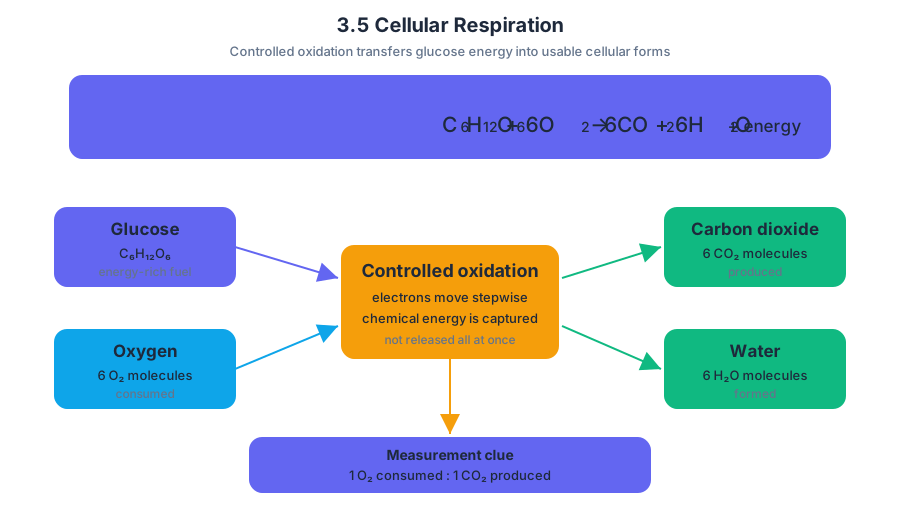
Cellular respiration is the controlled oxidation of glucose that transfers chemical energy into forms cells can use. Its overall reaction is:
3.5 Cellular Respiration
Cellular respiration is the controlled oxidation of glucose that transfers chemical energy into forms cells can use. Its overall reaction is:
$$ C_6H_{12}O_6 + 6O_2(g) \rightarrow 6CO_2(g) + 6H_2O + \text{energy} $$
The equation gives two powerful measurement clues: oxygen is consumed, and carbon dioxide is produced. For each molecule of glucose oxidized, $6$ molecules of $O_2$ are consumed and $6$ molecules of $CO_2$ are produced—so, for glucose oxidation, one molecule of oxygen is consumed for every molecule of carbon dioxide produced.
Measuring respiration as a gas exchange
A respiration rate is the amount of cellular respiration occurring per unit time. Investigators can estimate it by measuring the consumption of $O_2$, the production of $CO_2$, or the release of heat. In practice, measuring gas exchange is often more direct than measuring heat.
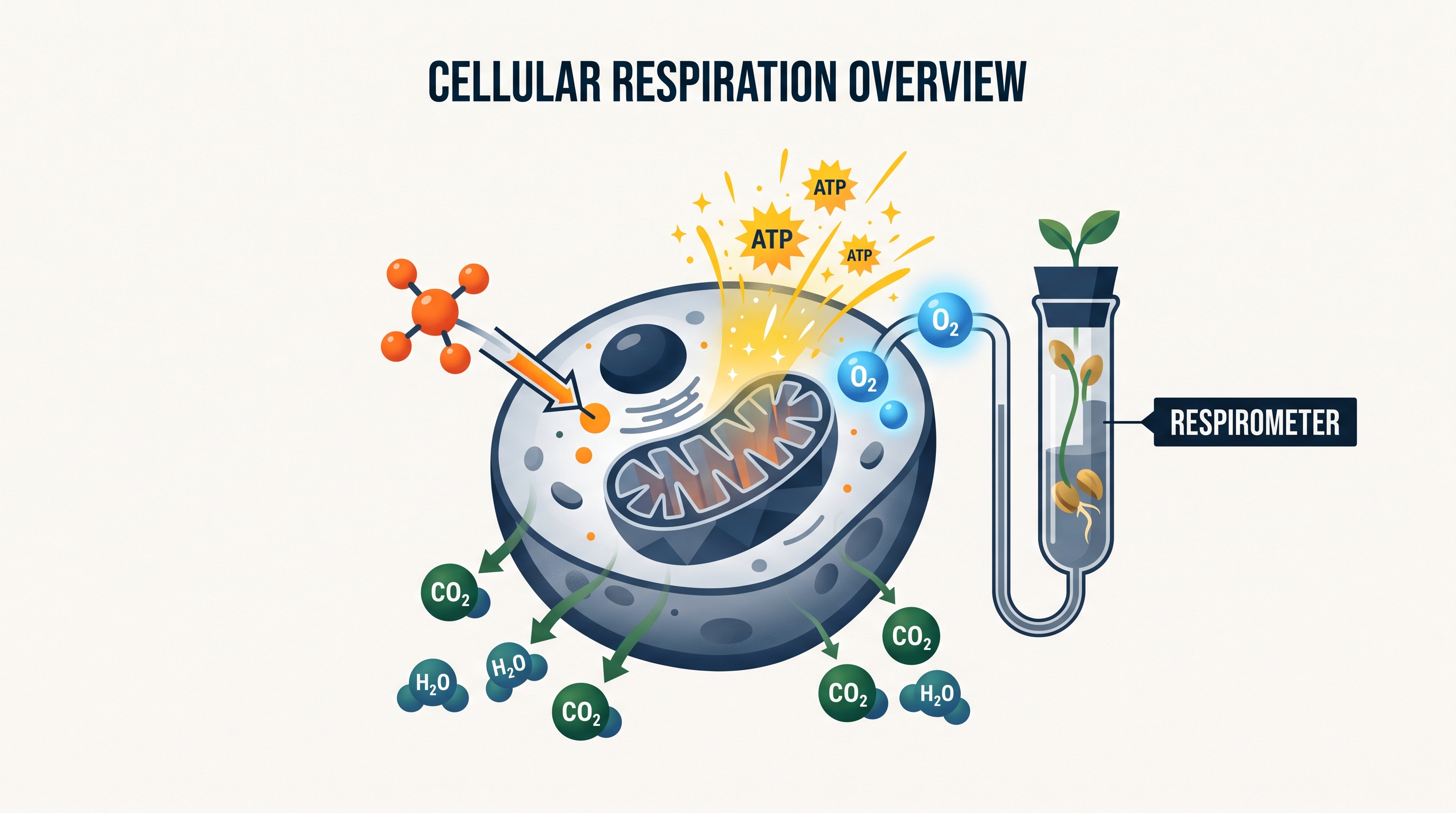
A respirometer is a device that detects changes in gas volume or pressure. Germinating seeds are especially useful experimental organisms because they are alive, actively growing, and require substantial energy for development.
In a closed respirometer, seeds consume $O_2$. If the produced $CO_2$ remains in the chamber, the total number of gas molecules may not change enough to reveal oxygen consumption. The investigator therefore adds potassium hydroxide, $KOH$, which removes carbon dioxide from the gas space:
$$ CO_2 + 2KOH \rightarrow K_2CO_3 + H_2O $$
Once $CO_2$ is chemically removed, oxygen consumption causes the overall gas volume to decrease. A drop in gas volume or pressure over time therefore indicates respiration. The rate can be represented conceptually as:
$$\text{respiration rate} \propto \frac{\text{decrease in }O_2\text{ volume}}{\text{time}}$$
Because temperature and atmospheric pressure also affect gas volume, a strong investigation includes a control respirometer—often containing glass beads or another nonliving material of equal volume. The control reveals gas changes caused by the environment rather than by seed respiration.
Worked example: interpreting a respirometer
A student places germinating seeds in one respirometer and equal-volume glass beads in a second. Both are kept at the same temperature; $KOH$ is present in both chambers. After the same time interval, the seed respirometer shows a greater decrease in gas volume.
The reasoning is:
- $KOH$ removes $CO_2$ in both chambers.
- The glass beads do not respire, so their chamber provides a baseline.
- The additional volume decrease in the seed chamber is attributable to biological $O_2$ consumption.
- A larger decrease per unit time means a higher cellular respiration rate.
If the experiment compares temperatures, seed types, or oxygen availability, only the selected independent variable should change. Replicate respirometers, identical seed masses, equal chamber volumes, and repeated measurements make the conclusion more reliable.
Respiration in plants and stored fuels
Most plant cells contain mitochondria and carry out cellular respiration. Plants do not perform photosynthesis instead of respiration; they use photosynthesis to build carbon compounds and use cellular respiration to release energy from those compounds.
Germinating seeds make this relationship visible. Before a seed develops leaves, it relies on stored molecules for energy. Fast Plant seeds store energy primarily as oil, whereas small grass seeds store energy as starch. During germination, enzymes break these reserves into molecules that can enter respiratory pathways.
A student investigation might compare respiration rates in germinating Fast Plant seeds and grass seeds by measuring the change in respirometer volume over equal time intervals. The key comparison is not simply which seed is larger; it is the rate normalized to a consistent quantity, such as seed mass or number of seeds.
Variables that affect respiration
Students can investigate how temperature, seed maturity, seed type, quantity of stored fuel, or another justified variable affects respiration in multicellular organisms. A prediction must connect the variable to a mechanism—for example, a temperature change may alter enzyme activity, while a different seed type may provide a different accessible energy reserve.
The investigation also connects respiration with photosynthesis. Photosynthesis stores energy in carbon compounds; cellular respiration releases usable energy from those compounds. In a plant, the two processes together help explain how carbon is both built into organic molecules and later transferred into cellular work.
Misconception check: “Plants only photosynthesize, while animals respire.”
Correction: Plant cells with mitochondria carry out cellular respiration, including cells that also photosynthesize. Photosynthesis and respiration have linked reactants and products, but they are not the same process.
AP Biology reasoning in this investigation
This topic most directly develops Science Practice 1: Concept Explanation, by explaining how glucose oxidation, oxygen consumption, and carbon dioxide production are connected; Science Practice 2: Visual Representations, by interpreting the reaction and respirometer diagram; Science Practice 3: Questions and Methods, by identifying variables, controls, and replication; Science Practice 4: Representing and Describing Data, by graphing gas-volume change over time; Science Practice 5: Statistical Tests and Data Analysis, by comparing replicated rates and variation; and Science Practice 6: Argumentation, by using respirometer evidence to support a claim about respiration.
Retrieval check: If $KOH$ were omitted from a respirometer containing germinating seeds, why might the measured decrease in gas volume be smaller or less clear? Identify the gas that would accumulate and explain how removing it improves the measurement.