From the free course AP Biology on Lykke
6.4 Translation
A ribosome can turn a sequence of nucleotide “letters” into a specific amino-acid chain because each three-base unit in messenger RNA, called a codon, corresponds to an amino acid or a stop signal.
6.4 Translation
A ribosome can turn a sequence of nucleotide “letters” into a specific amino-acid chain because each three-base unit in messenger RNA, called a codon, corresponds to an amino acid or a stop signal. Translation is therefore the physical step that connects genetic information to a polypeptide’s primary structure.
LO 6.4-1 — Explain how the sequence of nucleotides in a gene is used to produce a polypeptide.
From mRNA message to polypeptide
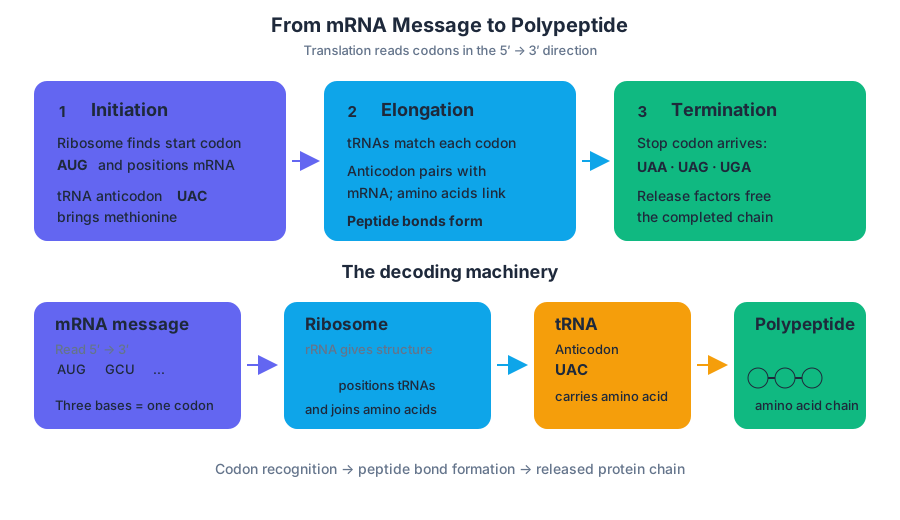
Translation is the process in which information in mRNA directs the assembly of amino acids into a polypeptide. The mRNA molecule carries the message to a ribosome, which reads the message in the $5'$ to $3'$ direction. The ribosome does not read individual bases one at a time; it reads groups of three bases.
Each codon is recognized by a complementary three-base anticodon on a transfer RNA molecule, or tRNA. The tRNA also carries the amino acid specified by that codon. Ribosomal RNA, or rRNA, forms essential structural and functional parts of the ribosome, including regions that help position tRNAs and join amino acids.
The process has three major stages:
- Initiation: The ribosome assembles on the mRNA at the start codon, usually $AUG$. A tRNA with the complementary anticodon $UAC$ brings methionine.
- Elongation: New tRNAs enter the ribosome. Their anticodons pair with successive mRNA codons, and the ribosome forms peptide bonds between adjacent amino acids.
- Termination: When the ribosome reaches a stop codon—$UAA$, $UAG$, or $UGA$—no tRNA matches it. Release factors help release the completed polypeptide.
Worked example: reading a codon sequence
Suppose an mRNA segment is:
$$5' - AUG\ GGC\ UAC\ UGA - 3'$$
Read it in groups of three, beginning at $AUG$:
| mRNA codon | Function or encoded amino acid |
|---|---|
| $AUG$ | Start; methionine |
| $GGC$ | Glycine |
| $UAC$ | Tyrosine |
| $UGA$ | Stop |
The resulting primary sequence is:
$$\text{methionine} - \text{glycine} - \text{tyrosine}$$
The stop codon does not add an amino acid. It signals that the polypeptide should be released. The chain may then fold or interact with other molecules, but those later events do not change the nucleotide-to-codon decoding shown here.
Why the reading frame matters
The ribosome must begin at the correct position because shifting the starting point changes every codon afterward. For example:
$$AUG\ GGC\ UAC\ UGA$$
If one nucleotide is inserted near the beginning, the grouping can become:
$$AUG\ CGG\ CUA\ CUG\ \ldots$$
This frameshift mutation changes the downstream amino-acid sequence and may eliminate the original stop signal. By contrast, a base substitution can affect only one codon, although it may still produce a different amino acid or a premature stop codon.
Misconception check: “The anticodon is the amino-acid code”
The anticodon does not independently determine which amino acid is attached. A specific enzyme attaches the appropriate amino acid to each tRNA. The anticodon allows the loaded tRNA to pair with the correct mRNA codon at the ribosome.
A second common error is treating the DNA template strand as if it were the mRNA sequence. If the template DNA is:
$$3' - TAC\ CCG\ ATG\ ACT - 5'$$
the mRNA is complementary:
$$5' - AUG\ GGC\ UAC\ UGA - 3'$$
The mRNA—not the DNA template—is read directly by the ribosome.
AP Biology science practices
Science Practice 1.C — Explain biological concepts and processes in applied contexts: Use a sequence, mutation, or missing translation component to predict the resulting polypeptide and explain the mechanism.
Science Practice 6.A — Make a scientific claim: State how a changed nucleotide sequence affects translation.
Science Practice 6.B — Support a claim with evidence: Cite the altered codon, changed amino acid, or new stop signal as evidence.
Science Practice 6.E — Predict the causes or effects of a change in, or perturbation to, a biological system: Predict what happens if a ribosome, tRNA, mRNA, or aminoacyl-tRNA synthetase is unavailable.
Retrieval check: An mRNA codon changes from $UAU$ to $UAA$. What kind of translation consequence is most likely, and why? The correct interpretation is a premature stop: $UAU$ encodes tyrosine, whereas $UAA$ terminates translation, producing a shortened polypeptide.