From the free course AP Biology on Lykke
6.1 DNA and RNA Structure
Key concepts: DNA structure and function · RNA structure and function · Purine nitrogenous bases · Pyrimidine nitrogenous bases · Differences between DNA and RNA · Single-stranded and double-stranded nucleic acids
DNA and RNA are information-carrying polymers whose nucleotide sequences store biological instructions, but their structures suit different jobs: DNA is a stable, typically double-stranded archive, while RNA is usually a more flexible, single-stranded molecule whose folded shape helps determine its function.
6.1 DNA and RNA Structure
DNA and RNA are information-carrying polymers whose nucleotide sequences store biological instructions, but their structures suit different jobs: DNA is a stable, typically double-stranded archive, while RNA is usually a more flexible, single-stranded molecule whose folded shape helps determine its function.
Learning Objective 1.6.A: Describe the structure and function of DNA and RNA.
Nucleotides: the repeating units of nucleic acids
A nucleic acid is a polymer made from repeating nucleotides. Each nucleotide contains three structural components:
- a five-carbon sugar—deoxyribose in DNA or ribose in RNA;
- a phosphate group;
- a nitrogenous base.
The order of bases along a nucleic-acid strand encodes biological information. The sugar and phosphate form the strand’s repeating backbone, while the bases project from that backbone and provide the sequence that can be read, copied, or used to direct cellular activities.
Purines and pyrimidines: two base shapes
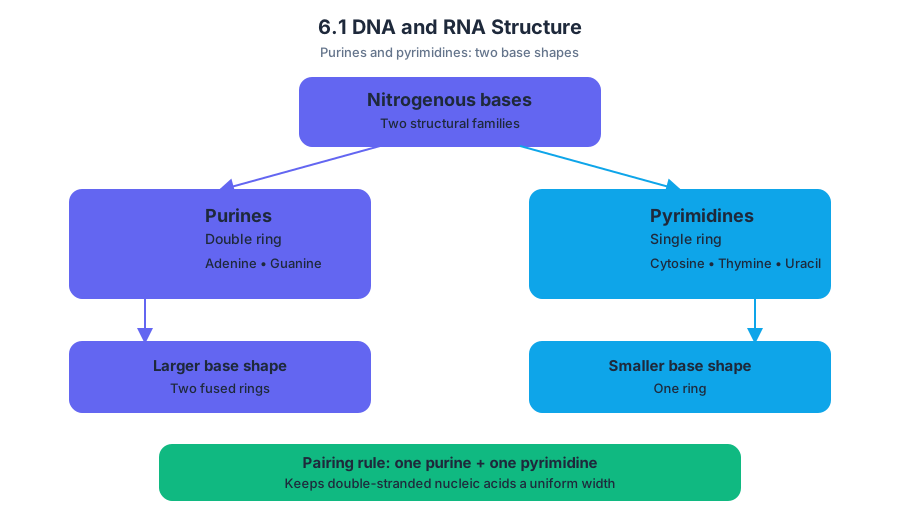
Nitrogenous bases fall into two structural families. Purines—adenine and guanine—have a larger double-ring structure. Pyrimidines—cytosine, thymine, and uracil—have a smaller single-ring structure.
A useful visual rule is:
- Purines: adenine, guanine — double ring
- Pyrimidines: cytosine, thymine, uracil — single ring
The pairing rules match one purine with one pyrimidine. This keeps the width of a double-stranded nucleic acid relatively uniform: two large purines would be too wide, while two small pyrimidines would leave too much space.
DNA: a stable, antiparallel information archive
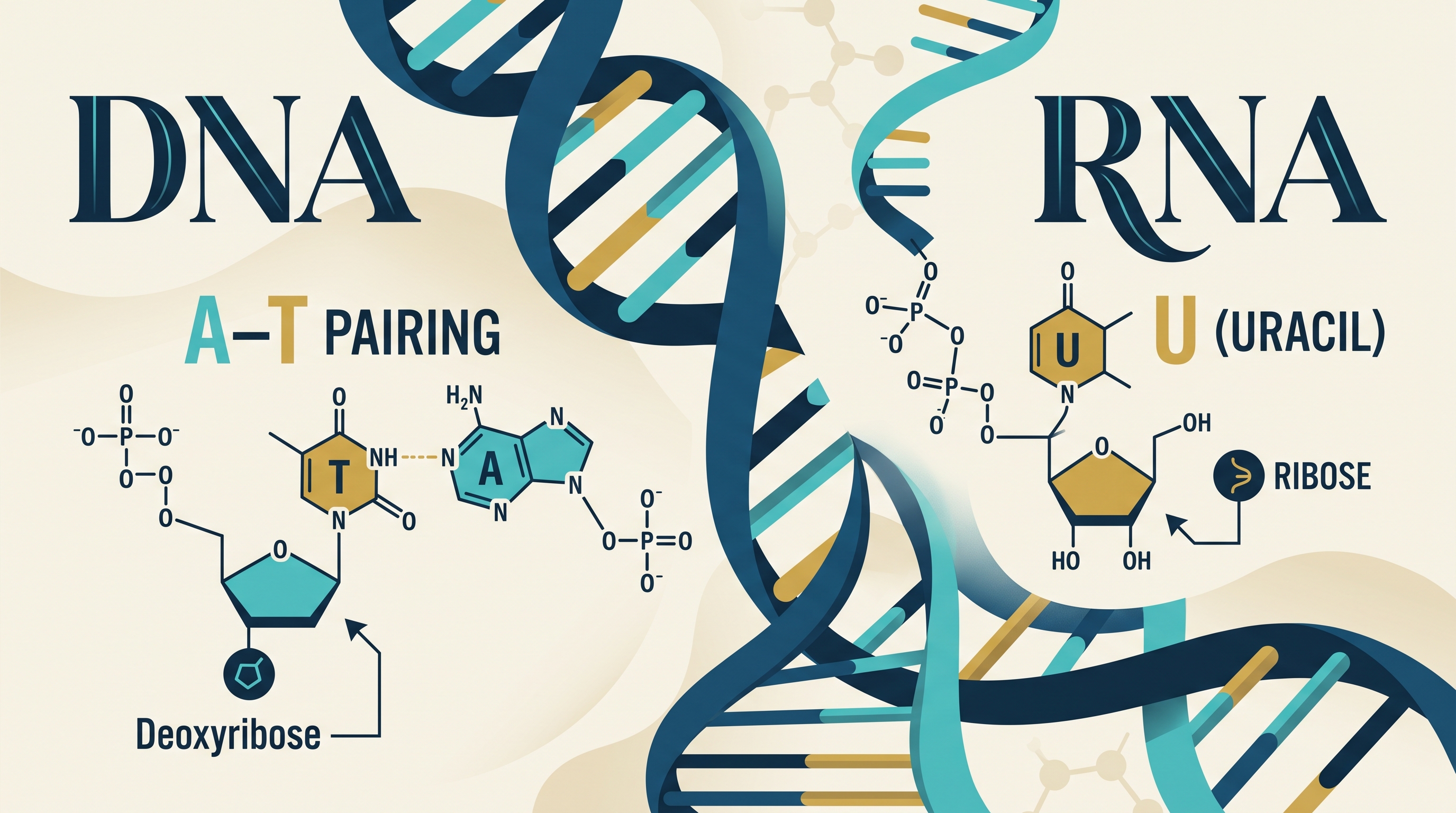
DNA, or deoxyribonucleic acid, contains deoxyribose and the bases adenine, thymine, cytosine, and guanine. It is typically a double helix: two nucleotide strands coil around one another, with paired bases held together by hydrogen bonds.
Essential Knowledge 1.6.A.3: DNA is an antiparallel double helix. Its two strands run in opposite $5'$ to $3'$ orientations. Adenine pairs with thymine, written A–T, and cytosine pairs with guanine, written C–G.
Antiparallel means that the two strands point in opposite chemical directions. One strand runs $5'$ to $3'$, while its partner runs $3'$ to $5'$. The strands are complementary: knowing the sequence of one strand allows the matching sequence of the other to be predicted.
RNA: structure shaped for a specific job
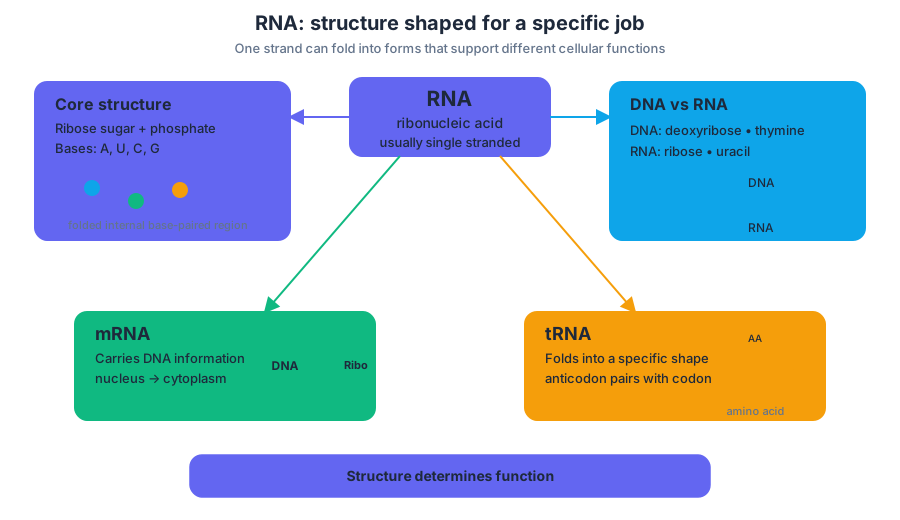
RNA, or ribonucleic acid, contains ribose and the bases adenine, uracil, cytosine, and guanine. RNA is typically single stranded, although a single strand can bend and form internal base-paired regions.
Essential Knowledge 1.6.A.4: DNA contains deoxyribose, whereas RNA contains ribose; DNA contains thymine, whereas RNA contains uracil; DNA is typically double stranded, whereas RNA is typically single stranded.
RNA’s structure determines its function. Messenger RNA, or mRNA, carries information from DNA in the nucleus to a ribosome in the cytoplasm. Transfer RNA, or tRNA, folds into a distinctive shape, binds a specific amino acid, and uses an anticodon sequence to pair with an mRNA codon.
DNA and RNA compared
| Feature | DNA | RNA |
|---|---|---|
| Sugar | Deoxyribose | Ribose |
| Distinctive base | Thymine | Uracil |
| Typical structure | Double stranded | Single stranded |
| Base pairing | A–T and C–G | A–U in paired regions |
| Representative function | Long-term information storage | Information transfer and specialized cellular tasks |
Worked example: identifying an unknown nucleic acid
A molecule is found to contain ribose, uracil, and one strand that folds into a compact shape. Identify the molecule type and explain why its structure is biologically useful.
Step 1: Identify the sugar. Ribose indicates RNA rather than DNA.
Step 2: Identify the base. Uracil is found in RNA; DNA uses thymine.
Step 3: Identify the strand arrangement. A single strand is typical of RNA and can fold through internal base pairing.
Step 4: Connect structure to function. Folding can create a specific three-dimensional shape, allowing an RNA molecule such as tRNA to bind a particular amino acid or interact with other molecules.
Misconception check
Misconception: “RNA is always single stranded and never forms base pairs.” RNA is typically single stranded, but its strand can fold back on itself. In those folded regions, adenine can pair with uracil, and cytosine can pair with guanine. “Single stranded” describes the overall number of strands, not the absence of every hydrogen-bonded region.
Retrieval check
A nucleic acid contains deoxyribose and has two antiparallel strands. Which base pair belongs in it: A–U or A–T? Explain your answer in one sentence.
Answer: A–T, because DNA contains deoxyribose and thymine, whereas RNA contains ribose and uracil.
Source Materials
- Ap Biology Course And Exam Description
- Ap Biology Course Overview
- Ap Biology Course At A Glance
- Ap Biology Equations And Formulas Sheet
- Chapter 3 Quantitative Skills In Ap Sciences
- Ap Biology Teacher Lab Manual Effective Fall 2019
- Updates 2025 26
- AP Biology Course-AP Central-College Board
- AP Biology-AP Students
- Biology of AP Courses-OpenStax
- AP Biology-Acellus
- AP/College Biology