From the free course AP Biology on Lykke
2.6 Facilitated Diffusion
Key concepts: Diffusion is a nondirectional process caused by random molecular motion · Kinetic energy affects the extent and rate of diffusion · Particles move from areas of high concentration to areas of low concentration · The diffusion rate depends on the concentration gradient · Surface area-to-volume ratio influences diffusion rate · Intestinal villi and root hair cells are adaptations that facilitate nutrient uptake · Diffusion can be investigated using dialysis tubing and solutions of differing concentrations · Students can design experiments to test factors affecting diffusion · Molarity is calculated from moles of solute per liter of solution · Indicator color changes and accessible household materials can demonstrate diffusion-related principles
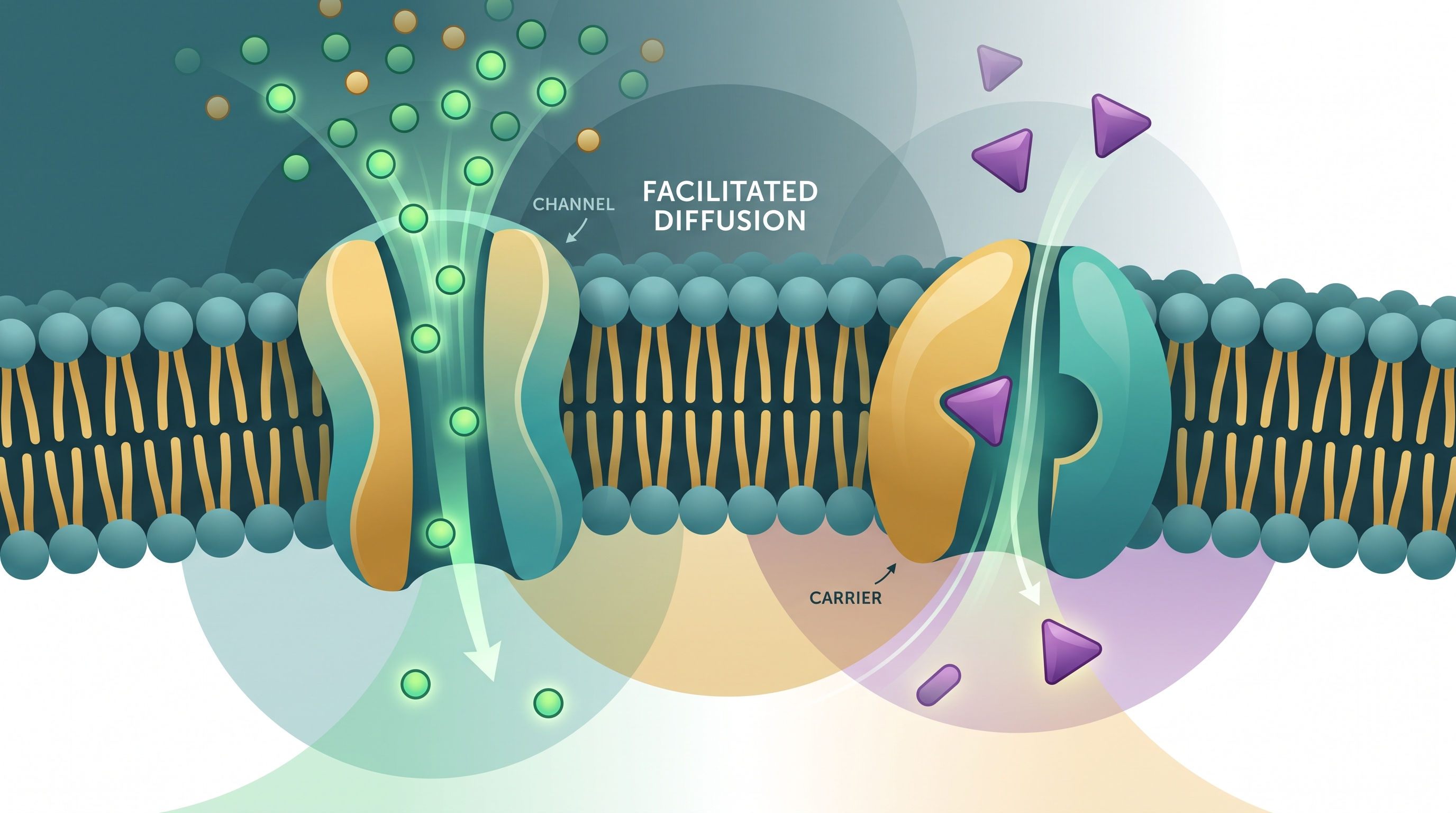
A molecule can move across a membrane without cellular energy input, yet still require a protein doorway. Facilitated diffusion is the passive movement of a substance down its concentration gradient through a membrane protein.
2.6 Facilitated Diffusion
A molecule can move across a membrane without cellular energy input, yet still require a protein doorway. Facilitated diffusion is the passive movement of a substance down its concentration gradient through a membrane protein. The protein does not push the molecule uphill; it makes a membrane crossing possible for a substance that cannot easily pass through the hydrophobic interior of the phospholipid bilayer.
Learning Objective 2.6: Explain how facilitated diffusion moves specific substances across a membrane.
Essential Knowledge 2.6.A: Facilitated diffusion allows specific substances to cross selectively permeable membranes down their concentration gradients.
Random motion creates directional net movement
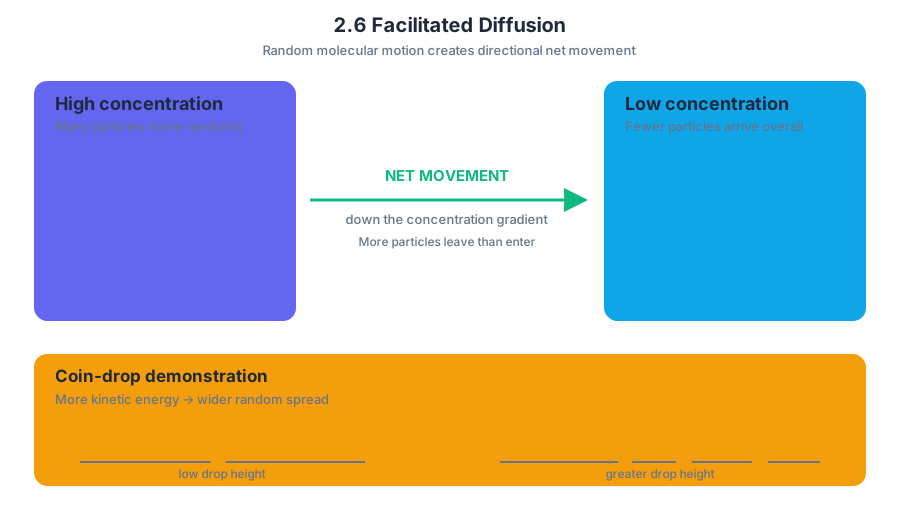
Individual particles move randomly and nondirectionally because of their kinetic energy—the energy associated with motion. If particles are more concentrated in one region, however, more particles leave that region than enter it during a given interval. The result is net movement from high concentration to low concentration, even though every individual particle continues moving randomly.
A coin-drop demonstration makes this distinction visible. Drop coins from a low height onto a table: they spread a short distance. Drop them from a greater height: the coins strike with more kinetic energy and spread farther in many directions. The spreading is not aimed outward by the coins; greater random motion produces a greater distribution.
Key distinction: Diffusion is nondirectional at the molecular level but produces directional net movement down a concentration gradient.
The concentration gradient—the difference in concentration between two regions—affects diffusion rate. A steep gradient produces faster net diffusion because the imbalance between the two sides is larger. As the concentrations become more similar, net diffusion slows. At dynamic equilibrium, molecules still move in both directions, but movement in one direction balances movement in the other.
Why facilitated diffusion needs proteins
Small nonpolar molecules can often cross the lipid bilayer directly, but ions and many polar molecules cannot cross its hydrophobic interior efficiently. Channel proteins provide hydrophilic passageways, whereas carrier proteins bind particular molecules and change shape to move them across. Both mechanisms preserve the essential features of facilitated diffusion: specificity, passive movement, and dependence on the concentration gradient.
For example, glucose is polar and relatively large. A glucose transporter can bind glucose on the side where glucose concentration is higher, change conformation, and release glucose on the lower-concentration side. If the gradient disappears, the transporter no longer produces net glucose movement in either direction; if the lower-concentration side becomes higher, net movement reverses.
Misconception check — “Facilitated” means active: It does not. Facilitated diffusion requires a membrane protein, but it does not require ATP. A protein doorway is not an energy pump.
Surface area, volume, and diffusion rate
Diffusion is faster when a structure has a large surface area-to-volume ratio, written as $\frac{SA}{V}$. Surface area provides space for exchange; volume represents the amount of material that must be supplied. As an object becomes larger without changing shape, its volume increases faster than its surface area, so diffusion becomes less effective.
For a cube with side length $s$:
$$SA = 6s^2$$
$$V = s^3$$
$$\frac{SA}{V} = \frac{6s^2}{s^3} = \frac{6}{s}$$
A cube with $s=1\ \text{cm}$ has $SA=6\ \text{cm}^2$, $V=1\ \text{cm}^3$, and $\frac{SA}{V}=6:1$. A cube with $s=2\ \text{cm}$ has $SA=24\ \text{cm}^2$, $V=8\ \text{cm}^3$, and $\frac{SA}{V}=3:1$. The larger cube has more total surface area but a lower ratio, so each unit of internal volume has less exchange surface available.
Biological exchange surfaces
Intestinal villi and root hair cells are adaptations that increase surface area for nutrient uptake. Villi project into the intestine, while root hairs extend into soil; both create extensive exchange surfaces without requiring a proportionally large increase in volume. A larger surface area can increase the number of membrane proteins available for facilitated diffusion and shorten the distance substances must travel.
In an agar investigation, differently sized artificial cells can be placed in a solution that changes color as diffusion proceeds. Students can measure the depth of the color change, calculate each object’s $\frac{SA}{V}$, and compare diffusion rate. The independent variable might be object size, the dependent variable might be diffusion depth per unit time, and temperature, agar concentration, and solution concentration should be controlled.
Dialysis tubing as a membrane model
Dialysis tubing models selective movement across a membrane. Its pores allow small ions and molecules—including water and glucose—to pass, but restrict larger molecules such as starch and proteins. Placing different solutions inside and outside the tubing allows students to test which substances cross and whether movement follows the concentration gradient.
Molarity expresses concentration as moles per liter:
$$M=\frac{\text{moles of solute}}{\text{liters of solution}}$$
For $5%$ ovalbumin, use $50\ \text{g}$ per $1\ \text{L}$ and a molecular mass of $45{,}000\ \text{g mol}^{-1}$:
$$M=\frac{50\ \text{g}}{45{,}000\ \text{g mol}^{-1}}\div 1\ \text{L}\approx 0.0011\ \text{M}$$
This calculation matters because diffusion comparisons require concentrations to be described quantitatively, not merely as “more” or “less” concentrated.
AP Biology science practices in action
This topic most directly uses Science Practice 1: Concept Explanation—especially explaining why concentration gradients produce net movement; Science Practice 2: Visual Representations—interpreting membrane diagrams and surface-area models; Science Practice 3: Questions and Methods—designing a diffusion investigation; Science Practice 4: Representing and Describing Data—graphing diffusion rate against $\frac{SA}{V}$; Science Practice 5: Statistical Tests and Data Analysis—comparing replicated treatments and identifying variation; and Science Practice 6: Argumentation—using evidence to support a claim about which factor affects diffusion.
Retrieval check: Two cells have the same volume, but Cell A has twice the surface area of Cell B. Which cell should exchange materials faster, and why? A strong answer identifies Cell A’s larger $\frac{SA}{V}$ and connects that ratio to more exchange surface per unit volume—not simply to “more membrane.”