From the free course AP Biology on Lykke
AP Practice 6
A short free-response question rewards a chain of biological reasoning: identify the pattern in the evidence, connect it to a mechanism, and justify the conclusion without claiming more than the data support.
AP Practice 6
A short free-response question rewards a chain of biological reasoning: identify the pattern in the evidence, connect it to a mechanism, and justify the conclusion without claiming more than the data support. The strongest response is not the longest one; it is the one that makes each requested claim visible and evidence-based.
Task type: Short free-response question
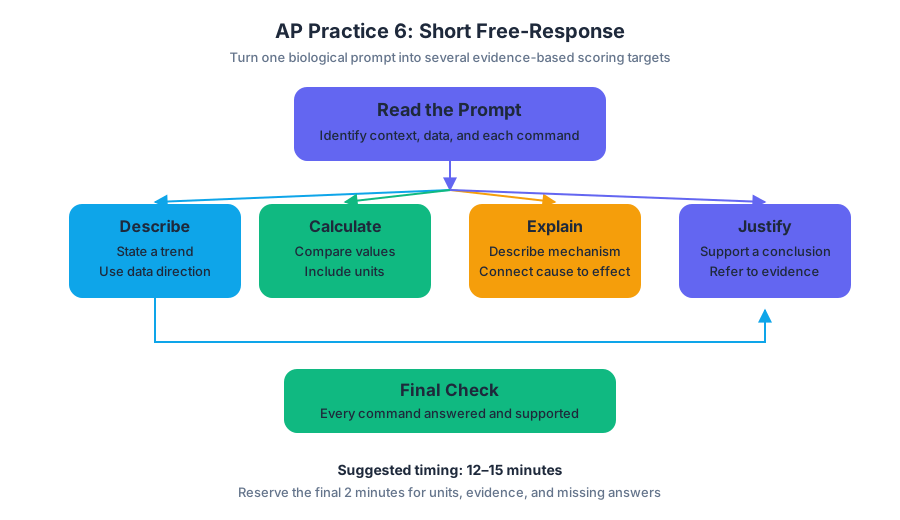
On the current AP Biology exam, a short free-response question typically combines a biological context with several focused tasks. A prompt may ask you to describe a trend, calculate or compare values, explain a mechanism, propose an investigation, or justify a conclusion. Treat each command as a separate scoring target.
Suggested timing: spend about $12$–$15$ minutes reading, reasoning, and writing. Reserve the final $2$ minutes to check that every command has an answer, every numerical result includes appropriate units, and every conclusion refers to evidence.
Original practice prompt: enzyme activity and temperature
A researcher measures the initial reaction rate of an enzyme at several temperatures. The enzyme catalyzes the breakdown of a pigment molecule.
| Temperature ($^\circ\mathrm{C}$) | Initial reaction rate ($\mu\mathrm{mol,min^{-1}}$) |
|---|---|
| $10$ | $1.8$ |
| $20$ | $3.7$ |
| $30$ | $6.1$ |
| $40$ | $4.9$ |
| $50$ | $1.2$ |
(a) Describe the relationship between temperature and initial reaction rate from $10^\circ\mathrm{C}$ to $50^\circ\mathrm{C}$.
(b) The researcher claims that the enzyme has an optimum temperature of approximately $30^\circ\mathrm{C}$. Support the claim using the data.
(c) Explain the decrease in reaction rate above $30^\circ\mathrm{C}$.
(d) Design a control for an investigation testing whether the enzyme itself, rather than the pigment substrate, causes the temperature-dependent pattern.
Worked reasoning
(a) Describe the pattern
The rate increases from $1.8\ \mu\mathrm{mol,min^{-1}}$ at $10^\circ\mathrm{C}$ to $6.1\ \mu\mathrm{mol,min^{-1}}$ at $30^\circ\mathrm{C}$. It then decreases to $4.9\ \mu\mathrm{mol,min^{-1}}$ at $40^\circ\mathrm{C}$ and $1.2\ \mu\mathrm{mol,min^{-1}}$ at $50^\circ\mathrm{C}$.
Why this earns credit: the response gives both parts of the relationship—an increase followed by a decrease—and cites values from the table. Saying only “the rate changes with temperature” is too vague.
(b) Support the optimum-temperature claim
The claim is supported because the enzyme has its greatest measured initial reaction rate, $6.1\ \mu\mathrm{mol,min^{-1}}$, at $30^\circ\mathrm{C}$. The rate is lower at both neighboring tested temperatures: $3.7\ \mu\mathrm{mol,min^{-1}}$ at $20^\circ\mathrm{C}$ and $4.9\ \mu\mathrm{mol,min^{-1}}$ at $40^\circ\mathrm{C}$.
The precise wording matters: the data support $30^\circ\mathrm{C}$ as the optimum among the temperatures tested. They do not prove that the exact optimum is $30^\circ\mathrm{C}$, because the researcher did not test temperatures between $20^\circ\mathrm{C}$ and $40^\circ\mathrm{C}$.
(c) Explain the decline at high temperature
Temperatures above approximately $30^\circ\mathrm{C}$ can disrupt the weak interactions that maintain the enzyme’s three-dimensional shape. As the active site changes shape, the substrate binds less effectively, so fewer enzyme-substrate complexes form and the reaction rate decreases. At sufficiently high temperatures, the enzyme may become denatured, meaning that its functional shape is lost.
A complete explanation connects temperature to protein structure, then to active-site function, and finally to reaction rate:
$$ \text{higher temperature} \rightarrow \text{altered enzyme shape} \rightarrow \text{reduced substrate binding} \rightarrow \text{lower reaction rate} $$
(d) Design a control
Prepare reaction mixtures containing the same pigment substrate, buffer, and volume as the experimental mixtures, but omit the enzyme. Incubate these control mixtures at the same temperatures and for the same duration as the experimental mixtures. If the pigment does not break down substantially in the enzyme-free controls, the temperature-dependent pattern in the experimental mixtures is more likely to result from enzyme activity rather than spontaneous pigment degradation.
This is a negative control: it shows what happens when the proposed causal factor—the enzyme—is absent. A strong design also keeps substrate concentration, pH, total volume, incubation time, and measurement method constant, and uses repeated trials at each temperature.
Official science practices exercised
This practice set intentionally combines the six AP Biology science practices:
- Science Practice 1: Concept Explanation — explain how temperature can alter enzyme structure and function.
- Science Practice 2: Visual Representations — interpret or construct a graph showing reaction rate as a function of temperature.
- Science Practice 3: Questions and Methods — identify an appropriate control and controlled variables.
- Science Practice 4: Representing and Describing Data — describe the increase-then-decrease pattern using values.
- Science Practice 5: Statistical Tests and Data Analysis — compare reaction rates and recognize the limitation of measuring only selected temperatures.
- Science Practice 6: Argumentation — support the optimum-temperature claim with quantitative evidence while limiting the conclusion to the tested range.
Examiner-style error check
Common error: confusing an optimum with the highest possible temperature. The optimum is the condition producing the highest measured activity, not necessarily the warmest condition.
Common error: writing a mechanism without a causal link. “High temperature denatures the enzyme” is a useful start, but the explanation should continue to the active site and substrate binding.
Common error: proposing an unrelated control. A second temperature is not a control by itself. The control must remove or alter the factor being tested while preserving the other conditions.
Common error: overclaiming. Because only five temperatures were tested, conclude that $30^\circ\mathrm{C}$ is the best tested temperature—not that it is unquestionably the exact optimum.
Retrieval check
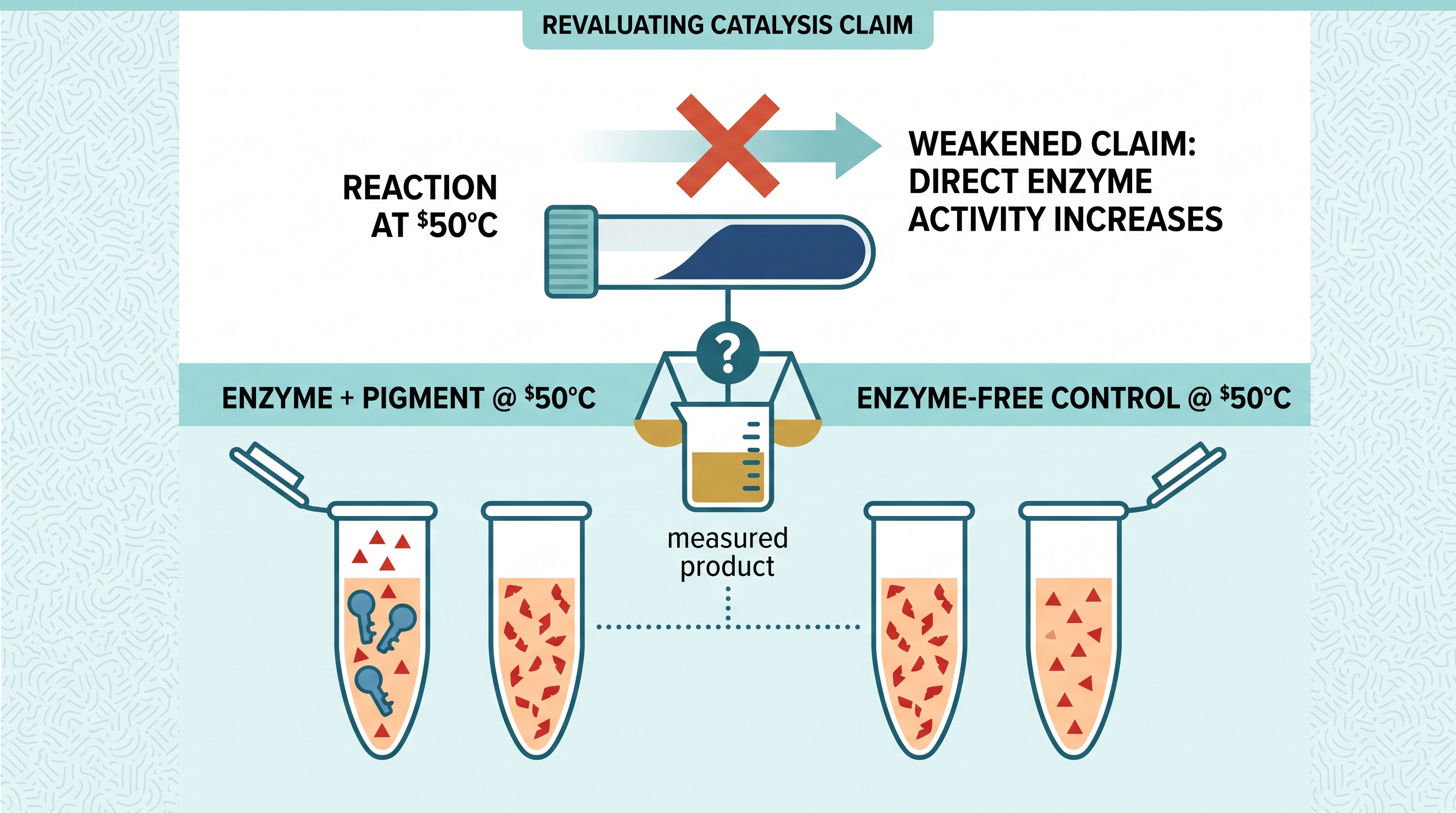
If the reaction rate were high at $50^\circ\mathrm{C}$ but the pigment also degraded rapidly in the enzyme-free control at that temperature, what would happen to the claim that temperature directly increases enzyme activity? The claim would be weakened, because the measured product could result from nonenzymatic pigment breakdown rather than catalysis by the enzyme.
Source Materials
- Ap Biology Course And Exam Description
- Ap Biology Course Overview
- Ap Biology Course At A Glance
- Ap Biology Equations And Formulas Sheet
- Chapter 3 Quantitative Skills In Ap Sciences
- Ap Biology Teacher Lab Manual Effective Fall 2019
- Updates 2025 26
- AP Biology Course-AP Central-College Board
- AP Biology-AP Students
- Biology of AP Courses-OpenStax
- AP Biology-Acellus
- AP/College Biology