From the free course AP Biology on Lykke
7.3 Artificial Selection
Key concepts: Artificial selection · Human-directed evolution · Quantitative traits · Polygenic inheritance · Phenotypic variation within a population · Directional selection across generations · Trichome production in Brassica rapa · Experimental investigation design · Data analysis and graphing · Mendelian and quantitative traits
Artificial selection occurs when humans choose individuals with a desired trait to reproduce, causing that trait to become more common in later generations. The key question is not whether an individual plant changes during its lifetime, but whether the population’s distribution of phenotypes changes after the…
7.3 Artificial Selection
Artificial selection occurs when humans choose individuals with a desired trait to reproduce, causing that trait to become more common in later generations. The key question is not whether an individual plant changes during its lifetime, but whether the population’s distribution of phenotypes changes after the selected plants produce offspring.
Investigative question: Can extreme selection change the expression of a quantitative trait in a population in one generation?
Human-directed evolution
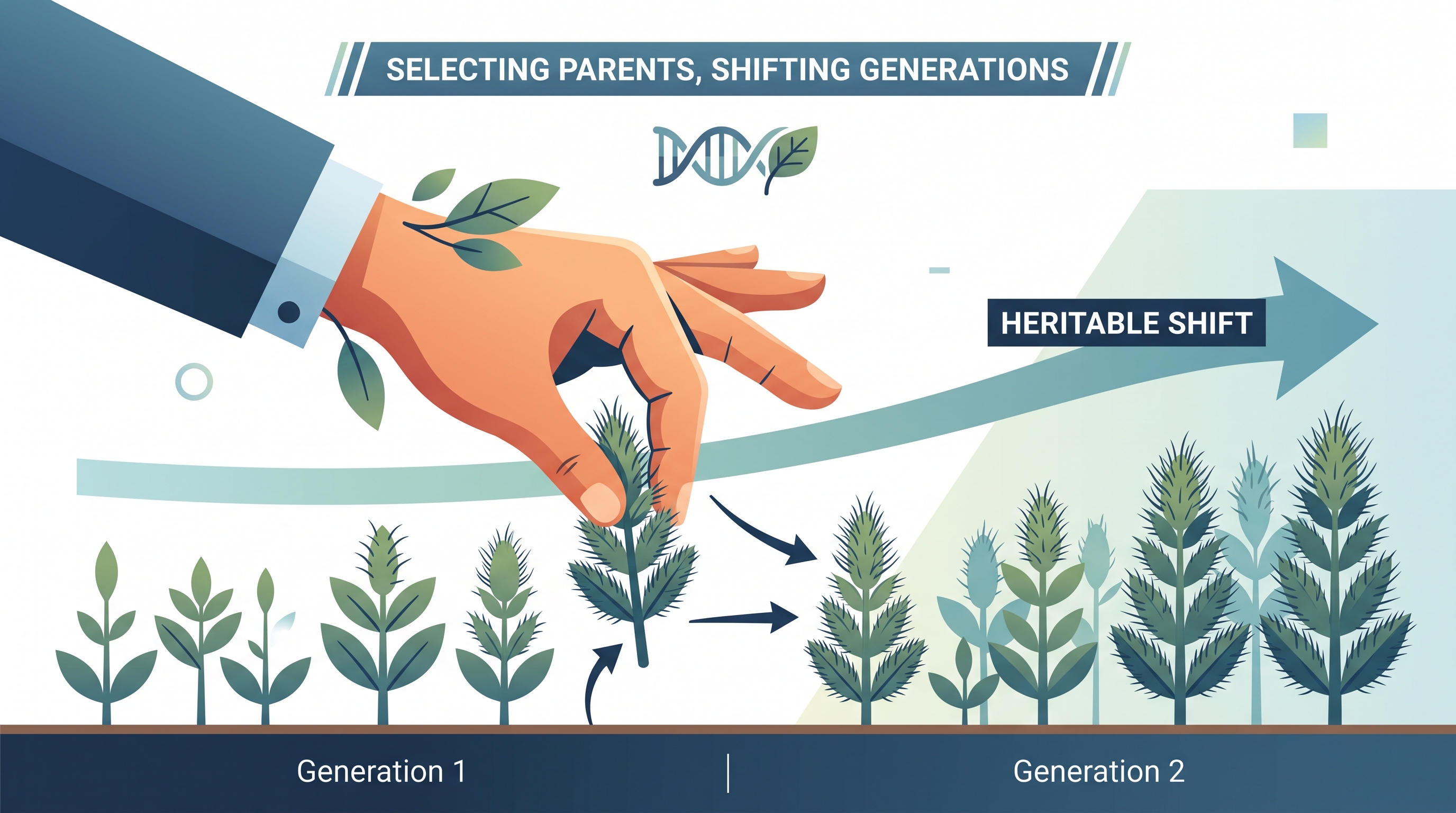
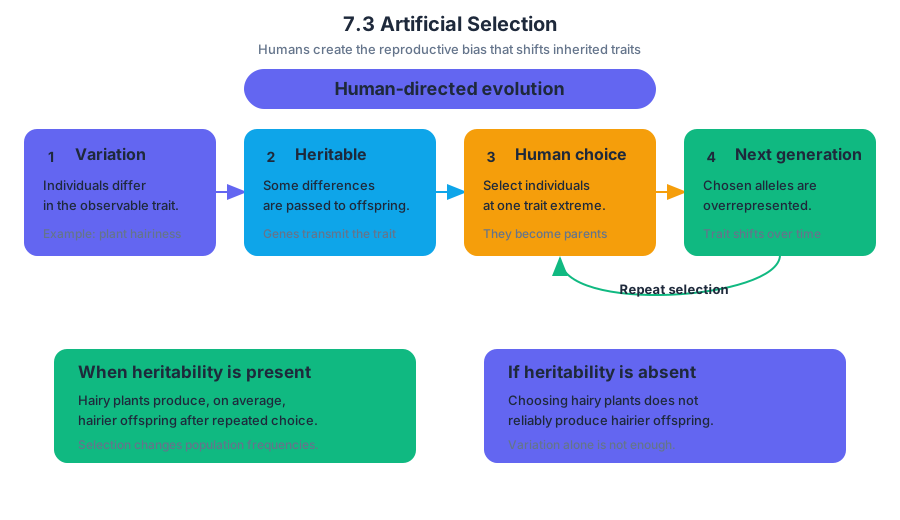
In natural environments, differences in survival or reproduction determine which heritable traits become more common. In artificial selection, humans create the reproductive bias: they identify individuals at one extreme of a trait, use those individuals as parents, and allow their offspring to form the next generation. This is human-directed evolution because allele combinations associated with the selected phenotype are represented disproportionately among breeders.
Artificial selection requires three ingredients:
- Phenotypic variation within a population: individuals differ in the observable trait.
- A heritable component: some of the variation must be transmitted genetically.
- Differential reproduction: humans choose particular individuals to become parents.
If plants differ in hairiness but hairiness has no heritable component, selecting hairy plants will not reliably produce hairier offspring. If hairiness is heritable, repeated selection can shift the population toward greater hairiness.
Quantitative traits and polygenic inheritance
A quantitative trait varies along a continuum rather than appearing in only a few discrete categories. Plant height, trichome number, and the amount of purple anthocyanin are examples. Quantitative traits are typically influenced by polygenic inheritance, meaning that multiple genes contribute to the phenotype. Environmental conditions can also affect the phenotype, so the observed trait reflects both genetic and environmental influences.
For example, one plant might have $18$ trichomes in a measured area, another $24$, and another $31$. These values form a continuous distribution rather than a simple “hairy” versus “not hairy” classification. Because many genes may contribute small effects, offspring usually resemble—but do not exactly duplicate—the selected parents.
Misconception check — “Selection creates the desired trait.”
Selection does not manufacture a new phenotype because a human wants it. It changes which existing individuals reproduce. The response depends on variation already present in the population and on whether that variation is heritable.
Fast Plant investigation: selecting hairiness
Brassica rapa Fast Plants provide a practical model for investigating artificial selection. The number of trichomes, or hair-like structures on the plant surface, can be counted as a quantitative trait. A class can begin with a large population, because reliable selection requires ample variation and enough individuals for comparison; a recommended class-level starting population is approximately $120$–$180$ plants.
Fast Plant seed stock C1-122 is useful because it displays variation in hairiness. It also contains additional observable genetic variation: the plants are heterozygous for two Mendelian traits involving green versus light-green leaves and the presence versus absence of anthocyanin, which can produce purple stems. Thus, one starting population can support an artificial-selection investigation of hairiness or stem color while also providing material for a separate Mendelian investigation.
Designing and analyzing the experiment
Begin with an observation and a question: Do plants with more trichomes differ in a life-history trait such as growth or reproduction? Define the chosen trait operationally—for example, “trichome number counted in a specified leaf region”—so every group measures the same feature. Then repeatedly select individuals with extreme values, such as the hairiest plants, cross or pollinate those individuals, and grow their offspring as the next generation.
A useful design compares the trait distribution across generations:
| Generation | Action | Data to collect |
|---|---|---|
| Starting generation | Measure many plants before selection | Trichome count for every plant |
| Parent selection | Choose individuals with extreme values | Parent identities and trait values |
| Offspring generation | Grow and measure their progeny | Trichome counts and distribution |
| Repeated generation | Select new extremes and breed again | Change in mean, range, and frequency |
Compile class data for every generation, then graph the results using a frequency distribution or another appropriate display. For example, suppose the starting population has a mean trichome count of $22$, the selected parents average $34$, and their offspring average $27$. The offspring mean has shifted toward the selected extreme, but it has not reached the parental mean. That pattern is consistent with a heritable response to selection while also showing that environmental effects and many genes influence the trait.
AP skill in action
This investigation aligns with EVO-1.F: Explain how humans can affect diversity within a population and EVO-1.G: Explain the relationship between changes in the environment and evolutionary changes in the population. Artificial selection changes the reproductive environment: human choice determines which phenotypes contribute most strongly to the next generation.
It also explicitly develops Skill 4.B: Describe data from a table or graph, within Science Practice 4, Representing and Describing Data. A strong description identifies the direction and pattern of change without overclaiming causation: “The offspring frequency distribution shifted toward higher trichome counts after hairy parents were selected.” It should cite the measured pattern, not merely say that the graph “shows evolution.”
Retrieval check
A population’s average trichome count rises from $20$ in the starting generation to $26$ in the offspring generation after the hairiest plants were selected as parents. What evidence would most strongly support artificial selection rather than a measurement artifact?
Answer: Consistent measurement procedures, adequate sample size, and a repeated shift toward higher trichome counts across generations would support artificial selection. The critical evidence is a heritable change in the population distribution, not simply that the selected parents were hairy.