From the free course AP Biology on Lykke
AP Practice 2
Key concepts: Science practices in experimental design and data analysis · Evolution, biodiversity, and the importance of genetic diversity · Cellular organelles and compartmentalization · Membrane transport and metabolic energy · Cell signaling and communication between cells · Meiosis, chromosome behavior, and crossing over · Mendelian genetics and inheritance · Chi-square hypothesis testing · Embryonic development and gene expression · Modeling biological processes such as transcription
A population survives environmental change only when some individuals carry heritable variation that gives them a chance to persist. That biological story connects chromosome behavior, Mendelian inheritance, cellular compartments, membrane transport, signaling, and the statistical tests used to decide whether…
AP Practice 2
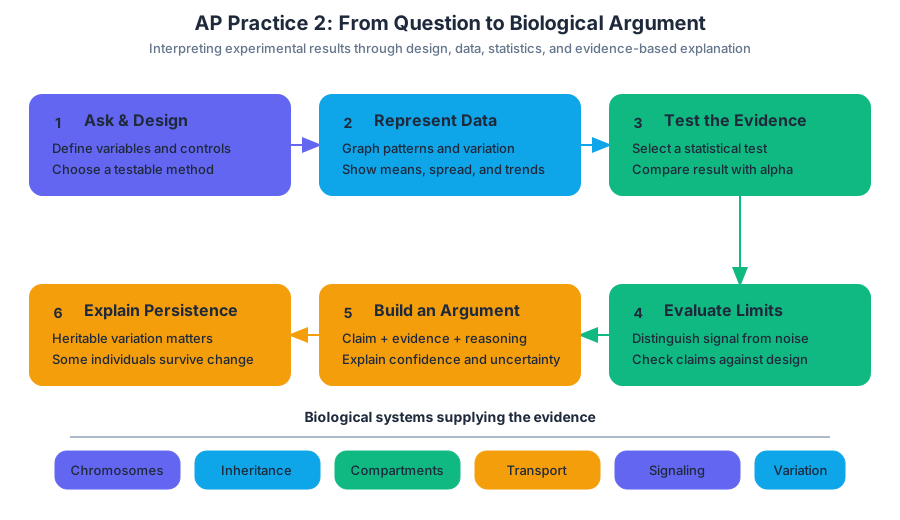
A population survives environmental change only when some individuals carry heritable variation that gives them a chance to persist. That biological story connects chromosome behavior, Mendelian inheritance, cellular compartments, membrane transport, signaling, and the statistical tests used to decide whether experimental evidence supports an explanation.
Task type: Interpreting and Evaluating Experimental Results, with integrated Science Practice 3: Questions and Methods, Science Practice 4: Representing and Describing Data, Science Practice 5: Statistical Tests and Data Analysis, and Science Practice 6: Argumentation.
Question 1 — Design the investigation before collecting data
Researchers want to test whether ATP-dependent transport helps animal cells maintain their internal ion concentration. They place equal numbers of cultured cells into solutions containing the same external ion concentration. One group receives a treatment that reduces ATP production; the control group receives an otherwise identical treatment that does not reduce ATP production. After a fixed interval, the researchers measure the average internal ion concentration in each culture.
Student tasks
- Identify the independent variable, dependent variable, control condition, and one controlled variable.
- Predict the result for the ATP-reduced group.
- Explain why the prediction is biological rather than merely descriptive.
- State a suitable null hypothesis.
- Name one design improvement that would make the conclusion stronger.
Worked reasoning
The independent variable is ATP availability or ATP-production treatment. The dependent variable is the measured internal ion concentration. The control group receives the same handling and solution but does not receive the ATP-reducing treatment. Controlled variables could include cell number, solution volume, external ion concentration, temperature, exposure time, and measurement method.
The prediction is that cells with reduced ATP production will show a smaller ability to maintain the normal internal ion concentration. Active transport moves molecules or ions against a concentration gradient and requires metabolic energy such as ATP. If ATP-dependent transport decreases, ions may no longer be moved across the membrane at the normal rate, allowing the internal concentration to shift.
A suitable null hypothesis is: Reducing ATP production has no effect on the mean internal ion concentration compared with the control treatment. The hypothesis is tied directly to the experimental variables; it is not the vague claim that “nothing happens.”
A stronger design would use several independent cultures per treatment, randomize their positions, and repeat the experiment across multiple trials. Replication helps distinguish a treatment effect from random variation, while randomization reduces the possibility that position, handling order, or another hidden variable explains the pattern.
Question 2 — Analyze data and distinguish correlation from causal support
The researchers obtain the following internal ion-concentration data, measured in arbitrary concentration units:
| Treatment | Replicate measurements | Mean |
|---|---|---|
| Control | $9.8,\ 10.1,\ 10.0,\ 9.9,\ 10.2$ | $10.0$ |
| Reduced ATP | $7.1,\ 7.5,\ 7.2,\ 7.4,\ 7.3$ | $7.3$ |
Student tasks
- Describe the pattern in the data, including variation within each treatment.
- Calculate the percent decrease in mean internal ion concentration.
- Explain how the results support the role of ATP in active transport.
- Explain why the result is stronger than a simple correlation but does not prove that ATP directly transports the ions.
- Predict what would happen if ATP production were restored.
Worked reasoning
The control measurements cluster closely around $10.0$, ranging from $9.8$ to $10.2$. The reduced-ATP measurements also cluster relatively closely, ranging from $7.1$ to $7.5$, but their entire range lies below the control range. The separation between group means is therefore much larger than the variation among replicates within either group.
The percent decrease is
$$ \frac{10.0-7.3}{10.0}\times 100 = 27%. $$
The reduced-ATP cells maintained an average ion concentration approximately $27%$ lower than the control cells. Because the researchers deliberately changed ATP availability while holding other conditions as constant as possible, the result provides causal support for the claim that ATP-dependent processes are needed to maintain the ion gradient.
This is stronger than correlation because ATP availability was experimentally manipulated. However, the treatment could affect several ATP-dependent cellular processes, not only the transport protein itself. The data support the causal explanation that ATP availability is required for normal maintenance of the ion concentration, but they do not demonstrate that ATP physically carries ions through the membrane.
If ATP production were restored, ion concentrations would be predicted to move back toward the control value, provided that the transport proteins and membranes were not permanently damaged. A follow-up “rescue” treatment would test that prediction.
Examiner-rewarded reasoning: identify a numerical trend, connect ATP to active transport, distinguish manipulation from observation, and avoid claiming more than the experiment establishes.
Question 3 — Organelles, compartmentalization, and transport
A protein destined for secretion is synthesized on ribosomes associated with the rough endoplasmic reticulum. It is transported in vesicles to the Golgi apparatus, a membrane-bound structure consisting of a series of flattened membrane sacs. The Golgi modifies, sorts, and packages the protein for delivery to its final destination.
Mitochondria have a double membrane, creating compartments with different chemical conditions and functions. Internal membranes also increase the surface area available for reactions and minimize competing interactions between pathways. These compartments are not decorative walls: they make incompatible or specialized reactions possible in the same cell.
Student tasks
- Predict one consequence of disrupting Golgi membranes.
- Explain why the mitochondrial double membrane supports ATP production.
- Compare vesicle transport with active transport across the plasma membrane.
- Predict the effect of blocking ATP production on an ion pump.
Worked reasoning
Disrupting Golgi membranes would be expected to interfere with protein modification, sorting, or packaging. A secreted protein might be synthesized but fail to reach the correct cellular destination.
The mitochondrial double membrane separates regions where different steps of energy conversion occur. This separation permits the cell to establish chemical gradients across a membrane and use those gradients to produce ATP. If the membranes became freely permeable, the gradient would dissipate and ATP production would decrease.
Vesicle transport moves a membrane-enclosed package through the cytoplasm, whereas active transport moves specific molecules or ions across a membrane using energy. Both are organized cellular processes, but they are not interchangeable mechanisms.
Blocking ATP production would reduce the activity of an ion pump that moves ions against their concentration gradient. The pump would not necessarily stop every membrane movement: passive diffusion can continue, but the cell would lose the energy-dependent process that maintains unequal ion concentrations.
Misconception check — “All transport requires ATP.” Passive diffusion and facilitated diffusion do not directly require ATP because substances move down an electrochemical gradient. Active transport requires metabolic energy because it moves substances against that gradient.
Question 4 — Cell signaling across distance
Signals released by one cell type can travel long distances to target cells of another type. A signaling molecule may circulate through a body, but only cells with the appropriate receptor respond. The receptor converts the external signal into an intracellular change, such as altered enzyme activity or gene expression.
Student task
Predict the result if a target cell produces no functional receptor for the signal, and explain why neighboring nontarget cells may remain unaffected.
Worked reasoning
The target cell would fail to initiate the normal response because signal binding and signal transduction require a functional receptor. Nontarget cells may remain unaffected even when exposed to the same circulating molecule because they lack the receptor or the downstream pathway needed to interpret the signal.
A useful experimental test would compare cells with a functional receptor, cells with a receptor-blocking treatment, and untreated controls. Measuring a downstream response would connect receptor function to cellular behavior.
Question 5 — Meiosis, crossing over, and Mendelian inheritance
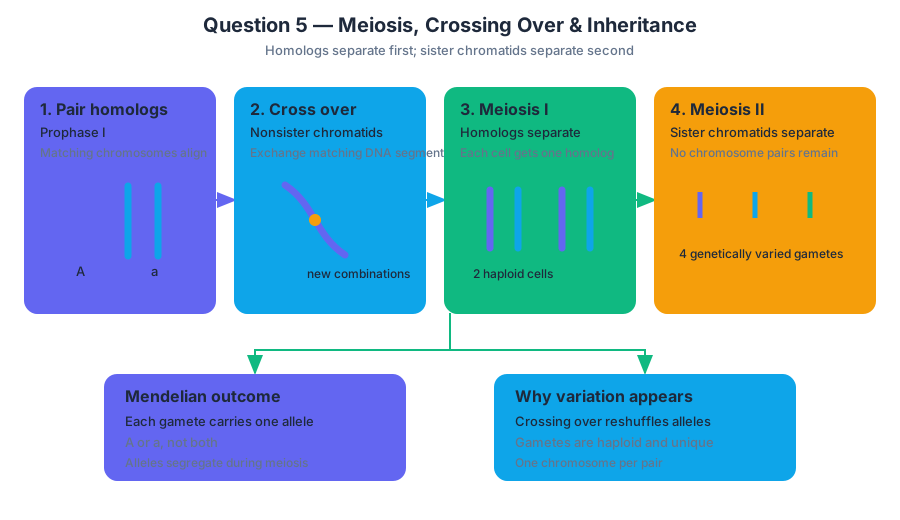
A diploid organism has homologous chromosomes carrying alleles $A$ and $a$. During meiosis, homologous chromosomes pair during prophase I. Crossing over can exchange corresponding DNA segments between nonsister chromatids. Homologs then separate in meiosis I; sister chromatids separate in meiosis II. The final products are haploid because each contains one chromosome from each homologous pair.
Student tasks
- Predict the haploid allele products of meiosis for an organism with genotype $Aa$.
- Identify the mistake if homologous chromosomes separate during meiosis II instead of meiosis I.
- For a cross between $Aa$ and $Aa$, calculate the genotypic and phenotypic ratios when $A$ is completely dominant.
- Explain how meiosis and crossing over contribute to biodiversity and population resilience.
Worked reasoning
An $Aa$ organism produces haploid gametes carrying either $A$ or $a$. Under ordinary segregation, approximately half the gametes carry $A$ and half carry $a.
If homologous chromosomes fail to separate during meiosis I, both homologs may enter the same daughter cell. This produces cells with abnormal chromosome numbers after meiosis. Confusing homolog separation with sister-chromatid separation is a common error: homologs separate in meiosis I, while sister chromatids separate in meiosis II.
The cross is
$$ Aa \times Aa. $$
Each parent produces gametes $A$ and $a$. The possible offspring are $AA$, $Aa$, $Aa$, and $aa$. Therefore, the genotypic ratio is
$$ 1\ AA : 2\ Aa : 1\ aa, $$
while the phenotypic ratio is
$$ 3\ \text{dominant phenotype} : 1\ \text{recessive phenotype}. $$
The genotypic ratio counts allele combinations; the phenotypic ratio counts observable traits. A dominant allele is expressed in a heterozygote, but “dominant” does not mean more common, stronger, or better.
Mutation introduces new alleles, while independent assortment, crossing over, and fertilization rearrange existing alleles. A diverse gene pool is vital because environmental conditions change: if a new pathogen, temperature pattern, or food shortage affects a population, genetically diverse populations are more likely to contain individuals with traits that permit survival and reproduction.
Question 6 — Chi-square hypothesis testing
A researcher crosses two heterozygous organisms and observes $78$ offspring with the dominant phenotype and $22$ with the recessive phenotype. The researcher expects a $3:1$ phenotypic ratio.
Student tasks
- State the null hypothesis.
- Calculate the expected counts.
- Calculate $\chi^2$.
- Determine the degrees of freedom.
- Using a critical value of $3.84$ at $p=0.05$, decide whether to reject or fail to reject the null hypothesis.
- State the biological conclusion.
Worked reasoning
The null hypothesis is that the observed offspring numbers are consistent with the expected $3:1$ phenotypic ratio and that deviations are caused by chance.
There are $100$ total offspring. The expected dominant count is
$$ E_{\text{dominant}}=\frac{3}{4}(100)=75, $$
and the expected recessive count is
$$ E_{\text{recessive}}=\frac{1}{4}(100)=25. $$
Using
$$ \chi^2=\sum \frac{(o-e)^2}{e}, $$
the calculation is
$$ \chi^2= \frac{(78-75)^2}{75} + \frac{(22-25)^2}{25}
\frac{9}{75}+\frac{9}{25}
0.12+0.36
0.48. $$
There are two outcome categories, so
$$ df=2-1=1. $$
Because $0.48<3.84$, the researcher fails to reject the null hypothesis. The observed data do not differ significantly from the expected $3:1$ ratio at the $p=0.05$ threshold. This does not prove that the ratio is exactly $3:1$; it means the observed deviation is plausibly explained by random sampling variation.
Chi-square testing also applies beyond genetics, but it is not automatically appropriate for every data set. The investigator must match the test to the type of data and the hypothesis. A strong investigation chooses the statistical method before data collection, considers sample size and possible errors, and clearly connects the null hypothesis to the experimental variables.
Communication and model-building
Scientific reasoning includes communicating how a model produces a prediction. Students can model transcription with pool noodles representing DNA strands or RNA, then use labeled sketches or photographs to document the biological stages. The model is useful only when its parts and limitations are explained: a pool noodle can represent a strand, but it cannot reproduce molecular interactions or enzyme specificity.
Retrieval check
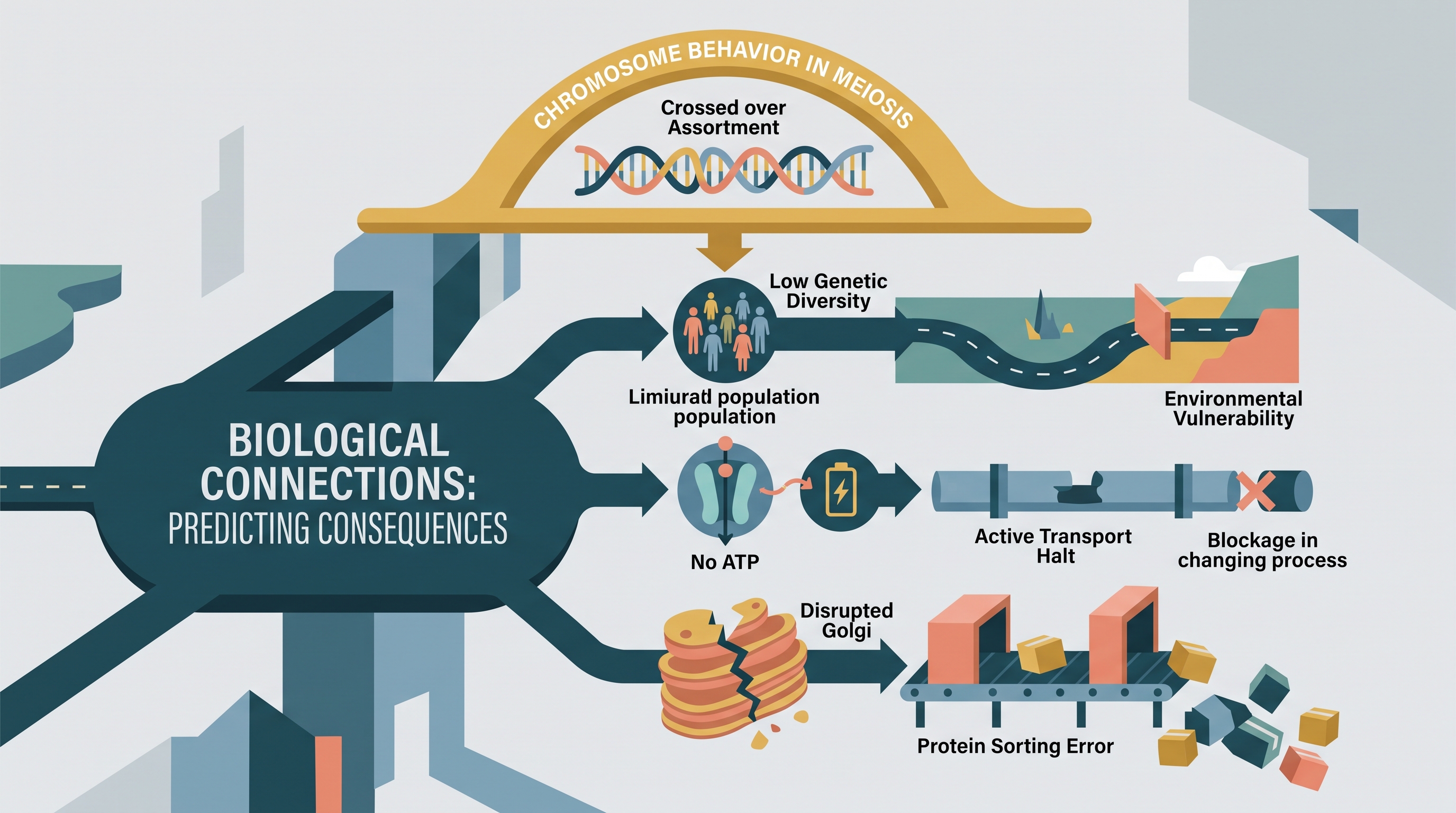
A population has low genetic diversity, an ion pump loses access to ATP, and a cell’s Golgi apparatus is disrupted. Predict one consequence of each change, then identify which prediction depends most directly on chromosome behavior during meiosis. A complete response should connect genetic diversity to changing environments, ATP to active transport, Golgi structure to protein sorting, and homolog separation plus crossing over to inherited variation.
Source Materials
- Ap Biology Course And Exam Description
- Ap Biology Course Overview
- Ap Biology Course At A Glance
- Ap Biology Equations And Formulas Sheet
- Chapter 3 Quantitative Skills In Ap Sciences
- Ap Biology Teacher Lab Manual Effective Fall 2019
- Updates 2025 26
- AP Biology Course-AP Central-College Board
- AP Biology-AP Students
- Biology of AP Courses-OpenStax
- AP Biology-Acellus
- AP/College Biology