From the free course AP Biology on Lykke
4.6 Regulation of Cell Cycle
Key concepts: Cell cycle regulation · Cyclins and cyclin-dependent kinases (CDKs) · Cell-cycle checkpoints · G1/S transition checkpoint · G2/M transition checkpoint · Metaphase/anaphase spindle checkpoint · Cell-cycle arrest and the G0 phase · Growth factors and cell-cycle progression · Disruptions of cell-cycle regulation · Cancer cells and abnormal cell division
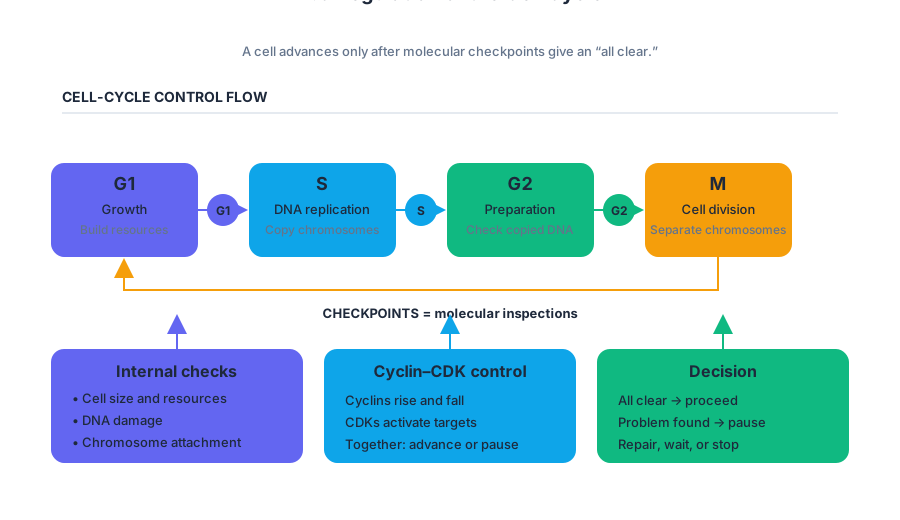
A cell does not divide merely because it has reached the end of its growth phase: it divides only when internal checkpoints and regulatory proteins indicate that division is safe and useful.
4.6 Regulation of Cell Cycle
A cell does not divide merely because it has reached the end of its growth phase: it divides only when internal checkpoints and regulatory proteins indicate that division is safe and useful. Cell-cycle regulation is the control system that coordinates growth, DNA replication, chromosome distribution, and cell division.
Learning Objective 4.6.A: Describe the role of checkpoints in regulating the cell cycle.
Essential Knowledge 4.6.A.1: A number of internal controls or checkpoints regulate progression through the cell cycle.
Essential Knowledge 4.6.A.2: Interactions between cyclins and cyclin-dependent kinases control the cell cycle.
A useful mental model is an airport: a plane cannot proceed to takeoff simply because it has reached the runway. It must pass inspections for fuel, damage, weather, and equipment. Likewise, a cell pauses at several checkpoints until it receives the molecular equivalent of “all clear.”
Cyclins and CDKs: the molecular timing system
Cyclins are regulatory proteins whose concentrations rise and fall during the cell cycle. Cyclin-dependent kinases, or CDKs, are enzymes that become active when associated with cyclins. Together, cyclins and CDKs activate or modify other proteins involved in moving the cell from one phase to the next.
The changing amount of cyclin provides timing. A cyclin may accumulate until enough is present to activate its associated CDK; after the transition occurs, the cyclin is broken down, reducing that signal. The cell therefore does not use one permanent “division switch.” It uses changing combinations of regulatory proteins to make progression conditional and ordered.
The transition from $G_2$ into mitosis is regulated by cyclin-dependent activity, including MPF, commonly described as a maturation-promoting or M-phase-promoting factor. MPF activity helps initiate the events of mitosis, but the important AP Biology idea is the general mechanism: cyclin-dependent activity promotes a cell-cycle transition only when the regulatory conditions are satisfied.
Scope boundary: Knowledge of specific cyclin-CDK pairs or growth factors is beyond the scope of the AP Exam. Focus on the interaction between cyclins, CDKs, and checkpoint control rather than memorizing pair names.
Misconception check — “Cyclins make the cell divide by themselves.” Cyclins are not independent on/off switches. Their interaction with CDKs produces regulatory activity, and that activity affects other proteins. A change in cyclin concentration can alter the timing of a transition, but the cell’s decision also depends on checkpoint signals and the condition of the cell.
Three checkpoints, three questions
Each major checkpoint asks a different biological question. A failure at one checkpoint can delay the cycle, stop it temporarily, send the cell into a nondividing state called $G_0$, or contribute to abnormal division if the control system is damaged.
| Checkpoint | Main question | If conditions fail |
|---|---|---|
| $G_1/S$ transition | Is the cell large enough, undamaged, and in a suitable environment to replicate DNA? | Arrest, repair, or entry into $G_0$ |
| $G_2/M$ transition | Has DNA replication finished accurately, and is the cell ready for mitosis? | Arrest and repair |
| Metaphase/anaphase spindle checkpoint | Are chromosomes correctly attached to spindle fibers before sister chromatids separate? | Delay in chromosome separation |
$G_1/S$ transition checkpoint
The $G_1/S$ checkpoint evaluates cell size, DNA damage or mutations, and whether environmental conditions support DNA replication. Entering $S$ phase commits the cell to copying its DNA, so beginning replication when the cell is too small, damaged, or poorly supplied could produce defective daughter cells.
For example, if DNA damage is detected before $S$ phase, checkpoint signaling can pause progression. The cell may repair the DNA; if the damage cannot be managed, the cell may remain arrested or undergo apoptosis, a form of programmed cell death.
$G_2/M$ transition checkpoint
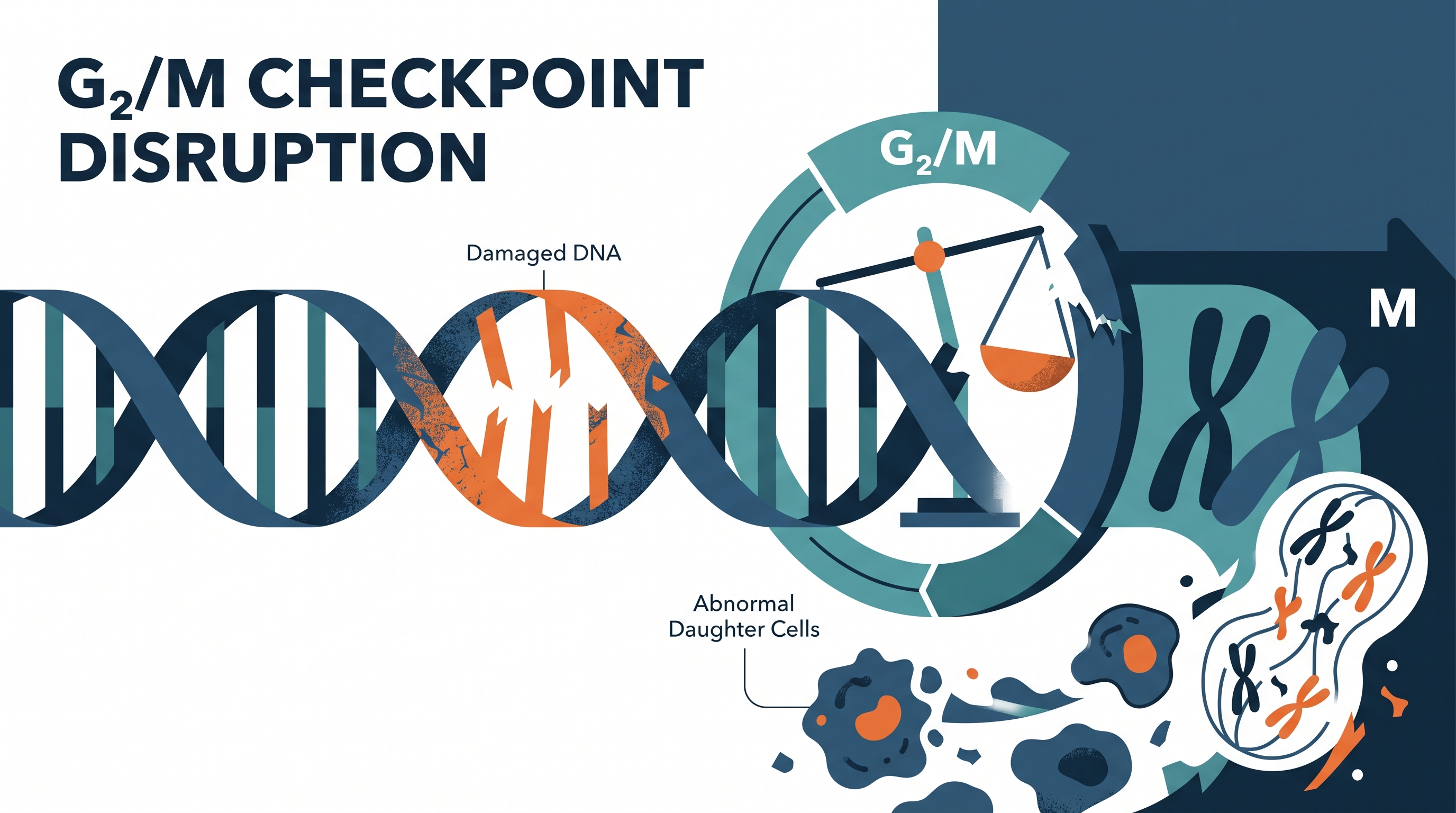
The $G_2/M$ checkpoint evaluates whether DNA replication is complete, whether the DNA contains damage or mutations, and whether the cell is large enough to divide. Only after these conditions are acceptable should cyclin-dependent activity, including MPF activity, promote entry into mitosis.
This checkpoint prevents a cell from distributing incomplete or damaged chromosomes to daughter cells. A cell with duplicated DNA is not automatically ready for mitosis; replication must be complete and the genetic material must be sufficiently intact.
Metaphase/anaphase spindle checkpoint
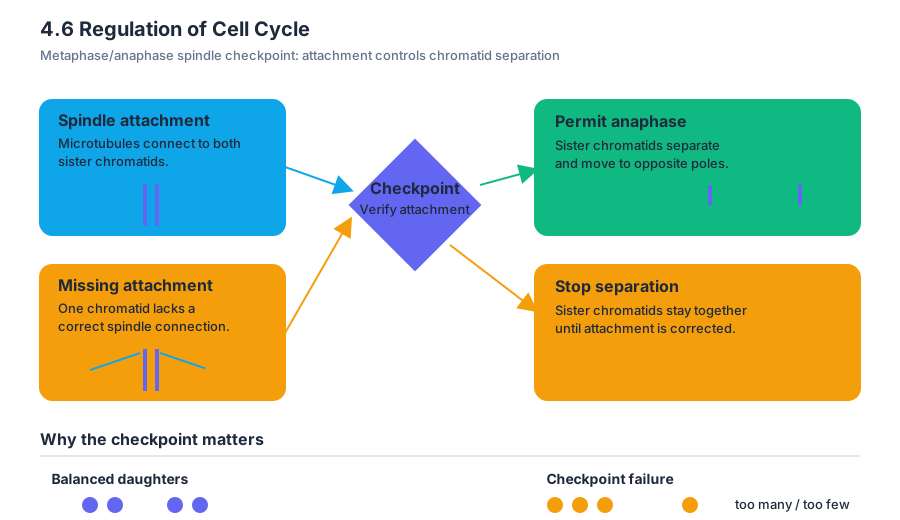
The metaphase/anaphase spindle checkpoint verifies that chromosomes are properly attached to spindle fibers, which are microtubule structures that move chromosomes during mitosis. If a chromosome is not correctly attached, sister chromatids should not separate.
This control reduces the risk that one daughter cell receives too many chromosomes while the other receives too few. Such unequal chromosome distribution can impair cell function and is especially dangerous when checkpoint failure occurs repeatedly.
When regulation fails
Learning Objective 4.6.B: Describe the effects of disruptions to the cell cycle on the cell or organism.
Essential Knowledge 4.6.B.1: Disruptions to the cell cycle may result in cancer or apoptosis (programmed cell death).
Normal cells generally require appropriate internal conditions and external signals before progressing. Cancer cells may lose these restraints: mutations in tumor-suppressor genes such as $p53$ or Rb can impair checkpoint responses, allowing cells with damaged DNA or abnormal chromosome behavior to continue dividing.
The result is not simply “more growth.” Uncontrolled division can produce a tumor, disrupt tissue organization, and increase the chance of additional mutations. By contrast, a functioning checkpoint may stop a damaged cell or direct it toward apoptosis, protecting the organism by removing a potentially harmful cell.
Environmental and biological factors can also change the rate of mitosis without necessarily destroying the entire regulatory system. In plant roots, for instance, soil salinity, soil pH, or interactions with organisms such as roundworms may increase or decrease root growth by altering the rate of cell division.
Worked example: predicting a checkpoint disruption
Suppose a mutation prevents a cell from responding to DNA damage at the $G_2/M$ checkpoint. The correct prediction is not merely “the cell divides faster.” The immediate consequence is that the cell may enter mitosis even though its DNA is damaged or incompletely replicated; the later consequence may be abnormal daughter cells, further mutations, cell death, or uncontrolled proliferation.
This is Skill 6.E — Predict the causes or effects of a change in, or a disruption to, one or more components in a biological system based on a biological concept or model. The reasoning chain is:
- Identify the disrupted component: the $G_2/M$ checkpoint response.
- State the normal function: block mitotic entry until DNA replication and integrity are acceptable.
- Remove that function: damaged or incomplete DNA can proceed into mitosis.
- Predict the biological outcome: abnormal chromosome transmission, apoptosis, or increased risk of cancer.
Retrieval check: A cell has completed DNA replication, but one chromosome is not attached to spindle fibers. Which checkpoint should delay progression, and why? The metaphase/anaphase spindle checkpoint should delay sister-chromatid separation because chromosome attachment has not been verified. A response that instead cites the $G_1/S$ checkpoint has confused the timing and purpose of the checkpoints.