From the free course AP Biology on Lykke
1.5 Lipids
A lipid’s behavior depends less on a single “lipid building block” than on how its subcomponents are assembled. Because lipids are typically nonpolar, they do not mix readily with water; this hydrophobic behavior helps organisms store energy and build boundaries between watery environments.
Learning Objective 1.5.A: Describe the structure and function of lipids.
Essential Knowledge 1.5.A.1: Lipids are typically nonpolar, hydrophobic molecules whose structure and function are derived from the way their subcomponents are assembled.
Why oil stays separate from water
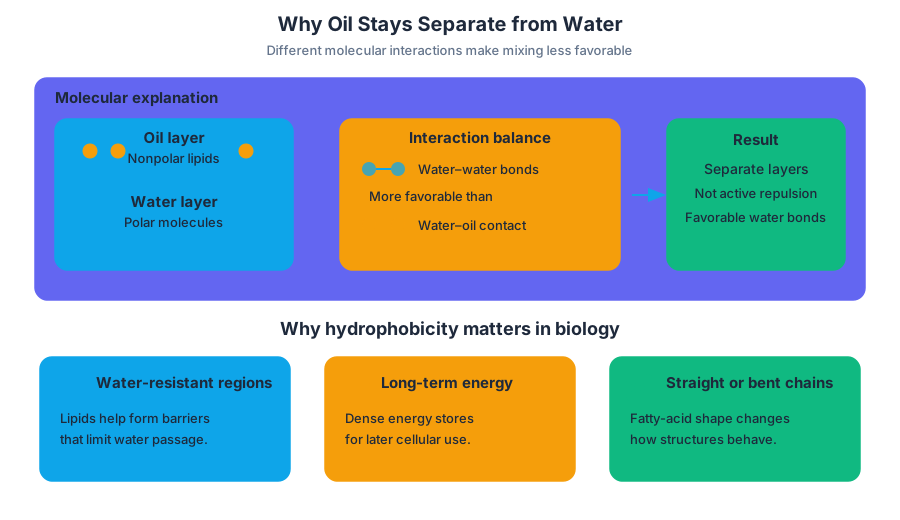
When cooking oil is poured into water, the two liquids form separate layers. Water molecules interact strongly with one another, while the nonpolar lipid molecules do not form comparable interactions with water. The result is not that oil is “repelled” by an active force; rather, water-water interactions are more favorable than mixing water with nonpolar molecules.
This hydrophobic property is biologically useful. Lipids can form water-resistant regions, serve as long-term energy stores, and contribute to structures whose behavior depends on whether their fatty-acid components are straight or bent.
Fatty acids: saturated versus unsaturated
A fatty acid is a hydrocarbon chain with a carboxyl group at one end. Its carbon-carbon bonding pattern determines whether it is saturated or unsaturated.
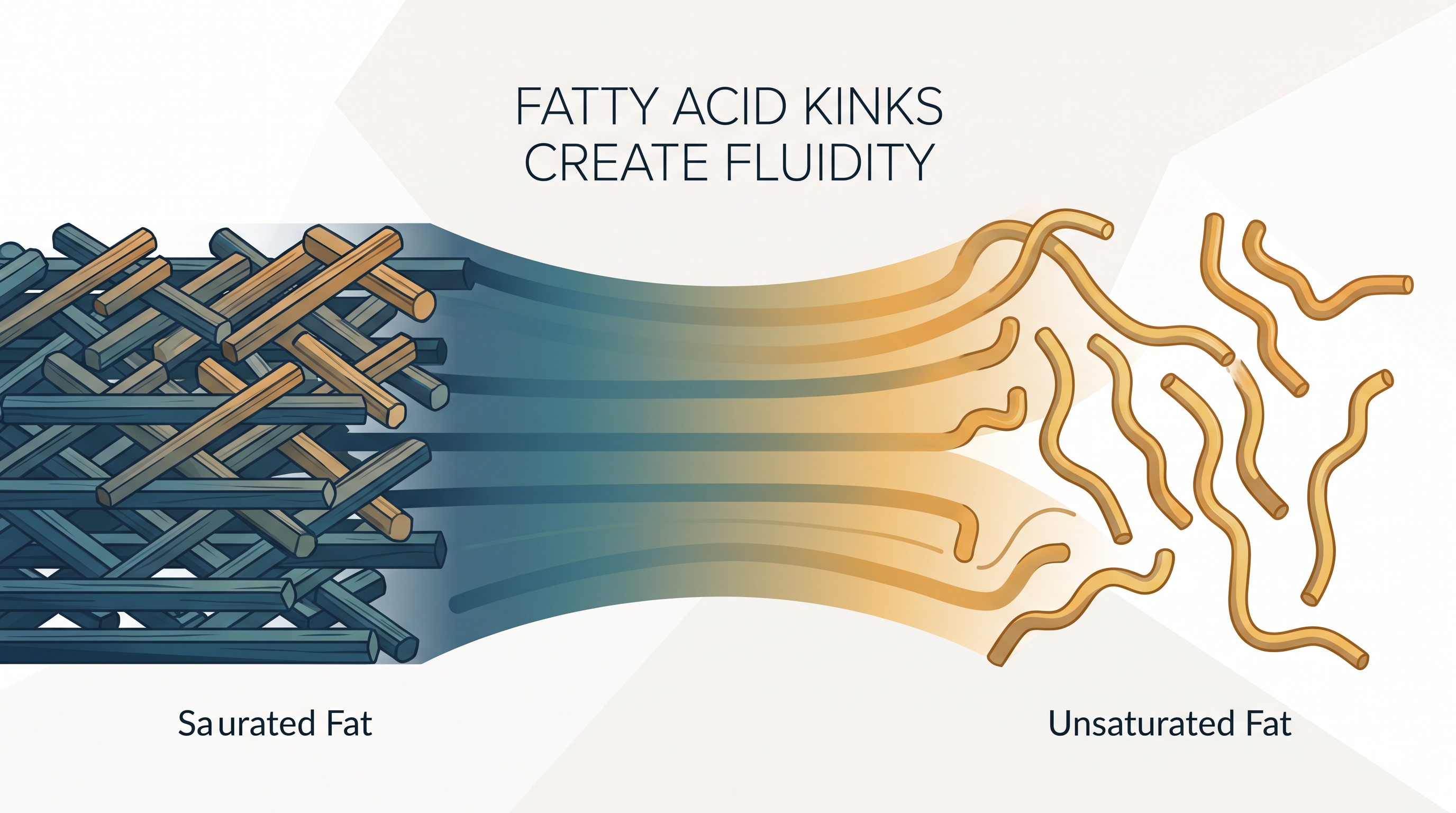
- Saturated fatty acids contain only single bonds between carbon atoms. Their chains remain relatively straight, allowing neighboring molecules to pack closely.
- Unsaturated fatty acids contain one or more carbon-carbon double bonds. A cis double bond introduces a bend, or kink, into the chain.
- The more unsaturated a lipid is, the more likely it is to remain liquid at room temperature.
The word saturated refers to hydrogen saturation: with only single carbon-carbon bonds, the chain holds as many hydrogen atoms as its carbon skeleton permits. A double bond reduces the number of attached hydrogens, making the fatty acid unsaturated.
Worked example: butter and olive oil
Suppose butter is firm on a kitchen counter while olive oil remains liquid. A useful explanation begins with structure rather than memorized food labels:
- Butter contains a greater proportion of fatty acids with straight, saturated chains.
- Straight chains can pack closely together.
- Close packing strengthens the collective attractions among lipid molecules.
- More energy is therefore required to disrupt the organized arrangement, so the material tends to be solid at room temperature.
- Olive oil contains a greater proportion of unsaturated fatty acids.
- Cis double bonds create kinks that interfere with close packing.
- The less efficiently packed molecules remain more mobile, so the lipid is more likely to be liquid at room temperature.
The key prediction is not simply “plant oils are liquid” or “animal fats are solid.” The stronger reasoning is: more unsaturated fatty-acid chains produce poorer packing and greater fluidity. This same structure-function logic becomes important when lipid molecules are assembled into biological membranes.
One structure, different behavior
Lipids are not one uniform substance. Their functions emerge from the arrangement of their subcomponents. Long hydrocarbon-rich regions make a molecule strongly nonpolar, while the presence and placement of double bonds alter chain shape, packing, and physical state.
| Fatty-acid structure | Chain shape | Packing | Expected physical behavior |
|---|---|---|---|
| Only single bonds | Relatively straight | Close | More likely solid |
| One or more double bonds | One or more bends may occur | Less close | More likely liquid |
| Greater unsaturation | More disrupted shape | Less efficient | Greater fluidity |
Misconception check: “All lipids are fats”
Misconception: Every lipid is a stored-fat molecule, and “lipid” and “fat” mean exactly the same thing.
Correction: Lipids are a broad group of typically nonpolar, hydrophobic molecules. Their shared feature is their chemical behavior and structure, not one identical shape or one single function. The structure of each lipid—and the way its subcomponents are assembled—helps determine whether it functions primarily in energy storage, water resistance, or cellular structure.
AP Biology reasoning in this topic
This topic is especially suited to Science Practice 2.A: Describe characteristics of visual representations of biological concepts and processes. On a molecular diagram, identify carbon chains, single bonds, double bonds, and the kink associated with a cis double bond. Then connect the visible shape to packing and fluidity rather than merely naming the molecule.
It also develops Science Practice 6.E: Predict the causes or effects of a change in, or disruption to, one or more components in a biological system. For example, increasing the proportion of unsaturated fatty acids should make a lipid mixture more fluid at room temperature because the added kinks reduce close packing.
Retrieval check
A lipid mixture changes from mostly saturated fatty acids to mostly unsaturated fatty acids. Predict its room-temperature state and explain the molecular cause in one sentence.
Answer: It should become more liquid because double bonds—especially cis double bonds—bend fatty-acid chains, reduce close packing, and increase fluidity.