From the free course AP Biology on Lykke
2.1 Cell Structure and Function
Key concepts: Cellular membranes and their role in separating internal and external environments · Phospholipid bilayers in plasma and cell membranes · Hydrophobic/nonpolar, hydrophilic/polar, and ionic chemical properties · Fats as energy-storage molecules that support cell function · Steroids as hormones involved in growth, development, energy metabolism, and homeostasis · Cholesterol as a structural component that stabilizes animal cell membranes · Organelles and their contributions to cellular structure and function · Chloroplasts as double-membrane organelles where photosynthesis occurs · Mitochondrial folds and efficient ATP synthesis · Biological systems using energy and molecular building blocks to grow, reproduce, and maintain dynamic homeostasis
A cell survives because its membrane creates a controlled boundary: it separates the cell’s internal environment from the external environment while still allowing selected substances to cross.
2.1 Cell Structure and Function
A cell survives because its membrane creates a controlled boundary: it separates the cell’s internal environment from the external environment while still allowing selected substances to cross. That boundary is not a rigid wall; it is a dynamic, lipid-based surface whose chemical properties determine which molecules interact with it, enter it, or remain outside.
Learning Objective 2.1.A: Describe the structure and function of cells.
Essential Knowledge 2.1.A.1–2.1.A.2: Cell structures are related to their functions, and differences between prokaryotic and eukaryotic cells reflect different levels of internal organization.
Membranes as selective boundaries
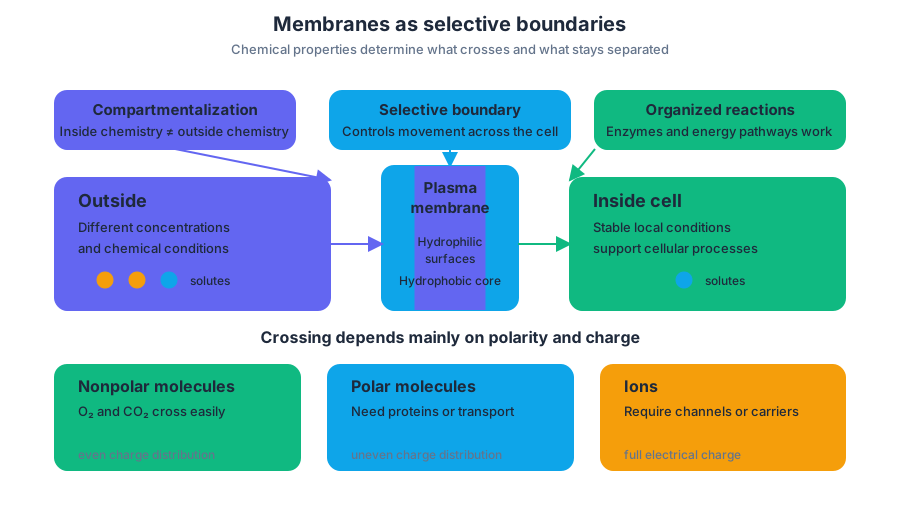
The plasma membrane is the cell’s outer boundary. Its central job is compartmentalization, meaning that it keeps the chemistry inside a cell different from the chemistry outside. This separation makes cellular processes possible: enzymes can operate at appropriate concentrations, ions can be distributed unevenly, and energy-converting reactions can occur in organized locations.
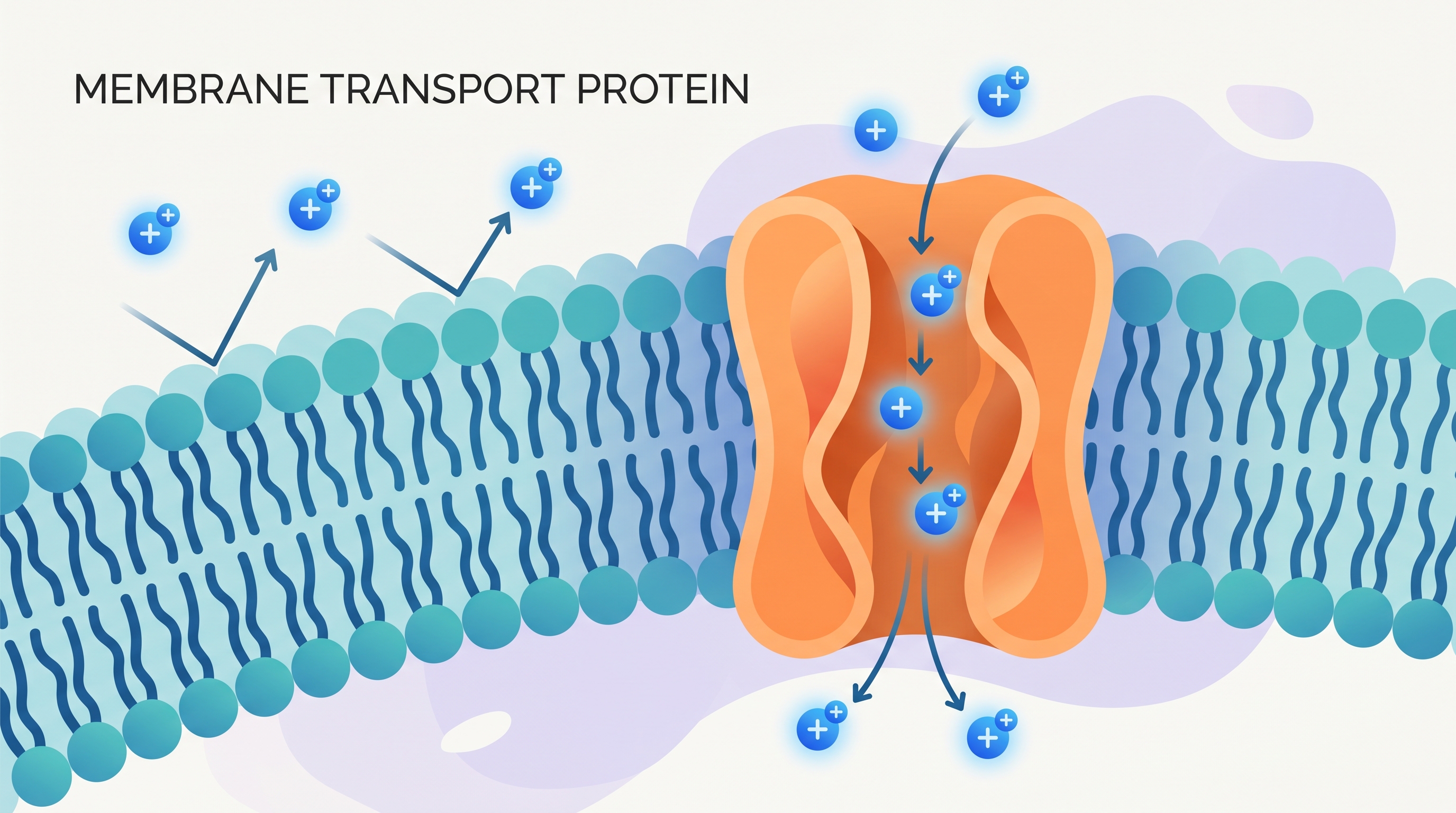
A membrane’s interior is largely hydrophobic, meaning that it avoids water and interacts poorly with charged or polar substances. Its surfaces interact more readily with water. As a result, small nonpolar molecules such as $O_2$ and $CO_2$ can pass through the membrane relatively easily, whereas many ions and polar molecules require membrane proteins or other transport mechanisms.
The important distinction is chemical, not simply physical. A molecule’s size matters, but its polarity and charge often matter more for crossing a membrane. Nonpolar molecules distribute their charge relatively evenly; polar molecules have uneven charge distribution; ions carry a full electrical charge. These properties influence membrane interactions, transport, signaling, and cellular targeting.
The phospholipid bilayer
Phospholipids group together to form the lipid bilayers found in plasma membranes and other cell membranes. A bilayer has two opposing layers of phospholipids, creating a hydrophobic interior between water-facing surfaces. This arrangement forms a stable boundary because the molecules organize according to their chemical interactions with water.
The membrane therefore behaves like a selective filter rather than an open doorway. Its lipid composition and associated proteins determine whether a substance crosses by direct diffusion, through a channel or carrier, or not at all. The molecular structure of specific lipids is beyond the required scope here; the functional principle is the relationship between chemical properties and membrane behavior.
Lipids support both structure and physiology
Lipids are not a single-purpose group. Fats provide long-term energy storage and support cell function. In mammals, stored fat can also provide insulation, reducing heat loss and helping maintain body temperature. Their energy-storage role connects molecular structure to whole-organism physiology: the same class of molecules can help supply fuel and protect against thermal stress.
Steroids, including cholesterol, are lipids. Steroid hormones act as chemical signals that support growth and development, energy metabolism, and homeostasis—the maintenance of relatively stable internal conditions. A hormone can travel from its site of production to target cells, where it changes cellular activity.
Cholesterol has a distinct structural role in animal cell membranes. It helps stabilize the membrane, preventing it from becoming excessively loose or excessively rigid as conditions change. Cholesterol is therefore both a lipid and a membrane component; it should not be treated only as a hormone.
Organelles use membranes to organize work
Eukaryotic cells use internal membranes to create specialized compartments. Chloroplasts contain a double membrane and are the location of photosynthesis. Mitochondria also use internal membrane organization; folds in their membranes provide a larger surface on which ATP can be synthesized more efficiently. The general principle is structure supports function: membrane boundaries and folds organize reactions and increase useful working area.
A useful way to apply this principle is to predict what happens when membrane structure changes. If a membrane becomes too permeable, ion gradients and concentration differences can collapse. If its internal surface area is increased by folds, more energy-producing machinery can operate simultaneously, improving the efficiency of ATP synthesis.
Worked example: connecting chemistry to transport
Suppose a cell is placed in an environment containing equal concentrations of $O_2$ and a charged ion. The $O_2$ concentration inside the cell is lower than outside, while the ion concentration is also higher outside. Predict their movement.
Because $O_2$ is small and nonpolar, it can move directly through the hydrophobic membrane interior by diffusion, from outside to inside. The charged ion cannot cross the hydrophobic interior freely; it requires a membrane protein, and its movement may depend on both the concentration gradient and the electrical gradient. The prediction follows from chemical properties rather than from the molecule’s name alone.
This reasoning can be tested experimentally by measuring the movement of a substance across membranes with different lipid compositions. Science Practice 3.C, Identify experimental procedures that are aligned to the question, requires choosing a procedure that actually measures permeability. Science Practice 5.D, Use data to evaluate a hypothesis or prediction, including rejecting or failing to reject the null hypothesis, can be applied by comparing measured transport rates between membrane treatments rather than merely describing the appearance of the cells.
Misconception check
Misconception: “All lipids are just stored fat.” Fats are important energy-storage molecules, but steroids function in signaling, cholesterol stabilizes animal membranes, and phospholipids form bilayers. A second misconception is that a membrane blocks everything; in reality, its selective permeability allows some substances to cross readily while restricting others.
Retrieval check
A molecule is electrically charged and cannot pass directly through the hydrophobic interior of a plasma membrane. What membrane feature would most directly allow its movement, and why?
Answer: A membrane transport protein, such as a channel or carrier, because the protein provides a pathway that avoids direct contact between the ion and the hydrophobic lipid interior.
Source Materials
- Ap Biology Course And Exam Description
- Ap Biology Course Overview
- Ap Biology Course At A Glance
- Ap Biology Equations And Formulas Sheet
- Chapter 3 Quantitative Skills In Ap Sciences
- Ap Biology Teacher Lab Manual Effective Fall 2019
- Updates 2025 26
- AP Biology Course-AP Central-College Board
- AP Biology-AP Students
- Biology of AP Courses-OpenStax
- AP Biology-Acellus
- AP/College Biology