From the free course AP Biology on Lykke
4.5 Cell Cycle
Key concepts: Cell cycle in eukaryotes · Binary fission in prokaryotes · Binary fission of mitochondria and chloroplasts · DNA replication and sister chromatids · Mitosis · Cell-cycle checkpoints · G1 checkpoint · G2 checkpoint · M-spindle checkpoint · Cell-cycle regulation and cancer
A cell cannot divide safely by simply splitting in half: it must first copy its DNA, check the copy, and distribute one complete genetic set to each daughter cell.
4.5 Cell Cycle
A cell cannot divide safely by simply splitting in half: it must first copy its DNA, check the copy, and distribute one complete genetic set to each daughter cell. The cell cycle is this controlled sequence of growth, DNA replication, preparation, nuclear division, and cytoplasmic division.
CED traceability: Topic 4.5 Cell Cycle; Learning Objective 4.5.A; Essential Knowledge 4.A.2. This topic is especially assessed through Science Practice 1: Concept Explanation, Science Practice 2: Visual Representations, and Science Practice 6: Argumentation.
Two solutions to the same biological problem
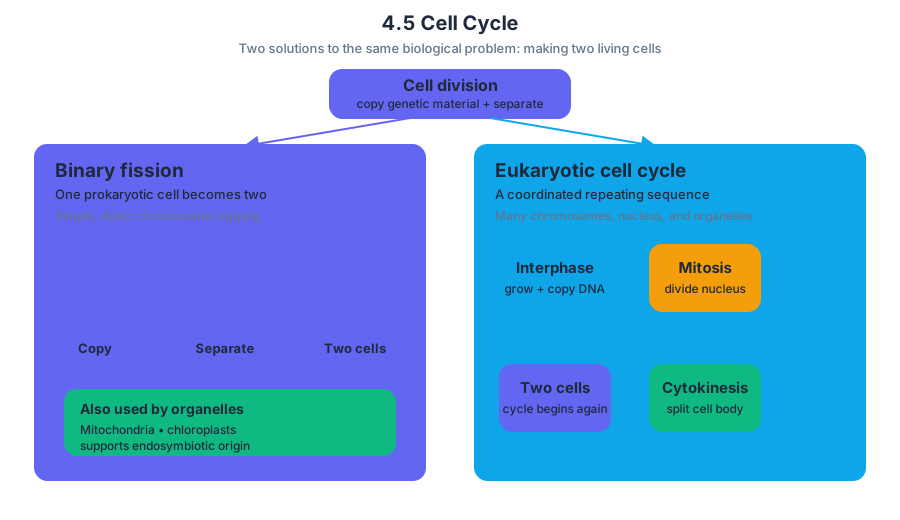
A bacterium often solves cell division with binary fission, a process in which one prokaryotic cell copies its chromosome and divides into two cells. Mitochondria and chloroplasts also replicate by binary fission. Their division method is evidence supporting the evolutionary relationship between these organelles and prokaryotes, consistent with the endosymbiotic origin of mitochondria and chloroplasts.
Eukaryotic division is more elaborate because a eukaryotic cell must coordinate duplication of its nucleus, multiple chromosomes, and other organelles. Its repeating sequence is the cell cycle, which includes interphase, mitosis, and cytokinesis.
The eukaryotic cell cycle
The four named phases are $G_1$, $S$, $G_2$, and $M$. The first three phases make up interphase; the $M$ phase includes mitosis and cytokinesis.
| Phase | Main event | Key question before moving on |
|---|---|---|
| $G_1$ | Cell grows and prepares to copy DNA | Is the cell large and healthy enough to begin? |
| $S$ | Chromosomal DNA is replicated | Was the genetic material copied? |
| $G_2$ | Cell grows and prepares for division | Is the copied DNA intact? |
| $M$ | Mitosis distributes chromosomes; cytokinesis divides the cell | Are chromosomes attached correctly for separation? |
During the $S$ phase, each chromosome is copied. After replication, one chromosome consists of two genetically matching DNA copies called sister chromatids. The sister chromatids remain joined at a region containing the kinetochore, an attachment site for spindle microtubules.
Key distinction: DNA replication doubles the DNA content, but it does not immediately double the chromosome number. The two copies remain joined as sister chromatids until they separate during mitosis.
Mitosis as an orderly distribution system
Mitosis is the division of the nucleus. Its purpose is to distribute duplicated chromosomes so that each new nucleus receives an equivalent genetic set. Cytokinesis then divides the cytoplasm, producing two daughter cells.
A useful mental model is a library making two identical branches: the books are duplicated first, then carefully sorted so each branch receives one complete copy. If a chromosome is missing or sent to both daughter cells, the resulting cells may malfunction.
Checkpoints: the cycle does not run blindly
A cell-cycle checkpoint is a control point at which the cell verifies that essential tasks are complete and that conditions are suitable before continuing. Cells may pause in a nondividing state, often called $G_0$, rather than proceed.
The three major checkpoints are:
- $G_1$ checkpoint: The cell evaluates DNA damage, cell size, growth factors, and environmental conditions. Appropriate external growth factors can stimulate division; for example, platelet-derived growth factor can encourage cells near a wound to divide during repair.
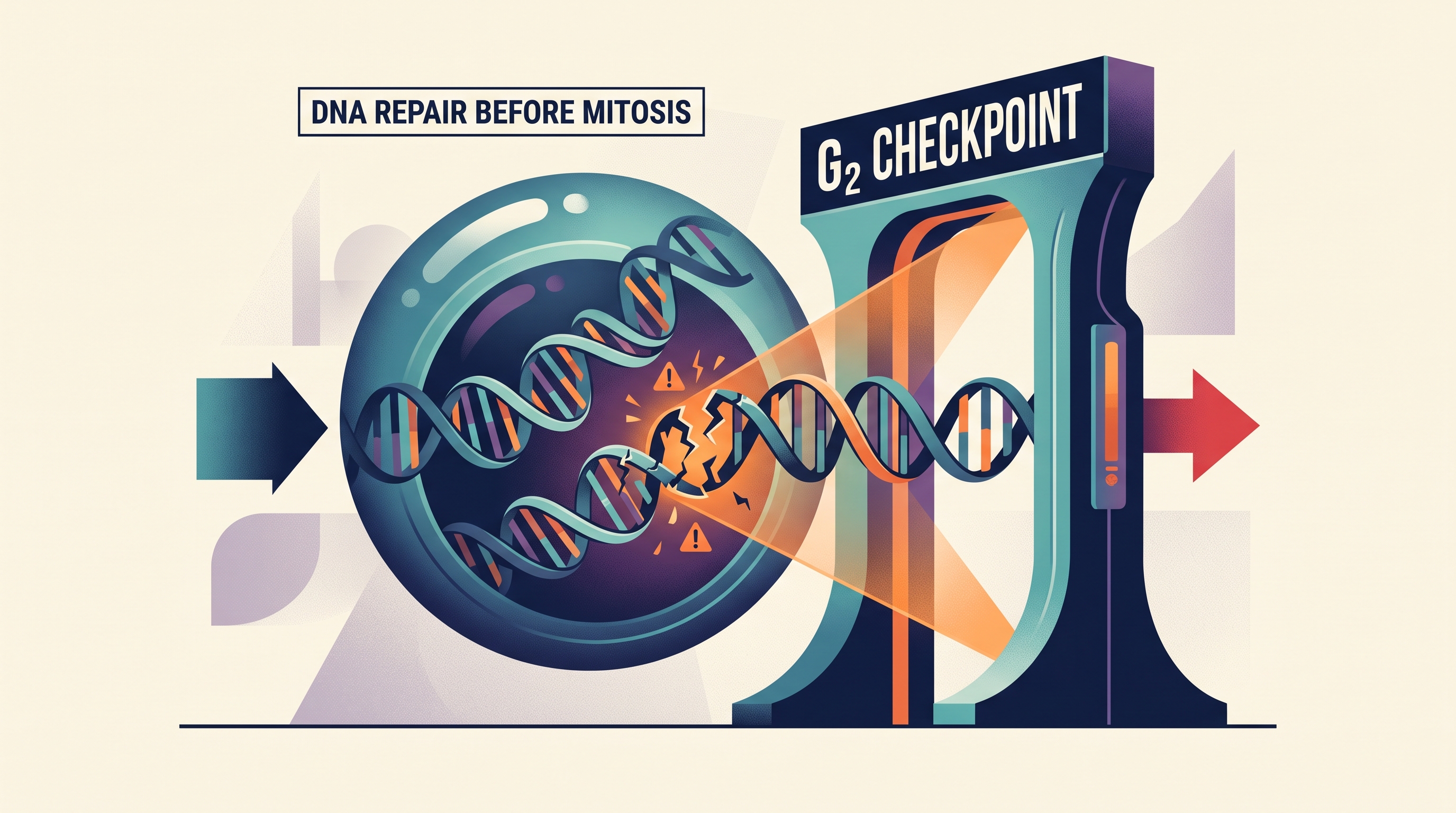
- $G_2$ checkpoint: After DNA replication, the cell checks whether replication is complete and whether the DNA contains damage or mutations. A damaged cell is prevented from entering mitosis.
- M-spindle checkpoint: During metaphase, the cell verifies that spindle fibers are properly attached to chromosome kinetochores. Incorrect attachment blocks progression toward chromosome separation.
Worked example: a damaged cell after replication
Suppose a cell completes $G_1$ and copies its DNA during $S$, but a mutation is detected before mitosis. The correct response is not to “repair the problem during mitosis.” The $G_2$ checkpoint pauses the cycle, allowing repair or preventing division if the damage cannot be safely resolved.
If the same cell passes $G_2$ but one chromosome lacks a properly attached spindle fiber, the M-spindle checkpoint stops the cell during metaphase. This prevents unequal chromosome distribution.
Misconception check
Misconception: “A chromosome is one DNA molecule only before replication and two chromosomes after replication.” Correction: before replication, a chromosome has one chromatid; after replication, it has two sister chromatids joined together, but it is still counted as one chromosome until the sister chromatids separate.
Misconception: “Cancer is caused only by cells dividing quickly.” Correction: cancer frequently involves mutations in genes controlling cell-cycle regulation. The deeper problem is failed control: cells may ignore checkpoint signals, continue dividing despite damage, or proceed with improperly organized chromosomes.
Retrieval check
A cell has completed DNA replication, but its DNA contains damage. Which checkpoint should prevent entry into mitosis, and why? A correct answer identifies the $G_2$ checkpoint and explains that it checks replicated DNA for damage or mutations before mitosis begins.