From the free course AP Biology on Lykke
3.2 Environmental Impacts on Enzyme Function
Key concepts: Enzyme molecular structure · Environmental temperature effects on enzymes · Environmental pH effects on enzymes · Hydrogen bonds in enzyme structure · Enzyme activity and catalytic efficiency · Enzyme denaturation · Reversible denaturation · Cellular environment and concentrations · Thermal energy and reaction kinetics
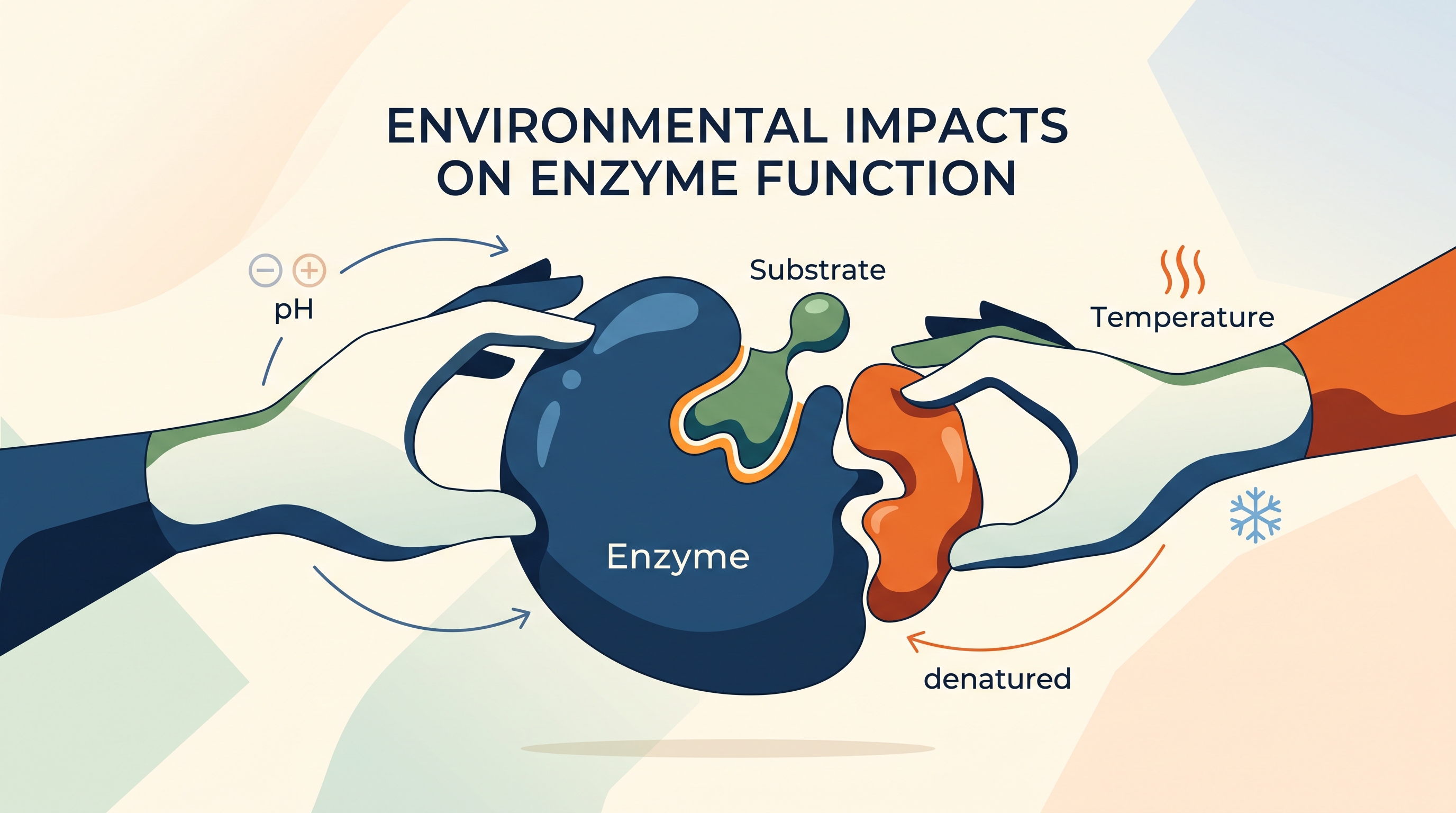
An enzyme can lose its catalytic power without losing a single amino acid: a shift in temperature or pH can disturb the weak interactions that hold its three-dimensional shape together.
3.2 Environmental Impacts on Enzyme Function
An enzyme can lose its catalytic power without losing a single amino acid: a shift in temperature or pH can disturb the weak interactions that hold its three-dimensional shape together. The central question is therefore: How can the cellular environment change the structure of an enzyme and, in turn, change the rate of a reaction?
Learning Objective 3.2.A: Explain how changes to the structure of an enzyme may affect its function.
Essential Knowledge 3.2.A.1: Change to the molecular structure of a component in an enzymatic system may result in a change to its function or efficiency.
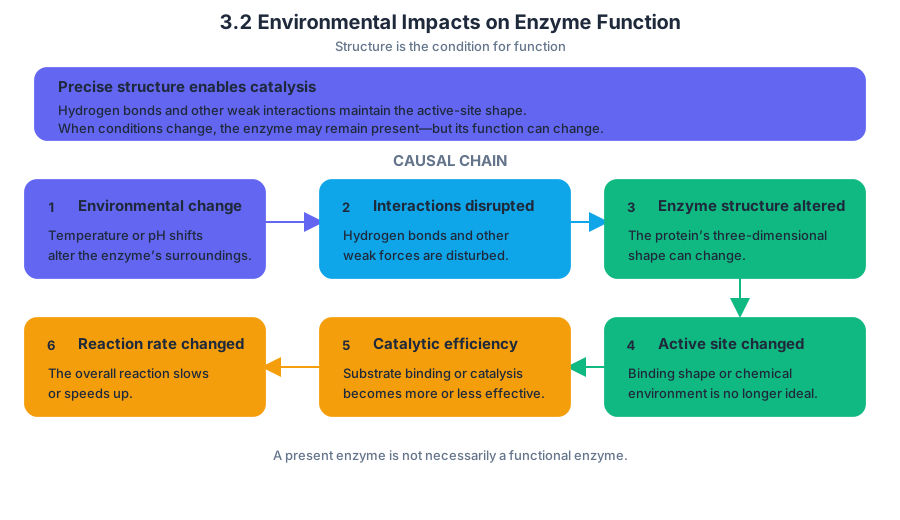
Structure is the condition for function
An enzyme’s catalytic efficiency depends on the precise shape of regions that interact with its substrate. That shape is maintained not only by strong covalent bonds but also by many weaker interactions, including hydrogen bonds—attractions between a partially positive hydrogen and an electronegative atom in another part of a molecule.
When temperature or pH changes, hydrogen bonds and other interactions can be disrupted. The enzyme may still be present in the solution, but its active site may no longer have the correct shape or chemical environment for effective substrate binding and catalysis.
The causal chain is:
- Environmental change
- Disruption of hydrogen bonds and other interactions
- Altered enzyme structure
- Changed active-site shape or chemistry
- Changed catalytic efficiency
- Changed reaction rate
Temperature: more motion, then structural damage
Temperature affects enzyme activity in two connected ways. At moderate temperatures, increasing temperature increases molecular motion, so enzyme and substrate molecules collide more frequently and with greater kinetic energy. More successful collisions can increase reaction rate.
Beyond an enzyme’s optimal temperature, however, thermal energy can disrupt the interactions maintaining its structure. The enzyme begins to unfold or change shape, so catalytic efficiency declines. Thus, enzyme activity often rises toward an optimum and then falls sharply rather than increasing indefinitely.
Worked example — a protease reaction: A protease breaks down a protein substrate. At $10^\circ\text{C}$, molecules move relatively slowly, so productive collisions are infrequent. At $37^\circ\text{C}$, collisions may occur more often and the reaction may proceed faster. At $80^\circ\text{C}$, disrupted hydrogen bonds can alter the protease’s structure; even though molecular motion is high, the damaged active site may catalyze the reaction poorly or not at all.
pH: changing charge and shape
pH measures the acidity of a solution. A pH outside an enzyme’s optimal range can alter the charges of amino-acid side chains within the protein. Those charge changes can disrupt hydrogen bonds and other attractions, changing the enzyme’s structure and the chemical interactions needed for catalysis.
A strongly acidic or basic environment does not merely make a reaction “faster” or “slower” in a vague way. It may change the enzyme molecule itself. Different enzymes therefore have different pH optima because their structures and cellular locations differ.
Denaturation may be permanent—or reversible
Denaturation is the disruption of a protein’s structure that eliminates or greatly reduces its ability to catalyze reactions. Temperature, pH, or another chemical change in the environment can cause denaturation.
Essential Knowledge 3.2.A.1.i: Denaturation of proteins, such as enzymes, occurs when the protein structure is disrupted by a change in temperature, pH, or chemical environment, eliminating the ability to catalyze reactions.
Denaturation is not automatically permanent. In some cases, when the environmental condition returns to a suitable range, the enzyme can refold and regain activity.
Essential Knowledge 3.2.A.2: In some cases, enzyme denaturation is reversible, allowing the enzyme to regain activity.
Concentrations and inhibitors also change reaction efficiency
The cellular environment includes the relative concentrations of substrates and products. If substrate concentration increases while enzyme availability remains constant, reaction rate may increase until the enzymes are operating near capacity. Accumulated product can reduce net forward progress, so substrate-to-product balance matters.
Learning Objective 3.2.B: Explain how the cellular environment affects enzyme activity.
Essential Knowledge 3.2.B.1: The relative concentrations of substrates and products determine how efficiently an enzymatic reaction proceeds.
Environmental effects can also involve inhibitors. A competitive inhibitor reversibly occupies the active site and competes with substrate. A noncompetitive inhibitor binds elsewhere, causing a conformational change that reduces enzyme function.
Misconception check
Misconception: “Cold temperatures denature enzymes.” Usually, low temperature slows molecular motion and reduces collision frequency; it does not necessarily destroy the enzyme’s structure. High temperature, extreme pH, and damaging chemical environments are more directly associated with structural disruption, although the exact response depends on the enzyme.
AP skills and retrieval check
This topic develops ENE-1.F: Explain how changes to the structure of an enzyme may affect its function, ENE-1.G: Explain how the cellular environment affects enzyme activity, and SYI-3.A: Explain the connection between variation in the number and types of molecules within cells to the ability of the organism to survive and/or reproduce in different environments. In an investigation, these skills require connecting a manipulated condition to molecular structure, reaction data, and biological consequence.
Quick check: An enzyme’s activity falls after exposure to extreme pH but returns when the enzyme is placed in its usual pH range. What does this suggest? The best interpretation is that the pH caused a reversible structural change, rather than permanent destruction of the enzyme.