From the free course AP Biology on Lykke
2.5 Membrane Transport
Key concepts: Membrane transport · Water potential · Water movement across a cell membrane · Plant cells · Surrounding environment · Transpiration · Lipids · Facilitated diffusion · Experimental investigations
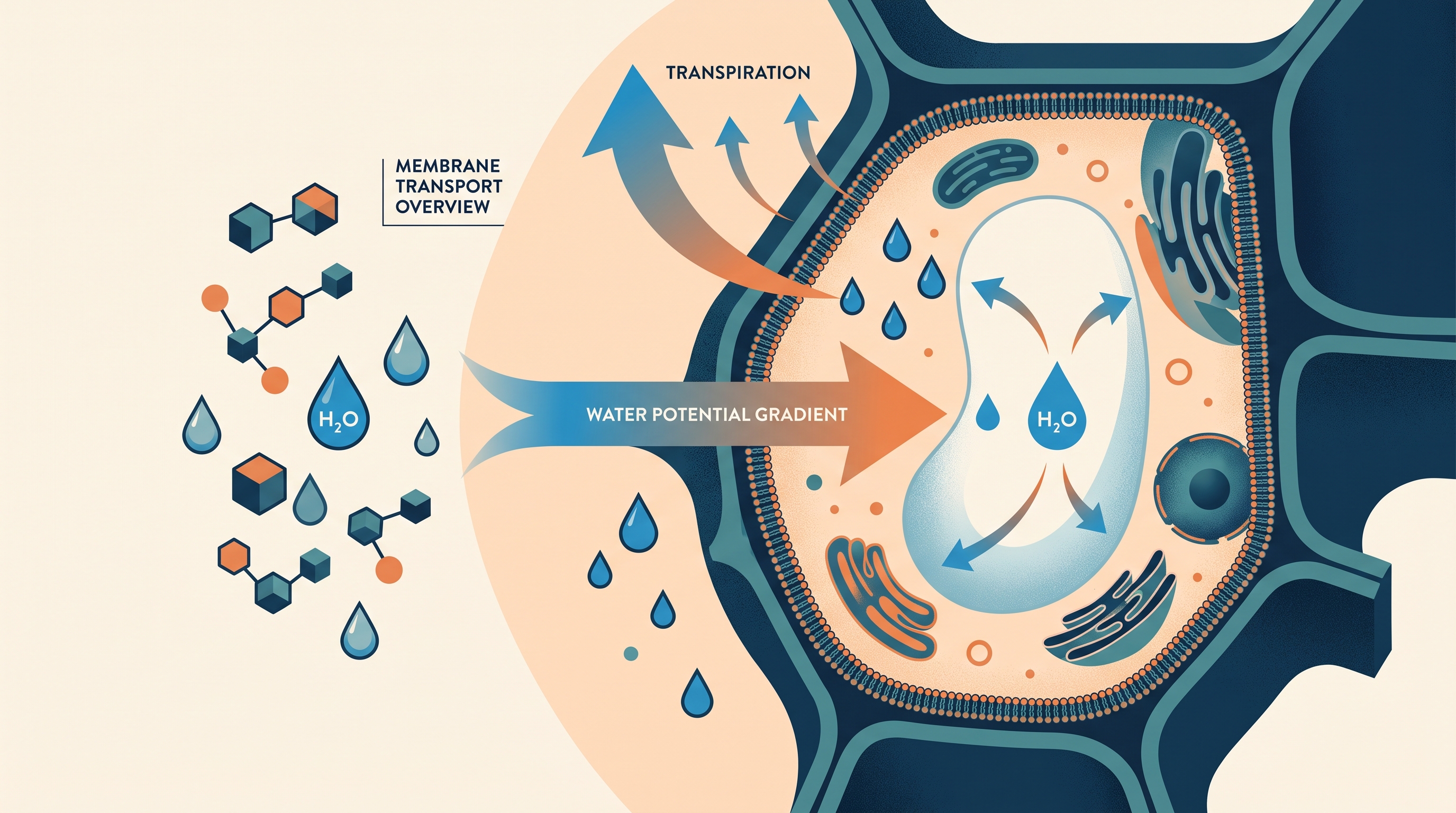
Water moves across a plant cell membrane from higher water potential to lower water potential. If a plant cell has a lower water potential than the surrounding environment, the cell will gain water because water moves down the water-potential gradient—from the surroundings into the cell.
2.5 Membrane Transport
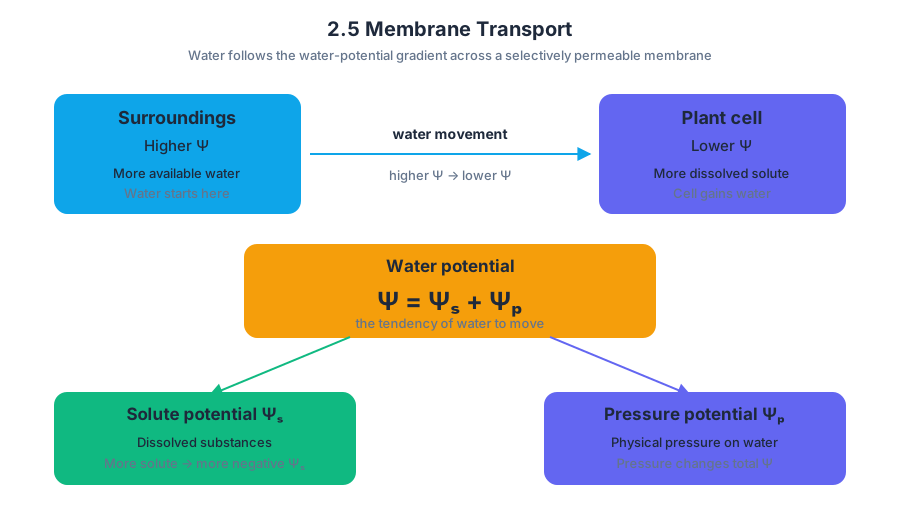
Water moves across a plant cell membrane from higher water potential to lower water potential. If a plant cell has a lower water potential than the surrounding environment, the cell will gain water because water moves down the water-potential gradient—from the surroundings into the cell.
Water potential, $\Psi$, is the tendency of water to move. Water moves spontaneously from higher $\Psi$ to lower $\Psi$.
A useful model is:
$$ \Psi = \Psi_s + \Psi_p $$
where $\Psi_s$ is solute potential, the effect of dissolved substances, and $\Psi_p$ is pressure potential, the effect of physical pressure on water. Dissolved solutes make $\Psi_s$ more negative. Therefore, a cell containing more solute may have a lower total water potential than its environment, even if the cell is under similar pressure.
Water movement across a plant cell membrane
Imagine a plant cell surrounded by a solution with $\Psi = -0.2$ MPa. The cell has $\Psi = -0.6$ MPa because its interior contains a greater concentration of dissolved solutes. Water moves into the cell:
$$ -0.2\ \text{MPa} \longrightarrow -0.6\ \text{MPa} $$
The direction may seem counterintuitive because $-0.6$ is numerically smaller, but it represents lower water potential. As water enters, pressure against the cell wall increases. This pressure potential can raise the cell’s total $\Psi$ until the movement of water slows or reaches equilibrium.
The cell membrane does not act like an open doorway. Its lipid bilayer provides a hydrophobic interior that restricts many charged or polar substances, while particular molecules can cross through membrane proteins. Water may cross the bilayer slowly, but plant cells also rely heavily on aquaporins—membrane proteins that provide channels for rapid water movement. The transport mechanism must therefore be explained together with the membrane’s lipid structure and selective proteins.
Why transpiration changes the system
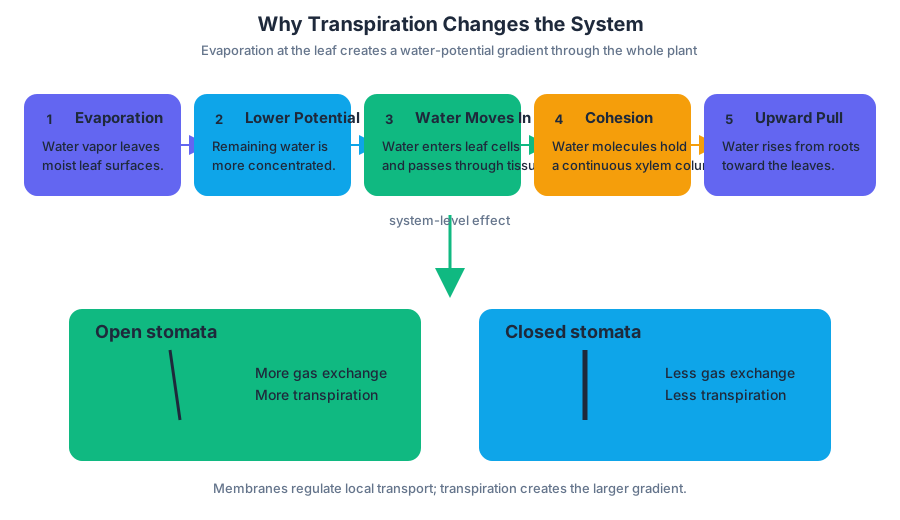
Transpiration is the loss of water vapor from plant surfaces, especially through leaves. When water evaporates from moist leaf surfaces, the water remaining in the leaf becomes more concentrated, lowering the leaf’s water potential. This creates a gradient that helps draw water upward through the plant, from the roots toward the leaves.
The chain of events is:
- Water evaporates from leaf surfaces.
- Evaporation lowers leaf water potential.
- Water moves into leaf cells and through their tissues.
- Cohesion between water molecules helps maintain a continuous water column in the xylem.
- Water is pulled upward from the roots, where water entered because of water-potential differences.
This is why a plant’s water movement cannot be understood by examining only one cell. A cell membrane regulates local transport, while evaporation at the leaf creates a larger-scale gradient. Open stomata generally increase gas exchange and transpiration; closed stomata reduce water loss but also limit carbon dioxide entry for photosynthesis.
Passive transport and membrane proteins
Passive transport moves substances down their concentration or electrochemical gradients without direct cellular energy input. Small nonpolar molecules, such as oxygen, can diffuse through the lipid bilayer. Other substances require proteins: a channel provides a passageway, while a carrier changes shape to move a substance across the membrane. This protein-assisted passive movement is called facilitated diffusion; its detailed mechanisms depend on the molecule and the protein involved.
A common mistake is to treat every movement through a protein as active transport. The decisive question is not whether a protein is involved, but whether the substance moves down its gradient or against it. Movement down a gradient is passive; movement against a gradient requires an energy source, usually ATP or an ion gradient.
Investigation entry point
Before conducting their own experiments, students encounter introductory questions that activate concepts such as osmosis, diffusion, active transport, photosynthesis, and transpiration. The prediction about a plant cell with lower water potential is not merely a vocabulary exercise: students must represent the direction of water movement in an annotated diagram and then use evidence from an investigation to evaluate that prediction.
For an experimental diagram, label the surrounding solution, the cell membrane, the cell interior, both water-potential values, and an arrow pointing from higher $\Psi$ to lower $\Psi$. A strong annotation explains why the arrow points inward: the cell’s lower water potential creates the driving force for water entry.
AP skills and identifiers
This topic develops the official science practices 1. Explanation of Concepts, 2. Visual Representations, 3. Questions and Methods, 4. Representing and Describing Data, 5. Statistical Tests and Data Analysis, and 6. Argumentation. In particular, a student should be able to explain a water-potential gradient, draw the transport model, predict an experimental outcome, represent changes in cell mass or water content, analyze variation among trials, and use evidence to defend or revise the prediction.
The investigation is associated with the identifiers IST-5.A, ENE-3.D, and SYI-1.H. These identifiers connect membrane transport to information-based scientific reasoning, energy and matter movement, and systems-level interpretation.
Misconception check: A plant cell does not automatically lose water because it is placed in a solution containing solute. Determine the direction by comparing water potentials, not by counting solute particles in only one compartment.
Retrieval check: A plant cell has $\Psi = -0.4$ MPa and its surrounding solution has $\Psi = -0.7$ MPa. Which way will water initially move, and what change caused by transpiration could make water continue entering the leaf?