From the free course AP Biology on Lykke
5.4 Non-Mendelian Genetics
Key concepts: Non-Mendelian genetics · Traits that do not segregate independently
A trait can fail to follow Mendel’s expected ratios even when the DNA is inherited normally, because genes may interact, travel together, or reside outside the nucleus.
5.4 Non-Mendelian Genetics
A trait can fail to follow Mendel’s expected ratios even when the DNA is inherited normally, because genes may interact, travel together, or reside outside the nucleus. Non-Mendelian genetics describes inheritance patterns that cannot be explained by treating one gene as an independently assorting unit with two alleles and a simple dominant–recessive relationship.
Learning Objective 5.4.A: Explain deviations from Mendel’s model of the inheritance of traits.
Essential Knowledge 5.4.A: Some traits do not segregate independently.
Why traits depart from simple Mendelian patterns
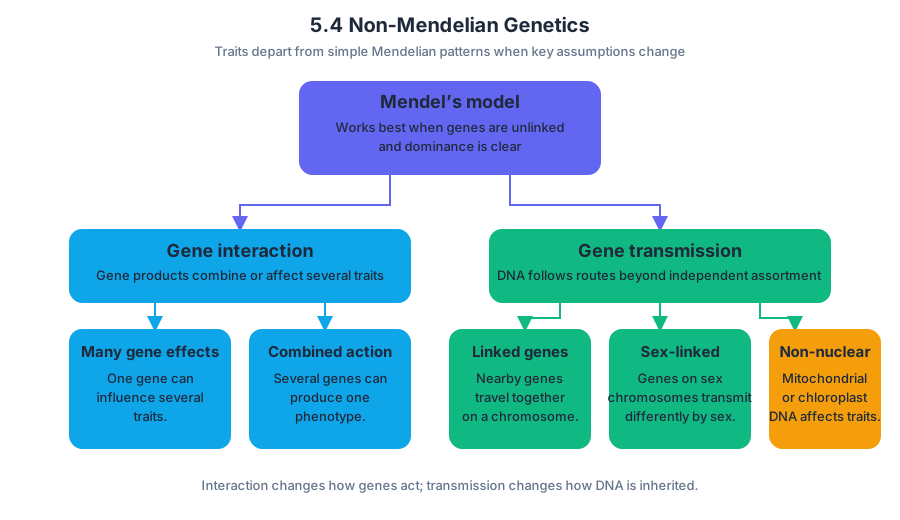
Mendel’s model works best when genes are on different chromosomes, alleles show a clear dominance relationship, and nuclear chromosomes are distributed predictably during meiosis. Several biological conditions violate one or more of these assumptions.
The most important distinction is between gene interaction and gene transmission:
- Gene interaction: the products of genes influence several traits or combine to produce one phenotype.
- Linked inheritance: genes located near one another on the same chromosome tend to travel together.
- Sex-linked inheritance: a gene lies on a sex chromosome, so its transmission differs between sexes.
- Non-nuclear inheritance: DNA in mitochondria or chloroplasts contributes to the phenotype.
Pleiotropy: one gene, several effects
Pleiotropy occurs when one gene affects multiple phenotypic traits. The traits are connected because they depend on the same gene product or on different effects of the same biological pathway; they are not independent outcomes controlled by unrelated genes.
For example, a mutation in a gene required for producing or transporting a structural protein could affect connective tissue strength, blood-vessel integrity, and skeletal development at the same time. A single inherited allele therefore produces a cluster of phenotypic effects.
Misconception check: Pleiotropy does not mean that one gene has several alleles. It means that one gene influences several traits.
Interpretation check: If one mutation causes both abnormal pigmentation and reduced vision, is this automatically evidence for two genes? No. It could be pleiotropy if one gene or its product affects both biological processes.
Linked genes do not assort independently
Genes positioned on the same chromosome are called linked genes. Because a chromosome is passed as a physical unit during meiosis, linked genes tend to be inherited together rather than assorting independently. Crossing over can separate them, but genes that are closer together are less likely to be separated than genes farther apart.
A useful prediction follows: linked genes produce more parental combinations of alleles and fewer recombinant combinations than independent assortment would predict. Thus, an unexpected excess of parental phenotypes can reveal linkage.
Worked example: Suppose a heterozygous organism carries chromosome arrangements $AB/ab$. If the genes assort independently, gametes $AB$, $ab$, $Ab$, and $aB$ are expected in roughly equal proportions. If the genes are linked, $AB$ and $ab$ gametes will be more common because the original allele combinations usually remain together. A smaller number of $Ab$ and $aB$ gametes results from crossing over.
Sex-linked inheritance
Sex-linked genes are located on sex chromosomes. Their inheritance patterns differ between sexes because the sexes may carry different numbers or combinations of those chromosomes. For an X-linked gene, an individual with only one X chromosome has no second X-linked allele that could mask a recessive allele; this affects expected phenotype frequencies.
Do not confuse sex-linked with sex-influenced. A sex-linked gene is located on a sex chromosome. A sex-influenced trait is controlled by genes that may be on autosomes but expressed differently in different physiological environments.
Non-nuclear inheritance
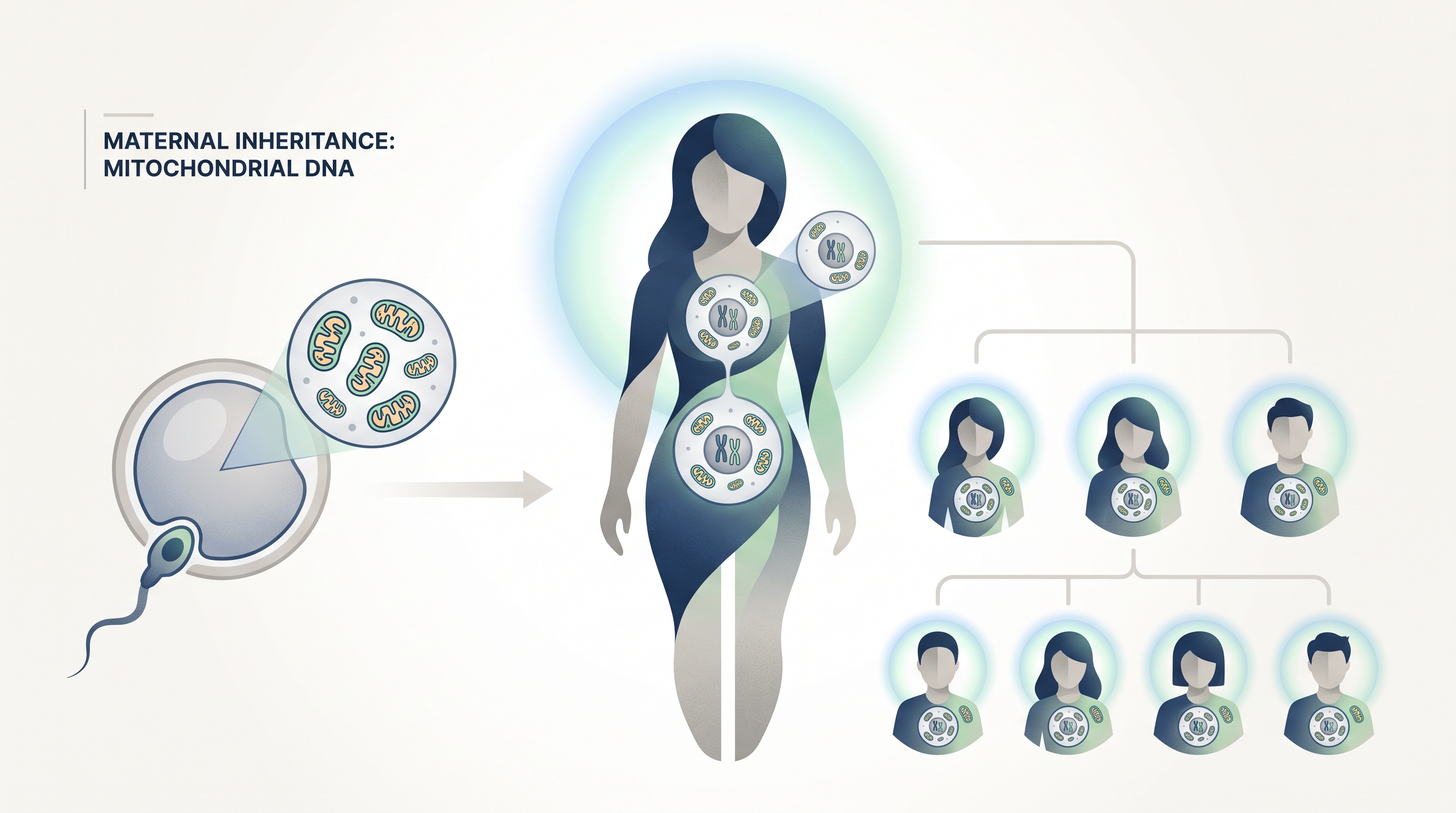
Non-nuclear inheritance occurs when traits are determined partly or entirely by DNA outside the nucleus. Mitochondria and chloroplasts contain their own genomes. These organelles are distributed to daughter cells and gametes in ways that do not follow the chromosome-by-chromosome pattern of nuclear inheritance.
In animals, mitochondria are usually transmitted through the egg rather than the sperm. Mitochondrial traits are therefore typically maternally inherited: affected mothers may transmit the trait to their offspring, whereas affected fathers generally do not transmit mitochondrial DNA.
In plants, mitochondria and chloroplasts are transmitted through the ovule rather than pollen. Consequently, traits determined by mitochondrial or chloroplast DNA are also typically maternally inherited.
Essential Knowledge 5.4.A.4: Some traits result from non-nuclear inheritance.
Misconception check: “Maternally inherited” does not mean that the trait is caused by a gene on the mother’s nuclear chromosomes. It means the relevant organelle DNA usually comes from the maternal gamete.
AP Biology reasoning tools
This topic most directly uses Science Practice 1: Concept Explanation, especially 1.A Describe biological concepts and processes and 1.B Explain biological concepts and processes; Science Practice 2: Visual Representations, especially 2.A Describe characteristics of a representation and 2.B Explain relationships among different characteristics of a representation; and Science Practice 6: Argumentation, especially 6.A Make a scientific claim, 6.B Support a claim with evidence, and 6.C Provide reasoning to justify a claim. On an exam, these skills appear when you identify an inheritance pattern from a pedigree or cross, interpret a chromosome diagram, or justify why observed offspring proportions depart from Mendelian expectations.
Retrieval check: A trait appears in offspring of affected mothers but not affected fathers, and the pattern follows the maternal line across generations. Which explanation is strongest: linked nuclear inheritance, mitochondrial inheritance, or independent assortment? Mitochondrial inheritance, because organelle DNA is typically transmitted through the egg.