From the free course AP Biology on Lykke
2.2 Cell Size
Key concepts: Cell size and shape · Surface area-to-volume relationships · Cell size limitations · Cell membranes with many convolutions · Diffusion gradients · Osmosis gradients · Water movement into or out of plant cells · Plant-cell internal (turgor) pressure · Measuring cell-size effects through weight change
Most cells are small because exchange with the environment depends on surface area, while the cell’s chemical demands depend on volume. As a cell grows, volume increases faster than surface area, making it increasingly difficult to obtain materials and remove wastes quickly enough.
2.2 Cell Size
Most cells are small because exchange with the environment depends on surface area, while the cell’s chemical demands depend on volume. As a cell grows, volume increases faster than surface area, making it increasingly difficult to obtain materials and remove wastes quickly enough.
Cell size and shape
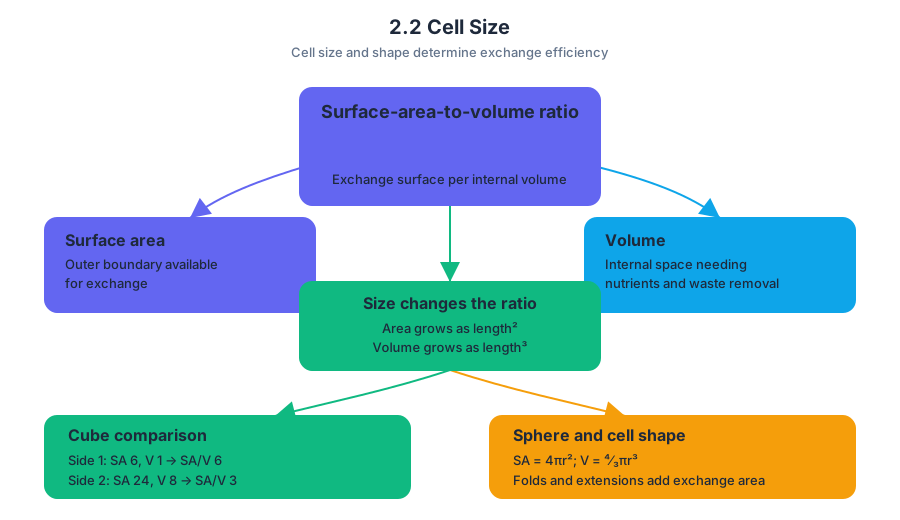
A cell’s surface area is the total area of its outer boundary available for exchange; its volume is the amount of internal space that requires nutrients, water, and waste removal. The relationship between these quantities is summarized by the surface-area-to-volume ratio, written as $\frac{SA}{V}$.
Consider two cubes. A cube with side length $1$ has surface area $6$ and volume $1$, so its ratio is $\frac{6}{1}=6$. A cube with side length $2$ has surface area $24$ and volume $8$, so its ratio is $\frac{24}{8}=3$. Doubling the side length quadruples surface area but increases volume eightfold; the larger cube therefore has less exchange surface per unit of internal volume.
The same pattern appears in a sphere: surface area is $4\pi r^2$, whereas volume is $\frac{4}{3}\pi r^3$. Because area depends on $r^2$ but volume depends on $r^3$, increasing radius causes volume to outpace surface area. Cell shape can partly solve this problem: intestinal epithelial cells and plant root-hair cells extend or fold their exchange surfaces, allowing more membrane area without requiring a proportionate increase in internal volume.
Membranes with many convolutions
A convolution is a fold, projection, or repeated contour that increases surface area. Many small cells and specialized cells have highly convoluted membranes because extra exchange surface supports faster movement of nutrients, gases, water, or wastes. The key idea is not that folding makes a cell smaller; it gives the cell more boundary through which exchange can occur.
Common misconception — “Large cells simply need more food.” The deeper limitation is geometric. A larger cell needs more resources because it has greater volume, but its surface area does not increase at the same rate. Even if substances can cross the membrane, the available exchange surface may be insufficient to support the entire interior.
Diffusion gradients
Diffusion is the net movement of particles from a region of higher concentration to a region of lower concentration. This difference is a concentration gradient. Diffusion is driven by the gradient, not by a cell “wanting” a substance to move; as the gradient becomes smaller, net movement slows until dynamic equilibrium is reached.
For a cell, short diffusion distances matter. A small cell places most of its cytoplasm close to the membrane, so oxygen or dissolved nutrients can reach the interior efficiently. A large, spherical cell has a relatively distant center, combining a lower $\frac{SA}{V}$ with a longer path for diffusion.
Osmosis gradients and plant-cell pressure
Osmosis is the net movement of water across a selectively permeable membrane in response to a water-potential gradient. Water tends to move toward the side with lower water potential, often the side with a higher effective solute concentration. Thus, water movement depends on a gradient rather than on the solute concentration of one solution considered in isolation.
In a plant cell, water entering the cell pushes the plasma membrane against the cell wall, producing internal turgor pressure. Turgor helps support leaves and stems. If water leaves the cell in a sufficiently concentrated surrounding solution, turgor pressure falls and the cell may become flaccid; severe water loss can cause the membrane to pull away from the wall.
Common misconception — “Water always moves into a plant cell because plants need water.” Water moves according to the water-potential gradient. A plant cell can lose water to its surroundings if the surrounding environment has lower water potential, such as after saltwater is applied to the soil.
Worked investigation: measuring cell response
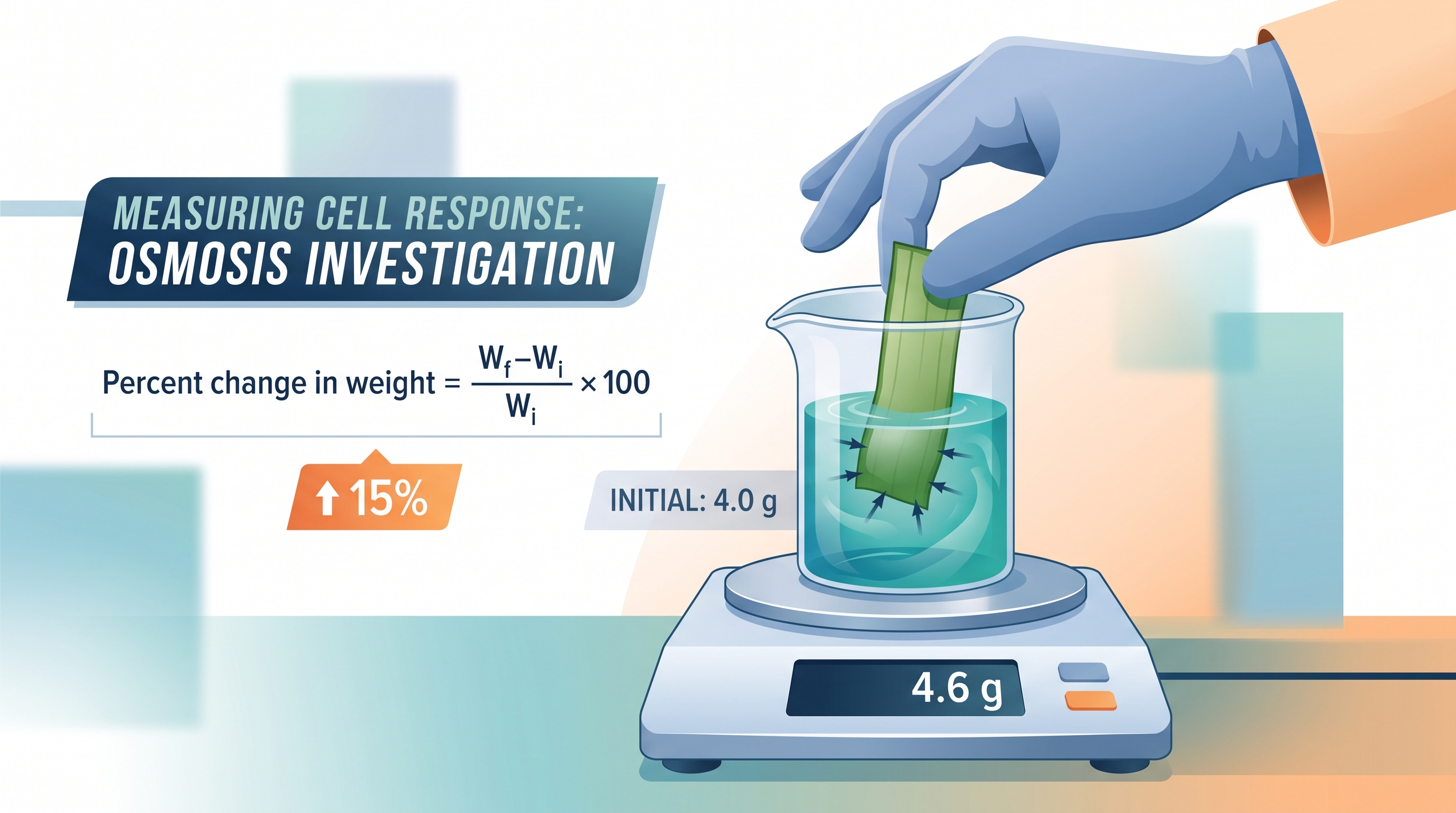
Suppose a piece of plant tissue is placed in a solution to test osmosis. First record its initial weight, $W_i$. After $30$ minutes, remove the tissue, measure its final weight, $W_f$, and record both values. Calculate percent change in weight with:
$$ \text{Percent change in weight}
\frac{W_f-W_i}{W_i}\times 100 $$
If $W_i=4.0\ \text{g}$ and $W_f=4.6\ \text{g}$, then:
$$ \frac{4.6-4.0}{4.0}\times 100
15% $$
A positive result indicates net water gain; a negative result indicates net water loss; a result near $0%$ suggests little net water movement over the measurement period. The solution producing approximately no weight change estimates an isotonic condition for that tissue.
Retrieval check: A cell’s radius increases by a factor of $2$. By what factors do its surface area and volume increase, and why does this make diffusion more challenging? What would a negative percent change in tissue weight reveal about the direction of net water movement?