From the free course AP Biology on Lykke
7.9 Phylogeny
A phylogeny is a model of the evolutionary relationships among organisms, showing which groups share more recent common ancestors. A phylogenetic tree is therefore not a ladder from “primitive” to “advanced”; it is a branching hypothesis about ancestry and descent.
7.9 Phylogeny
A phylogeny is a model of the evolutionary relationships among organisms, showing which groups share more recent common ancestors. A phylogenetic tree is therefore not a ladder from “primitive” to “advanced”; it is a branching hypothesis about ancestry and descent.
Investigative question: How can a diagram reveal evolutionary history?
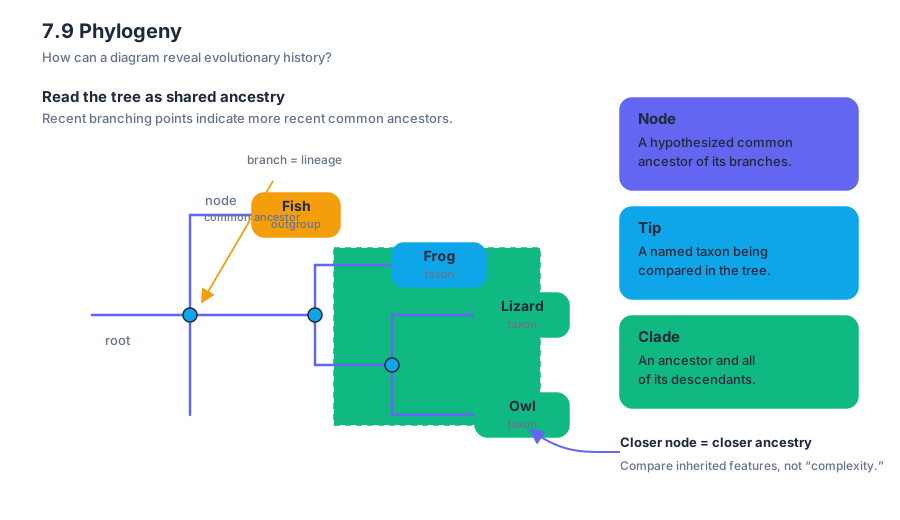
Imagine comparing four organisms—an owl, a lizard, a frog, and a fish—using inherited characteristics. The key question is not “Which organism looks most complex?” but “Which organisms share the most recent inherited features because they share a recent common ancestor?”
In a phylogenetic tree, each branch represents a lineage, each tip represents a taxon—a named biological group being compared—and each node represents a hypothesized common ancestor. A clade is an ancestor and all of its descendants. The point where two branches meet is especially important: it indicates that those two lineages share a common ancestor at that node.
Essential knowledge 7.9.A.1: Phylogenetic trees and cladograms show evolutionary relationships among organisms or groups.
Reading a phylogenetic tree
The most reliable way to read a tree is to trace lineages backward from the tips until they meet. Two taxa are sister taxa when they share the most recent common ancestor with each other. Sister taxa do not have to look alike, live in the same environment, or be physically adjacent on the page; their relationship depends on the branching pattern.
A tree can be rotated around any internal node without changing its meaning. For example, swapping the positions of two branches at the same node produces a visually different diagram but the same evolutionary relationships.
Worked interpretation
Suppose a cladogram groups organisms in this pattern:
- Fish branches off first.
- Frog branches off next.
- Lizard and owl share the most recent node.
The correct conclusions are:
- The lizard and owl are sister taxa.
- Lizard and owl share a more recent common ancestor with each other than either does with the frog.
- All four organisms share a more distant common ancestor.
- The owl did not evolve from the lizard, and the lizard did not evolve from the owl. Both descended from an ancestral lineage represented by their shared node.
The tree does not necessarily show that the owl is “more evolved” than the fish. Every living lineage has been evolving for the same amount of elapsed time since its ancestors diverged. The tree shows branching relationships, not a ranking of living organisms.
Building relationships from shared characteristics
Scientists construct phylogenies by comparing inherited characteristics, including anatomical traits, developmental patterns, and molecular sequences. A characteristic shared because of common ancestry is a homologous character. When a derived homologous character is shared by members of one clade, it is called a shared derived character, or synapomorphy.
For example, consider a comparison in which a backbone is present in fish, frogs, lizards, and owls; four limbs occur in frogs, lizards, and owls; and amniotic eggs occur in lizards and owls. The most economical interpretation places the backbone at the common ancestor of all four groups, four limbs at the common ancestor of frogs and the two amniote lineages, and amniotic eggs at the common ancestor of lizards and owls.
This reasoning uses parsimony: when several evolutionary explanations are possible, the preferred model generally requires the fewest independent evolutionary changes. Parsimony is not an absolute guarantee that the shortest tree is correct, but it provides a testable way to compare hypotheses.
Skill focus: 2.D Visual Representations
2.D — Represent relationships within biological models, including mathematical models, diagrams, flowcharts, and systems. In phylogeny problems, this skill requires more than recognizing vocabulary. You must translate between a branching diagram, a table of traits, and a written claim about common ancestry.
A strong response identifies the relevant node, names the taxa connected by that node, and uses the branching pattern as evidence. For example: “Taxa A and B are sister taxa because they share the most recent common ancestor shown by their immediate shared node.” A statement such as “A and B are related because they are next to each other” does not demonstrate the skill; page position is not evidence.
Misconception check: “The tree’s tips are arranged from oldest to newest”
Correction: The horizontal or vertical order of tips is usually arbitrary. What matters is the sequence of branching events. Unless a scale or time axis is explicitly provided, branch length does not automatically represent elapsed time, amount of evolutionary change, or biological complexity.
Retrieval check
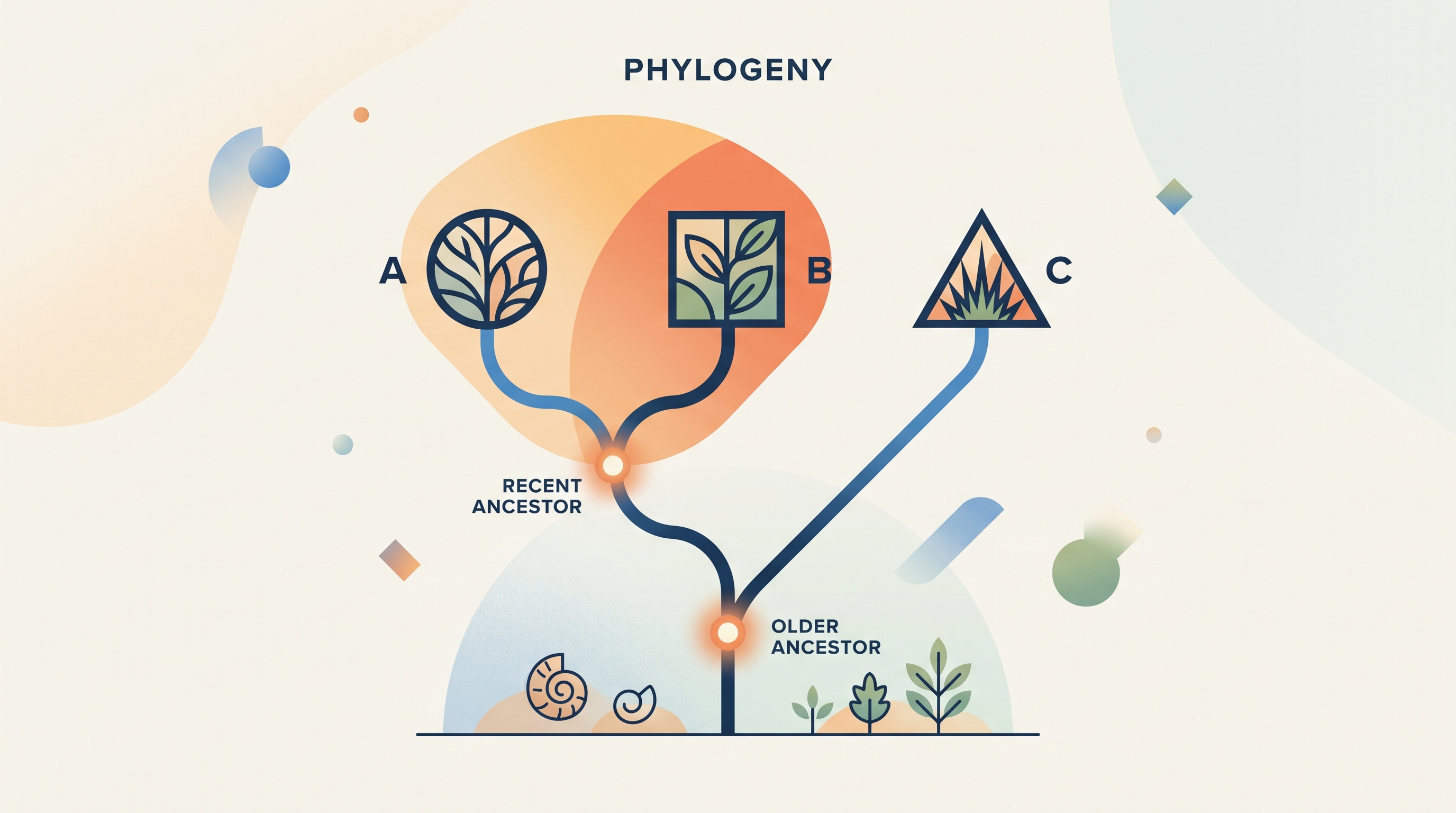
A tree shows taxa A and B joining at one node, while taxon C joins their lineage at an older node. Which pair is more closely related, and what feature of the diagram supports your answer?
Answer: A and B are more closely related because they share the most recent common ancestor—their branches meet at the younger, more immediate node. This conclusion depends on branching order, not on the organisms’ appearance or their positions on the page.