From the free course AP Biology on Lykke
6.2 DNA Replication
Key concepts: DNA replication · Replication fork · Helicase-mediated DNA unwinding · Topoisomerase-mediated relaxation of supercoiling · RNA primers and DNA polymerase initiation · Continuous leading-strand synthesis · Discontinuous lagging-strand synthesis · DNA ligase and joining lagging-strand fragments
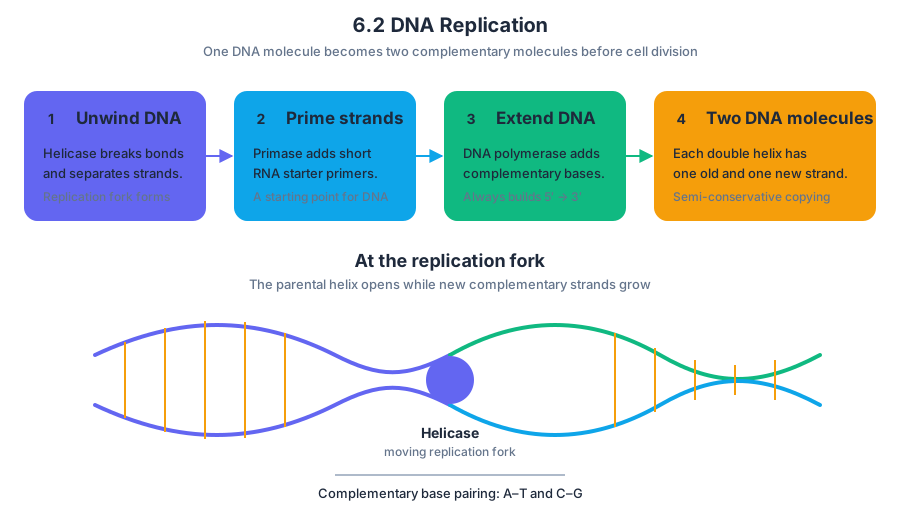
A dividing cell must copy its DNA before it can distribute genetic information to two daughter cells. DNA replication is the process of producing a complementary DNA molecule from an existing DNA molecule, and it begins when helicase separates the two strands at a moving replication fork.
6.2 DNA Replication
A dividing cell must copy its DNA before it can distribute genetic information to two daughter cells. DNA replication is the process of producing a complementary DNA molecule from an existing DNA molecule, and it begins when helicase separates the two strands at a moving replication fork.
The replication fork: a coordinated molecular machine
A replication fork is the Y-shaped region where the parental DNA strands have been unwound and copied. The two original strands do not serve as identical templates: because their strands run in opposite directions, the replication machinery must copy one new strand continuously and the other in short pieces.
The major events occur in a defined sequence:
- Helicase unwinds the DNA strands by breaking the hydrogen bonds between complementary bases.
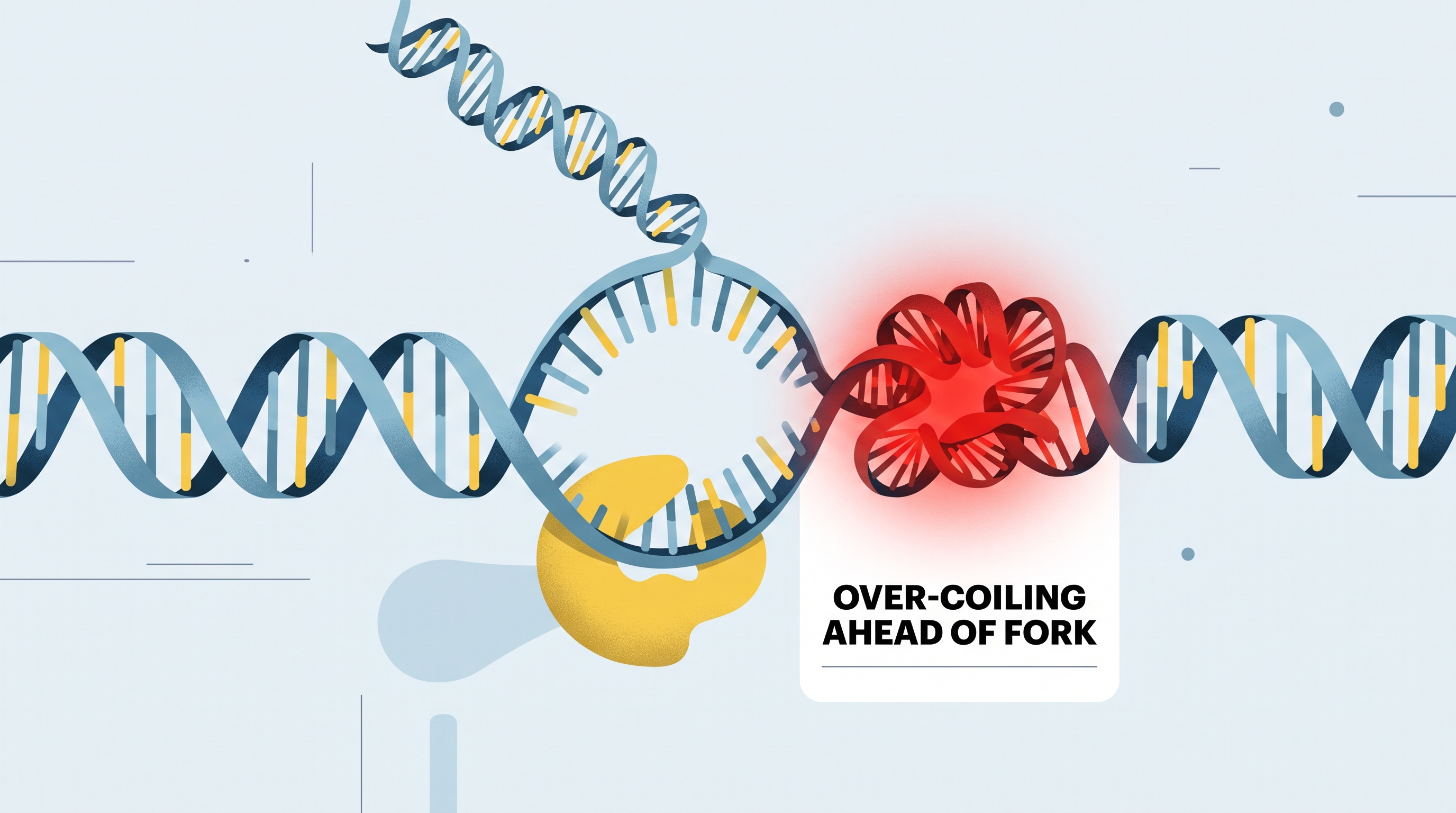
- Unwinding creates twisting stress, or supercoiling, ahead of the fork.
- Topoisomerase relaxes supercoiling in front of the replication fork, preventing the DNA from becoming excessively twisted or damaged.
- Short RNA primers provide starting points.
- DNA polymerase extends the primers with new DNA nucleotides.
- The leading strand is copied continuously, while the lagging strand is copied discontinuously.
- DNA ligase joins the fragments on the lagging strand.
| Component | Immediate problem | Role in replication |
|---|---|---|
| Helicase | The template strands are still paired | Unwinds the DNA |
| Topoisomerase | Unwinding creates supercoiling ahead of the fork | Relaxes twisting |
| RNA primer | DNA polymerase cannot start from nothing | Provides a nucleic-acid starting point |
| DNA polymerase | The new strand must be built | Adds complementary DNA nucleotides |
| DNA ligase | The lagging strand contains separate pieces | Joins the pieces into one strand |
Why primers are necessary
DNA polymerase requires RNA primers to initiate DNA synthesis. A primer is a short RNA segment complementary to the template strand. It supplies an available chemical end from which DNA polymerase can add nucleotides; DNA polymerase extends an existing strand but does not independently create the first bond of a new strand.
This requirement explains why replication is not simply “DNA polymerase reads the old strand and makes a new one.” First, an RNA primer must mark a usable starting point. DNA polymerase then builds the DNA strand complementary to the template, preserving the base-pairing relationship established by the original molecule.
Leading and lagging strands
The leading strand is synthesized continuously as the replication fork opens. DNA polymerase can follow the helicase and add nucleotides in one uninterrupted stretch.
The lagging strand is synthesized discontinuously because its template orientation points away from the direction in which the fork opens. DNA polymerase therefore builds short DNA segments, each beginning from an RNA primer. These segments must later be connected by DNA ligase.
A useful mental model is road construction at a widening fork. One crew can pave a continuous lane in the direction the road is expanding: this represents the leading strand. The other crew must repeatedly build short sections in the opposite orientation, then seal the gaps between sections: this represents the lagging strand and ligase.
Worked example: predicting the effect of an enzyme defect
Suppose a mutation prevents topoisomerase from functioning during DNA replication. Helicase could still begin separating the DNA strands, but twisting stress would accumulate ahead of the replication fork. The fork would eventually stall or the DNA could become damaged because unwinding is occurring without relaxation of supercoiling.
Now suppose instead that DNA ligase is defective. DNA polymerase could still synthesize the leading strand and produce individual pieces on the lagging strand, but those pieces would remain disconnected. The daughter DNA molecule would contain an incomplete, discontinuous backbone rather than one intact strand.
Misconception check: “The lagging strand is copied backward”
Misconception: DNA polymerase reverses direction on the lagging strand. Correction: DNA polymerase does not reverse its synthesis direction. It always extends the new strand in the same chemical direction; the lagging strand appears discontinuous because its template orientation requires repeated synthesis from multiple RNA primers.
Another common error is to treat helicase and topoisomerase as interchangeable. Helicase separates the paired DNA strands at the fork; topoisomerase acts ahead of the fork to relieve the supercoiling produced by that separation.
AP alignment: representation and reasoning
The CED Suggested Skill: Representations, 2.B — Explain relationships between characteristics of biological models in both theoretical and applied contexts is central here. In a replication-fork diagram, the student should connect each visual feature to a mechanism: the Y-shape represents unwinding, the continuous line represents leading-strand synthesis, short segments represent lagging-strand synthesis, and small connecting sites represent ligase action.
The CED required-content sequence includes: iv. Topoisomerase relaxes supercoiling in front of the replication fork; v. DNA polymerase requires RNA primers to initiate DNA synthesis; vi. DNA polymerase synthesizes new strands of DNA continuously on the leading strand and discontinuously on the lagging strand; vii. Ligase joins the fragments on the lagging strand. The names of additional steps and enzymes beyond helicase, topoisomerase, DNA polymerase, RNA polymerase, and ligase are outside the stated AP scope.
Retrieval check
At a replication fork, helicase is active but topoisomerase is inhibited. What immediate physical problem develops, and why would DNA ligase not solve it? A strong answer identifies accumulating supercoiling ahead of the fork and explains that ligase joins lagging-strand fragments only after synthesis; it does not relax twisted parental DNA.