From the free course AP Biology on Lykke
4.4 Feedback
A biological system stays within workable limits because its outputs can alter the process that produced them. This self-regulation is feedback: information about a system’s condition is used to adjust the system’s activity.
4.4 Feedback
A biological system stays within workable limits because its outputs can alter the process that produced them. This self-regulation is feedback: information about a system’s condition is used to adjust the system’s activity.
Learning Objective 4.4.A: Explain how feedback mechanisms regulate biological processes.
Essential Knowledge 4.A.2: Biological systems interact with one another and with their environments, producing regulation and emergent properties.
Negative feedback: correcting a deviation
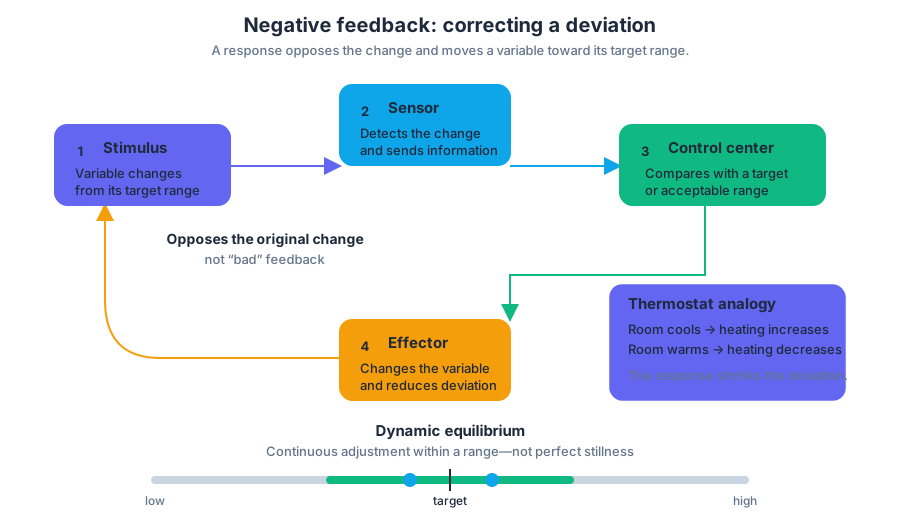
Negative feedback reduces the original stimulus. It does not mean “bad” feedback; it means that the response opposes a change and moves a variable back toward a target range. A useful analogy is a household thermostat: when room temperature falls below the set point, heating increases; as the room warms, heating decreases.
A negative-feedback loop usually contains four functional parts:
- Stimulus: a regulated variable changes.
- Sensor: a receptor detects the change.
- Control center: information is evaluated against a target or acceptable range.
- Effector: a response changes the variable, reducing the original deviation.
The regulated variable is not necessarily held at one perfectly fixed value. Body temperature, blood glucose concentration, and blood water potential fluctuate within ranges. Feedback therefore supports dynamic equilibrium—continuous adjustment rather than complete stillness.
Worked example: blood glucose after a meal
After a carbohydrate-rich meal, digestion increases the concentration of glucose in the blood. The pancreas detects this change and releases insulin, a hormone that acts as a chemical signal. Insulin promotes glucose uptake by many cells and encourages liver and muscle cells to store glucose as glycogen.
The reasoning chain is:
$$ \text{Meal} \rightarrow \text{blood glucose rises} \rightarrow \text{insulin secretion increases} $$
$$ \text{insulin} \rightarrow \text{cellular glucose uptake and storage} \rightarrow \text{blood glucose falls toward its normal range} $$
Because the response decreases the initiating change, this is negative feedback. If blood glucose falls too low, the pancreas releases glucagon, which promotes the breakdown of stored glycogen and the release of glucose into the blood. Insulin and glucagon therefore act in opposing pathways that help regulate the same variable.
Positive feedback: amplifying a process
Positive feedback strengthens the original stimulus. The response produces more of the signal or activity, pushing the process farther in the same direction. Positive feedback is useful when a biological event must proceed rapidly to completion, but it usually requires a stopping event or endpoint.
During childbirth, stretching of the cervix stimulates nerve signals to the hypothalamus, which promotes release of oxytocin from the posterior pituitary. Oxytocin increases uterine contractions; stronger contractions cause more cervical stretching, which promotes additional oxytocin release.
$$ \text{cervical stretching} \rightarrow \text{oxytocin} \rightarrow \text{stronger contractions} \rightarrow \text{more stretching} $$
The loop ends when childbirth is complete and cervical stretching is removed. Blood clotting provides another example: activated platelets release signals that recruit and activate additional platelets until the damaged area is sealed.
Do not confuse feedback with a simple cause-and-effect chain
A pathway is feedback only when a later outcome influences the activity of an earlier part of the process. A signal causing a response is not automatically feedback. For example, a hormone binding to a receptor is signal transduction; feedback occurs when the resulting response changes the stimulus, signal production, or pathway activity.
Misconception check: “Negative feedback stops a process completely.”
Correction: Negative feedback usually decreases the process enough to restore a regulated range. It is an adjustment, not necessarily an off switch.
Another common error is labeling every increase as positive feedback. An increase is positive feedback only when it amplifies the initiating change. If blood glucose rises and insulin increases but glucose then falls, the overall loop is negative feedback.
AP science practices in feedback problems
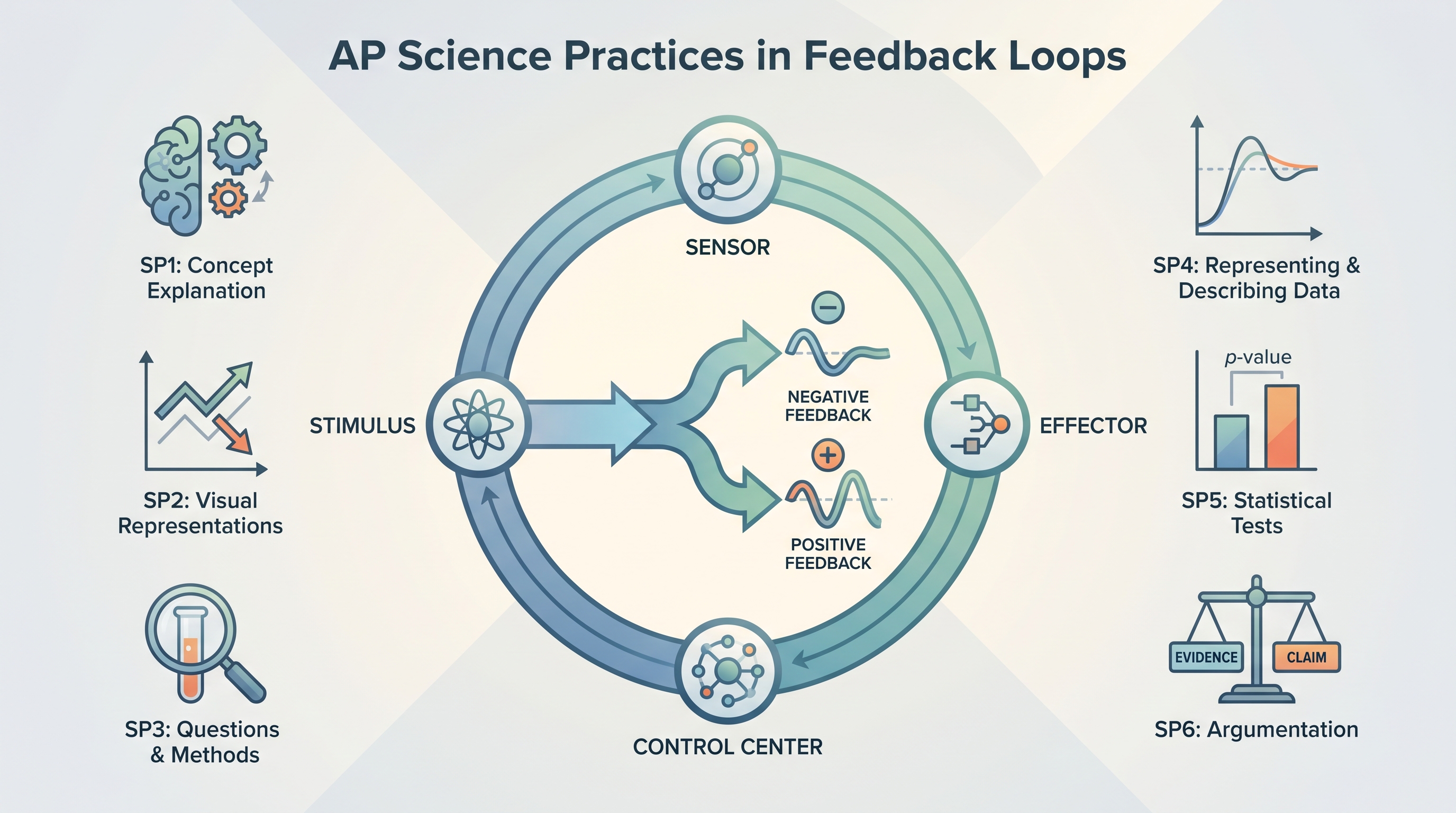
Feedback is commonly assessed through all six official science practices:
- Science Practice 1: Concept Explanation — explain how a stimulus, sensor, control center, and effector interact.
- Science Practice 2: Visual Representations — construct or interpret arrows showing whether a response opposes or amplifies a change.
- Science Practice 3: Questions and Methods — identify variables and design a test of whether disrupting a sensor or hormone alters regulation.
- Science Practice 4: Representing and Describing Data — graph a regulated variable over time and identify recovery, overshoot, or amplification.
- Science Practice 5: Statistical Tests and Data Analysis — determine whether treatment and control responses differ enough to support a feedback claim.
- Science Practice 6: Argumentation — use evidence from a graph or experiment to justify that a mechanism is negative or positive feedback.
Retrieval check: Blood calcium falls, causing increased secretion of a hormone that raises blood calcium back toward its normal range. Is this positive or negative feedback, and what feature of the loop proves your answer?