AP United States History
Institution: MIT
171 study materials · 62 sections
AP United States History students working the current College Board Course and Exam Description, including first-time students with no prior background in the subject, plus teachers reviewing the page for CED alignment.; Teach every official CED unit and every numbered topic at topic granularity, one page per topic.; Develop every AP skill / science-practice code explicitly and by name.; Replace description with teaching: worked contextual examples, named misconceptions, and in-flow retrieval checks on every topic.; Build an exam-practice unit covering every task type on the current exam.
Course Sections
Course Framework, Skills and Reasoning Processes
Key concepts: AP U.S. History course framework and curriculum design · College- and university-level expectations · Historical thinking skills · Analysis of primary and secondary sources · Evaluation of diverse historical evidence and perspectives · Constructing historical arguments in writing · Founding documents and their influence on American history · Use of individuals, events, and documents to trace ideas and themes · Student prerequisites and academic readiness · Optional unit sequencing and teacher-designed curricula
AP U.S. History is an introductory college-level course spanning approximately $1491$ to the present, but it has no formal prerequisites: students should be able to read a college-level textbook and write grammatically correct, complete sentences.
Course Framework, Skills and Reasoning Processes
AP U.S. History is an introductory college-level course spanning approximately $1491$ to the present, but it has no formal prerequisites: students should be able to read a college-level textbook and write grammatically correct, complete sentences.
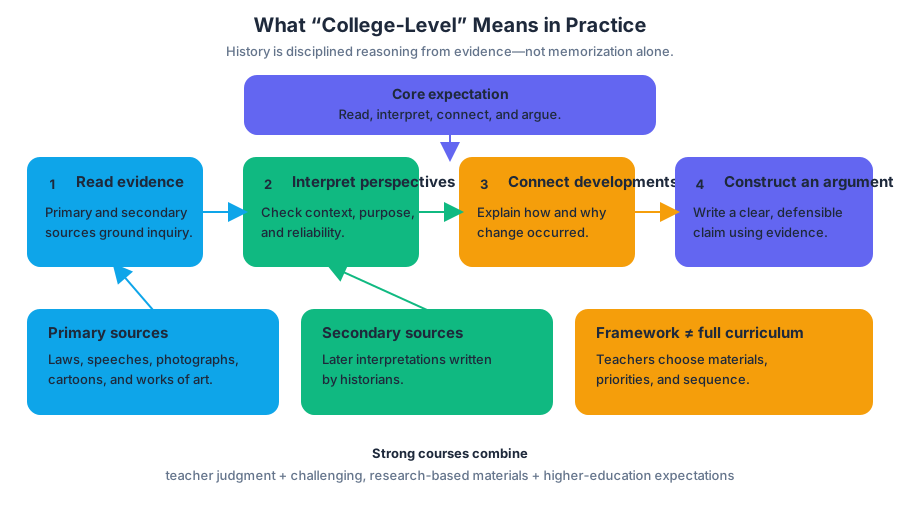
What “college-level” means in practice
College-level history is not the memorization of an endless list of names and dates. It is the disciplined use of evidence to explain how and why historical developments occurred. Students read primary sources created during the period—such as laws, speeches, photographs, political cartoons, and works of art—and secondary sources written later by historians, then evaluate perspective, context, purpose, and reliability.
Core expectation: Read evidence, interpret perspectives, connect developments, and construct a defensible historical argument in writing.
Teachers select the specific textbooks, individuals, events, and documents used in instruction. The Course Framework establishes required content and historical thinking expectations, but it is not a complete curriculum, and its chronological unit sequence is optional. A strong curriculum therefore combines teacher judgment and local priorities with challenging, research-based materials aligned to higher-education expectations.
The framework’s organizing architecture
The framework is grounded in themes: cross-cutting concepts that build understanding and reappear across different periods. Themes prevent history from becoming a series of isolated episodes. For example, WXT: Work, Exchange, and Technology can connect colonial labor systems, industrial capitalism, and the post-1945 economy; MIG: Migration and Settlement can connect Indigenous societies, westward expansion, immigration, and modern migration.
The eight recurring themes are NAT: American and National Identity, PCE: Politics and Power, WXT: Work, Exchange, and Technology, WOR: America in the World, GEO: Geography and the Environment, MIG: Migration and Settlement, ARC: American and Regional Culture, and SOC: Social Structures. A single event usually belongs to several themes at once: the Mexican–American War, for instance, involves national identity, territorial expansion, diplomacy, geography, and slavery-related sectional conflict.
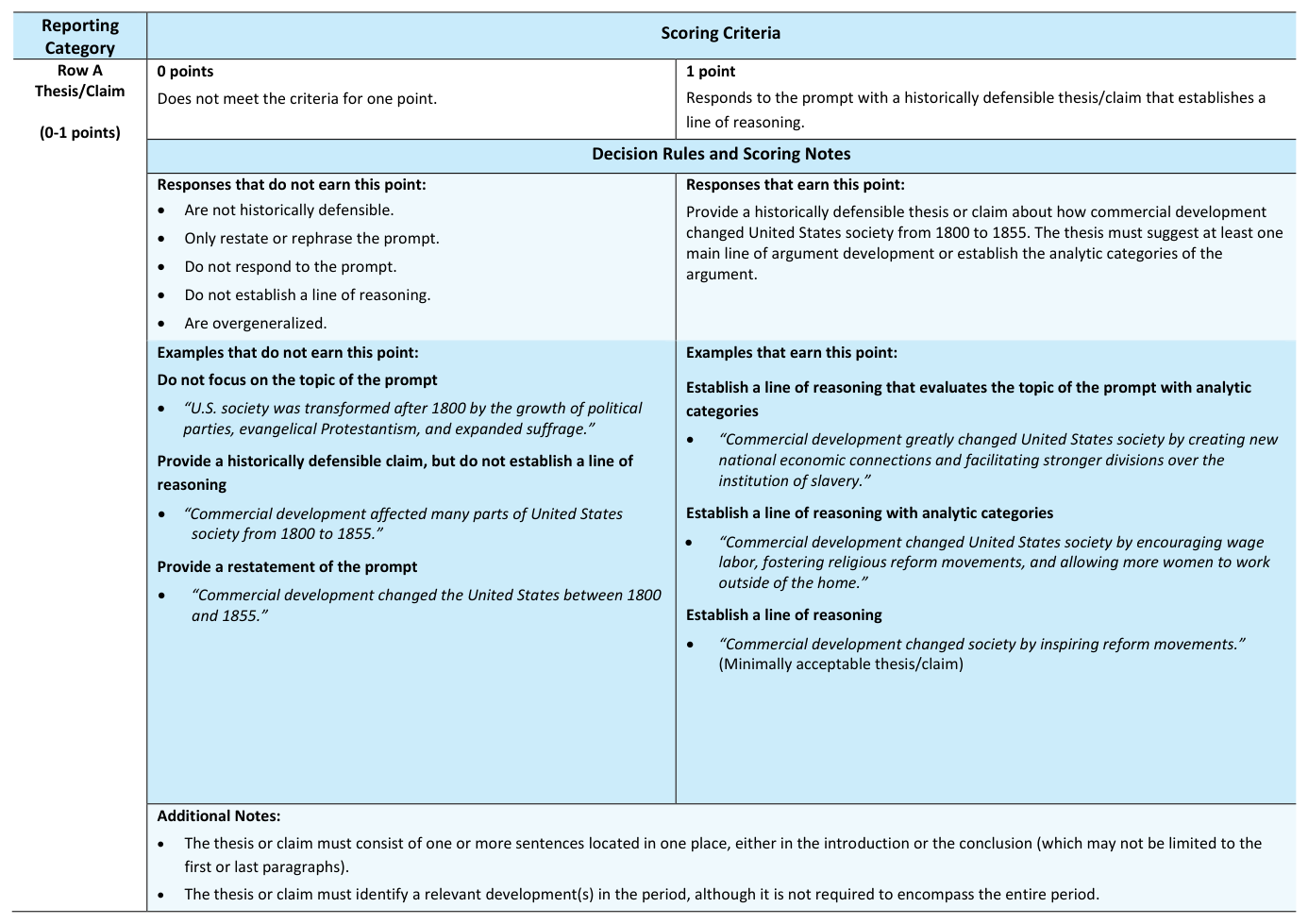
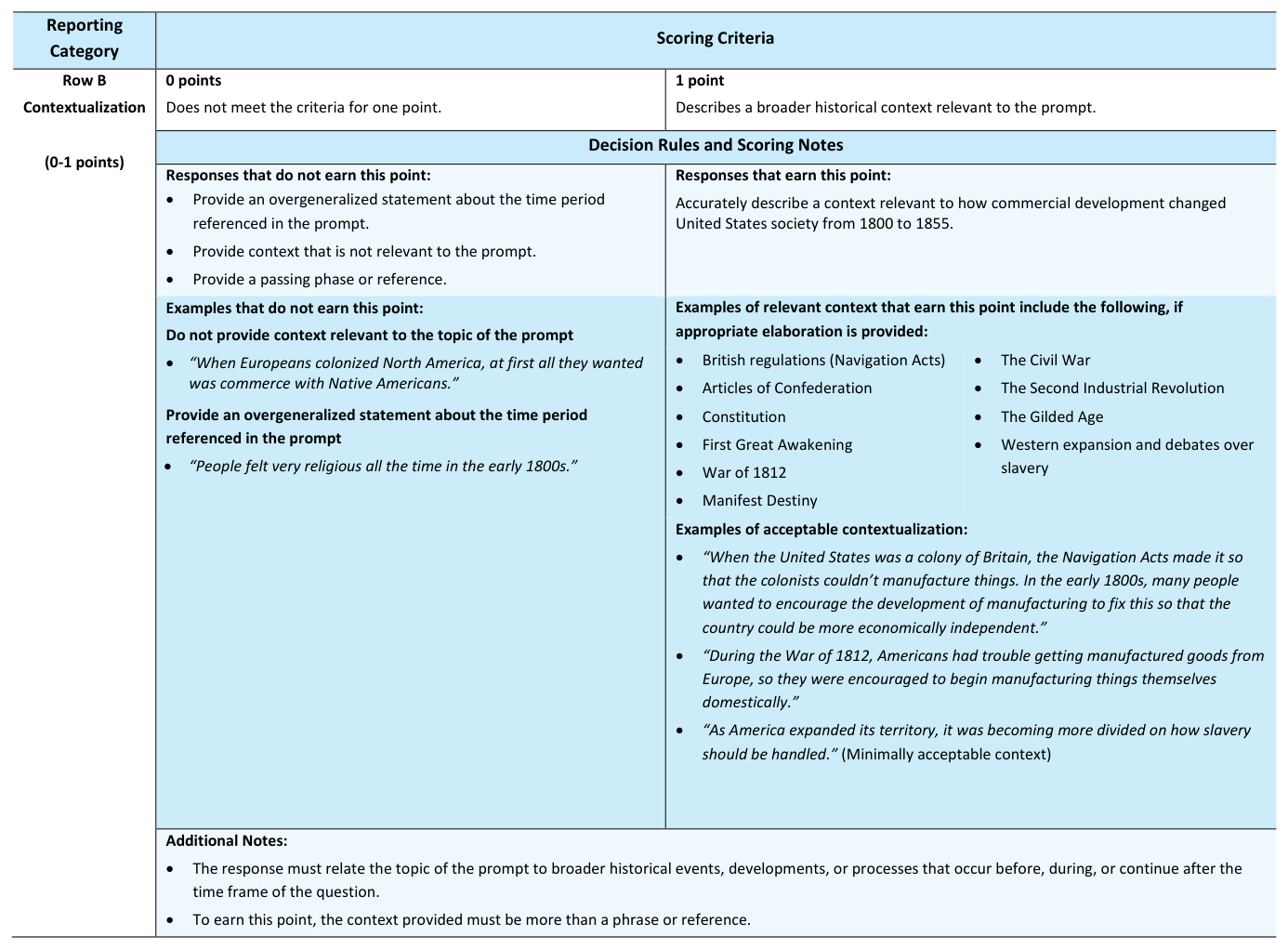
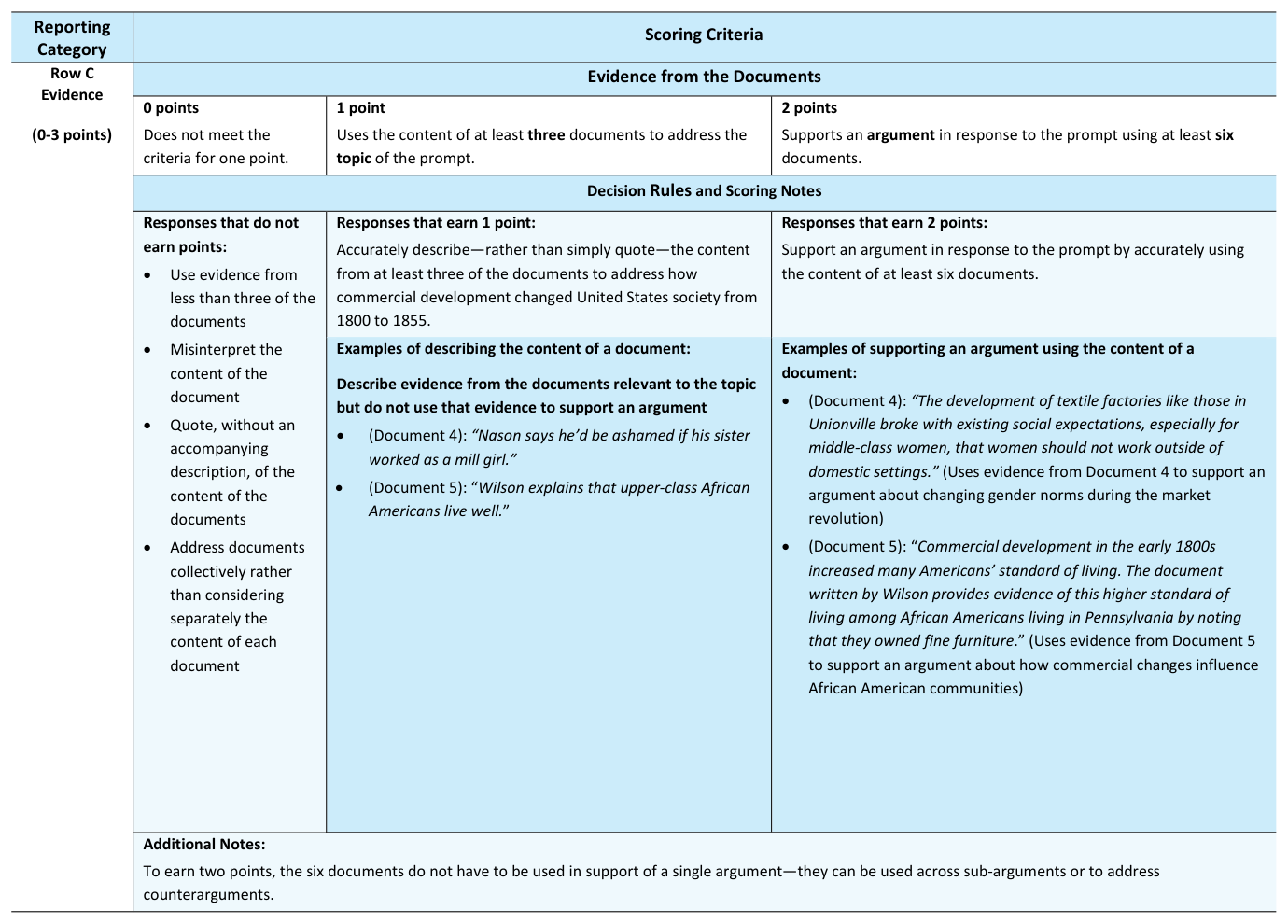
| Historical thinking skill | What the historian does |
|---|---|
| Skill 1: Developments and Processes | Identifies and explains significant historical developments and processes |
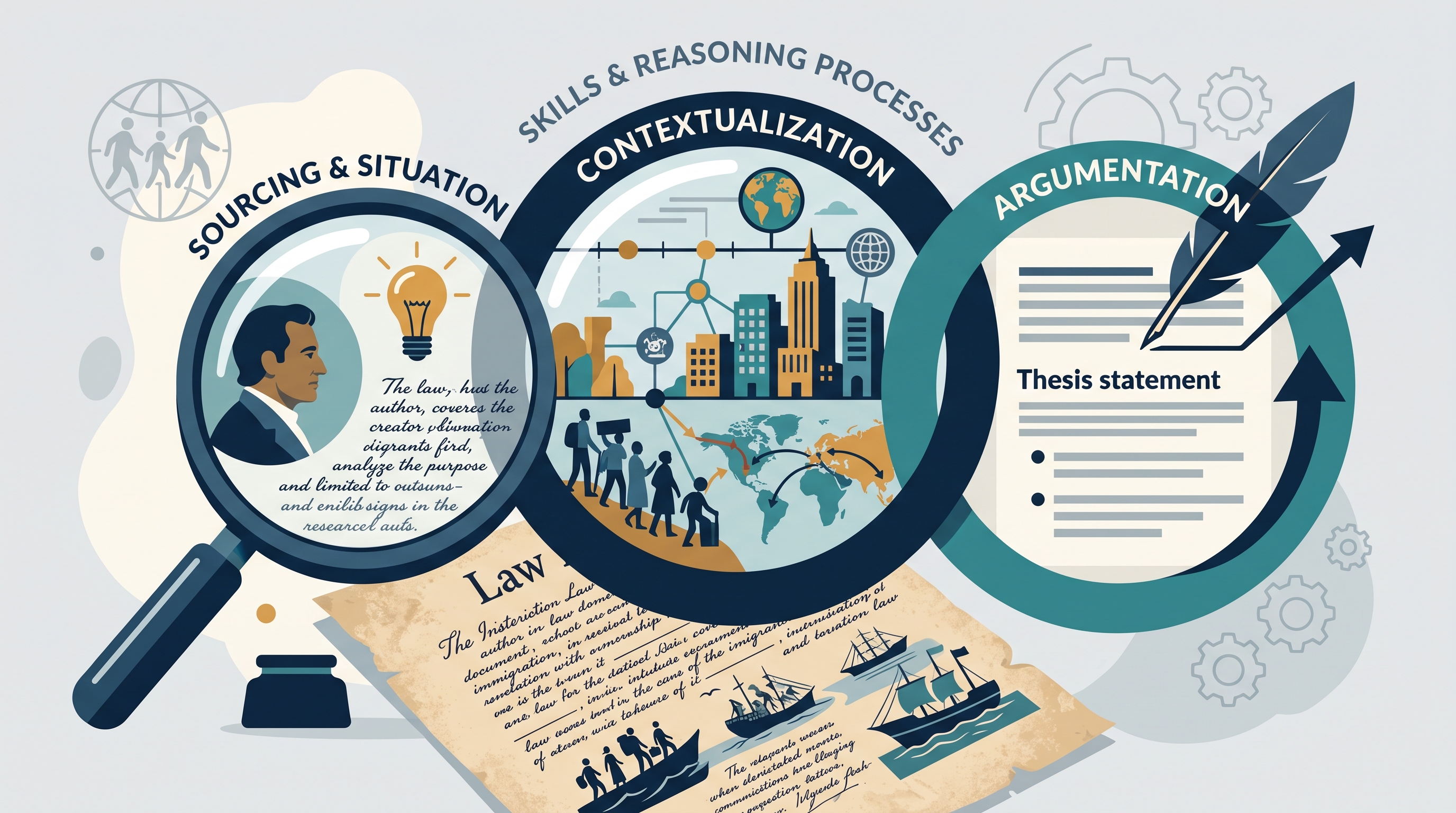
| Skill 2: Sourcing and Situation | Analyzes a source’s point of view, purpose, historical situation, and/or audience |
| Skill 3: Claims and Evidence in Sources | Evaluates claims and uses evidence from sources |
| Skill 4: Contextualization | Connects a development to broader regional, national, or global circumstances |
| Skill 5: Making Connections | Explains relationships among historical developments |
| Skill 6: Argumentation | Constructs a historically defensible argument using evidence and reasoning |
How historical thinking works
These skills operate as a chain rather than as separate tricks. Suppose a student reads a colonial law regulating labor. Skill 2: Sourcing and Situation asks who issued it, when, for what purpose, and for which audience. Skill 3: Claims and Evidence in Sources asks what the law reveals—and what it cannot reveal—about labor conditions. Skill 4: Contextualization places the law within imperial expansion, Indigenous dispossession, and labor demand. Skill 5: Making Connections links it to later racial and economic hierarchies. Skill 6: Argumentation turns those observations into a claim supported by precise evidence.
Worked example: A student examining the Declaration of Independence should not merely identify its date, $1776$. The student can explain how Enlightenment ideas and imperial disputes provide context; analyze the document’s purpose in justifying separation; identify its language about equality as evidence of revolutionary ideals; and connect those ideals to later debates over slavery, women’s rights, and civil rights. The argument becomes stronger when it distinguishes the document’s universal language from the unequal society in which it was written.
Founding documents as historical evidence
The Declaration of Independence, Constitution, Bill of Rights, and Federalist Papers deserve sustained attention because their ideas and debates influenced pivotal moments throughout American history. “Command” of these documents means more than recalling their provisions: students should recognize arguments, identify tensions, and trace how later Americans invoked, contested, or reinterpreted them.
A common misconception is that founding documents express a single, settled national meaning. In reality, they contain competing principles and emerged from conflict. The Constitution, for example, created a stronger national government while leaving major questions—including the status of slavery and the balance between federal and state authority—to ongoing political struggle.
Misconception check: A founding document is not automatically a neutral description of society. It is also an argument produced by particular people, for particular purposes, in a particular historical situation.
Evidence, perspectives, and written argument
Students are expected to analyze a wide array of historical evidence and perspectives, including voices that differ by region, race, gender, class, political position, and relationship to power. Diverse evidence makes historical reasoning more accurate: a government report may reveal official policy, while a personal letter, protest song, oral testimony, image, or newspaper may expose experiences and criticisms that policy documents omit.
On the AP U.S. History Exam, students read and analyze primary and secondary sources, draw evidence from them, and connect that evidence to their own historical knowledge. The skills therefore appear across multiple task types: selected-response questions test interpretation and connections; short-answer questions require concise evidence-based reasoning; and extended writing asks students to contextualize, use evidence, and construct an argument.
Retrieval check
A law is passed during a period of intense immigration. Name the skill that asks you to examine the law’s author and purpose, the skill that places it in broader circumstances, and the skill that turns your interpretation into a defensible written claim. Answer: Skill 2: Sourcing and Situation, Skill 4: Contextualization, and Skill 6: Argumentation.
1.1 Contextualizing Period 1 · 1.2 Native American Societies Before European Contact
Key concepts: Contextualization · Native American societies before European contact · Maize cultivation · Geography and the environment · Economic development · Settlement patterns · Advanced irrigation · Social diversification · Algonquian societies · Historical source analysis
How did Native American societies turn environmental limits into different ways of living before 1607? The answer begins with geography: maize cultivation supported permanent settlements and social complexity in some regions, while aridity and grasslands encouraged mobility in others.
1.1 Contextualizing Period 1 · 1.2 Native American Societies Before European Contact
How did Native American societies turn environmental limits into different ways of living before 1607? The answer begins with geography: maize cultivation supported permanent settlements and social complexity in some regions, while aridity and grasslands encouraged mobility in others. Period 1, defined as 1491–1607, is not a story of one “Native American” society but of many societies adapting to distinct environments and interacting with one another.
Investigative question: How and why did various native populations in the period before European contact interact with the natural environment in North America?
The central pattern: environment shaped choices
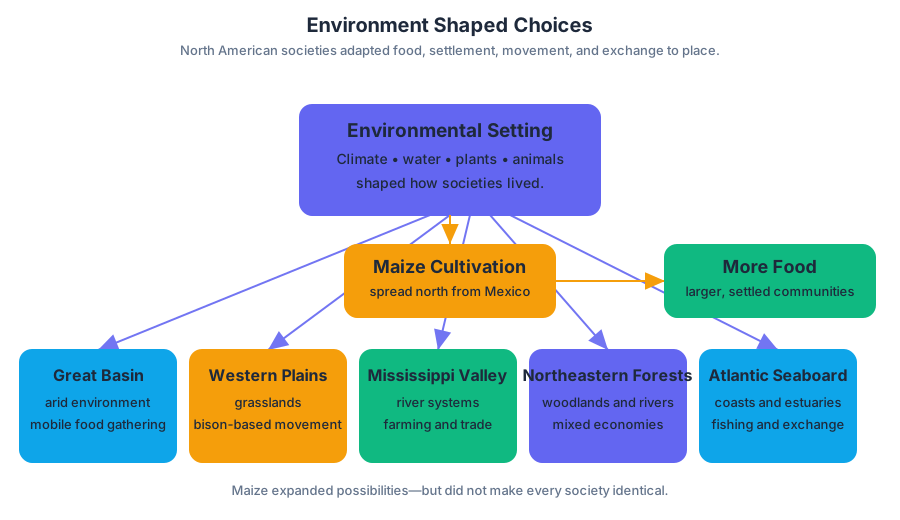
Contextualization means placing a historical development within the broader conditions that shaped it. For Topic 1.1, the essential context is that North America contained sharply different environments: the arid Great Basin, the grasslands of the western Great Plains, the river systems of the Mississippi Valley, the forests of the Northeast, and the Atlantic seaboard. These settings affected food production, settlement patterns, movement, economic development, and relationships among societies.
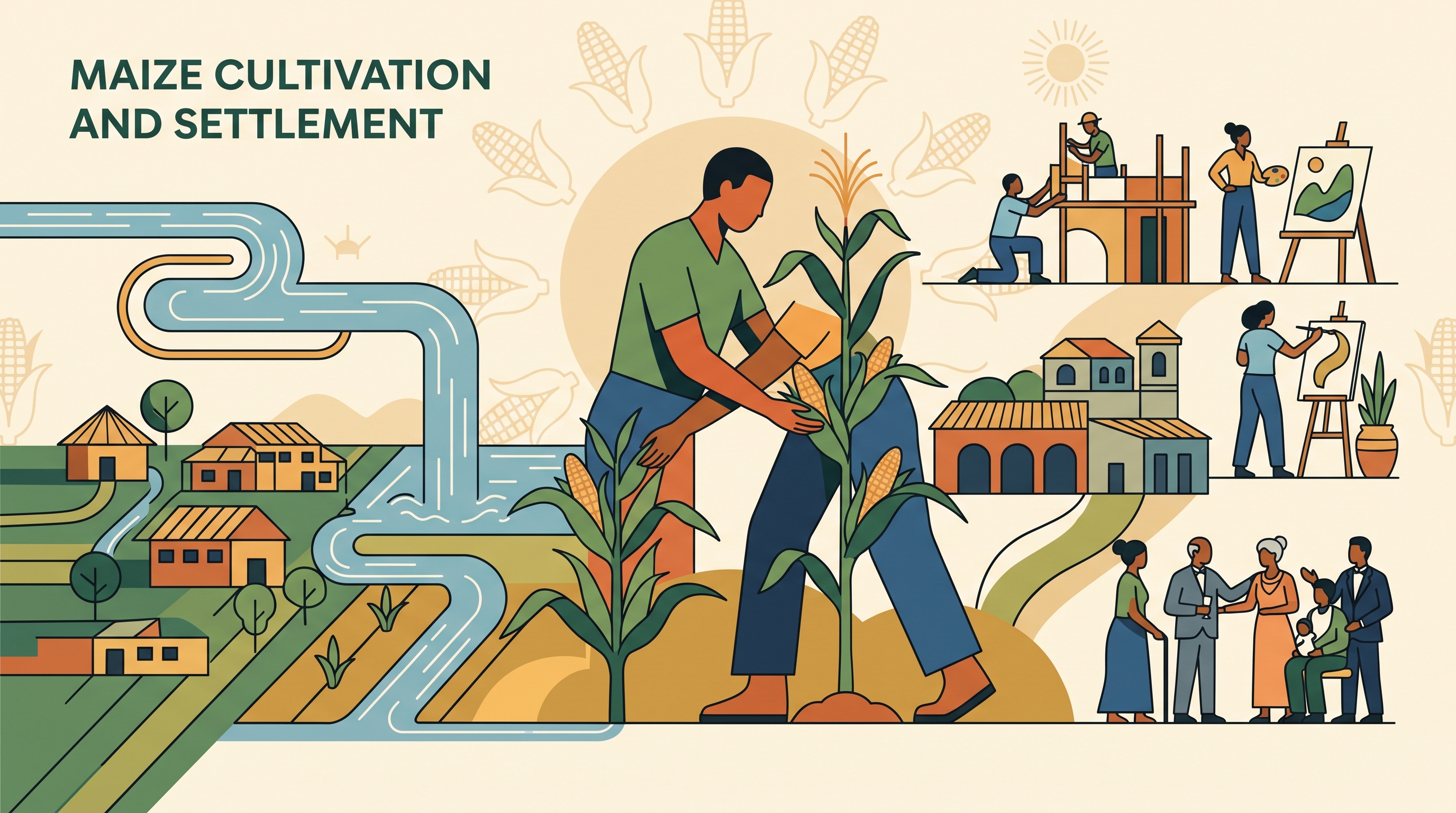
The most important development was the spread of maize cultivation, or the farming of corn, northward from present-day Mexico into the present-day American Southwest and beyond. Maize did not make every society identical. Instead, where climate and water permitted, it expanded the food supply and supported larger, more permanent communities.
Maize, irrigation, and social diversification
The causal chain is worth memorizing because it explains several required ideas at once:
- Maize spread northward from present-day Mexico.
- Reliable cultivation supported economic development, because communities could produce and store agricultural surpluses.
- Surpluses encouraged settlement, including permanent villages.
- In dry regions, farming required advanced irrigation systems to direct scarce water to fields.
- Larger, more settled communities became increasingly socially diversified, meaning that people performed different economic, political, and religious roles.
This development is identified in KC-1.1.I.A and is tied to Unit 1: Learning Objective B: explain how and why various native populations before European contact interacted with the natural environment in North America. The key is not merely to state that maize existed. A strong historical explanation shows how agriculture changed population size, settlement, technology, and social organization.
Worked contextual example
Suppose a historian compares an irrigated agricultural community in the Southwest with a society living in the Great Basin. The Southwest community could use canals or other irrigation techniques to move water toward maize fields. That food system could support a permanent settlement and specialized roles such as farming, construction, leadership, or religious activity. By contrast, the Great Basin’s aridity made intensive agriculture more difficult, so societies often developed largely mobile lifestyles, moving to make use of seasonally available resources. The difference is not that one society was “advanced” and the other was not; each represented an adaptation to environmental conditions.
Regional adaptations and interaction
KC-1.1.I.B identifies the mobile lifestyles that developed in response to the aridity of the Great Basin and the grasslands of the western Great Plains. KC-1.1.I.C emphasizes that in the Northeast, the Mississippi River Valley, and along the Atlantic seaboard, some societies combined agriculture with hunting and gathering. This mixed economy favored permanent villages while allowing communities to draw on multiple food sources.
These regional differences shaped interaction. Societies exchanged goods, competed over resources, migrated, formed alliances, and responded to one another’s presence. The environment did not mechanically determine behavior; rather, it created opportunities and constraints within which people made decisions. This is the broader GEO (Geography and the Environment) theme: geography shapes human development, while human communities also reshape geography through farming, settlement, and irrigation.
Reading visual evidence: Roanoke
The Roanoke engravings by Theodor de Bry, based on John White’s work and published in 1590, depict Indigenous people and aspects of Algonquian life on the eve of colonial contact. A visual source can provide evidence about clothing, settlement, labor, tools, food production, and social activity—but historians must ask what the image shows, who created it, and when it was published. The image is evidence of Indigenous life as represented by European observers, not a perfectly neutral photograph.
Misconception check
Misconception: “Native American societies were either nomadic hunters or settled farmers.” The reality was more varied. Some communities were largely mobile; others lived in permanent villages; and some combined agriculture with hunting and gathering. Environmental adaptation produced diversity rather than a single universal pattern.
Retrieval check
Explain the relationship among maize cultivation, irrigation, settlement, and social diversification. Then identify one environmental reason a society in the Great Basin or western Great Plains might develop a largely mobile lifestyle. A complete answer should name the environmental condition, the adaptation, and the resulting settlement pattern.
1.3 European Exploration in the Americas · 1.4 Columbian Exchange, Spanish Exploration, and Conquest
Key concepts: European motivations for exploration and conquest · European economic, military, religious, and political competition · Joint-stock companies and organized international trade · Transatlantic voyages and changes in European and American societies · Spanish exploration, conquest, and incorporation of diverse populations · Indigenous responses and resistance to colonial encroachment · The role of horses and livestock in conquest and colonial change · The transatlantic slave trade and Portuguese involvement in West Africa · Columbian Exchange-era social, cultural, political, and economic changes · Indigenous perspectives on Spanish conquest and colonial expansion
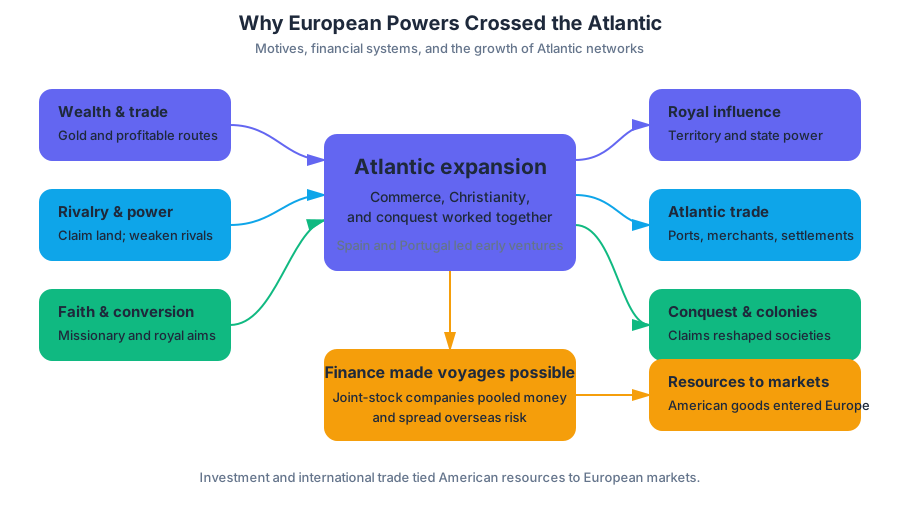
European expansion into the Americas was driven by three linked motives: the search for wealth, competition among European states, and the desire to spread Christianity.
1.3 European Exploration in the Americas · 1.4 Columbian Exchange, Spanish Exploration, and Conquest
European expansion into the Americas was driven by three linked motives: the search for wealth, competition among European states, and the desire to spread Christianity. The result was not simply “discovery,” but a transformation of societies across the Atlantic through exploration, conquest, migration, disease, trade, and cultural conflict.
Unit 1: Learning Objective A · KC-1.2.I: European expansion into the Western Hemisphere generated intense social, religious, political, and economic competition and changes within European societies.
Why European powers crossed the Atlantic
Spain and Portugal sought precious metals, profitable trade routes, and political influence. European monarchies also competed with one another: an expedition could claim territory, weaken a rival, and increase royal power. Catholic rulers and missionaries presented conversion as a religious purpose, but Christianity, commerce, and conquest usually operated together rather than separately.
New financial systems made expensive voyages possible. Joint-stock companies pooled money from many investors, spreading the risk of overseas ventures; organized international trade connected merchants, monarchies, ports, and colonial settlements. These arrangements helped shift European economies toward larger Atlantic networks and tied American resources to European markets.
Transatlantic voyages and the Columbian Exchange
Christopher Columbus’s 1493 letter to Luis de Santángel illustrates how a contemporary European source described the first voyage to the Americas. Such a source is useful but not neutral: Columbus emphasized the lands, peoples, and resources that might interest Spanish officials and investors. Its purpose helps explain why exploration accounts often framed Indigenous societies as opportunities for empire, conversion, and wealth.
The Columbian Exchange was the movement of plants, animals, diseases, people, and commercial practices between the Americas, Europe, and Africa after sustained contact began. Its effects were demographic, economic, geographic, social, cultural, and political.
| Movement or development | Historical effect |
|---|---|
| European diseases | Epidemics caused catastrophic population losses among Indigenous peoples who lacked previous exposure to many Old World pathogens. |
| Horses | Spanish cavalry gained mobility and military advantages; horses later reshaped Indigenous travel, hunting, and warfare in parts of North America. |
| Cattle and pigs | Livestock altered landscapes and produced conflicts when animals damaged Indigenous crops and territory. |
| Wheat | An Old World crop supported new agricultural, milling, and trade economies, including colonial Pennsylvania’s movement from cultivation to milling, barreling, and export. |
| Enslaved Africans | Portuguese Atlantic networks connected West Africa, Europe, and American colonization. |
Portugal established trading forts and commercial networks along the West African coast. Portuguese merchants and officials participated in the capture and purchase of enslaved Africans through existing and expanding regional networks, then transported enslaved people across the Atlantic. A letter from Dom João III to the king of Kongo illustrates Portugal’s role in this West African trade and shows how Atlantic expansion linked African political relationships to American colonization. The later development of colonial labor systems depended on this connection, but the key point here is the formation of the transatlantic network itself.
The exchange also generated conflict over land use. Lion Gardener’s account of Narragansett leader Miantonomi records a call for Indigenous unity against colonial encroachment, including trespass and damage caused by cattle and other livestock. A 1662 Virginia law forbidding Indigenous people from killing English hogs reveals the unequal political response: colonial authorities protected settlers’ animals even when those animals threatened Indigenous land and food systems.
Spanish exploration and conquest
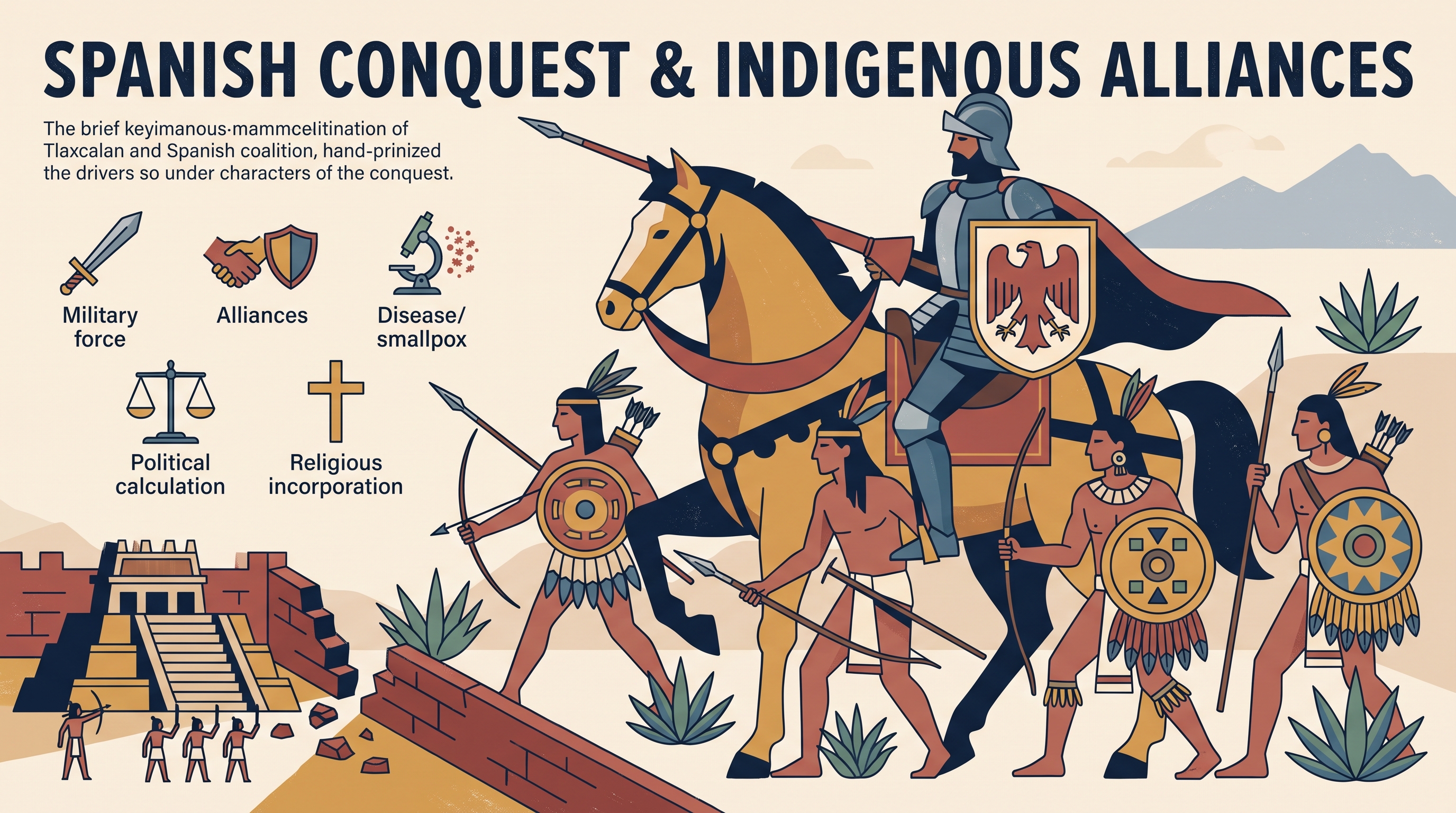
Spanish conquest combined military force, alliances, disease, political calculation, and religious incorporation. Spanish forces did not defeat large Indigenous states through European weapons alone; they also exploited divisions among Indigenous communities and recruited allies who opposed imperial rule.
The Lienzo de Tlaxcala, created around 1550, presents the conquest of Mexico from a Tlaxcalan perspective. Its images of Spanish soldiers on horseback record the military importance of horses, while the document’s viewpoint reminds us that Indigenous allies were historical actors rather than passive observers. The same visual tradition depicts the Mixton War, demonstrating that Spanish conquest continued to provoke resistance after initial victories.
Indigenous responses to Spanish exploration varied. Some communities formed alliances, negotiated, converted, or used Spanish institutions for their own purposes; others resisted directly or called for broader unity against colonial expansion. An Apache account of Oñate’s 1601 expedition illustrates that Spanish exploration was experienced as an encounter with armed outsiders entering Indigenous homelands—not as an empty-land “discovery.”
Worked historical reasoning example
Prompt: Identify one major theme affected by transatlantic voyages and support it with evidence.
Model reasoning: Choose geography and the environment. European cattle and pigs changed land use and damaged Indigenous fields, producing conflicts recorded by Gardener and reflected in Virginia’s livestock law. Horses altered warfare and mobility, as the Lienzo de Tlaxcala shows. Wheat created new agricultural and commercial landscapes. These examples support a defensible claim: transatlantic voyages transformed American environments, and those environmental changes redistributed power between colonizers and Indigenous communities.
AP skills and misconception check
This topic develops Skill 1: Developments and Processes, especially explaining how motives, voyages, conquest, and exchange produced connected changes. It uses Skill 2: Sourcing and Situation through Columbus’s letter, the Lienzo de Tlaxcala, the Apache account, and colonial laws; Skill 3: Claims and Evidence in Sources by connecting each source to a historical claim; Skill 4: Contextualization by placing Atlantic expansion within European competition and West African trade networks; Skill 5: Making Connections by linking environmental, demographic, economic, and political effects; and Skill 6: Argumentation by constructing a claim supported by specific evidence.
Misconception check: European conquest was not achieved by technology alone, and Indigenous peoples did not respond uniformly. Disease, alliances, internal rivalries, horses, weapons, religious institutions, and Indigenous resistance all mattered. Likewise, the Columbian Exchange was not an equal exchange of benefits: its effects were profoundly unequal, especially in Indigenous demographic loss and the expansion of coerced Atlantic labor.
Retrieval check: Explain how one European motive, one Atlantic institution or network, and one introduced organism changed societies in the Americas. Then name a source that would help you study the change and explain how its point of view shapes the evidence.
1.5 Labor, Slavery, and Caste in the Spanish Colonial System · 1.6 Cultural Interactions Between Europeans, Native Americans, and Africans
Explain and apply 1.5 Labor, Slavery, and Caste in the Spanish Colonial System · 1.6 Cultural Interactions Between Europeans, Native Americans, and Africans.
1.5 Labor, Slavery, and Caste in the Spanish Colonial System · 1.6 Cultural Interactions Between Europeans, Native Americans, and Africans
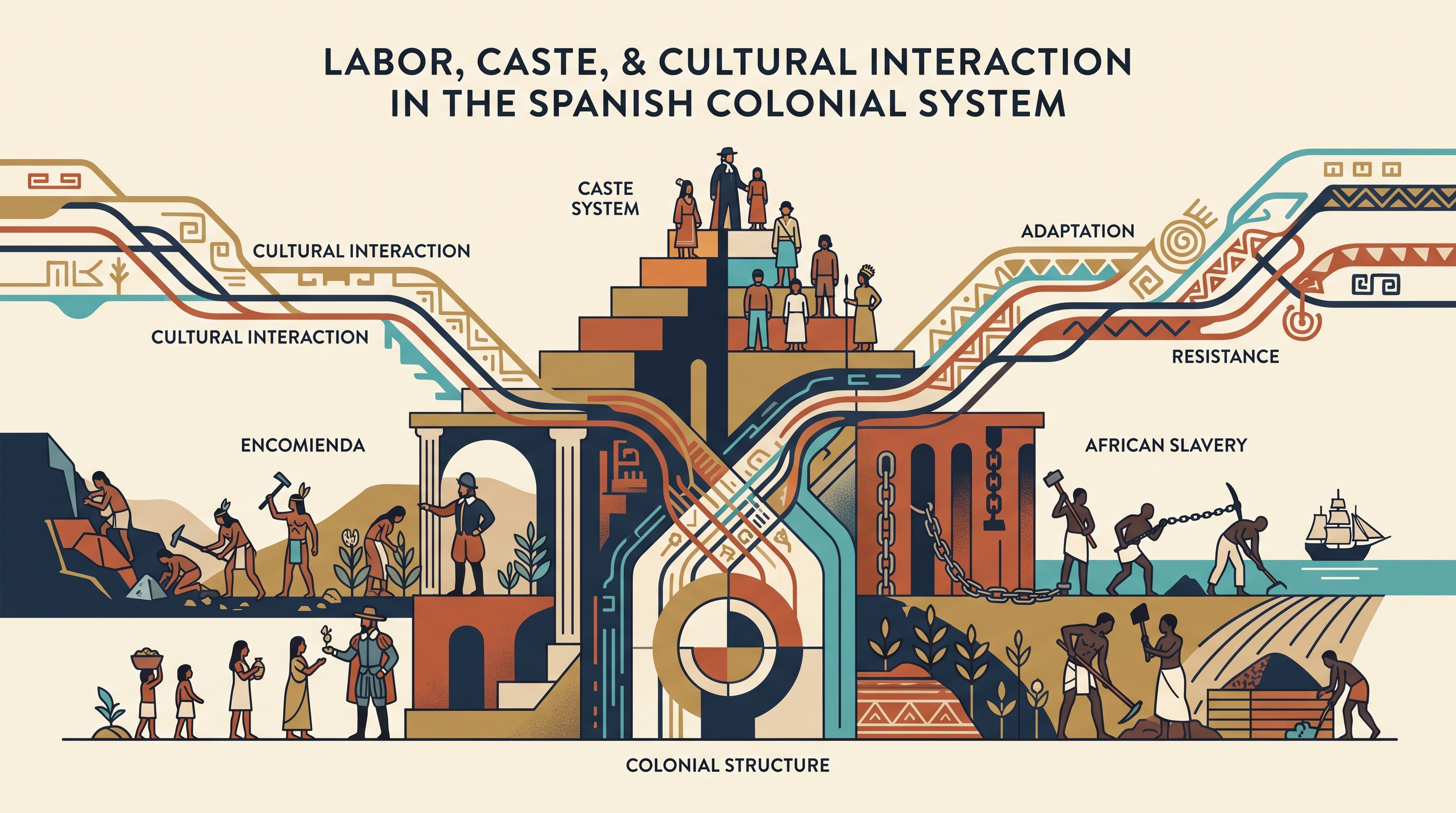
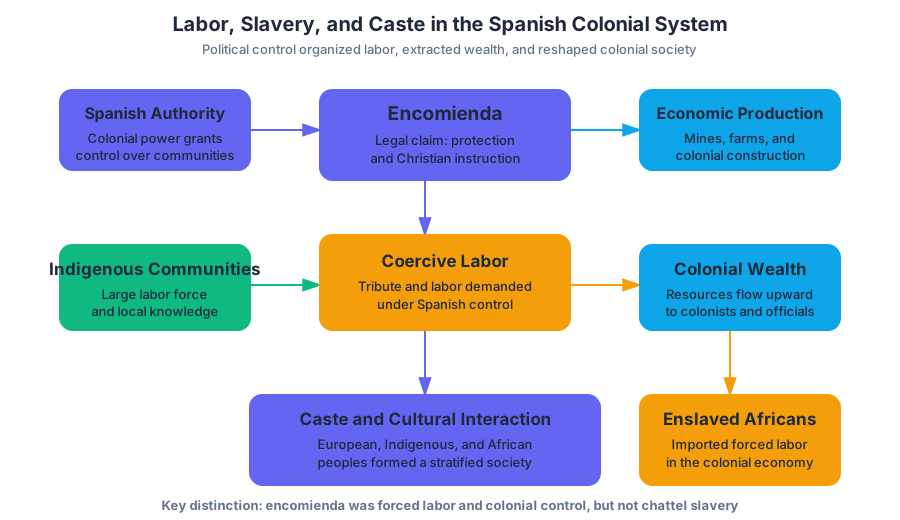
Spanish colonial society rested on a deliberate chain: labor extraction created wealth, wealth sustained empire, and racial classification organized the people forced to produce it. The result was not a simple Spanish-versus-Native American society, but a layered colonial world involving Europeans, Native Americans, and Africans.
The labor system: encomienda and exploitation
The encomienda system granted Spanish colonists authority over specified Native American communities. In theory, the encomendero—the holder of the grant—was supposed to protect Indigenous people and provide Christian instruction. In practice, the system frequently demanded tribute and labor in agriculture, mining, and construction under coercive conditions.
Key idea: The encomienda system was not the same as chattel slavery, but it subjected Native Americans to forced labor and placed them under Spanish colonial control.
The system connected political power to economic production. Spanish authorities and colonists needed workers for mines and plantations; Indigenous communities possessed local knowledge and represented a large labor force; colonial officials therefore organized Native labor into a structure that claimed legal justification while extracting wealth.
Essential Knowledge KC-1.2.II.C identifies the Spanish colonial society’s use of forced labor, including the encomienda system, and the importation of enslaved Africans. This distinction matters: Spanish expansion depended not only on conquest, but also on institutions that converted conquered populations into laborers.
African slavery and Atlantic labor
As Indigenous populations declined because of epidemic disease, warfare, and harsh labor conditions, Spanish colonists increasingly imported enslaved Africans. Spanish involvement also intersected with West African groups that practiced slavery and with the wider Atlantic trade that forcibly transported Africans to the Americas.
Enslaved Africans were used in plantation agriculture, mining, domestic service, and other forms of labor. Their presence was therefore structural rather than incidental: African labor helped sustain the imperial economy alongside Indigenous labor.
Worked example: Imagine a silver-mining region in Spanish America. The mine requires a large, disciplined workforce. Spanish authorities first compel nearby Native communities to provide labor or tribute through systems related to the encomienda. If the Indigenous workforce becomes smaller or harder to control, colonists purchase or transport enslaved Africans. The mine’s production thus reflects a sequence of conquest, forced labor, demographic crisis, and racialized Atlantic slavery.
Misconception check — “Spanish colonial slavery was only Indigenous.” This is incorrect. Spanish colonization exploited Native American labor and also expanded African slavery. The two systems could operate simultaneously, although their legal categories and social meanings differed.
The caste system: hierarchy made visible
The Spanish developed a caste system, a racialized hierarchy that classified people according to ancestry and place of origin. Europeans occupied the highest positions in colonial society, while Native Americans and Africans faced systematic subordination. People of mixed ancestry occupied intermediate categories whose status could vary according to racial classification, wealth, occupation, and local circumstances.
Essential Knowledge KC-1.2.II.D: The Spanish developed a caste system that incorporated, and carefully defined the status of, the diverse population of Europeans, Africans, and Native Americans in their empire.
The caste system did more than describe difference; it helped distribute privilege. Access to political office, legal treatment, social honor, land, and economic opportunity was shaped by racial identity. In this way, labor exploitation and social hierarchy reinforced one another: those assigned lower status were more vulnerable to coercion, while those at the top benefited from colonial institutions.
Cultural interactions and cultural change
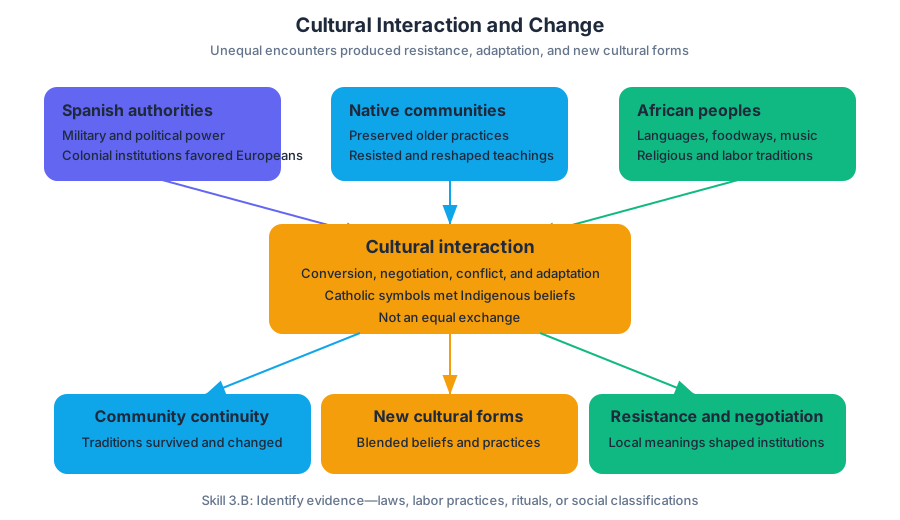
Cultural interaction produced conflict, adaptation, and new cultural forms. Spanish missionaries attempted to convert Native Americans to Catholicism, while Native communities preserved older practices, reshaped Christian teachings, or combined Catholic symbols with Indigenous beliefs. Africans also contributed languages, religious practices, foodways, music, and labor traditions to the societies being formed in the Americas.
These interactions were not equal exchanges. Spanish authorities possessed greater military and political power, and colonial institutions favored Europeans. Yet Native Americans and Africans were not passive recipients of European culture. They resisted coercion, negotiated with colonial authorities, maintained community traditions, and transformed imported institutions into practices with local meanings.
Skill 3.B — Identify the evidence used in a source to support an argument. When analyzing a source about Spanish America, locate the specific evidence the author uses: a law, labor practice, religious ritual, social classification, or testimony. Then explain how that evidence supports an argument about cultural interaction. For example, a source describing Catholic worship alongside Indigenous symbols may support the claim that conversion involved both Spanish pressure and Native adaptation.
Skill 5.A — Identify patterns among or connections between historical developments and processes. A strong connection links labor, demography, and culture: forced Indigenous labor contributed to population decline; population decline encouraged the importation of enslaved Africans; the presence of multiple peoples produced new cultural interactions; and the caste system attempted to control the resulting diversity.
Retrieval check
- How did the encomienda system extract Indigenous labor?
- Why did Spanish colonists import enslaved Africans?
- How did the caste system connect racial identity to power?
- Give one example showing that cultural interaction involved both coercion and adaptation.
A complete answer should connect encomienda, African slavery, and the caste system as parts of one colonial structure, while explaining that Native Americans and Africans shaped colonial culture even under unequal conditions.
1.7 Causation in Period 1
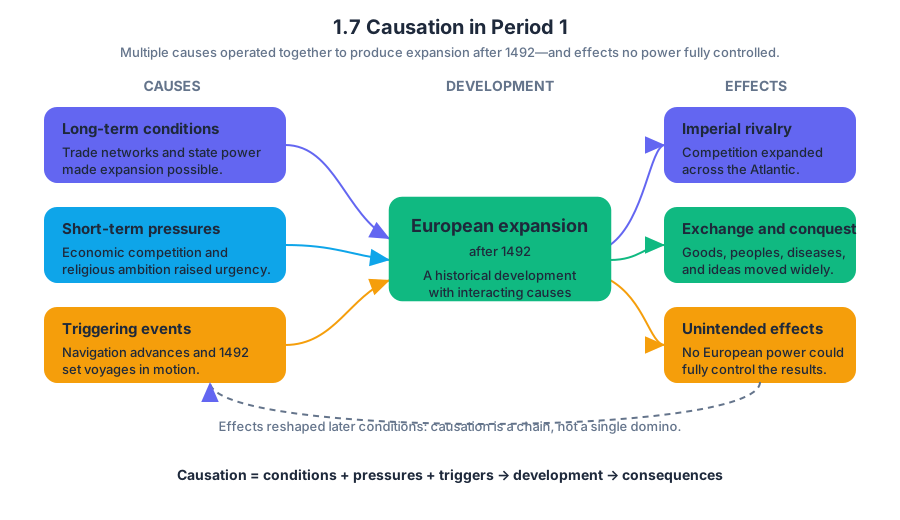
European expansion after 1492 did not result from a single motive. It emerged from a chain of causes—economic competition, religious ambition, technological change, and political rivalry—that produced consequences no European power could fully control.
1.7 Causation in Period 1
European expansion after 1492 did not result from a single motive. It emerged from a chain of causes—economic competition, religious ambition, technological change, and political rivalry—that produced consequences no European power could fully control. Causation means explaining how earlier conditions helped produce a historical development and how that development generated later effects.
CED traceability: Learning Objective 1.7.A, Essential Knowledge 1.7.A.1, and Skill 1: Developments and Processes—especially explaining the causes and effects of a historical development or process.
The key historical habit is to avoid treating causation like a single domino. A major development usually has several causes operating at different levels: long-term conditions make an event possible, short-term pressures make it likely, and triggering events set it in motion.
The Period 1 causal chain
The expansion of Europe into the Americas illustrates this layered structure:
- Long-term conditions: growth of centralized monarchies, Christian missionary goals, commercial ambitions, and competition among European states.
- Enabling factors: improved sailing technology, navigational knowledge, ship design, and access to Asian and African trade networks.
- Immediate motivations: the search for wealth, new trade routes, territorial claims, and opportunities to spread Christianity.
- Historical development: European voyages, colonization, Spanish conquest, and the creation of colonial labor systems.
- Consequences: the Columbian Exchange, demographic catastrophe among Native peoples, expansion of Atlantic slavery, new mixed societies, and intensified European rivalry.
The important distinction is between a cause and a condition. A cause helps produce an outcome; a condition creates the environment in which that outcome can occur. For example, Atlantic winds and improved ships helped make transoceanic travel possible, but they did not by themselves explain why monarchs financed voyages. Political competition and the pursuit of wealth supplied the motivation.
Worked example: Why did Spain conquer large American empires?
Suppose the question asks why Spanish conquest succeeded so rapidly in parts of the Americas. A weak answer names one factor: “Spain had better weapons.” A stronger causal explanation connects several factors and shows how they interacted.
Step 1—Identify the development: Spanish conquest brought regions such as the Aztec and Inca empires under Spanish control during the sixteenth century.
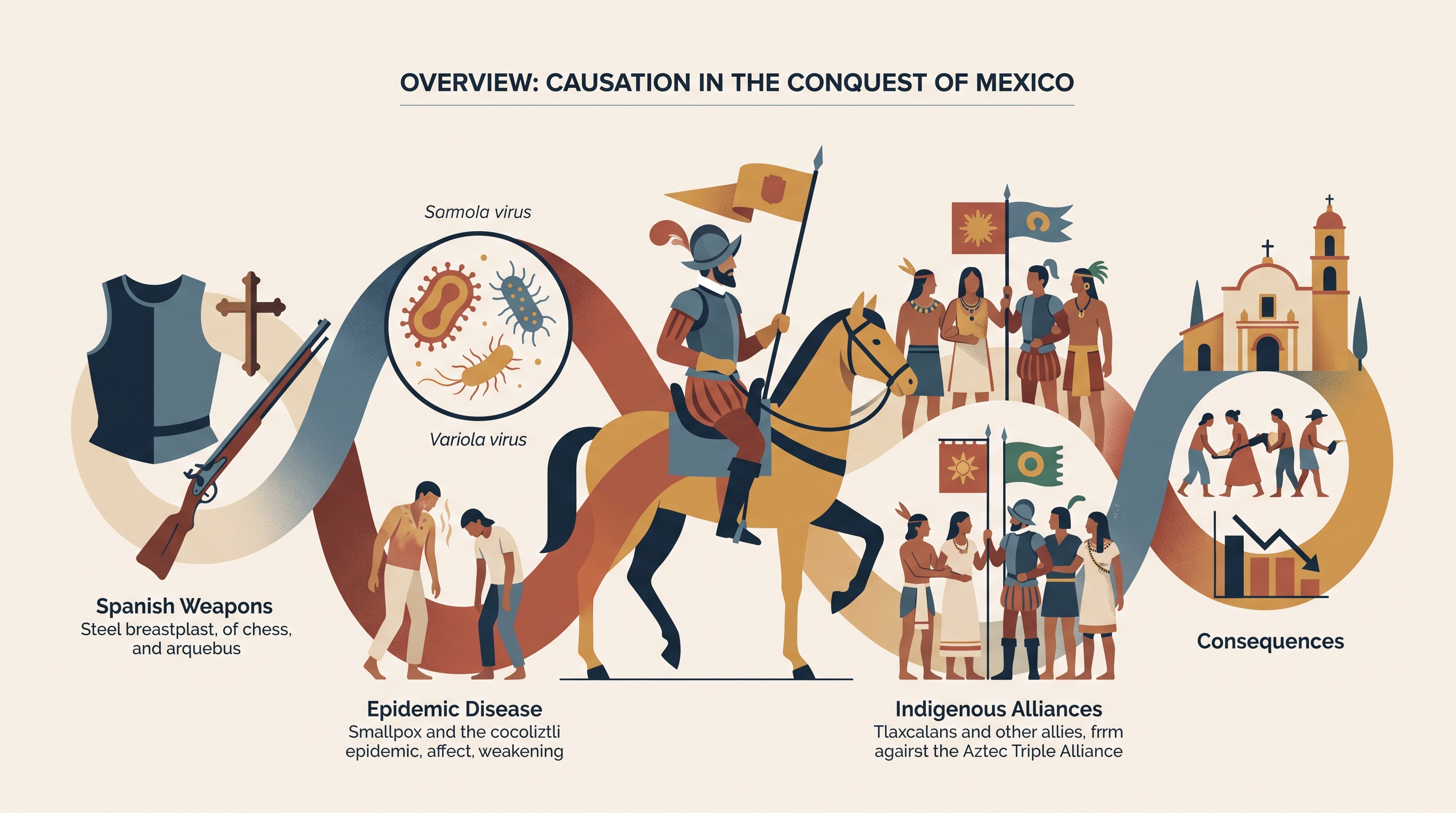
Step 2—Establish causes: Spanish forces possessed steel weapons, firearms, horses, and military experience. They also benefited from Native political divisions and from Indigenous allies who opposed imperial rule. Epidemic diseases, introduced through contact, caused devastating population losses and weakened the ability of Native societies to resist.
Step 3—Explain the relationship: Military technology mattered, but it worked together with local alliances and disease. A small Spanish force could not have defeated a large empire through weapons alone. Internal rivalries supplied allies, while disease disrupted leadership, armies, agriculture, and communication.
Step 4—Connect consequences: Conquest enabled Spain to impose colonial institutions, extract labor and wealth, spread Christianity, and reorganize societies through systems such as encomienda. Those institutions then produced further effects: coerced labor, racial and social hierarchies, cultural blending, and resistance.
This is causation rather than chronology because it answers why events occurred and how one development produced another. It also demonstrates Skill 1: Developments and Processes by identifying a process, explaining multiple causes, and tracing consequences across time.
The Columbian Exchange as a chain reaction
The Columbian Exchange—the movement of plants, animals, people, diseases, and commodities between the Americas and Afro-Eurasia—shows why historical consequences can be both intended and unintended. Europeans sought trade, territory, and conversion; they did not intend to create a biological exchange that would transform global populations.
European diseases, especially smallpox, measles, and influenza, spread among Native populations that lacked previous exposure. The resulting epidemics caused enormous mortality and weakened many communities. In Europe, American crops such as maize and potatoes increased the available food supply and contributed to population growth. In the Americas, European animals, crops, and colonial land-use practices altered environments and economies.
A causation argument must distinguish direct from indirect effects. Spanish conquest directly imposed colonial authority; indirectly, it encouraged expanded African slavery as colonizers sought labor after catastrophic Native population decline. Likewise, the search for labor helped create Atlantic commercial networks that connected the Americas, Europe, and Africa.
Misconception check: “Europeans won because they were inherently superior”
Named misconception—Technological determinism: the belief that technology alone explains Spanish victory. Europeans did possess military and maritime advantages, but conquest depended on Native alliances, political divisions, disease, geography, and Spanish exploitation of existing conflicts. Treating conquest as inevitable erases Indigenous decision-making and resistance.
A second misconception is that “contact” produced only European change. Native peoples adopted, rejected, adapted, and reshaped European technologies, animals, religions, and institutions. Causation in Period 1 is therefore multidirectional: Europeans transformed the Americas, but American environments, peoples, and resources also transformed Europe and Africa.
Retrieval and interpretation check
Explain in two or three sentences why Spanish conquest cannot be attributed to weapons alone. Your response should name two additional causes, explain how they interacted with military technology, and identify one consequence that followed from conquest.
A complete response would connect Spanish weapons and horses with Native alliances and epidemic disease, then trace conquest to colonial labor systems, Christianization, demographic change, or the expansion of Atlantic slavery. The goal is not to list factors; it is to show the causal links among them.
2.1 Contextualizing Period 2 · 2.2 European Colonization
By 1607, European powers were no longer merely visiting North America: they were competing to control land, labor, trade, and strategic waterways. Between 1607 and 1754, that competition produced colonies with sharply different purposes and institutions.
2.1 Contextualizing Period 2 · 2.2 European Colonization
By 1607, European powers were no longer merely visiting North America: they were competing to control land, labor, trade, and strategic waterways. Between 1607 and 1754, that competition produced colonies with sharply different purposes and institutions. The central question is: Why did European colonies develop differently even though they occupied the same continent?
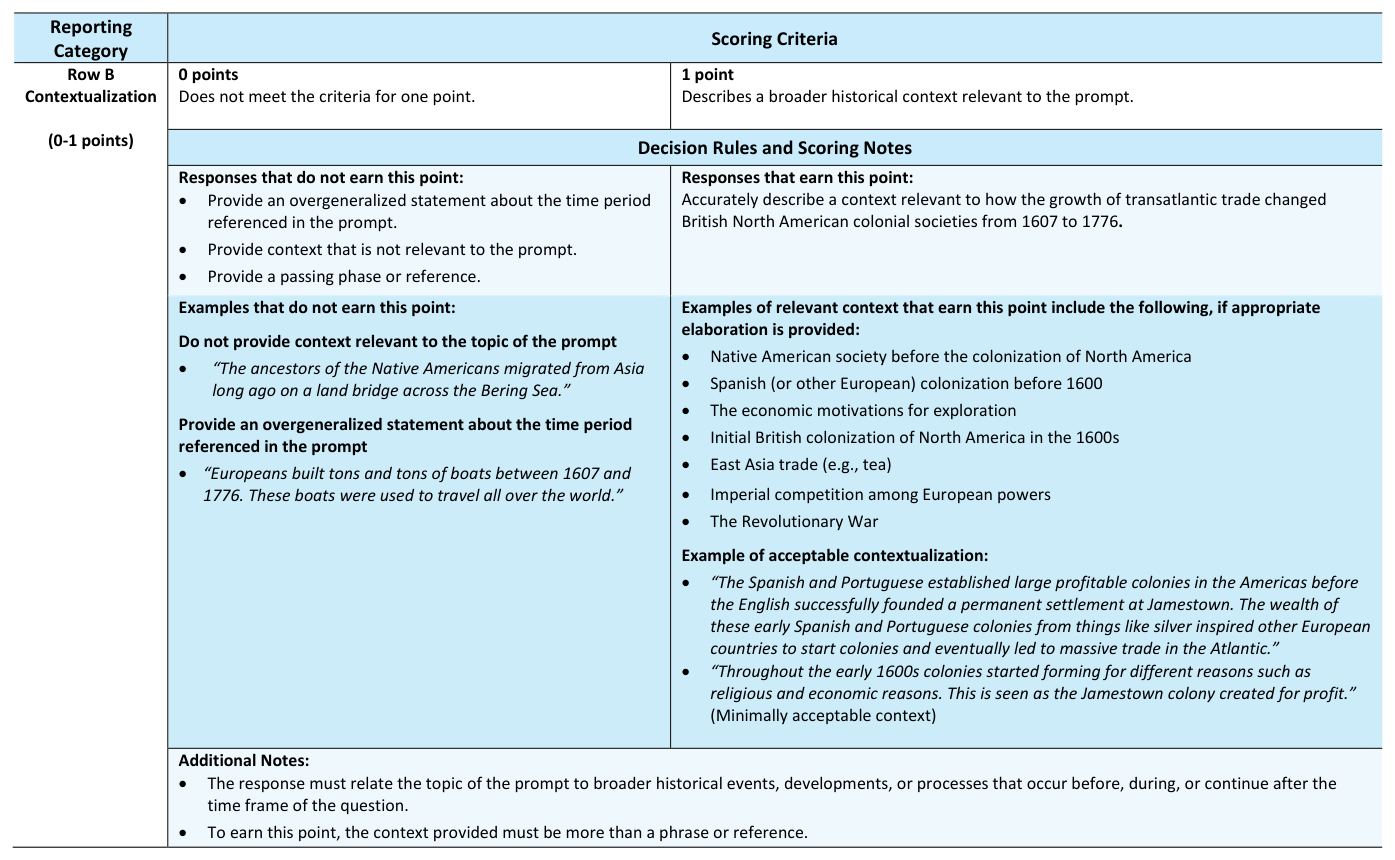
Learning Objective 2.1: Explain the context for the colonization of North America from 1607 to 1754.
Learning Objective 2.2: Explain how and why various European colonies developed and expanded from 1607 to 1754.
The larger Atlantic setting
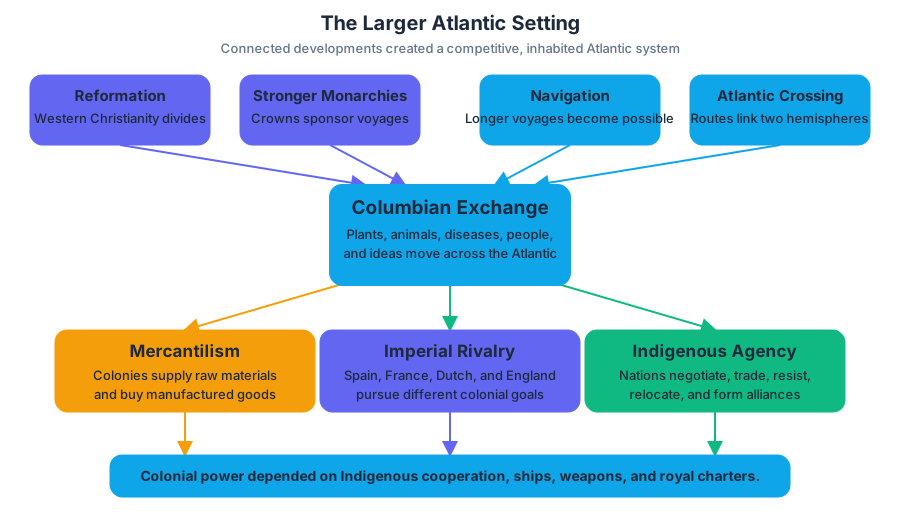
European colonization followed several connected developments: the Protestant Reformation divided western Christianity; stronger monarchies sponsored overseas exploration; improvements in navigation made longer voyages possible; and the Columbian Exchange, the movement of plants, animals, diseases, people, and ideas across the Atlantic, transformed both hemispheres.
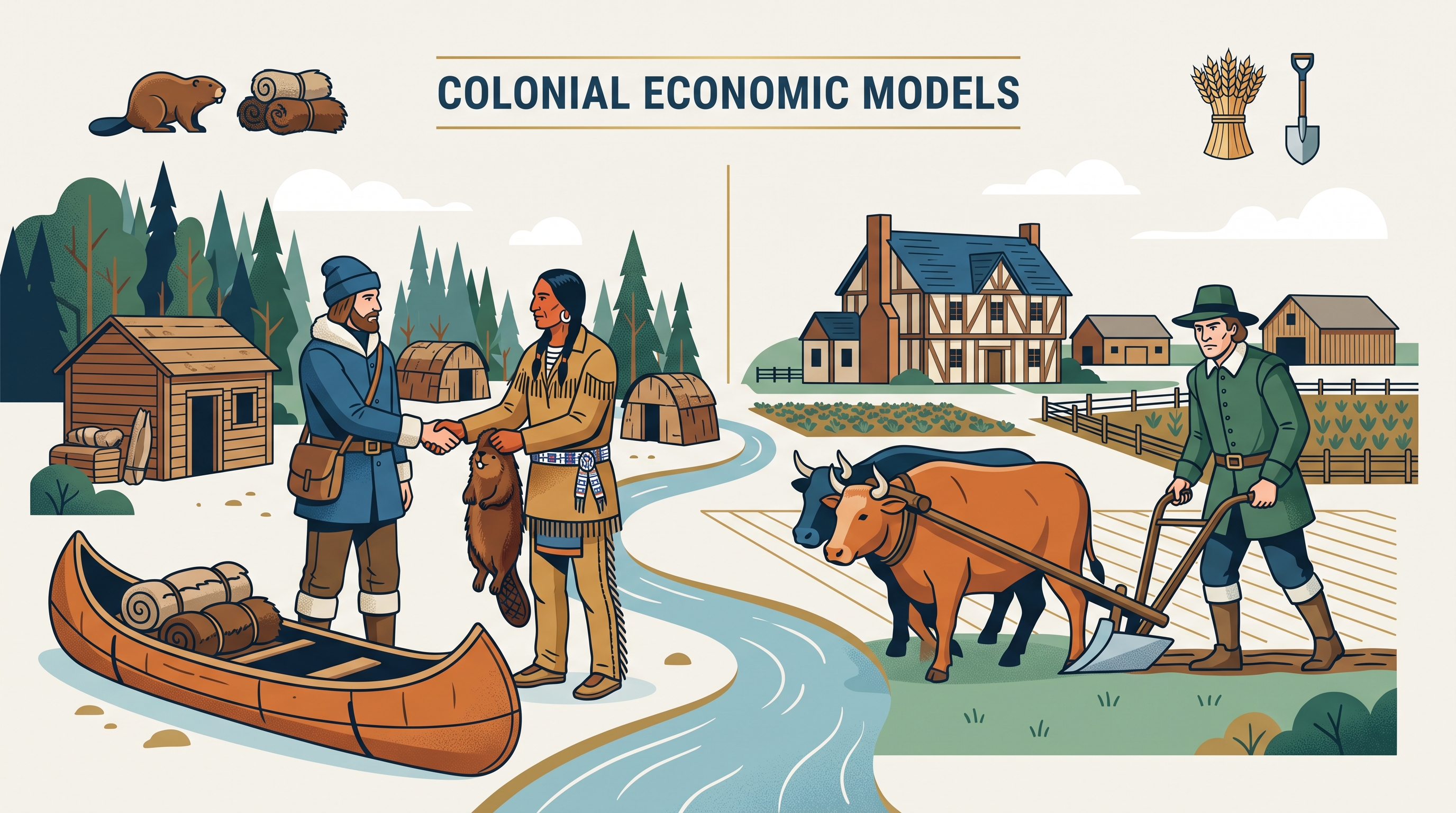
European rulers also embraced mercantilism, an economic system in which colonies supplied raw materials and purchased manufactured goods from the imperial power. Colonies were valuable not only as places to settle but also as tools in European rivalry. Spain sought precious metals and religious influence, France pursued the fur trade and alliances, the Dutch emphasized commerce, and England promoted settlement, trade, and strategic expansion.
The Atlantic system worked like a competitive board game, but the “board” was already inhabited. European empires claimed territory, while Native nations negotiated, traded, resisted, relocated, and formed military alliances. European power therefore depended on Indigenous cooperation as well as on weapons, ships, and royal charters.
European colonial models
KC-2.1.I.A–C and KC-2.2.I.A–C require attention to both imperial rivalry and colonial difference. Spain created missions, presidios, and settlements across Florida, the Southwest, and California. French colonization centered more heavily on the St. Lawrence River valley, the Great Lakes, and the Mississippi system, where traders and missionaries depended on relationships with Native peoples.
The Dutch established New Netherland as a commercial colony organized around trade, especially in the Hudson River valley. England created the largest settler population along the Atlantic coast, including colonies founded for profit, religious purposes, and mixed economic goals.
| Imperial power | Major motive | Common colonial pattern | Important relationship with Native peoples |
|---|---|---|---|
| Spain | Wealth, strategic control, conversion | Missions, presidios, forced labor systems, settlements | Conquest, conversion, resistance, and accommodation |
| France | Fur trade, commerce, Catholic missions | Trading posts and river-based networks | Extensive diplomacy and military alliances |
| Netherlands | Commercial profit | Port-centered trade colony | Trade relationships and competition |
| England | Settlement, profit, religion, expansion | Large farming communities and towns | Trade, diplomacy, land conflict, and warfare |
A crucial distinction is between colonization and exploration. Exploration mapped routes and identified resources; colonization established permanent political and economic control. Jamestown, founded in 1607, marked England’s first permanent settlement in the Chesapeake, while Plymouth, founded in 1620, represented a separatist religious community. Massachusetts Bay, founded in 1630, combined religious purpose with a larger program of Puritan settlement.
Worked contextual example: Jamestown
Suppose a historian asks why Jamestown struggled during its first years. Begin with context: England was competing with Spain and France, investors expected profit, and the settlement was organized through the Virginia Company. That context explains why many settlers initially searched for marketable goods rather than developing reliable food production.
Next, connect environment and human choices. Jamestown’s swampy location created health problems, while insufficient preparation and strained relations with the Powhatan Confederacy made survival harder. The colony eventually stabilized through stronger leadership, expanded agriculture, and the cultivation of tobacco, which became an export crop and increased the demand for land and labor.
The reasoning chain is:
$$ \text{Imperial rivalry and investment} \rightarrow \text{profit-oriented settlement} \rightarrow \text{early instability} \rightarrow \text{tobacco expansion} \rightarrow \text{greater demand for land and labor} $$
This example demonstrates Historical Reasoning Process: Causation: the colony’s difficulties had multiple causes, and tobacco did not simply “save” Jamestown. It also transformed Virginia by intensifying land disputes, political conflict, and labor exploitation.
Native diplomacy was central, not incidental
Native nations were active political powers. The Powhatan Confederacy managed relations with Jamestown through trade, diplomacy, and calculated resistance. In New England, English settlers relied on Indigenous knowledge and alliances but also entered conflicts over land and sovereignty, including the Pequot War and King Philip’s War.
Common misconception — “Europeans conquered an empty wilderness.” North America was neither empty nor politically unorganized. Native societies had established economies, territorial systems, diplomatic traditions, and military capabilities. European settlement altered those systems through disease, warfare, trade, land seizure, and demographic pressure, but Indigenous peoples continued to shape colonial outcomes.
AP skills in action
This topic most directly develops Skill 3.A: Identify and describe a historical concept, development, or process and Skill 3.B: Explain and analyze the significance of a historical concept, development, or process when distinguishing exploration, colonization, mercantilism, and the Columbian Exchange.
It also uses Skill 4.A: Identify and describe patterns and trends and Skill 4.B: Explain and analyze patterns and trends to compare Spanish missions, French trading networks, Dutch commercial settlement, and English settler colonies. For source-based questions, apply Skill 2.A: Identify a source’s point of view, purpose, historical situation, and/or audience before deciding what the source proves. A strong response uses Skill 6.A: Make a historically defensible claim and Skill 6.B: Support an argument using specific and relevant evidence.
Retrieval and interpretation check
Check: Why did French colonization generally depend more on diplomacy with Native peoples than English colonization did?
Answer: French settlement concentrated on trade networks and waterways, especially the fur trade, so French colonists needed Indigenous partners. English colonies attracted larger numbers of permanent farmers who sought land, making sustained territorial conflict more likely. The difference arose from contrasting economic goals, settlement patterns, and relationships with Native nations—not from a simple difference in “friendliness.”
2.3 The Regions of British Colonies · 2.4 Transatlantic Trade
By the mid-1700s, Britain’s mainland colonies were not one unified society. Geography, climate, labor systems, and Atlantic commerce produced three recognizable regions: New England, the Middle Colonies, and the Southern Colonies.
2.3 The Regions of British Colonies · 2.4 Transatlantic Trade
By the mid-1700s, Britain’s mainland colonies were not one unified society. Geography, climate, labor systems, and Atlantic commerce produced three recognizable regions: New England, the Middle Colonies, and the Southern Colonies. The same ocean connected them, but local conditions made them economically and socially distinct.
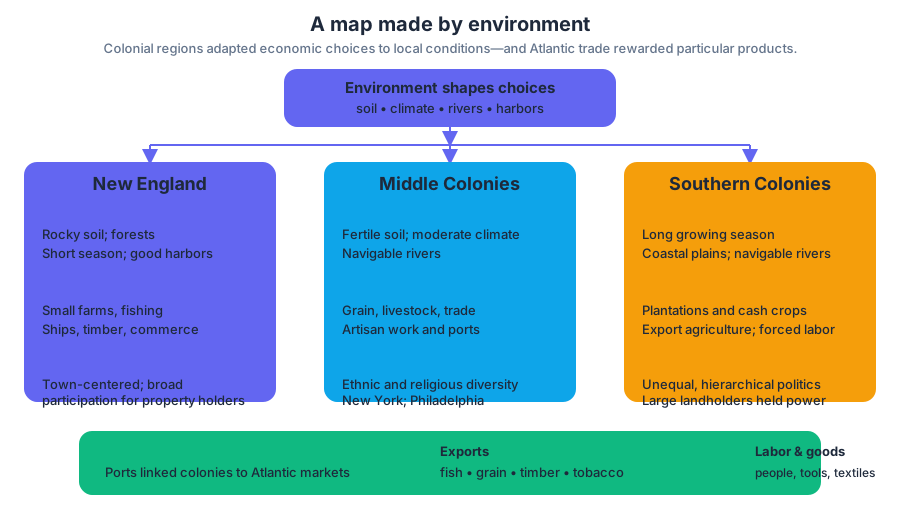
A map made by environment
Key idea: Colonial regions developed differently because people adapted economic choices to local environments—and because Atlantic trade rewarded particular products and labor systems.
| Region | Environment | Major economic pattern | Social and political tendencies |
|---|---|---|---|
| New England | Rocky soil, forests, shorter growing season, excellent harbors | Small farms, fishing, shipbuilding, timber, and commerce | Town-centered communities, congregational religious influence, relatively broad participation among property-holding men |
| Middle Colonies | Fertile soil, moderate climate, navigable rivers | Grain production, livestock, trade, and artisan work | Ethnic and religious diversity; important port cities such as New York and Philadelphia |
| Southern Colonies | Long growing season, fertile coastal plains, navigable rivers | Export agriculture, especially tobacco, rice, and indigo | Large plantations, dispersed settlements, and increasing dependence on enslaved labor |
In New England, rocky terrain and a short growing season discouraged plantation agriculture. Colonists therefore combined modest farming with maritime activities. Ports such as Boston connected local merchants to England and the Caribbean, while forests supported shipbuilding and timber exports.
The Middle Colonies occupied a productive middle ground. Their fertile land supported wheat and other grains, earning them the nickname “bread colonies.” Their ports attracted merchants, artisans, immigrants, and religious groups, making the region more diverse than either New England or the plantation South.
The Southern Colonies had conditions favorable to cash crops—agricultural products grown primarily for sale rather than local use. Tobacco became central in the Chesapeake, while rice and indigo flourished farther south. Because these crops required substantial labor, wealthy planters increasingly built plantation economies around enslaved labor.
Worked example: explaining regional difference
Suppose an exam prompt asks why New England and the Southern Colonies developed different economies. A strong causal chain would be:
$$ \text{environment} \rightarrow \text{crop possibilities} \rightarrow \text{labor demand} \rightarrow \text{social structure} $$
New England’s rocky soil and short growing season limited large-scale cash-crop agriculture, encouraging mixed farming, fishing, shipbuilding, and commerce. The South’s longer growing season supported tobacco, rice, and indigo exports; these crops generated demand for intensive labor, helping produce plantations and a society sharply divided between wealthy planters, small farmers, and enslaved Africans.
This explanation demonstrates Historical Reasoning Process: Causation and AP Historical Thinking Skill 1: Developments and Processes: it identifies a development, explains why it occurred, and traces consequences rather than merely listing regional facts.
Transatlantic trade: the colonies inside an Atlantic system
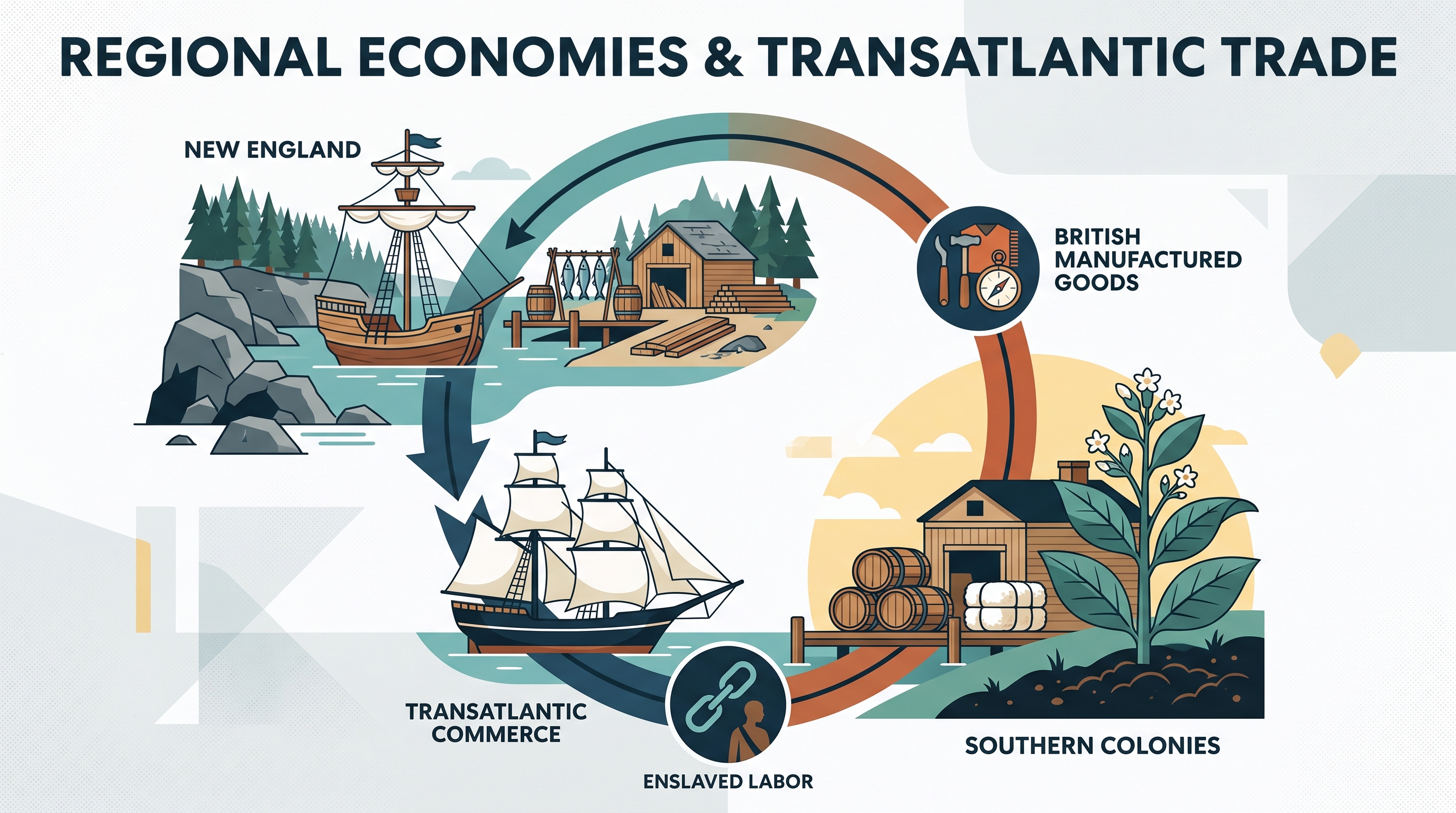
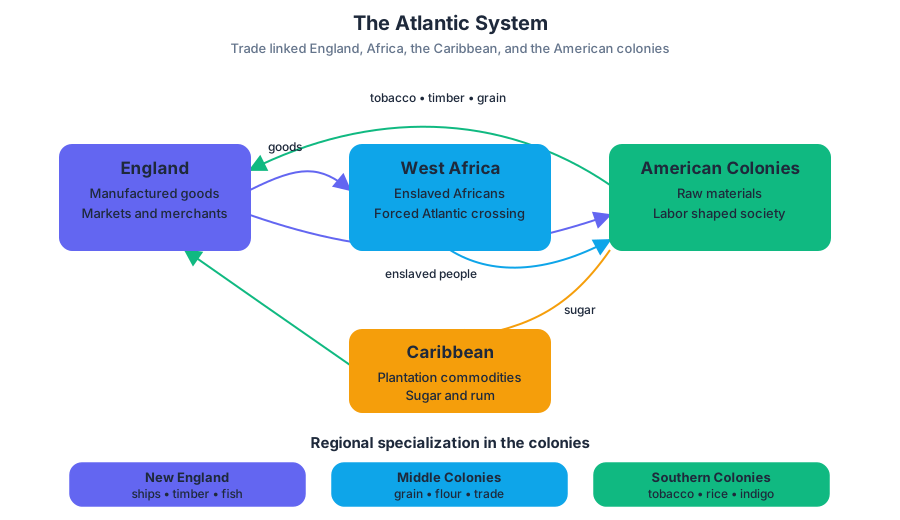
Transatlantic trade was the movement of people, commodities, and manufactured goods across the Atlantic Ocean among Europe, Africa, the Caribbean, and the Americas. It tied the British colonies to England, but it also transformed colonial society by encouraging regional specialization and expanding slavery.
A simplified trade pattern looked like this:
$$ \text{British manufactured goods} \rightarrow \text{Africa and the Americas} $$
$$ \text{Enslaved Africans} \rightarrow \text{the Americas} $$
$$ \text{Colonial raw materials} \rightarrow \text{England} $$
Colonial producers sold raw materials—such as tobacco, timber, grain, and other agricultural goods—to English consumers and manufacturers. Profits from these exchanges supported much of the colonial economy, while English merchants supplied manufactured goods that colonists often could not produce locally.
The triangular trade was not a single, universally fixed route. It describes recurring commercial connections among several Atlantic regions. Ships and merchants could follow different routes, but the larger system linked European capital and manufacturing, African societies and forced migration, Caribbean plantation production, and mainland colonial markets.
Slavery and the Southern economy
The transatlantic slave trade forcibly transported millions of Africans to the Americas. European traders often purchased captives from African political authorities and merchants involved in warfare, raiding, and the capture of prisoners; Europeans also used violence and coercion. Captives endured the Middle Passage—the deadly ocean voyage to the Americas—before sale into systems of forced labor.
In British North America, the greatest concentration of enslaved labor developed in the Southern Colonies, where plantation agriculture required a large workforce. The growth of slavery therefore did more than increase agricultural output: it shaped wealth, political power, settlement patterns, and racial hierarchy.
Misconception check — “The regions were completely separate.”
They were distinct, not isolated. New England merchants, Middle Colony farmers, Southern planters, English manufacturers, Caribbean producers, and African traders participated in interconnected Atlantic commerce. Regional specialization increased interdependence.
CED traceability and exam reasoning
Learning Objective 2.3: Explain how and why different European colonies developed differently. Essential Knowledge 2.3.A–2.3.C: regional development reflected environmental conditions, economic specialization, population patterns, and labor systems.
Learning Objective 2.4: Explain how and why transatlantic trade affected the development of British colonies. Essential Knowledge 2.4.A–2.4.C: Atlantic commerce connected the colonies to England, encouraged export economies, and expanded the forced migration and exploitation of Africans.
For document-based or short-answer work, apply AP Historical Thinking Skill 2: Sourcing and Situation by asking who benefited from a trade description, Skill 3: Claims and Evidence in Sources by linking evidence to a regional argument, and Skill 5: Making Connections by connecting Atlantic trade to regional economic development.
Retrieval check
- Why did geography encourage commerce and maritime work in New England?
- Which regional conditions supported plantation agriculture?
- How did transatlantic trade simultaneously connect the colonies to England and make Southern society increasingly dependent on enslaved labor?
Answer: New England’s rocky land, forests, and harbors favored maritime commerce; the South’s long growing season and fertile land supported export crops; Atlantic trade created markets for colonial goods and supplied manufactured goods and enslaved labor, strengthening both imperial dependence and plantation slavery.
2.5 Interactions Between American Indians and Europeans · 2.6 Slavery in the British Colonies
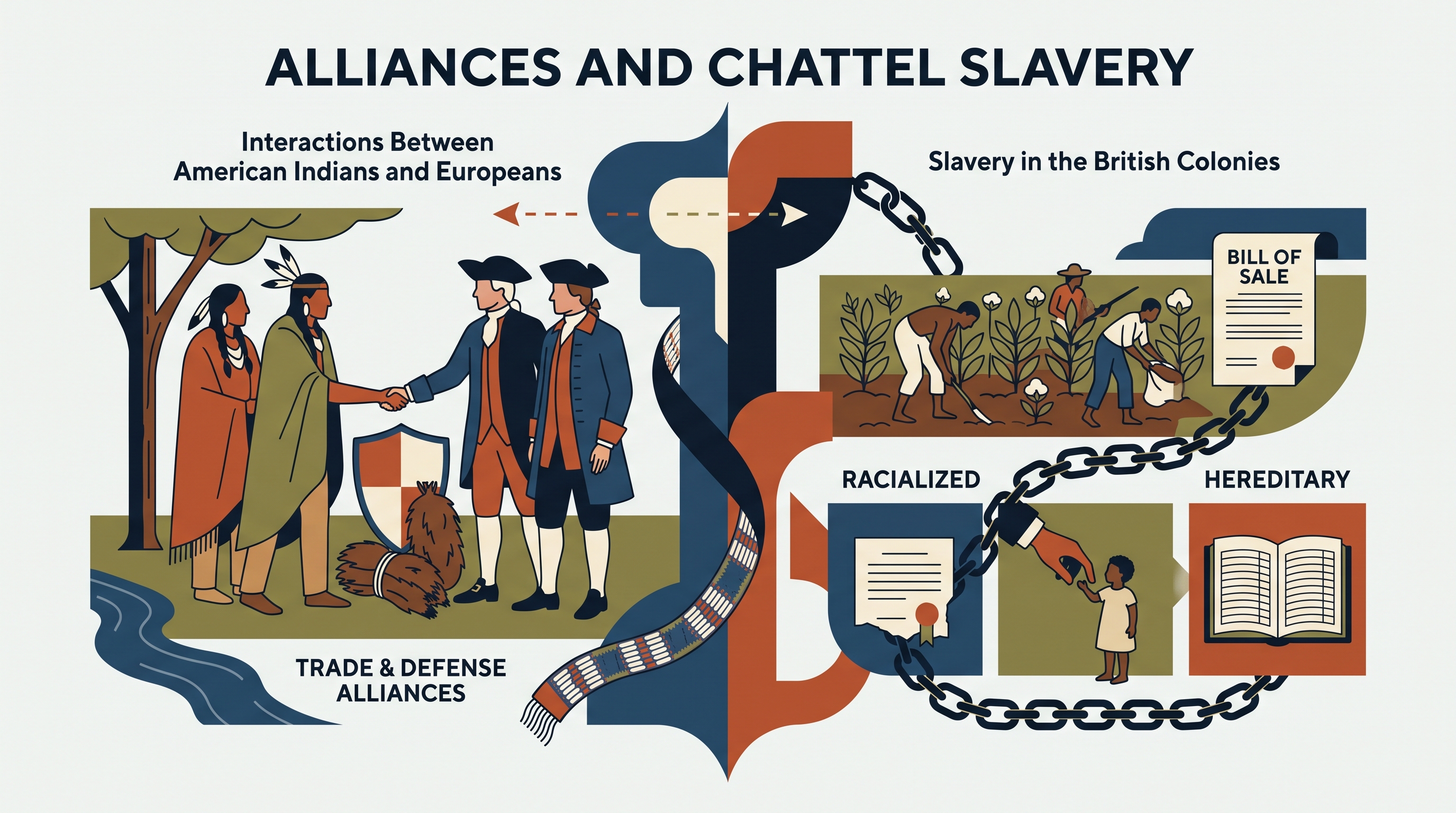
European colonization created neither simple cooperation nor constant warfare: American Indians and Europeans repeatedly negotiated, traded, allied, resisted, and fought according to changing political and economic interests.
2.5 Interactions Between American Indians and Europeans · 2.6 Slavery in the British Colonies
European colonization created neither simple cooperation nor constant warfare: American Indians and Europeans repeatedly negotiated, traded, allied, resisted, and fought according to changing political and economic interests. At the same time, British colonists built a racialized system of hereditary slavery that transformed labor, law, demography, and power across the colonies.
Investigative question: Why did some American Indian groups cooperate with European empires while others resisted them—and why did British colonies increasingly rely on African slavery?
2.5 Interactions Between American Indians and Europeans
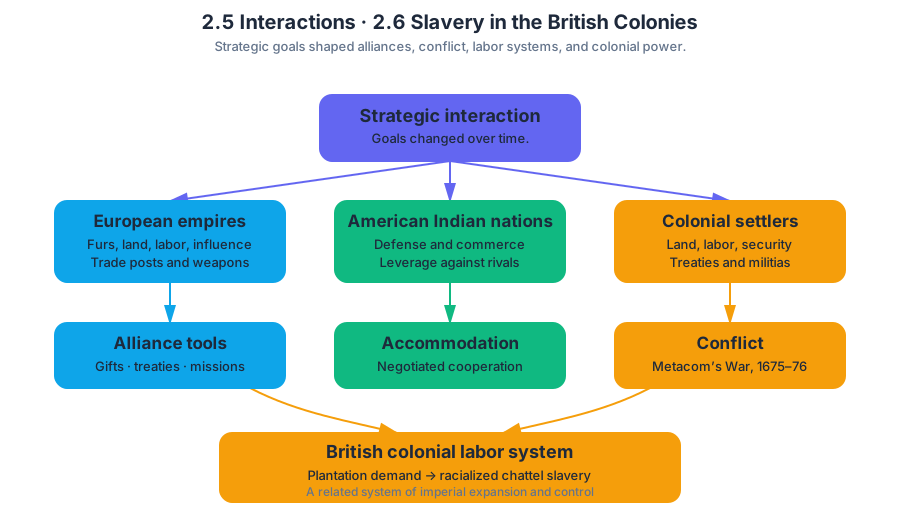
The central idea in Unit 2: Learning Objective E is that interactions between European nations and American Indians changed over time because both sides pursued strategic goals. Europeans competed for land, labor, trade, and imperial influence; American Indian nations sought to protect territory, control commerce, defeat rivals, and preserve political independence.
The CED identifier KC-2.1.III.C captures this flexibility: European rivals—including French, Dutch, British, and Spanish colonists—formed alliances with and armed American Indian groups. American Indian leaders were not merely responding to European decisions; they often sought alliances themselves against neighboring Native nations. These relationships could produce accommodation, meaning negotiated cooperation, as well as conflict.
A useful way to analyze an alliance is to ask what each participant expected to gain:
| Participant | Possible objective | Typical strategy |
|---|---|---|
| European empire | Furs, military support, territory, trade access | Gifts, weapons, treaties, missionaries, trade posts |
| American Indian nation | Defense, commerce, political leverage, advantage over rivals | Diplomacy, selective alliance, trade, warfare |
| Colonial settlers | Land, labor, local security, economic opportunity | Settlement, treaties, militias, expansion |
Worked contextual example: Metacom’s War. In New England, expanding English settlement intensified disputes over land, resources, and political boundaries. These pressures contributed to Metacom’s War (King Philip’s War), identified in KC-2.1.III.E. The conflict demonstrates that “trade” and “alliance” did not eliminate underlying competition: when English colonists continued to expand, many Native communities viewed accommodation as increasingly dangerous.
Spanish colonization produced a different pattern in the Southwest. American Indian resistance to Spanish efforts—especially after the Pueblo Revolt—forced Spanish authorities to accommodate some aspects of Native culture. This development, specified in KC-2.1.III.F, shows that resistance could alter imperial policy even when it did not remove Spanish influence entirely.
Misconception check: American Indians did not “fail to unite” because they lacked political organization. Native nations possessed their own governments, diplomatic traditions, economies, and rivalries. Europeans exploited those divisions, but American Indian leaders made calculated choices within a complex international environment.
2.6 Slavery in the British Colonies
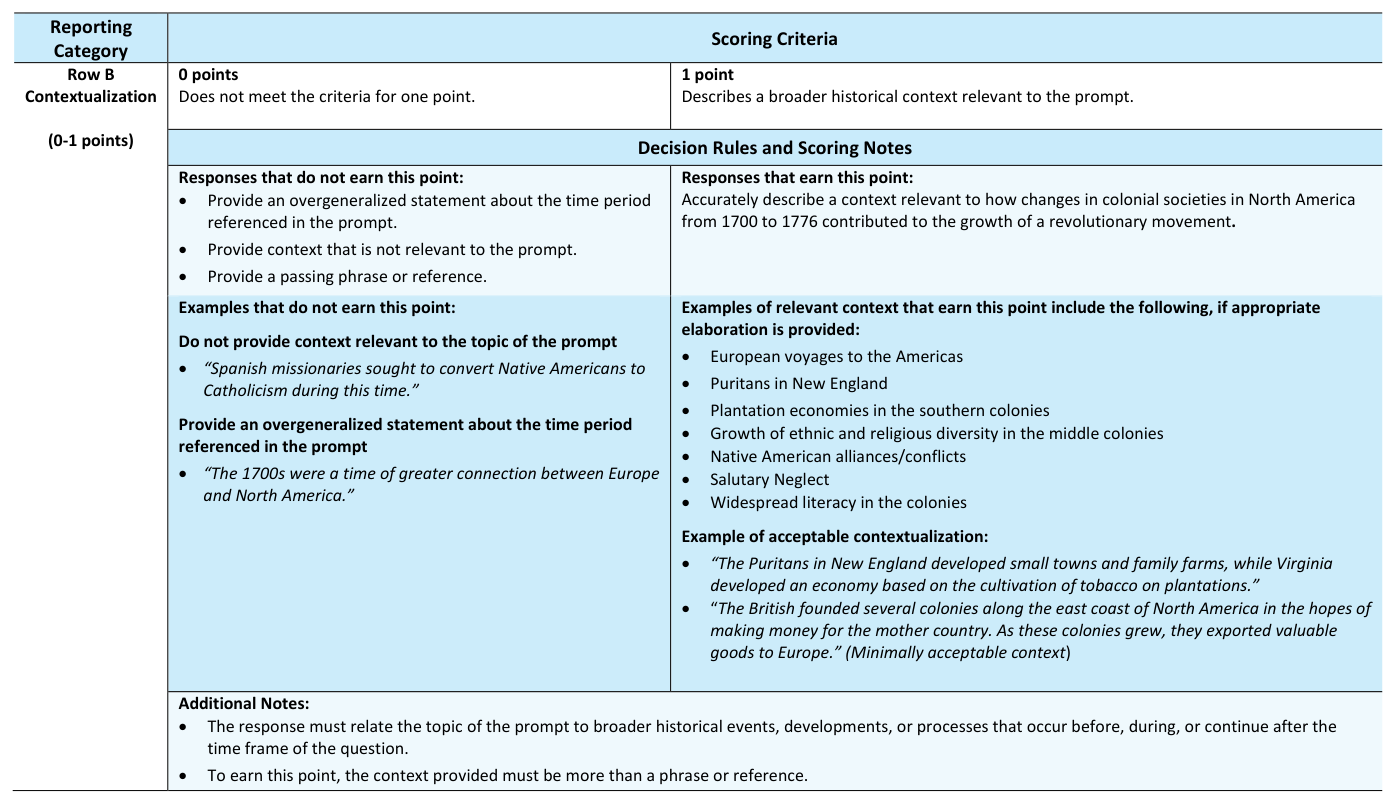
Unit 2: Learning Objective F requires explaining how and why slavery developed and expanded in the British colonies. The key development is KC-2.2.II: like other European empires participating in the Atlantic slave trade, the English colonies developed slavery in forms shaped by specific economic, demographic, and geographic conditions.
At first, many English colonies used a mixture of Indigenous labor, indentured European servants, and enslaved Africans. Over time, plantation agriculture—especially tobacco in the Chesapeake and rice and indigo in the Carolina lowcountry—created intense demand for labor. As the supply of enslaved Africans increased and colonial laws hardened, slavery became increasingly hereditary and identified with African ancestry.
The system was not simply “labor shortage plus plantations.” Colonial governments converted racial assumptions into law. The result was racialized chattel slavery: enslaved people were treated as property, slavery generally passed from mother to child, and enslaved Africans and their descendants could be denied legal rights regardless of individual skill, religion, or status.
Regional conditions mattered. Chesapeake tobacco plantations often relied on dispersed farms and developed a large enslaved population over time. In South Carolina and Georgia, rice cultivation required specialized knowledge and arduous labor in disease-heavy environments, encouraging planters to import large numbers of Africans. New England had fewer plantation exports, but merchants, shipowners, and consumers still participated in Atlantic slavery and profited from the wider commercial system.
Enslaved people resisted slavery in both direct and indirect ways. Resistance included slowing work, breaking tools, preserving family and religious traditions, negotiating for limited autonomy, running away, and participating in revolts. These actions did not always overthrow slavery, but they demonstrate that enslaved people were historical actors who continually challenged the system imposed upon them.
Misconception check: Slavery was not confined to the plantation South, and enslaved people were not passive. Northern colonies also held enslaved people and benefited from Atlantic commerce, while resistance appeared wherever slavery existed.
Connecting the Two Topics
These topics connect through power and adaptation. European empires adjusted their diplomacy when American Indian resistance threatened colonial authority; British colonists adjusted labor systems when plantation economies demanded a more controllable workforce. In both cases, historical outcomes emerged from conflict among competing groups—not from a single European plan that everyone else simply accepted.
AP Historical Reasoning in Practice
For Skill 1.A: Identify and describe a claim, identify whether a source presents alliance, resistance, or slavery as its central argument. For Skill 2.A: Analyze features of historical sources, examine who created a treaty, colonial law, missionary account, or enslaved person’s testimony. For Skill 2.B: Explain the point of view, purpose, audience, and historical situation, ask why a colonial official might describe an alliance differently from an American Indian leader.
For Skill 3.B: Explain the causes and effects of historical developments, connect plantation production and labor demand to the expansion of slavery, or connect land pressure to Metacom’s War. For Skill 5.A: Compare historical developments, compare French trade alliances with American Indians to English settler expansion. For Skill 6.A: Develop a thesis, make a defensible claim that explains both cooperation and conflict rather than treating either as universal.
Retrieval Check
Answer without looking back: What were two reasons American Indian nations formed alliances with European powers, and how did British colonial slavery become different from temporary forms of labor? A strong response should identify Native strategic goals—such as defense or rivalry—and explain that British slavery became hereditary, racialized, and legally treated enslaved people as property.
2.7 Colonial Society and Culture · 2.8 Comparison in Period 2
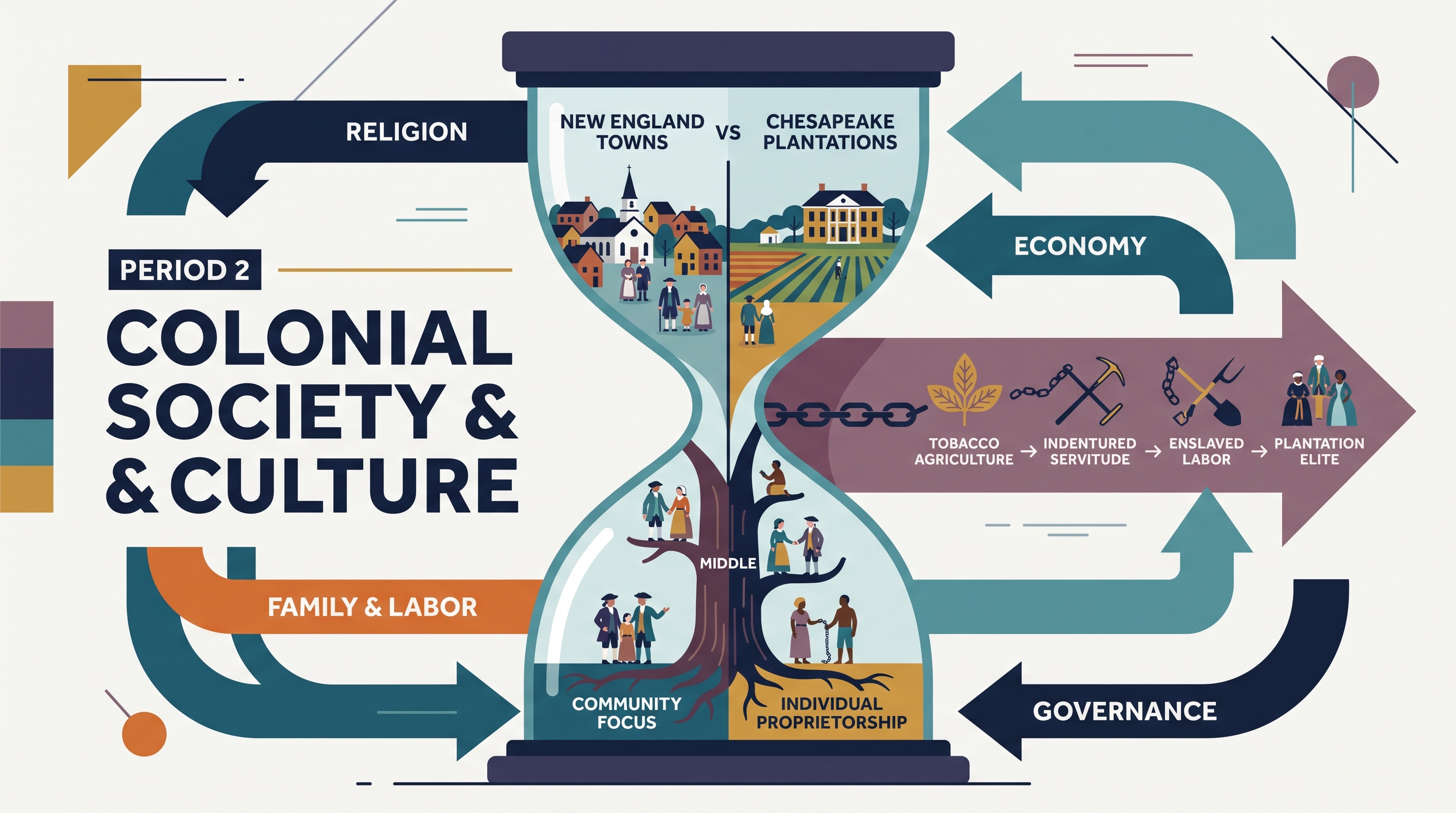
By 1754, Britain’s mainland colonies were not one society but a collection of regional societies connected by language, trade, Protestant Christianity, and political allegiance. The central question is therefore not simply what were the colonies like?
2.7 Colonial Society and Culture · 2.8 Comparison in Period 2
By 1754, Britain’s mainland colonies were not one society but a collection of regional societies connected by language, trade, Protestant Christianity, and political allegiance. The central question is therefore not simply what were the colonies like? but why did similar European colonies develop such different cultures—and why did those differences matter?
Learning Objective 2.G: Explain how and why the different goals and interests of European leaders and colonists affected how they viewed themselves and their relationship with Britain.
Learning Objective 2.H: Compare the effects of the development of colonial society in the various regions of North America.
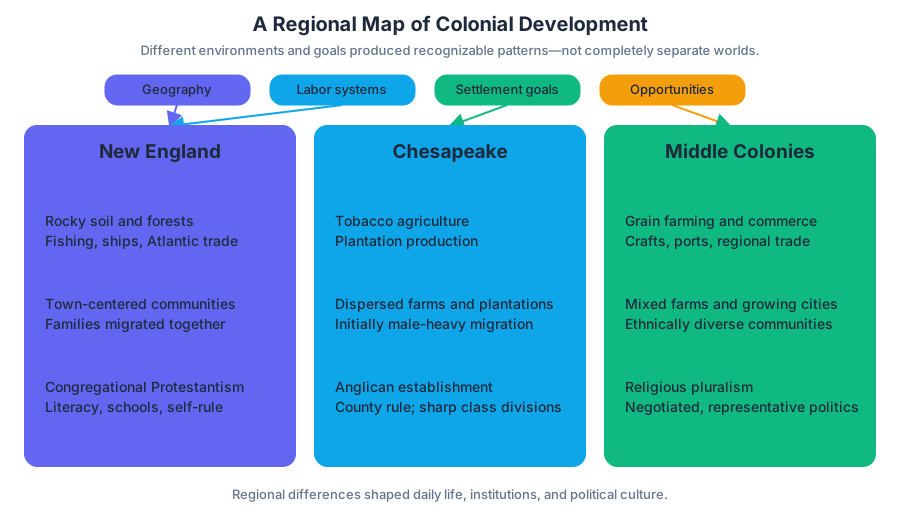
A regional map of colonial development
The three broad colonial regions developed from different combinations of geography, labor systems, settlement goals, and economic opportunities. These differences did not create completely separate worlds, but they produced recognizable patterns.
| Region | Environment and economy | Society and settlement | Culture and politics |
|---|---|---|---|
| New England | Rocky soil, forests, fishing, shipbuilding, and Atlantic trade | Town-centered communities; many families migrated together | Congregational Protestantism, literacy, schools, and local self-government |
| Chesapeake | Tobacco agriculture and plantation production | Dispersed farms and plantations; initially male-heavy migration | Anglican establishment, county government, and sharp class divisions |
| Middle Colonies | Grain farming, commerce, crafts, and port trade | Mixed farms, growing cities, and ethnically diverse communities | Religious pluralism, immigration, and comparatively broad cultural exchange |
New England: community, faith, and literacy
Puritan settlers in Massachusetts Bay sought to build a disciplined Protestant society rather than merely extract wealth. Their migration included substantial numbers of families, which encouraged stable communities, higher population growth, and settlements organized around towns and congregations.
Religion shaped public life, but Puritan society was not completely tolerant. Roger Williams challenged Massachusetts authorities by defending separation between church and government and insisting that colonists should not seize Native land without legitimate purchase. Anne Hutchinson challenged the authority of Puritan ministers by emphasizing individual religious faith. Both were expelled, demonstrating the tension between religious purpose and religious conformity.
Literacy became especially important because Puritans believed people should read the Bible. New England communities therefore supported schooling earlier and more systematically than many other colonies. This helped produce a culture of sermons, pamphlets, town meetings, and religious debate.
Misconception check: Puritans did not come to America to establish modern religious freedom. They wanted freedom to practice their own religion and often restricted competing beliefs within their communities.
The Chesapeake: tobacco, hierarchy, and dispersed settlement
Virginia developed around tobacco, a labor-intensive cash crop that tied the colony to Atlantic markets. Tobacco encouraged planters to seek more land and labor, while the plantation economy produced dispersed settlement rather than the compact towns common in New England.
Early Chesapeake society was unstable. Many immigrants were young men, mortality was high, and social divisions were severe. Over time, the expansion of slavery and the consolidation of plantation wealth created a rigid hierarchy: wealthy planters held the most land and political influence, while small farmers, indentured servants, enslaved Africans, and landless laborers occupied less powerful positions.
Virginia’s House of Burgesses gave some colonists experience with representative government, but “representative” did not mean democratic equality. Political participation was concentrated among propertied men, and colonial institutions often protected elite control.
The Middle Colonies: diversity and exchange
Pennsylvania, New York, New Jersey, and Delaware benefited from fertile farmland, navigable rivers, and commercial ports. Grain production supported export markets, while Philadelphia and New York became major centers of trade, printing, immigration, and political discussion.
The Middle Colonies contained English, Dutch, German, Scots-Irish, and other communities. Religious diversity was also pronounced: Quakers, Presbyterians, Lutherans, Dutch Reformed Christians, Jews, and others lived in the region. Pennsylvania’s Quaker leadership promoted comparatively broad religious toleration, although colonial societies still contained inequality and conflict.
This diversity made the Middle Colonies less culturally uniform than New England and less dominated by a single staple crop than the Chesapeake. It also encouraged negotiation among groups with different languages, customs, and religious commitments.
Colonial culture: shared institutions, unequal access
Across the colonies, people developed local political institutions such as assemblies, town meetings, church organizations, and county governments. These institutions gave colonists practical experience in managing local affairs and helped them form identities as Virginians, New Englanders, Pennsylvanians, or other colonials—not simply as distant subjects of Britain.
At the same time, colonial culture was profoundly unequal. Gender roles generally placed political authority and property control in men’s hands, while women performed essential agricultural, domestic, and commercial labor with limited legal independence. Enslaved Africans and their descendants created families, religious practices, music, and community networks despite laws designed to deny their autonomy.
The First Great Awakening in the 1730s and 1740s further connected the colonies through traveling preachers and emotional Protestant revivals. It also challenged established religious authority by encouraging ordinary people to evaluate ministers and religious experience for themselves.
Comparison as historical reasoning
AP Skill 5.A, Making Connections—Identify patterns and connections between and among historical developments and processes, is more than listing similarities and differences. A strong comparison explains a relationship: New England’s family migration and town structure encouraged communal institutions, whereas Chesapeake tobacco production and dispersed settlement encouraged plantation hierarchy and county-based politics.
AP Skill 1.A, Developments and Processes—Identify and describe a historical development or process, helps establish the evidence before comparison. For example, identifying the growth of tobacco agriculture, religious pluralism, or Atlantic commerce gives the comparison concrete historical content rather than vague regional stereotypes.
AP Skill 6, Argumentation—Develop an argument, requires a defensible claim supported by specific evidence. A workable thesis might argue that colonial regions became different primarily because environmental and economic conditions shaped settlement patterns, while shared Atlantic connections gradually produced cultural links among them.
Worked comparison
Prompt: Explain one major difference between New England and the Chesapeake colonies and explain one cause of that difference.
Reasoning: The difference was settlement structure. New England developed compact towns because many Puritan families migrated together and organized communities around churches and local institutions. The Chesapeake developed dispersed plantations because tobacco required extensive land and labor, encouraging planters to spread along waterways and producing greater dependence on hierarchical agricultural production.
Notice the complete chain: economic or religious goal → migration pattern → settlement structure → social and political consequences. That chain turns comparison into historical explanation.
Retrieval check
- Why did New England develop stronger town-centered institutions than the Chesapeake?
- Which region was most associated with religious and ethnic diversity?
- How could colonial assemblies exist alongside social inequality?
- Complete the causal chain: tobacco agriculture → __________ → plantation hierarchy.
Answers: 1. Family migration and Puritan community organization encouraged towns. 2. The Middle Colonies. 3. Political representation was generally limited to propertied men. 4. Expanded land and labor demands, producing dispersed plantations and sharp class divisions.
3.1 Contextualizing Period 3 · 3.2 The Seven Years’ War (French and Indian War)
Key concepts: Historical context · Colonial rivalry · British-French competition in North America · Indigenous diplomacy and resistance · Economic and political competition · Territorial expansion · The Seven Years’ War · The French and Indian War · Pontiac’s resistance · Negotiation over Indigenous space
By 1754, North America had become a crowded political map: British colonies were expanding westward, France was defending its trade networks, and diverse Indigenous nations were protecting their lands, economies, and political authority.
3.1 Contextualizing Period 3 · 3.2 The Seven Years’ War (French and Indian War)
By 1754, North America had become a crowded political map: British colonies were expanding westward, France was defending its trade networks, and diverse Indigenous nations were protecting their lands, economies, and political authority. The resulting conflict was not simply a European war transferred overseas. It was a struggle in which Britain and France competed for imperial power while Indigenous nations made differing choices—supporting France, supporting Britain, resisting both, or negotiating independently.
Unit 3: Learning Objective A: Explain the context in which America gained independence and developed a sense of national identity.
The central conflict: land, trade, and influence
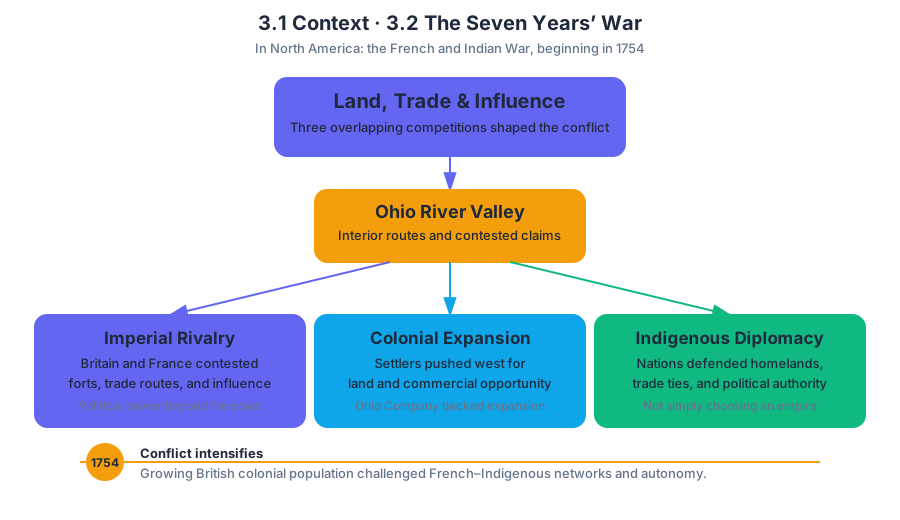
The Seven Years’ War was an international conflict that, in North America, is commonly called the French and Indian War. Its North American phase began in 1754, when British-French colonial rivalry intensified in the interior. The growing population of Britain’s North American colonies pushed beyond the Appalachian Mountains, threatening French–Indigenous trade networks and Indigenous autonomy.
A useful way to see the conflict is as three overlapping competitions:
| Competition | What was at stake |
|---|---|
| British–French imperial rivalry | Territory, trade routes, forts, and political influence |
| Colonial expansion | Access to western land and commercial opportunities |
| Indigenous diplomacy and resistance | Control of homelands, trade relationships, and political authority |
The Ohio River Valley became especially important because it connected interior trade routes and contained land claimed by multiple groups. The British-backed Ohio Company sought commercial and territorial opportunities there, while French forces built forts to defend their connection between Canada and the Mississippi Valley. Indigenous nations also claimed authority in the region; their interests cannot be reduced to choosing between two European empires.
Indigenous nations as political actors
Indigenous communities were active participants rather than bystanders. Some nations supported France because French trade relationships or military cooperation appeared useful; others supported Britain; still others attempted to preserve independent positions or shift alliances as circumstances changed. These decisions reflected diplomacy, security, economic interests, and efforts to protect land—not a single “American Indian” policy.
This distinction matters when interpreting the outcome. Britain defeated France and gained major territorial holdings, but that did not mean Indigenous nations uniformly supported France or that British victory established uncontested control. Indigenous resistance challenged European attempts to dominate North American lands, often forcing continued negotiation over territory and political authority.
A worked contextual example: from overlapping claims to resistance
Step 1 — Context: British colonial population growth encouraged movement into the interior. French efforts to defend trade networks and forts made that expansion a direct imperial threat.
Step 2 — Escalation: The Jumonville Glen Skirmish occurred within this environment of overlapping British, French, and Indigenous territorial claims. It illustrates how local disputes could ignite a much larger imperial war.
Step 3 — Outcome: Britain’s victory expanded its territorial holdings, but the war imposed tremendous financial costs. Imperial officials subsequently sought to raise revenue and consolidate control, while attempts to restrict colonial movement westward generated colonial opposition.
Step 4 — Indigenous response: After the war, resistance associated with Pontiac and other Indigenous communities challenged the assumption that Britain could simply replace France as the region’s governing power. Pontiac’s 1763 speech at Detroit emphasized the relationship between Indigenous communities and European colonists, revealing that diplomacy and political authority remained contested.
The historical conclusion is therefore more precise than “Britain defeated France and the Indians”: Britain defeated France, while Indigenous nations pursued varied alliances, resistance, and negotiations before, during, and after the war.
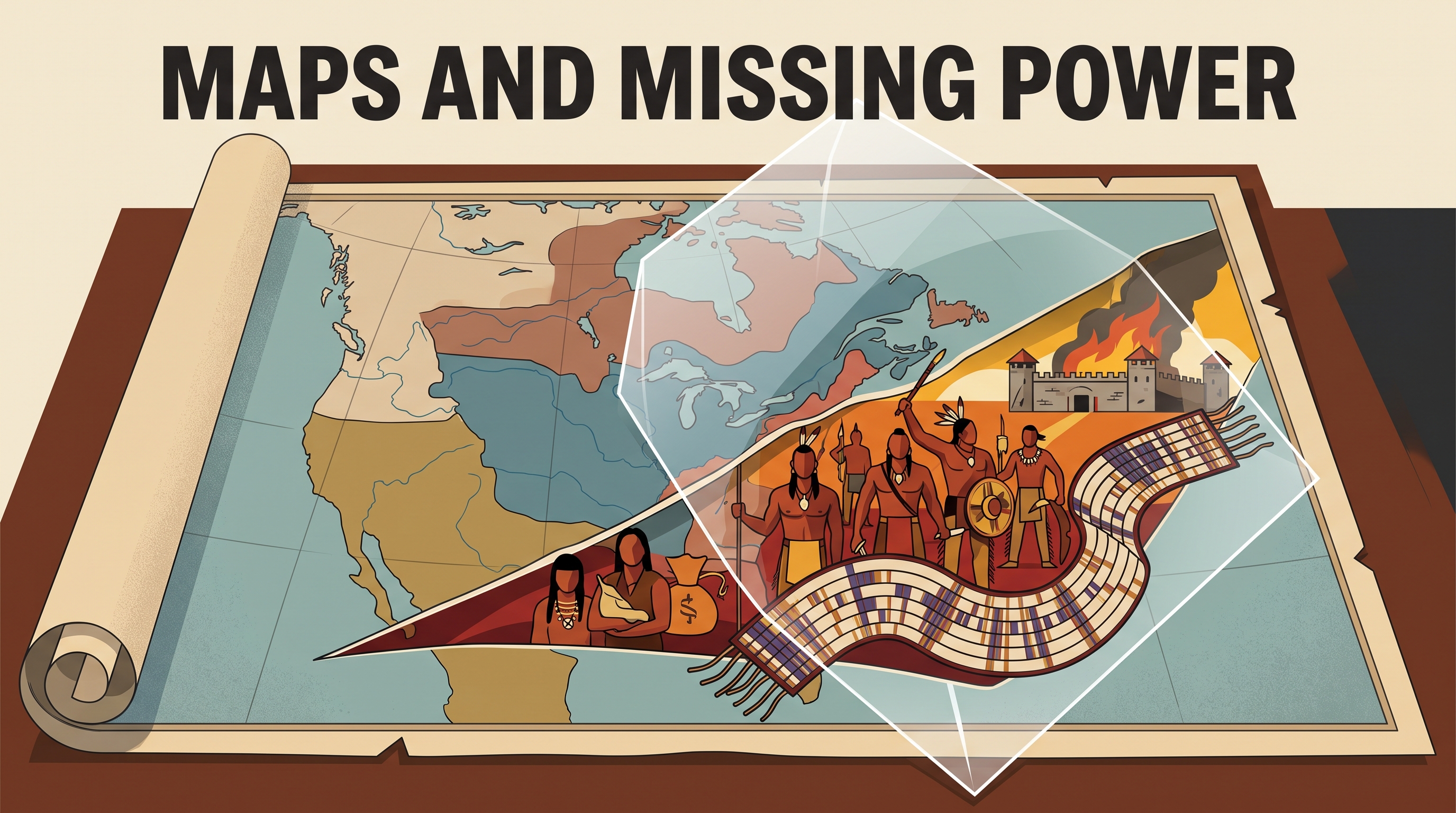
Reading what maps leave out
Maps showing European possessions in 1754 and 1763 are useful for tracking imperial boundaries, but they can create an incomplete picture. A map may show France losing territory and Britain gaining it while failing to show Indigenous homelands, independent political authority, trade relationships, or successful resistance.
Ask of any map: Whose claims are visible, and whose power is missing? The changes in European-controlled territory do not automatically measure the extent of Indigenous control, influence, or resistance. The Shawnee, Delaware, Seneca, Ojibwa, and Ottawa responses—including resistance often associated with Pontiac’s Rebellion—show that the postwar landscape involved continued negotiation over space rather than an instant transfer of authority.
Skill focus and misconception check
Skill 4.A — Contextualization: Identify and describe a historical context for a specific historical development or process. To contextualize the Seven Years’ War, connect it to British population growth, westward expansion, French efforts to protect trade networks, and Indigenous efforts to preserve autonomy.
Skill 1.B — Explain a historical concept, development, or process: Explain how economic and political competition produced conflict, and how the British victory created new territorial and financial pressures.
Misconception check: Indigenous nations were not a single French-aligned bloc. Different nations made different alliances, resisted European encroachment, and negotiated from their own political positions.
Retrieval check
Why would the Seven Years’ War be misrepresented by a map showing only British and French territorial changes? A strong answer identifies both the visible imperial rivalry and the omitted Indigenous diplomacy, resistance, and continuing negotiation over land and authority.
3.3 Taxation Without Representation · 3.4 Philosophical Foundations of the American Revolution
Key concepts: Taxation without representation · New taxes · Philosophical foundations of the American Revolution · Enlightenment ideas · American Revolution · Historical analysis of primary sources · Point of view · Purpose · Historical situation · Audience
The American Revolution began as a dispute over a deceptively simple question: Who had the legitimate power to tax the colonies? After the Seven Years’ War, Great Britain claimed that the colonies should help pay the costs of imperial defense.
3.3 Taxation Without Representation · 3.4 Philosophical Foundations of the American Revolution
The American Revolution began as a dispute over a deceptively simple question: Who had the legitimate power to tax the colonies? After the Seven Years’ War, Great Britain claimed that the colonies should help pay the costs of imperial defense. Many colonists answered that taxation required the consent of their elected representatives—and that Parliament did not represent them.
Taxation without representation means imposing taxes on people who have no elected representatives with a meaningful voice in the legislature that creates those taxes.
From imperial victory to imperial crisis
Britain’s victory in the Seven Years’ War expanded its territory but also left the empire deeply in debt. British leaders therefore tried to make colonial administration more orderly and to require colonists to contribute more directly to imperial expenses. The Proclamation of 1763 restricted colonial settlement west of the Appalachian Mountains, while the Sugar Act of 1764 strengthened customs enforcement and placed duties on imported molasses and other goods.
The Stamp Act of 1765 went further: it required printed materials—including newspapers, legal documents, and licenses—to carry a tax stamp. Colonists objected not simply because the tax was expensive, but because Parliament had enacted it without the approval of colonial assemblies. Resistance included petitions, public demonstrations, intimidation of stamp distributors, and the formation of the Sons of Liberty.
The argument over representation
British officials argued that Parliament represented the interests of the entire empire through virtual representation, the idea that members of Parliament represented all British subjects, even those who did not vote for them. Colonial critics rejected this theory. They claimed that only their own elected assemblies could tax them because those assemblies represented the communities that paid the taxes.
The slogan “No taxation without representation” therefore expressed a constitutional argument, not merely opposition to high prices. Colonists generally did not begin by demanding independence. They demanded the rights they believed belonged to them as English subjects, including consent in taxation and protection from arbitrary government.
Key distinction: Colonial resistance initially challenged Parliament’s authority over internal taxation; it did not automatically reject the entire British Empire.
The Stamp Act Congress of 1765 asserted that colonists possessed the rights of Englishmen and that taxes could not be imposed without their consent. Although Parliament repealed the Stamp Act in 1766, it simultaneously passed the Declaratory Act, announcing its authority to legislate for the colonies “in all cases whatsoever.” The Townshend Acts of 1767 then placed duties on imported glass, lead, paint, paper, and tea, producing renewed boycotts and confrontation.
A worked primary-source analysis: sourcing before interpretation
Imagine a visual source published in the 1760s showing a colonial tax collector surrounded by angry colonists. Do not begin by treating the image as a neutral photograph. Apply Skill 2.A: Sourcing and Situation — Identify a source’s point of view, purpose, historical situation, and/or audience.
Step 1 — Historical situation: The image appeared during disputes over the Stamp Act or Townshend duties, when imperial officials were enforcing new revenue measures. Step 2 — Purpose: If the image exaggerates the tax collector’s humiliation, its purpose may be to mobilize resistance by portraying British policy as oppressive. Step 3 — Audience: A colonial newspaper audience would already understand local grievances and might be encouraged to boycott British goods. Step 4 — Point of view: The image likely reflects the perspective of colonial opponents rather than that of Parliament or royal officials.
The interpretation becomes stronger when the source is connected to its context: the image is evidence of colonial political mobilization, not proof that every colonist opposed every British policy. This is the difference between using a source and merely repeating what it depicts.
Enlightenment ideas and revolutionary political thought
The conflict became more radical because colonists drew on Enlightenment ideas, an intellectual movement that emphasized reason, natural rights, and the examination of government through rational principles. John Locke argued that people possessed natural rights—including life, liberty, and property—and that governments existed through a social contract to protect those rights.
Locke’s reasoning created a powerful chain:
$$ \text{Natural rights} \rightarrow \text{social contract} \rightarrow \text{limited government} \rightarrow \text{right of resistance} $$
Colonial writers adapted these ideas to arguments about representation and liberty. Republican political thought also warned that concentrated power produced corruption and threatened freedom. These ideas did not mechanically cause revolution; they supplied a language through which colonists interpreted taxes, military enforcement, and imperial authority.
Misconception check
Misconception: “The Enlightenment directly caused all colonists to become revolutionaries.” In reality, revolutionary ideology interacted with concrete events: taxation, enforcement, troop presence, economic boycotts, and clashes such as the Boston Massacre. Ideas helped colonists explain why those events violated liberty; events made the ideas politically urgent.
Retrieval check: Why did colonists object to the Stamp Act even though some taxes were relatively modest? Identify one British argument, one colonial counterargument, and one Enlightenment idea that strengthened colonial resistance. A complete answer should connect parliamentary authority, consent, and natural rights rather than treating the conflict as a simple complaint about money.
CED traceability
This topic develops Learning Objective 3.C: Explain the causes and effects of the growing tensions between England and the American colonies and Learning Objective 3.D: Explain how and why different intellectual and ideological beliefs influenced the political, economic, and social development of the colonies and the United States. It connects especially to Key Concept 3.1.II.B, concerning Britain’s efforts to consolidate imperial control and impose new taxes, and Key Concept 3.1.II.C, concerning colonial resistance, rights as Englishmen, and republican self-government.
The central historical relationship is causal but not single-factor: imperial debt encouraged taxation; taxation provoked constitutional resistance; enforcement intensified distrust; and Enlightenment and republican ideas transformed resistance to particular policies into a broader argument about legitimate government. That combination prepared the political ground for the American Revolution.
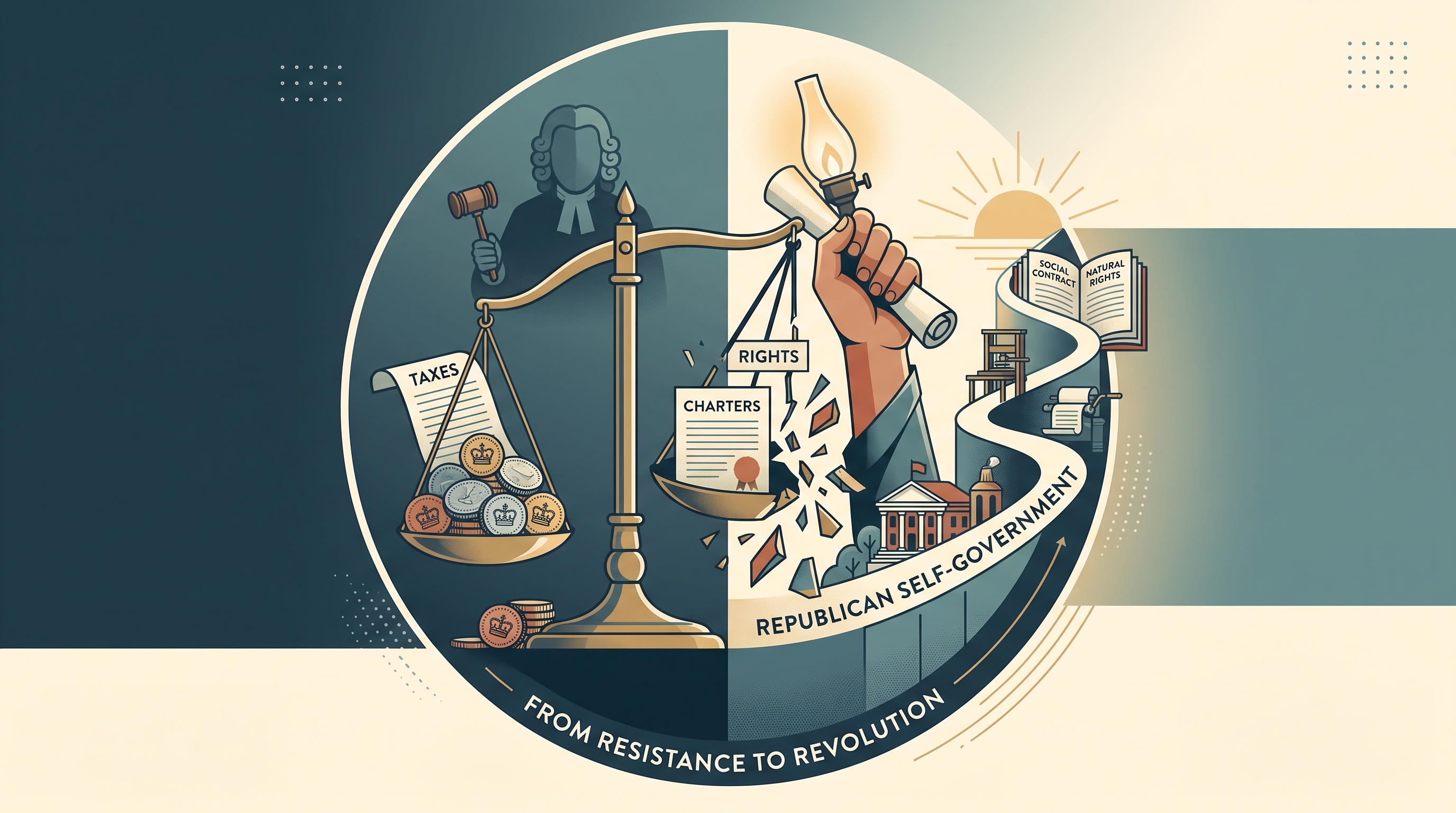
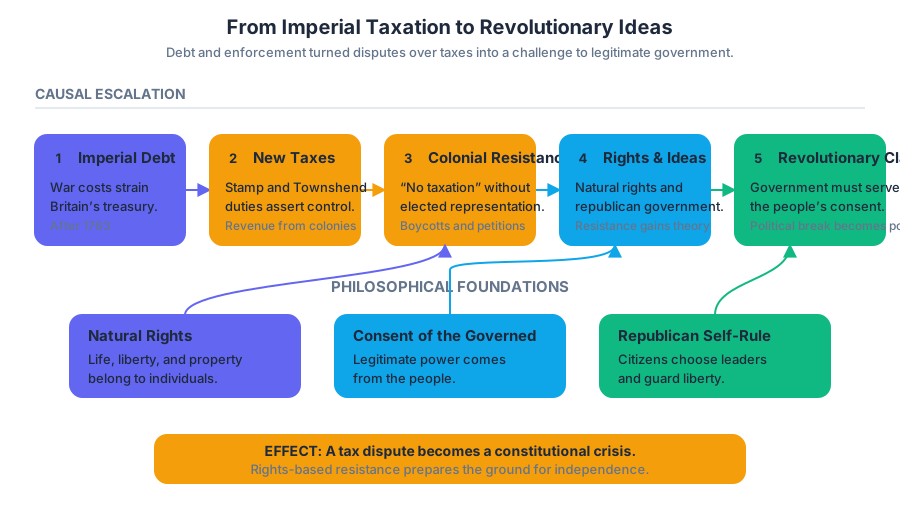
3.5 The American Revolution · 3.6 The Influence of Revolutionary Ideals
Key concepts: American Revolution · American independence and national identity · Democratic and republican ideals · Thomas Paine’s Common Sense · Declaration of Independence · State and federal government · Individual liberties · Limits on centralized power · New constitutions and declarations · Global influence of the American Revolution
The American Revolution did more than separate thirteen colonies from Britain: it created a political laboratory in which Americans tested how a nation could protect liberty without reproducing the concentrated power they had just resisted.
3.5 The American Revolution · 3.6 The Influence of Revolutionary Ideals
The American Revolution did more than separate thirteen colonies from Britain: it created a political laboratory in which Americans tested how a nation could protect liberty without reproducing the concentrated power they had just resisted. Independence made the United States possible; revolutionary ideals made its government a continuing experiment.
Investigative question: How did the Revolution transform a colonial rebellion into a new national identity and a debate over the proper limits of government?
From independence to national identity
Victory over Britain enabled the former colonies to claim independence and begin imagining themselves as one people. That identity was not automatic. Regional differences, local loyalties, economic interests, and disagreements over political power continued, but new national symbols, institutions, and political language gradually connected the states.
National identity means a shared sense of belonging to a political community. During and after the Revolution, Americans developed that identity through common experiences: resistance to British authority, wartime sacrifice, independence declarations, state-building, and the belief that their political experiment had significance beyond North America.
Paine and the argument for independence
Thomas Paine’s Common Sense, published in 1776, translated revolutionary arguments into direct language for a broad audience. Paine attacked monarchy and hereditary rule, challenged the idea that a distant island should govern a continent, and argued that independence would allow Americans to build a new political order rather than merely repair the old one.
Paine’s importance was not that he single-handedly caused independence. His pamphlet mattered because it helped shift the debate from resistance within the British Empire toward complete separation. It connected political theory to practical claims about geography, monarchy, military security, and the future of American society.
Misconception check: Common Sense did not itself declare independence or create the Revolution. The pamphlet influenced public opinion; the Continental Congress formally declared independence.
The Declaration of Independence
The Declaration of Independence performed two jobs at once. Internationally, it announced that the colonies were no longer British subjects. Politically, it justified separation by asserting that legitimate government rests on the rights and consent of the governed.
Its democratic ideals emphasized political legitimacy through the people rather than through inherited privilege. Its republican ideals emphasized representative government, civic responsibility, and resistance to arbitrary power. The Declaration therefore presented independence as a defense of rights and as an argument for a new form of government.
The document’s universal language created a powerful tension. Its claims about equality and liberty could be used to challenge slavery, political exclusion, and unequal treatment, even though the Revolution did not immediately extend those principles to everyone. Revolutionary ideals became standards against which American institutions could be judged.
Constitutions, rights, and divided power
After independence, political leaders created new constitutions and declarations of rights. These documents did not merely replace British officials; they defined how authority should operate inside the new states and across the emerging nation.
The central problem was balance:
| Political goal | Danger leaders wanted to avoid | Institutional response |
|---|---|---|
| Protect individual liberties | Government could violate rights | Declarations of rights and written protections |
| Limit centralized power | A distant national authority could become oppressive | Stronger state authority and divided powers |
| Prevent excessive popular influence | Sudden majorities could threaten property or stability | Representation, elections, and constitutional limits |
| Create effective national action | States could act without coordination | Experiments with federal institutions |
State government governed a particular former colony, while federal government referred to authority operating across the states. Revolutionary political systems tried to make both useful: states would preserve local control, while national institutions would address shared concerns. The unresolved balance between liberty, order, state power, federal power, and popular influence became a defining problem of the early republic.
Worked contextual example: tracing an ideal
Suppose a historian asks how the Revolution influenced American government. A strong chain of reasoning would look like this:
- British rule encouraged resistance to concentrated and arbitrary authority.
- Common Sense popularized the argument that monarchy and hereditary power were illegitimate.
- The Declaration of Independence expressed consent, rights, and resistance to tyranny.
- New state constitutions and rights declarations converted those ideals into political rules.
- Americans then debated how much authority a national government should possess.
The key is causation: revolutionary ideals did not produce one settled system. They produced experiments—different forms of government designed to protect liberty while limiting centralized power and excessive popular influence.
Revolutionary ideals beyond the United States
The Revolution and the Declaration influenced France, Haiti, and Latin America by demonstrating that inherited political authority could be challenged and that independence could be justified through rights-based language. Future independence movements around the world drew on the idea that a people could claim sovereignty and construct a new political order.
These influences were selective and contested. Different movements adapted revolutionary language to local conditions, and the United States itself continued to struggle over whose liberty, citizenship, and political voice the ideals protected.
AP skill focus
Skill 1: Developments and Processes asks you to explain how independence, national identity, constitutions, and revolutionary ideals developed over time. Skill 5: Making Connections links the Declaration’s political language to later movements in France, Haiti, Latin America, and the United States. Skill 6: Argumentation requires a defensible claim that connects evidence—such as Common Sense, the Declaration, and new constitutions—to the broader transformation in government.
Retrieval check: Why did the Revolution produce both stronger ideas about popular liberty and continued concern about excessive popular influence? Name one document or political development that demonstrates this tension.
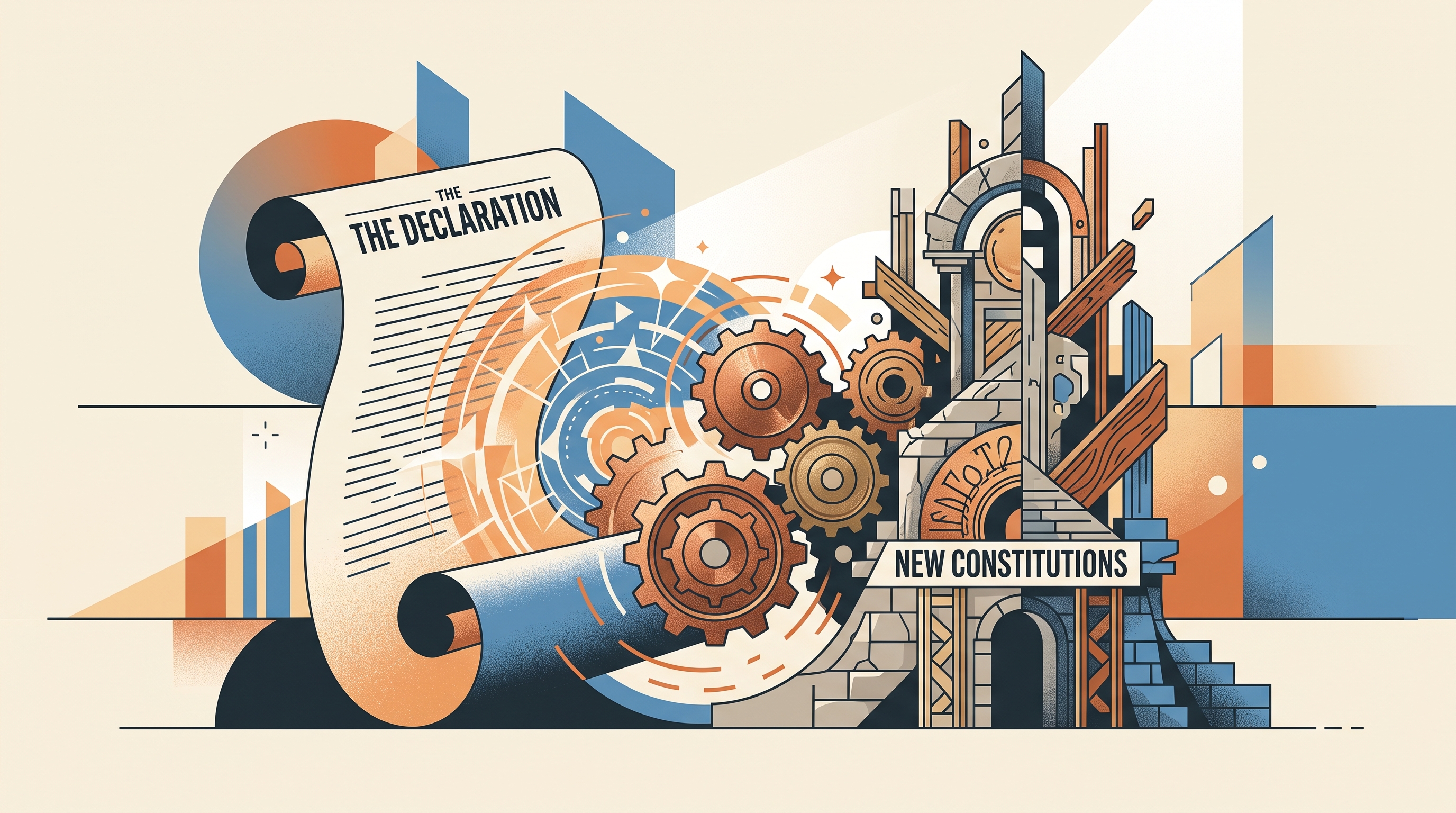
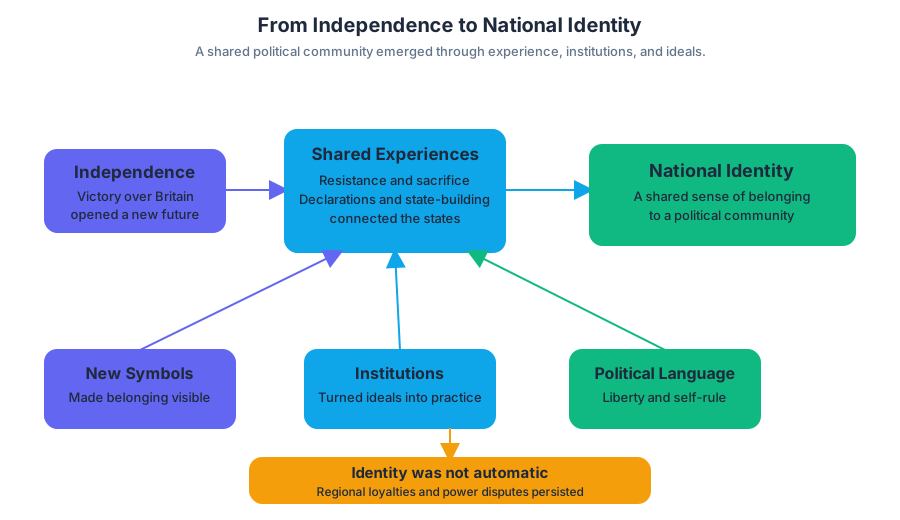
3.7 The Articles of Confederation · 3.8 The Constitutional Convention and Debates over Ratification
Key concepts: Articles of Confederation · Legislative supremacy under the Articles · Property qualifications for voting and citizenship · Northwest Ordinance · Constitutional Convention · Federalism · Separation of powers · Constitutional compromises over slavery and the slave trade · Federalists and Anti-Federalists · Bill of Rights and ratification
The Articles of Confederation unified the newly independent states, but they placed most government power in a single legislative body and gave the central government limited authority.
3.7 The Articles of Confederation · 3.8 The Constitutional Convention and Debates over Ratification
The Articles of Confederation unified the newly independent states, but they placed most government power in a single legislative body and gave the central government limited authority. The central problem was not whether Americans wanted government; it was where governmental power should reside and how much power the national government could safely exercise.
Investigative question: How did Americans move from a government dominated by state legislatures to a federal system with separate branches, while still fearing concentrated national power?
The Articles: unity without strong central authority
The Articles created a confederation, meaning a union in which the states retained primary sovereignty and delegated only selected powers to a central government. Under this arrangement, the Confederation Congress handled national concerns, but it lacked the full institutional tools needed to govern effectively.
Power under the Articles was concentrated in the legislative branch: there was no separate executive president to enforce national decisions and no national judiciary to interpret federal law. This reflected Revolutionary suspicion of executive authority, but it also made the government slow and difficult to coordinate.
Many new state constitutions likewise placed power in legislative bodies and maintained property qualifications—requirements that voters or citizens own property. These rules limited political participation and show that Revolutionary language about liberty did not immediately produce universal suffrage or equal citizenship.
| Problem under the Articles | Why it mattered |
|---|---|
| Limited central authority | Congress struggled to respond to national problems |
| Difficulties with finances | The government had trouble meeting expenses and obligations |
| Interstate commerce disputes | States could pursue conflicting trade policies |
| Foreign-relations weakness | Other nations could doubt the Confederation’s ability to enforce agreements |
| Internal unrest | Events such as Shays’s Rebellion encouraged calls for stronger government |
Misconception check — “The Articles created no national government.” They did create a central government and unified the states, but that government had limited power. The more accurate contrast is weak central authority under the Articles versus stronger, constitutionally divided authority under the Constitution.
The Northwest Ordinance: governing expansion
The Northwest Ordinance demonstrated that the Confederation Congress could create durable national policy. It established a process for territories in the Northwest Territory to become states, rather than treating western settlement as an unplanned scramble among existing states.
The ordinance also promoted public education, protected private property, and banned slavery in the Northwest Territory. Its state-admission process became a model for orderly expansion: territories could develop institutions and eventually enter the Union as states.
Worked contextual example: Suppose a historian argues that the Articles were entirely ineffective. The Northwest Ordinance complicates that claim. The Articles-era government struggled with finance and interstate coordination, but it successfully established rules for territorial governance, education, property, and slavery. A strong historical argument therefore distinguishes institutional weakness from complete failure.
The Constitutional Convention: redesign through compromise
Delegates from the states met at the Constitutional Convention to negotiate the structure and functions of a new government. They did not simply replace one document with another; they bargained over representation, federal authority, slavery, and the relationship between state and national governments.
The Constitution created federalism, a system that divides power between a national government and state governments. It also established separation of powers, assigning legislative, executive, and judicial responsibilities to distinct branches. This produced a central government that was limited by constitutional boundaries but dynamic because it possessed clearer authority to act.
Convention compromises revealed the Constitution’s contradictions. The agreement over slavery permitted the international slave trade to continue until 1808, after which Congress could prohibit it. The compromise protected sectional cooperation in the short term while embedding slavery into the new national political order.
Ratification: Federalists, Anti-Federalists, and the Bill of Rights
Federalists supported ratification because they believed the nation needed a stronger government capable of managing finance, commerce, defense, and foreign relations. Anti-Federalists feared that the proposed government would endanger state authority and individual liberty. Federalists, including Alexander Hamilton and James Madison, defended the Constitution through the Federalist Papers.
Federalists secured ratification in part by promising to add a Bill of Rights, a written list of protected individual liberties. George Washington endorsed the Constitution in his September 17, 1787, letter transmitting it to Congress, helping give the document legitimacy during the ratification debate.
AP historical reasoning in action
This topic most directly develops Unit 3: Learning Objective H, “Explain how different forms of government developed and changed as a result of the Revolutionary Period,” and Unit 3: Learning Objective I, “Explain the differing ideological positions on the structure and function of the federal government.”
Use HISTORICAL THINKING SKILL 1.A: Identify and describe a development or process to trace the movement from legislative supremacy under the Articles to federalism and separation of powers. Use HISTORICAL THINKING SKILL 3.A: Identify and describe a claim and/or argument in a non-primary source and 3.B: Identify and describe a claim and/or argument in a primary source when comparing Federalist and Anti-Federalist arguments. Use HISTORICAL THINKING SKILL 4.B: Explain how a historical context affects a specific historical development to connect Revolutionary distrust of centralized power to the Articles, and postwar difficulties to the Constitutional Convention.
Retrieval check: Why is the Northwest Ordinance evidence both for the Articles government’s limitations and for its achievements? Then explain why the Bill of Rights was a ratification compromise rather than part of the original Constitution.
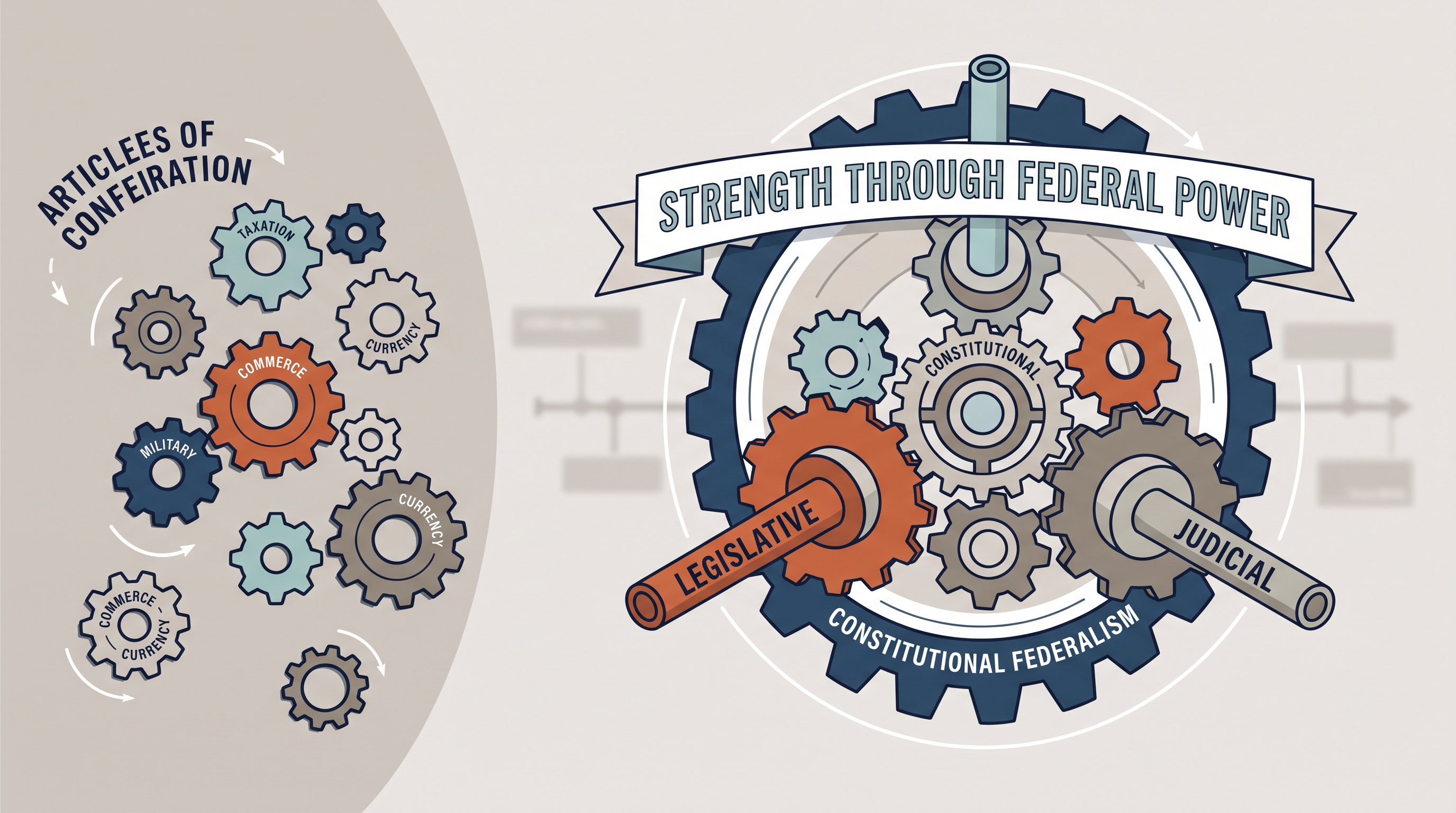
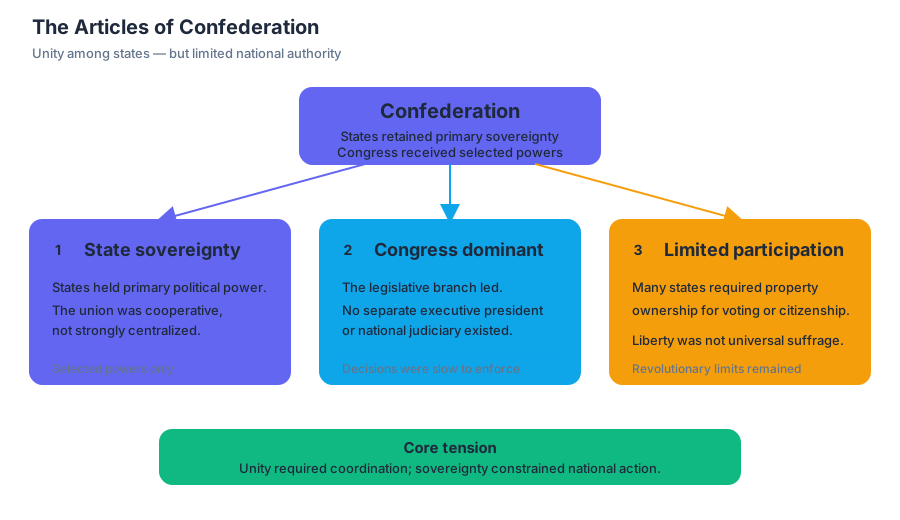
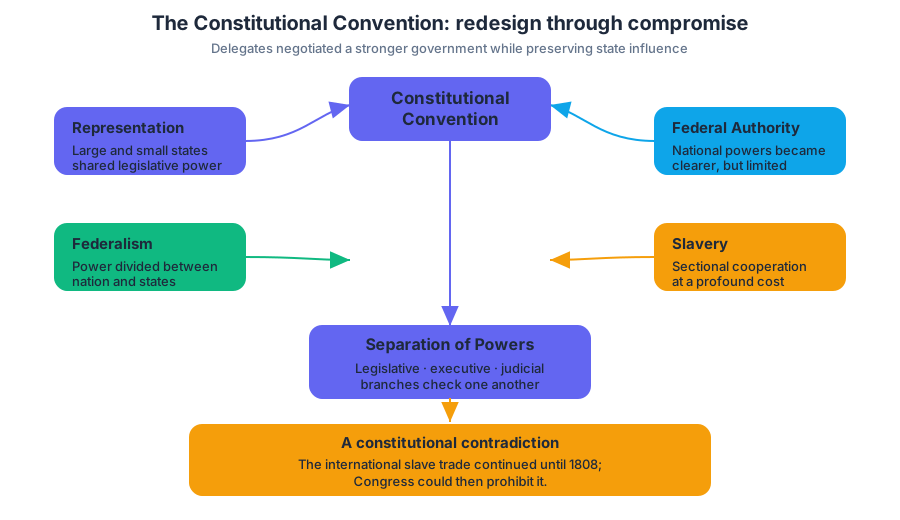
3.9 The Constitution · 3.10 Shaping a New Republic
Key concepts: State constitutions · Massachusetts State Constitution of 1780 · Natural rights · Representative self-government · U.S. Constitution · Bill of Rights · Executive branch · Political parties · George Washington’s Farewell Address · National unity and foreign policy
The Constitution did more than create a national government: it created a system that had to be interpreted, operated, and defended by real people. The first presidents therefore established precedents—early examples that later leaders could follow—while disagreements over constitutional power helped produce the…
3.9 The Constitution · 3.10 Shaping a New Republic
The Constitution did more than create a national government: it created a system that had to be interpreted, operated, and defended by real people. The first presidents therefore established precedents—early examples that later leaders could follow—while disagreements over constitutional power helped produce the nation’s first political parties.
Learning Objective L: Explain how and why political ideas, institutions, and party systems developed and changed in the new republic.
State constitutions: rights and representation
After independence, Americans wrote state constitutions to define government authority and the rights of citizens. The Massachusetts State Constitution of 1780 identified two foundations of legitimate government: protecting natural rights, the rights people possess by virtue of being human, and advancing representative self-government, the principle that citizens govern through elected officials.
The Massachusetts Constitution linked rights to institutions. Its Preamble presented government as responsible for securing the common welfare, while Chapter I, Section 3, Article 4 addressed representation in the House of Representatives. The underlying logic was clear: government existed to protect rights, but the people needed representative institutions to control how government exercised power.
State constitutions also revealed that revolutionary ideals were applied unevenly. The New Jersey State Constitution of 1776, for example, used gender-neutral language—“they” rather than “he”—and did not specify racial categories in its voting qualifications. As a result, property-owning women and African Americans could vote under the provision until the legislature restricted voting in 1807 to White male taxpayers. The contrast shows both the possibilities and limits of early republican government.
Natural rights + representation: A government could claim legitimacy only if it protected fundamental rights and allowed the governed some meaningful role in making public decisions.
The Constitution in operation
Ratification of the U.S. Constitution established the framework of the new national government. Its executive branch, headed by a president, gave the government a single institution responsible for enforcing laws, conducting diplomacy, and directing national administration. The Constitution also created legislative and judicial branches, but the presidency immediately raised a practical question: how much authority should the executive exercise?
George Washington’s administration answered that question through practice. Washington established a cabinet of department heads, consulted advisers even though the Constitution did not explicitly require a cabinet, and accepted the title “President of the United States.” These choices became precedents: later presidents inherited expectations about executive leadership without needing a constitutional amendment each time.
John Adams added another precedent by occupying the presidency during severe conflict with France and with the opposition Democratic-Republican Party. His administration demonstrated that constitutional government had to survive partisan disagreement, foreign-policy crises, and arguments over the boundaries between liberty and order.
Why political parties formed
The Constitution did not mention political parties, yet parties developed because leaders disagreed about how its powers should be used. In the 1790s, debates centered on the relationship between the national government and the states, economic policy, foreign policy, and the proper balance between liberty and order.
| Political group | Major leaders | General emphasis |
|---|---|---|
| Federalists | Alexander Hamilton | Strong national government, national economic programs, and order |
| Democratic-Republicans | Thomas Jefferson and James Madison | Greater emphasis on states’ rights, agrarian interests, and suspicion of concentrated national power |
These parties were not simply modern ideological teams. Both claimed to defend republican liberty, but they interpreted the Constitution differently. Hamilton’s financial policies represented one vision of energetic national power; Jefferson and Madison feared that such policies could recreate the hierarchy and dependence Americans had resisted.
Common misconception: Political parties did not appear because the Constitution formally authorized them. They emerged because constitutional choices required interpretation, and competing interpretations created organized political coalitions.
Washington’s Farewell Address
George Washington’s Farewell Address became a foundational document concerning national unity and foreign policy. Washington warned that intense factionalism could allow temporary political interests to overpower the nation’s long-term interests. He also cautioned against permanent alliances, especially when they might pull the United States into European conflicts.
To analyze the address, use Skill 2: Sourcing and Situation. Washington’s point of view reflected his experience as the first president and as a revolutionary leader; his purpose was to advise citizens as he left office; the historical situation included growing partisan conflict and international tension; and the likely audience was the American public and future political leaders.
A strong analysis connects those features to meaning: because Washington was leaving office after helping establish national institutions, his warning about faction and foreign entanglement carried unusual authority. The address was not proof that parties were unnecessary; it was an argument that party competition should not destroy national unity.
The Bill of Rights and the new republic
Ratification eventually resulted in the addition of the Bill of Rights, the first ten amendments to the Constitution. The amendments addressed concerns that the new national government might threaten individual liberties. Their addition demonstrated that constitutional government could be revised through an established process when political pressure exposed unresolved fears about rights.
This is a useful example of Skill 5: Making Connections: state constitutions’ concern with natural rights connected to the demand for federal protections. It also supports Skill 3: Claims and Evidence in Sources, because a constitutional document can serve as evidence of what its authors considered dangerous or necessary.
Worked example: sourcing a constitutional-era document
Suppose a document says that government must protect liberty but warns that organized factions may place party loyalty above the nation. Identify it as Washington’s Farewell Address, then reason through the four sourcing questions:
- Point of view: A retiring first president concerned with the survival of the Union.
- Purpose: To offer public advice about national unity and foreign policy.
- Historical situation: Partisan divisions and international pressures in the 1790s.
- Audience: Citizens and future officeholders.
The historical significance follows from the evidence: the document shows that the new republic’s central problem was no longer simply designing institutions, but maintaining constitutional government amid disagreement. An argument using this evidence demonstrates Skill 6: Argumentation when it makes a defensible claim about how early leaders shaped national political practice.
Retrieval check
Why did the Bill of Rights become part of the Constitution, and how did the first two presidents shape the new republic even when they were not changing the constitutional text? A complete answer should mention concerns about natural rights, the executive branch, presidential precedents, political parties, and Washington’s warnings about faction and foreign alliances.
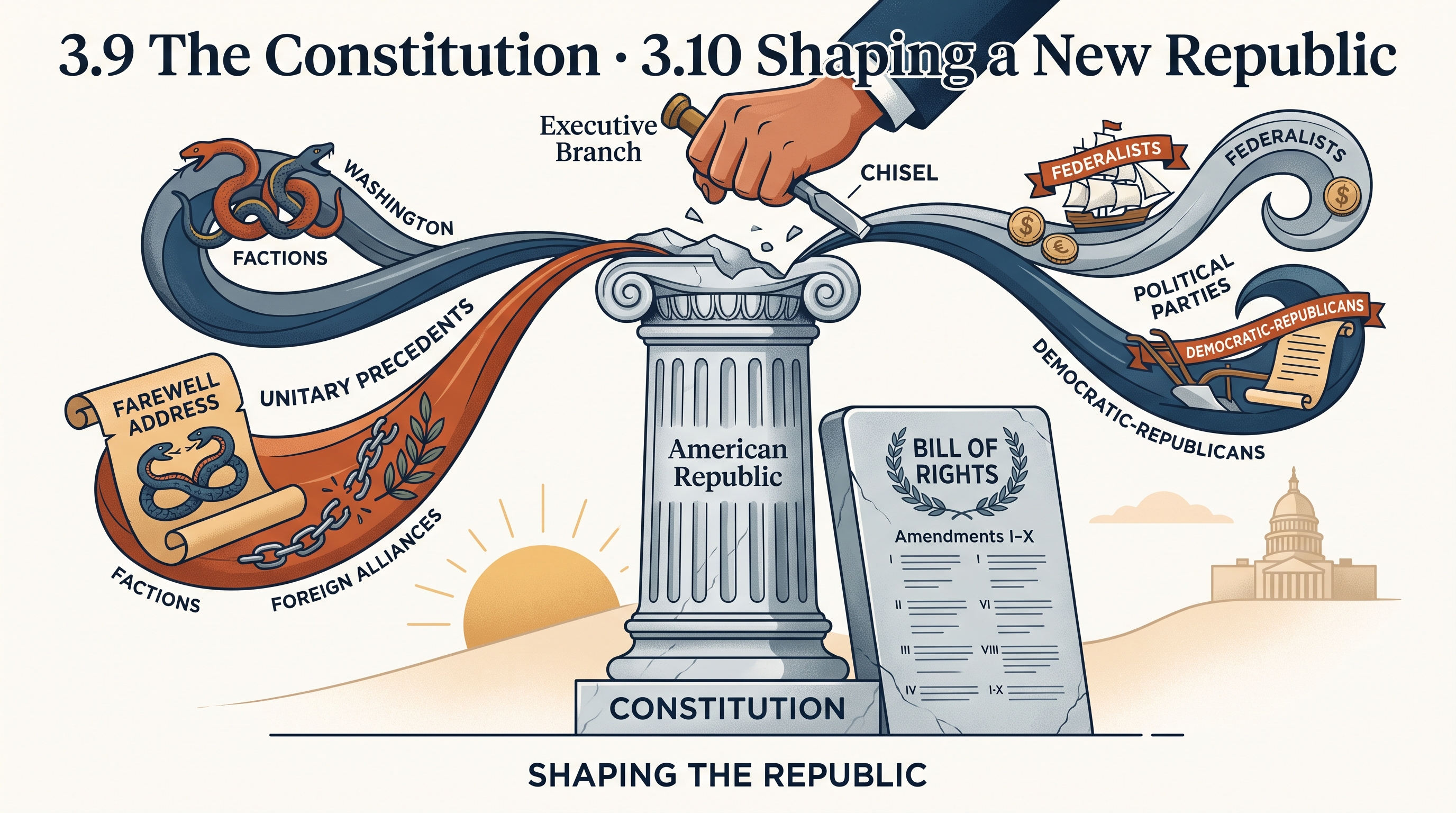
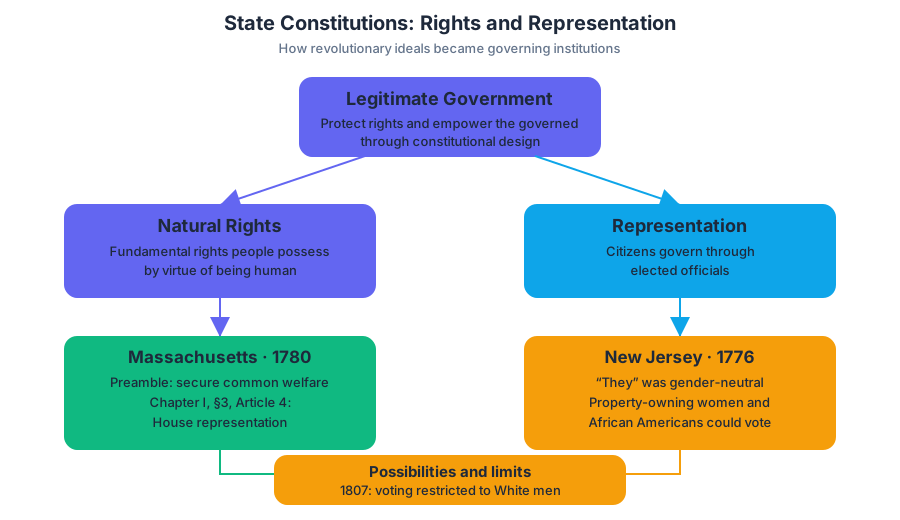
3.11 Developing an American Identity · 3.12 Movement in the Early Republic
Key concepts: Developing an American identity · American and regional culture · Regional variations and cultural change from 1754 to 1800 · Ethnic and religious diversity in colonial America · Patriotism and resistance to British policies · Women’s political activism during the American Revolution · Indigenous cultures and early historical accounts · Historical source analysis: point of view, purpose, context, and limitations · The Patriot cause and the Battle of Trenton · Early-republic development, including territorial settlement, frontier defense, self-rule, trade, political parties, citizens’ rights, and the American System
Between 1754 and 1800, Americans developed new ideas of national identity without becoming culturally uniform. Patriotism, political resistance, migration, religious diversity, and regional customs produced a shared American vocabulary—but not a single American culture.
3.11 Developing an American Identity · 3.12 Movement in the Early Republic
Between $1754$ and $1800$, Americans developed a stronger sense of belonging to a single nation without becoming culturally uniform. Patriotism, resistance to British policies, migration, religious diversity, women’s activism, and regional customs created a shared American vocabulary—but not one shared American culture.
A national identity built from difference
American identity means the ideas, loyalties, practices, and symbols through which people understood what it meant to belong to the United States. After independence, Americans created new forms of national culture while preserving major regional variations.
The key tension was visible everywhere: people increasingly described themselves as Americans, yet they continued to identify as New Englanders, Virginians, backcountry settlers, Native peoples, members of ethnic communities, or adherents of different churches. National identity therefore developed through negotiation rather than cultural sameness.
KC-3.2.III.ii: New forms of national culture developed in the United States alongside continued regional variations.
Patriotism and resistance
Before independence, opposition to British policies helped transform local grievances into a broader political identity. Resistance to taxation and imperial control encouraged colonists to use shared language—liberty, rights, representation, and tyranny—even though different colonies experienced British rule differently.
Patriotism became visible through public rituals and symbols: resistance organizations, boycotts, revolutionary committees, militia service, printed arguments, and eventually loyalty to the Continental cause. The term Patriot described colonists who supported resistance and independence, but not every colonist accepted that identity. Loyalists remained attached to the British Empire, while others tried to avoid choosing sides.
A common misconception is that the Revolution instantly erased older identities. In reality, revolutionary unity was powerful but conditional. Americans cooperated against a common imperial opponent while continuing to disagree about religion, slavery, political authority, economic interests, and the proper balance between state and national power.
American and regional culture
The American and Regional Culture theme, or ARC, emphasizes that creative expression, demographic change, philosophy, religious beliefs, scientific ideas, social mores, and technology shape national, regional, and group cultures. These cultures can then influence government policy and economic systems.
From $1754$ to $1800$, national culture grew through shared revolutionary experiences, republican political language, new state and national institutions, and symbols of independence. Yet regional differences remained substantial.
| Region or cultural setting | Important characteristics | Effect on identity |
|---|---|---|
| New England | Commercial communities, Congregational religious traditions, town-centered political life | Encouraged civic participation and a strong local identity |
| Middle Colonies and states | Greater ethnic and religious diversity, including Quakers and other Protestant groups | Made pluralism an important part of American life |
| Chesapeake and Southern regions | Plantation agriculture, Anglican influence, and racial slavery | Produced a hierarchical regional culture that conflicted with revolutionary ideals |
| Backcountry | New migration, frontier communities, and conflict over land | Strengthened demands for local control while intensifying conflict with Native peoples |
Regional culture did not merely decorate political life; it shaped policy. Different ideas about land, labor, religion, and political authority influenced debates over state constitutions, representation, western settlement, and the powers of the new federal government.
Ethnic and religious diversity
Colonial America contained people of English, Scottish, Irish, German, Dutch, African, and other backgrounds, as well as many American Indian nations. Enslaved Africans and their descendants created and preserved cultural traditions despite the violence of slavery. German-speaking communities, Dutch settlements, and other ethnic groups retained languages, customs, and religious practices while participating in wider colonial and revolutionary society.
Religious diversity also expanded beyond the older dominance of established churches. Congregationalists, Anglicans, Quakers, Presbyterians, Baptists, Catholics, Jews, and other communities practiced different forms of worship. The Revolution encouraged arguments that political membership should not depend entirely on belonging to one established church.
The important distinction is between diversity and equality. Revolutionary language broadened claims about liberty, but women, enslaved people, free African Americans, Native peoples, and many others remained excluded from full political power.
Women’s political activism
Women participated actively in the revolutionary movement even though most could not vote or hold office. They organized boycotts, produced homespun cloth, managed farms and businesses while men served in armies, circulated political information, and supported the Patriot cause through consumer choices.
The Daughters of Liberty became a prominent example of women turning household labor into political action. By making homespun goods and refusing imported products, women helped enforce resistance to British trade policies. Their activity challenged the idea that politics happened only in legislatures or battlefields.
Abigail Adams’s call to “remember the ladies” illustrates a related argument: revolutionary claims about liberty could be applied to women’s legal and political status. Yet the immediate result was limited. Women gained greater visibility as republican citizens and moral participants, but the dominant expectation remained republican motherhood—the idea that women should educate virtuous future citizens within the household rather than exercise equal formal political power.
Movement, migration, and conflict in the early republic
After independence, increasing numbers of migrants moved westward within North America. Frontier cultures that had emerged during the colonial period continued to grow, producing new communities but also intensifying social, political, and ethnic tensions.
Migration placed settlers and Native nations in direct conflict over land and natural resources. American Indian groups repeatedly evaluated and adjusted alliances with Europeans, other tribes, and the United States in an effort to limit white settlement and preserve control of their territories. These were strategic political decisions, not signs of passive resistance.
British alliances with American Indian groups contributed to continuing tensions between the United States and Britain after the Revolution. The existence of an independent United States did not end imperial competition or Native resistance; instead, western migration made sovereignty and land control central problems for the early republic.
Work the AP historical skill
The suggested skill is 1.B: Explain a historical concept, development, or process. A strong explanation must identify a development, describe how it operated, and connect it to a broader historical result.
For example: Women’s participation in boycotts and homespun production helped the Patriot movement by turning domestic consumption into organized resistance. This broadened political activism beyond male officeholders, although it did not produce equal voting rights for women.
This answer explains a process rather than merely naming the Daughters of Liberty. It identifies the action, the mechanism, and the limitation.
Retrieval and DBQ practice
Quick check: Why did a shared American identity coexist with regional variation?
Answer: Revolutionary institutions and symbols created national loyalties, while differences in religion, economy, ethnicity, geography, labor systems, and relations with Native peoples preserved distinct regional cultures.
DBQ-oriented prompt: Evaluate the extent to which the American Revolution expanded political participation between $1754$ and $1800$.
A defensible thesis would argue that the Revolution expanded participation by encouraging women’s activism, public political debate, and new ideas of citizenship, but that expansion remained sharply limited by slavery, gender restrictions, Native dispossession, and continuing social hierarchy. To develop the argument, connect each document’s point of view and historical situation to the larger conflict between revolutionary ideals and unequal power.
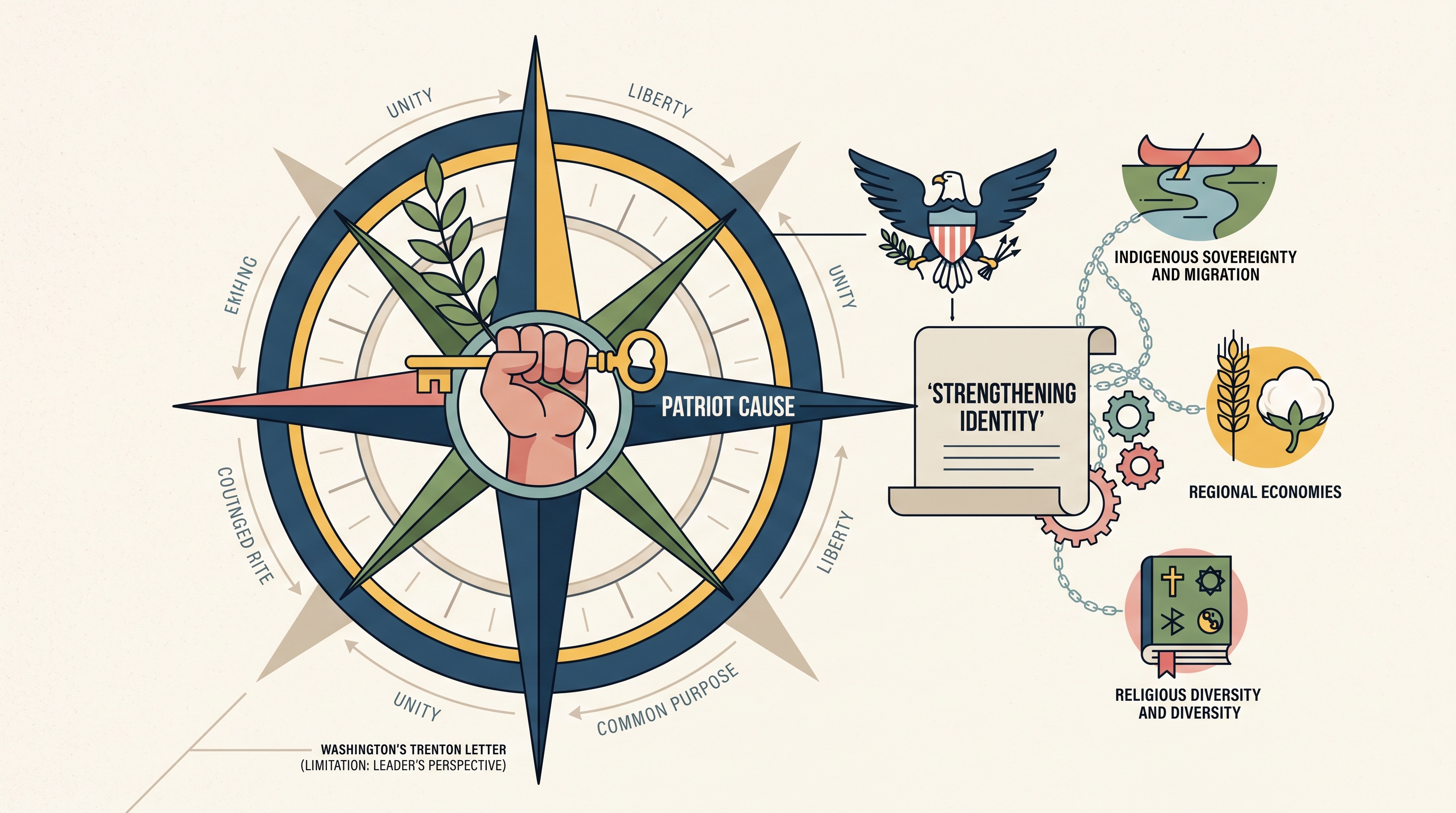
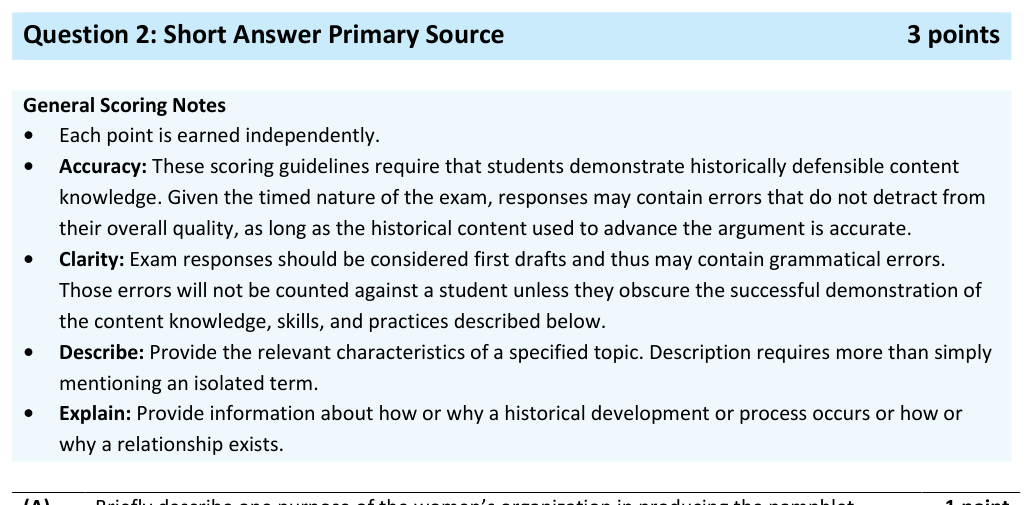
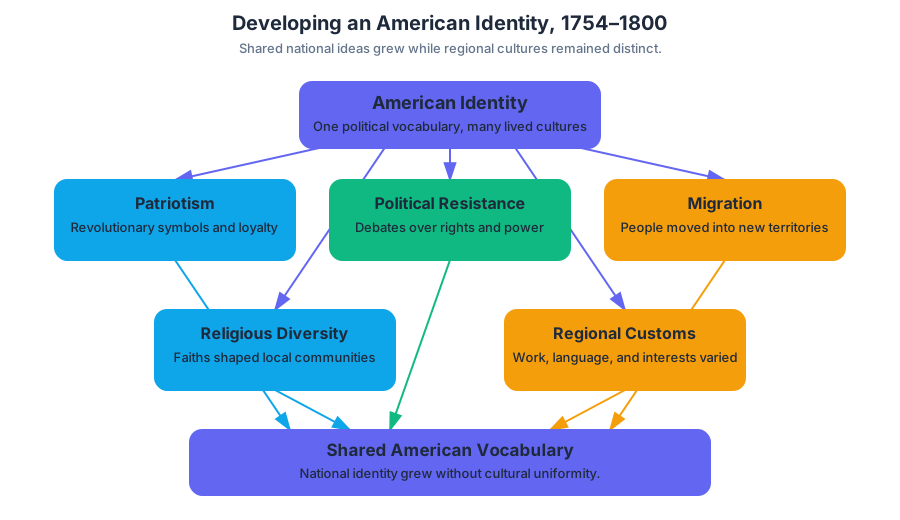
3.13 Continuity and Change in Period 3
Between 1754 and 1800, the United States experienced a political revolution without a complete social revolution: independence replaced imperial rule, but inequality, forced labor, and struggles over power remained deeply rooted.
3.13 Continuity and Change in Period 3
Between 1754 and 1800, the United States experienced a political revolution without a complete social revolution: independence replaced imperial rule, but inequality, forced labor, and struggles over power remained deeply rooted.
Investigative question: How could the Revolution create a new republic while preserving so many older systems of inequality?
3.13 Continuity and Change in Period 3 asks you to identify both sides of that paradox. Change means a meaningful transformation over time; continuity means a pattern, institution, belief, or inequality that persisted despite major events.
The period at a glance
| Area | Major change, 1754–1800 | Important continuity |
|---|---|---|
| Government | Colonists moved from imperial rule to republican government under the Constitution | Political power remained concentrated among propertied white men |
| Political ideas | Natural rights, popular sovereignty, and republicanism became central public principles | Those principles were applied unevenly |
| Slavery | Revolutionary language encouraged some northern emancipation and antislavery criticism | Slavery expanded and remained protected, especially in the South |
| Native nations | The United States became independent from Britain | Native peoples continued resisting land loss and U.S. expansion |
| Economy and movement | Americans expanded westward and developed stronger national markets and institutions | Agriculture remained central, and regional differences persisted |
| Identity | A distinct American identity developed through symbols, republican language, and shared wartime experience | Americans continued to disagree over who belonged within “the people” |
Political transformation: from subjects to citizens
The clearest change was political. In 1754, most people living in Britain’s mainland colonies were imperial subjects who participated in local assemblies but accepted the authority of the British monarch and Parliament. By 1800, the United States had declared independence, written state constitutions, adopted the Articles of Confederation, replaced them with the Constitution, and developed competing national political parties.
The new system rested on republicanism, the belief that legitimate government derives from the people and should be directed by representatives rather than a hereditary monarch. Popular sovereignty, the principle that political authority ultimately comes from the people, also became more important. The Constitution strengthened the national government through taxation, regulation of interstate commerce, executive authority, and federal courts.
Yet political participation did not become broadly equal. Many states restricted voting or officeholding through property requirements, and women, enslaved people, most free Black people, and Native Americans were excluded from full political citizenship. The Revolution changed the source of political legitimacy more dramatically than it changed the distribution of political power.
Revolutionary ideals versus social reality
The language of liberty created new pressure against old institutions. The Declaration of Independence’s assertion that people possessed natural rights encouraged antislavery arguments, northern gradual-emancipation laws, and debates over women’s education and civic influence. Abigail Adams’s appeal to “remember the ladies” illustrates how revolutionary language could be used to challenge traditional authority, even though it did not produce women’s suffrage.
Named misconception — “The Revolution ended slavery.” It did not. Some northern states adopted gradual emancipation, but slavery continued throughout the early republic and remained economically powerful. The Constitution protected slaveholders through provisions involving representation, fugitive laborers, and the continuation of the transatlantic slave trade until 1808.
The contradiction was not accidental: revolutionary leaders faced pressure to defend liberty while preserving social order and economic interests. Thus, the period produced both an expanding vocabulary of rights and a durable racial hierarchy.
Native nations and western expansion
Independence also changed the balance of power in North America. The United States no longer had to operate through British imperial boundaries, and the Treaty of Paris of 1783 transferred British claims east of the Mississippi River to the new nation. However, Native nations had not surrendered their lands through that treaty, and many resisted U.S. settlement through diplomacy, military alliances, and warfare.
The continuity is crucial: European and American settlers continued the older pattern of treating Indigenous land as available for expansion. The change was that the United States now pursued that expansion as an independent republic. Conflicts in the Ohio Country and the defeat of Native forces at the Battle of Fallen Timbers in 1794 demonstrated that independence intensified, rather than ended, Indigenous dispossession.
Worked contextual example: the Constitution
Prompt: Explain one major change and one major continuity in American political life between the Seven Years’ War and 1800.
Step 1 — Establish the context. The Seven Years’ War increased Britain’s debt and led imperial officials to seek more revenue from the colonies. Resistance to taxation helped produce the Revolution and independence.
Step 2 — Identify the change. The United States replaced monarchy and parliamentary sovereignty with republican government. The Constitution created a stronger federal structure than the Articles of Confederation.
Step 3 — Identify the continuity. Political authority still remained largely in the hands of elite white men. The new republic rejected hereditary monarchy but did not create universal democracy.
Step 4 — Explain the relationship. The Revolution transformed governmental institutions and political language, but social hierarchies limited how fully those changes were applied.
This response demonstrates S.P.4 Contextualization by connecting developments to the Seven Years’ War, S.P.5 Making Connections through continuity-and-change reasoning, and S.P.6 Argumentation by making a defensible claim supported by specific evidence. It also applies the reasoning process Continuity and Change, which asks not merely what changed? but what persisted, and why did both occur together?
CED traceability and retrieval check
Learning Objective 3.13.A: Explain how and why the American Revolution and the early republic produced both continuities and changes in American society and government.
Essential Knowledge identifiers: KC-3.1.I.A, KC-3.1.I.B, KC-3.2.I.A, KC-3.2.I.B, and KC-3.3.I.A are especially useful for tracing revolutionary ideals, republican government, social hierarchy, slavery, Native dispossession, and the development of American identity across Period 3.
Retrieval check: Complete the sentence with two precise examples: “The Revolution changed ________, but it preserved ________ because ________.” A strong answer might identify the shift from imperial rule to republican government, the persistence of slavery or elite political power, and the economic or racial interests that limited revolutionary reform.
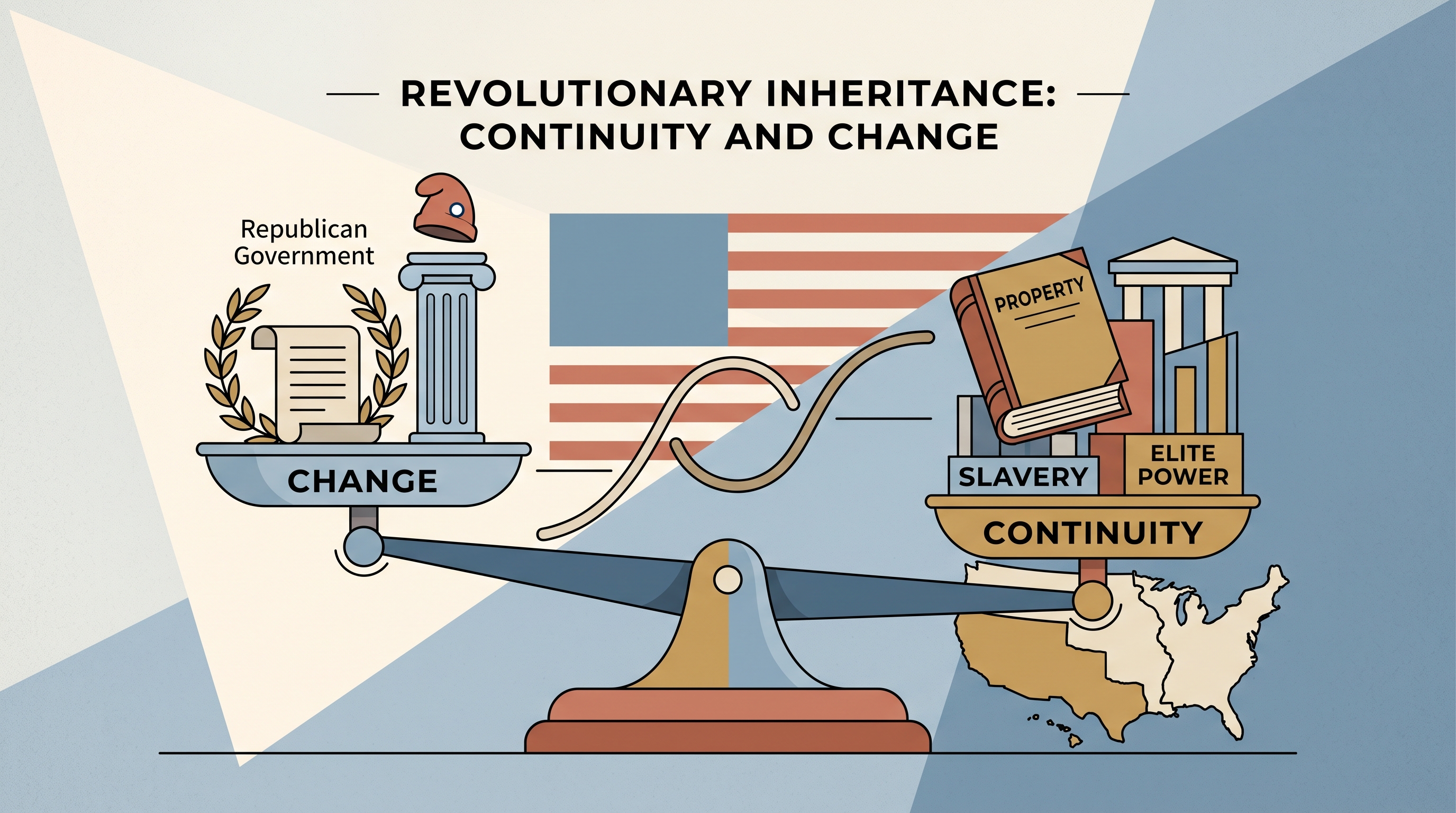
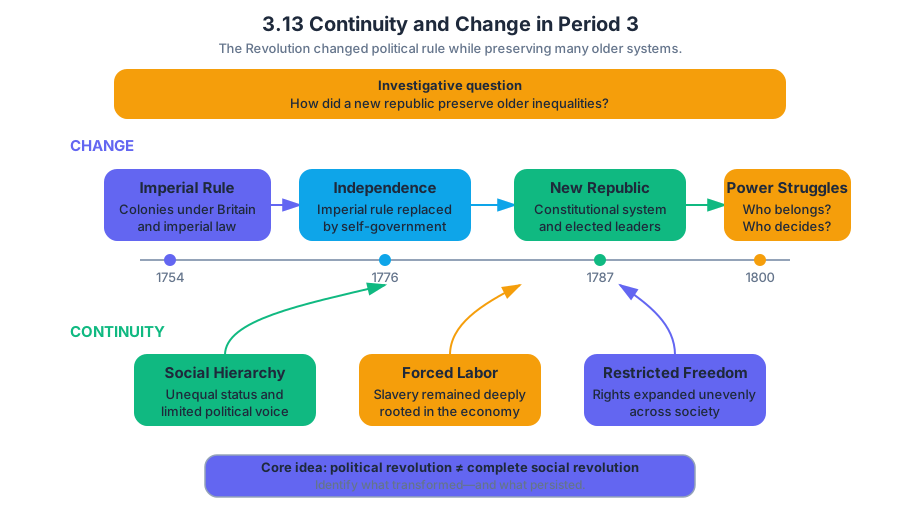
4.1 Contextualizing Period 4 · 4.2 The Rise of Political Parties and the Era of Jefferson
By 1800, the United States had won independence but had not yet agreed on what independence should produce: a powerful national government led by commercial elites, or a more decentralized republic centered on independent farmers.
4.1 Contextualizing Period 4 · 4.2 The Rise of Political Parties and the Era of Jefferson
By 1800, the United States had won independence but had not yet agreed on what independence should produce: a powerful national government led by commercial elites, or a more decentralized republic centered on independent farmers. The election of Thomas Jefferson exposed that disagreement—and then demonstrated that competing parties could transfer power without destroying the constitutional system.
4.1 Contextualizing Period 4
Period 4 covers $1800$–$1848, a time when the early republic expanded geographically, politically, economically, and socially. The Constitution had created a stronger federal government than the Articles of Confederation, but Americans continued to debate how much power that government should exercise.
Essential idea for 4.1: The early republic established constitutional institutions, but their meaning remained contested.
The critical background includes the ratification debates, the creation of the first party system, and the policies of George Washington and John Adams. Federalists such as Alexander Hamilton favored a vigorous national government, public credit, commercial development, and close ties with Britain. Democratic-Republicans such as Jefferson and James Madison emphasized agricultural independence, limited federal authority, and sympathy for revolutionary France.
A useful contextual chain is:
- Constitutional settlement → created a stronger federal structure.
- Hamiltonian economic program → expanded national financial power.
- Political disagreement → produced organized parties.
- Election of 1800 → tested whether parties could compete within the Constitution.
- Jeffersonian presidency → reinterpreted, rather than simply erased, federal power.
This is AP Historical Thinking Skill 4.A: Contextualization. To contextualize an event, connect it to broader developments before, during, or after it. For example, the election of 1800 makes little sense if treated as an isolated contest: it followed disputes over the national bank, taxation, foreign affairs, and the Federalist response to domestic dissent.
4.2 The Rise of Political Parties
Political parties were not explicitly described in the Constitution. They emerged because political leaders disagreed about how to interpret the new government’s powers. The first party system therefore reflected competing constitutional visions, not merely personal rivalries.
| Federalists | Democratic-Republicans |
|---|---|
| Favored stronger federal authority | Favored limited federal authority |
| Supported commerce, manufacturing, and public credit | Emphasized agriculture and the independent farmer |
| Accepted a broad interpretation of federal power | Preferred a strict interpretation of federal power |
| Generally admired Britain’s political stability | Generally sympathized with revolutionary France |
| Supported institutions such as the national bank | Feared concentrated financial and governmental power |
AP Historical Thinking Skill 2.A: Sourcing and Situation asks students to analyze how a source’s point of view, purpose, audience, and historical situation shape its meaning. A Federalist defense of the national bank, for instance, should be read in the context of post-Revolutionary financial instability; a Democratic-Republican criticism should be read in the context of fears that centralized finance would reproduce European-style aristocracy.
The crisis under John Adams
During John Adams’s presidency, conflict intensified. The Alien and Sedition Acts expanded federal authority over immigrants and punished some forms of criticism directed at the government. Democratic-Republicans argued that these laws violated freedom of speech and exceeded constitutional limits. The Virginia and Kentucky Resolutions responded by advancing the controversial idea that states could judge the constitutionality of federal actions.
The controversy revealed a central contradiction: Federalists claimed that national strength protected the republic, while Democratic-Republicans warned that national strength could become tyranny. Neither side simply opposed government; they disagreed about where legitimate power should reside and how constitutional liberty should be protected.
The election of 1800
The election of 1800 pitted Adams against Jefferson. Because Jefferson and Aaron Burr received the same number of electoral votes, the House of Representatives chose Jefferson after several ballots. The result became known as the “Revolution of 1800” because power passed from one party to another through constitutional procedures rather than military force.
Jefferson described his victory as a restoration of republican principles, but his administration did not dismantle the entire Federalist system. The national government remained, federal institutions continued operating, and Jefferson sometimes used powers that his earlier political arguments had questioned.
Jefferson’s governing paradox
Jefferson reduced some Federalist policies, including military spending and certain internal taxes, while presenting himself as a defender of limited government. Yet the Louisiana Purchase of 1803 dramatically enlarged the nation and relied on presidential action whose constitutional basis was not perfectly clear. The purchase doubled the territorial size of the United States and strengthened the long-term possibility of westward expansion.
This produces an exam-worthy paradox: Jefferson’s political language emphasized strict construction and limited federal authority, while his presidential decisions sometimes expanded national power. The key is not to label Jefferson simply “for” or “against” federal power; instead, explain how practical circumstances could produce tension between ideology and policy.
Named misconception check — “The election of 1800 ended political conflict.”
It did not. It established a peaceful precedent for partisan change, but disputes over constitutional interpretation, federal authority, civil liberties, and the nation’s economic direction continued.
Worked contextual example
Suppose a source from $1798$ condemns the Sedition Act as an attack on republican liberty, while a Federalist source defends it as necessary during an international crisis. A strong analysis would first identify the historical situation: the United States faced conflict with revolutionary France and feared internal opposition. It would then connect each argument to party ideology—Democratic-Republican distrust of centralized power versus Federalist concern for national security—and conclude that the dispute helped define the first party system.
Retrieval check: Why did the election of 1800 matter beyond Jefferson’s personal victory? Name the constitutional development it demonstrated and one contradiction in Jefferson’s approach to federal power.
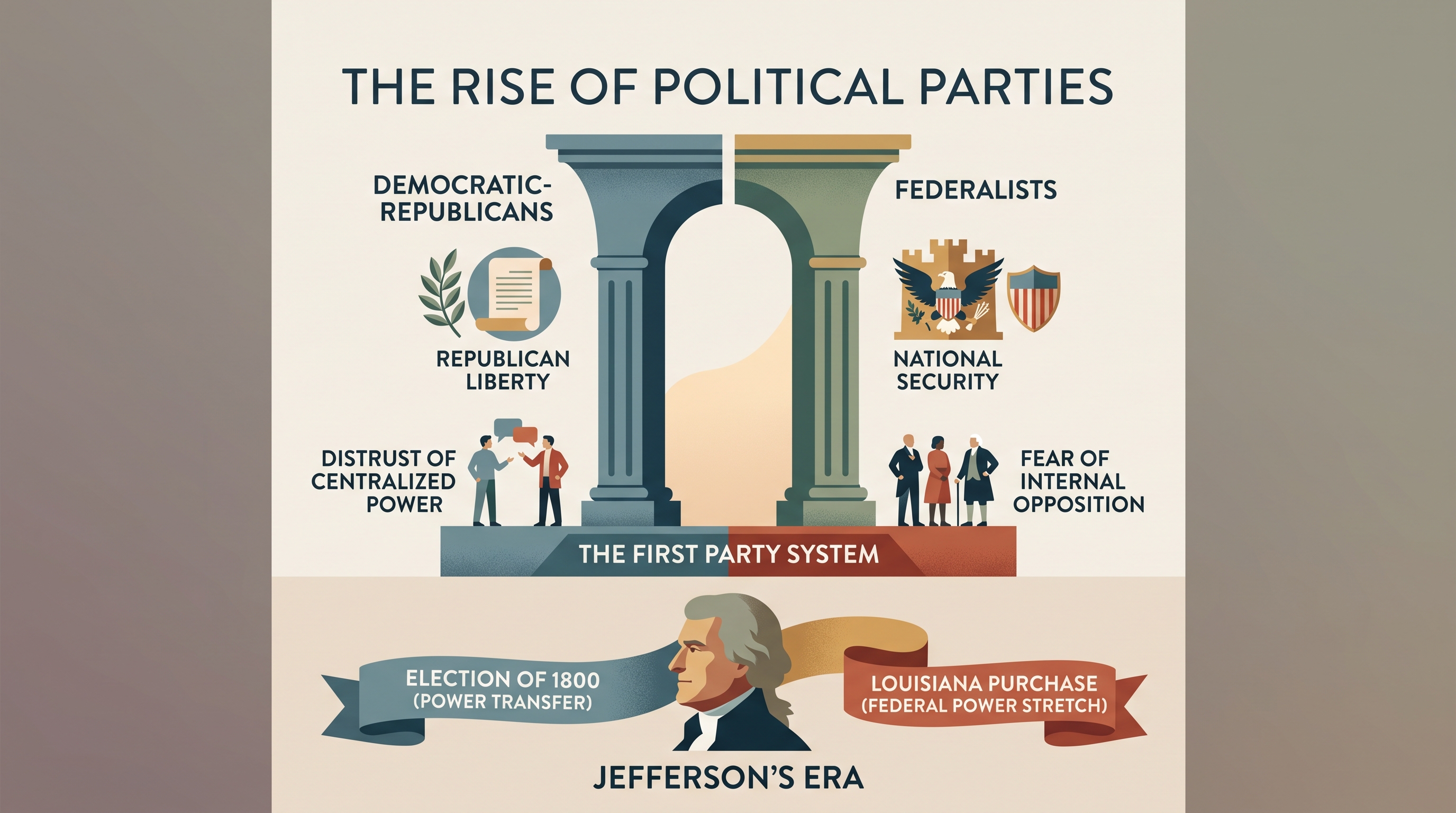
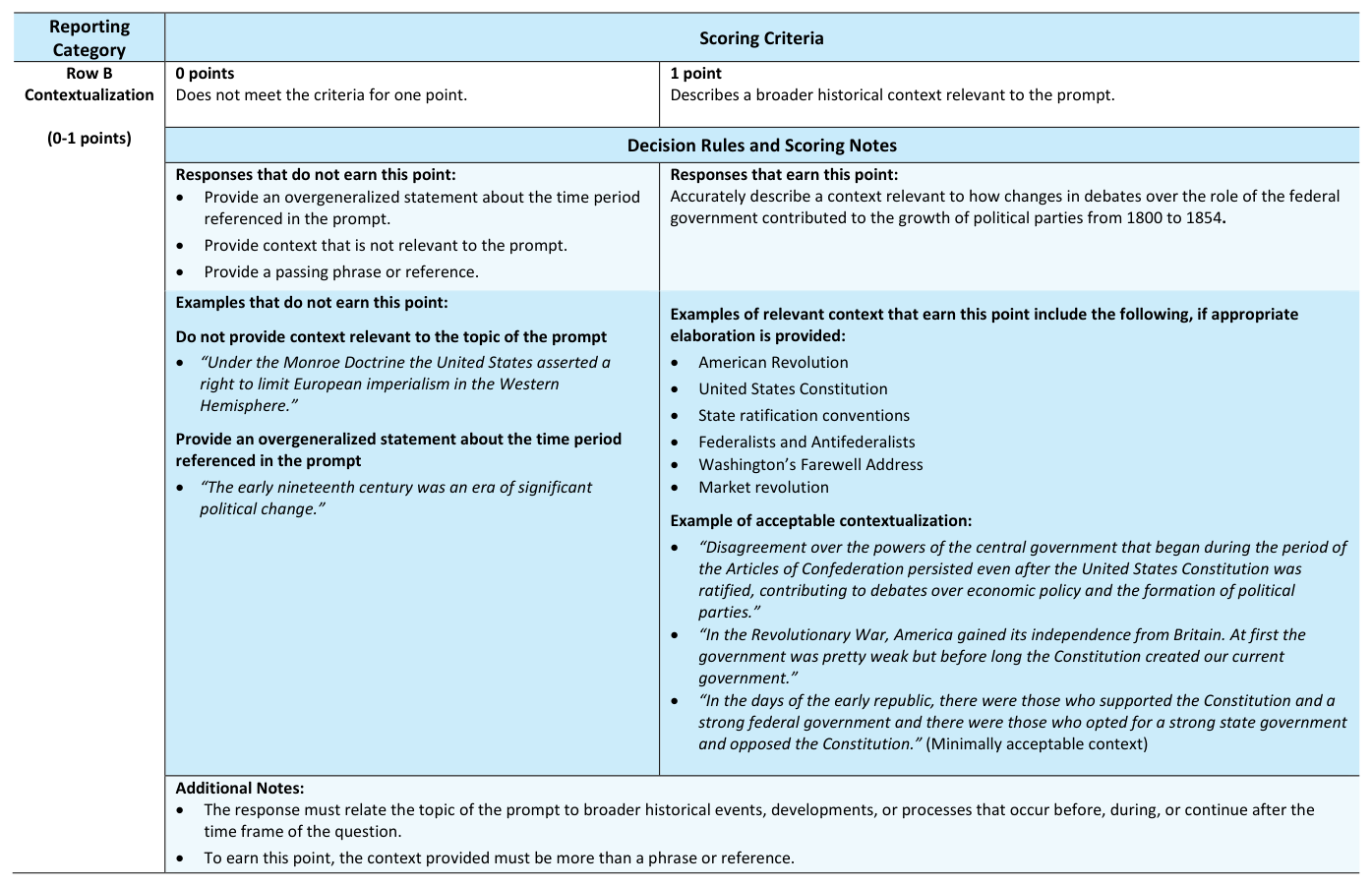
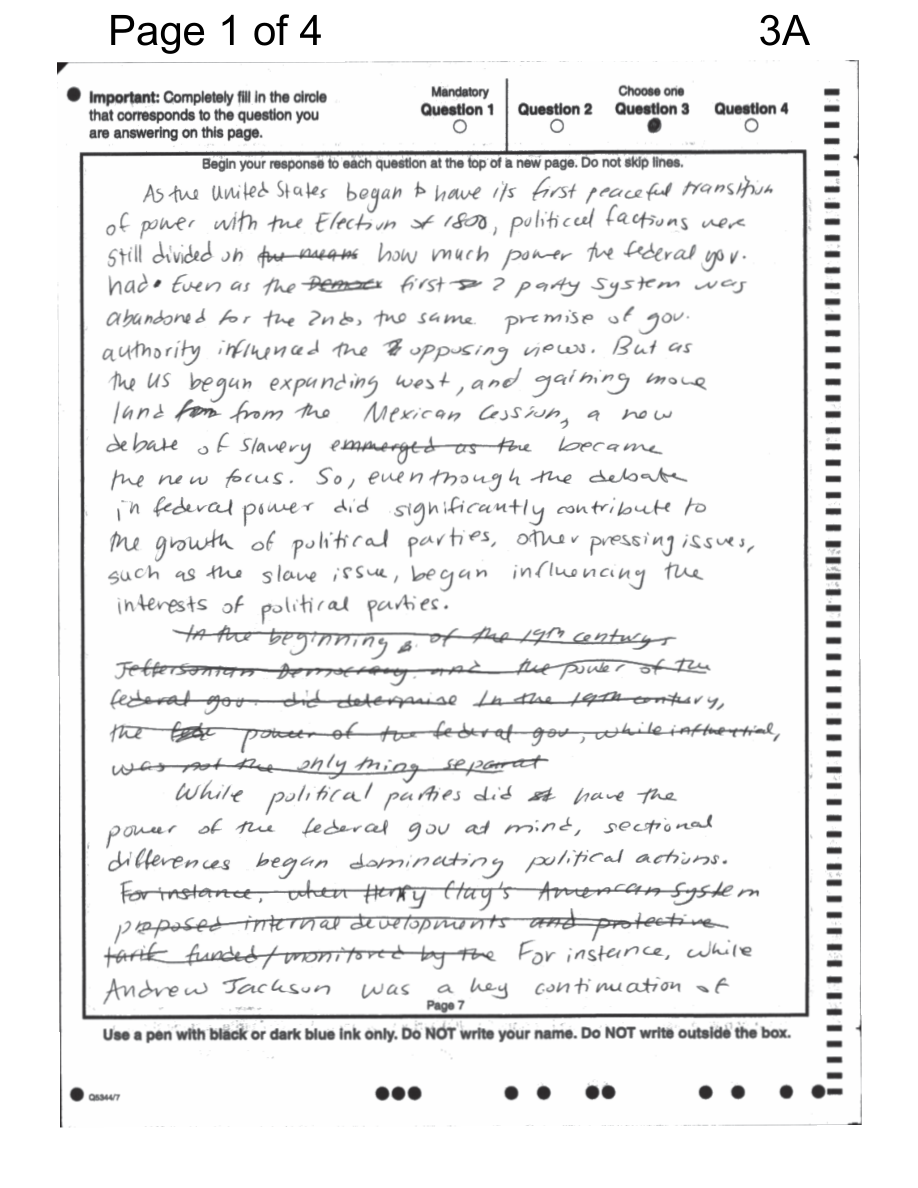
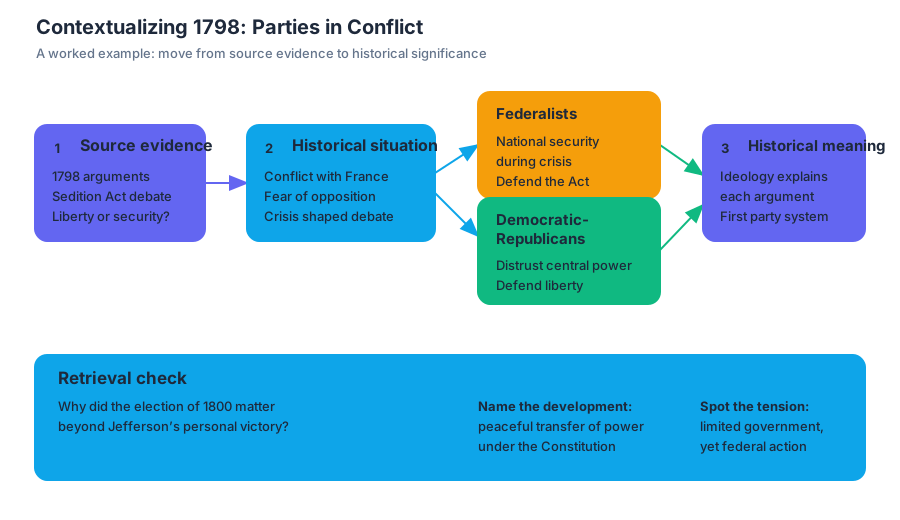
4.3 Politics and Regional Interests · 4.4 America on the World Stage
The early republic faced a problem that no constitutional clause could solve by itself: How could one nation reconcile regions with different economies, priorities, and visions of American power?
4.3 Politics and Regional Interests · 4.4 America on the World Stage
The early republic faced a problem that no constitutional clause could solve by itself: How could one nation reconcile regions with different economies, priorities, and visions of American power? In the 1810s and 1820s, debates over tariffs, banks, slavery, western settlement, and foreign policy revealed that “national interest” often meant something different in New England, the South, and the West.
Investigative question: Why did national expansion and stronger federal policies unite Americans in some moments but deepen sectional conflict in others?
4.3 Politics and Regional Interests
CED traceability: Topic 4.3 Politics and Regional Interests develops Skill 2: Sourcing and Situation and Theme PCE: Politics and Power. Its central learning objective is PCE-2.A: Explain how different regional interests affected debates about the role of the federal government during the early republic. The associated essential-knowledge identifiers are PCE-2.A.1 and PCE-2.A.2.
Regional interests grew from economic differences. New England merchants and manufacturers generally favored protective tariffs and federally funded transportation because these policies supported commerce and industry. Southern planters often opposed high tariffs, which made imported goods more expensive and seemed to invite foreign retaliation against cotton exports. Western settlers wanted roads, canals, and military protection, but they also resisted policies that appeared to favor eastern financial interests.
The American System, associated with Henry Clay, attempted to connect these interests through three policies: a protective tariff, a national bank, and federally funded internal improvements. The plan illustrates a crucial AP historical pattern: a policy can be nationally framed while producing sharply unequal regional effects.
The Missouri Compromise of 1820 exposed the political danger of western expansion. Missouri entered the Union as a slave state, Maine entered as a free state, and slavery was prohibited in the rest of the Louisiana Purchase north of latitude $36^\circ 30'$, except in Missouri. The compromise temporarily preserved the balance between free and slave states, but it also confirmed that every new territory could trigger a national argument over slavery.
The conflict over the Tariff of Abominations and the Nullification Crisis showed how regional interests could challenge federal authority directly. South Carolina claimed that a state could reject an unconstitutional federal law; President Andrew Jackson insisted that federal law remained supreme. The Compromise Tariff of 1833 reduced tensions, but the underlying disagreement—whether the Union was a permanent nation or a voluntary compact of states—remained unresolved.
Worked contextual example: from policy to sectional conflict
Suppose a historian asks why a protective tariff produced political conflict rather than national unity. Begin with context: the postwar economy was becoming more interconnected, but regional economies remained distinct. Then connect policy to interest: manufacturers benefited from protection, while the plantation South feared higher costs and foreign retaliation. Finally, explain the political consequence: South Carolina transformed an economic objection into a constitutional challenge through nullification.
Strong historical reasoning: Regional economic differences shaped political beliefs about federal power; those beliefs then determined whether citizens viewed national policies as cooperation or coercion.
Misconception check
Misconception: “The Missouri Compromise solved the slavery issue.” It did not. It postponed a crisis by creating a temporary geographic rule and maintaining sectional balance. Its importance lies partly in showing that westward expansion made slavery impossible to contain as a merely local or regional institution.
4.4 America on the World Stage
CED traceability: Topic 4.4 America on the World Stage develops Skill 2: Sourcing and Situation and Theme WOR: America in the World. Its central learning objective is WOR-2.A: Explain how U.S. foreign policy in the early republic affected political debates. The associated essential-knowledge identifiers are WOR-2.A.1 and WOR-2.A.2.
The United States sought security and recognition while avoiding domination by European empires. The War of 1812 strengthened American nationalism despite its mixed military results, and the postwar period encouraged leaders to defend national independence through diplomacy, military preparedness, and control of North American borders.
Several agreements reduced tensions with Britain. The Rush-Bagot Agreement limited naval forces on the Great Lakes, while the Convention of 1818 established part of the U.S.-Canadian boundary and created joint occupation of the Oregon Country. The Adams–Onís Treaty of 1819 transferred Florida to the United States and clarified boundaries with Spanish territory.
The Monroe Doctrine of 1823 announced that European powers should not establish new colonies or interfere in independent nations of the Western Hemisphere. Although the United States lacked the military strength to enforce the policy alone, British naval power made European intervention less likely. The doctrine therefore expressed both ambition and limitation: the United States claimed a special regional role but still depended on international circumstances.
Foreign policy also produced domestic disagreement. Nationalists supported a more assertive United States, while critics worried that military expansion, commercial commitments, or sympathy for revolutions abroad could endanger republican government. The same nationalism that encouraged continental expansion could therefore intensify sectional disputes over slavery and the political future of new territories.
Sourcing and situation in practice
When analyzing a speech defending the Monroe Doctrine, identify who spoke, when, and what audience or crisis shaped the statement. A president addressing Congress in 1823 had reason to present U.S. policy as confident and principled; that purpose does not prove the United States possessed the power to enforce every claim independently.
Retrieval and interpretation check
- Why did the Missouri Compromise temporarily reduce conflict but fail to eliminate it?
- How did the Nullification Crisis challenge the meaning of federal supremacy?
- Why was the Monroe Doctrine more than a foreign-policy statement?
Answer check: The Missouri Compromise preserved sectional balance while leaving slavery’s expansion unresolved; nullification challenged whether states could reject federal law; and the Monroe Doctrine asserted a U.S. sphere of influence in the Western Hemisphere while reflecting the nation’s continuing dependence on broader international power relationships.
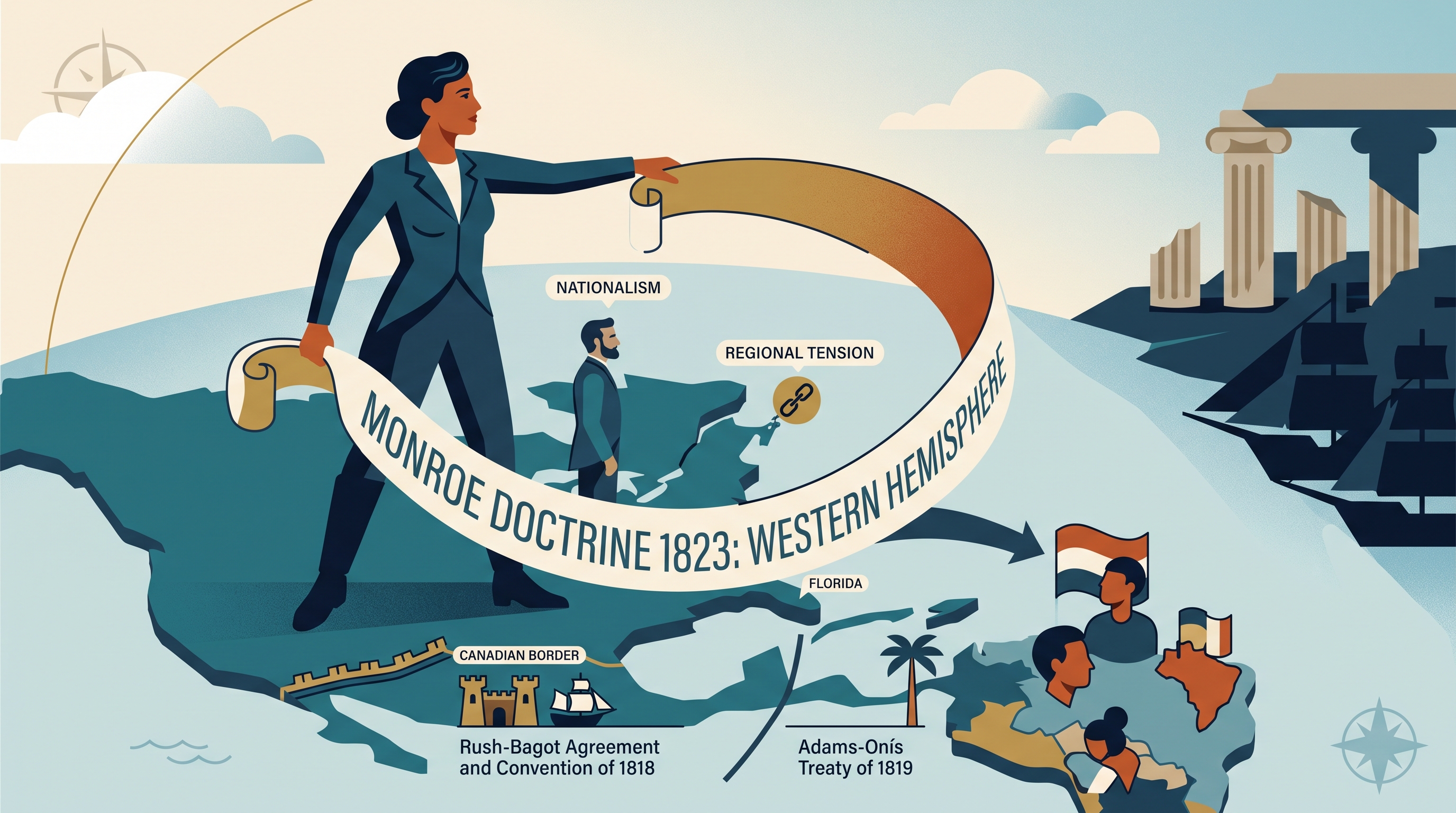
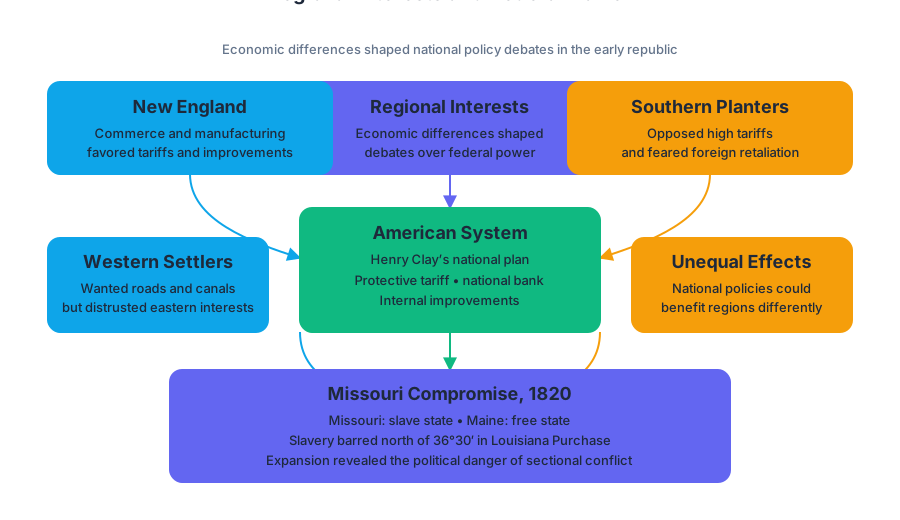
4.5 Market Revolution: Industrialization · 4.6 Market Revolution: Society and Culture
Between 1800 and 1848, the United States began shifting from a mostly local, household-based economy toward a national market economy linked by factories, canals, roads, railroads, banks, and commercial farming.
4.5 Market Revolution: Industrialization · 4.6 Market Revolution: Society and Culture
Between 1800 and 1848, the United States began shifting from a mostly local, household-based economy toward a national market economy linked by factories, canals, roads, railroads, banks, and commercial farming. The Market Revolution was this transformation: goods, labor, information, and investment moved across much greater distances, changing not only how Americans worked but also where—and how—they lived.
Investigative question: How did new systems of transportation and production reshape American society, and why did the benefits of economic growth remain unevenly distributed?
The industrial network: from local exchange to national markets
Before the Market Revolution, many families produced much of what they consumed. A farmer might grow food, spin thread, make clothing, and trade surplus goods within a nearby community. Industrialization changed that pattern by connecting specialized producers to distant consumers. A product could now pass through a chain: raw material, factory, wholesaler, retailer, and customer.
Transportation made this network practical. The Erie Canal, completed in 1825, connected the Great Lakes to the Hudson River and therefore linked western farmers to New York City and the Atlantic coast. Steamboats reduced travel time on western rivers, while turnpikes, improved roads, and expanding railroads connected farms, towns, and cities. Geography still mattered, but infrastructure increasingly allowed people and goods to overcome geographic barriers.
Worked connection: A farmer near the Great Lakes could ship wheat through the Erie Canal to New York City. Lower transportation costs made western grain more competitive, encouraged settlement in the Old Northwest, strengthened New York’s commercial importance, and increased the nation’s regional specialization. One canal therefore connected technology, economic development, migration, and urban growth.
Factories, technology, and wage labor
The factory system concentrated workers and machines in one location, allowing owners to supervise production and manufacture goods in larger quantities. In textile production, inventions such as the power loom accelerated cloth-making. The Waltham-Lowell system in Massachusetts recruited young women—often called “mill girls”—to work for wages in textile factories while living in supervised boardinghouses.
Industrialization did not eliminate older forms of production immediately. The putting-out system, in which merchants supplied raw materials to dispersed household workers, continued in some areas. The important change was the growing coexistence of household labor, workshops, factories, and commercial agriculture within one expanding market.
Misconception check: Industrialization did not mean that every American became a factory worker. Most people still lived in rural areas, but factories and markets increasingly influenced prices, employment, family choices, and regional development.
Society and culture under the Market Revolution
The Market Revolution encouraged urbanization, or the growth of towns and cities, because factories, warehouses, banks, and transportation hubs needed concentrated labor. Immigration added to this growth, especially in northeastern cities. Cities offered jobs and commercial opportunities, but they also produced crowded housing, disease, dangerous workplaces, and sharp inequalities between wealthy merchants and wage workers.
The transformation also changed gender expectations. The emerging separate-spheres ideology associated men with paid work, politics, and the public world, while it associated middle-class women with the household, child-rearing, and moral influence. Yet this ideal described only some families: working-class women, enslaved women, immigrant women, and many rural women continued to perform income-producing labor.
Commercial growth also created new consumer habits and social identities. Middle-class Americans increasingly measured status through education, fashionable goods, respectable homes, and participation in reform or religious communities. At the same time, wage workers developed shared interests, sometimes organizing strikes and early labor movements in response to long hours, low wages, and limited workplace control.
Regional specialization and uneven change
The Market Revolution connected the regions while making their economic differences more pronounced. The Northeast developed manufacturing, shipping, finance, and commercial cities. The Old Northwest expanded grain and livestock production. The South became increasingly dependent on cotton and enslaved labor as textile demand grew in Britain and the northern United States.
These developments were connected rather than separate. Northern factories created demand for cotton; southern plantations supplied it; western farms fed growing cities; canals and railroads moved products between regions. Economic interdependence increased, but it also helped make slavery more profitable and intensified sectional conflict—a connection that later political developments would build upon.
AP skill focus: Making Connections (5.B)
Skill 5.B — Making Connections: Explain how a historical development or process relates to another historical development or process. A strong response does more than name two related developments. It explains the mechanism connecting them: “The Erie Canal lowered shipping costs, which allowed western farmers to reach eastern markets and encouraged both commercial agriculture and urban expansion.”
For a document about an immigrant traveling on the Mississippi River, connect specific evidence to the Market Revolution: transportation enabled migration; migration supplied labor and created new communities; new communities expanded commercial exchange. Relevance alone is insufficient—the evidence must support the argument’s causal link.
Retrieval check
- Why did the Erie Canal matter beyond transportation?
- How did the factory system differ from household production?
- Name one way the Market Revolution expanded opportunity and one way it deepened inequality.
- Complete the connection: cotton textile demand → ________ → expansion of slavery.
Answers: The canal connected western producers to eastern markets and encouraged migration and urban growth. The factory system centralized workers and machines, while household production dispersed labor. Economic growth created jobs and markets but also produced exploitation, inequality, and dependence on slavery. The final chain is cotton textile demand → increased cotton cultivation and production → expansion of slavery.
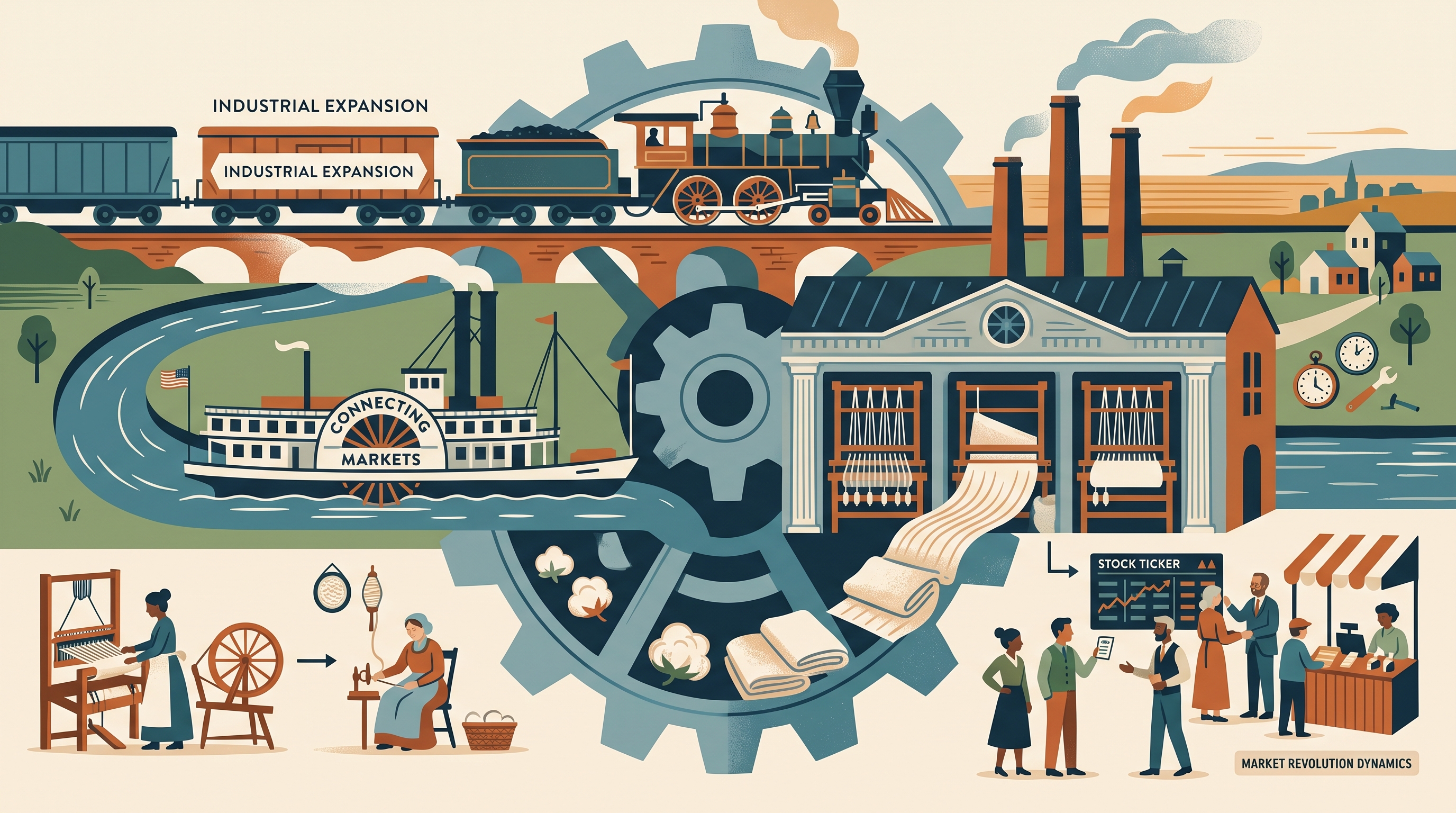
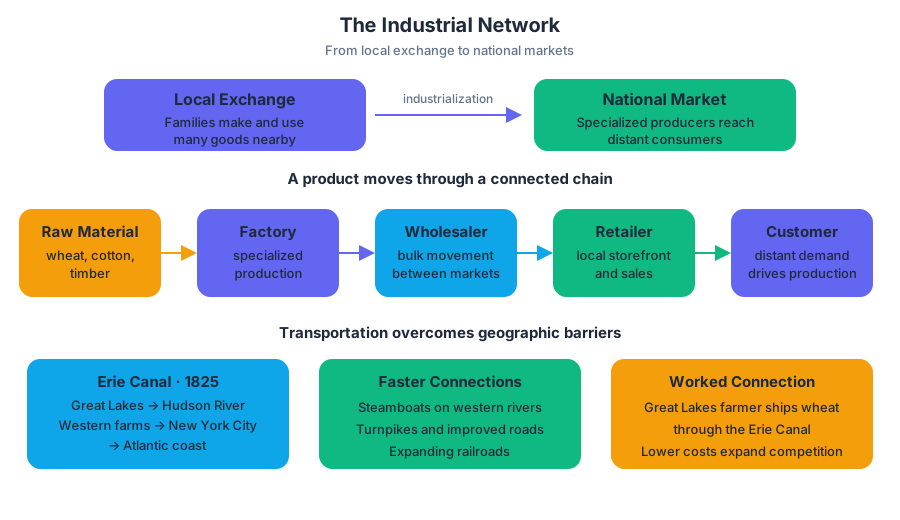
4.7 Expanding Democracy · 4.8 Jackson and Federal Power
Key concepts: Expanding democracy in the early republic · Jacksonian democracy and the "common people" · Federal power during Andrew Jackson’s presidency · The American System · Internal improvements and the Cumberland Road Bill · The rise of the Whig Party in opposition to Jackson · The Tariff of 1828 (Tariff of Abominations) · Gibbons v. Ogden and federal authority · Voting restrictions based on age and race · Indigenous resistance and federal policy, including the Black Hawk War
How could American democracy expand while political power remained restricted—and why did that expansion produce a new struggle over federal authority? Between the 1820s and 1830s, more states adopted universal White manhood suffrage, meaning that adult White men could vote without owning property.
4.7 Expanding Democracy · 4.8 Jackson and Federal Power
How could American democracy expand while political power remained restricted—and why did that expansion produce a new struggle over federal authority? Between the 1820s and 1830s, more states adopted universal White manhood suffrage, meaning that adult White men could vote without owning property. Yet women, most African Americans, Indigenous people, and minors remained excluded. Democracy widened, but it did not become universal.
Key distinction: Expanded participation is not the same as equal political power.
The “common people” and the expansion of democracy
The rise of Andrew Jackson reflected—and accelerated—a change in political culture. Jackson presented himself as the champion of the “common people”, contrasting ordinary White farmers and laborers with wealthy elites, inherited privilege, and concentrated national power. Increased voter participation and the removal of property qualifications helped create the period’s reputation as the “Era of the Common Man.”
The label is useful but incomplete. Voting restrictions still included age requirements, racial restrictions, and gender restrictions. “Universal White manhood suffrage” therefore described a major expansion within a sharply limited political community: the electorate became more broadly White and male, not broadly inclusive of all Americans.
Misconception check — “Jacksonian democracy gave everyone the vote.”
It did not. The change was democratic in comparison with earlier property-based systems, but it preserved racial and gender exclusions. A strong historical explanation must hold both facts together: participation expanded for many White men while political power remained restricted overall.
Jackson and the meaning of federal power
Jackson’s presidency exposed a central contradiction. He opposed federal actions that he believed favored privileged economic interests, yet he also used presidential and national authority forcefully. His response to the tariff controversy illustrates this conflict.
The Tariff of 1828, designed in part to protect Northern industry from foreign competition, raised the cost of imported goods. Many Southerners called it the Tariff of Abominations because they believed it harmed the export-oriented Southern economy while benefiting Northern manufacturers. South Carolina’s claim that a state could reject a federal law challenged national supremacy.
Jackson rejected the idea that a state could nullify federal law. Although he supported reducing the tariff through compromise, he also secured the Force Bill, authorizing federal action to enforce tariff collection. The episode demonstrates that Jackson’s populist appeal did not mean weak federal authority: he could oppose elite economic policy while defending the Union’s power to make and enforce national law.
The American System and internal improvements
Debates over the American System supplied the context for arguments about the Cumberland Road Bill. The American System promoted a stronger national economy through protective tariffs, a national bank, and federally supported internal improvements—roads, canals, and other transportation projects.
The Cumberland Road Bill concerned federal support for internal improvements. Supporters argued that national investment could connect frontier settlements to eastern markets, strengthen commerce, and bind distant regions together. Opponents objected that the Constitution did not clearly authorize Congress to fund local transportation projects and feared that federal spending would expand national power or favor particular regions.
This disagreement was not simply “North versus South.” It also involved constitutional interpretation, regional economic interests, and competing visions of development. A federal road could be understood simultaneously as a practical transportation project, an economic investment, and a test of how far national authority should reach.
Courts, territories, and Indigenous resistance
Federal power also operated through the courts and through policy toward western territories and frontier settlements. In Gibbons v. Ogden (1824), the Supreme Court strengthened federal authority over interstate commerce by ruling that federal law governed navigation crossing state boundaries. The decision limited state-created monopolies and reinforced the Constitution’s commerce power.
Federal-government actions likewise shaped territorial disputes and frontier settlement. Treaties, military campaigns, land policies, and transportation projects altered who could occupy land and whose claims the government recognized. The Black Hawk War revealed the violent consequences of these policies.
Black Hawk, a Sauk leader, resisted forced removal from ancestral lands. His 1832 surrender speech expressed Indigenous grievances after military defeat: surrender did not mean that removal had been just. The Treaty of Fort Jackson ending the Creek War similarly resulted in major Indigenous land cessions. These examples connect expanding American settlement to federal power and Indigenous resistance, a relationship identified in KC-4.3.I.B.
The Whigs emerge in opposition
Opposition to Jackson’s use of federal power helped produce the Whig Party. Whigs criticized what they regarded as executive overreach, especially Jackson’s opposition to the national bank and his willingness to use presidential authority against opponents. They generally favored congressional leadership, economic modernization, federally supported internal improvements, and policies associated with the American System.
The political conflict therefore involved more than personal dislike of Jackson. It was a dispute over whether democracy was best protected by a forceful president claiming to represent ordinary citizens or by institutions that restrained executive power and encouraged national economic planning.
AP historical reasoning in this topic
This topic develops Skill 1: Developments and Processes by tracing the expansion of White male suffrage and the growth of executive authority. It uses Skill 3: Claims and Evidence in Sources when interpreting Black Hawk’s surrender speech or a defense of the Cumberland Road Bill. Skill 4: Contextualization places the tariff and internal-improvement debates within the broader transformation of the early republic. Skill 5: Making Connections links democracy, sectionalism, economic policy, territorial expansion, and Indigenous resistance. Skill 6: Argumentation requires a defensible claim about whether Jackson expanded democracy, federal power, or both.
Retrieval and interpretation check
In two or three sentences, explain why the phrase “Era of the Common Man” is both accurate and misleading. Then connect one of these examples—the Tariff of 1828, Gibbons v. Ogden, the Cumberland Road Bill, or the Black Hawk War—to the larger question of federal authority. A complete response should identify the specific development, explain its historical significance, and acknowledge the limitation or conflict within it.
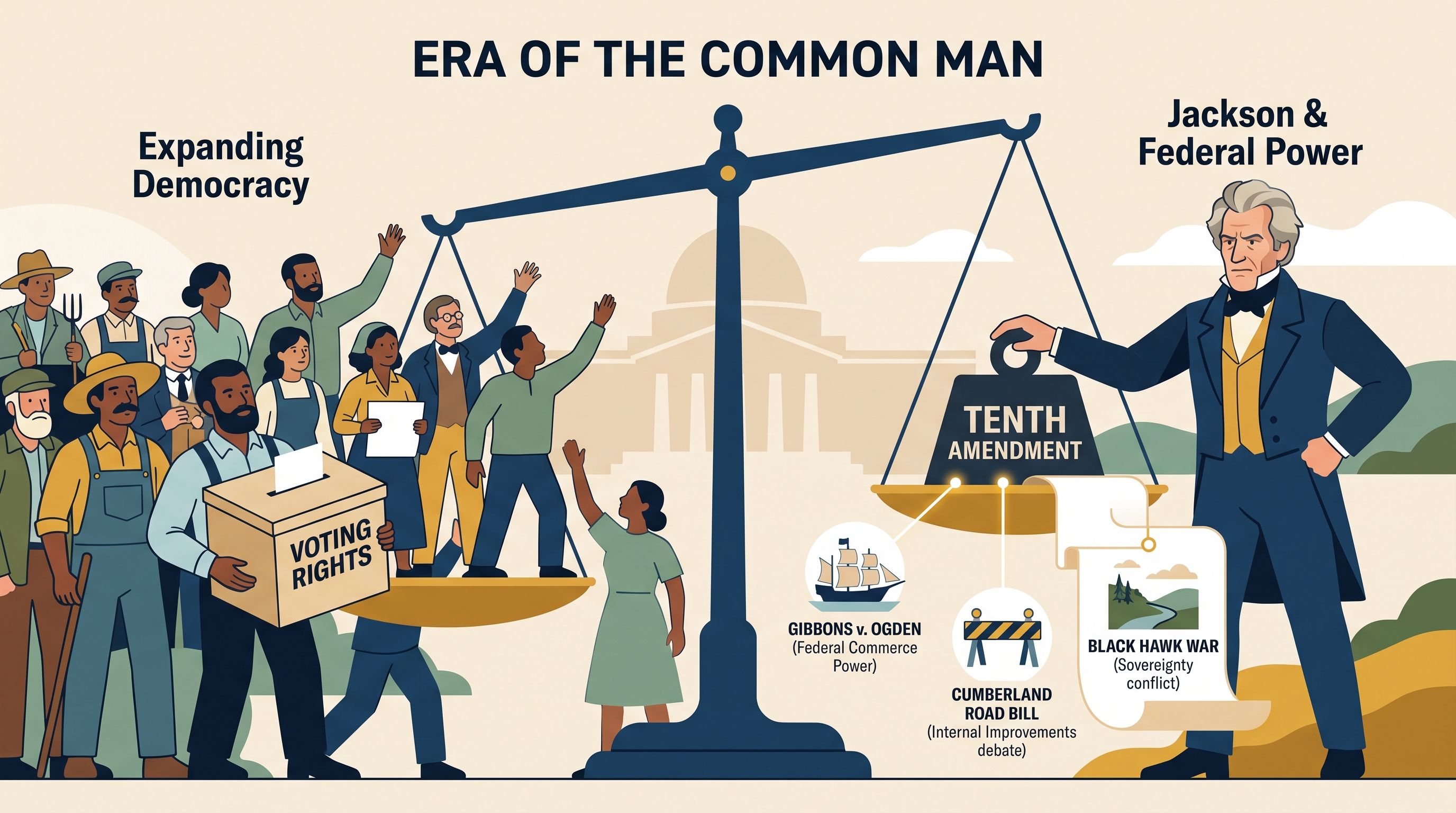
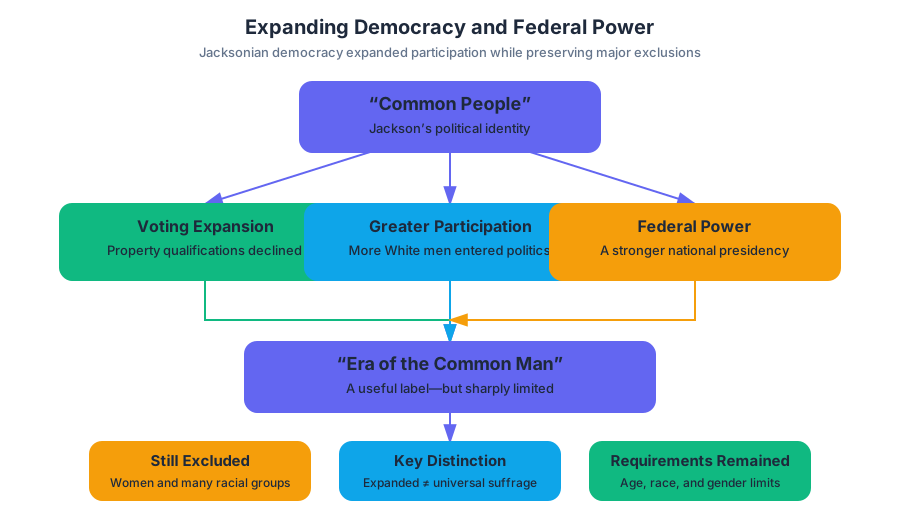
4.9 The Development of an American Culture · 4.10 The Second Great Awakening
Key concepts: American culture · Creative expression · Religious beliefs · The First and Second Great Awakenings · George Whitefield’s preaching · Transcendentalism · Ralph Waldo Emerson · Alexis de Tocqueville’s analysis of American democracy · Cultural diversity and African American cultural expression · Universal suffrage and the expansion of voting rights
American culture developed through collision and exchange: creative expression, demographic change, philosophy, religious beliefs, scientific ideas, social mores, and technology continually reshaped how Americans understood themselves and their society.
4.9 The Development of an American Culture · 4.10 The Second Great Awakening
American culture developed through collision and exchange: creative expression, demographic change, philosophy, religious beliefs, scientific ideas, social mores, and technology continually reshaped how Americans understood themselves and their society. During the first half of the nineteenth century, expanding democracy and religious revival made culture especially dynamic—but not uniformly democratic or inclusive.
Investigative question: How did religious revival, intellectual movements, artistic traditions, and expanded political participation transform American culture while preserving older social boundaries?
A culture is plural, changing, and politically important
Culture means the ideas, beliefs, practices, arts, technologies, and social expectations through which a group organizes meaning and daily life. American culture was never a single national tradition: European ethnic and religious diversity encouraged pluralism, or the coexistence of multiple traditions, while Atlantic movement carried Enlightenment ideas, evangelical Christianity, artistic forms, and political arguments into North America.
The key historical process is not simple replacement. Cultural categories and practices could be maintained, challenged, and transformed at the same time. For example, expanding voting rights altered the meaning of political participation, while racial, gender, and class boundaries continued to restrict who could fully exercise power.
Religious revival: from the First to the Second Great Awakening
The First Great Awakening was an eighteenth-century wave of evangelical religious revival. Evangelical preaching emphasized emotional conversion—a personal experience of spiritual rebirth—rather than relying only on formal church membership or inherited religious authority.
George Whitefield’s 1741 preaching illustrates the revival’s cultural force. His powerful outdoor sermons attracted large crowds, including listeners such as Heaton, whose response demonstrates how revival preaching could move ordinary people emotionally and encourage them to evaluate their own spiritual condition. The significance was not merely theological: the revivals created shared public experiences, strengthened popular religious participation, and encouraged challenges to established authority.
The Second Great Awakening, which developed during the first half of the nineteenth century, extended this pattern of religious change. Revival meetings, conversion experiences, and energetic preaching helped make Protestant Christianity more participatory and socially visible. Religious enthusiasm also supplied language for individual moral responsibility and collective improvement, linking belief to the reform culture that expanded later in the period.
Misconception check: The First and Second Great Awakenings were not one continuous event. The First Great Awakening belonged primarily to the eighteenth century; the Second Great Awakening emerged in the early nineteenth century amid expanding democracy, westward movement, and social change.
Transcendentalism and the search for individual truth
Transcendentalism was an intellectual movement that emphasized individual conscience, intuition, spiritual experience, and the possibility of discovering truth beyond established institutions. Ralph Waldo Emerson became one of its leading nineteenth-century thinkers.
Emerson’s 1842 lecture “The Transcendentalist” exemplifies the movement’s thought. Rather than treating inherited customs or institutions as the final source of truth, transcendentalism encouraged individuals to trust moral insight and direct experience. Emerson also connected these ideas to abolitionist politics, showing how cultural and philosophical beliefs could influence arguments about government, slavery, and human freedom.
Democracy and political culture
Alexis de Tocqueville’s Democracy in America analyzed American democracy and its distinctive political culture. His work treated democracy as more than a voting system: it involved habits of association, ideas about equality, and expectations concerning popular participation.
The expansion of voting rights during the first half of the nineteenth century changed that political culture. States increasingly abolished property requirements, taxpayer requirements, and religious tests for voting, contributing to the movement toward universal white male suffrage. This broadened political participation for many white men, but it did not create universal democracy in the modern inclusive sense.
African American cultural expression
African American communities developed distinctive cultural traditions despite enslavement, displacement, and legal oppression. Musical instruments and practices—including the stick, drum, banjo, and sheguras—preserved and transformed African cultural elements in American settings.
Cultural expression also appeared in naming patterns. Research on Sea Island communities shows that African Americans created distinctive naming practices, demonstrating that culture survives not only in famous speeches or published books but also in family structures, sound, memory, and everyday language.
Skill application: explaining development and connection
1.B — Explain a historical concept, development, or process: To explain the development of American culture, identify multiple forces and show their interaction: Atlantic pluralism supplied diverse ideas; religious revivals expanded popular participation; transcendentalism elevated individual conscience; technological and demographic change spread practices; and expanded suffrage altered political expectations.
2.B — Explain how a historical development relates to another historical development: A strong connection links religious revival to later reform-oriented politics without claiming that revival automatically caused reform. Similarly, expanded suffrage strengthened democratic participation for white men while cultural practices and racial hierarchies continued to limit equality.
Worked interpretation
Suppose a historian places Whitefield’s sermon, Emerson’s 1842 lecture, Tocqueville’s analysis, and evidence of Sea Island naming practices in one collection. The best interpretation is that American culture developed through competing forms of participation: public religion, individual philosophy, political observation, and community-based African American expression. The evidence shows cultural creation from above and below—not a single national culture imposed uniformly on everyone.
Retrieval check
Answer without looking back: What is one continuity and one change in American culture during the first half of the nineteenth century? A defensible answer might identify continuity in unequal racial or social boundaries and change in evangelical participation, transcendentalist thought, African American cultural expression, or voting access.
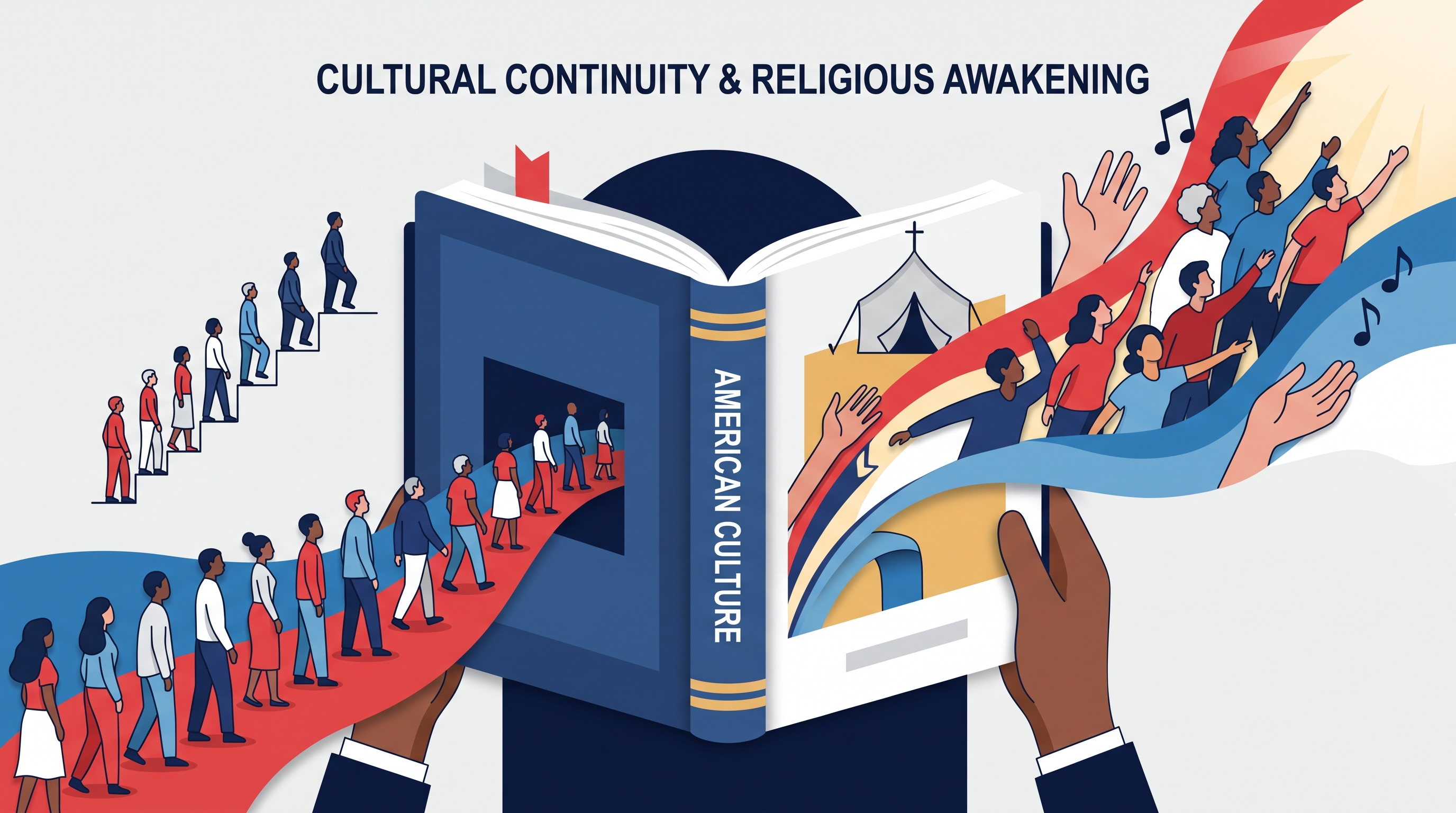
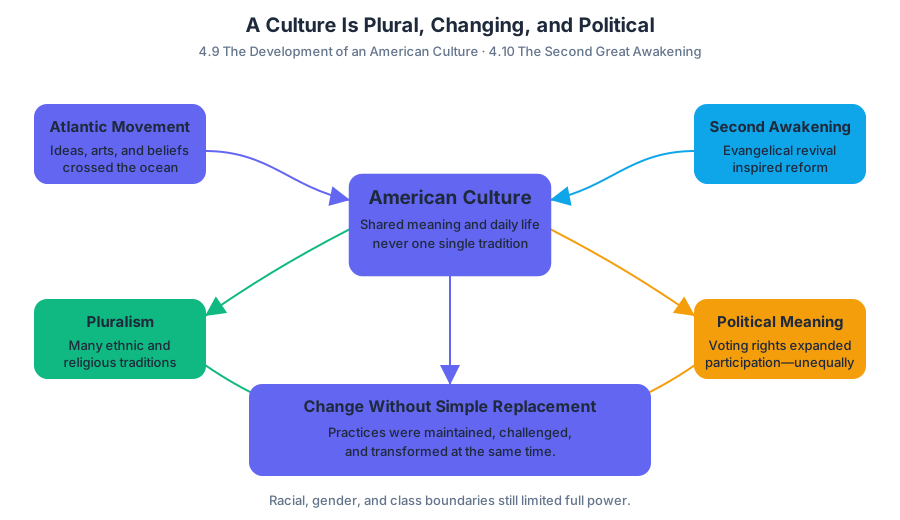
4.11 An Age of Reform · 4.12 African Americans in the Early Republic
Key concepts: Antebellum reform and abolitionism · African American community institution-building · The African Meeting House in Boston · Free Black communities in the early republic · Proslavery arguments based on poverty and racial inequality · African American resistance to slavery · Congo Square and African American cultural continuity in New Orleans · African American intellectual and political activism · Black religious, educational, and civic organizations
A free Black community in Boston built the African Meeting House in 1806—not merely as a place of worship, but as a school, abolitionist meeting place, and center for collective action.
4.11 An Age of Reform · 4.12 African Americans in the Early Republic
Abolition did not begin with a single speech or law; it grew through institutions that allowed free and enslaved African Americans to worship, teach, organize, publish, and resist. The African Meeting House in Boston captures this transformation: built by Boston’s free Black community in 1806, it functioned simultaneously as a church, school, abolitionist meeting place, and center for community organizations.
Reform and abolitionism
Antebellum reform refers to the wave of organized efforts in the early nineteenth century to correct perceived social and moral problems. Religious revivalism, especially evangelical Protestantism, encouraged many Americans to believe that individuals and communities could deliberately improve society. Reformers attacked issues such as alcohol abuse, inadequate education, harsh prisons, and slavery.
Abolitionism was the movement to end slavery. Abolitionists disagreed about methods—some relied on moral persuasion, others on political action, petitions, newspapers, or direct resistance—but they shared the claim that slavery was incompatible with the nation’s ideals of liberty and human equality.
African Americans were not merely subjects of white reform campaigns. They built their own churches, schools, mutual-aid societies, newspapers, and political organizations. These institutions gave Black communities places to preserve family and cultural life, debate strategy, educate children, and challenge slavery and racial discrimination.
African American community institution-building
Free Black communities faced legal restrictions, economic discrimination, violence, and the constant danger that slavery could expand or that free people could be kidnapped. Institution-building therefore served two purposes: it strengthened daily community life and created a platform for collective resistance.
The church was especially important. It was a place of worship, but also a schoolroom, meeting hall, political forum, and source of mutual aid. Community organizations could collect funds, support families in crisis, promote literacy, and coordinate opposition to slavery.
The African Meeting House
The African Meeting House in Boston illustrates how one building could concentrate several forms of power. Constructed by Boston’s free Black community in 1806, it served as a church and school while also hosting abolitionists and community organizations. Its significance lies not only in its architecture but in the authority it represented: African Americans created and controlled a public institution devoted to their community’s needs.
The building also challenges a common misconception: free did not mean equal. Free Black Bostonians could organize institutions, but they still confronted racial inequality and insecure civil rights. Their meeting house was therefore both a place of community independence and a response to exclusion from white-controlled institutions.
Free Black communities and cultural survival
Free Black communities formed in northern cities and in parts of the South, while enslaved people created their own networks under far more dangerous conditions. Family ties, religious practices, oral traditions, music, work skills, and collective gatherings helped African Americans preserve identity despite legal and physical attempts to control them.
Congo Square in New Orleans represents this cultural dimension of community life. Enslaved people gathered there to perform music and dance, sustaining forms of collective expression within a society organized around unfree labor. Such practices were not evidence that slavery was benign; they show how people maintained culture and solidarity under coercion.
Proslavery arguments
As abolitionism gained strength, defenders of slavery developed arguments intended to make racial inequality appear natural, necessary, or beneficial. One argument claimed that African Americans were poor because of racial inferiority and therefore required white control. Another reversed the cause and effect: because slavery had deprived Black people of wealth, education, and legal rights, proslavery writers used their resulting poverty as supposed evidence that they were incapable of independence.
These arguments treated conditions produced by slavery as proof that slavery was justified. The logical flaw is circular: slavery created inequality, and slaveholders then cited that inequality to defend slavery.
| Abolitionist claim | Proslavery response | Historical problem |
|---|---|---|
| Slavery violates liberty and human dignity. | Enslaved people supposedly need white guardianship. | The argument denies freedom in order to claim that freedom is impossible. |
| African Americans deserve education and citizenship. | Poverty and limited education supposedly prove racial inferiority. | Slavery itself restricted education, property, movement, and legal rights. |
| Enslaved people resist because slavery is oppressive. | Resistance supposedly proves Black people are disorderly. | Resistance can instead reveal the coercion of the system. |
African American resistance to slavery
Resistance took many forms. Enslaved people preserved family and religious life, slowed or disrupted work, escaped, communicated secretly, learned despite restrictions, and sometimes rebelled openly. These actions differed in scale, but each asserted that enslaved people were human actors rather than property without will.
Omar Ibn Said’s autobiography provides an individual perspective on enslavement and resistance. An educated Muslim born in Africa, he described his early life, his arrival in the United States, and the circumstances of his enslavement. His act of writing—preserving his own voice and history—resisted the slave system’s attempt to define him solely as property.
A useful AP historical argument connects institutions and resistance: African American communities built organizations because slavery and racism threatened autonomy; those organizations then made education, worship, abolitionist activism, and collective resistance more sustainable. The African Meeting House is therefore evidence of both community formation and opposition to racial oppression.
Retrieval check and DBQ move
Quick check: Why is the African Meeting House stronger evidence of community agency than a simple example of religious practice? Because its functions extended across worship, education, abolitionism, and organization, demonstrating that free Black Bostonians created a coordinated public sphere.
DBQ-style prompt: Evaluate the extent to which African Americans shaped reform and resistance in the early republic. A defensible thesis would argue that African Americans were central actors: they built independent institutions, preserved cultural communities, produced testimony such as Omar Ibn Said’s autobiography, and resisted slavery through both everyday actions and organized abolitionism. A strong response should also explain the limits imposed by racial discrimination and proslavery ideology.
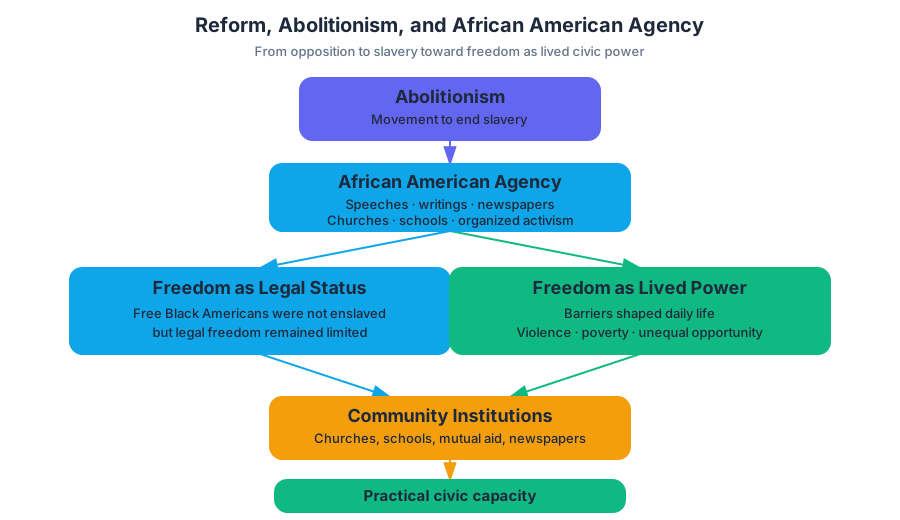
4.13 The Society of the South in the Early Republic · 4.14 Causation in Period 4
Key concepts: Society of the South in the Early Republic · Causation in Period 4 · Continuity and change over time · Indigenous enslavement and colonial violence · Haudenosaunee women and gender roles · Abolitionism and antislavery activism · Women’s reform movements · Temperance organizations · Reconstruction and its effects on race relations · Historical argumentation and evidence sorting
The early republic’s South was not simply a region where plantations existed; it was a society organized around agriculture, racial hierarchy, and coercive labor. At the same time, Americans contested slavery, Indigenous enslavement, gender expectations, and social reform—revealing how regional societies could…
4.13 The Society of the South in the Early Republic · 4.14 Causation in Period 4
The early republic’s South was not simply a region where plantations existed; it was a society organized around agriculture, racial hierarchy, and coercive labor. At the same time, Americans contested slavery, Indigenous enslavement, gender expectations, and social reform—revealing how regional societies could preserve older structures while developing new identities.
CED traceability: Topic 4.13, The Society of the South in the Early Republic; Topic 4.14, Causation in Period 4. Related AP themes include SOC (Social Structures), GEO (Geography and the Environment), POL (Politics and Power), and CUL (Culture).
A southern society built on hierarchy
The South’s social order rested on unequal access to land, political power, and personal freedom. Wealthy white planters occupied the highest position; small farmers and landless white people held less economic power but were still granted racial privileges; enslaved African Americans were legally treated as property and denied autonomy. This hierarchy made slavery more than a labor system: it shaped law, family life, politics, and ideas about race.
Colonial violence also included the enslavement of Indigenous people. In South Carolina, Colonel James Moore led raids to capture and enslave Indigenous people, demonstrating that European and colonial expansion repeatedly converted military power into forced labor. This evidence complicates the misconception that slavery in early North America began only with the large-scale nineteenth-century cotton economy or affected only Africans.
Misconception check — “Slavery was only an economic institution.” Economic profit was central, but slavery also produced racial laws, political alliances, violence, and social definitions of freedom. A causation answer that identifies only plantation profits is incomplete; a stronger answer explains how labor exploitation reinforced an entire social order.
Gender, community, and competing worldviews
Recent scholarship on women in Haudenosaunee society challenges older portrayals that treated Indigenous communities as automatically organized according to European gender expectations. Haudenosaunee women exercised important authority within households, agriculture, and community decision-making. The larger historical point is not that every Indigenous society had identical gender roles, but that gender operated differently across cultures.
This comparison is useful because historical evidence may reveal both continuity and change over time. European colonists often attempted to impose patriarchal assumptions, while Indigenous communities maintained institutions that gave women forms of authority unfamiliar to European observers. Avoid the misconception that “women had power” means all gender inequality disappeared; historians must identify which powers women held, in which settings, and how colonial pressure altered them.
Antislavery activism and reform associations
Northern opposition to slavery became increasingly organized in the early nineteenth century. The 1834 Constitution of the Boston Female Anti-Slavery Society presents an abolitionist message from northern women opposed to slavery. Its existence shows that women participated in political reform even when formal voting and officeholding were largely closed to them. They used petitions, meetings, publications, fundraising, and moral persuasion to influence public debate.
Reform organizations also developed around temperance. Martha Washington Salem Union No. 4, Daughters of Temperance, operated through a constitution and bylaws. Such documents reveal how reformers created rules, membership expectations, leadership structures, and collective discipline. The organization’s name also shows how women used respectable domestic and civic identities to claim a public role.
4.14 Causation in Period 4
Causation is the historical reasoning process of explaining why a development occurred and what consequences followed. Instead of listing events, historians identify relationships among causes, developments, and effects—while distinguishing long-term conditions from immediate triggers and intended effects from unintended ones.
A useful model is Reconstruction, although Reconstruction belongs primarily to Period 5. Its short-term successes changed race relations in the defeated South through emancipation’s enforcement, expanded African American political participation, and constitutional protections. Reconstruction also shifted the balance of power between Congress and the presidency, especially during conflicts over the treatment of the former Confederate states.
To build a causal explanation, sort effects under relevant themes and explain the sorting choice:
| Historical effect | Theme | Why the classification fits |
|---|---|---|
| Expanded African American citizenship and political participation | SOC | It changed relationships among racial groups and the meaning of membership in society. |
| Congressional direction of Reconstruction policy | POL | It altered the distribution of authority between Congress and the president. |
| Federal enforcement in the South | POL / SOC | Government power directly affected social relations and civil rights. |
The same method applies to Period 4. For example, reform activism grew from religious revivalism, voluntary associations, print culture, and dissatisfaction with social problems. Those causes produced abolitionist and temperance campaigns, but the campaigns also exposed limits: reformers challenged slavery while sometimes relying on gendered ideas about moral authority.
Worked causal example
Question: Why did women’s antislavery organizations become influential despite women’s limited formal political rights?
Reasoning: First, identify the condition: women generally lacked voting rights and officeholding. Next, connect causes: religious reform traditions and voluntary associations gave women organizational networks; abolitionism supplied a moral issue that could be discussed through petitions and public statements. Finally, explain the effect: groups such as the Boston Female Anti-Slavery Society entered political debate indirectly, helping expand the boundaries of women’s public activism.
This example develops AP Historical Thinking Skill 1: Developments and Processes, especially identifying patterns of continuity and change; Skill 3: Claims and Evidence in Sources, by using the 1834 constitution as evidence; Skill 4: Contextualization, by linking reform organizations to the early republic; Skill 5: Making Connections, by explaining relationships among religion, gender, and activism; and Skill 6: Argumentation, by making a defensible causal claim.
Retrieval check: How do James Moore’s raids, Haudenosaunee women’s authority, the Boston Female Anti-Slavery Society, and the Daughters of Temperance help historians see both continuity and change? A strong answer should identify one continuing pattern—organized power and social hierarchy—and one change: the expansion of collective activism and the public roles available to women and reformers.
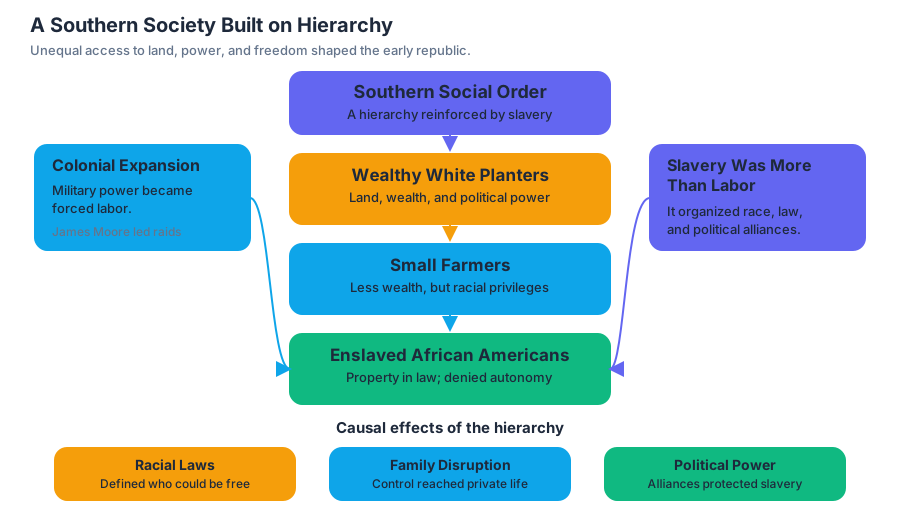
5.1 Contextualizing Period 5 · 5.2 Manifest Destiny
Key concepts: Manifest Destiny · westward expansion · contextualization · Period 5 · Louisiana Purchase · Native American-settler conflict · forced removal of Native Americans · closing of the frontier · national growth and identity · AP Historical Thinking Skill 4.B
Manifest Destiny was the belief that the United States was destined to expand westward across North America. In the 1840s, this idea transformed territorial growth from a government policy into a supposed national mission: settlers and politicians presented expansion as natural, progressive, and even ordained.
5.1 Contextualizing Period 5 · 5.2 Manifest Destiny
Manifest Destiny was the belief that the United States was destined to expand westward across North America. In the 1840s, this idea transformed territorial growth from a government policy into a supposed national mission: settlers and politicians presented expansion as natural, progressive, and even ordained.
Period 5 in the larger timeline
Period 5 covers 1844–1877, but its causes reach backward and its consequences continue forward. The Louisiana Purchase of 1803 greatly enlarged the United States before Manifest Destiny became the dominant language of expansion. Period 5 then includes the intensification of westward settlement, the Civil War, and Reconstruction. Period 6 begins in 1865, so the periods overlap: 1865–1877 belongs both to the end of Period 5’s chronological frame and the beginning of the later period’s developments.
A useful timeline is:
| Date or period | Development | Why it matters here |
|---|---|---|
| 1803 | Louisiana Purchase | Expanded U.S. claims west of the Mississippi River |
| 1840s | Manifest Destiny becomes a powerful public justification | Made expansion appear to be a national obligation |
| 1844–1877 | Period 5 | Links territorial growth to sectional conflict, war, and Reconstruction |
| 1865 | Beginning of Period 6 | Marks the chronological transition into the postwar era |
| Late nineteenth century | Closing of the frontier | Demonstrates the long-term result of continental settlement |
From the Louisiana Purchase to Manifest Destiny
The Louisiana Purchase illustrates the difference between territorial expansion and the later ideology used to justify it. In 1803, President Thomas Jefferson purchased French-controlled Louisiana for $15 million. The acquisition roughly doubled the nation’s territory and provided land for farming, settlement, and future political development. At that moment, however, the phrase “Manifest Destiny” had not yet become the central public argument for expansion.
By the 1840s, expansion was increasingly described as the fulfillment of America’s destiny. Supporters connected westward movement to national power, economic opportunity, and American identity. The language could make the seizure or incorporation of territory sound less like a contested political choice and more like the inevitable progress of the nation.
Key distinction: The Louisiana Purchase was an earlier development that enabled expansion; Manifest Destiny was a later belief used to justify continued expansion.
Expansion and Native American dispossession
Westward expansion did not occur across empty land. Native American nations already occupied, governed, cultivated, and defended the territories that settlers entered. As the United States extended its claims and settlers moved west, Native Americans faced warfare, treaty violations, land seizure, and forced removal. Many displaced communities were confined to reservations, areas set aside by the federal government but controlled and restricted by it.
The central contradiction is important: supporters of Manifest Destiny described expansion as freedom for settlers while expansion meant the loss of land, sovereignty, and mobility for Native peoples. Thus, westward settlement created both opportunities for some Americans and coercion and dispossession for others.
Named misconception: “Manifest Destiny was just a harmless slogan”
Manifest Destiny was not merely decorative language. It helped shape policy and public debate during the 1840s by presenting expansion as morally legitimate. That justification did not mean every American supported expansion, nor did it erase political disagreements. It means the belief supplied a powerful rationale for actions that produced conflict with Native Americans and other populations living in or claiming the expanding territories.
What contextualization actually requires
Contextualization means situating a historical development within the broader conditions that made it possible or meaningful. It is not enough to mention several related facts. A contextual statement must explain the relationship between the background and the development being analyzed.
Worked contextual example: Suppose an argument concerns the importance of westward expansion to American national identity from 1800 to 1848. A weak context would say, “The United States bought Louisiana and later expanded west.” That is accurate but merely lists facts. A stronger context explains that the Louisiana Purchase created a much larger national territory, encouraged settlement and agricultural ambition, and helped establish expansion as a recurring feature of U.S. policy. By the 1840s, Manifest Destiny gave that earlier pattern a more explicit ideological justification.
This reasoning uses AP Skill 4: Contextualization because it connects Manifest Destiny to earlier territorial growth. It also uses AP Skill 1: Developments and Processes by tracing how expansion developed over time, and AP Skill 5: Making Connections by linking geography, migration, national identity, and Native American–settler conflict. In an argument, AP Skill 6: Argumentation requires turning those connections into a defensible claim rather than simply naming them.
The closing of the frontier
The closing of the frontier refers to the near-completion of U.S. settlement across the continent. It was a later consequence of the same expansion process described here: territorial acquisition, Native land seizure, settler migration, and the creation of farms and communities gradually reduced the areas that U.S. officials and settlers treated as available for further continental settlement. The phrase therefore signals not one single event, but the result of decades of expansion and dispossession.
Retrieval check
- Why is the Louisiana Purchase important but not identical to Manifest Destiny?
- What did westward expansion mean for Native American nations?
- Rewrite this weak context into a stronger one: “Americans believed in Manifest Destiny and moved west.”
Answer check: The Louisiana Purchase expanded U.S. territory in 1803, while Manifest Destiny became a major justification for expansion in the 1840s. Expansion brought settlement and national growth for many Americans but also conflict, land seizure, and forced removal of Native Americans to reservations. A stronger context would explain how the earlier territorial enlargement and settlement pattern made the later ideology and policies of expansion possible.
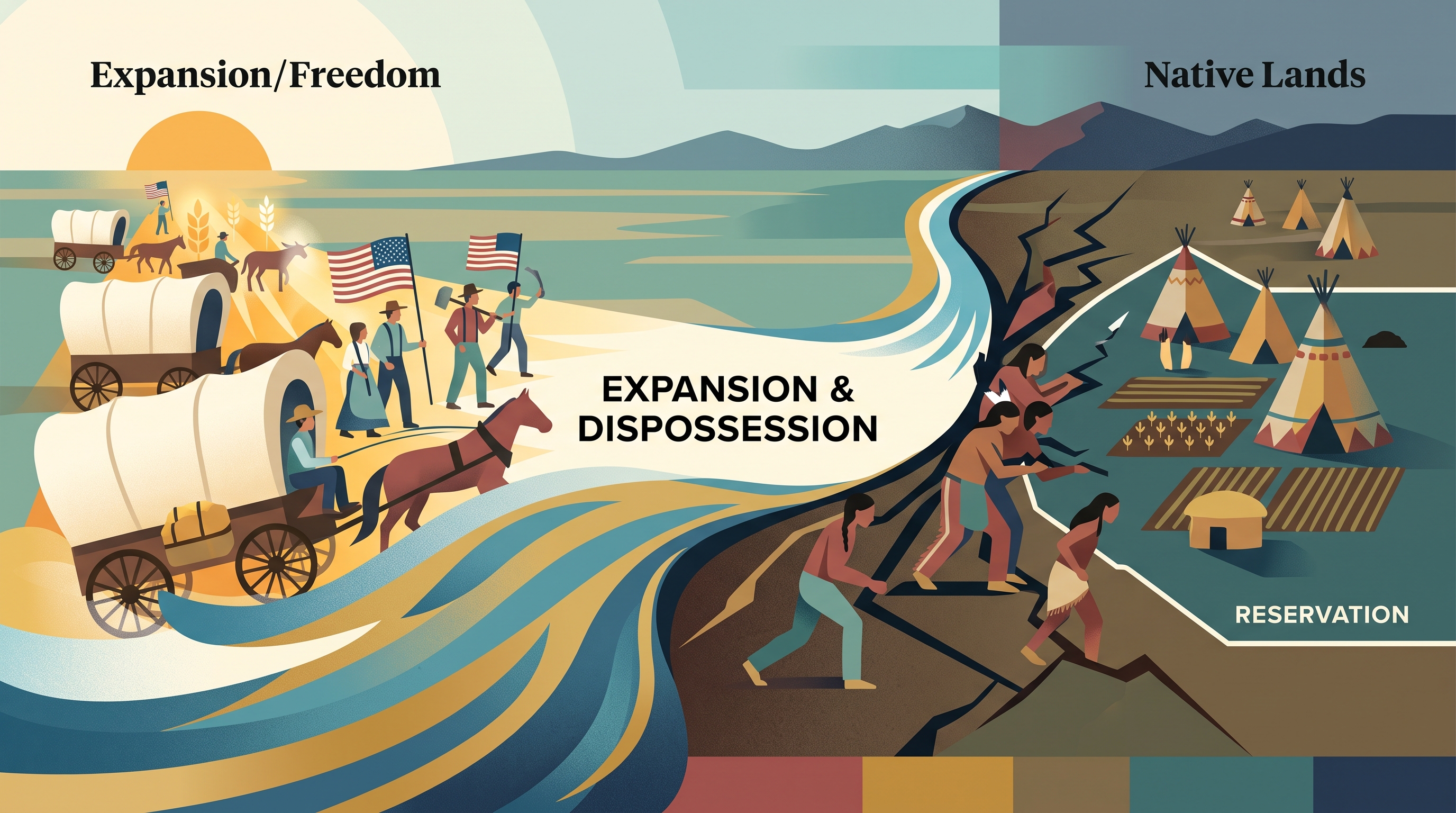
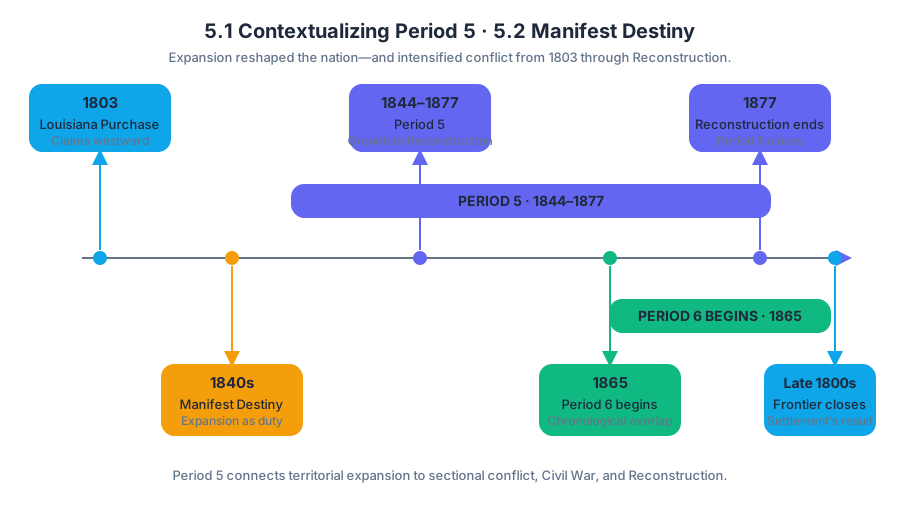
5.3 The Mexican–American War · 5.4 The Compromise of 1850
Key concepts: Mexican–American War · Compromise of 1850 · Tallmadge amendment · Slavery in the territories · Regional differences over slavery · Federal government intervention in slavery disputes · Indigenous peoples and Mexican Americans in newly acquired lands · Arguments for and against compromise · Immigration and opportunities and hardships for recent immigrants · Connections between the Mexican–American War and the Civil War
The Mexican–American War did more than redraw the map: it forced the United States to answer an explosive question—when the nation acquires new territory, who decides whether slavery may enter it?
5.3 The Mexican–American War · 5.4 The Compromise of 1850
The Mexican–American War did more than redraw the map: it forced the United States to answer an explosive question—when the nation acquires new territory, who decides whether slavery may enter it? Victory over Mexico created the Mexican Cession, a vast region that included present-day California, Nevada, Utah, and parts of several other western states. Expansion enlarged the nation while making sectional conflict harder to contain.
Unit 5: Learning Objective C: Explain the causes and effects of the Mexican–American War.
Unit 5: Learning Objective D: Explain the similarities and differences in how regional attitudes affected federal policy in the period after the Mexican–American War.
Expansion creates a political crisis
The war grew from the expansionist vision often called Manifest Destiny—the belief that the United States should extend across the continent. President James K. Polk supported acquiring California and New Mexico, while disputes over the Texas–Mexico boundary intensified after Texas joined the Union. Fighting began in 1846 after U.S. and Mexican claims collided near the Rio Grande.
The Treaty of Guadalupe Hidalgo ended the war in 1848. Mexico recognized the Rio Grande as the boundary of Texas and ceded a large western territory to the United States. Under KC-5.1.I.C, this expansion raised questions about the status of slavery, American Indians, and Mexicans in lands newly controlled by the United States. Under KC-5.1.II.C, federal interaction and conflict with Mexican Americans and American Indians increased, threatening established economic practices, political authority, and cultural independence.
The Wilmot Proviso and the Tallmadge amendment
The central dispute was whether Congress could prohibit slavery in the territories gained from Mexico. Representative David Wilmot proposed the Wilmot Proviso, which sought to ban slavery in any territory acquired from Mexico. It passed the House of Representatives but failed in the Senate, where southern senators had greater ability to block it.
The earlier Tallmadge amendment provides an important comparison. In 1819, Representative James Tallmadge proposed limiting slavery in Missouri by prohibiting the further introduction of enslaved people and requiring gradual emancipation for children born there. Southern opposition defeated the proposal, but the debate helped produce the Missouri Compromise. Both the Tallmadge amendment and the Wilmot Proviso show Congress becoming the battlefield for disputes over slavery’s expansion.
Misconception check: The Wilmot Proviso did not end slavery in the South. It concerned slavery’s expansion into territory acquired from Mexico. The distinction between existing slavery and slavery in the territories is essential.
Regional positions: three different answers
Northern opinion was not completely uniform, but many northerners opposed the expansion of slavery because they feared the political power of slaveholders and competition from enslaved labor. The Free Soil position emphasized keeping western territories available for free white labor, even when it did not demand immediate abolition in the states where slavery already existed.
Southern leaders generally argued that enslaved people were property protected by the Constitution and that Congress should not discriminate against slaveholders who carried that property into the territories. Some demanded federal protection for slavery; others defended the principle that territorial settlers should decide the issue themselves.
A third position favored popular sovereignty, meaning that residents of a territory—not Congress—would determine whether slavery was legal. Senator Lewis Cass promoted this approach, which appeared democratic but postponed rather than solved the conflict. The question remained: Who counts as the legitimate political community, and whose freedom or property receives federal protection?
The Compromise of 1850
The discovery of gold accelerated California’s population growth, and California requested admission as a free state. This threatened the previous sectional balance in the Senate. Senator Henry Clay proposed a package of measures, later shaped through the work of Stephen Douglas, that became the Compromise of 1850.
| Provision | Immediate effect |
|---|---|
| California entered as a free state | Increased the number of free states |
| Utah and New Mexico territories used popular sovereignty | Territorial residents would decide slavery |
| Texas surrendered disputed western land | The federal government assumed Texas’s debts |
| The slave trade ended in Washington, D.C. | Buying and selling enslaved people ended in the capital, although slavery remained |
| Fugitive Slave Act strengthened | Federal enforcement required the return of alleged escapees |
The compromise temporarily reduced congressional conflict, but it satisfied neither section completely. Northerners objected to the Fugitive Slave Act, while many southerners believed popular sovereignty offered insufficient protection. Under KC-5.2.II.A, the Mexican Cession produced heated controversy over slavery in the territories. Under KC-5.2.II.B.i, the Compromise represents one of several attempts by courts and national leaders to resolve that controversy through federal policy.
Worked comparison: explaining causation
Suppose an argument claims: The Mexican–American War intensified sectional conflict because territorial expansion made slavery an immediate national issue. Build the reasoning in three steps:
- Development: The war produced the Mexican Cession.
- Political problem: Americans disagreed over whether slavery could enter the new territories.
- Policy response: Congress debated the Wilmot Proviso and eventually adopted the Compromise of 1850.
The argument is stronger when it includes both similarity and difference: the Tallmadge amendment and Wilmot Proviso each used congressional power to restrict slavery’s expansion, whereas popular sovereignty attempted to transfer the decision to territorial settlers.
AP historical thinking skills
This topic most directly develops Skill 4.A: Identify and describe a historical context for a specific historical development or process and Skill 4.B: Explain how a specific historical development or process is situated within a broader historical context. The Mexican–American War must be placed within Manifest Destiny, Texas annexation, and sectional arguments over slavery.
It also develops Skill 5.A: Identify patterns or trends in historical development and Skill 5.B: Explain how a historical development relates to another historical development. The pattern is repeated federal intervention—Tallmadge amendment, Missouri Compromise, Wilmot Proviso, and Compromise of 1850—as national leaders repeatedly tried to manage the territorial expansion of slavery. For comparison, use Skill 5.C: Explain how a historical development relates to another historical development, distinguishing what each policy attempted and why each left unresolved tensions.
Retrieval check
Answer without looking back: Why did the Mexican Cession create a more serious sectional crisis than earlier western expansion? Then identify one provision of the Compromise of 1850 that favored northern interests, one that favored southern interests, and one that attempted to avoid choosing between them. A complete answer should connect territorial expansion to the federal government’s growing role in slavery disputes.
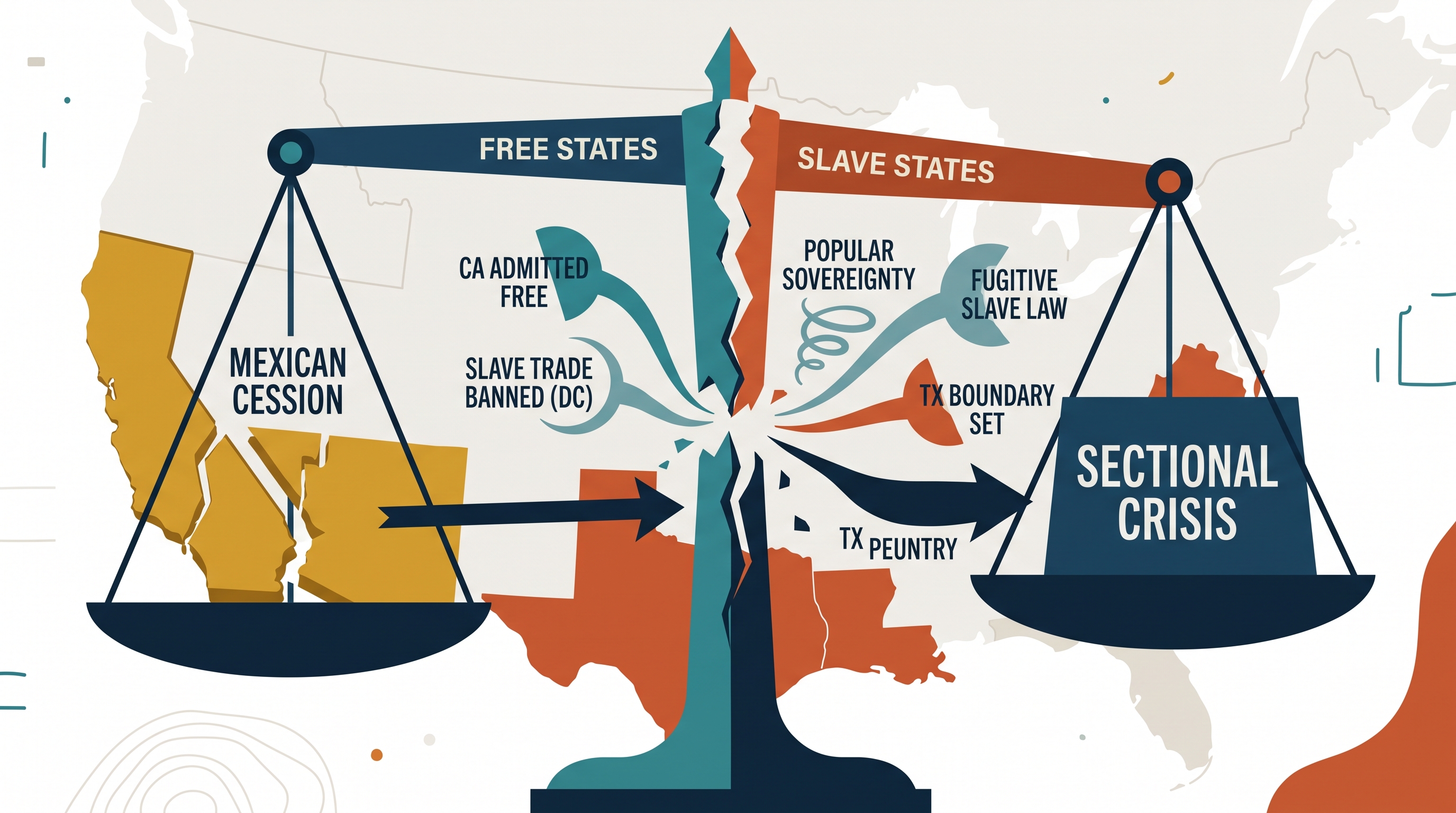
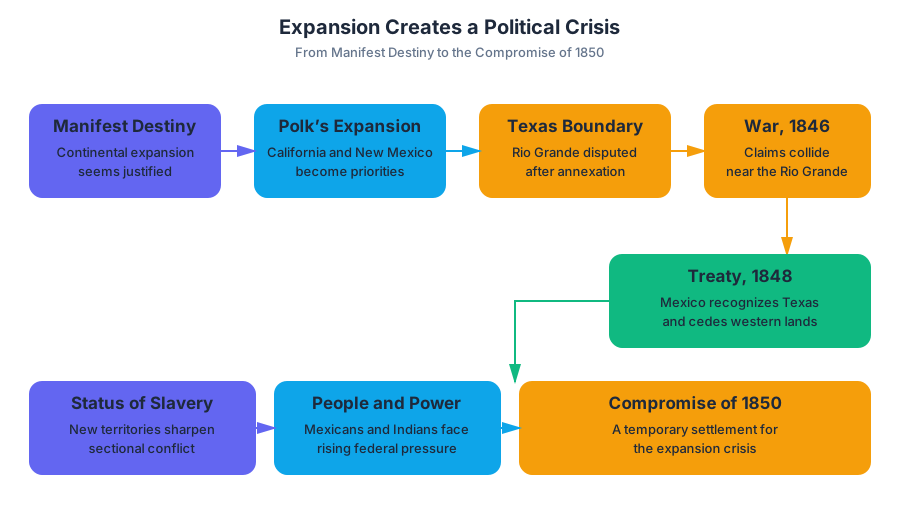
5.5 Sectional Conflict: Regional Differences · 5.6 Failure of Compromise
Key concepts: Sectional conflict between the North and South · The Compromise of 1850 · The Missouri Compromise · Popular sovereignty · Free-soil ideology · Federal versus state authority over slavery · Attempts by courts and national leaders to resolve slavery in the territories · The Kansas–Nebraska Act · The admission of Texas and its effect on sectional tensions · Industrialization and regional differences
By the 1850s, the United States was arguing over a question that no compromise could permanently contain: who had the authority to decide whether slavery could expand into western territories—the federal government, territorial settlers, or the states themselves?
5.5 Sectional Conflict: Regional Differences · 5.6 Failure of Compromise
By the 1850s, the United States was arguing over a question that no compromise could permanently contain: who had the authority to decide whether slavery could expand into western territories—the federal government, territorial settlers, or the states themselves? The dispute was not only moral. It also involved political power, economic systems, constitutional interpretation, and the future balance between free and slave states.
Sectional conflict was the growing political, economic, and cultural rivalry between regions—especially the industrializing North and the plantation-based South.
Two regions, increasingly different interests
Industrialization helped widen the economic distance between the North and South. Northern states developed factories, wage labor, commercial agriculture, railroads, and expanding cities. The Southern economy remained heavily tied to cotton cultivation, plantation agriculture, and enslaved labor. These systems created different priorities: many Northern politicians favored tariffs, internal improvements, and restrictions on slavery’s expansion, while Southern leaders defended slavery and opposed federal policies they believed threatened it.
| North | South |
|---|---|
| Industrializing economy and wage labor | Plantation agriculture and enslaved labor |
| Growing cities, factories, and rail networks | Cotton production linked to international markets |
| Free-soil opposition to slavery’s expansion | Defense of slavery as essential to prosperity and social order |
| Concern about the political power of slaveholders | Concern about becoming a permanent minority in national politics |
Free-soil ideology opposed the expansion of slavery into western territories, even when its supporters did not demand immediate emancipation in the South. Many Free-Soil advocates argued that slavery threatened opportunities for white farmers and wage workers by allowing wealthy planters to dominate western land and labor. This position differed from abolitionism, which sought to end slavery, but both movements challenged Southern efforts to expand the institution.
Why the Missouri Compromise mattered later
The Missouri Compromise of 1820 admitted Missouri as a slave state and Maine as a free state while prohibiting slavery in much of the Louisiana Purchase north of latitude $36^\circ 30'$. It temporarily preserved the balance between free and slave states, but it did not settle the underlying constitutional or moral conflict.
Its deeper importance was political: the compromise treated slavery’s expansion as a problem that could be managed geographically. That solution postponed rather than resolved the issue. As the nation acquired new territory, politicians repeatedly returned to the same unresolved question, and each new settlement carried greater stakes.
Misconception check: The Missouri Compromise did not “end” the slavery debate. It created a temporary boundary and postponed the conflict until later territorial expansion made the boundary inadequate.
Texas, western territory, and the balance of power
The admission of Texas into the Union intensified sectional disagreement. Texas entered as a large slaveholding state in 1845, and its annexation raised questions about the future admission of additional slave states, the expansion of slavery toward the Southwest, and the political balance in Congress. Northern critics saw annexation as evidence that slaveholders were using national power to enlarge their influence; Southern supporters viewed it as protection for economic interests and regional security.
The Mexican–American War and the resulting Mexican Cession made the problem even more urgent. The question was no longer merely whether existing states would remain free or slave. It was whether slavery would enter territories stretching across the continent.
Compromise as a repeated strategy—and a repeated failure
The Compromise of 1850 attempted to lower tensions through several linked measures concerning California, territorial status, slavery, and enforcement of federal law. It reduced immediate political pressure, but the Fugitive Slave Act intensified Northern opposition by requiring assistance in the recovery of escaped enslaved people. A policy designed to protect Southern interests therefore strengthened abolitionist resistance in the North.
Debates over slavery also became debates over popular sovereignty, the principle that settlers in a territory should decide whether to permit slavery. Supporters presented popular sovereignty as democratic self-government. Opponents argued that it could allow slavery to spread before a territory became a state and that enslaved people could not meaningfully participate in the decision.
The Kansas–Nebraska Act of 1854 applied popular sovereignty to territories where the Missouri Compromise had previously restricted slavery. It therefore reopened land that many Northerners believed had been reserved for free settlement. Proslavery and antislavery settlers rushed into Kansas, where fraudulent elections and armed violence produced Bleeding Kansas. Rather than settling the issue democratically, popular sovereignty transformed the territorial question into direct sectional conflict.
Federal power, state authority, and the collapse of compromise
The conflict involved competing claims about federal versus state authority. Southern leaders often argued that the federal government had a duty to protect slaveholders’ property in the territories. Northern antislavery politicians increasingly argued that Congress could restrict slavery’s expansion. Some defenders of states’ rights claimed that states could resist federal actions they considered unconstitutional, while national leaders warned that such resistance threatened the Union.
Courts and national leaders repeatedly attempted to resolve the territorial slavery issue, including through the Missouri Compromise, the Compromise of 1850, the Kansas–Nebraska Act, and the Dred Scott decision. These measures failed because each settlement addressed a procedure without resolving the central conflict: whether slavery was a legitimate national institution that could expand, or a sectional institution whose growth had to be restricted.
The key causal chain:
Economic and regional differences → disagreement over slavery’s expansion → conflict over federal authority and popular sovereignty → failed compromises → sectional parties and escalating violence.
Worked historical reasoning
Suppose a source from 1856 celebrates popular sovereignty as “the right of settlers to govern themselves.” To interpret it, apply Skill 2: Sourcing and Situation: ask who created it, when, and amid what conflict. The Kansas–Nebraska Act had recently produced violence, so the language may defend territorial self-government while minimizing the fact that competing groups were using migration, elections, and force to control Kansas.
Then apply Skill 5: Making Connections. The source connects to the failure of the Missouri Compromise because popular sovereignty replaced a clear geographic restriction with a process that reopened the controversy. A strong explanation would not merely identify the source’s topic; it would show how the policy increased sectional tension.
AP skill and identifier traceability
This topic aligns with Unit 5: Learning Objective D, “Explain the similarities and differences in how regional attitudes affected federal policy in the period after the Mexican–American War,” and Unit 5: Learning Objective G, “Explain the political causes of the Civil War.”
The required historical developments include KC-5.2.II.A, the controversy over slavery in territories acquired through the Mexican Cession; KC-5.2.II.B.i, attempts including the Compromise of 1850; KC-5.2.II.B.ii, the Kansas–Nebraska Act and Dred Scott decision and their failure to reduce conflict; and KC-5.2.II.C, the weakening of the Second Party System and emergence of sectional parties, especially the Republican Party.
Use Skill 1: Developments and Processes to trace how one compromise produced the conditions for another crisis; Skill 4: Contextualization to place each policy within territorial expansion and regional economic change; Skill 5: Making Connections to link legislation, court decisions, and political realignment; and Skill 6: Argumentation to defend the claim that compromise postponed conflict more often than it solved it. When analyzing a source, Skill 3: Claims and Evidence in Sources requires explaining how its evidence supports an interpretation rather than simply describing what it says.
Retrieval check
Why did the Kansas–Nebraska Act increase sectional conflict even though it promised democratic self-government? A complete answer should identify popular sovereignty, explain how it reopened the Missouri Compromise’s restriction, and connect the resulting violence in Kansas to broader disagreements over federal authority and slavery’s expansion.
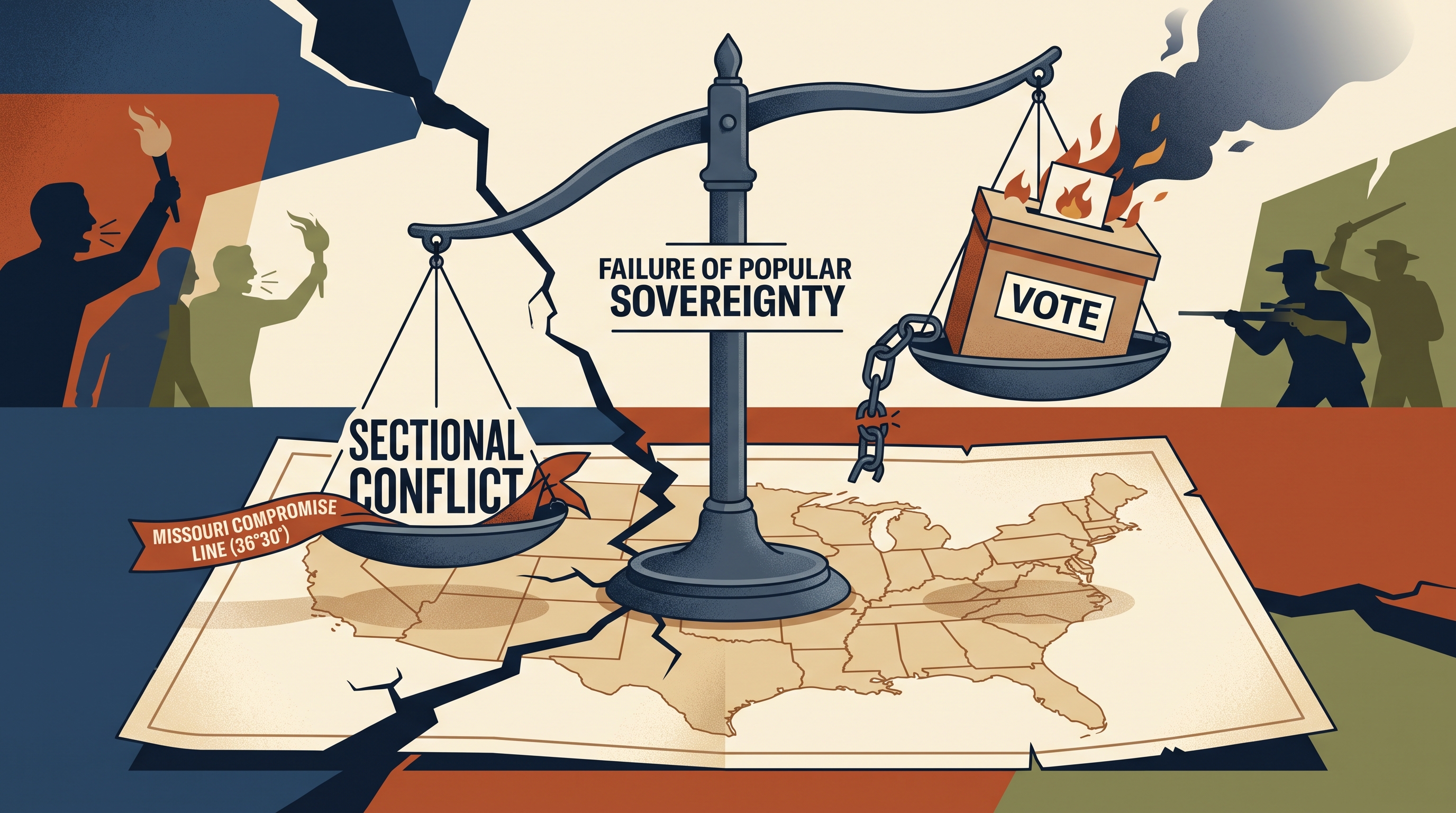
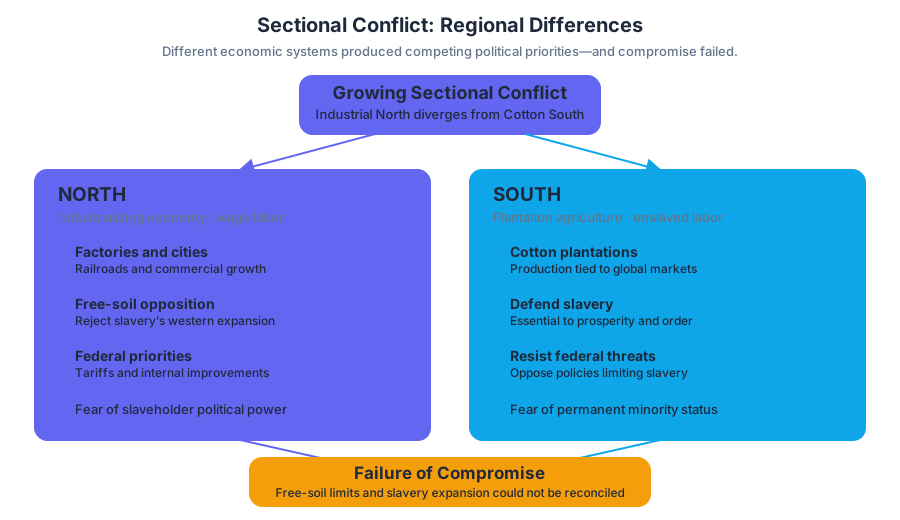
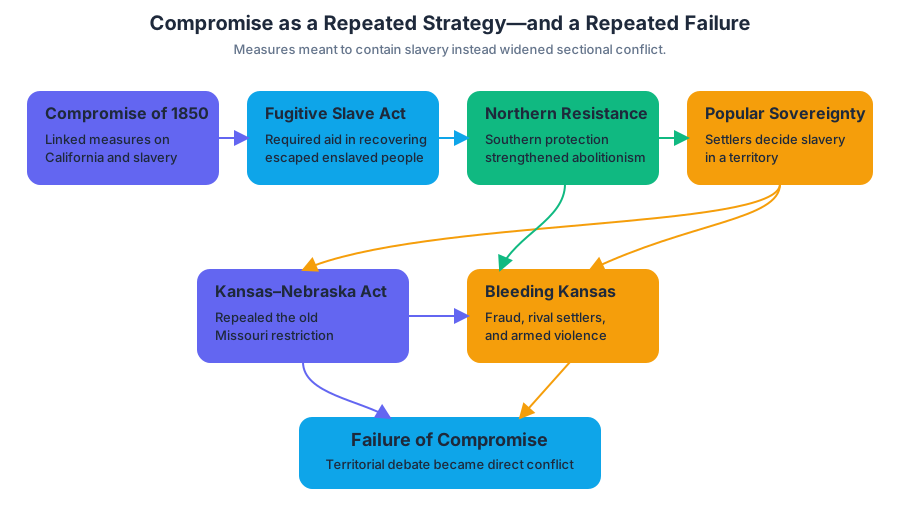
5.7 Election of 1860 and Secession · 5.8 Military Conflict in the Civil War
Key concepts: Election of 1860 · Secession and debates over leaving the Union · Slavery as the central cause of sectional conflict · Regional differences between the North and South · States’ rights arguments · Proslavery racial doctrines and the belief that slavery was a positive social good · Alexander Stephens’s Cornerstone Speech · Union and Confederate economic and societal mobilization · Military conflict in the Civil War · Union military victory over the Confederacy
Abraham Lincoln won the presidency in 1860 without carrying a single Southern state, and that fact exposed the central crisis of the Union: could a nation remain united when one section believed slavery must expand and the other increasingly opposed its expansion?
5.7 Election of 1860 and Secession · 5.8 Military Conflict in the Civil War
Abraham Lincoln won the presidency in 1860 without carrying a single Southern state, and that fact exposed the central crisis of the Union: could a nation remain united when one section believed slavery must expand and the other increasingly opposed its expansion?
Investigative question: Why did the election of one Republican president lead to secession—and why did the resulting war end in Union victory?
Unit 5 Learning Objective A: Explain the context in which sectional conflict emerged from 1844 to 1877.
CED traceability: KC-5.2, KC-5.2.I, KC-5.2.II, KC-5.3, and KC-5.3.I are central to this topic. The most useful AP Historical Thinking Skills are Skill 1: Developments and Processes, Skill 2: Sourcing and Situation, Skill 3: Claims and Evidence in Sources, Skill 4: Contextualization, Skill 5: Making Connections, and Skill 6: Argumentation.
The election that broke the two-party system
The election of 1860 occurred after the national Democratic Party split over slavery. The Republican Party, founded in the 1850s, opposed the expansion of slavery into western territories. Its candidate, Abraham Lincoln, presented the Republican position as a defense of free labor and the belief that slavery should not gain new political power.
Four major candidates divided the electorate:
| Candidate | Party or coalition | Core political position |
|---|---|---|
| Abraham Lincoln | Republican | Block slavery’s expansion into the territories |
| Stephen Douglas | Northern Democrat | Allow territorial settlers to decide through popular sovereignty |
| John C. Breckinridge | Southern Democrat | Protect slavery’s expansion and federal protection |
| John Bell | Constitutional Union | Preserve the Union by avoiding the slavery issue |
Lincoln won the Electoral College because the Republican vote was concentrated in the North, while the Democratic vote was divided among Douglas, Breckinridge, and Bell. His victory did not immediately abolish slavery where it already existed. Southern secessionists nevertheless interpreted a Republican victory as evidence that the South had lost national political influence and that slavery’s future was endangered.
Secession: constitutional argument and practical purpose
Secession was the formal withdrawal of a state from the Union. South Carolina seceded in December 1860, followed by Mississippi, Florida, Alabama, Georgia, Louisiana, and Texas before Lincoln’s inauguration. These states formed the Confederate States of America, with Jefferson Davis as president. Virginia, Arkansas, Tennessee, and North Carolina later joined after fighting began.
Secessionists often used states’ rights, the claim that states retained authority to resist or reject federal power, as their constitutional justification. Yet the immediate issue protected by that argument was slavery. Mississippi’s secession declaration, for example, identified its society and economy with slavery. States’ rights functioned less as an abstract principle than as a defense against federal action threatening slaveholders’ power.
Misconception check: “The Civil War was mainly about states’ rights, unrelated to slavery.”
Correction: States’ rights was a major argument, but slavery was the central issue that made secession urgent. The relevant historical question is: states’ rights to do what? In 1860–1861, the answer was primarily the right to preserve and protect slavery.
KC-5.2.I requires attention to competing responses. Many white Northerners opposed slavery’s expansion because they feared competition with enslaved labor, not because they supported racial equality. Abolitionists such as Frederick Douglass and other antislavery activists made stronger moral arguments, condemned slavery as a violation of human rights, assisted freedom seekers, and sometimes accepted resistance or violence. Southern defenders claimed that racial hierarchy was natural, that slavery benefited enslaved people, and that the Constitution protected slave property.
From political crisis to military conflict
Lincoln initially sought to preserve the Union without immediately attacking slavery where it already existed. The Confederacy, however, claimed federal forts and military installations located inside seceded states. When Confederate forces fired on Fort Sumter in April 1861, Lincoln called for troops to suppress the rebellion. The conflict became a war over national sovereignty: could individual states leave the Union by force?
The North and South entered the war with sharply different strengths:
| Union advantage | Confederate advantage |
|---|---|
| Larger population and manpower | Fighting largely on home territory |
| Greater industrial capacity | Strong military tradition among many officers |
| More railroad, banking, and manufacturing resources | Defensive strategy could make Union conquest costly |
| Established navy and ability to blockade ports | Hope that Britain or France might intervene |
The Confederacy’s strategy was largely defensive: survive, defend its territory, and persuade the North that victory would cost too much. The Union developed a broader strategy—blockade Southern ports, control the Mississippi River, divide the Confederacy, and capture its political and economic centers. The Union’s resources mattered, but resources alone did not guarantee victory; military leadership, political will, and emancipation also changed the war’s meaning and direction.
Why emancipation became a military strategy
KC-5.3.I identifies three connected causes of Union victory: Northern manpower and industrial resources, leadership including Abraham Lincoln’s, and the decision to emancipate enslaved people. The Emancipation Proclamation of 1863 declared enslaved people in areas still rebelling against the Union to be free. It did not immediately free every enslaved person, but it transformed Union war aims and weakened the Confederacy.
Emancipation damaged the Confederate labor system, encouraged enslaved people to flee plantations or seek Union protection, and allowed African American men to enlist in the Union army. Nearly 180,000 Black soldiers served in the United States Colored Troops. Their military participation made freedom an active part of Union victory rather than merely a postwar promise.
The war’s major turning points included the Union victory at Antietam, which gave Lincoln the opportunity to announce emancipation; the Union victories at Gettysburg and Vicksburg in 1863, which checked Confederate offensives and secured the Mississippi River; and the campaigns of Ulysses S. Grant and William Tecumseh Sherman, which increasingly targeted Confederate armies, transportation, supplies, and morale.
Worked causal example: from election to war
Prompt: Explain how the election of 1860 contributed to the outbreak of the Civil War.
Step 1—Contextualize: Expansion into western territories had intensified disagreement over whether slavery would spread.
Step 2—Identify the development: Lincoln’s Republican victory demonstrated that a candidate opposed to slavery’s expansion could win through Northern electoral strength.
Step 3—Explain the reaction: Southern leaders feared permanent minority status and believed Republican control threatened slavery’s security.
Step 4—Connect cause to outcome: Several slave states seceded, formed a Confederacy, and seized federal property. The Fort Sumter attack prompted Lincoln to use military force, turning secession into civil war.
This chain earns a causal explanation because it connects political change, sectional interpretation, secession, and military escalation rather than merely listing events.
In-flow retrieval check
- Why did Lincoln win the Electoral College even though he received no electoral votes from the Deep South?
- How did the Emancipation Proclamation affect the Union war effort?
- Give one Union advantage and one Confederate advantage.
- Why is “states’ rights” an incomplete explanation unless the specific right is identified?
Answers: The Democratic vote split among several candidates, while Republican support was concentrated in the North. Emancipation weakened Confederate labor, encouraged escape, and opened Union service to Black soldiers. The Union had greater manpower and industry; the Confederacy fought defensively on familiar territory. The claimed right primarily concerned protecting slavery and resisting federal authority over it.
Skill connection: A strong AP response uses Skill 1: Developments and Processes to connect election, secession, and war; Skill 4: Contextualization to place 1860 within expanding sectional conflict; Skill 5: Making Connections to link emancipation with military victory; and Skill 6: Argumentation to make a defensible claim that recognizes both constitutional language and slavery’s central role.
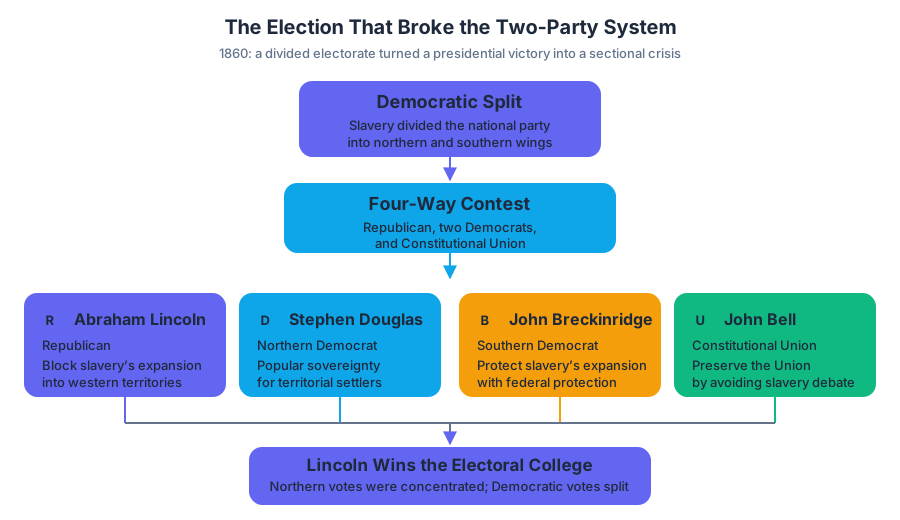
5.9 Government Policies During the Civil War · 5.10 Reconstruction
Key concepts: Emancipation Proclamation · African American flight from plantations and enlistment in the Union Army · Union victory over the Confederacy · 13th Amendment · 14th Amendment · 15th Amendment · African American citizenship and civil rights · Equal protection under the law · Voting rights · Contested Reconstruction and unresolved questions about federal power and minority rights
The Civil War transformed emancipation from a moral demand into federal policy—and Reconstruction transformed that policy into a constitutional struggle over citizenship, equality, and political power.
5.9 Government Policies During the Civil War · 5.10 Reconstruction
The Civil War transformed emancipation from a moral demand into federal policy—and Reconstruction transformed that policy into a constitutional struggle over citizenship, equality, and political power. The central question is not simply when slavery ended, but how wartime decisions and postwar amendments attempted to remake American society.
From emancipation policy to Union victory
At the beginning of the Civil War, President Abraham Lincoln defined the conflict primarily as a fight to preserve the Union. As the war continued, however, enslaved people themselves made slavery impossible for the federal government to ignore. African Americans fled plantations, sought protection behind Union lines, and forced military commanders and policymakers to decide whether freedom would become part of the Union war effort.
The Emancipation Proclamation, issued by Lincoln in 1863, declared enslaved people in areas still rebelling against the United States to be free. Its immediate reach was limited: it did not free enslaved people in loyal slave states or in Confederate areas already controlled by the Union. Its importance was nevertheless enormous because it made emancipation an official Union war aim, weakened the Confederacy’s labor system, discouraged European support for the Confederacy, and authorized the enlistment of African American soldiers.
Key distinction: The Emancipation Proclamation was a wartime executive order, not a constitutional amendment abolishing slavery everywhere.
African American flight from plantations was therefore both an individual act of resistance and a form of wartime policy-making from below. People who reached Union lines became known as “contraband” in early federal policy; their presence supplied the Union with laborers, refugees, and eventually soldiers. Nearly 200,000 African American men served in the Union Army and Navy, strengthening Union military capacity while making emancipation inseparable from African American citizenship claims.
The chain of causation can be represented simply:
Enslaved people flee plantations → Union forces shelter and employ them → Federal policy moves toward emancipation → African American men enlist → Union military power increases → Confederate defeat becomes more likely.
This process helped produce Union victory over the Confederacy in 1865. Victory destroyed the Confederate government, but it did not automatically settle the meaning of freedom. The United States still had to determine who counted as a citizen, what rights citizenship protected, and whether the federal government would enforce those rights against resistant states.
Reconstruction and the constitutional reordering of citizenship
Reconstruction refers to the effort, from 1865 to 1877, to rebuild the former Confederate states and redefine the political and social consequences of emancipation. Under KC-5.3.II.ii, Reconstruction altered relationships between the states and the federal government and produced debates over new definitions of citizenship, especially for African Americans, women, and other minorities.
The constitutional amendments formed a sequence:
| Amendment | Core change | Why it mattered |
|---|---|---|
| 13th Amendment | Abolished slavery | Made emancipation permanent in the Constitution |
| 14th Amendment | Established African American citizenship and equal protection under the laws | Expanded federal responsibility for civil rights |
| 15th Amendment | Protected voting rights for African American men, with limits in its wording | Recognized political participation as central to freedom |
The 13th Amendment abolished slavery. This distinction matters because the Emancipation Proclamation depended on wartime conditions, while the amendment made slavery unconstitutional throughout the United States. The amendment also exposed a new conflict: if formerly enslaved people were free, could southern states force them into labor systems that reproduced slavery under another name?
The 14th Amendment granted African Americans citizenship, required states to provide equal protection under the laws, and strengthened the federal government’s ability to challenge state violations of rights. The 15th Amendment prohibited denying the vote on the basis of race, color, or previous condition of servitude. Together, these amendments attempted to move the nation from emancipation—the ending of legal slavery—to civil and political equality.
Misconception check: The 14th Amendment did not create complete equality for every group. Women remained excluded from national voting guarantees, and the 15th Amendment protected African American men rather than establishing universal suffrage.
Competing Republican approaches
Republicans disagreed over how far Reconstruction should go. Radical Republicans sought stronger federal protection for African American rights, punishment or restriction for former Confederate leaders, and a fundamental reordering of race relations in the South. Moderate Republicans also supported congressional action and constitutional change, but often favored more limited measures and worried about prolonged federal control.
Their conflict with President Andrew Johnson produced a struggle over the balance of power between Congress and the presidency. Congressional Republicans attempted to shape Reconstruction policy, protect the freedpeople, and reorganize southern governments, while Johnson favored a more lenient approach toward white southern leadership. The political cartoon Swing Around the Circle mocked Johnson’s 1866 speaking tour, portraying his attempt to win public support as politically disastrous.
Reconstruction achieved short-term successes: formerly enslaved people gained constitutional rights, African American men voted and held political office, and the federal government briefly expanded its role as protector of civil rights. Yet Southern resistance—including organized violence, intimidation, and resistance to Black political participation—undermined those gains. Reconstruction ultimately failed because resistance combined with waning Northern resolve, allowing federal enforcement to recede by 1877.
Citizenship debates beyond African American rights
Reconstruction also reshaped other movements. The women’s rights movement was emboldened and divided by the 14th and 15th Amendments under KC-5.3.II.B. Some activists welcomed the amendments as steps toward equal citizenship; others criticized the decision to extend voting protections to African American men while women remained excluded.
Frederick Douglass’s argument in “The Composite Nation” expanded the meaning of American identity by defending a multiracial nation and advocating naturalization for Chinese Americans. His position shows that Reconstruction raised a broad question: whether citizenship should be defined narrowly by race or expanded as a national political principle.
Worked interpretation: making a historical claim
Suppose a source argues that Reconstruction was a complete success because the amendments transformed the Constitution. A strong response using Suggested Skill: Claims and Evidence in Sources and 3.D, Explain how claims or evidence support, modify, or refute a source’s argument, would both recognize and qualify the claim: the 13th, 14th, and 15th Amendments created revolutionary legal changes, but Southern resistance and declining Northern commitment limited their enforcement. The evidence therefore supports the argument about constitutional transformation while modifying any claim that legal change immediately produced secure equality.
Retrieval check: Which amendment abolished slavery, which established citizenship and equal protection, and which addressed voting rights? Why was the Emancipation Proclamation historically important even though it did not itself abolish slavery everywhere?
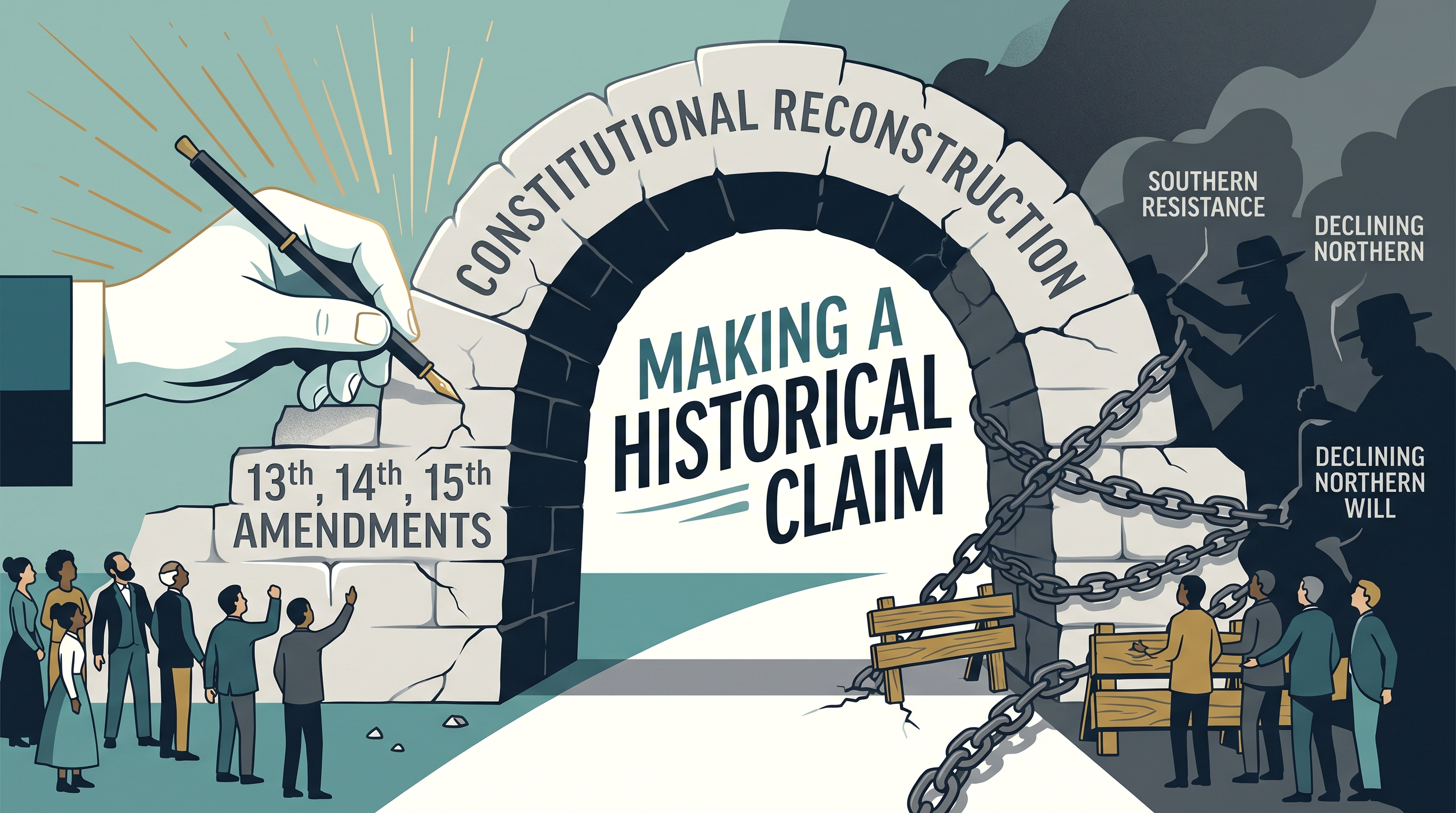
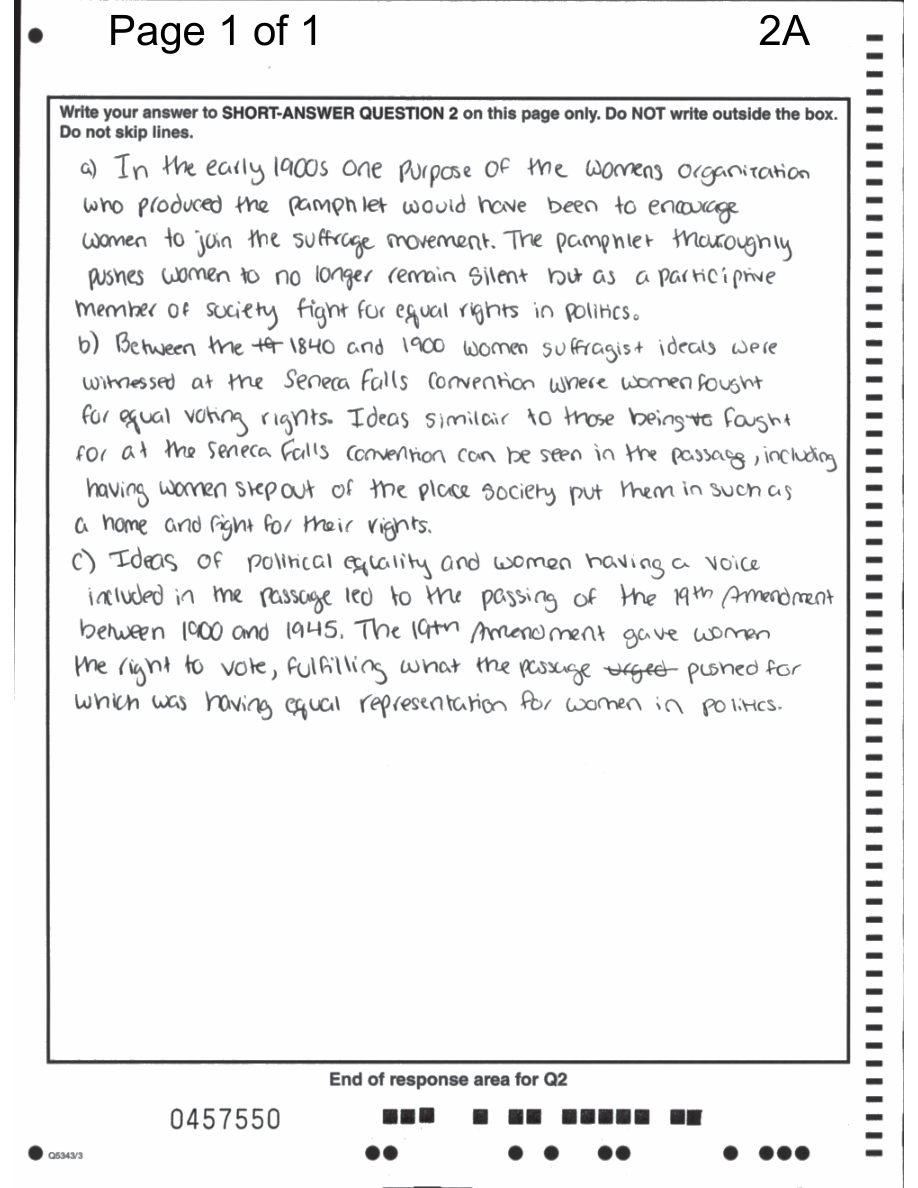
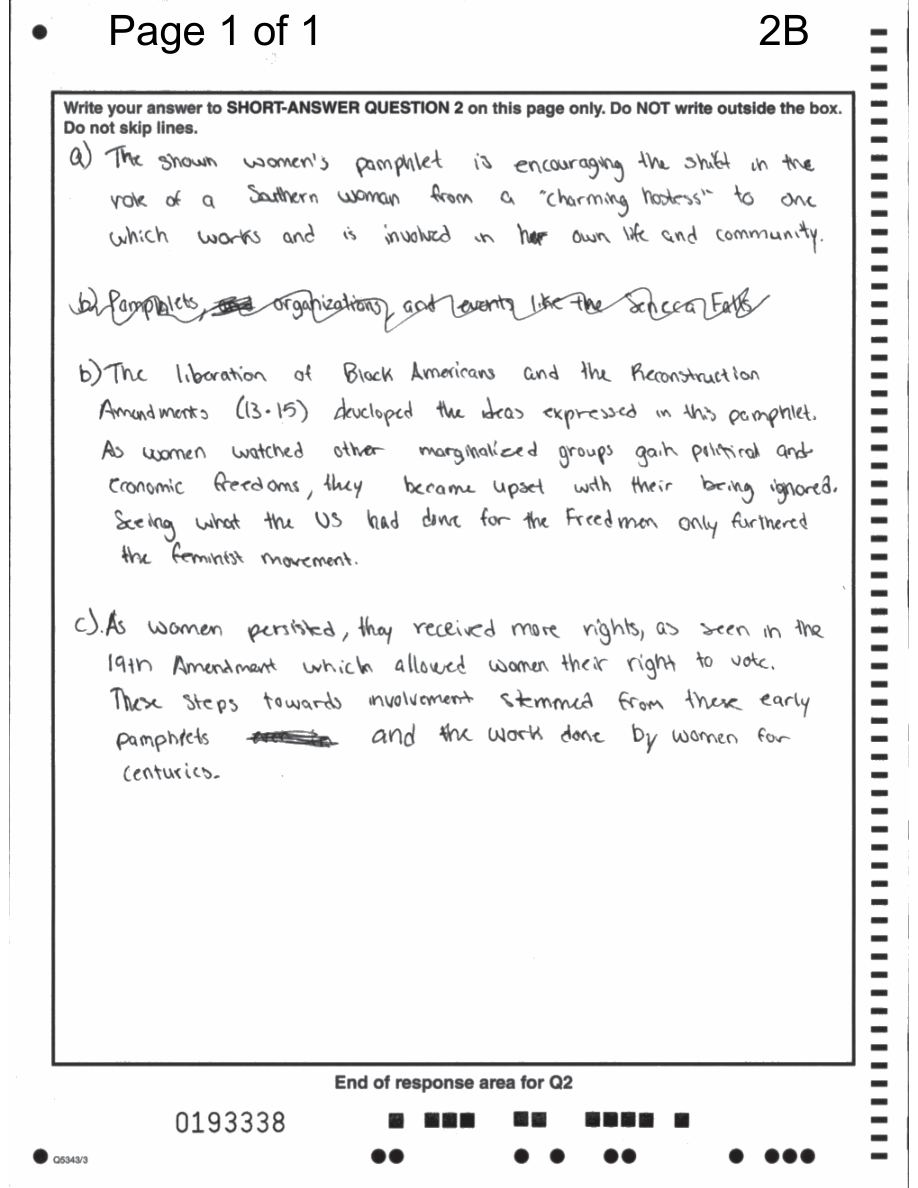
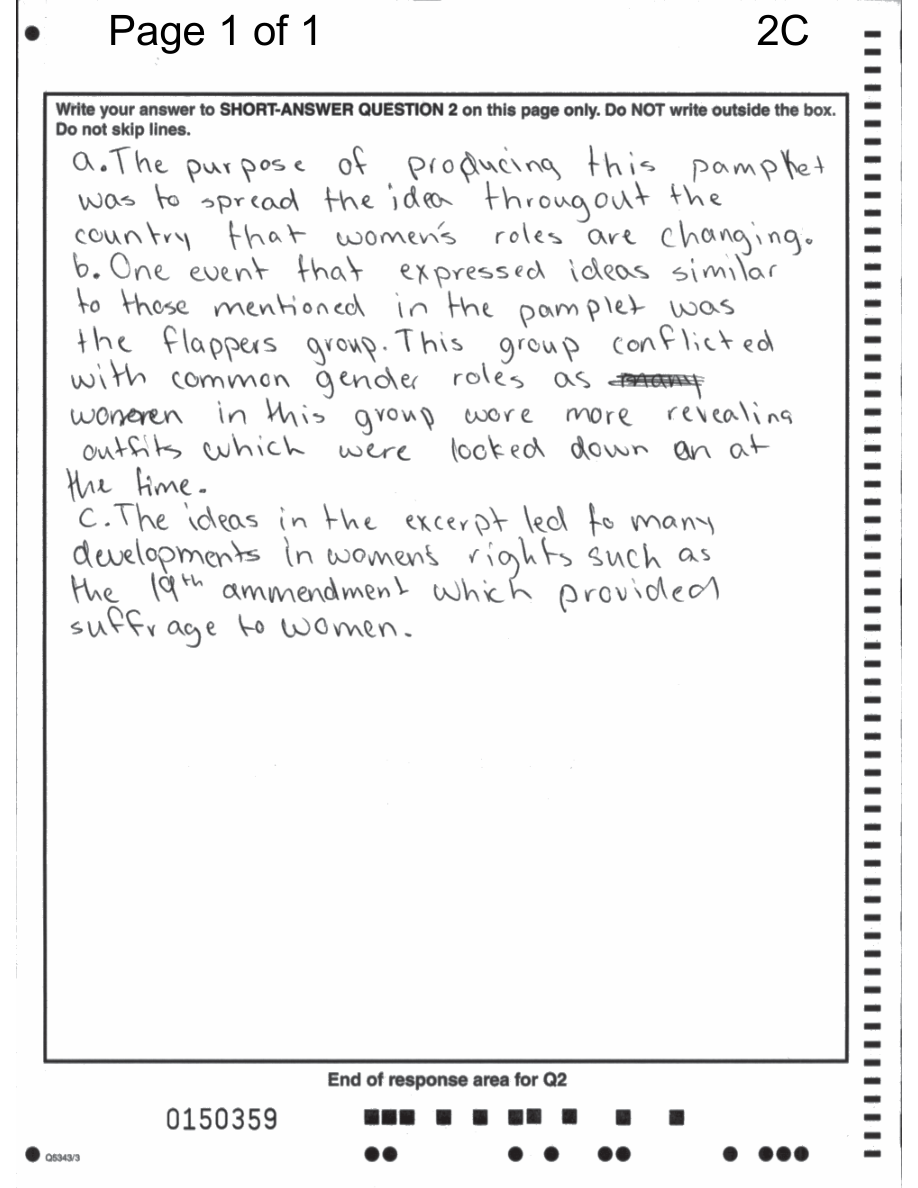
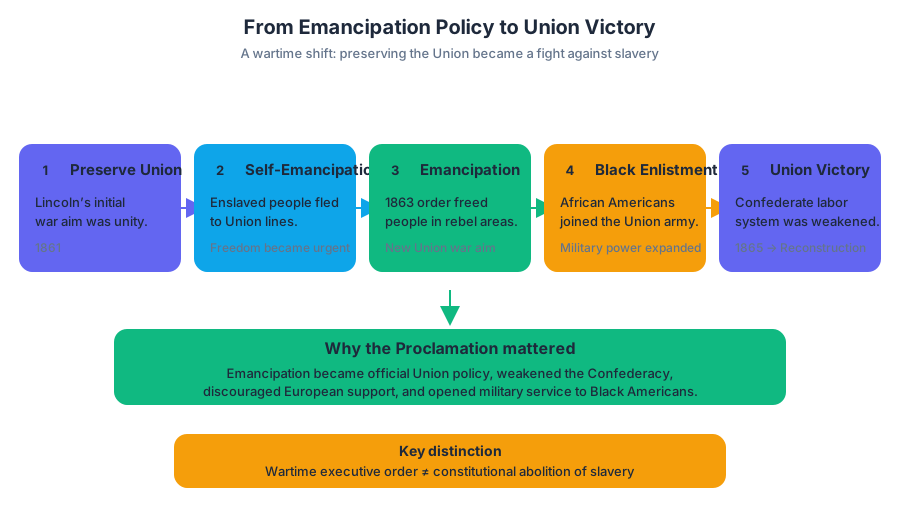
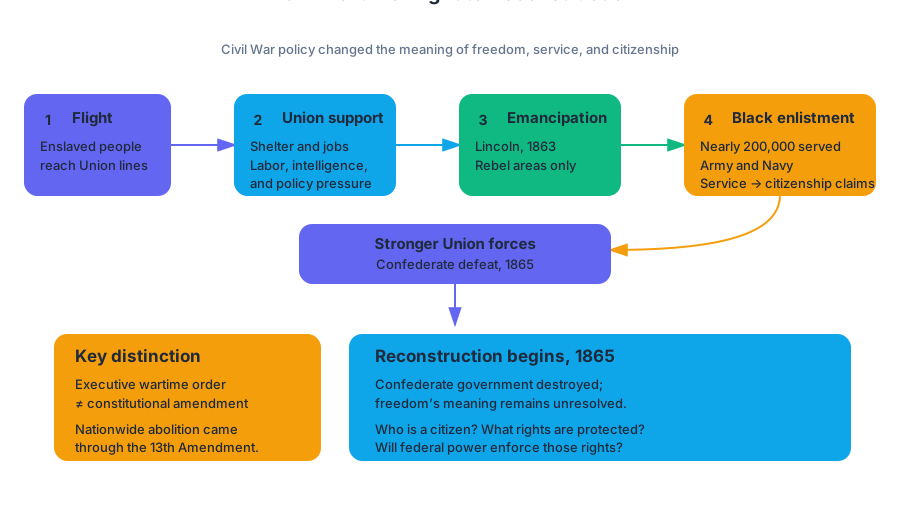
5.11 Failure of Reconstruction · 5.12 Comparison in Period 5
Key concepts: Failure of Reconstruction · Supreme Court interpretation of the Fourteenth Amendment · Limits of federal protection against racial violence · Colfax Massacre · Individual versus state action under constitutional law · Historical comparison as a method of analysis · Using primary-source legal opinions · Defining the scope of historical study
Reconstruction ultimately failed to secure lasting federal protection for African Americans, even though the constitutional amendments adopted after the Civil War created new national definitions of freedom and citizenship.
5.11 Failure of Reconstruction · 5.12 Comparison in Period 5
Reconstruction ultimately failed to secure lasting federal protection for African Americans, even though the constitutional amendments adopted after the Civil War created new national definitions of freedom and citizenship. The central contradiction is stark: the federal government could abolish slavery and establish citizenship in law, yet it did not sustain the political and legal power needed to protect Black citizens from racial violence, disenfranchisement, and economic dependence.
Scope of the comparison: Period 5 covers approximately $1844$–$1877, with attention to the United States as a whole and especially the former Confederate South. The comparison connects the Civil War and Reconstruction governments, African Americans seeking citizenship and landownership, southern white political groups, and the Supreme Court’s interpretation of federal power. These boundaries matter because they let us compare the expansion of federal authority during wartime with its later retreat from protecting individual rights.
Why Reconstruction failed
Southern plantation owners continued to control most of the region’s land after Reconstruction. Formerly enslaved people sought landownership, but many could not become economically self-sufficient. Sharecropping—an arrangement in which farmers worked land owned by someone else in exchange for a share of the crop—often trapped Black families and poor white farmers in debt. This economic dependence made political independence difficult: a person who owed money to a landowner could face eviction, job loss, or violence for challenging local authority.
The failure was also political and legal. Segregation, racial violence, local political tactics, and Supreme Court decisions progressively weakened African American rights. The Fourteenth and Fifteenth Amendments remained in the Constitution, but constitutional language alone could not guarantee safety when federal enforcement declined and local authorities tolerated or participated in racial terror.
Misconception check — “Reconstruction failed because the amendments were meaningless.” The amendments were not meaningless. The Fourteenth and Fifteenth Amendments later became foundations for twentieth-century civil-rights decisions. The more precise conclusion is that Reconstruction failed to enforce those promises consistently in the nineteenth century.
The Fourteenth Amendment and federal protection
The Fourteenth Amendment defined national citizenship and required states to respect due process and equal protection. The key constitutional question was whether the amendment allowed the federal government to punish private individuals who violated other people’s rights, or whether it mainly restricted governments themselves.
In United States v. Cruikshank (1876), arising from the Colfax Massacre, the Supreme Court interpreted the Fourteenth Amendment narrowly. The majority held that the amendment did not give the federal government general authority to punish individuals for violence committed against other individuals. Its reasoning treated the amendment primarily as a limit on state action—official conduct by state governments—not as a broad federal guarantee against every private act of racial violence.
This distinction weakened federal protection. If a white mob attacked Black citizens but local and state officials failed to prosecute the attackers, victims could not automatically rely on the Fourteenth Amendment to obtain federal intervention. The ruling therefore stripped victims of racial violence of an important federal legal remedy precisely when local systems were least willing to protect them.
Reading the majority opinion as evidence
When analyzing the assigned portions of the Supreme Court majority opinion, separate the Court’s claim, constitutional reasoning, and historical consequence:
| Analytical question | What to identify |
|---|---|
| Claim | What protection does the Court say the Fourteenth Amendment provides? |
| Reasoning | Does the Court distinguish state action from private action? |
| Consequence | What happens when local authorities do not protect victims? |
| Historical significance | How does the interpretation limit Reconstruction’s promise? |
The opinion’s legal logic may appear formally neutral because it applies a general rule about federalism and state action. Its practical effect, however, was unequal: racial violence in the South was often carried out by private groups with the cooperation or inaction of local officials. A rule that required state responsibility to be clearly demonstrated could leave Black victims without protection when state authorities deliberately refused to act.
The Colfax Massacre as a worked example
In the Colfax Massacre of $1873$, armed white attackers overwhelmed Black Republican defenders in Colfax, Louisiana, after a disputed election. The violence demonstrated that emancipation and citizenship did not automatically produce physical security or political equality. Federal prosecutors brought charges under federal enforcement laws, but the Supreme Court’s later interpretation weakened the legal basis for prosecuting such private violence.
Worked comparison: Use federal protection as the criterion. During the Civil War and early Reconstruction, the national government expanded its role: it defeated the Confederacy, abolished slavery through the Thirteenth Amendment, and supported new constitutional protections. By the mid-$1870$s, however, decisions such as Cruikshank narrowed the federal government’s ability to respond when private mobs attacked African Americans.
The comparison shows both change and continuity. The change was the expansion and then contraction of federal authority. The continuity was the persistence of racial power: land remained concentrated, local white leaders resisted Black political participation, and violence enforced the social order. A strong historical argument must include both sides rather than labeling Reconstruction simply a success or a failure.
Comparison as historical argument
Topic 5.12 emphasizes Skill 3.C: Claims and Evidence in Sources and comparison as a method of argumentation. Comparing sources or developments means more than listing similarities and differences. It requires a criterion—such as citizenship, federal power, landownership, or protection from violence—and an explanation of why the comparison reveals historical change.
Retrieval check: In one sentence, explain why the Colfax Massacre exposed the limits of Reconstruction. Then compare wartime federal action with the postwar interpretation in Cruikshank using the criterion of federal protection. A complete answer should identify the shift from national enforcement to a narrower state-action doctrine and explain why that shift left victims of racial violence vulnerable.
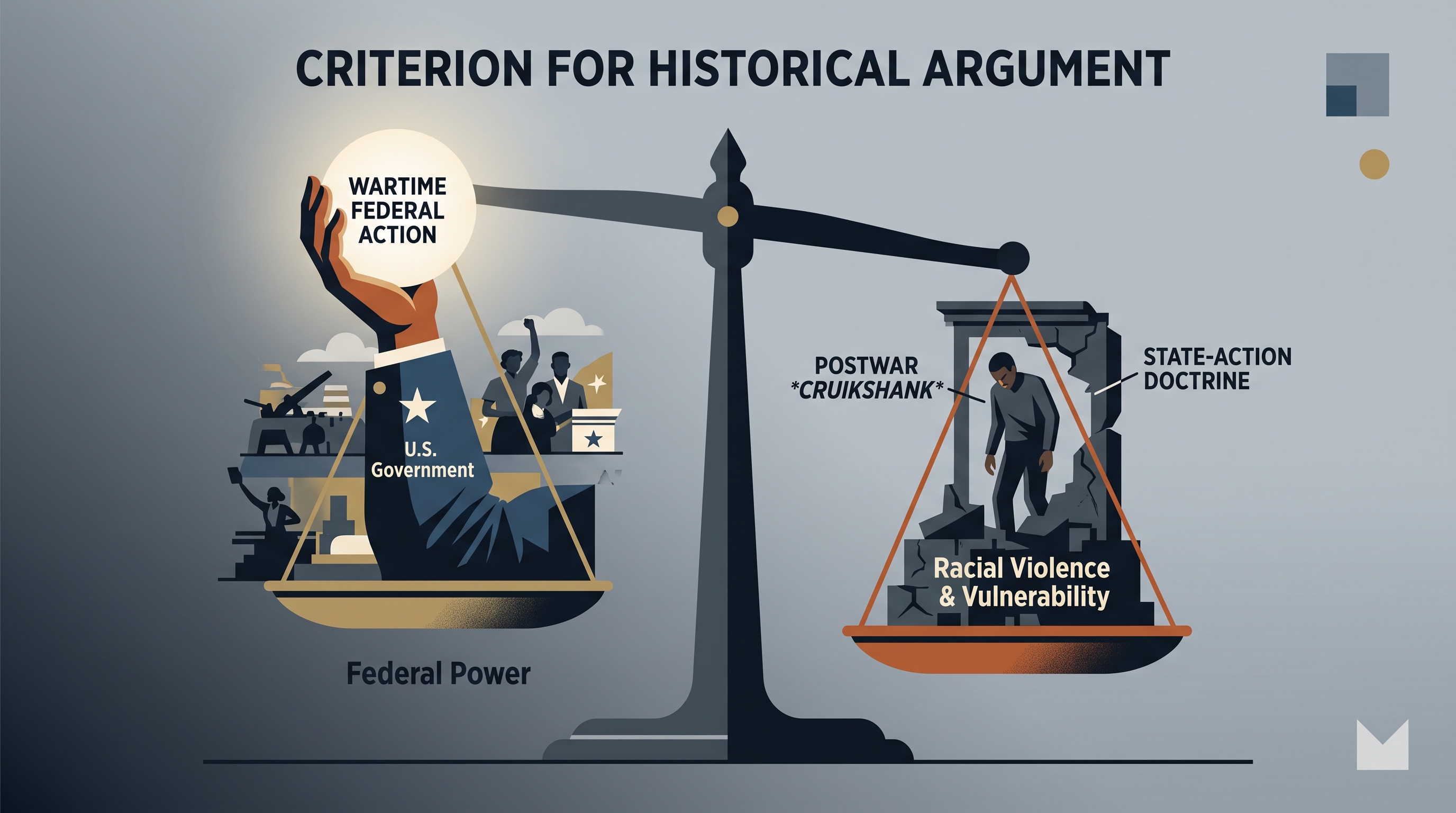
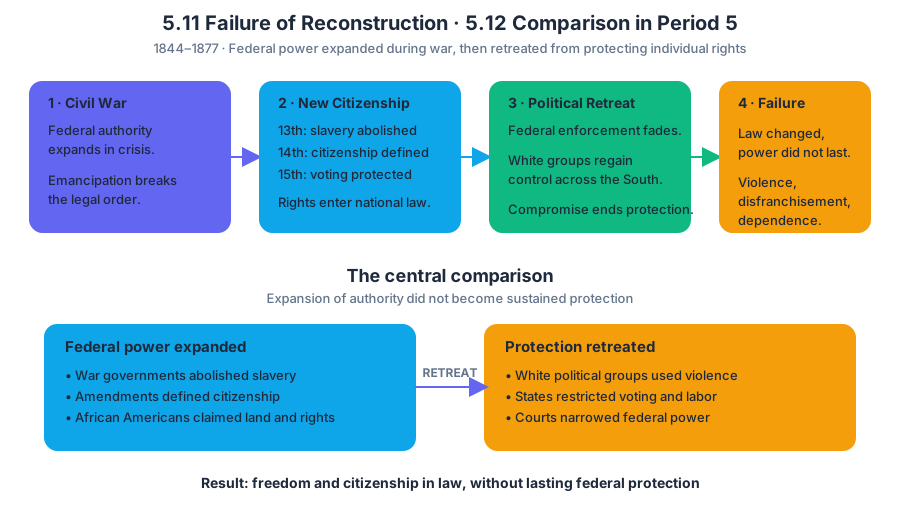
6.1 Contextualizing Period 6 · 6.2 Westward Expansion: Economic Development
Key concepts: Historical contextualization · Westward expansion · Economic development · Indigenous resistance · Westward migration · American identity · Land treaties and negotiation · Northwest Ordinance · Urban manufacturing · Rural agricultural innovation
Between 1865 and 1898, the United States expanded westward while transforming its economy: railroads, factories, farms, and new technologies tied distant regions into a national market.
6.1 Contextualizing Period 6 · 6.2 Westward Expansion: Economic Development
Between 1865 and 1898, the United States expanded westward while transforming its economy: railroads, factories, farms, and new technologies tied distant regions into a national market. The central historical question is not simply why did Americans move west? but how did economic development encourage expansion, and how did expansion reshape American power, identity, and conflict?
Historical contextualization: putting expansion in a larger pattern
Historical contextualization explains how broader political, economic, cultural, and social developments shaped a specific historical development or process. Context is the historical “weather system” surrounding an event: it does not replace the event itself, but it helps explain why that event became possible and why it mattered.
Contextualization means connecting a specific development to a broader pattern that came before or existed around it.
A reliable three-step method is:
- Identify a broad pattern. For example, the United States repeatedly expanded its territory and population after independence.
- Identify a specific example. The Northwest Ordinance created a process for organizing western territories and admitting new states.
- Explain the link. By establishing rules for territorial government and statehood, the ordinance helped make expansion appear orderly, lawful, and connected to national development.
This method matters because an isolated fact—such as a treaty, migration movement, or invention—does not yet demonstrate historical understanding. The explanation must show how the fact relates to a larger process.
From the early republic to Period 6
Period 6 begins in 1865, but its expansion story rests on earlier developments. From 1783 to 1800, the new nation confronted questions that remained important after the Civil War: Who controlled western land? How would Indigenous nations respond? Could treaties and negotiation settle competing claims? What did territorial growth mean for American identity?
The Northwest Ordinance and later land treaties established precedents for federal involvement in western expansion. Yet these policies often treated Indigenous homelands as territories available for American settlement, producing recurring conflict. Indigenous resistance was therefore not an obstacle appearing suddenly in Period 6; it was part of a longer struggle over sovereignty, land, and the meaning of United States expansion.
A strong contextual chain looks like this:
| Broad pattern | Specific development | Historical connection |
|---|---|---|
| Territorial growth after independence | Northwest Ordinance | Federal procedures encouraged organized settlement and state formation |
| Persistent competition over land | Treaties and negotiation | Agreements attempted to transfer or define land claims, often under unequal pressure |
| Movement toward a continental nation | Westward migration | Settlers, farmers, workers, and businesses carried population and institutions into new regions |
| Expansion of national identity | “American” claims to western space | Territorial growth became associated with opportunity, independence, and national power |
Economic development and westward expansion
After the Civil War, expansion operated through two connected economic systems. Urban manufacturing, including textile mills and other factories, concentrated labor and investment in cities. Rural agriculture relied on improved tools and access to expanding markets. Westward expansion connected these systems: farms supplied food and raw materials, while cities produced goods, machinery, credit, and transportation services.
The steel plow allowed farmers to cut through tough prairie soil more effectively than earlier wooden or iron plows. The mechanical reaper increased the speed at which crops could be harvested. These technologies did not eliminate hardship—farmers still faced debt, falling prices, drought, and transportation costs—but they made large-scale agriculture more productive and tied rural producers to national and international markets.
Worked contextual example: Suppose a source shows a farmer using a mechanical reaper on the Great Plains. First, identify the broad pattern: postwar economic development expanded production and national markets. Next, identify the specific evidence: the reaper represents technological innovation in rural agriculture. Finally, explain the link: improved machinery made farming more commercially viable, encouraged settlement in western lands, increased demand for transportation, and connected rural production to urban manufacturing and markets.
Reading historical images and sources
A historical image can be analyzed as evidence rather than decoration. Ask:
- What professions or economic activities appear? Farming, factory labor, transportation, mining, or commerce may reveal the economy represented.
- Who is centered or left out? The image may celebrate settlers or industry while omitting Indigenous communities or exploited labor.
- What is the primary message? A scene may promote progress, abundance, national unity, or the promise of western opportunity.
These questions activate AP Historical Thinking Skill 4: Contextualization, especially when the image is linked to broader economic and geographic developments. They also support AP Historical Thinking Skill 5: Making Connections, because students must connect technology, labor, migration, land policy, and regional development rather than treating them as separate facts. When using a written or visual source, AP Historical Thinking Skill 3: Claims and Evidence in Sources requires identifying what the source actually supports.
Misconception check
Misconception: “Westward expansion was mainly individual movement by adventurous settlers.” Expansion also depended on government policy, land treaties, transportation systems, technological innovation, capital, labor, and markets. Settlers mattered, but expansion became powerful because public policy and private economic development reinforced one another—often at the expense of Indigenous sovereignty.
Retrieval and interpretation check
Prompt: How could the Northwest Ordinance help contextualize westward expansion in Period 6?
Answer: It established an earlier pattern of federal organization of western territories and state formation. That pattern helps explain why later expansion involved government policy, land negotiation, migration, and competing claims over Indigenous land—not merely spontaneous settlement.
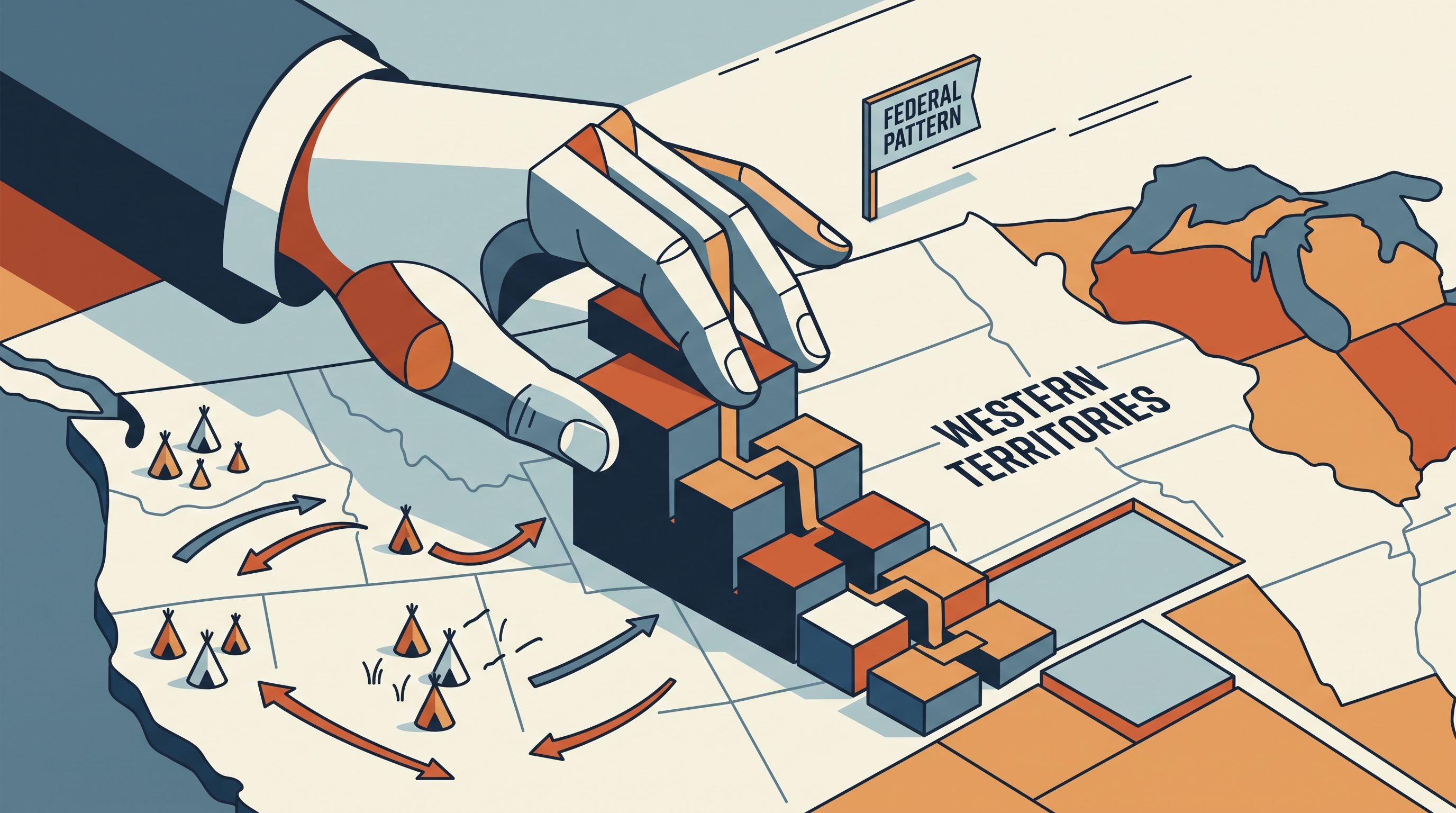
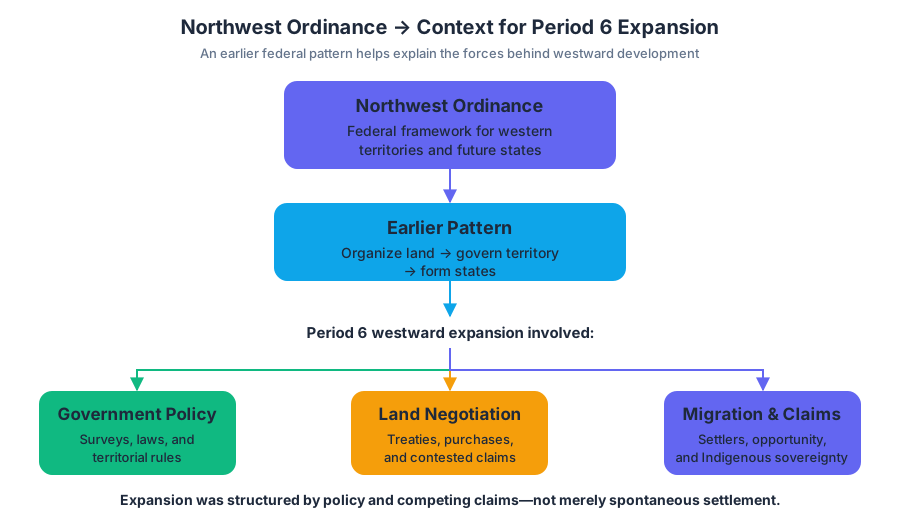
6.3 Westward Expansion: Social and Cultural Development · 6.4 The “New South”
Key concepts: Manifest Destiny and westward expansion · Westward migration after the Civil War · Federal legislation promoting western transportation · Regional interdependence and transportation networks · The emergence of a national culture · The decline of open-range ranching and cattle drives · Mechanization and steam-powered agricultural equipment · The Oklahoma Land Rush · The economic and cultural development of the New South
Westward expansion after the Civil War was not simply a story of empty land being settled; it was a struggle over who could control land, labor, transportation, and regional identity.
6.3 Westward Expansion: Social and Cultural Development · 6.4 The “New South”
Westward expansion after the Civil War was not simply a story of empty land being settled; it was a struggle over who could control land, labor, transportation, and regional identity.
Unit 6: Learning Objective B: Explain the causes and effects of westward expansion from 1865 to 1898.
A connected West—and contested ground
Federal policy and transportation networks tied distant communities together. Railroads carried settlers, cattle, crops, manufactured goods, and news across the continent, helping create a more integrated national economy and culture.
The same networks that encouraged migration also intensified conflict. Settlers, Indigenous peoples, Mexican Americans, ranchers, farmers, railroad companies, and federal officials often wanted the same land for different purposes. Competition for land and resources means that western expansion must be analyzed as a conflict among groups—not as a simple movement into unused territory.
KC-6.2.II.C connects this competition to resistance and violence. In New Mexico, the Gorras Blancas—“White Caps”—challenged settler land grabs by cutting fences, burning haystacks, and sabotaging railroads. Their actions reflected opposition to the enclosure of land that had previously been used more openly by local communities.
Migration, cultural exchange, and conflict
Western migration involved more than Anglo-American homesteaders. Mexican cultural influence remained visible in ranching, especially through the work and knowledge of vaqueros, or Mexican cowboys. The history of cattle ranching therefore demonstrates cultural exchange: practices associated with Mexican communities shaped the wider cattle industry, even as Mexican Americans frequently faced discrimination and loss of land.
The Oklahoma Land Rush of 1889 shows the contradictory character of western settlement. “Boomers” rushed to claim land, while accounts also recognized corruption and the effects on Indigenous people. The event could be celebrated by settlers as an opportunity for economic advancement while experienced by Native peoples as another stage of dispossession.
Worked contextual example: Suppose a historian compares a settler account of the Oklahoma Land Rush with a Gorras Blancas platform. The settler account might emphasize opportunity and movement; the Gorras Blancas document would reveal resistance to fencing and land seizure. A strong historical explanation would argue that westward expansion produced both mobility for some and dispossession for others. The evidence supports a cause-and-effect chain:
$$ \text{Federal support and transportation} \rightarrow \text{increased migration} \rightarrow \text{competition for land} \rightarrow \text{resistance and conflict} $$
Why the open range disappeared
The cattle industry first depended heavily on open-range ranching and long cattle drives. Ranchers moved herds across unfenced grasslands toward railroad towns, where cattle could be shipped to eastern markets. Railroads made the drives profitable, but railroads also helped transform the West in ways that eventually undermined them.
Farmers and ranchers increasingly used barbed wire to enclose land. Fencing blocked cattle routes, restricted access to water and grass, and turned shared or contested spaces into private property. Severe winters, drought, overgrazing, and the expansion of commercial agriculture further weakened the open range. Thus, the decline of cattle drives resulted from both environmental pressures and the growing privatization of western land.
Misconception check: The cowboy was not an exclusively Anglo-American figure. Mexican vaqueros deeply influenced cattle-ranching techniques, equipment, language, and labor practices.
The “New South”: industrial hopes, agricultural realities
After the Civil War, some southern leaders promoted a “New South”—a region that would diversify beyond cotton, attract factories, develop railroads, and participate more fully in national markets. The vision promised modernization and economic independence rather than continued dependence on one cash crop.
In practice, industrial growth remained limited and uneven. The South continued to rely heavily on agriculture, especially cotton, while systems such as sharecropping kept many African American and poor white farmers economically dependent. The region became more connected to national markets without becoming economically equal to the industrial North.
The New South therefore contained a central tension:
| Promised transformation | Continuing reality |
|---|---|
| Factories and railroads | Predominantly agricultural economy |
| Diversified production | Continued dependence on cotton |
| Economic opportunity | Debt and dependence through sharecropping |
| Modern regional identity | Persistent racial inequality |
Misconception check: “New South” did not mean that the South immediately became industrial or socially transformed. It described an aspiration promoted by regional boosters, not a complete economic reality.
AP historical reasoning: Developments and Processes
The most direct skill here is HSP-1: Developments and Processes, especially explaining how developments unfolded and produced consequences. To apply it, connect federal transportation policy, migration, land competition, cultural exchange, and changing economic systems rather than listing them separately.
A complete explanation might state: Federal support for transportation encouraged migration and connected western producers to national markets; this intensified conflicts over land and resources, contributed to the decline of open-range ranching, and helped produce a more nationally integrated culture. In the South, similar transportation and market connections supported limited industrial growth but did not displace agricultural dependence.
Retrieval check: Why did railroads both encourage cattle ranching and contribute to the decline of open-range cattle drives? Name one group that gained from western expansion and one group that resisted it, then explain why their interests collided.
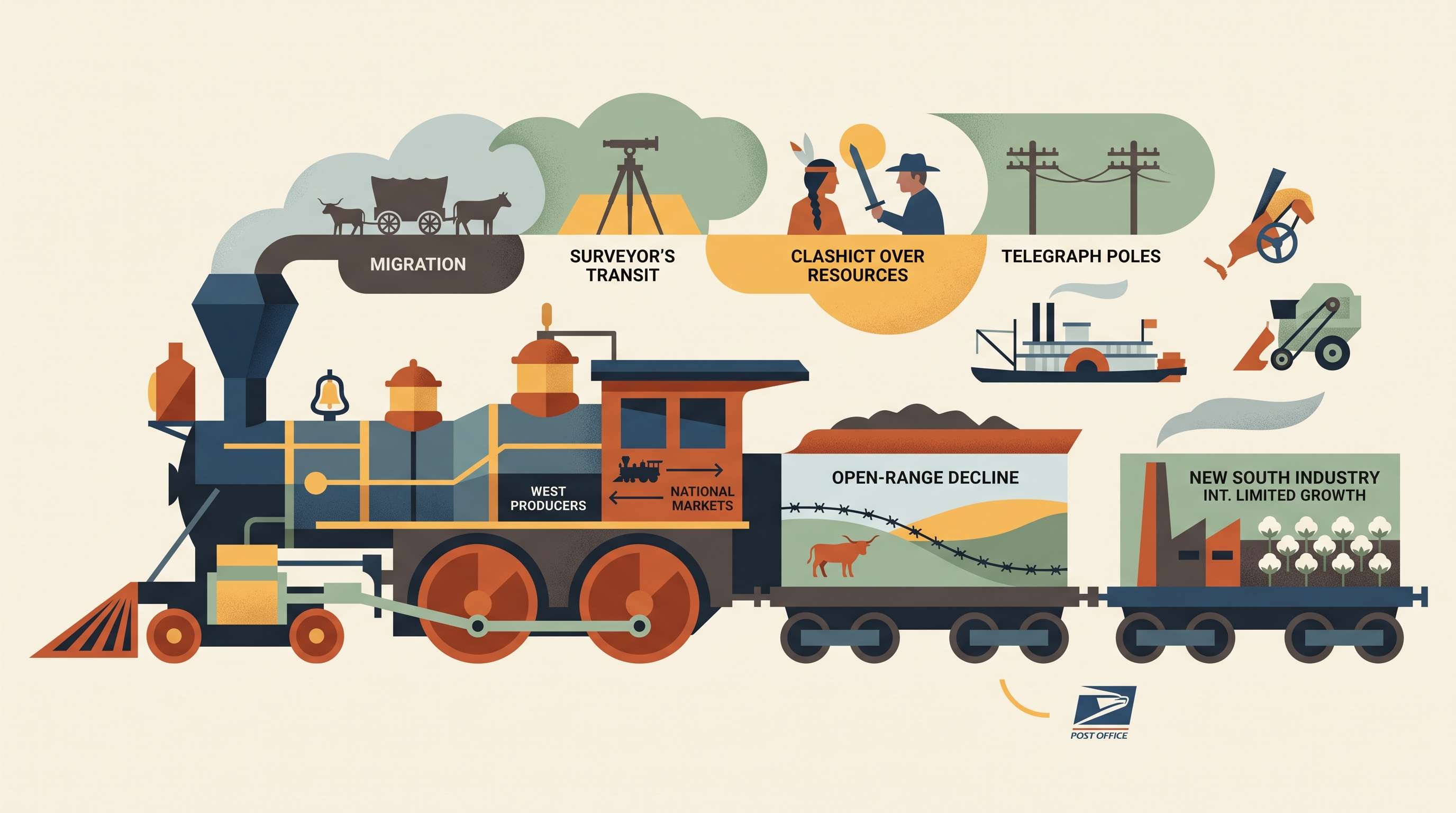
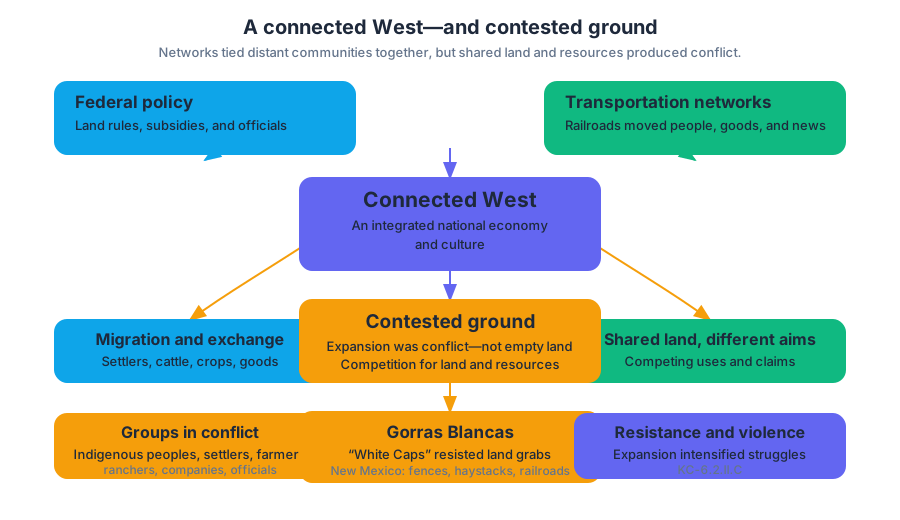
6.5 Technological Innovation · 6.6 The Rise of Industrial Capitalism
Key concepts: Technological innovation · Large-scale production · Industrial capitalism · Business consolidation · Government economic policies · Rapid economic development · Concentrated wealth · Growth and control of markets and natural resources · Farmers’ responses to agricultural instability · Labor changes during industrialization
Between 1865 and 1898, a new economic system made production faster, markets larger, and wealth more concentrated: industrial capitalism, an economy in which private businesses invest capital in machinery, factories, transportation, and natural resources to produce goods for profit.
6.5 Technological Innovation · 6.6 The Rise of Industrial Capitalism
Between 1865 and 1898, a new economic system made production faster, markets larger, and wealth more concentrated: industrial capitalism, an economy in which private businesses invest capital in machinery, factories, transportation, and natural resources to produce goods for profit. The central question is not simply what new machines appeared? It is: How did technology, government policy, and business organization reinforce one another?
Core claim: Technological advances, large-scale production methods, expanding markets, and pro-growth government policies generated rapid economic development and business consolidation.
The industrial growth machine
Industrialization worked like a connected system rather than a collection of isolated inventions. Railroads opened markets; telegraphs and expanding communication networks coordinated distant operations; factories used machinery and standardized production; government policies supported economic growth; and corporations gathered the money required for enormous projects.
Large-scale production means producing standardized goods in high volume, often with specialized machinery and divided tasks. This lowered the cost per item and made products available to much larger markets. Industrial companies consequently sought control over not only factories but also transportation routes, raw materials, and distribution networks.
| Industrial force | Immediate effect | Larger consequence |
|---|---|---|
| New technologies | Faster or more efficient production | Lower costs and expanded output |
| Railroads and communication networks | Connected distant producers and consumers | National and international markets |
| Pro-growth government policies | Encouraged investment and infrastructure | Faster economic development |
| Corporate organization | Pooled large amounts of capital | Business consolidation |
| Control of resources and markets | Reduced competition | Concentrated wealth and power |
The result was business consolidation, the combination or coordination of firms into larger, more powerful enterprises. Industrial companies grew by controlling markets and natural resources, contributing to a society in which economic power was increasingly concentrated in the hands of corporate owners and investors.
A worked example: from gelatin to Jell-O
The development and production of Jell-O illustrates how technological and industrial change reached ordinary households. Gelatin had existed before the Gilded Age, but industrial production, standardized packaging, advertising, transportation, and national distribution transformed it into a mass-market product.
The causal chain looks like this:
$$ \text{industrial processing} \rightarrow \text{standardized product} \rightarrow \text{mass production} \rightarrow \text{national distribution} \rightarrow \text{mass consumption} $$
Jell-O therefore mattered historically not because it was uniquely revolutionary, but because it demonstrates how industrial capitalism converted a product into a brand. The same system that expanded consumer choice also rewarded firms able to control production, marketing, transportation, and access to markets.
Technology compared across periods
The technology of the Gilded Age continued developments associated with the Market Revolution, but it operated on a much larger scale.
| Market Revolution | Gilded Age |
|---|---|
| Canals, steamboats, early railroads, and mechanical production | National railroad systems, advanced communication networks, and large factories |
| Expanded regional markets | Integrated national and international markets |
| Increased commercial exchange | Created powerful corporations and concentrated industrial wealth |
| Changed work and transportation | Intensified the scale and organization of industrial capitalism |
The important continuity is that technology continued to reduce distance and connect producers with consumers. The major change was scale: late-nineteenth-century systems required vastly more capital, resources, coordination, and government assistance.
Government and corporate power
Industrial capitalism did not develop independently of government. Businesses sought policies that protected investment, supported infrastructure, opened markets, or removed restrictions they considered obstacles to growth. The Chicago, Burlington, and Quincy Railroad offers a revealing example: its president, C. B. Perkins, contacted future Attorney General Richard Olney and asked for help persuading the Cleveland administration to abolish a government restriction or policy.
The episode shows the reciprocal relationship between business and government. Economic activity shaped government policy, while government decisions helped determine which companies could expand. Government was not merely an outside referee; its choices could accelerate, limit, or redirect industrial development.
Instability beneath rapid growth
Rapid development did not produce equal security. Financial panics and economic downturns exposed the risks of an economy dependent on credit, markets, railroads, and industrial investment. Agricultural instability also prompted varied responses from farmers, who faced falling prices, debt, transportation costs, and powerful corporations.
Misconception check — “Industrial capitalism benefited everyone equally.” Industrialization expanded production and created new consumer opportunities, but it also concentrated wealth, increased dependence on corporations, and produced instability for farmers and other groups. Economic growth and economic inequality could occur simultaneously.
AP reasoning in this topic
For KC-6.1, KC-6.1.I, and KC-6.1.II, the most useful AP skill is Skill 6: Argumentation, especially 6.A — Develop a thesis or claim and 6.B — Support an argument using specific and relevant evidence. A strong argument connects technology to mechanisms: railroads expanded markets, factories enabled large-scale production, government policies encouraged investment, and corporations consolidated control.
This topic also activates Skill 1: Developments and Processes, particularly 1.A — Identify a historical concept, development, or process and 1.B — Explain a historical concept, development, or process. Do not merely list inventions; explain how technological change altered production, markets, corporate organization, and government policy.
Retrieval check
In two or three sentences, explain why Jell-O is evidence of industrial capitalism rather than merely a food innovation. Then identify one continuity with the Market Revolution and one major change in the scale of economic organization after 1865. A complete response should mention standardized production, mass distribution, expanded markets, and corporate control.
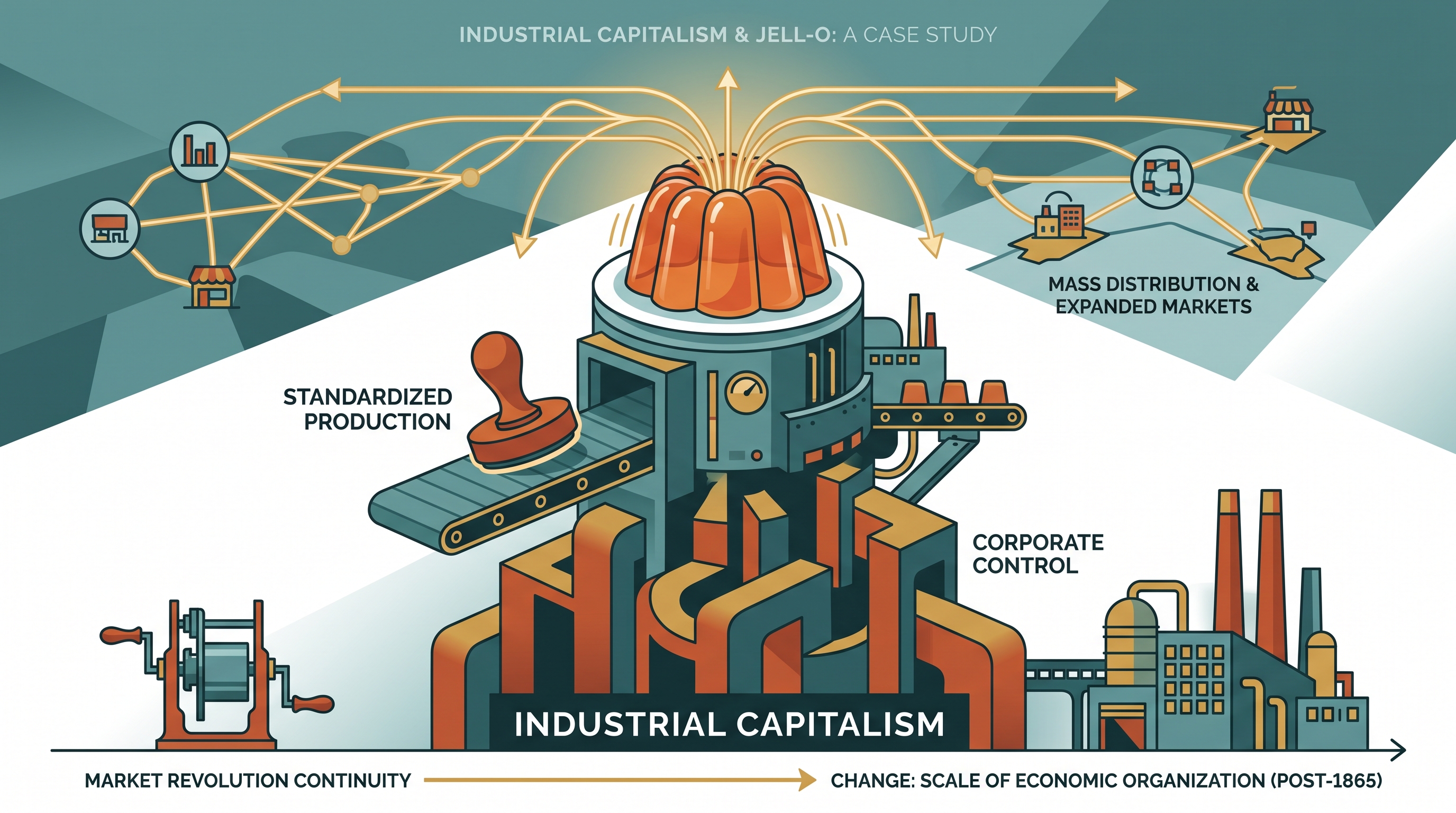
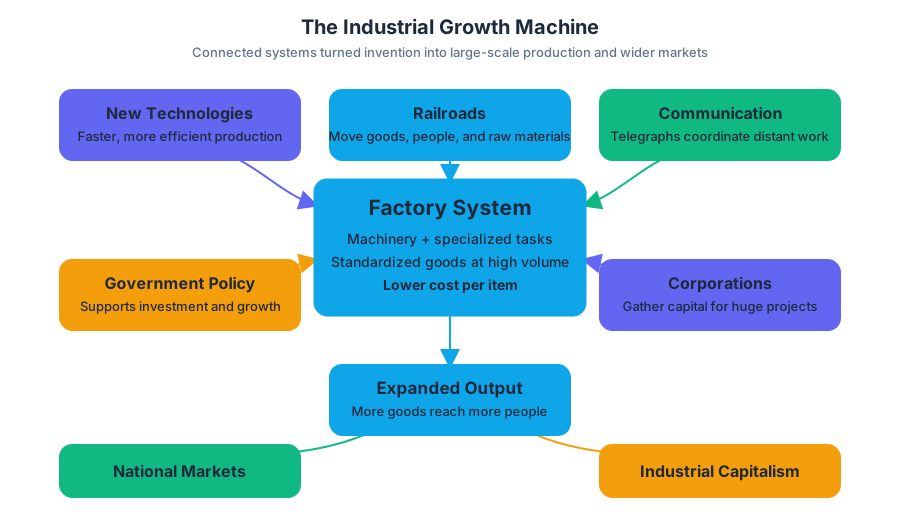
6.7 Labor in the Gilded Age · 6.8 Immigration and Migration in the Gilded Age
Key concepts: International and internal migration · Urbanization in the Gilded Age · Growth of urban culture · Labor unions · African American labor organization · National Colored Labor Convention · Colored National Labor Union · Knights of Labor · Labor activism and radicalism · Immigration and migration in the Gilded Age
Industrial growth pulled people into cities while land hunger pushed others westward, but neither movement was peaceful or evenly shared. Migration reshaped where Americans lived; labor organizing tried to determine who would benefit from the new economy.
6.7 Labor in the Gilded Age · 6.8 Immigration and Migration in the Gilded Age
Industrial growth pulled people into cities while land hunger pushed others westward, but neither movement was peaceful or evenly shared. Migration reshaped where Americans lived; labor organizing tried to determine who would benefit from the new economy.
Investigative question: How did migration and urbanization create both new opportunities and new conflicts in the Gilded Age?
A map of movement and conflict
International migration brought people from other countries into the United States. Internal migration moved people within the country, including movement from rural areas to cities and movement westward in search of land and economic opportunity. Together, these migrations increased urban populations and fostered the growth of a new urban culture (KC-6.2.I).
Westward migration also intensified competition. Larger numbers of migrants moved west seeking land and economic opportunity, frequently provoking competition and violent conflict (KC-6.2.II). The key point is causation: migration did not simply fill empty spaces. It brought migrants into conflict with Native peoples, earlier settlers, landholders, railroads, and one another over access to land and resources.
Retrieval check: If a historian connects immigration, rural-to-urban movement, and western settlement to population change, which two migration categories should appear in the explanation? International and internal migration.
Urbanization and a new culture
Urbanization is the growth of cities as a share of the population and economy. Cities became meeting points for migrants, wage workers, employers, political organizations, newspapers, entertainment, and reform efforts. The result was not merely crowded streets; it was a new urban culture shaped by diverse languages, neighborhoods, religious institutions, labor associations, and commercial spaces.
Industrialization and urbanization therefore worked together. Factories, railroads, construction, and service industries attracted workers; the growing population supplied employers with labor and created markets for new goods. At the same time, crowded housing, dangerous workplaces, and unequal wages made urban life a setting for labor conflict and public anxiety.
The Gilded Age also produced new cultural and intellectual movements and public reform efforts (KC-6.3). These developments should not be treated as separate from migration and labor: changing cities created the social problems, organizations, and political debates that reformers addressed.
Labor unions and exclusion
A labor union is an organization through which workers act collectively to seek higher wages, safer conditions, shorter hours, or greater control over employment. Collective action mattered because an individual worker usually had little bargaining power against a large business, whereas workers acting together could strike, negotiate, or publicize workplace abuses.
African American workers faced an additional barrier: exclusion from predominantly White labor organizations. In 1869, African Americans formed the Colored National Labor Union to organize their labor on a national level because they were denied membership in predecessor labor organizations. The National Colored Labor Convention was reported in The New York Tribune on December 7, 1869.
The name distinction matters. The convention was a meeting and public event; the Colored National Labor Union was the organization created to coordinate African American labor nationally. Both reveal that African American workers pursued organized economic power rather than merely waiting for existing unions to become inclusive.
Named misconception check — “Labor unions represented all workers.” They did not. Many unions excluded African Americans, women, immigrants, or particular categories of workers. A strong historical explanation asks who was included, who was excluded, and why that boundary mattered.
Herrera, land resistance, and competing interpretations
Juan José Herrera illustrates how labor activism could overlap with local struggles over land and economic power. Herrera was a leader of a land-grab resistance group and a local organizer for the Knights of Labor, a broad labor organization that sought to unite workers across some occupational and ethnic boundaries.
The land-grab resistance included cutting fences, burning haystacks, and sabotaging railroads. Through Herrera’s organizing, the Knights of Labor and the land-grab resistance organization became closely associated. This association shows why authorities and business leaders could portray labor activism as a threat to property and public order, while participants could portray resistance as defense against dispossession.
This conflict also requires source comparison. Sources from unions and business leaders can be used to compare interpretations of labor conflict and changing standards of living (KC-6.1.II.B.i). A business leader might emphasize property damage, disrupted transportation, or radicalism. A union source might emphasize low wages, dangerous work, exclusion, or declining control over land and labor. Neither source should be accepted automatically: its author, purpose, audience, and historical situation shape its interpretation.
AP historical thinking in action
Skill 1.A — Developments and Processes: Identify urbanization, migration, union formation, and land resistance as connected developments.
Skill 2.A — Sourcing and Situation: Ask how a union newspaper, business statement, or New York Tribune report shaped its account.
Skill 3.A — Claims and Evidence in Sources: Extract each source’s claim about labor conflict and identify the evidence used.
Skill 4.A — Contextualization: Place labor disputes within post–Civil War industrialization, migration, and urban growth.
Skill 5.A — Making Connections: Connect migration patterns to urban population growth, labor markets, and western conflict.
Skill 6.A — Argumentation: Make a defensible claim about whether migration expanded opportunity, intensified exploitation, or did both.
Increased anxiety about radicalism contributed to attacks on labor activism and immigrant culture. The crucial distinction is between cause and response: migration and industrial change helped produce labor conflict, while fear of radicalism shaped how employers, officials, and other Americans reacted to that conflict.
Final interpretation check: A historian argues that Gilded Age labor conflict resulted partly from the interaction of migration and industrial urbanization. What evidence would best support the argument? A defensible answer would connect growing migrant populations and crowded cities to wage labor, union organizing, exclusion from unions, and competing interpretations of strikes or land resistance.
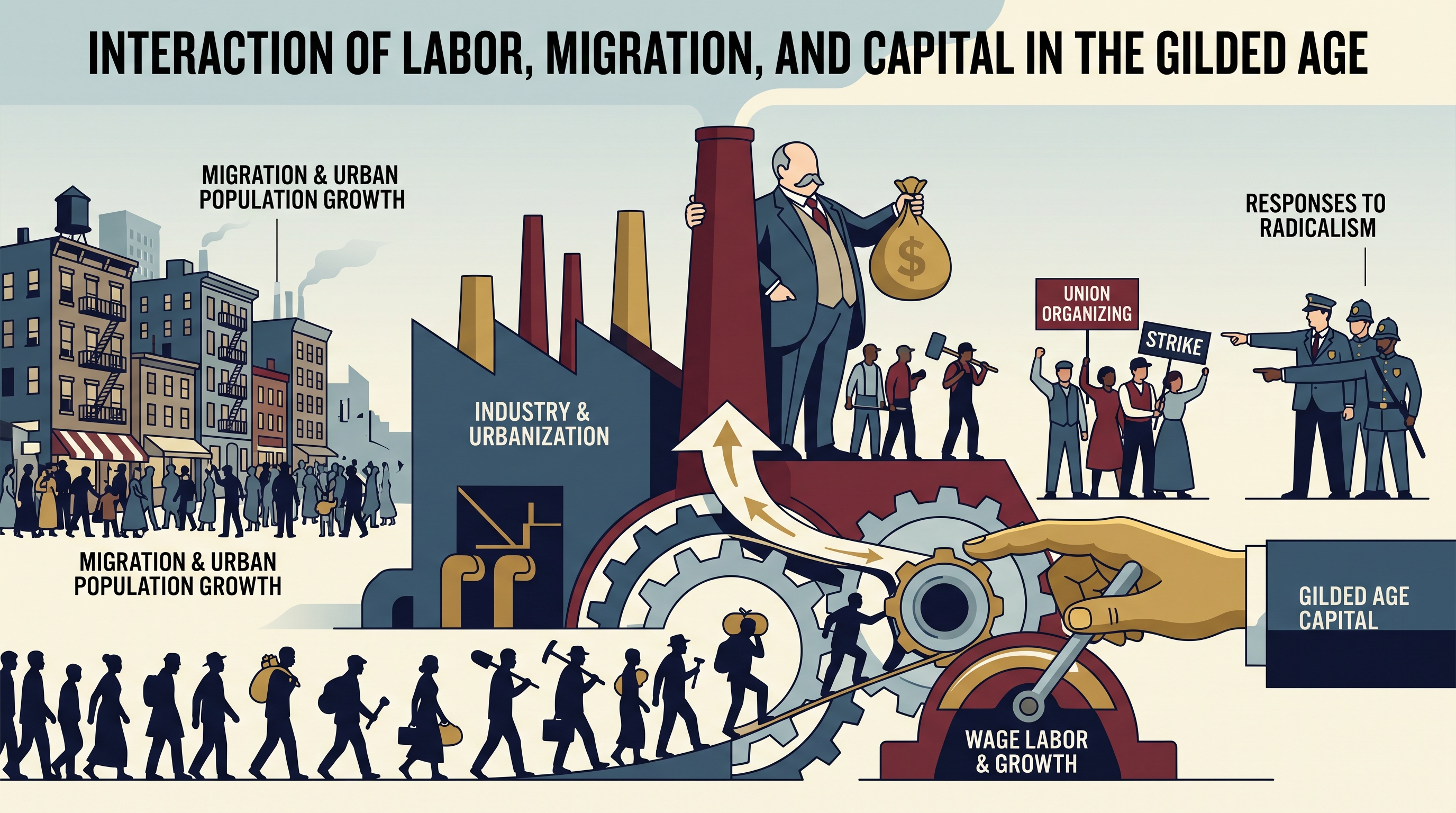
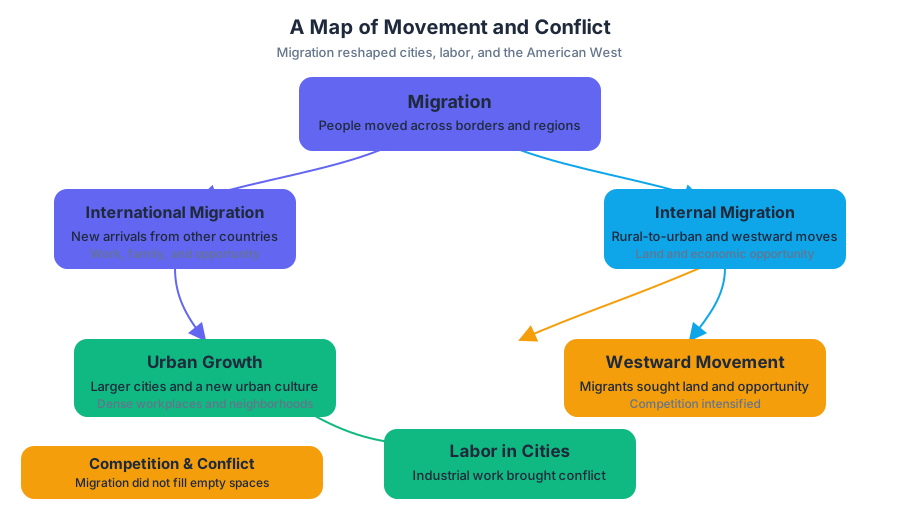
6.9 Responses to Immigration in the Gilded Age · 6.10 Development of the Middle Class
Key concepts: Responses to immigration in the Gilded Age · Development of the middle class · Push and pull factors of immigration and internal migration · Demographic change and its effects on migrants and society · Anti-immigrant attitudes toward the Irish and Chinese · Chinese rights and exclusion in California · Labor unions and worker-management relations · Industrial capitalism and standards of living · Historical contextualization · Argumentation using primary sources
Crowded industrial cities transformed immigration from a private journey into a public argument about who could belong in the United States. The migration patterns established during the Gilded Age filled urban neighborhoods, expanded factories and markets, and intensified conflicts over race, religion,…
6.9 Responses to Immigration in the Gilded Age · 6.10 Development of the Middle Class
Crowded industrial cities transformed immigration from a private journey into a public argument about who could belong in the United States. The migration patterns established during the Gilded Age filled urban neighborhoods, expanded factories and markets, and intensified conflicts over race, religion, citizenship, labor, and political power.
From migration to public controversy
As immigrants and internal migrants concentrated in cities, American responses divided between incorporation and exclusion. Some reformers and employers promoted Americanization—the expectation that immigrants should adopt English-language institutions and dominant cultural practices—while many politicians and workers portrayed immigrants as threats to wages, public order, or national identity. Under KC-6.2.I.C, immigrants did not simply abandon their earlier cultures; they negotiated compromises between inherited traditions and the society they encountered.
The results were visible in ethnic urban communities. In New York, Little Italy provided Italian immigrants with familiar language, food, religious institutions, mutual-aid societies, and employment connections. Such neighborhoods could ease the shock of migration, but outsiders often interpreted cultural difference as evidence that immigrants were refusing to become “American.”
In Tacoma, Washington, Japanese Issei—first-generation immigrants from Japan—built businesses, farms, churches, and community institutions despite discrimination. Their experience shows that immigrant communities were not passive enclaves: they created social networks and economic opportunities while facing laws and public attitudes that restricted landownership, citizenship, and mobility.
Anti-Irish and anti-Chinese language
Earlier anti-Irish prejudice supplied a vocabulary that could be redirected toward Chinese immigrants. Nativists had described Irish Catholics as alien, politically dangerous, dependent, and incapable of republican self-government. In California, anti-Chinese writers reused similar language, depicting Chinese workers as permanently foreign, morally suspect, disease-bearing, and unwilling or unable to assimilate.
The comparison must be handled carefully. Anti-Irish discrimination was severe, but many Irish immigrants gradually entered the category of “white” in American racial politics and gained greater access to citizenship and political power. Chinese immigrants faced racial barriers that became explicit federal exclusion: the Page Act of 1875 restricted Chinese women’s entry, the Chinese Exclusion Act of 1882 barred most Chinese laborers, and later laws extended exclusion and limited reentry.
Key distinction: Similar stereotypes did not produce identical outcomes. Anti-Irish prejudice contributed to social marginalization; anti-Chinese racism helped justify a durable system of racialized immigration restriction.
A primary source can reveal this process through its wording. When a California newspaper or political speaker described Chinese people as a “race” that could never assimilate, the language did more than express dislike: it transformed a labor conflict into an argument for unequal rights. Ask what the author’s description assumes, whom it targets, and what policy the language makes seem reasonable. That is the evidence needed to connect rhetoric to exclusion.
Industrial capitalism and the expanding middle class
Industrial capitalism did not create prosperity equally, but it expanded the social space between corporate elites and wage laborers. Growing firms required salaried managers, bookkeepers, salespeople, teachers, clerks, engineers, lawyers, doctors, and other professionals. These occupations usually depended less on physical labor than factory work and offered more regular income, although clerical and service workers—especially women—often remained poorly paid and had limited authority.
The middle class also became visible through consumption and leisure. Industrial production and improved transportation made clothing, household goods, newspapers, entertainment, and urban recreation more accessible to many salaried families. Places such as Coney Island symbolized this change: mass entertainment reflected the new combination of industrial wages, transportation networks, commercial culture, and free time.
Industrial capitalism therefore produced a mixed social outcome. For some Americans, rising real wages, consumer access, and professional opportunities improved living standards. For others, long hours, dangerous conditions, insecure employment, and low wages persisted. The rise of labor unions altered relationships between workers and management because employees increasingly acted collectively rather than negotiating as isolated individuals.
Jane Addams illustrates another response to urban industrial society. As a middle-class woman, she used education, organizational skill, and social position to establish Hull House in Chicago, where reformers worked with immigrant communities through education, childcare, cultural programs, and assistance. Her work reflected both the expansion of middle-class women’s public roles and the belief that urban poverty required organized social action.
Worked historical claim
Claim: Industrial capitalism changed American society substantially, but unevenly. It expanded salaried and professional middle-class occupations, consumer culture, and organized reform while also deepening class divisions and provoking anti-immigrant politics. Evidence such as Little Italy, Issei communities in Tacoma, Chinese exclusion, labor unions, Coney Island, and Hull House supports a Skill 6.C: Argumentation explanation because each example connects economic change to altered relationships among workers, migrants, reformers, businesses, and government.
Misconception check
Misconception: “The middle class was simply wealthy factory owners.”
Correction: Industrial elites owned or controlled major businesses; wage laborers depended primarily on direct wages; the expanding middle class occupied varied salaried, clerical, managerial, and professional positions. Its members could enjoy greater stability and consumption while still facing gender, racial, and economic limits.
Retrieval check: Why did similar anti-immigrant language affect Irish and Chinese people differently? A strong answer should identify the shared language of foreignness and unassimilability, then explain the crucial difference: Irish immigrants increasingly gained access to whiteness and political inclusion, while Chinese immigrants faced formal exclusion and racially restricted citizenship.
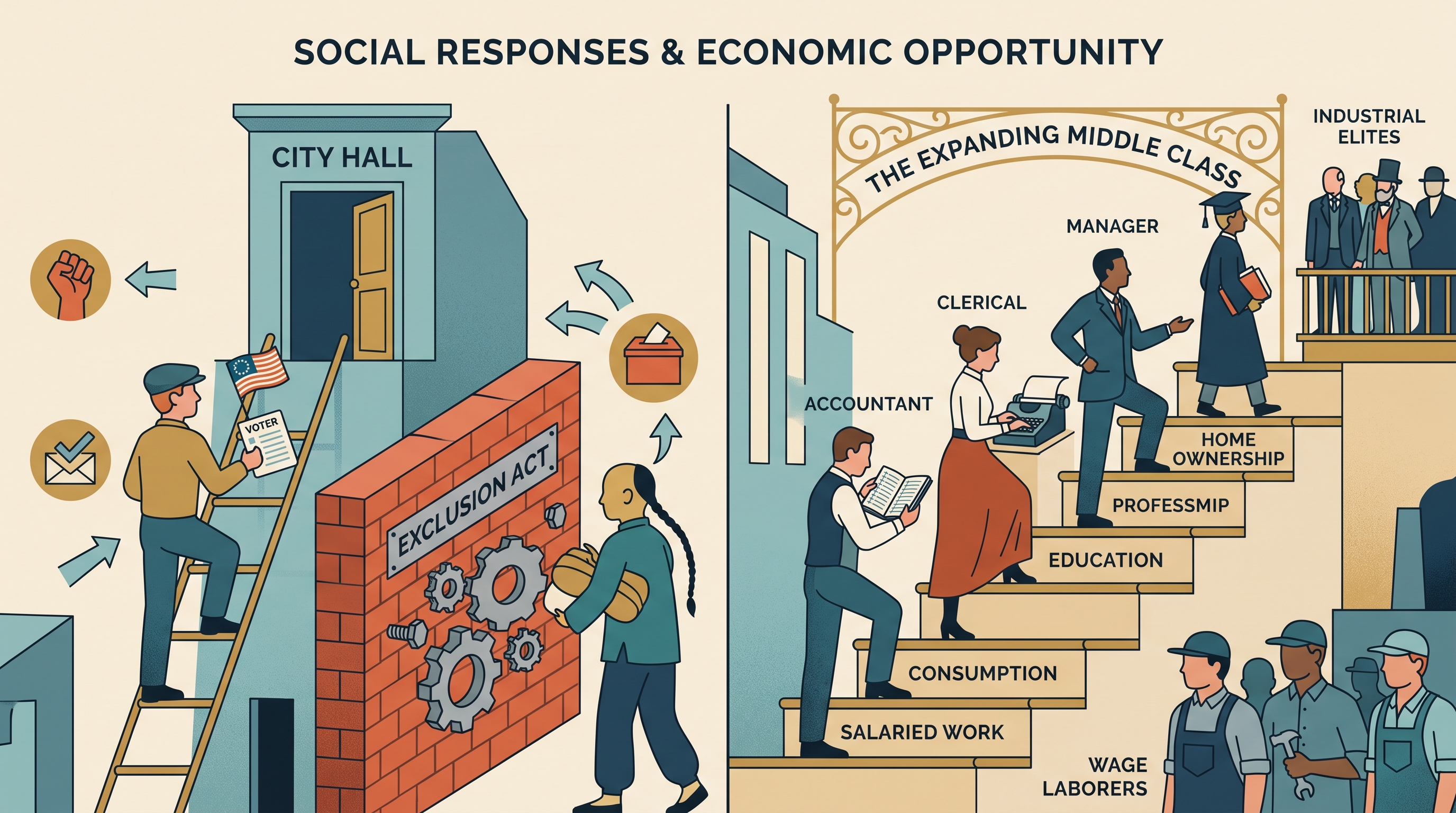
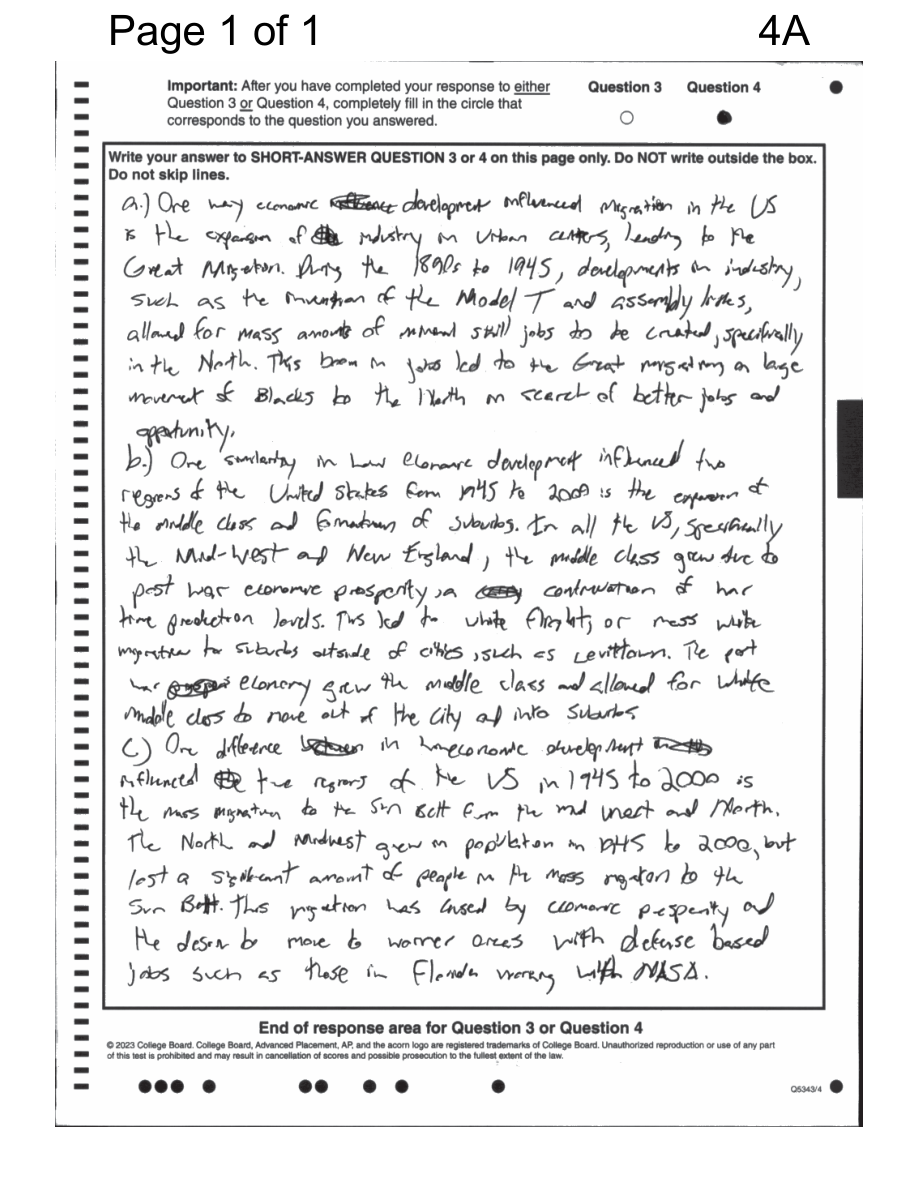
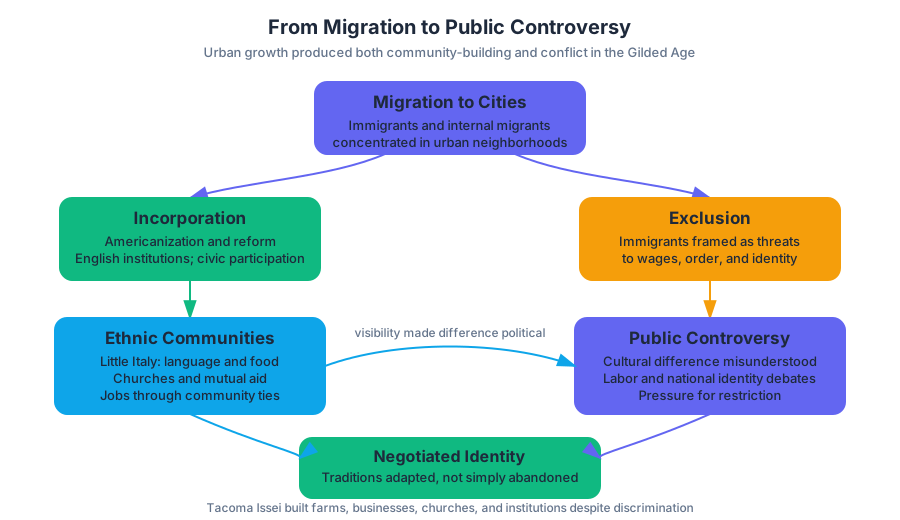
6.11 Reform in the Gilded Age · 6.12 Controversies over the Role of Government in the Gilded Age
Key concepts: Gilded Age reform movements · Industrial capitalism · Laissez-faire government policies · Economic competition · Government intervention during economic downturns · Political corruption and self-interest · Debates over citizenship and the proper role of government · Public reform efforts · Economic and social policy debates · Conflict over government aid to farmers
Explain and apply 6.11 Reform in the Gilded Age · 6.12 Controversies over the Role of Government in the Gilded Age.
6.11 Reform in the Gilded Age · 6.12 Controversies over the Role of Government in the Gilded Age
Industrial capitalism created enormous wealth while concentrating poverty, political power, and economic risk, prompting Americans to ask a difficult question: Should government protect competition and workers, or should it leave economic life largely alone?
Reform in a “Gilded” Society
The term Gilded Age describes the period from roughly 1870 to 1900 as an era whose glittering surface—mansions, railroads, factories, and financial fortunes—covered serious problems beneath it. Industrial growth produced jobs and new opportunities, but also dangerous workplaces, overcrowded cities, political corruption, and sharp inequality.
This tension connects directly to KC-6.3, which identifies the Gilded Age as a period of “new cultural and intellectual movements, public reform efforts, and political debates over economic and social policies.” Under KC-6.3.I, reformers both buttressed and challenged the existing social order: some sought to improve industrial society without changing capitalism, while others questioned whether concentrated wealth was compatible with democracy.
Reform movements and their assumptions
Social Gospel reformers argued that Christian ethics required action against poverty, unsafe labor, and urban misery. Organizations such as settlement houses—most famously Jane Addams’s Hull House in Chicago—provided education, childcare, and social services while documenting the conditions faced by working-class and immigrant families.
Other reform efforts focused on temperance, public sanitation, education, women’s activism, and government corruption. The Woman’s Christian Temperance Union connected alcohol abuse to domestic violence and poverty, while reformers increasingly argued that women’s moral influence justified a larger public role, including voting rights.
Civil service reform attacked the spoils system, in which elected officials rewarded political supporters with government jobs. The assassination of President James Garfield by a disappointed office seeker in 1881 helped build support for the Pendleton Civil Service Reform Act of 1883, which introduced competitive examinations for some federal positions.
Key insight: Gilded Age reform did not form one unified movement. Reformers disagreed about whether the solution was charity, moral reform, professional administration, labor protection, regulation of corporations, or a fundamental restructuring of capitalism.
Laissez-faire and the Role of Government
Laissez-faire means allowing economic activity to operate with limited direct government interference. Many business leaders defended this approach by claiming that competition rewarded efficiency and that government regulation threatened individual liberty and economic growth.
In practice, laissez-faire policies did not mean that government disappeared. Federal and state governments granted land to railroads, enforced contracts, used troops during labor conflicts, imposed tariffs, and sometimes regulated corporations. The central controversy was therefore not simply “government versus no government,” but which groups government would assist and what kinds of intervention it would permit.
Competing perspectives
Industrialists such as Andrew Carnegie defended unequal wealth through ideas associated with Social Darwinism. In this view, economic competition selected the most capable individuals, while extensive aid to the poor might interfere with what supporters described as natural competition.
Critics answered that competition was not fair when corporations controlled railroads, credit, markets, and political influence. Farmers and workers demanded regulation of railroad rates, protection from monopolies, and relief during economic downturns. The Interstate Commerce Act of 1887 and Sherman Antitrust Act of 1890 represented attempts to regulate corporate power, although early enforcement was weak and courts often interpreted these measures narrowly.
Economic crises intensified the debate. During the Panic of 1873 and the Panic of 1893, bank failures, business closures, unemployment, and falling prices exposed the human cost of an economy with limited public relief. Reformers increasingly supported government intervention, while defenders of laissez-faire feared that aid would reward failure or expand federal power.
Worked Contextual Example: The Pullman Strike
The Pullman Strike of 1894 demonstrates how reform, economic crisis, and government power collided. The Pullman Palace Car Company cut wages during a depression but did not proportionally reduce rents in its company town. Workers joined the American Railway Union, led by Eugene V. Debs, and refused to handle Pullman cars.
The federal government obtained an injunction against the strike and sent troops to keep the mail moving. The strike collapsed, Debs was imprisoned, and the episode suggested that government intervention often protected the uninterrupted operation of business more readily than workers’ bargaining power.
Reasoning chain: depression → wage cuts and unemployment → worker protest → federal intervention → public debate over whether government neutrality was genuine. This evidence supports KC-6.3.II, because social change generated arguments about corruption, citizenship, and the proper relationship between business and government.
AP Skills and Common Misconceptions
This topic most directly develops AP Historical Thinking Skill 1: Developments and Processes, especially 1.B Explain a historical development or process, by tracing how industrial inequality produced reform. It also uses Skill 4: Making Connections, including 4.B Explain how a specific historical development relates to another historical development, when connecting economic downturns to government intervention.
For documents or cartoons about monopolies, labor, or corruption, apply Skill 2: Sourcing and Situation, particularly 2.A Identify a source’s point of view, purpose, historical situation, and/or audience. A strong argument also uses Skill 5: Argumentation, including 5.A Make a historically defensible claim and 5.B Support an argument using specific and relevant evidence.
Misconception check: “Laissez-faire meant the government never intervened.”
Correction: Government intervened frequently, but intervention often favored property owners, railroads, and corporations. The debate concerned the direction and purpose of government power.
Retrieval Check
Explain, in two steps, why the Pullman Strike became evidence for critics of laissez-faire. Then identify one reform movement that sought to improve Gilded Age society and explain whether it mainly addressed economic inequality, political corruption, or social conditions.
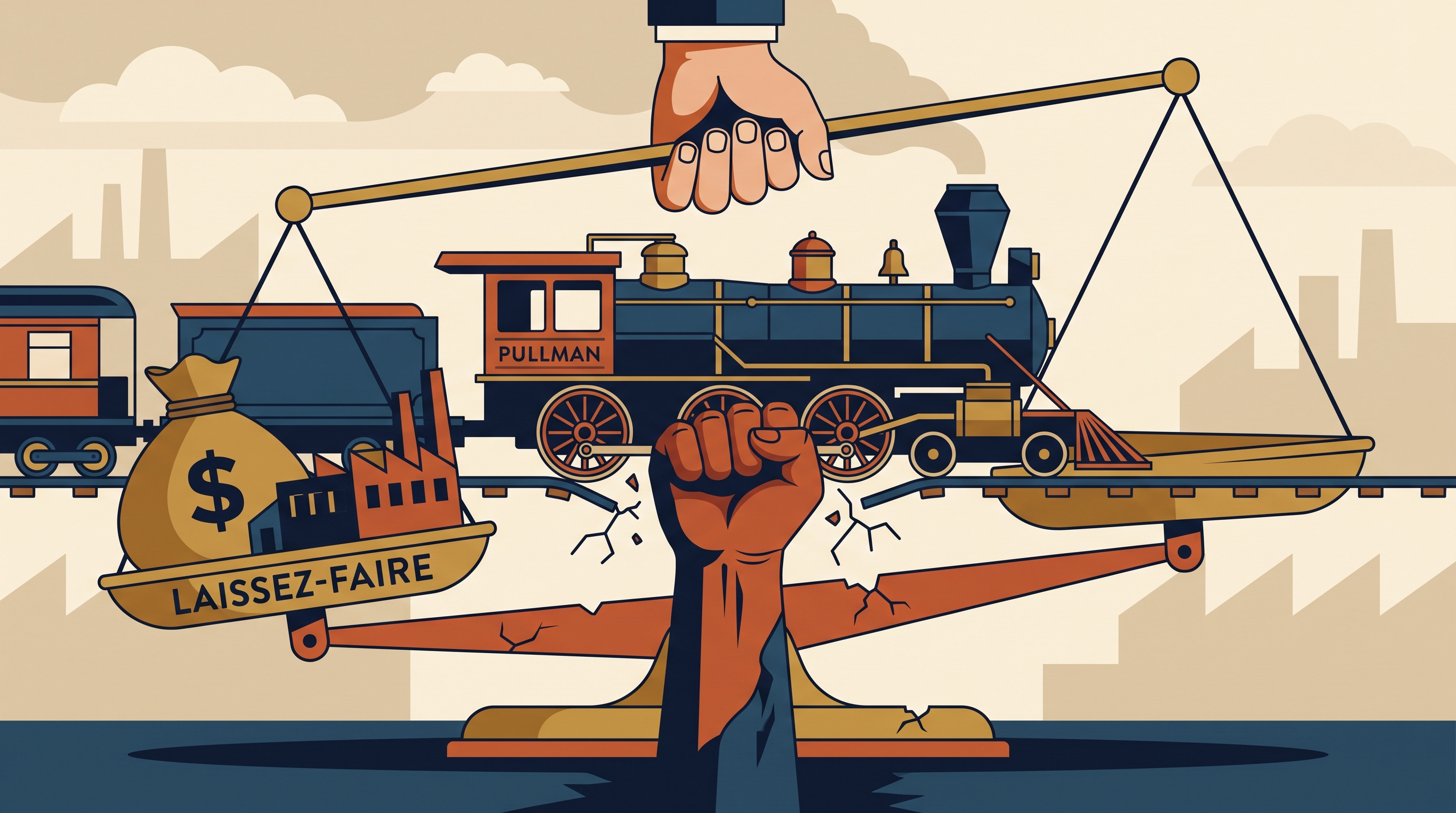
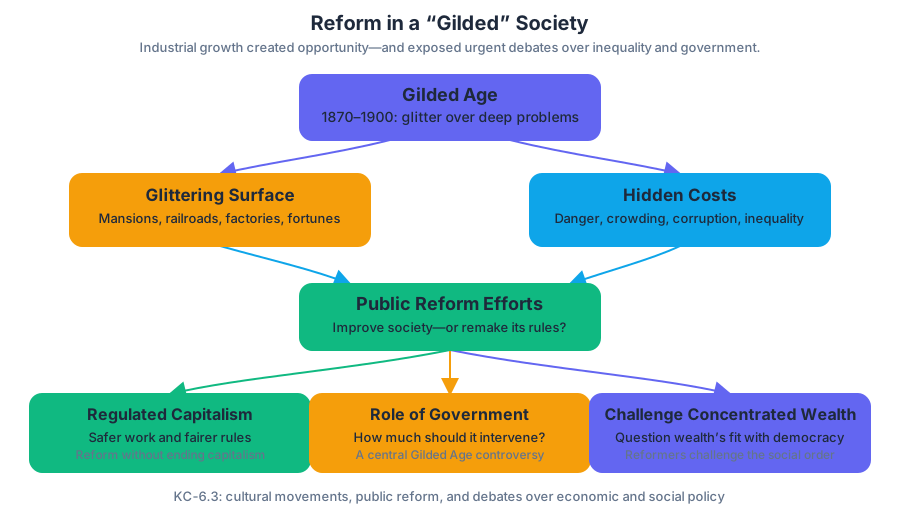
6.13 Politics in the Gilded Age · 6.14 Continuity and Change in Period 6
Between 1865 and 1898, American politics became more democratic in participation yet less democratic in practice: party organizations mobilized millions of voters while employers, political machines, racial violence, and unequal access to the ballot narrowed who could exercise power.
6.13 Politics in the Gilded Age · 6.14 Continuity and Change in Period 6
Between 1865 and 1898, American politics became more democratic in participation yet less democratic in practice: party organizations mobilized millions of voters while employers, political machines, racial violence, and unequal access to the ballot narrowed who could exercise power.
Investigative question: How could political parties become stronger and elections become more competitive while many Americans lost meaningful political influence?
6.13 Politics in the Gilded Age
6.13.A focuses on how political parties changed and remained the same during the Gilded Age. Republicans and Democrats continued to dominate national politics, but both parties relied heavily on organization, patronage, and appeals to sectional, religious, ethnic, and economic interests.
A political machine was an organized party network that exchanged services or jobs for political support. In cities such as New York, Tammany Hall connected immigrants to food, employment, housing assistance, and legal help; in return, machine leaders expected votes. This system could provide real assistance to poor residents, but it also encouraged corruption, bribery, and control over elections.
| Political force | What it sought | Typical supporters or examples |
|---|---|---|
| Republican Party | High tariffs, economic modernization, and federal protection of African American rights, especially earlier in the period | Northern business interests, many African Americans, Union veterans |
| Democratic Party | Limited federal government, lower tariffs, and local control | White southerners, urban immigrants, conservative business interests |
| Populist Party | Monetary reform, railroad regulation, and greater political power for farmers and workers | Farmers facing debt, falling crop prices, and railroad costs |
The major parties often competed intensely without offering radically different solutions to industrial capitalism. Elections were close, but party loyalty was unusually strong. Campaigns used parades, newspapers, rallies, ethnic appeals, and patronage to turn social identities into votes.
Patronage, corruption, and contested elections
Patronage means awarding government jobs or contracts in exchange for political loyalty. The “spoils system” made party victory materially valuable, but it also encouraged unqualified appointments and corruption. The assassination of President James A. Garfield by a disappointed office seeker in 1881 strengthened support for civil-service reform; the Pendleton Civil Service Reform Act created competitive examinations for some federal positions.
The election of 1876 revealed how fragile the political system remained after Reconstruction. Democrat Samuel J. Tilden won more popular votes, but disputed electoral returns in several southern states prevented a clear Electoral College victory. The informal Compromise of 1877 placed Republican Rutherford B. Hayes in the presidency and contributed to the withdrawal of federal troops from the South, helping end Reconstruction.
Misconception check: The Compromise of 1877 was not a formal constitutional amendment or a single public law. It was an informal political settlement whose consequences included the end of sustained federal enforcement of Reconstruction governments.
The Populist challenge
Farmers organized through the Grange, Farmers’ Alliances, and finally the People’s Party, commonly called the Populists. They demanded policies such as the free coinage of silver, a graduated income tax, government control or regulation of railroads, and reforms intended to make government more responsive to ordinary producers.
The 1896 election demonstrated both the appeal and limitation of Populism. Democrat William Jennings Bryan adopted the Populist free-silver position, but Republican William McKinley won by defending the gold standard and presenting himself as the candidate of economic stability. Populist ideas later influenced Progressive reforms, even though the party itself declined.
6.14 Continuity and Change in Period 6
6.14.A requires analysis of continuity and change across Period 6, not a list of events. Period 6 transformed the scale of the economy and the federal government, but older structures of racial inequality, gender inequality, class conflict, and territorial expansion persisted.
| Area | Significant change, 1865–1898 | Important continuity |
|---|---|---|
| Economy | Railroads, factories, corporations, and national markets expanded rapidly | Wealth and decision-making remained concentrated among powerful elites |
| Government | Federal agencies and courts increasingly addressed national economic questions | Government frequently protected property and corporate interests |
| West | Railroads, mining, ranching, and settlement linked the West to national markets | Indigenous peoples faced dispossession, warfare, and forced assimilation |
| Labor | Industrial workers formed unions and organized strikes | Employers retained major power, and labor conflict remained severe |
| Immigration and cities | Urban populations and immigrant communities grew | Nativism and ethnic discrimination continued |
| African Americans | The Fourteenth and Fifteenth Amendments established formal citizenship and voting rights | Segregation, disfranchisement, racial violence, and sharecropping restricted freedom |
| Politics | Mass parties, machines, and new reform movements mobilized voters | Two-party competition and patronage remained central |
A strong continuity-and-change argument must explain why both patterns existed. Industrialization produced new corporations, urban classes, and national conflicts, but older assumptions about racial hierarchy, property, and social control shaped how institutions responded to those changes.
Worked argument: building a complex claim
Consider the claim: “Period 6 greatly expanded federal power.” The claim is partly valid. Congress supported railroad construction, regulated interstate commerce through the Interstate Commerce Act, and used federal troops and courts during labor conflicts and Reconstruction. Yet federal power was uneven: courts often limited regulation, federal officials withdrew from protecting Black voting rights, and government frequently acted on behalf of corporations.
This reasoning demonstrates Skill 6: Continuity and Change Over Time, especially 6.D, which asks students to corroborate, qualify, or modify an argument using diverse evidence to develop a complex argument. It also uses Skill 3: Analyzing Historical Evidence, specifically 3.D, “Explain how claims or evidence support, modify, or refute a source’s argument.”
Exam-ready distinction: “Change” identifies what became different; “continuity” identifies what persisted; “complexity” explains how the two interacted. Saying that industrialization “changed everything” is not analysis because it erases the persistence of racial, class, and gender hierarchies.
Retrieval check
- Why did political machines attract immigrant support despite corruption?
- How did the Populists challenge both major parties?
- Give one major change and one major continuity in Period 6.
- Qualify the statement: “The federal government became more powerful after the Civil War.”
A complete response should connect machines to material assistance and votes; Populism to farmer demands such as free silver and railroad regulation; change to industrialization or national markets; continuity to racial inequality or elite economic power; and federal expansion to its uneven enforcement and frequent support for property interests.
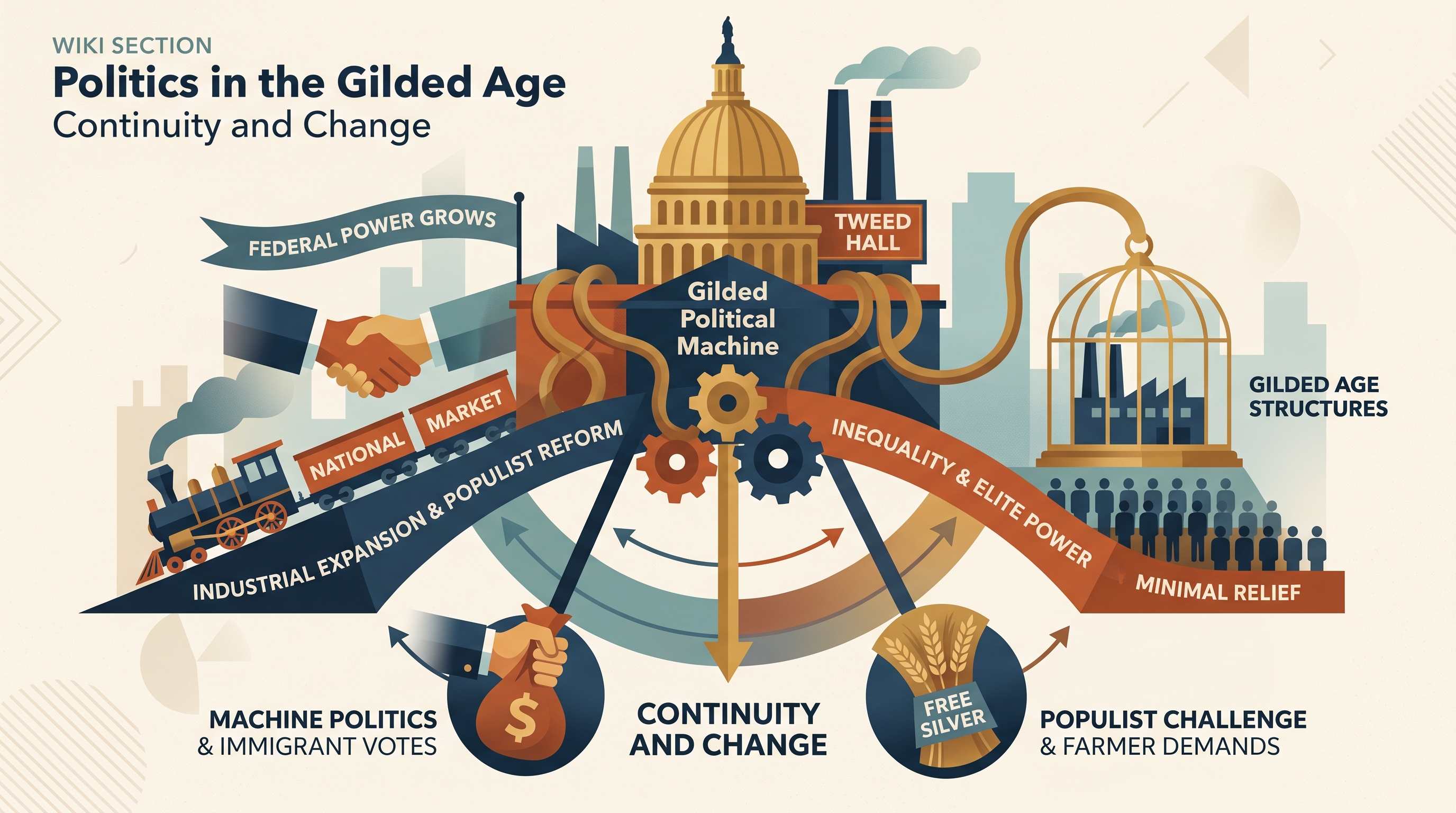
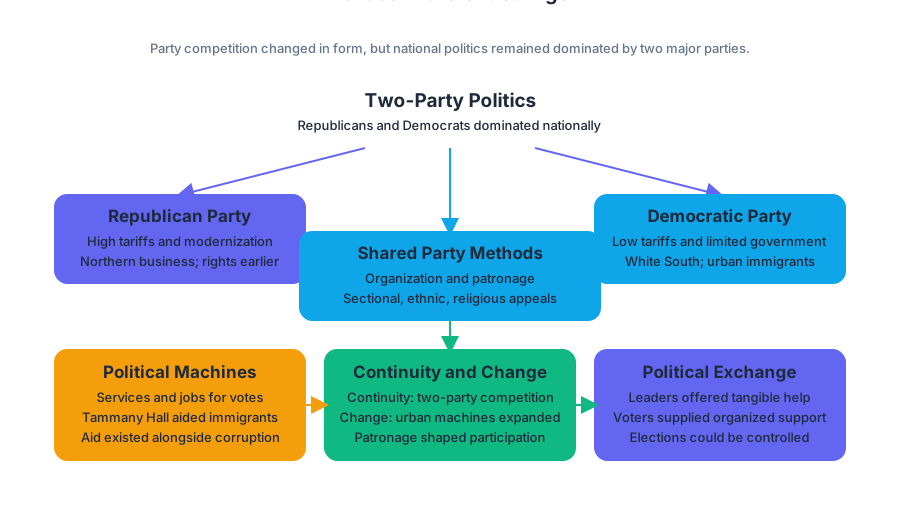
7.1 Contextualizing Period 7 · 7.2 Imperialism: Debates
By 1890, the United States had become an industrial power with expanding factories, railroads, cities, financial institutions, and overseas trade—but Americans sharply disagreed about what that power should do beyond the continent.
7.1 Contextualizing Period 7 · 7.2 Imperialism: Debates
By 1890, the United States had become an industrial power with expanding factories, railroads, cities, financial institutions, and overseas trade—but Americans sharply disagreed about what that power should do beyond the continent. Imperialism, the policy of extending a nation’s political, economic, or military influence over other peoples and territories, became one of the defining debates of Period 7, 1890–1945.
7.1 Contextualizing Period 7: A nation looking outward
The period opened after the Civil War and Reconstruction had transformed the United States. Industrial growth increased national wealth and production, while westward expansion, the completion of transcontinental railroads, and the incorporation of western lands strengthened federal authority. At the same time, industrial capitalism created intense competition: American businesses sought new markets, investors sought profitable opportunities, and naval strategists argued that overseas bases were essential to national security.
A useful analogy is a factory that has become too productive for its local customers. Its owners may search for new buyers, cheaper supplies, and protected shipping routes. That analogy captures one part of American expansion after 1890—but it can mislead if it makes imperialism seem purely economic. National identity, racial theories, Christian missionary activity, military strategy, and competition with European empires also shaped policy.
Learning Objective 7.1.A — Explain the context for the development of the United States in the period 1890 to 1945. The context includes several connected developments:
- Industrial and economic expansion: Mass production and corporate growth encouraged Americans to seek foreign markets and access to raw materials.
- Naval and strategic expansion: Alfred Thayer Mahan’s argument that national power depended on a modern navy, a strong merchant fleet, and overseas bases influenced policymakers.
- Nationalism and racial ideology: Some Americans claimed that Anglo-Saxon or “civilized” nations had a duty to govern supposedly less-developed peoples. These ideas supplied an ideological defense for imperial rule.
- Reform and social tension: Urban poverty, labor conflict, immigration, and racial violence produced domestic debates about democracy and citizenship. Those tensions shaped how Americans interpreted expansion abroad.
- Global competition: European powers had already established colonial empires in Africa and Asia. Supporters of expansion feared that the United States would become economically and strategically weaker if it remained outside this competition.
Retrieval check: Why did industrialization encourage overseas expansion, and why is industrialization alone an incomplete explanation? A strong answer connects production and markets to at least one additional factor, such as naval strategy, nationalism, racial ideology, or global rivalry.
7.2 Imperialism: Debates
Imperialism created a conflict between power and principle. Supporters argued that overseas expansion would strengthen the economy, protect trade, spread Christianity and “civilization,” and give the United States international influence. Opponents responded that ruling people without their consent contradicted the Declaration of Independence and the republican traditions Americans claimed to defend.
The debate was not simply “expansionists versus isolationists.” Many anti-imperialists supported a powerful United States but rejected colonial rule. The Anti-Imperialist League included people with different motives: some defended self-government, some feared the costs of empire, some opposed racial hierarchy, and some worried that imperial possessions would bring nonwhite populations into the American political system.
Supporters of imperialism also disagreed about methods. Some favored formal annexation and direct political control; others preferred informal influence through trade, investment, military pressure, or unequal diplomatic agreements. This distinction matters because a country can exercise imperial power without formally declaring a colony.
A worked sourcing example
Imagine a newspaper editorial arguing that the United States should govern an overseas island because its inhabitants were “not ready” for self-government. To source it, begin with the author’s likely point of view: the writer may be a nationalist, business advocate, missionary, military strategist, or believer in racial hierarchy. Then identify the purpose: the editorial is trying to persuade readers and justify political control. Finally, connect the argument to its historical situation: the United States was debating overseas expansion while European empires were competing for territory.
The strongest interpretation does more than label the source “biased.” It explains how the author’s assumptions shaped the argument. For example: Because the editorial was written during an era of global imperial competition and reflected racial theories about “civilization,” its claim that foreign rule was benevolent helped transform conquest into a supposed obligation.
Skill 4.B — Explain how a historical development relates to another historical development. Imperialism debates should be connected to industrialization, nationalism, racial ideology, naval expansion, and the earlier American tradition of territorial growth.
Sourcing also activates Skill 2.B — Explain the point of view, purpose, historical situation, or audience of a source. On a DBQ, naming the author’s position earns little by itself; the analysis must show why that position mattered and how it shaped the source’s claims.
Misconception check
Misconception: “All imperialism supporters wanted the same thing.” Correction: expansionists shared a belief that overseas influence could benefit the United States, but they differed over annexation, economic control, military occupation, citizenship, and the meaning of self-government. Likewise, anti-imperialists did not necessarily favor weakness or complete withdrawal from world affairs.
The central contradiction of Period 7 is therefore clear: the United States presented itself as a nation founded on liberty while debating whether it should govern people who had not consented to American rule. That contradiction would become concrete in the Spanish–American War and the arguments over territories acquired afterward.
Final retrieval check: Construct a two-part explanation: first, identify one material cause of American imperialism; second, explain why an anti-imperialist might argue that the resulting policy violated American ideals.
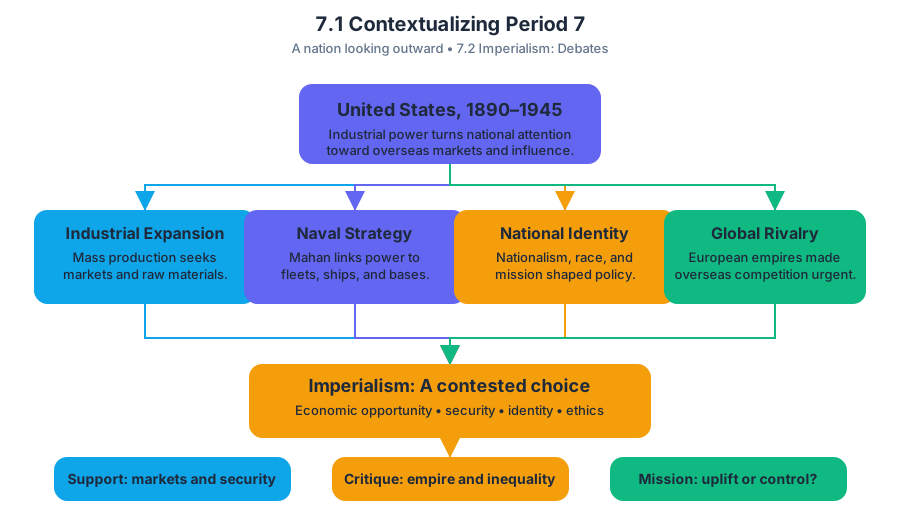
7.3 The Spanish–American War · 7.4 The Progressives
The Spanish–American War of 1898 transformed the United States from a nation mainly focused on continental expansion into an overseas power, while Progressivism tried to control the social and political consequences of rapid industrialization.
7.3 The Spanish–American War · 7.4 The Progressives
The Spanish–American War of 1898 transformed the United States from a nation mainly focused on continental expansion into an overseas power, while Progressivism tried to control the social and political consequences of rapid industrialization. The two developments were connected by a shared question: How should the United States use its growing power?
7.3 The Spanish–American War
By the 1890s, economic growth, naval expansion, missionary activity, and nationalistic journalism encouraged many Americans to look beyond the continent. The war with Spain began in the context of a Cuban rebellion against Spanish rule, but its results reached far beyond Cuba: the United States acquired island territories in the Caribbean and Pacific, increased its involvement in Asia, and suppressed a nationalist movement in the Philippines.
The immediate crisis developed around Cuba. Spanish authorities attempted to defeat Cuban rebels through harsh policies, including the forced relocation of rural civilians into overcrowded camps. American newspapers used sensational stories and dramatic images to portray Spanish rule as cruel. This yellow journalism helped intensify public pressure for intervention, although newspaper coverage alone did not cause the war.
The explosion of the USS Maine in Havana Harbor in February 1898 became the decisive trigger. Although the cause of the explosion remained uncertain, the slogan “Remember the Maine!” encouraged Americans to blame Spain. President William McKinley initially resisted war, but Congress and public opinion pushed the administration toward intervention.
Key distinction: The war’s causes included Cuban resistance, Spanish repression, American economic interests, nationalism, and the Maine crisis. The war’s effects included an expanded American empire and a new conflict over whether the United States should govern other peoples.
The conflict was brief but geographically broad. Commodore George Dewey defeated the Spanish fleet at Manila Bay, while American forces and Filipino allies fought Spain in the Philippines. In the Caribbean, U.S. forces invaded Cuba. The Treaty of Paris ended the war: Spain relinquished Puerto Rico and Guam, transferred the Philippines to the United States, and recognized Cuban independence.
Cuba did not become fully independent in practice. Through the Platt Amendment, the United States claimed the right to intervene in Cuban affairs and gained control of Guantánamo Bay. In the Philippines, Emilio Aguinaldo and other nationalists expected independence after helping defeat Spain. Instead, the United States took possession of the islands, producing the Philippine–American War and suppressing Filipino independence fighters.
A useful sourcing example comes from a Filipino independence argument describing American rule as a “barbaric war” and contrasting “government by consent in America” with “government by force in the Philippine Islands.” Under Sourcing and Situation 2.B: Explain the point of view, purpose, historical situation, and/or audience of a source, a strong response does more than identify the author. It explains that a representative of Aguinaldo wrote from the perspective of a nationalist movement angered by the United States’ failure to honor its stated liberation ideals.
7.4 The Progressives
Progressivism was a broad reform movement that responded to the problems created by industrial capitalism, urbanization, immigration, and political corruption. Progressives were not a single unified party or ideology. They included journalists, settlement-house workers, clergy, middle-class reformers, labor advocates, and politicians who believed government could correct social and economic abuses.
Their methods reflected the problems they confronted:
| Problem | Progressive response |
|---|---|
| Unsafe food and medicine | Federal inspection and regulation |
| Political machines | Civil-service reform, direct primaries, and initiatives |
| Corporate power | Antitrust enforcement and government regulation |
| Urban poverty | Settlement houses and social-work programs |
| Workplace danger | Factory-safety laws and workers’ compensation |
| Political exclusion | Women’s suffrage and, more unevenly, restrictions on corruption |
Investigative journalists called muckrakers exposed abuses through photographs, articles, and books. Upton Sinclair’s The Jungle described unsanitary meatpacking conditions; public reaction helped produce the Meat Inspection Act and the Pure Food and Drug Act in 1906. The important historical connection is not that one book single-handedly created reform, but that investigative evidence strengthened existing demands for federal action.
Progressive reform also reshaped the presidency. Theodore Roosevelt used the federal government as a “steward” of the public interest, supported regulation of large corporations, and intervened in the 1902 coal strike. William Howard Taft continued some reforms, while Woodrow Wilson promoted the Federal Reserve, the Federal Trade Commission, and stronger antitrust legislation.
Progressivism contained major contradictions. Many reformers supported women’s suffrage and social welfare, yet some embraced racial segregation, eugenics, immigration restriction, or paternalistic control of poor and immigrant communities. Reform could therefore expand democracy for some Americans while limiting freedom for others.
Worked connection and misconception check
Worked example: To connect the two topics, ask why Progressive-era leaders might support both domestic regulation and overseas expansion. A defensible explanation is that many believed modern government should organize society scientifically and efficiently. At home, that logic encouraged regulation of corporations; abroad, it could justify controlling territories that Americans claimed were not yet prepared for self-government.
Named misconception — “The Spanish–American War liberated all the peoples involved.” The United States helped end Spanish rule in Cuba, but it retained substantial influence there and denied Philippine nationalists the independence they expected. Likewise, “Progressives all agreed on reform” is inaccurate: they shared concern about social problems but disagreed sharply over race, immigration, labor, gender, and the proper limits of federal power.
Retrieval check
- Name two causes and two effects of the Spanish–American War.
- Why did the Philippines become a test of American claims about self-government?
- How did muckraking contribute to Progressive reform?
- Identify one contradiction within Progressivism.
A strong final connection is this: the Spanish–American War expanded the nation’s external power, while Progressivism expanded—or attempted to expand—the government’s internal capacity. Both developments forced Americans to debate whether power should be used for liberation, order, reform, economic advantage, or control.
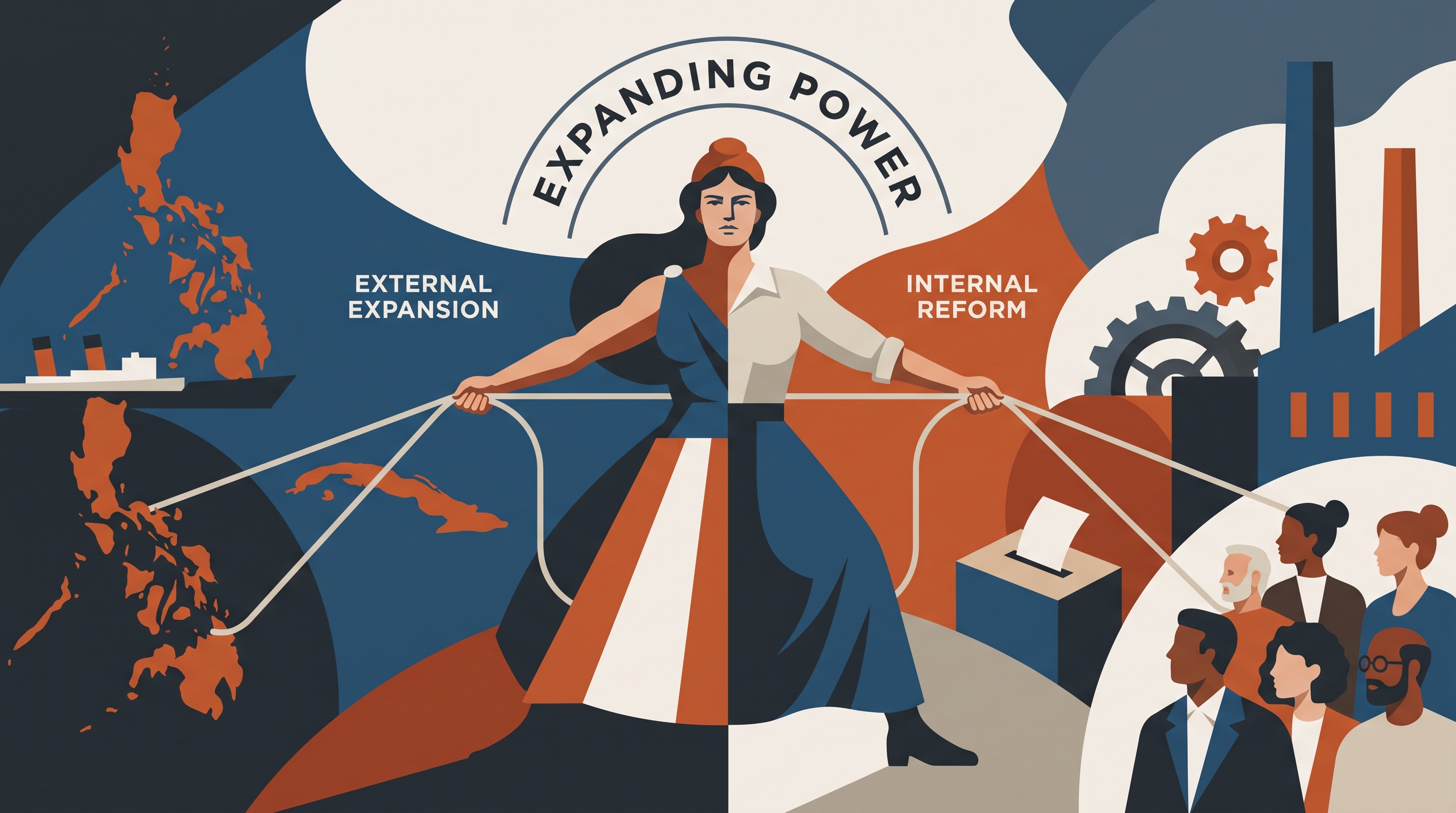
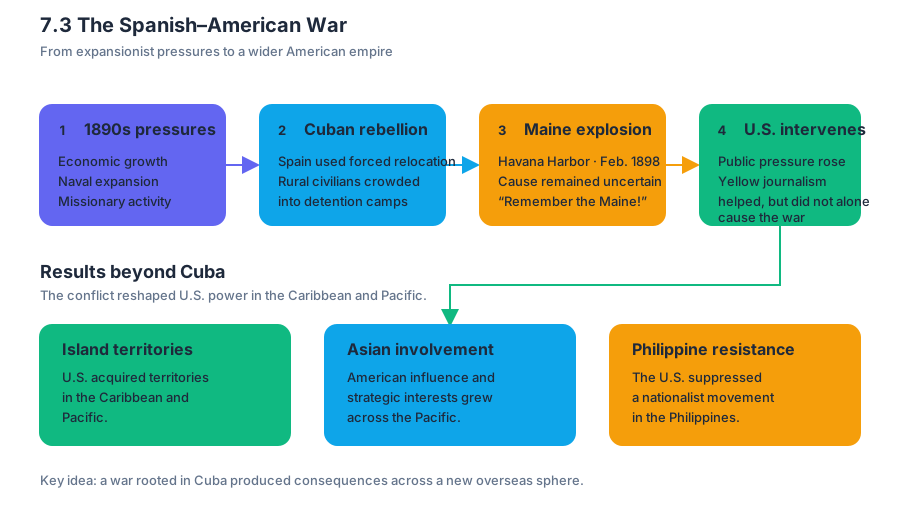
7.5 World War I: Military and Diplomacy · 7.6 World War I: Home Front
World War I transformed the United States from a powerful nation watching Europe’s crisis from across the Atlantic into a combatant claiming a responsibility to reshape world politics.
7.5 World War I: Military and Diplomacy · 7.6 World War I: Home Front
World War I transformed the United States from a powerful nation watching Europe’s crisis from across the Atlantic into a combatant claiming a responsibility to reshape world politics. The central tension was immediate: could the United States defend democratic and humanitarian principles abroad without abandoning its long-standing tradition of avoiding European power struggles at home?
7.5 World War I: Military and Diplomacy
When war began in Europe in 1914, President Woodrow Wilson declared American neutrality. Neutrality meant more than refusing to send troops: the United States attempted to trade with countries on both sides while avoiding formal commitment to either alliance. This policy reflected the older tradition of noninvolvement in European affairs, even though American commerce and public opinion increasingly connected the nation to the conflict.
KC-7.3.II.A: After initial neutrality in World War I, the nation entered the conflict in response to Woodrow Wilson’s call for the defense of humanitarian and democratic principles.
The position became increasingly difficult to sustain. Germany’s unrestricted submarine warfare threatened neutral shipping and civilian lives, while the Zimmermann Telegram revealed a German proposal for an alliance with Mexico against the United States. In April 1917, Wilson asked Congress for a declaration of war. His justification emphasized defending international law, democracy, and a world order “safe for democracy,” rather than acquiring territory.
Worked contextual example — from neutrality to intervention: A historian comparing 1914 and 1917 should identify both continuity and change. Continuity lay in the desire to avoid traditional European balance-of-power politics. Change lay in the growing belief that submarine attacks, economic ties, and democratic ideals made European events directly relevant to American security and moral responsibility. The best causal explanation connects German actions to Wilson’s broader diplomatic vision rather than treating the declaration of war as a single-cause reaction.
The American Expeditionary Forces, or AEF, were the U.S. military forces sent to Europe under General John J. Pershing. American participation was relatively brief compared with the years of fighting endured by European armies, and the AEF did not single-handedly win the war. Nevertheless, fresh American troops, industrial supplies, loans, and transportation strengthened the exhausted Allies at a decisive moment.
KC-7.3.II.B: Although the American Expeditionary Forces played a relatively limited role in combat, American troops and resources affected the outcome of the war.
The Meuse-Argonne Offensive demonstrates the scale of that contribution. Fought from September 26 to November 11, 1918, it became the final major Allied offensive and the largest AEF operation. Nearly one million American soldiers participated. African American soldiers also served, including the 369th Infantry Regiment, later known as the Harlem Hellfighters, whose wartime service and 1919 return parade exposed the contradiction between fighting for democracy overseas and facing racial inequality in the United States.
7.6 World War I: Home Front
War required mobilization: the government coordinated factories, transportation, food production, military recruitment, and public opinion. Agencies such as the War Industries Board encouraged industrial production, while the Food Administration promoted conservation. Liberty Bond campaigns asked civilians to finance the war, and posters, films, and speeches presented military participation as a patriotic duty.
Mobilization expanded some opportunities but restricted civil liberties. The government used the Espionage Act of 1917 and Sedition Act of 1918 to punish interference with the war effort and harsh criticism of government policy. Socialist and labor activist Emma Goldman became a prominent target; her opposition to conscription contributed to her arrest and eventual deportation to Russia.
KC-7.2.I.C: Wartime repression of radicalism helped produce the postwar Red Scare.
The home front also accelerated migration. Wartime industrial labor shortages encouraged African Americans to leave the South for jobs in northern and western cities, beginning the Great Migration. The Chicago Defender helped publicize these opportunities, while migrant letters reveal both the attraction of factory employment and the continuing danger of racial discrimination.
KC-7.2.II.B.i: Economic opportunities in urban areas encouraged migration to cities such as Chicago and Los Angeles.
KC-7.2.II.C: African Americans found new opportunities in the North and West, although migration did not eliminate racism or segregation.
Skill 5.A — Making Connections: Identify patterns among or connections between historical developments and processes. The most important connection in these topics is that foreign policy and domestic change moved together. The war increased federal power, stimulated industrial production, encouraged the Great Migration, and intensified debates over free speech. A strong AP response does not list these developments separately; it explains how wartime demands produced them.
Misconception check
Misconception: “The United States entered World War I only because Germany attacked it.” German submarine warfare was crucial, but the decision also involved economic ties, the Zimmermann Telegram, Wilson’s interpretation of democratic responsibility, and the collapse of neutrality as a workable policy. A second misconception is that the war immediately created racial equality: African American military service and migration produced claims for citizenship and opportunity, but discrimination remained deeply entrenched.
Retrieval check
- Why did Wilson present intervention as a defense of democracy rather than an effort to gain territory?
- How did the AEF contribute despite its relatively limited combat role?
- Explain one connection between wartime mobilization and the Great Migration.
- Why did World War I produce both expanded opportunity and reduced civil liberties?
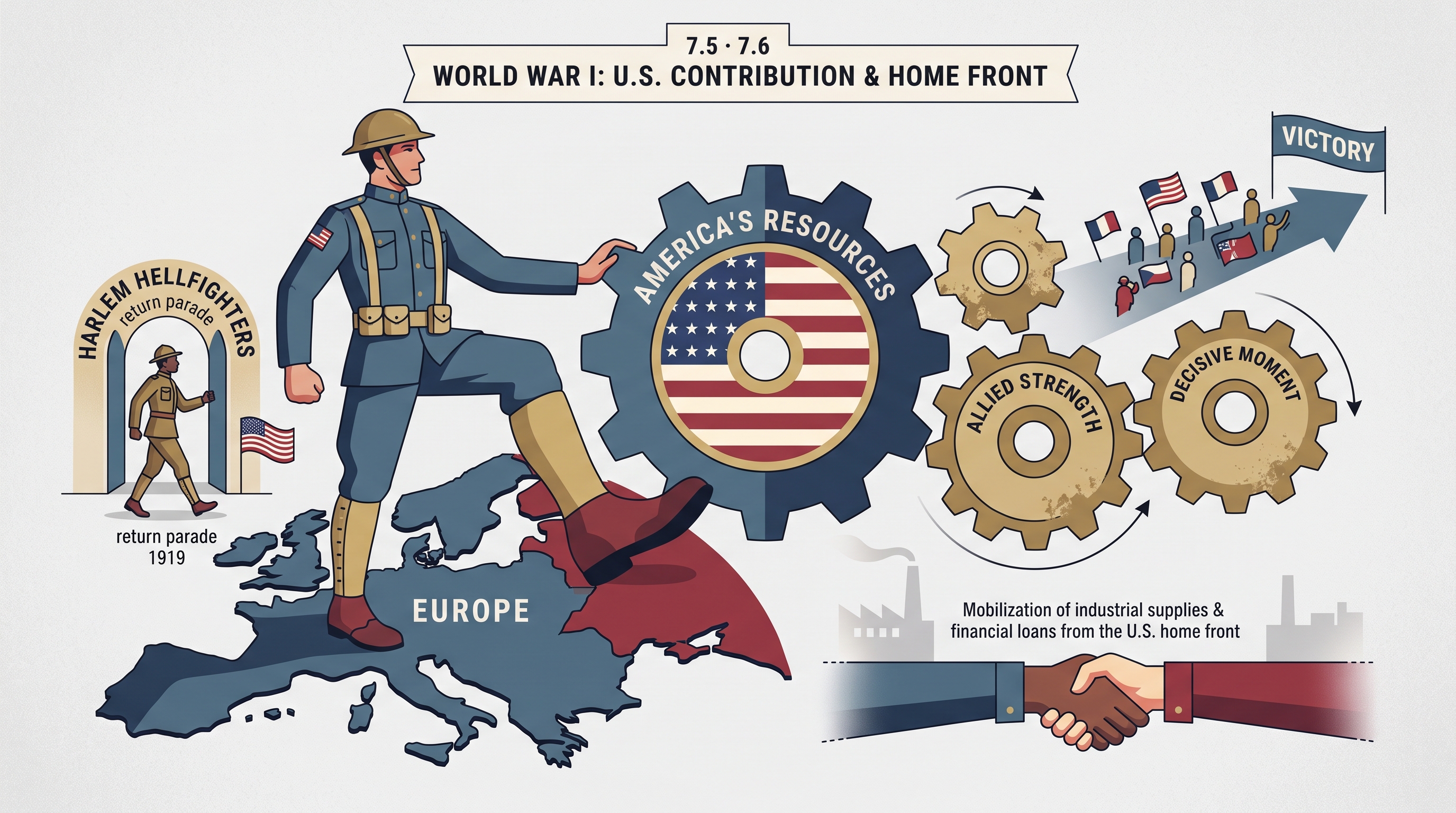
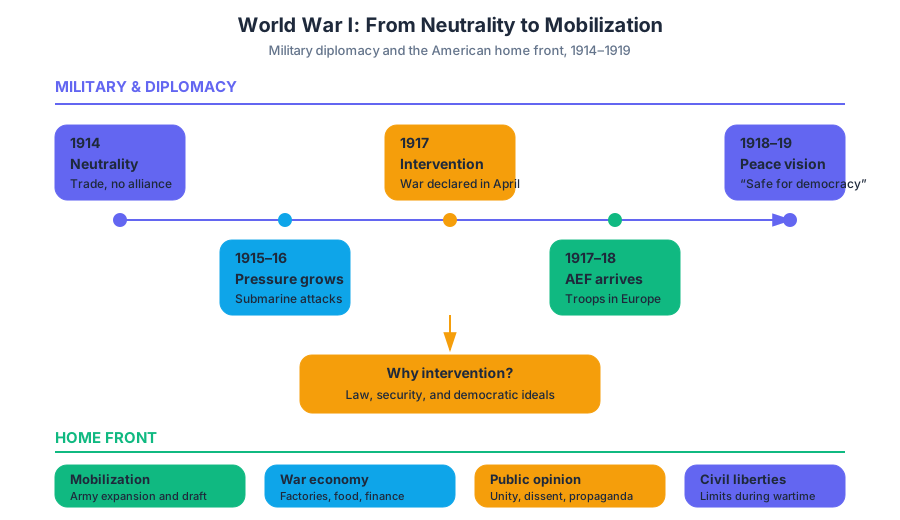
7.7 1920s: Innovations in Communication and Technology · 7.8 1920s: Cultural and Political Controversies
The 1920s transformed American life because new technologies made national culture faster, more commercial, and more connected—while the same changes intensified conflicts over race, religion, immigration, gender, and modernity.
7.7 1920s: Innovations in Communication and Technology · 7.8 1920s: Cultural and Political Controversies
The 1920s transformed American life because new technologies made national culture faster, more commercial, and more connected—while the same changes intensified conflicts over race, religion, immigration, gender, and modernity. The central tension was simple: who would benefit from a more modern America, and who would decide what “modern” meant?
7.7 — Technology creates a mass market
The automobile became the decade’s signature technology. Henry Ford’s moving assembly line lowered production costs and helped make the Model T affordable to many middle-class families. Cars did more than change transportation: they encouraged road construction, expanded suburbs, supported gasoline stations and roadside businesses, and gave young people and families greater mobility.
Electricity and consumer appliances also reshaped daily life. Radios, refrigerators, vacuum cleaners, and washing machines connected household life to industrial production. Installment buying—purchasing an item through a sequence of payments—allowed consumers to buy goods before they had saved the full price, expanding demand but also making household prosperity dependent on continued income.
Radio created a shared national audience. A family in a rural town could hear the same music, advertisements, political speeches, sporting events, and entertainment as listeners in a major city. Motion pictures performed a similar cultural function, spreading fashion, celebrity images, and social expectations across regional boundaries.
This relationship between technology and economic growth illustrates the WXT theme, Work, Exchange, and Technology: mass production increased the supply of consumer goods, advertising stimulated demand, and credit helped connect households to national markets. The result was not equal prosperity, however. Farmers, many workers, and people excluded from consumer opportunities did not experience the decade’s prosperity in the same way.
Key insight: Technology did not merely make existing habits more convenient. It reorganized markets, leisure, family life, transportation, and the circulation of ideas.
Worked contextual example: the automobile
Suppose a historian finds that automobile ownership rose sharply during the 1920s while paved-road construction expanded. The strongest explanation would connect several developments: assembly-line production reduced prices; installment credit broadened access; increased ownership created pressure for better roads; and improved roads encouraged suburban growth and commercial expansion. A response that says only “cars made travel easier” describes an effect but does not explain the broader historical process.
7.8 — Modernism meets cultural resistance
Mass communication helped create popular culture, shared entertainment and consumer habits experienced by large audiences. Yet national culture did not become uniform. Migration, especially the movement of African Americans from the rural South to northern cities, generated new artistic and literary expression. The Harlem Renaissance—a flowering of African American literature, music, art, and intellectual life—expressed ethnic and regional identities, directly reflecting KC-7.2.I.B.
The Harlem Renaissance included writers such as Langston Hughes and Zora Neale Hurston, musicians associated with jazz, and intellectuals such as Alain Locke. Jazz and other forms of Black cultural expression entered mainstream commercial culture, but this popularity existed alongside segregation, racial violence, and discrimination. Cultural influence did not equal political or economic equality.
The decade also produced sharp disputes between modernism, which emphasized new scientific ideas, individual freedom, and changing social practices, and fundamentalism, which defended traditional religious beliefs and literal interpretations of the Bible. The Scopes Trial of 1925 dramatized this conflict: the issue was formally the teaching of evolution, but the larger debate concerned science, religion, public education, and authority.
Immigration and race produced another contradiction. The Emergency Quota Act of 1921 and the Immigration Act of 1924 restricted immigration through national-origins quotas, favoring immigrants from northern and western Europe and sharply limiting others. The revived Ku Klux Klan promoted white Protestant nationalism, anti-Black racism, antisemitism, and hostility toward Catholics, immigrants, and radicals.
Women’s public roles changed after the Nineteenth Amendment, expanded employment, and the visibility of the “flapper,” a symbol of new consumer fashions and social independence. But the decade did not produce a complete gender revolution: most women continued to face unequal wages, restricted occupations, and pressure to center their lives on domestic responsibilities.
Misconception check
Misconception: “The 1920s were uniformly modern and prosperous.” In reality, the decade contained both innovation and reaction. Radio and automobiles expanded national consumer culture, while immigration restrictions and the Klan enforced exclusion; the Harlem Renaissance celebrated Black creativity while racial violence continued; and religious traditionalists resisted modern science.
AP reasoning in action
These topics most directly develop Historical Thinking Skill 1: Developments and Processes, especially explaining how technology and migration produced multiple effects; Historical Thinking Skill 4: Contextualization, by placing 1920s conflicts within postwar demographic and economic change; and Historical Thinking Skill 5: Making Connections, by linking consumer technology to culture, migration, and politics. They also support Historical Thinking Skill 6: Argumentation when evaluating whether the decade represented cultural liberation, cultural conflict, or both.
The governing learning objective is Unit 7: Learning Objective I, which asks students to explain the causes and effects of developments in American culture and politics over time. KC-7.2.I.D captures the broader controversy: Americans debated gender roles, modernism, science, religion, popular culture, race, and immigration. In a historical argument, the strongest answer connects a development to both its causes and its uneven consequences.
Retrieval check
- Why did automobiles affect more than transportation?
- How did the Harlem Renaissance express migration and identity?
- Why is the Scopes Trial evidence of a broader conflict rather than an isolated court case?
Answer check: Automobiles stimulated roads, suburbs, and related businesses; the Harlem Renaissance transformed migration into artistic and intellectual expression; and the Scopes Trial represented the national struggle between modern science and religious traditionalism.

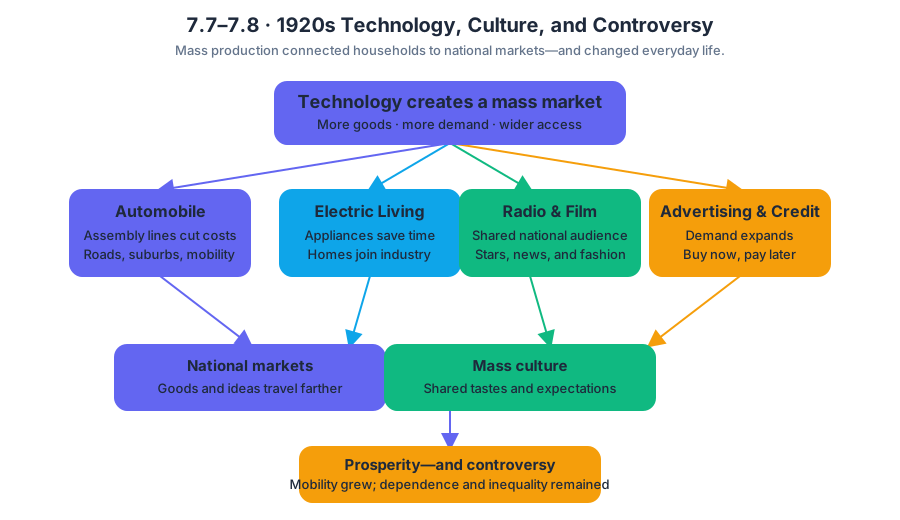
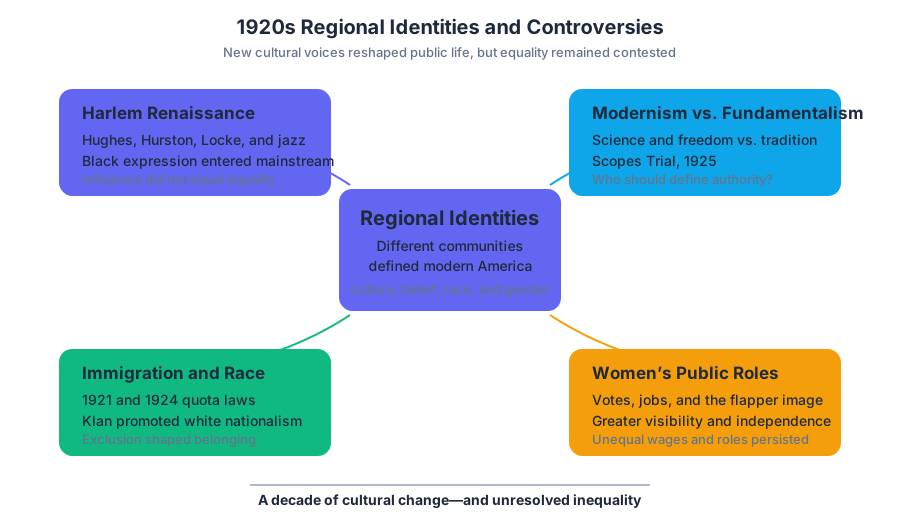
7.9 The Great Depression · 7.10 The New Deal
Key concepts: Great Depression · Franklin Delano Roosevelt’s New Deal · Relief, recovery, and reform · Federal financial regulation · Glass–Steagall Act · Limited welfare state · Political realignment toward the Democratic Party · Civilian Conservation Corps and youth employment · Mary McLeod Bethune and the National Youth Administration · Political conflict over the scope of the New Deal
How much power should the federal government use when private markets fail? The Great Depression transformed that question from a constitutional argument into an urgent human crisis, and Franklin Delano Roosevelt’s New Deal answered it with three linked goals: relief for suffering people, recovery for the collapsed…
7.9 The Great Depression · 7.10 The New Deal
How much power should the federal government use when private markets fail? The Great Depression transformed that question from a constitutional argument into an urgent human crisis, and Franklin Delano Roosevelt’s New Deal answered it with three linked goals: relief for suffering people, recovery for the collapsed economy, and reform to prevent another breakdown.
KC-7.1.III.A: Franklin Roosevelt’s New Deal attempted to end the Great Depression by using government power to provide relief to the poor, stimulate recovery, and reform the American economy.
From economic collapse to federal action
The Depression created mass unemployment, poverty, and insecurity. A useful way to distinguish the New Deal’s purposes is to imagine a damaged bridge: relief gives immediate aid to people stranded by the collapse; recovery tries to rebuild traffic and employment; reform changes the bridge’s design so the same failure is less likely to happen again.
The Civilian Conservation Corps (CCC) illustrated relief and recovery together by providing employment and public-service opportunities for young people. Workers received jobs connected to environmental and infrastructure projects rather than simply receiving private charity. The National Youth Administration similarly sought to expand opportunities for youth, including African Americans; Mary McLeod Bethune’s appointment in 1936 as director of its Division of Negro Affairs demonstrated that Black leadership could operate within New Deal institutions.
Reform and financial regulation
The Glass–Steagall Act, formally part of the Banking Act of 1933, represented the reform side of the New Deal. Passed after the stock-market crash that helped bring on the Great Depression, it strengthened federal regulation of banking and sought to reduce dangerous financial practices. Its significance was not merely technical: it showed the federal government accepting responsibility for supervising a financial system that many Americans no longer trusted to regulate itself.
The New Deal therefore created a limited welfare state—a political system in which the federal government accepts continuing responsibility for aspects of citizens’ economic and social well-being. “Limited” matters: the United States did not become a fully government-managed economy, and New Deal programs did not eliminate poverty or guarantee equal benefits to every group. They did, however, permanently expand expectations about what Washington should do during economic emergencies.
Pressure from the left and resistance from the right
Roosevelt did not act in a political vacuum. Radical, union, and populist movements pushed him toward more extensive efforts to change the economic system. Their pressure helped make labor rights, social welfare, and stronger economic regulation politically unavoidable.
KC-7.1.III.B: Radical, union, and populist movements pushed Roosevelt toward more extensive efforts to change the American economic system, while conservatives in Congress and the Supreme Court sought to limit the New Deal’s scope.
Conservatives in Congress and the Supreme Court resisted this expansion of federal power. In Schechter Poultry Corp. v. United States in 1935, the Supreme Court found portions of the National Industrial Recovery Act unconstitutional, limiting the administration’s ability to regulate the economy through broad national codes. Conservative opposition, expressed in congressional debates and documents such as the 1937 Conservative Manifesto, argued that the New Deal threatened private enterprise, constitutional limits, and individual liberty.
Political realignment and the New Deal coalition
The New Deal also changed party politics. A political realignment is a durable shift in the groups that identify with and support a political party. As federal programs offered jobs, assistance, labor protections, and a greater voice in national policy, many working-class communities, ethnic groups, and African American voters increasingly identified with the Democratic Party.
This shift did not mean that every New Deal program treated African Americans equally, nor that all Black voters immediately abandoned the Republicans, the party historically associated with emancipation. It meant that practical experience with federal action increasingly altered political loyalties. Bethune’s role in the National Youth Administration illustrates this change: African Americans were not simply recipients of policy but also participants in shaping its administration. The resulting New Deal coalition became a major Democratic alliance of workers, urban voters, ethnic communities, and many African Americans.
KC-7.1.III.C: Although the New Deal did not end the Depression, it left a legacy of reforms and regulatory agencies and fostered a long-term political realignment in which many ethnic groups, African Americans, and working-class communities identified with the Democratic Party.
The crucial evaluation: reform is not the same as recovery
A common misconception is that the New Deal ended the Great Depression. The more precise conclusion is that it provided substantial relief, expanded federal responsibility, and produced lasting reforms, but it did not fully restore the economy. The economic recovery associated with the end of the Depression is a distinct historical development tied to the increased demand for war production and labor during World War II.
This distinction is an example of Skill 5.B: Making Connections—explaining how one historical development or process relates to another. New Deal programs changed the relationship between citizens and the federal government; wartime production later transformed employment and industrial demand. The first development helped reshape American government, while the second supplied the economic force that finally ended Depression-era mass unemployment.
Retrieval check: Classify each development as primarily relief, recovery, reform, political realignment, or a connection to wartime recovery: the CCC, the Glass–Steagall Act, Bethune’s NYA appointment, the Democratic shift among many African American voters, and wartime labor demand. Then explain in one sentence why “the New Deal ended the Depression” is an incomplete claim.
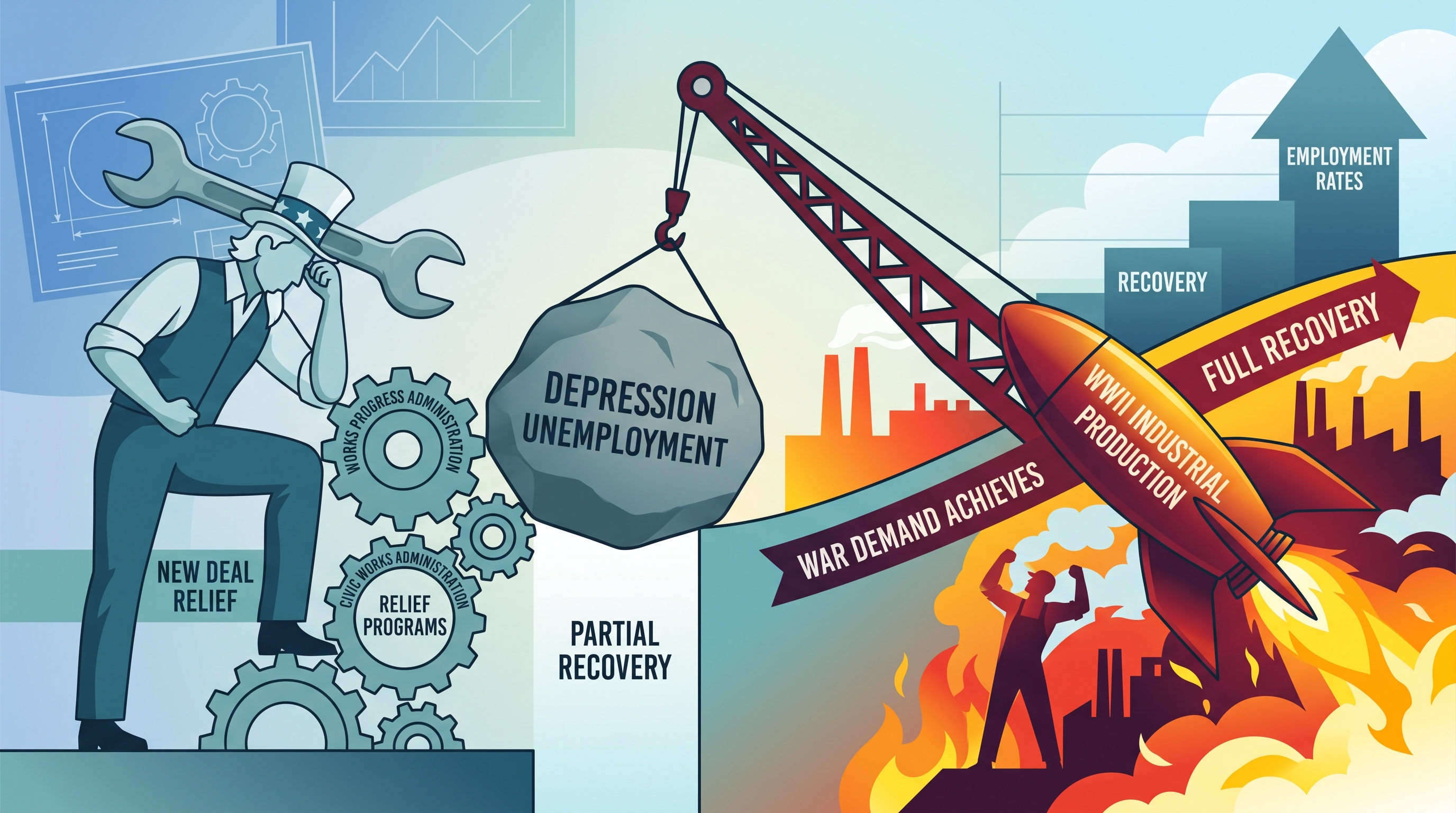
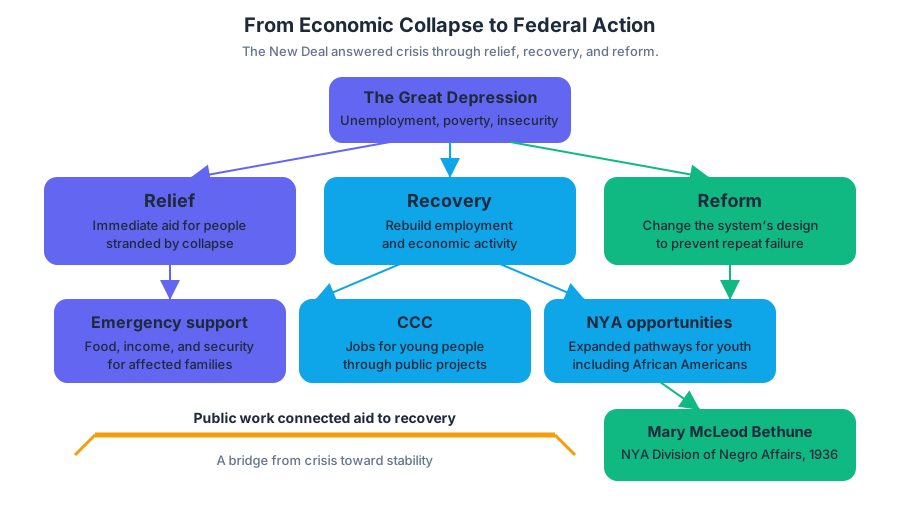
7.11 Interwar Foreign Policy · 7.12 World War II: Mobilization
Key concepts: Interwar foreign policy · World War II mobilization · Unilateral foreign policy · Multilateral foreign policy · Interventionism · Non-interventionism · Internationalism · Isolationism · U.S. foreign-policy traditions and involvement in European affairs · Historical analysis of primary sources and cultural or political values
Between World War I and World War II, the United States tried to shape world affairs without fully committing to permanent military involvement overseas. That tension produced a foreign policy that was simultaneously isolationist in public mood and active through finance, treaties, diplomacy, and selective…
7.11 Interwar Foreign Policy · 7.12 World War II: Mobilization
Between World War I and World War II, the United States tried to shape world affairs without fully committing to permanent military involvement overseas. That tension produced a foreign policy that was simultaneously isolationist in public mood and active through finance, treaties, diplomacy, and selective intervention.
Investigative question: How could the United States claim to avoid foreign entanglements while still attempting to organize international order—and how did World War II make that balance impossible?
From neutrality to intervention—and back again
The United States initially remained neutral in World War I. When it entered the conflict, it departed from the older tradition of noninvolvement in European affairs. President Woodrow Wilson presented intervention not simply as a strategy for national security but as a defense of humanitarian and democratic principles. Although the American Expeditionary Forces played a relatively limited role in combat, U.S. entry helped tip the balance toward the Allies.
KC-7.3.II.A: After initial neutrality in World War I, the nation entered the conflict, departing from the tradition of noninvolvement in European affairs in response to Wilson’s call to defend humanitarian and democratic principles.
The experience created a political problem: Americans could believe that democratic ideals mattered internationally while also fearing that military involvement would draw the nation into endless European conflicts. Isolationism favored keeping the United States outside broad international commitments. Non-interventionism more specifically opposed military intervention in particular foreign conflicts. The approaches overlapped, but they were not identical: a country could avoid war while still using diplomacy or economic power abroad.
The interwar policy grid
Foreign-policy actions can be classified along three separate dimensions. These categories should not be collapsed into one another.
| Dimension | Central question | Possible U.S. position |
|---|---|---|
| Unilateral vs. multilateral | Does the United States act alone or through coordinated international institutions? | The interwar United States often acted unilaterally. |
| Interventionist vs. non-interventionist | Does the United States actively intervene in another country’s affairs, especially militarily? | It could reject war while still using economic pressure or diplomacy. |
| Internationalist vs. isolationist | Does the United States accept sustained responsibility for global affairs or emphasize withdrawal? | Public opinion often leaned isolationist, even as policy remained internationally engaged. |
Unilateral foreign policy means acting primarily through national decisions rather than binding collective institutions. Multilateral foreign policy means coordinating with several nations through shared agreements or organizations. The interwar United States pursued a unilateral foreign policy that used international investment, peace treaties, and selective military intervention to promote an American vision of international order, even while maintaining isolationism.
KC-7.3.II.D: In the years following World War I, the United States pursued a unilateral foreign policy using international investment, peace treaties, and select military intervention to promote a vision of international order while maintaining U.S. isolationism.
Worked example: the Dawes Plan
In 1924, U.S. banker Charles Dawes led negotiations for the Dawes Plan, an arrangement designed to help Germany pay World War I reparations and revive its economy. The United States did not enter a permanent European political alliance, yet American financial leadership influenced European reconstruction and stability.
Classify the action step by step:
- It was unilateral in leadership because U.S. officials and bankers drove the arrangement.
- It was internationalist in effect because it addressed a European economic crisis.
- It was largely non-interventionist militarily because it relied on finance rather than deploying an army.
- It coexisted with isolationism because Americans could oppose political entanglement while accepting limited economic engagement.
Retrieval check: Why would calling the Dawes Plan simply “isolationist” be incomplete? A strong answer identifies its isolationist limits but also its international economic purpose.
The road to World War II
During the 1930s, many Americans were alarmed by the rise of fascism and totalitarianism. Nevertheless, most opposed military action against the aggression of Nazi Germany and Japan. Neutrality reflected the memory of World War I, the desire to avoid another overseas war, and the belief that domestic problems required attention.
KC-7.3.II.E: In the 1930s, many Americans recognized the danger posed by fascism and totalitarianism, but most opposed military action against German and Japanese aggression until the Japanese attack on Pearl Harbor brought the United States into World War II.
The Japanese attack on Pearl Harbor transformed the debate. The United States moved from non-interventionism to direct intervention, and mobilization reorganized the nation’s economy, labor force, technology, and social life for total war. This transition connects foreign policy to the domestic consequences of wartime production.
Mobilization: war as a national system
World War II mobilization was the rapid coordination of government, industry, workers, and citizens for military production and national defense. Factories shifted toward airplanes, ships, weapons, and vehicles; the federal government directed resources; and millions of Americans entered military or defense-related work.
The image of Rosie the Riveter captures one visible result. Women entered industrial jobs traditionally associated with men, demonstrating that wartime necessity could temporarily alter workplace expectations. The change was significant, but it did not automatically eliminate gender inequality or guarantee that women would permanently keep those jobs after the war.
Named misconception — “Mobilization only meant enlistment.” Mobilization included military service, but it also involved industrial production, labor changes, government planning, and civilian participation.
Historical thinking in action
This topic most directly develops Skill 1: Developments and Processes, especially 1.B: Explain a historical development. To explain interwar policy, connect the development to both sides of the tension: Americans resisted military entanglement, yet U.S. leaders used investment, treaties, and selective intervention to shape international affairs.
It also uses Skill 2: Sourcing and Situation, Skill 3: Claims and Evidence in Sources, Skill 4: Contextualization, Skill 5: Making Connections, and Skill 6: Argumentation. When analyzing a source about isolationism, fascism, or mobilization, do not adopt or reject its cultural or political values; identify what its authors’ words reveal about the period, then use that evidence to construct a historically defensible claim.
Interpretation check: A source praising “peace through withdrawal” may reveal strong interwar fear of military entanglement even if the reader disagrees with its politics. Historical analysis asks what the source shows, who produced it, and why—not whether its values should be endorsed.
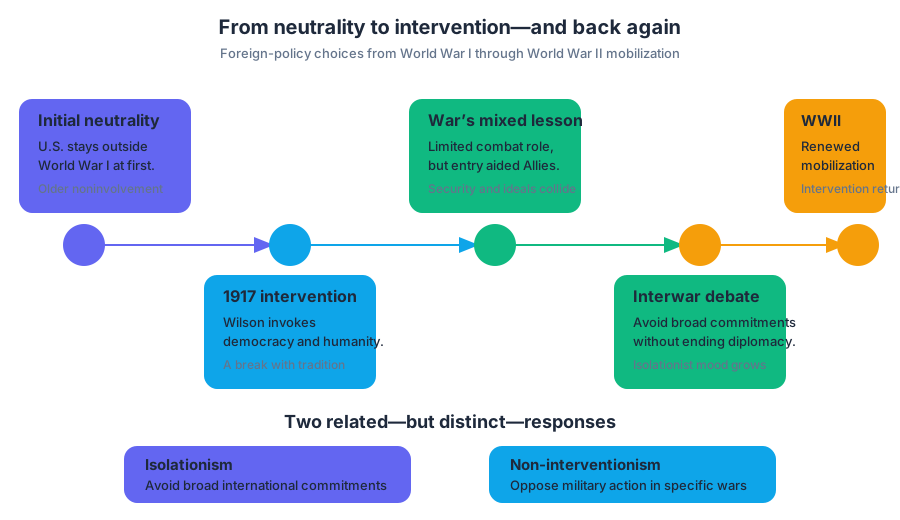
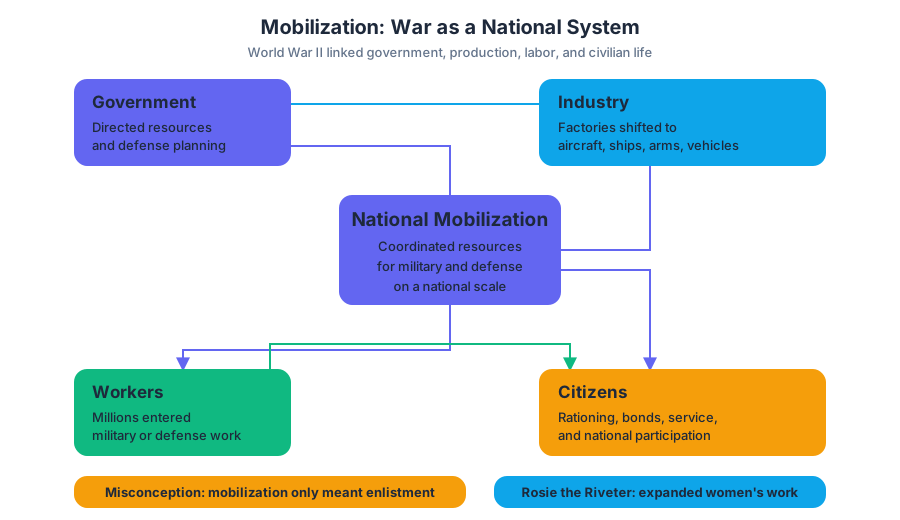
7.13 World War II: Military · 7.14 Postwar Diplomacy
Key concepts: World War II military history · Postwar diplomacy · Allied victory · Postwar peace settlements · The Big Three: the United States, Britain, and the Soviet Union · U.S. emergence as the world’s most powerful nation · The postwar condition of Europe and Asia · U.S. involvement in World War II · Historical causation · America’s role in the world
By 1945, the United States had helped defeat the Axis powers while its own industrial base remained intact; Europe and much of Asia lay devastated.
7.13 World War II: Military · 7.14 Postwar Diplomacy
By 1945, the United States had helped defeat the Axis powers while its own industrial base remained intact; Europe and much of Asia lay devastated. That contrast transformed victory into power: the United States did not merely win the war—it helped shape the peace that followed.
Learning Objective — Unit 7: Learning Objective N: Explain the consequences of U.S. involvement in World War II.
Historical Development — KC-7.3.III.E: The war-ravaged condition of Asia and Europe, and the dominant U.S. role in the Allied victory and postwar peace settlements, allowed the United States to emerge from the war as the most powerful nation on Earth.
From military cooperation to Allied victory
The central military coalition was the Big Three: the United States, Britain, and the U.S.S.R. They did not share identical political systems or postwar goals, but they cooperated against a common enemy. Britain resisted Germany from the war’s early stages, the Soviet Union absorbed enormous German pressure on the Eastern Front, and the United States supplied troops, equipment, technology, and industrial production across multiple theaters.
The Allied victory resulted from several interacting advantages rather than one isolated cause:
| Allied advantage | How it contributed to victory |
|---|---|
| Allied cooperation | Coordinated military strategy and shared resources across Europe and the Pacific |
| Industrial capacity | Produced ships, aircraft, vehicles, weapons, and supplies on a massive scale |
| Technological and scientific advances | Improved communication, medicine, weapons, intelligence, and transportation |
| Military service | Millions of servicemen and servicewomen supplied the personnel needed for global war |
| Pacific campaigns | “Island-hopping” bypassed some heavily fortified positions while moving U.S. forces toward Japan |
The United States played a dominant role, but “dominant” does not mean “alone.” Soviet forces made a decisive contribution by fighting Germany across the Eastern Front, while Britain provided essential resistance and strategic cooperation. A strong historical explanation therefore identifies U.S. leadership and resources while recognizing the multinational nature of the Allied victory.
Worked causal example
Suppose an argument claims that U.S. involvement mattered because it converted American economic strength into global military influence. The reasoning should proceed in a chain: U.S. factories produced war matériel → Allied forces could sustain campaigns in both Europe and the Pacific → the Axis powers were defeated → U.S. leaders gained greater authority in planning the postwar order. Each arrow explains how one development produced the next.
Military victory and the making of peace
Postwar diplomacy means more than ending combat. It includes the negotiations and peace settlements through which victorious powers establish political arrangements, security expectations, and international institutions after a war. The United States therefore expanded its influence twice: first through its military contribution to victory, and then through participation in deciding what the postwar world would look like.
The condition of the opposing regions made this influence especially powerful. Europe and Asia had suffered enormous destruction, including damaged cities, disrupted economies, displaced populations, and weakened governments. By contrast, the continental United States emerged with its productive capacity greatly strengthened, allowing it to provide aid, goods, loans, military protection, and diplomatic leadership.
The Big Three did not create a perfectly unified peace. Their cooperation during the war contained tensions over political systems, territorial control, and security. Nevertheless, U.S. participation in postwar settlements increased American international influence because the United States had both the resources to act and the military credibility to support its decisions.
Sourcing and Situation — Skill 2.B
Sourcing and Situation — Skill 2.B: Explain the point of view, purpose, historical situation, and/or audience of a source. To use a source as evidence about U.S. power after World War II, do not merely identify its author. Explain how the source’s circumstances make it useful.
Imagine a 1945 speech by a U.S. official urging Americans to help construct a stable international peace. Its historical situation—the recent Allied victory and the devastation of Europe and Asia—could explain why the speaker presents the United States as responsible for global leadership. Its purpose might be to persuade the public to support an active international role. The source would support the argument that military victory and peace-making combined to elevate U.S. power, although its official viewpoint might also encourage readers to overlook disagreements within the Allied coalition.
Strong sourcing sentence: Because the statement appeared immediately after a war that had weakened Europe and Asia, its appeal for U.S. leadership reflects a situation in which American officials possessed unusual economic and military influence; therefore, it supports the argument that postwar diplomacy expanded U.S. global power.
Misconception check
Misconception: “The United States became powerful only because other nations were destroyed.” The devastation of Europe and Asia created an opening, but it was not the whole explanation. U.S. power also rested on Allied military leadership, industrial production, scientific advances, military personnel, and participation in postwar settlements. The most complete claim connects relative weakness abroad with active American capacity and decision-making.
In-flow retrieval check
In one or two sentences, explain why the United States emerged from World War II as the most powerful nation on Earth. A complete answer should include all three links: the United States’ dominant contribution to Allied victory, the war-ravaged condition of Europe and Asia, and U.S. participation in postwar peace settlements.

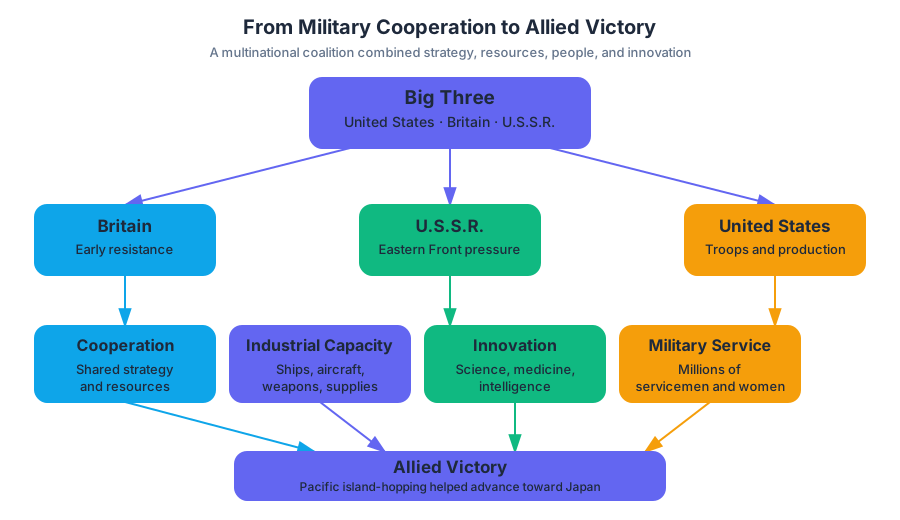
7.15 Comparison in Period 7
The Progressive Era and the New Deal both expanded the federal government’s response to social and economic problems, but they arose from different crises and produced different kinds of reform.
7.15 Comparison in Period 7
The Progressive Era and the New Deal both expanded the federal government’s response to social and economic problems, but they arose from different crises and produced different kinds of reform. The Progressive Era confronted the disorder of industrial capitalism; the New Deal confronted the collapse of the national economy during the Great Depression.
Learning Objective 7.15: Compare the effects of the Progressive Era and the New Deal.
Essential Knowledge 7.15.A: Reform movements in Period 7 expanded government responsibility for regulating the economy, protecting citizens, and addressing social problems, although reformers disagreed about the proper scope and methods of federal power.
The comparison at a glance
| Feature | Progressive Era | New Deal |
|---|---|---|
| Approximate period | 1890s–1920s | 1930s |
| Main problem | Industrialization, urban poverty, corporate power, political corruption | Banking collapse, mass unemployment, farm crisis, industrial depression |
| Reformers | Journalists, settlement workers, labor activists, middle-class reformers, some politicians | Franklin D. Roosevelt’s administration, New Dealers, labor organizations, reform economists |
| Government response | Regulation, antitrust action, consumer protection, electoral reform | Relief, recovery, reform of banks and markets, social welfare |
| Major examples | Pure Food and Drug Act, Federal Reserve Act, direct primaries, women’s suffrage | Social Security Act, Wagner Act, bank regulation, public employment programs |
| Main limitation | Often excluded African Americans and preserved racial segregation | Created broader protections but often administered programs unequally by race and region |
The comparison is not simply “small government versus big government.” Both eras increased government intervention. The more precise distinction is that Progressives usually tried to manage industrial capitalism and make government more efficient, while New Dealers used federal power to provide immediate economic relief and create a longer-lasting social safety net.
Progressive reform: correcting industrial capitalism
Progressive reformers believed that rapid industrialization had produced problems that individual charity could not solve: unsafe factories, polluted food supplies, political machines, corporate monopolies, and overcrowded cities. Investigative journalists such as Ida Tarbell exposed corporate practices, while settlement-house workers such as Jane Addams documented urban poverty and immigrant working conditions.
Their solution was not generally to abolish capitalism. Instead, reformers sought expert regulation and a more responsive democracy. Theodore Roosevelt’s “trust-busting,” the creation of the Federal Reserve under Woodrow Wilson, consumer-protection laws, conservation policies, and reforms such as initiative, referendum, and recall all reflected the belief that government could discipline concentrated power.
Key distinction: Progressive reform often targeted specific abuses of industrial society—monopoly, unsafe products, corruption, and poor working conditions—rather than promising universal economic security.
The New Deal: responding to systemic collapse
The Great Depression created a wider emergency. After the stock-market crash and banking failures, millions of Americans lost jobs, homes, savings, and farms. Franklin D. Roosevelt’s New Deal responded through three overlapping goals: relief for people suffering immediately, recovery for the economy, and reform to prevent another depression.
The Federal Deposit Insurance Corporation stabilized bank deposits; public employment programs put people to work; the Agricultural Adjustment Administration attempted to address farm prices; the Wagner Act strengthened collective bargaining; and the Social Security Act established old-age pensions and assistance programs. These policies permanently increased expectations that the federal government should protect economic security.
The New Deal did not end every Depression-era problem. Unemployment remained high until wartime production accelerated, and many programs excluded or disadvantaged agricultural and domestic workers—occupations held disproportionately by African Americans. Nevertheless, the New Deal reshaped the relationship between citizens and the federal government more broadly than most Progressive reforms had.
Worked comparison: building an argument
Prompt: Evaluate the extent to which the New Deal continued Progressive Era reform between 1933 and 1939.
Step 1 — Establish a shared context. Both periods responded to problems created or intensified by modern industrial capitalism. Progressives confronted corporate concentration and urban social problems; New Dealers confronted the economic collapse that exposed weaknesses in banks, farms, and labor markets.
Step 2 — Identify a continuity. Both movements expanded federal regulation. Progressive legislation regulated food, drugs, railroads, banks, and corporations; New Deal legislation regulated banking, securities markets, labor relations, and social welfare.
Step 3 — Identify a difference. The New Deal went beyond Progressive regulation by creating direct federal relief and a national social-insurance system. Social Security did not merely correct a corrupt institution; it established an ongoing federal responsibility for economic security.
Step 4 — Explain significance. The New Deal therefore continued the Progressive belief in active government but extended it from supervision of capitalism toward protection against capitalism’s failures.
Model thesis: The New Deal substantially continued Progressive reform by expanding federal regulation and using expert administration, but it also marked a major change because the federal government assumed direct responsibility for relief, employment, labor rights, and long-term economic security.
Misconception check
Misconception: “The Progressive Era helped everyone equally.” Progressive reform frequently excluded African Americans, tolerated segregation, and sometimes promoted racial control through supposedly scientific policies. Correction: evaluate reform by both its stated goals and its distribution of power and benefits.
Misconception: “The New Deal ended the Great Depression.” It reduced suffering, stabilized institutions, and reformed the economy, but full employment came only with the massive mobilization of World War II.
Retrieval and interpretation check
In two sentences, explain one continuity and one difference between the Progressive Era and the New Deal. A strong response should name a specific policy from each era and explain why the similarity or difference mattered—not merely list reforms.
Skill 6.C — Comparison: explain the significance of a similarity or difference. Skill 1.B — Developments and Processes: explain how reform developed in response to changing historical conditions.
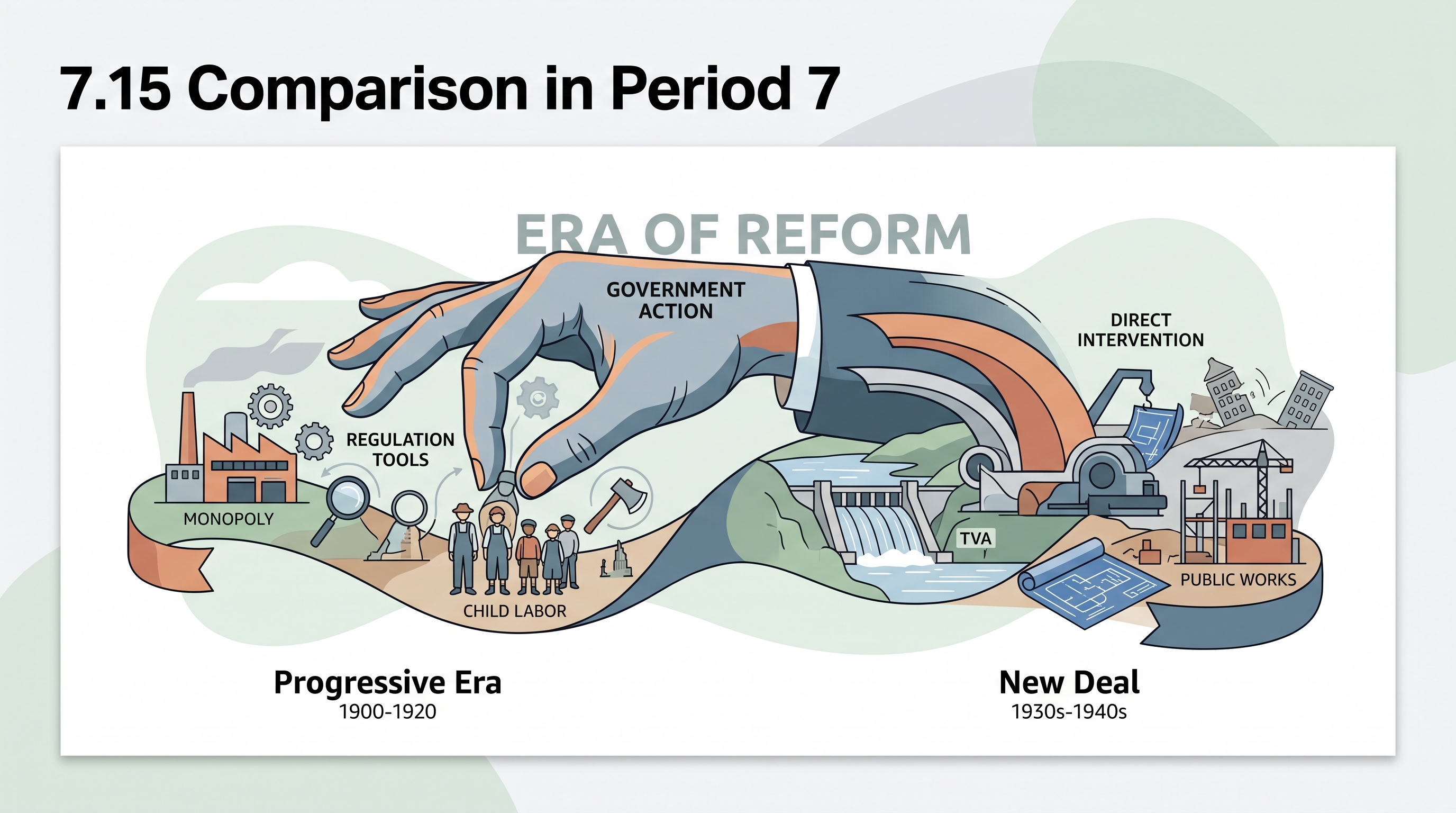
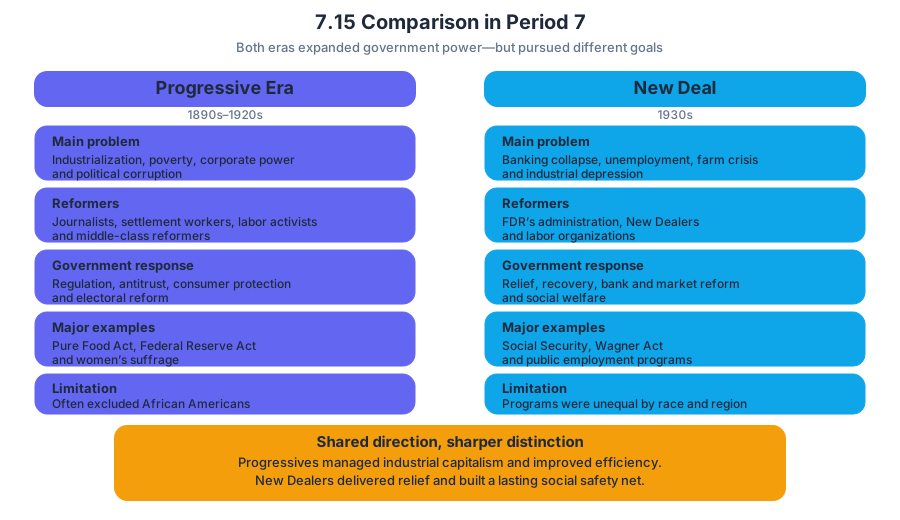
8.1 Contextualizing Period 8 · 8.2 The Cold War from 1945 to 1980
Key concepts: Period 8 of U.S. history, covering 1945–1980 · The Cold War from 1945 to 1980 · AP U.S. History periodization and exam weighting · Primary-source analysis · Formative multiple-choice and free-response questions · Economic effects of wheat production, milling, barreling, and trade · Dutch colonization and land transactions with Indigenous peoples at Fort Orange · Secession and the Civil War · American imperialism in the Philippines · Filipino self-determination
By 1945, the United States had emerged from World War II with enormous economic and military power—but victory created a new problem: how should the nation use that power in a world divided between American-led capitalism and Soviet-led communism?
8.1 Contextualizing Period 8 · 8.2 The Cold War from 1945 to 1980
By 1945, the United States had emerged from World War II with enormous economic and military power—but victory created a new problem: how should the nation use that power in a world divided between American-led capitalism and Soviet-led communism? Period 8, defined as 1945–1980, begins with that question and follows the expansion of American global leadership, the Cold War, and the domestic arguments those policies produced.
Period 8 = 1945–1980
The period begins after World War II and ends amid the political, economic, and international crises of the 1970s. It follows Period 7: 1890–1945, which includes U.S. imperialism, World War I, the Great Depression, the New Deal, and World War II.
The period as a historical problem
The end of World War II did not restore the older international order. Instead, the United States became a global superpower while the authoritarian Soviet Union expanded its influence across Eastern Europe and supported communist movements elsewhere. American policymakers therefore pursued three connected goals: limiting communist military and ideological influence, creating a free-market global economy, and constructing an international security system.
A useful causal map is:
World War II ends
        ↓
Power vacuum and Soviet-American rivalry
        ↓
U.S. containment policies
        ├── Economic aid and trade
        ├── Military alliances
        ├── Nuclear deterrence
        └── Political and covert intervention
        ↓
Global Cold War + domestic debates over federal power and civil liberties
CED traceability
8.1 Contextualizing Period 8 is assessed through Learning Objective 8.1, which asks students to explain the context in which the United States became a global superpower after World War II. Its essential knowledge includes KC-8.1.I, which identifies the goals of limiting Soviet power, promoting a free-market global economy, and building international security, and KC-8.1.II, which emphasizes debates over federal authority, international policy, and civil liberties.
8.2 The Cold War from 1945 to 1980 develops Learning Objective 8.2, explaining the causes and effects of U.S. involvement in the Cold War. The central concept is containment—the policy of limiting the expansion of communism rather than attempting to eliminate every communist government already in existence.
From wartime alliance to Cold War rivalry
The United States and the Soviet Union had cooperated against Nazi Germany, but their partnership concealed major disagreements. The United States favored political pluralism, private enterprise, and open international markets; the Soviet Union established communist governments in Eastern Europe and sought security through a sphere of influence near its borders. The destruction caused by World War II made European reconstruction urgent, while the development of atomic weapons made rivalry potentially catastrophic.
The United States responded with a combination of economic, diplomatic, and military measures. The Truman Doctrine promised support for governments resisting communist pressure; the Marshall Plan used economic assistance to rebuild Western Europe; the Berlin airlift demonstrated American opposition to Soviet pressure on West Berlin; and the North Atlantic Treaty Organization created a collective-security alliance. The Korean War transformed containment from a largely European policy into a global military commitment.
A worked contextualization example
Imagine a document dated 1948 that calls for American aid to European nations threatened by communist movements. To contextualize it, do not merely write “the Cold War was happening.” Build a chain of specific background developments: World War II had devastated Europe; Soviet influence had expanded in Eastern Europe; American leaders feared both political instability and the loss of markets; and the Truman administration was adopting containment.
Strong contextualization:
“The document reflects the post–World War II rivalry between the United States and the Soviet Union. Because European economies and governments were weakened by the war while Soviet influence expanded in Eastern Europe, U.S. officials used economic reconstruction as part of a broader strategy to contain communism and organize a U.S.-led international order.”
The explanation earns its force because it identifies developments that occurred before or around the document and shows why they mattered. A list of unrelated facts is not contextualization; a connected historical setting is.
Primary-source analysis: sourcing before argument
AP historical reasoning begins with Skill 2: Sourcing and Situation. When reading a primary source, identify the author, date, audience, purpose, and historical situation—but then connect one of those features to the source’s argument. For example, Andrew Carnegie’s opposition to American imperialism in the Philippines becomes more meaningful when read alongside an open letter arguing that the United States had violated Filipinos’ right to self-determination: both sources reveal that American expansion generated arguments about whether national power was consistent with democratic principles.
Those earlier debates provide useful context for Period 8 because Cold War policy revived the same tension: could the United States defend freedom abroad while limiting choices—or civil liberties—at home? A document’s date, therefore, is not decoration. It can show whether an argument arose during imperial expansion, wartime mobilization, or postwar superpower rivalry.
Historical connections and common traps
Skill 4: Contextualization connects Period 8 to earlier developments. The Dutch agent at Fort Orange, instructed to purchase land from Indigenous people and manage Dutch colonists, illustrates an earlier pattern in which overseas expansion combined economic goals with colonial administration. The secession of Southern states, which precipitated the Civil War, illustrates a different pattern: political conflict over sectional power can escalate into military conflict. These examples help students recognize recurring relationships without pretending that the Cold War was identical to colonialism or the Civil War.
Misconception check — “The Cold War was not a real war.” It was “cold” because the United States and Soviet Union generally avoided direct full-scale war against each other, especially because nuclear weapons made such a conflict extraordinarily dangerous. Yet the rivalry produced military alliances, arms competition, espionage, covert operations, and “hot” conflicts such as Korea.
Skill 1: Developments and Processes asks students to trace how containment expanded from European recovery and diplomacy into a worldwide security strategy. Skill 3: Claims and Evidence in Sources requires using a source to support a claim rather than merely summarizing it. Skill 5: Making Connections links foreign policy to domestic debates over federal power and civil liberties, while Skill 6: Argumentation turns those connections into a defensible historical claim.
Retrieval and interpretation check
Answer without looking back: Why did American policymakers connect economic reconstruction, military alliances, and the containment of communism after 1945? Then identify one line in a primary source that supplies contextual information and explain how that line would help establish the source’s historical situation for a DBQ.
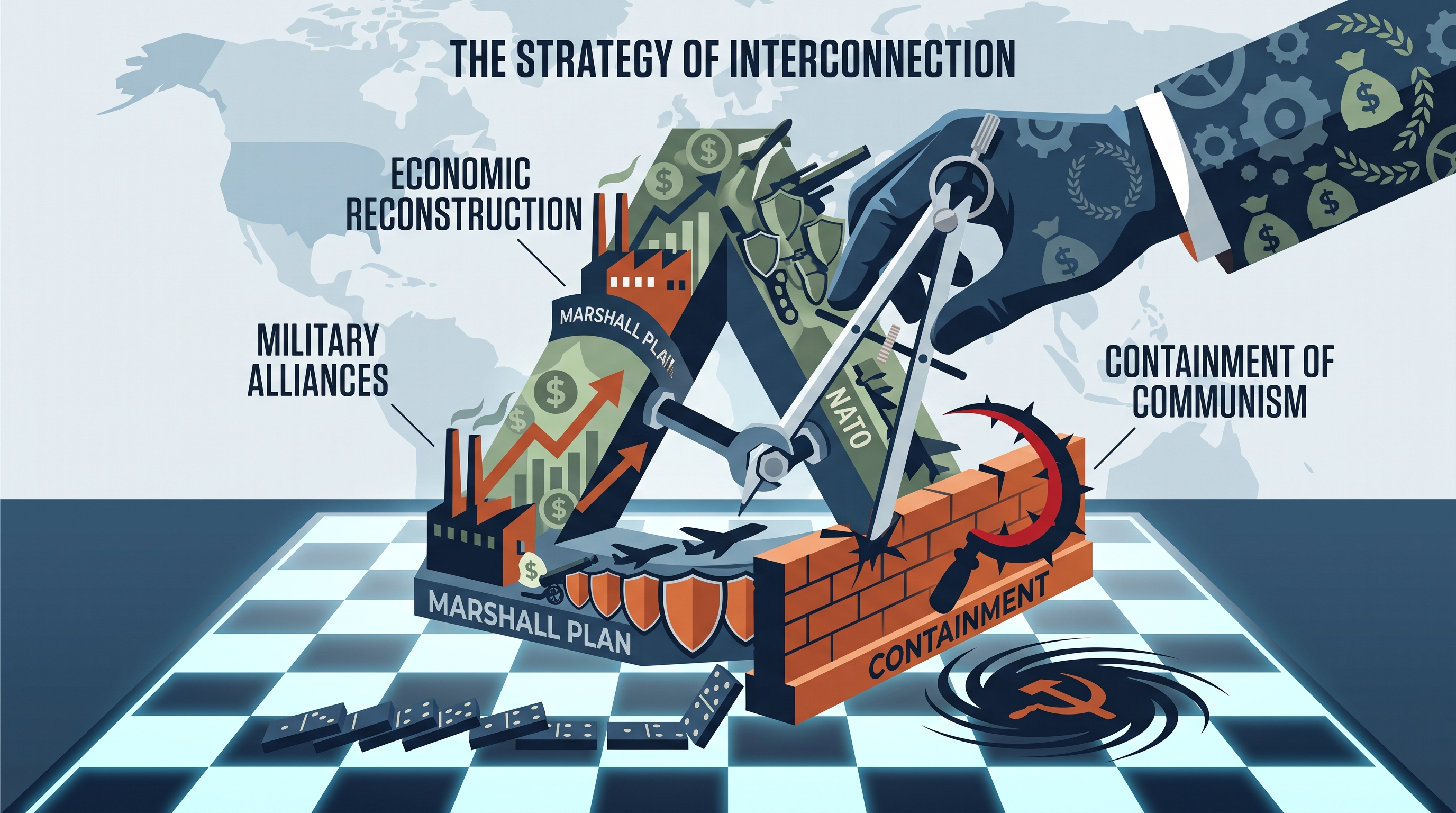
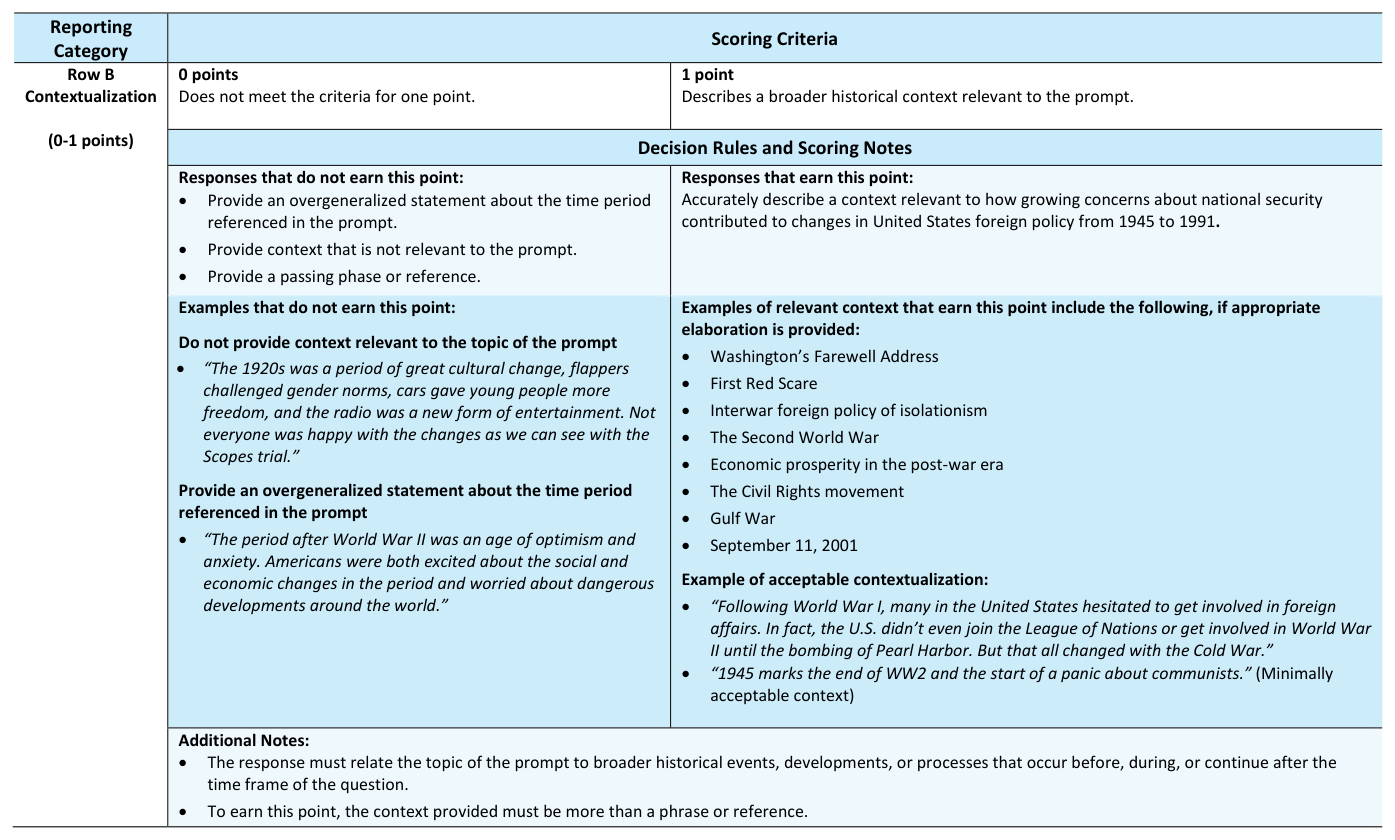
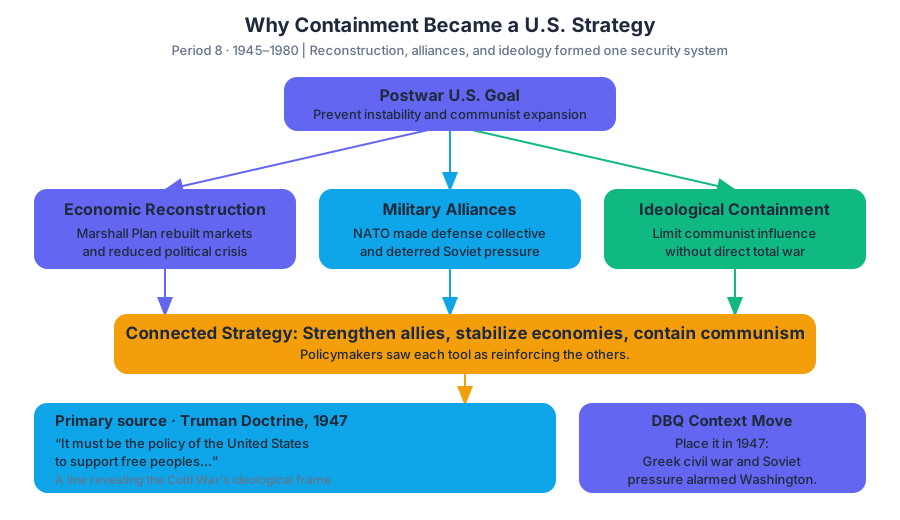
8.3 The Red Scare · 8.4 Economy After 1945
Key concepts: Red Scare after World War II · Containment of communism · McCarthyism · Lavender Scare · American and National Identity · Sourcing and situation · Post-1945 economic transformation · Shift from the industrial Midwest to the Sun Belt · Free trade and global economic competition · Economic inequality and conservatism
The post–World War II United States confronted two linked questions: How much freedom could be restricted to defend democracy? and Who would benefit from the new economy?
8.3 The Red Scare · 8.4 Economy After 1945
The post–World War II United States confronted two linked questions: How much freedom could be restricted to defend democracy? and Who would benefit from the new economy? The Red Scare answered the first question through investigations, loyalty programs, and public accusations; the postwar economy reshaped the second through technology, migration, regional change, and expanding global trade.
8.3 The Red Scare: Defending Democracy by Limiting Freedom?
Unit 8: Learning Objective C asks students to “Explain the causes and effects of the Red Scare after World War II.” The required historical development, KC-8.1.II.A, emphasizes a crucial distinction: Americans debated the policies and methods used to expose suspected communists inside the United States, even while both major political parties supported the broader foreign-policy strategy of containing communism.
American and National Identity (NAT): Debates about democracy, freedom, citizenship, diversity, and individualism shaped American beliefs about national identity—and those beliefs shaped political institutions and society.
The Red Scare was the postwar fear that communist influence threatened the United States from within. Its causes included tensions with the Soviet Union, the spread of communism abroad, espionage cases, and anxiety that American institutions were vulnerable. Its effects reached far beyond proven espionage: investigations damaged reputations, encouraged conformity, narrowed acceptable political speech, and forced Americans to debate whether suppressing dissent protected or undermined democracy.
McCarthyism describes the aggressive use of accusations, investigations, and public hearings to identify alleged communist sympathizers, especially when evidence was weak or selectively presented. Senator Joseph McCarthy became its most recognizable figure, but anticommunist activity also involved congressional investigations, executive-branch loyalty programs, employers, schools, and private organizations.
The political conflict was therefore not simply “communists versus anticommunists.” Many Americans agreed that communist expansion abroad should be contained, but they disagreed over due process, evidence, congressional authority, and the boundary between legitimate security concerns and political intimidation. Dwight D. Eisenhower’s frustration with McCarthyism appears clearly in an October 9, 1953, letter to his brother Milton S. Eisenhower: the president opposed McCarthy’s methods even though Eisenhower’s administration remained firmly anticommunist.
The Lavender Scare
The Lavender Scare involved efforts to identify and remove suspected LGBTQ people from federal employment. Officials connected homosexuality to supposed vulnerability, disloyalty, or blackmail, linking the campaign to broader anticommunist fears. This reveals how the Red Scare policed not only political beliefs but also citizenship, identity, privacy, and acceptable behavior.
Misconception check — “The Red Scare targeted only actual spies.”
Many targets were accused or investigated without reliable proof. The historical significance lies partly in how fear expanded the definition of danger and made suspicion itself socially and professionally destructive.
Sourcing and Situation: Why Context Changes Meaning
Skill 2.B: Sourcing and Situation means explaining a source’s point of view, purpose, historical situation, and/or audience. “Situation” asks what was happening around the author when the document was created—not merely what the author says.
Paul Robeson’s testimony illustrates this method. Robeson was an African American performer and political activist speaking in a period shaped simultaneously by the Red Scare and Jim Crow. That situation helps explain why his arguments and point of view cannot be read as an abstract debate about communism: racial inequality, citizenship, political repression, and the risks of public dissent shaped what he said and how audiences might interpret it.
Worked sourcing example: If a document defends an accused person’s right to dissent, first identify the author and date; next place the document in the postwar anticommunist climate; then connect that situation to the argument. A strong explanation would say that the author’s concern about government investigations reflects a period when accusations could threaten employment and reputation, making civil liberties—not simply foreign policy—the central issue.
8.4 Economy After 1945: Growth, Movement, and Unequal Rewards
Unit 8: Learning Objective D focuses on explaining the causes and effects of economic changes after 1945. The postwar economy benefited from technological innovation, mass production, expanded consumer demand, military spending, and increased access to education and economic opportunity. These forces helped enlarge the middle class and encouraged economic mobility, although prosperity was distributed unevenly.
Technology transformed both work and daily life. New systems of transportation, communication, manufacturing, and information processing increased productivity and helped shift employment away from traditional industrial labor toward services. The geographic result was a movement from the industrial Midwest—the “Rust Belt”—toward the Sun Belt of the South and West, where newer industries, defense contracts, lower taxes, air-conditioning, and population growth encouraged investment.
The United States also turned toward free trade, meaning fewer barriers to international exchange, as it competed in an increasingly global economy. This strengthened access to overseas markets and encouraged international economic integration, but it also exposed some American workers and industries to foreign competition.
Economic inequality remained an important feature of postwar change. Aggregate growth and a larger middle class did not mean that every group experienced equal wages, wealth, security, or opportunity. Conservatism gained strength partly through reactions against taxation, regulation, labor power, and federal activism, especially as economic restructuring created winners and losers.
Misconception check — “Postwar prosperity affected everyone equally.”
The economy grew dramatically, but regional decline, racial discrimination, gender inequality, unequal educational access, and later deindustrialization complicated the idea of universal prosperity.
Connecting the Two Topics
The Red Scare and the postwar economy were connected through competing ideas of American identity. Anticommunism portrayed private property, individualism, and political loyalty as markers of American freedom, while economic change raised difficult questions about mobility, inequality, labor, and the government’s responsibility to citizens.
Retrieval check: Explain one cause and two effects of the Red Scare after World War II. Then explain how the shift from the industrial Midwest to the Sun Belt reflected technological and economic change. Finally, for a Paul Robeson document, name one feature of its historical situation that could shape the author’s point of view.
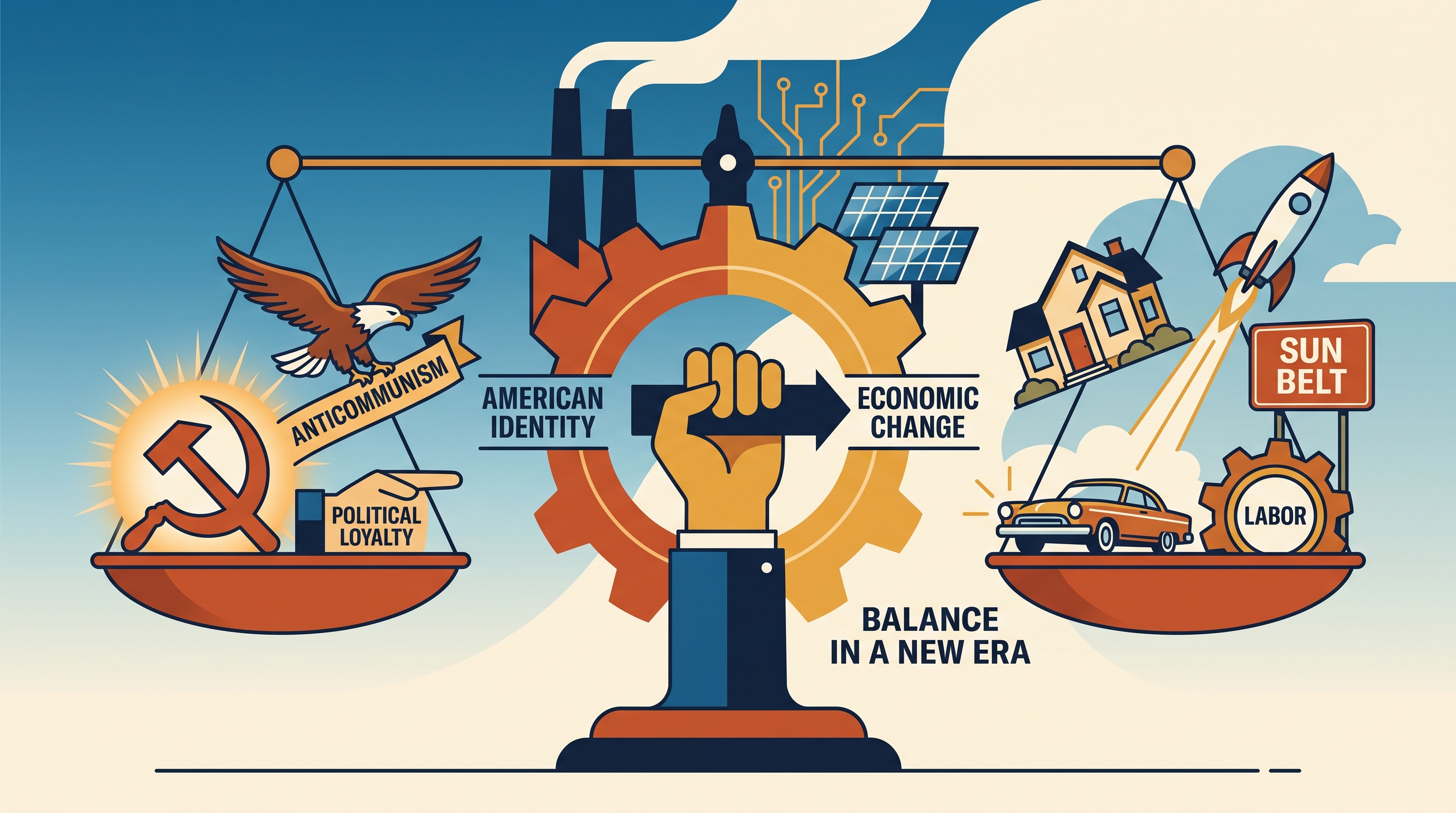
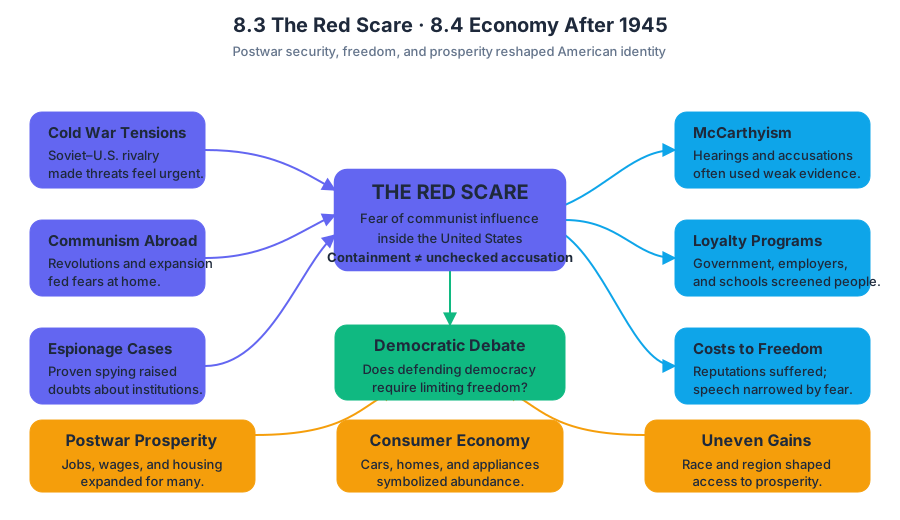
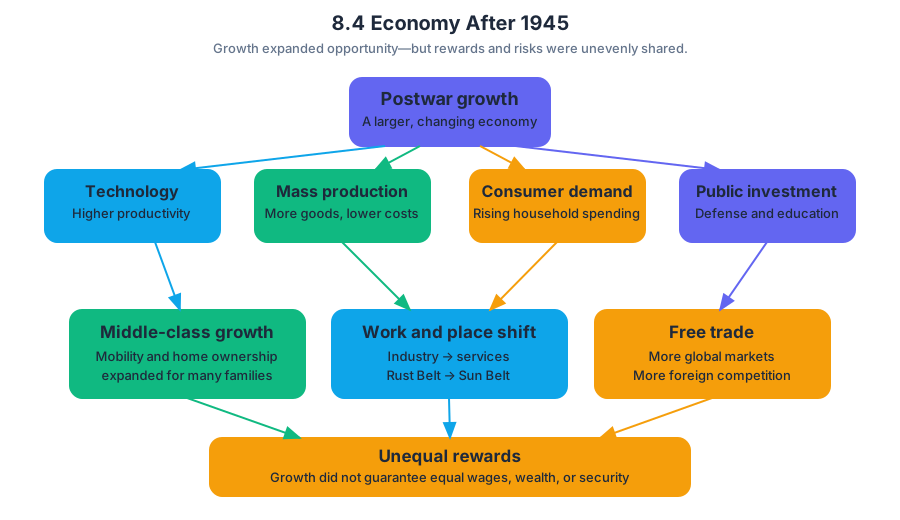
8.5 Culture After 1945 · 8.6 Early Steps in the Civil Rights Movement, 1940s and 1950s
Key concepts: Post-1945 mass culture and entertainment · Radio broadcasting and the Grand Ole Opry · Television’s portrayal of family and gender roles · Continuing resistance to desegregation · Civil rights activism and debates over nonviolence · Social and political unrest during the civil rights movement · The long civil rights movement from the World Wars to the 1960s · The March on Washington · Psychological struggle and civil rights institutions · Supreme Court enforcement of desegregation
After World War II, American culture became increasingly national: a radio broadcast, television program, or protest campaign could reach millions of people at once. That shared culture created both a reassuring image of postwar life and a powerful stage on which Americans confronted racial inequality.
8.5 Culture After 1945 · 8.6 Early Steps in the Civil Rights Movement, 1940s and 1950s
After World War II, American culture became increasingly national: a radio broadcast, television program, or protest campaign could reach millions of people at once. That shared culture created both a reassuring image of postwar life and a powerful stage on which Americans confronted racial inequality.
Mass culture and the “normal” postwar family
Mass culture means widely distributed entertainment and ideas produced for a large national audience. Radio remained influential after 1945, while television rapidly entered American homes. These media did not simply reflect society; they also presented models of what family life, gender behavior, and respectable citizenship supposedly looked like.
The Grand Ole Opry illustrates radio’s continuing cultural power. Broadcast from Nashville, the program turned country music into a national popular-culture institution. Its December 24, 1960, concert program shows how radio linked regional traditions to a broad American audience, carrying performances and images of rural identity into homes across the country.
Television often portrayed postwar stability through domestic comedy. Leave It to Beaver, for example, commonly presented the home as a secure suburban world organized around a breadwinning father, a homemaking mother, and children learning social rules under parental supervision. This image captured an important cultural ideal, but it did not describe every American family: women worked for wages, many families lived in poverty, and African American, immigrant, and working-class experiences were often minimized or excluded.
Key distinction: Popular media can reveal what a society valued or wanted to project without proving that everyone actually lived according to that image.
Civil rights activism: a longer movement
The civil rights movement did not suddenly begin in the 1960s. Its modern phase extended from the World Wars through the 1960s, as African American activists challenged discrimination through legal action, direct action, organizational work, and nonviolent protest. World War II intensified the contradiction between American claims about democracy and the reality of segregation, while postwar activism carried that contradiction into courts, workplaces, transportation systems, schools, and public spaces.
The CED identifies KC-8.2.I.A: during and after World War II, civil rights activists and leaders, especially Martin Luther King Jr., used several strategies against racial discrimination. Nonviolent protest means deliberately refusing physical violence while using marches, boycotts, sit-ins, prayer demonstrations, and related actions to expose injustice and pressure authorities. It was not passive acceptance; it required organization, discipline, publicity, and willingness to face arrest or violence without retaliating.
Law, resistance, and the limits of progress
Court victories could establish a constitutional principle, but local and state resistance often slowed its practical enforcement. Bailey v. Patterson (1962) held segregation in interstate bus terminals and related facilities unconstitutional. Because Bailey came after the central legal victories of the 1940s and 1950s, it is best understood as evidence of the continuing legal struggle: even after federal courts rejected transportation segregation, officials and institutions continued defending racial separation.
Resistance made desegregation uneven and dangerous. The CED’s KC-8.2.I.C explains that continuing resistance slowed desegregation and sparked social and political unrest nationwide. Violence, arrests, intimidation, and official obstruction convinced many activists that legal victories alone could not transform daily life.
The movement therefore contained strategic debates. Some activists supported nonviolence because it could expose the brutality of segregation, attract national attention, and build broad coalitions. Others increasingly questioned whether nonviolence produced results quickly enough, especially after 1965, when continued racial inequality and violence encouraged more militant approaches.
Worked connection: from protest to national unrest
Consider James Reeb, a minister and social worker who traveled to Selma, Alabama, to support the civil rights movement and was beaten there. His attack demonstrated that resistance was not merely an abstract disagreement over policy: people who entered the struggle could face deadly violence, and the violence itself could generate national outrage and political pressure.
Bayard Rustin’s account of the 1963 March on Washington emphasized a psychological struggle within the United States. The march sought not only legislation but also a change in how Americans understood citizenship, racial hierarchy, and national morality. In this sense, mass media and mass protest worked together: television and newspapers could make local injustice visible to a national audience, while public demonstrations challenged the comforting order portrayed by programs such as Leave It to Beaver.
AP historical reasoning
For Skill 4.B, Contextualization, connect postwar mass media and the civil rights movement to the larger setting of national expansion, federal constitutional authority, and heightened expectations of democracy after World War II. For Skill 5.A, Making Connections—Identify patterns of continuity and change, trace continuity in racial resistance alongside change in legal strategies, media visibility, and protest organization. The related Skill 5.B, Making Connections—Explain how a historical development or process relates to another historical development or process, is strongest when you explain the mechanism: resistance slowed desegregation, delayed equality, intensified protest, and contributed to wider social and political unrest.
Misconception check: The civil rights movement was not a single organization led by one person, and nonviolence did not mean that activists lacked anger or demands for structural change. It was a broad, evolving movement whose strategies and internal arguments changed as activists encountered legal victories, persistent resistance, and violence.
Retrieval check: Explain one way postwar mass culture created a shared national identity, then explain how civil rights activism challenged the racial assumptions hidden inside that identity. Include one legal strategy, one direct-action strategy, and one reason debates over nonviolence intensified after 1965.
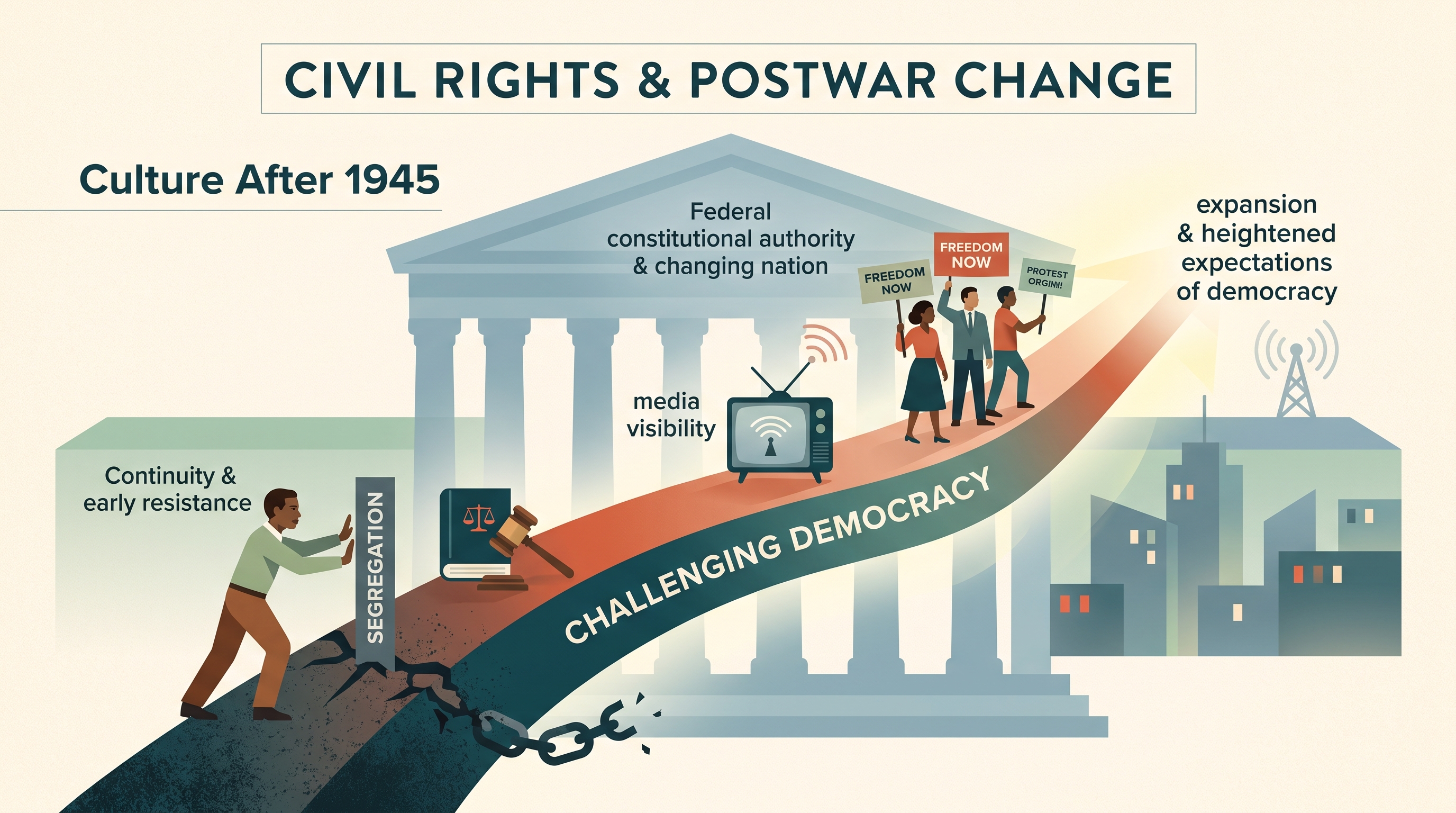
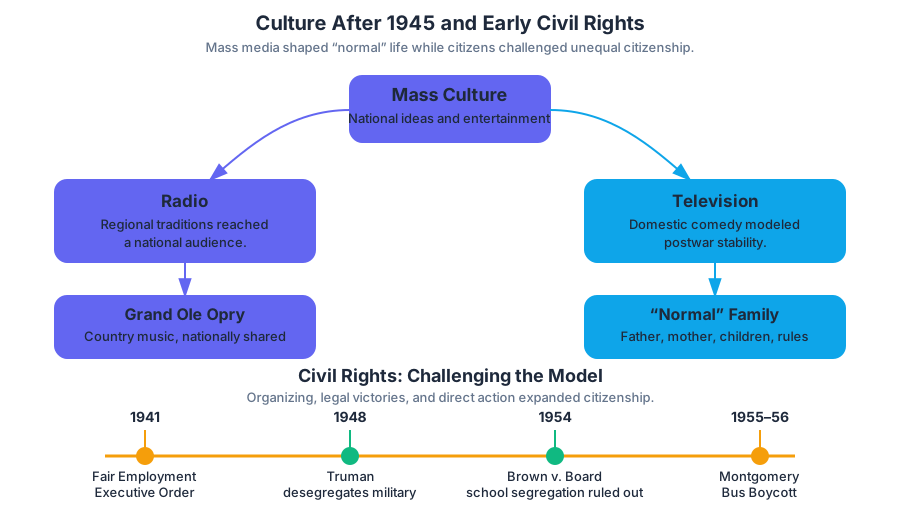
8.7 America as a World Power · 8.8 The Vietnam War
Key concepts: America’s increasingly important role in world affairs · Debates over U.S. internationalism and isolationism · Intervention to promote a vision of international order · Cold War competition · Diplomatic, economic, cultural, and military interactions among nations · U.S. strategic and economic interests in the Pacific Rim, Asia, and Latin America · The Vietnam War · Richard Nixon’s “Address to the Nation on the Vietnam War” · The relationship between U.S. policies toward Iran’s Mosaddegh and broader Cold War strategy
By the middle of the twentieth century, the United States had become a global power whose choices could reshape governments, economies, and wars far beyond North America.
8.7 America as a World Power · 8.8 The Vietnam War
By the middle of the twentieth century, the United States had become a global power whose choices could reshape governments, economies, and wars far beyond North America. The central question was no longer whether the United States could intervene abroad, but whether intervention, restraint, or withdrawal would best protect American security and define a stable international order.
From isolationist debate to global leadership
Isolationism means avoiding permanent political and military commitments overseas. During the 1930s, many Americans favored this approach after the enormous casualties and disappointing peace settlement that followed World War I. Policymakers nevertheless debated whether modern threats made neutrality unrealistic: economic interdependence, authoritarian expansion, and the security of the Western Hemisphere increasingly connected American interests to events abroad.
World War I and its aftermath intensified this argument. The United States participated in the war but rejected membership in the League of Nations, illustrating a lasting tension: Americans might support military action in an emergency while resisting institutions that seemed to limit national independence. By World War II, however, the combination of Axis aggression and the consequences of delayed action helped shift public and governmental opinion toward sustained international involvement.
After 1945, victory over the Axis powers placed the United States in a position of global political and military leadership. Internationalism—active participation in world affairs—now shaped policy through alliances, economic programs, diplomacy, intelligence operations, and military power. The Cold War was therefore not merely a contest of armies. It was a worldwide competition involving diplomatic pressure, economic assistance and sanctions, cultural influence, competing political systems, and direct or indirect military conflict.
Interests and intervention
U.S. leaders often justified intervention as containment, the effort to prevent the spread of communism rather than immediately overthrow every communist government. Yet containment was applied flexibly. American interests included the security of the Pacific Rim, access to Asian and Latin American markets, and the protection of natural resources and trade routes. In Latin America, the United States supported non-Communist regimes with varying commitments to democracy, revealing a recurring contradiction between defending “the free world” and cooperating with authoritarian governments.
A useful comparison is the U.S. response to Iranian prime minister Mohammad Mosaddegh in 1953. Fearing communist influence and concerned about oil interests, the United States supported covert efforts that helped remove Mosaddegh and strengthened the shah. This approach relied on secret intervention and regime change; Vietnam eventually involved a much larger, prolonged American military commitment. In both cases, officials interpreted local political conflict through the Cold War, but the scale, visibility, and consequences of the interventions differed sharply.
Key insight: Cold War policy was not driven by ideology alone. Security fears, economic interests, resource concerns, regional alliances, domestic politics, and assumptions about American credibility interacted.
Vietnam: containment becomes escalation
Vietnam exposed the dangers of treating every nationalist or revolutionary movement as part of a single Soviet-led conspiracy. After the division of Vietnam, the United States supported South Vietnam against communist North Vietnam and the Viet Cong. American presidents increased aid and advisers before committing large combat forces under Lyndon Johnson. The Gulf of Tonkin incident in 1964 provided political justification for expanded military action, and bombing and troop escalation followed.
The war became a test of competing claims about international order. U.S. officials argued that abandoning South Vietnam might encourage further communist expansion and weaken American credibility with allies. Opponents argued that Vietnamese nationalism, colonial history, civil war, and local political conditions could not be solved by overwhelming American force. The Tet Offensive of 1968, although costly for communist forces, undermined public confidence by showing that military strength had not produced a clear victory.
Richard Nixon’s “Address to the Nation on the Vietnam War” reflected an attempt to manage this crisis rather than simply intensify it. His policy of Vietnamization shifted increasing responsibility for combat to South Vietnamese forces while the United States reduced its ground presence, combined with continued diplomacy and military pressure. The approach sought to balance withdrawal, preservation of American credibility, and the goal of an acceptable settlement.
Skill application: Skill 1 and Skill 6
Skill 1: Developments and Processes asks students to explain how American foreign policy developed over time. A strong explanation traces a process: 1930s isolationist debate → World War II global leadership → Cold War containment → intervention in regional conflicts → reassessment after Vietnam.
Skill 6: Argumentation requires a defensible claim supported by evidence and reasoning. For example: Although Cold War intervention was presented as a defense of international order, U.S. actions in Iran and Vietnam also reflected economic interests, credibility concerns, and assumptions that local conflicts were extensions of global communism.
Misconception check
Misconception: “The Vietnam War was simply a military failure.” Military outcomes mattered, but the deeper problem involved political legitimacy, inaccurate assumptions about Vietnamese nationalism, public distrust, domestic opposition, and the limits of American power. A complete explanation connects battlefield developments to diplomatic, cultural, economic, and political consequences.
Retrieval and interpretation check
- Why did World War I intensify debates over U.S. involvement overseas?
- Name two dimensions of Cold War competition besides military conflict.
- How did Vietnamization differ from the approach used against Mosaddegh?
- In one sentence, explain how the Vietnam War challenged the assumption that intervention could reliably produce a favorable international order.
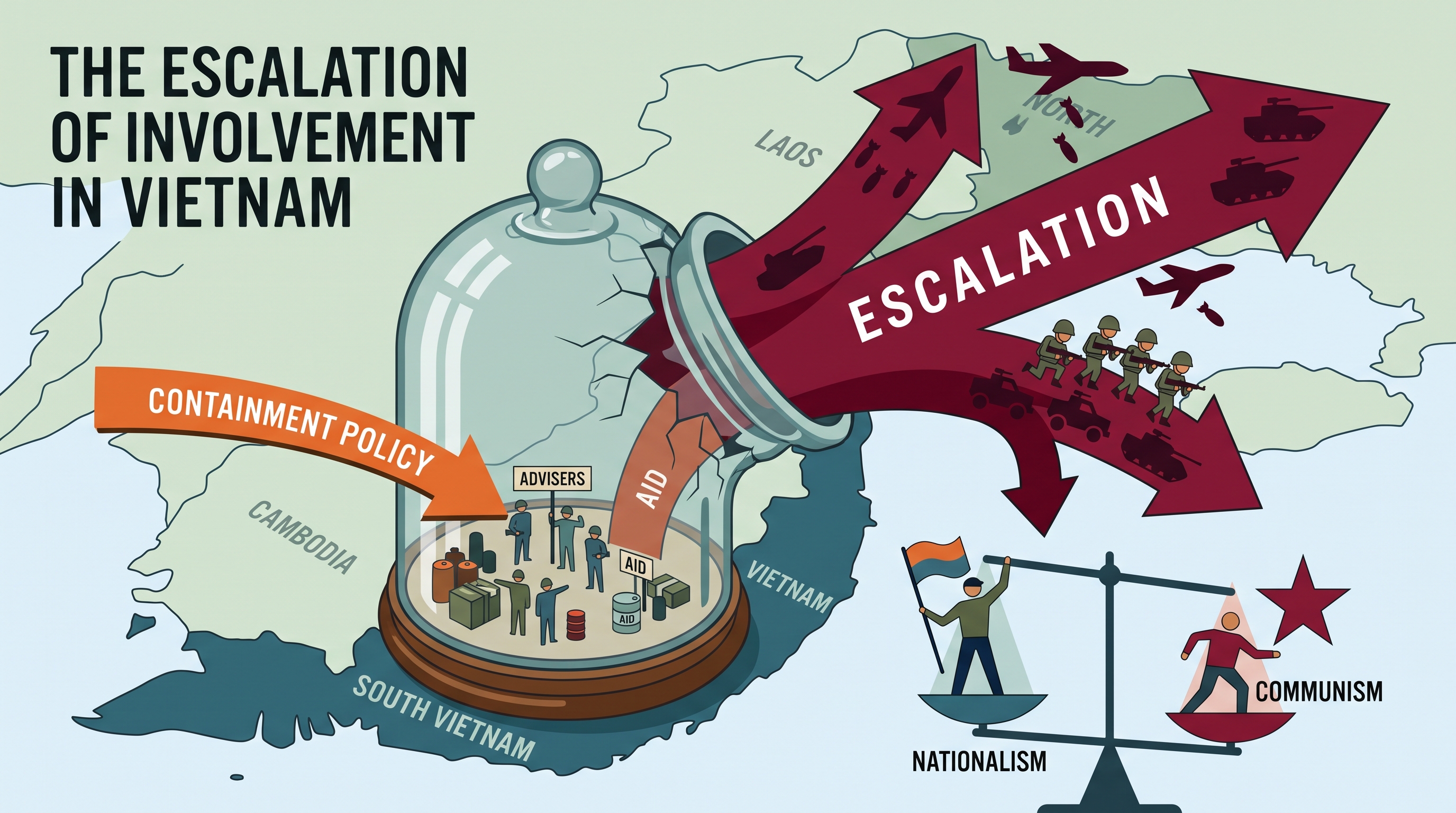
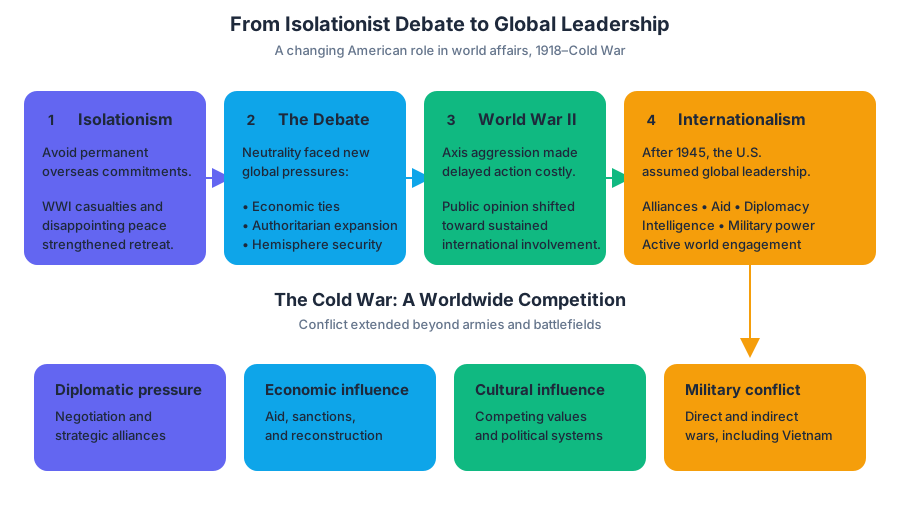
8.9 The Great Society · 8.10 The African American Civil Rights Movement in the 1960s
Key concepts: African American civil rights and voting rights · Political exclusion based on race and property · African American communities and institution-building · Abolitionism and African American self-determination · Sharecropping and post-emancipation landlessness · Reform organizations and voluntary associations · Women’s suffrage activism · Labor reform and working-class political organizing · Farmers’ Alliance and interracial labor politics · Racialized legal inequality in court testimony
The Great Society expanded the federal government’s responsibility for health, education, poverty, and civil rights, while African American activists transformed demands for equal citizenship into enforceable national law.
8.9 The Great Society · 8.10 The African American Civil Rights Movement in the 1960s
The Great Society expanded the federal government’s responsibility for health, education, poverty, and civil rights, while African American activists transformed demands for equal citizenship into enforceable national law. The central question is not simply what changed in the 1960s? but why did federal power expand—and why did legal victories fail to eliminate racial inequality?
Key Concept KC-8.2: New movements for civil rights and liberal efforts to expand the role of government generated a range of political and cultural responses.
From political exclusion to claims of citizenship
Political participation in the United States was never automatically universal. A state legislature that limited voting in 1807 to White male citizens who paid taxes illustrates how race, gender, property, and wealth could define the political community. The Pennsylvania State Constitution of 1776 reflected revolutionary arguments about politics, religion, and society, but changing ideals did not immediately produce equal access to power.
African American communities responded to exclusion by building institutions of their own. In 1841, James Willson described prosperous African American families in Philadelphia organizing leisure activities and sustaining a distinct free Black community. Churches, schools, newspapers, mutual-aid societies, and voluntary associations created leadership and resources that later movements could use.
Self-determination, abolitionism, and the long struggle for rights
Abolitionism opposed slavery, but many African American activists demanded more than emancipation: they sought education, economic independence, political equality, and control over their communities’ futures. In The Condition, Elevation, Emigration, and Destiny of the Colored People, Martin Delany advocated African American advancement, considered emigration, and emphasized self-determination. His argument reveals an important distinction: freedom from legal bondage did not guarantee the power or resources needed for genuine independence.
After emancipation, formerly enslaved people commonly pursued landownership because land could provide economic security and political autonomy. Yet most failed to achieve self-sufficiency. Sharecropping, a system in which farmers worked land in exchange for a share of the crop while often buying supplies on credit, trapped many families in debt and restricted access to land. This economic dependence helped preserve racial hierarchy even after slavery ended.
Misconception check: Emancipation ended slavery, but it did not automatically redistribute land, eliminate racial violence, or create equal political power.
Women’s suffrage and political citizenship
Women’s suffrage activists challenged the assumption that citizenship belonged primarily to men. The National Woman Suffrage Association (NWSA), formed in 1869, sought women’s voting rights alongside broader reforms. Its strategy treated voting as a national constitutional question, while other suffrage activists favored state-by-state campaigns and closer cooperation with existing political organizations.
Suffrage activism used petitions, public speeches, conventions, legal challenges, organizational constitutions, and civil disobedience. Susan B. Anthony’s prosecution for voting illegally in 1872 dramatized the argument that women were citizens whose political rights were being denied. Myra Bradwell’s unsuccessful challenge in Bradwell v. Illinois similarly showed that formal citizenship did not necessarily provide women equal access to professions or public authority.
African American women faced a dual burden of racism and sexism. Frances E. W. Harper’s “We Are All Bound Up Together” insisted that reform movements could not treat women’s rights and racial justice as unrelated struggles. Women’s organizations therefore became important voluntary associations: they linked voting, education, temperance, family welfare, and civil rights rather than treating suffrage as an isolated demand.
Labor reform and working-class organizing
Industrial workers also organized to challenge unequal power. The Lowell Female Labor Reform Association represented women workers’ efforts to demand better workplace conditions, including limits on exhausting hours and greater protection from employer abuses. Its existence demonstrates that women were not merely subjects of reform; they were political actors who connected workplace demands to broader claims about citizenship and human dignity.
Reformers formed voluntary organizations, groups created outside government to change individual behavior or social conditions. Temperance organizations, labor associations, women’s groups, churches, and mutual-aid societies used meetings, petitions, publications, and coordinated pressure to pursue reform. Some emphasized personal morality, while others argued that employers, corporations, and governments had to change the structures producing poverty and exploitation.
Working-class political organizing also exposed the limits of reform coalitions. Reverend J. L. Moore called for a political party representing farmers and laborers regardless of race because Black workers’ needs were being ignored at the ballot box. Yet racial exclusion, gender discrimination, unequal property access, and legal barriers repeatedly divided workers who shared economic grievances. California Chief Justice Hugh Murray’s ruling that Chinese immigrants could not testify against White citizens demonstrates how racialized law weakened equal protection and restricted the political standing of non-White workers.
The Great Society and civil rights law
By the 1960s, African American activists had built on generations of institution-building, legal challenges, boycotts, voter-registration drives, direct action, and appeals to federal authority. The federal government responded with major legislation: the Civil Rights Act of 1964 attacked segregation and discrimination in public accommodations and employment, while the Voting Rights Act of 1965 strengthened federal protection against racial barriers to voting.
President Lyndon B. Johnson’s Great Society extended liberal government through programs such as Medicare, Medicaid, federal education aid, and the War on Poverty. These initiatives reflected the belief that government could expand opportunity when local institutions and private charity were insufficient. Civil rights legislation and social-welfare programs therefore shared a political premise: national power could confront inequalities embedded in states, workplaces, schools, and markets.
The results were substantial but incomplete. Legal segregation weakened, African American voting rights gained federal protection, and access to public institutions expanded. At the same time, poverty, residential segregation, unequal schooling, economic discrimination, and racialized policing persisted. The strongest historical argument therefore explains both change—new legal and political protections—and continuity—the survival of unequal social and economic structures.
AP historical reasoning in this topic
- Skill 1: Developments and Processes: Trace how institution-building, reform associations, and activism developed into federal civil rights action.
- Skill 2: Sourcing and Situation: Analyze how Delany, Harper, Anthony, or Moore shaped arguments according to audience, purpose, and historical position.
- Skill 3: Claims and Evidence in Sources: Use a source’s specific argument as evidence rather than merely naming it.
- Skill 4: Contextualization: Connect 1960s activism to earlier exclusion, abolitionism, sharecropping, and voluntary organizing.
- Skill 5: Making Connections: Explain how civil rights, women’s suffrage, labor reform, and liberal government shared conflicts over political citizenship.
- Skill 6: Argumentation: Build a qualified claim showing that activism produced major legal change while failing to erase racial and economic inequality.
Retrieval check: Explain one way African American institution-building prepared later civil rights activism. Then identify one reason the Great Society expanded opportunity and one reason its programs did not produce full equality. Finally, distinguish the goals of the NWSA from a workplace reform organization such as the Lowell Female Labor Reform Association.
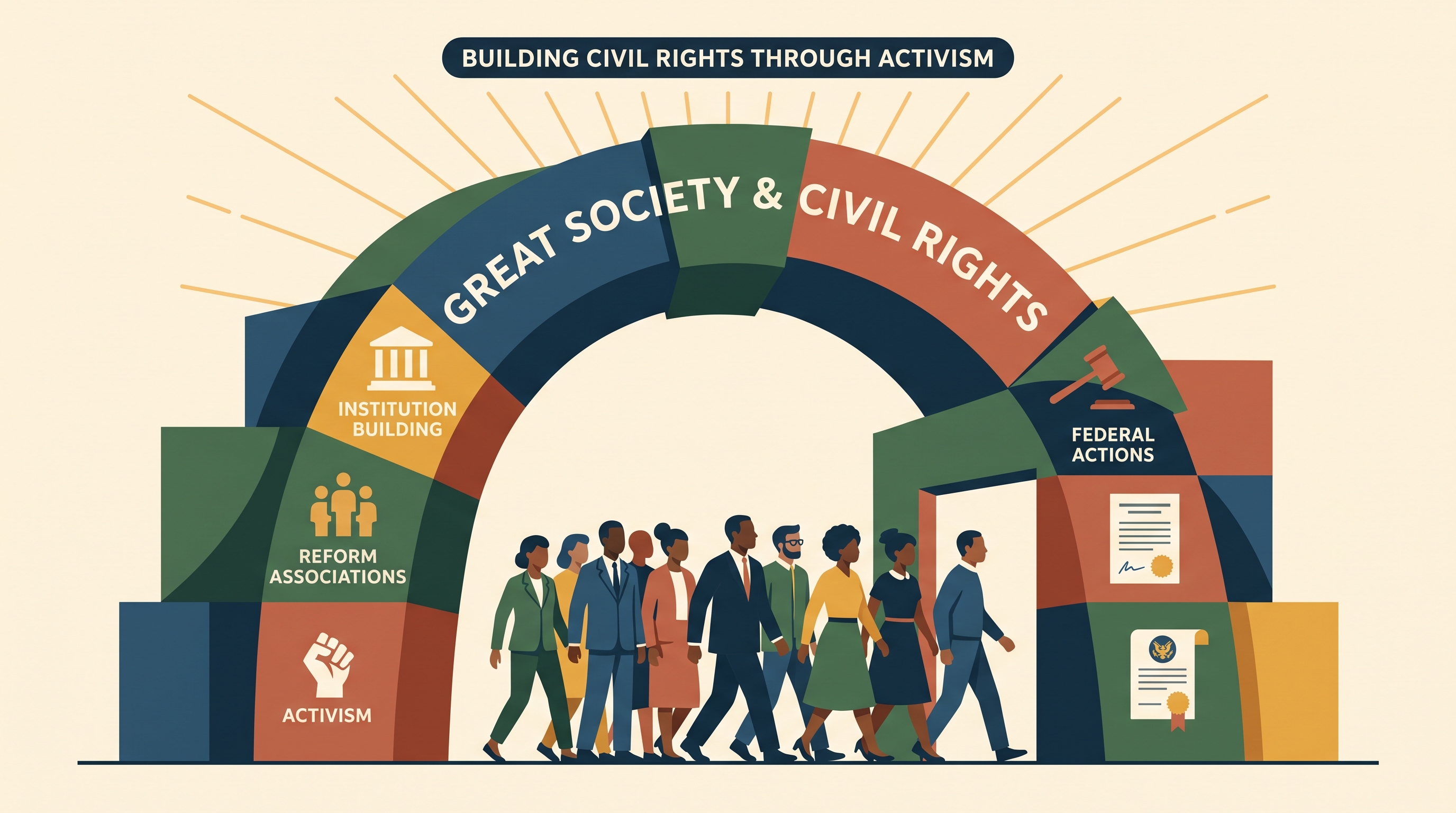
8.11 The Civil Rights Movement Expands · 8.12 Youth Culture of the 1960s
Key concepts: Expansion of the Civil Rights Movement, 1960–1980 · Latino and Chicano civil rights activism · United Farm Workers · Cesar Chavez · Dolores Huerta · Farm workers’ poor working conditions · Brown Berets and militant activism · Martin Luther King Jr.’s opposition to or decision regarding the Vietnam War · Kent State shootings, May 4, 1970 · 1960s youth culture and commercial dance halls
By 1968, civil rights activism had moved far beyond a single movement or community. Latino farm workers, Chicano students, American Indian activists, antiwar demonstrators, and young people challenging social conventions all demanded a broader meaning of equality, dignity, and political power.
8.11 The Civil Rights Movement Expands · 8.12 Youth Culture of the 1960s
By 1968, civil rights activism had moved far beyond a single movement or community. Latino farm workers, Chicano students, American Indian activists, antiwar demonstrators, and young people challenging social conventions all demanded a broader meaning of equality, dignity, and political power. The sharp question is: why did the language of civil rights expand so dramatically between 1960 and 1980?
Expansion of civil rights activism
The African American civil rights movement created a powerful political vocabulary—rights, equality, self-determination, and freedom from discrimination. Other groups adapted that vocabulary to problems that were specific to their own experiences. This was not simply imitation: activists connected racial discrimination to labor exploitation, cultural invisibility, unequal schooling, police violence, and exclusion from political decision-making.
Key idea: The expansion of the Civil Rights Movement meant that more groups claimed rights through organized activism, while also redefining what civil rights required in their own communities.
A useful historical connection is that earlier federal civil rights victories supplied legal and moral leverage, but those victories did not automatically eliminate inequality. Activists therefore shifted from demanding formal access—such as the right to vote or attend public facilities—to demanding economic justice, cultural recognition, and community control.
Latino and Chicano activism
Mexican American activists developed the Chicano Movement, a broad campaign for Mexican American political power, cultural pride, educational equality, and improved working and living conditions. The movement’s name itself challenged the assumption that Mexican Americans should assimilate quietly into an Anglo-American culture. Chicano activists instead asserted that their history, language, and identity belonged at the center of American public life.
The United Farm Workers (UFW) demonstrated how civil rights and labor rights could reinforce one another. Cesar Chavez and Dolores Huerta organized agricultural workers, especially in California, to challenge low wages, racial discrimination, unsafe conditions, and the weak bargaining position of seasonal laborers. The Delano Grape Strike became a national struggle because the UFW sought support from consumers and residents beyond the fields.
Huerta’s 1968 interview with Maria Huffman is valuable historical evidence because it directs attention to workers’ lived experiences. Farm workers faced poor working conditions and racial discrimination; their work was essential to agricultural production, yet their labor often brought insecurity rather than economic stability. Chavez’s 1968 open letter to Los Angeles supporters shows the movement’s strategy: build public pressure, sustain the grape strike, and turn a local labor dispute into a wider civil rights issue.
The Brown Berets represented a more militant branch of Chicano activism. Their activism, alongside the broader Chicano Movement, illustrates how civil rights groups increasingly linked identity, community defense, education, and economic justice rather than limiting their demands to courtroom equality.
Misconception check
Misconception: “The UFW was only a labor union.” The UFW certainly organized workers, but its demands also confronted racial discrimination and unequal power. On an AP question, the strongest answer explains the connection: farm workers used labor organizing as a vehicle for civil rights and economic justice.
Youth culture and opposition to war
Youth culture in the 1960s challenged established expectations about authority, consumption, sexuality, music, clothing, and political participation. Young people created or expanded public spaces—including dance halls and dance palaces—that served as social environments for female patrons and working-class youth. These spaces mattered because they allowed young people to form identities and relationships outside older institutions’ control.
Youth politics became especially visible in opposition to the Vietnam War. Martin Luther King Jr.’s involvement in discussions about the war showed that opposition to militarism could be connected to civil rights: money and political attention devoted to Vietnam could compete with efforts to address poverty and racial inequality. The antiwar movement therefore contained both moral arguments against the war and criticisms of federal priorities.
The May 4, 1970, Kent State shootings intensified distrust of government authority. After President Nixon announced that American and allied troops had entered Cambodia, unrest spread on campuses. The Ohio National Guard was sent to quell the protests, and four students were killed. John Paul Filo’s photograph captures the emotional aftermath, making the event a powerful example of how visual evidence can communicate grief, shock, and the human cost of political conflict.
How to analyze evidence
Use the AP historical thinking skills 2.A Sourcing and Situation and 2.B Sourcing and Situation by asking who created a source, when, for whom, and under what circumstances. Huerta’s interview gives access to a farm worker movement’s concerns; Chavez’s open letter reveals an organizing strategy; Filo’s photograph documents the aftermath of state violence but does not, by itself, explain every cause of the protest.
Use 3.A Claims and Evidence in Sources and 3.B Claims and Evidence in Sources to connect evidence to an argument. Use 4.A Contextualization to place Latino activism and youth protest within the larger expansion of civil rights after 1960. Use 5.A Argumentation to make a defensible claim rather than merely listing movements.
Worked example: Claim: From 1960 to 1980, civil rights activism expanded because groups applied earlier rights language to economic, cultural, and foreign-policy conflicts. Evidence: Huerta described farm workers’ poor conditions and discrimination; Chavez mobilized public support for the grape strike; Kent State revealed the widening conflict between youth protest and government authority. Reasoning: these examples show that civil rights activism increasingly addressed the distribution of power in workplaces, communities, and national policy.
Retrieval check
- How did the UFW connect labor rights to civil rights?
- Why is Huerta’s 1968 interview useful evidence?
- What did the Kent State shootings reveal about youth protest and government authority?
- How did youth culture create spaces for social independence?
A complete response should identify the group or event, explain its specific grievance, and connect it to the broader expansion of civil rights between 1960 and 1980.

8.13 The Environment and Natural Resources, 1968–1980 · 8.14 Society in Transition
Key concepts: Environmental problems and public policy, 1968–1980 · Geography and the Environment (GEO) · Competition over natural resources · The 1970s energy crisis · Creation and scope of the Federal Energy Administration · The Cuyahoga River fires · The Love Canal toxic-waste controversy · The Three Mile Island nuclear accident · Earth Day and environmental activism · Making connections by identifying patterns among environmental incidents and subsequent policies
Environmental accidents in the late 1960s and 1970s transformed pollution and energy use from local concerns into national political problems. The central question was no longer simply who caused the damage?
8.13 The Environment and Natural Resources, 1968–1980 · 8.14 Society in Transition
Environmental accidents in the late 1960s and 1970s transformed pollution and energy use from local concerns into national political problems. The central question was no longer simply who caused the damage? but also what authority should government use to prevent, investigate, and repair it?
Geography and the Environment (GEO): Geographic conditions and competition over natural resources shaped American development while producing conflicts over pollution, energy supplies, public health, and the proper scope of government action.
From environmental concern to public policy
The environmental movement connected visible local damage to national debates about responsibility. Earth Day activities—including the first and second Earth Days—made environmental protection a public issue, while Rachel Carson’s earlier warnings in Silent Spring helped Americans recognize that industrial chemicals could create long-term ecological and health dangers.
The period’s environmental concerns included toxic pollution and nuclear-power safety. These problems differed in appearance and scale, but they shared an important political pattern: residents, journalists, scientists, and activists demanded that government communicate risks and intervene before private or public institutions caused further harm.
The energy crisis and the Federal Energy Administration
The energy crisis of the 1970s contributed to the creation of the Federal Energy Administration (FEA). Its importance lay in its national coordinating role: energy production, transportation, prices, and fuel distribution affected every region, so a fragmented response could leave communities competing for scarce supplies.
The FEA’s scope included collecting and organizing energy information, coordinating national energy policy, administering fuel-allocation and pricing measures, and promoting conservation. In practice, this meant that the federal government could monitor shortages, help determine where fuel should go, manage emergency rules, and encourage reduced consumption rather than treating energy as only a private-market issue.
Roger Anders’s 1980 report, “The Federal Energy Administration,” provides historical context for the agency’s implementation and scope. The key historical development is the expansion of federal administrative capacity: an energy shortage encouraged the government to build an institution capable of managing a national resource problem.
Misconception check: The FEA was not simply an agency that “found more oil.” Its central function was coordination and regulation—gathering information, allocating fuel, addressing prices, and supporting conservation during a national crisis.
Three environmental accidents, three kinds of harm
The Cuyahoga River fires, Love Canal, and Three Mile Island illustrate different environmental threats and different demands for policy response.
| Incident | Main danger | What made it politically powerful | Likely policy response |
|---|---|---|---|
| Cuyahoga River fires | Industrial pollution in a river | A river visibly catching fire made water contamination impossible to ignore | Cleanup efforts and stronger water-pollution controls |
| Love Canal | Buried chemical waste contaminating a residential area | Residents reported health concerns and demanded relocation and government action | Investigation, public communication, intervention, and relocation demands |
| Three Mile Island | Nuclear-power safety failure | The accident raised fears about invisible radiation exposure and the safety of nuclear energy | Greater scrutiny of reactor safety, emergency planning, and regulation |
Love Canal: contamination and failed communication
Love Canal was a toxic-waste contamination controversy, not a controversy about “toxic radiation.” Buried chemical waste beneath a residential community produced fears about contamination and suspected health effects. Residents sought government intervention and, for some families, relocation from the affected area.
Loretta Gambino’s April 5, 1979 testimony described inadequate government intervention and communication. Her testimony matters because it shows that an environmental crisis involves more than physical contamination: residents also need reliable information, a clear authority responsible for action, and meaningful participation in decisions affecting their safety.
Three Mile Island and public trust
The Three Mile Island nuclear-power-plant accident occurred on March 28, 1979. Unlike the Cuyahoga fires, which produced highly visible flames, Three Mile Island generated fear about a technological system whose dangers were difficult for ordinary residents to observe or evaluate.
The comparison reveals a broader pattern. Each incident exposed a gap between modern economic activity and public safeguards; each prompted demands for investigation or policy action; and each made government credibility part of the crisis. Yet the effects differed because river pollution, buried chemical waste, and nuclear-power failure involved different pathways of harm, evidence, and public fear.
AP historical reasoning: Skill 5.A
5.A: Making Connections means identifying patterns among or connections between historical developments and processes. A strong connection does not merely say that three events were “similar.” It explains the shared mechanism and preserves the differences.
Worked example: The Cuyahoga fires made industrial water pollution visible; Love Canal made buried chemical contamination a residential and public-health issue; Three Mile Island made nuclear safety and government communication central concerns. Together, these events show how environmental problems between 1968 and 1980 expanded the expected responsibilities of government from reacting to damage toward monitoring risk, communicating danger, and coordinating national policy.
Retrieval check: Which incident involved buried chemical waste? What responsibility did the FEA exercise that was broader than local cleanup? Finally, state one similarity and one difference among the Cuyahoga River fires, Love Canal, and Three Mile Island. A complete answer should identify Love Canal, explain national energy coordination, and connect the accidents to policy responses while distinguishing their forms of harm.
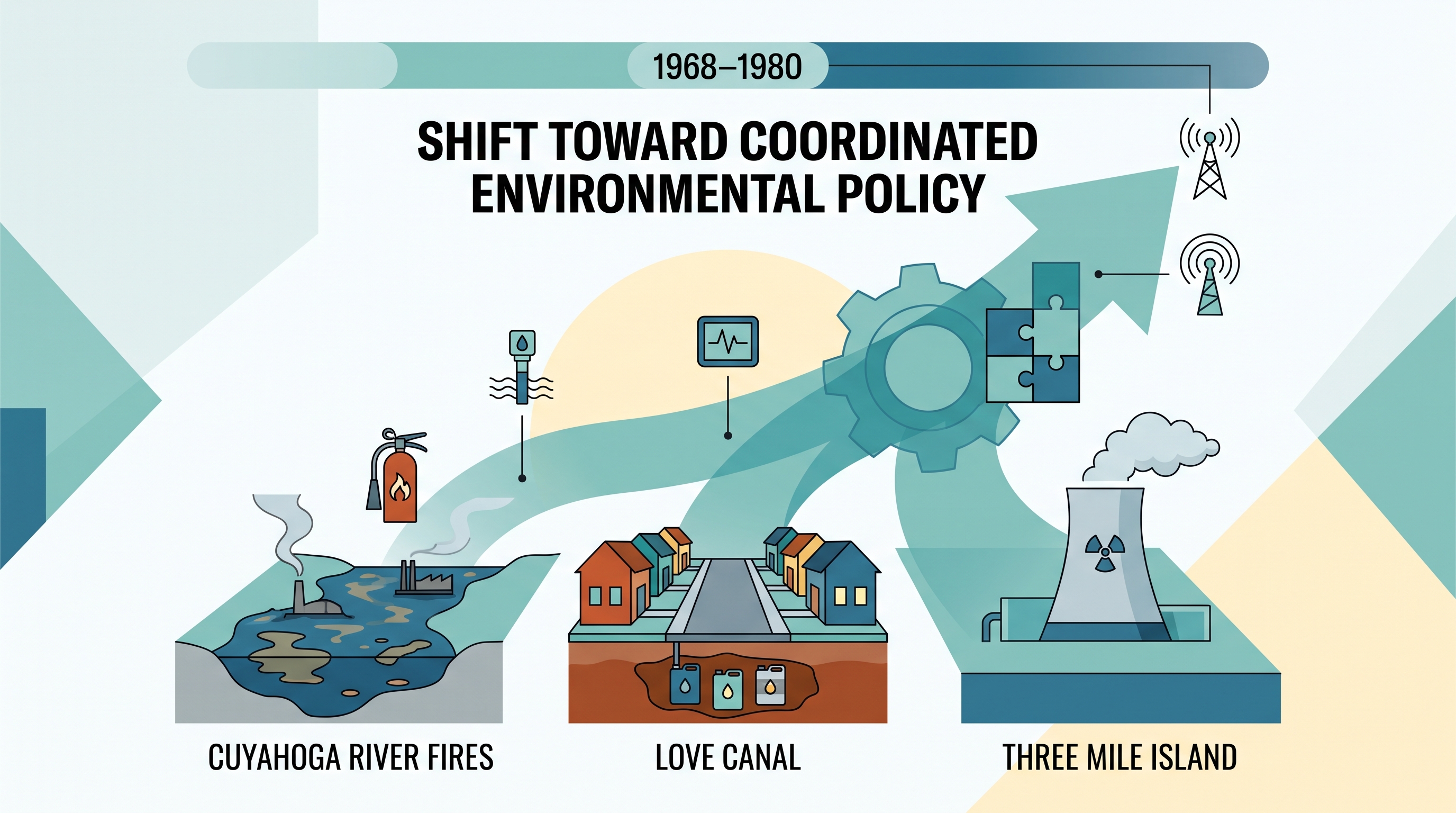
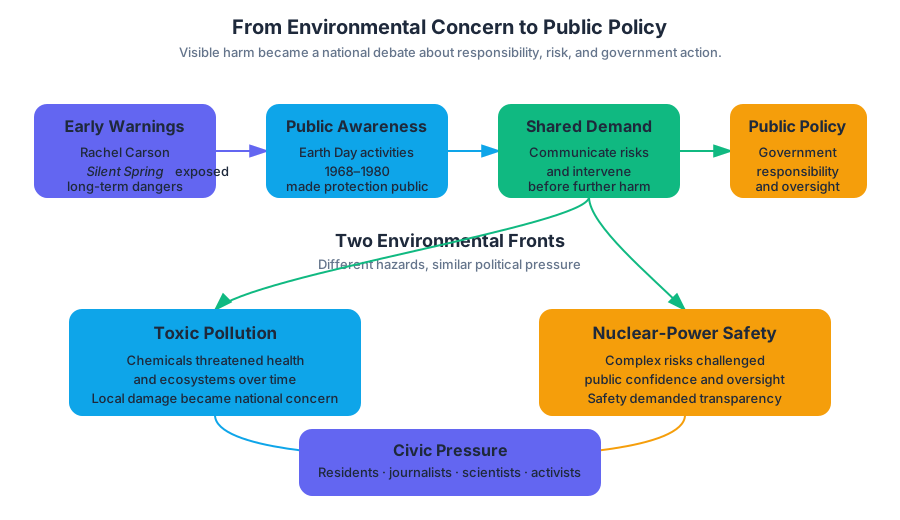
8.15 Continuity and Change in Period 8
The United States changed dramatically between 1945 and 1980, yet many older patterns—racial inequality, economic competition, global power politics, and debates over federal authority—remained remarkably persistent.
8.15 Continuity and Change in Period 8
The United States changed dramatically between 1945 and 1980, yet many older patterns—racial inequality, economic competition, global power politics, and debates over federal authority—remained remarkably persistent. The central historical problem is therefore not whether the period changed, but which developments changed, which continued, and why.
8.15 Continuity and Change in the Period 8 asks you to weigh transformation against persistence across 1945–1980 rather than treating the period as one uninterrupted “modern” revolution.
The period at a glance
| Dimension | Major change, 1945–1980 | Important continuity |
|---|---|---|
| Politics and power | The federal government expanded its role through civil rights and Great Society programs, while later resistance challenged that expansion. | Americans continued debating how much power the federal government should possess. |
| American identity | Civil rights activism broadened public claims about equality and citizenship. | Racial discrimination and unequal access to power persisted despite legal victories. |
| America in the world | The United States became a permanent global superpower engaged in containment and military alliances. | Fear of communism continued to shape foreign and domestic policy. |
| Work, exchange, and technology | Postwar prosperity, automation, consumer culture, and deindustrialization reshaped daily life. | Economic inequality and conflict between labor and management remained. |
| Migration and settlement | Suburbanization, Sun Belt growth, and immigration transformed population patterns. | Migration continued to reflect economic opportunity and racial or political pressure. |
| Culture and society | Youth culture, feminism, Black nationalism, and other movements challenged older social norms. | Social movements still faced institutional resistance and unequal treatment. |
How to reason about continuity and change
Continuity means an important pattern remains recognizable across time. Change means a development alters institutions, relationships, beliefs, or lived experiences. Strong historical analysis does not merely list examples; it explains the extent of change and identifies the forces producing both outcomes.
A useful method is to build a three-part argument:
- Identify the baseline: What pattern existed around 1945?
- Measure the change: What was different by 1980?
- Qualify the claim: What persisted, limited, or redirected that change?
For example, civil rights produced major political change. Supreme Court decisions, federal legislation, and presidential enforcement weakened legalized segregation and expanded voting protections. Yet the persistence of residential segregation, economic inequality, and resistance to integration shows that legal transformation did not immediately create social equality.
Worked contextual example: federal power
In 1945, the federal government already possessed enormous authority because of the New Deal and World War II. Between 1945 and 1980, that authority expanded further through Brown v. Board of Education, the Civil Rights Act of 1964, the Voting Rights Act of 1965, Medicare, Medicaid, and other Great Society programs.
However, the direction of federal power changed by the 1970s. Opposition to busing, taxation, regulation, and welfare programs helped fuel a conservative political reaction. The continuity was the persistent national argument over federal intervention; the change was that the federal government moved from primarily managing economic crisis and war to directly confronting racial inequality and administering broader social programs.
Historically defensible claim: From 1945 to 1980, federal power expanded substantially in its responsibilities for civil rights and social welfare, but the legitimacy and limits of that expansion remained contested, producing a conservative backlash by the end of the period.
Skill focus: 6.D — Corroborate, qualify, or modify an argument
Topic 8.15 is aligned with Skill 6.D — Corroborate, Qualify, or Modify an Argument. To earn this skill, do more than attach a second fact to your claim. Use evidence that confirms the argument, reveals an exception, or forces a more precise conclusion.
Weak reasoning: “The civil rights movement changed America because segregation became illegal.”
Stronger reasoning: “The movement transformed federal law by outlawing segregation and protecting voting rights, but its effects were limited by local resistance, economic inequality, and continuing residential segregation. Thus, it changed the legal meaning of equality more quickly than it changed everyday social conditions.”
Common misconception
Misconception: “Continuity” means that nothing changed. In historical writing, continuity can coexist with major transformation. The civil rights era changed laws and political expectations while preserving many unequal economic and social structures.
Retrieval and interpretation check
Prompt: Which argument best demonstrates continuity and change in Period 8?
A. The United States experienced change in every area of life after 1945.
B. The period was mostly continuous because older problems remained.
C. Federal civil rights intervention marked major political change, but persistent inequality limited the transformation’s reach.
D. Cultural change mattered more than political change because youth culture expanded.
Answer: C. It identifies a specific change, supplies a continuing pattern, and qualifies the overall judgment—the core reasoning required by Skill 6.D.
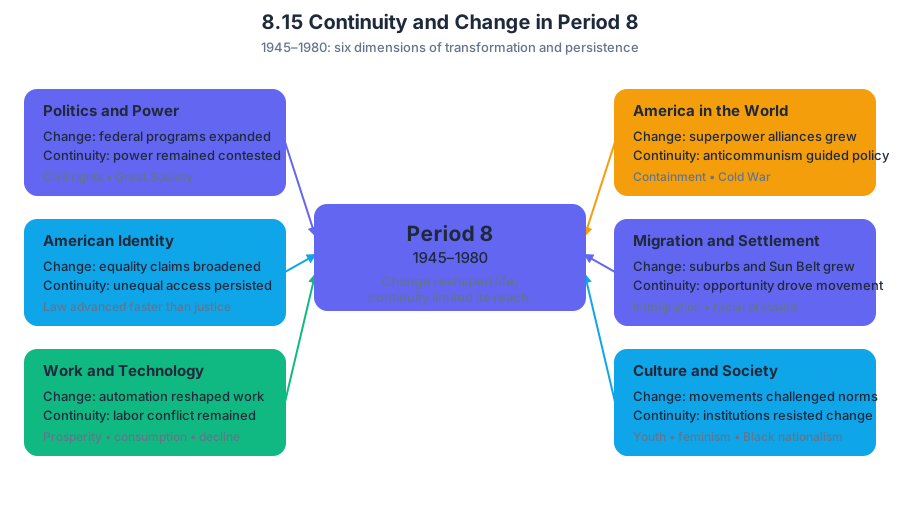
9.1 Contextualizing Period 9 · 9.2 Reagan and Conservatism
By 1980, many Americans no longer trusted the post–World War II political formula that had dominated national life: expanding federal programs, rising expectations of economic growth, and an active United States role in world affairs.
9.1 Contextualizing Period 9 · 9.2 Reagan and Conservatism
By 1980, many Americans no longer trusted the post–World War II political formula that had dominated national life: expanding federal programs, rising expectations of economic growth, and an active United States role in world affairs. Ronald Reagan’s election did not create this dissatisfaction; it converted decades of conflict over government, culture, race, and foreign policy into a powerful conservative movement.
Investigative question: Why did conservatism become such a successful national political force by 1980, and what did the Reagan presidency change?
9.1 Contextualizing Period 9: 1980–Present
The period beginning in 1980 emerged from several overlapping developments. Since the New Deal, the federal government had taken greater responsibility for economic security through programs such as Social Security and had expanded its role further during the Great Society. At the same time, the civil rights movement, the women’s movement, student activism, and other movements challenged older social arrangements. These changes expanded rights but also produced a conservative reaction among Americans who believed that federal power, social protest, and cultural change had moved too far.
The 1970s intensified this reaction. The Vietnam War damaged confidence in government and complicated the United States’ position in the world. Watergate deepened distrust of political leaders. Inflation, energy shortages, and unemployment made economic problems feel immediate, while debates over school desegregation, abortion, feminism, and affirmative action connected politics to questions of religion, race, family, and authority. These developments created the setting in which conservative ideas could be presented as a restoration of order rather than merely an opposition to liberalism.
Skill 4.B: Contextualization means connecting a historical development to broader conditions that preceded or surrounded it. For 9.1, do not treat Reagan’s victory as an isolated election result. A strong contextual explanation links it to the crisis of confidence after Vietnam and Watergate, economic troubles in the 1970s, and the mobilization of conservative voters around cultural and religious issues.
Worked contextual example
Suppose a prompt asks why a conservative presidential candidate could attract support in 1980. A weak answer says, “People voted for Reagan because they liked conservative ideas.” A stronger answer reasons through context: the Great Society had expanded federal activism; the Vietnam and Watergate eras weakened trust in government; economic instability made existing policies appear ineffective; and movements for racial, gender, and cultural change encouraged some voters to seek a return to traditional authority. Reagan’s campaign succeeded because it joined these concerns into one political message.
9.2 Reagan and Conservatism
Conservatism is a political outlook that generally emphasizes limited government, individual responsibility, private enterprise, traditional social values, strong national defense, and skepticism toward rapid social change. Reagan assembled different conservative groups rather than representing only one of them.
His coalition included economic conservatives who favored lower taxes and less regulation, social conservatives who opposed abortion and defended traditional family structures, anticommunist voters who wanted a stronger military, and many white voters who opposed federal civil-rights policies or perceived government programs as unfair. Religious conservatives, associated with leaders such as Jerry Falwell, helped turn evangelical activism into an important force in national elections. Earlier conservatives such as Barry Goldwater supplied intellectual and political foundations for this movement.
Reagan’s 1980 campaign presented government as part of the problem rather than the universal solution. His program emphasized tax reduction, deregulation, a larger defense budget, and a smaller role for some domestic programs. The phrase “Reagan Revolution” describes this effort to shift national policy and political debate toward conservative assumptions, even though the federal government did not disappear and many established programs survived.
Skill 3.C: Claims and Evidence in Sources requires more than identifying what a source says. It requires using evidence to support a historical claim. For example, a conservative platform criticizing federal power can support the claim that the movement opposed the expansion of government; a speech by a religious activist can support the claim that cultural and religious issues helped broaden conservatism beyond economics. The source’s purpose and audience also matter: a campaign document seeks votes, while a movement leader seeks mobilization.
Misconception check: “Reaganism meant abolishing government”
Reagan did not eliminate federal authority. His administration expanded military spending and used national power in other ways. The more precise argument is that Reagan sought to redirect government: reduce or restrain some domestic interventions, lower taxes, weaken certain regulations, and strengthen defense and anticommunist policies. Conservatism therefore involved a debate over the purposes of government, not simply a demand for no government.
Another misconception is that all conservatives shared identical motives. Economic conservatives, religious conservatives, anticommunists, and voters reacting against civil-rights-era changes sometimes formed a common coalition while disagreeing about priorities. Historical analysis should explain both the coalition’s shared goals and its internal tensions.
Retrieval and interpretation check
Answer in two or three sentences: How did conditions in the 1970s help Reagan’s conservatism succeed? Your answer should name one political or cultural development, one economic or institutional problem, and explain how Reagan connected them to a broader argument about government.
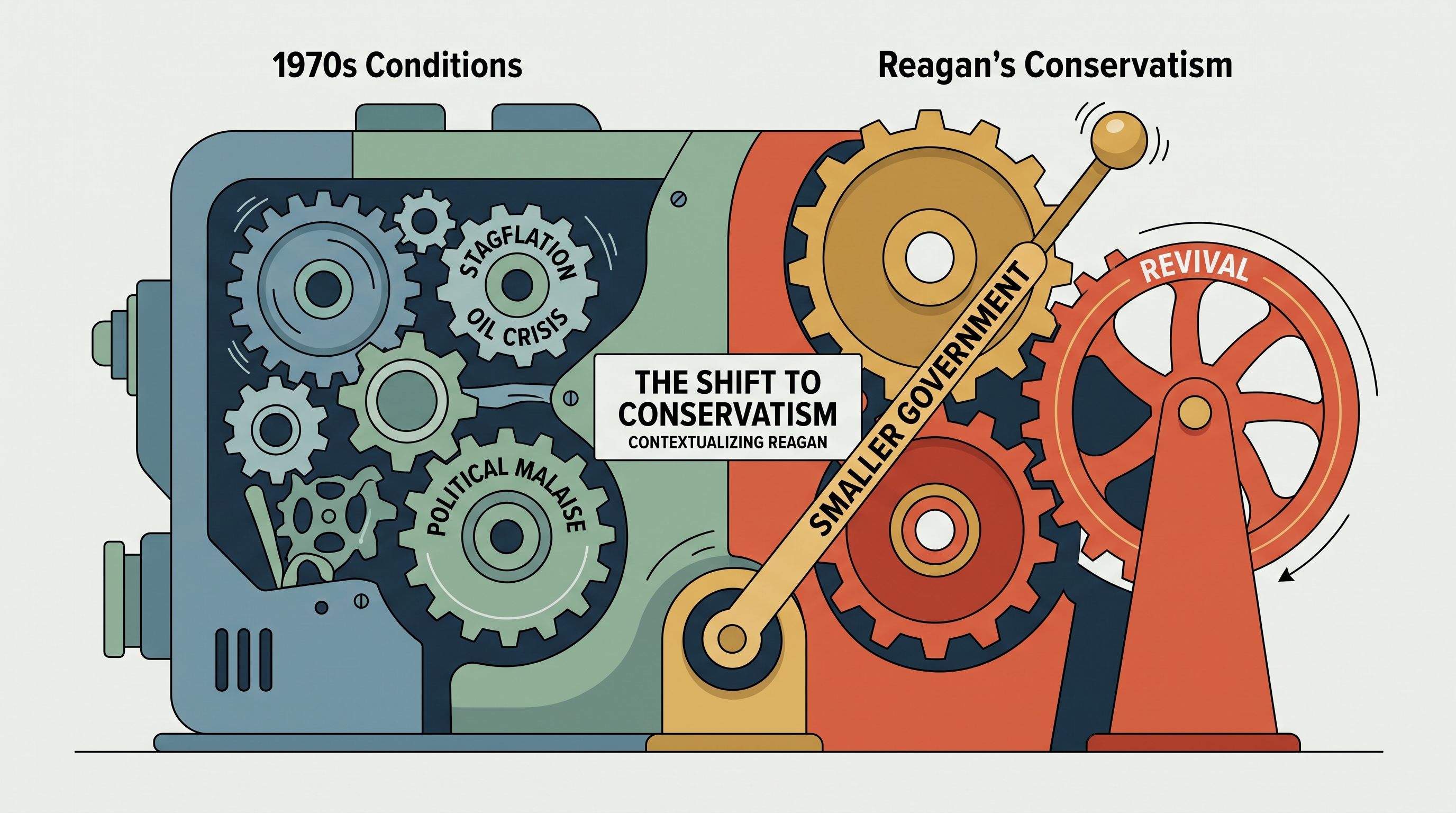
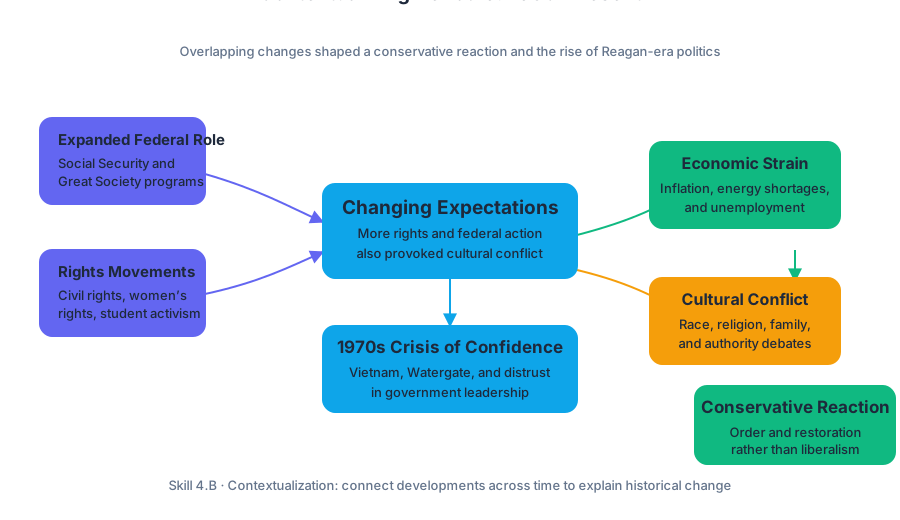
9.3 The End of the Cold War · 9.4 A Changing Economy
Key concepts: The end of the Cold War · Containment of communism · U.S.-Soviet ideological conflict between democracy and authoritarianism · Military intervention and diplomacy · Nuclear and conventional arms buildup · Strategic Defense Initiative · Reagan administration’s role in ending the Cold War · Economic transformation and globalization · The dot-com boom and its social effects · Historical analysis of primary sources
The Cold War ended not through a single battlefield victory, but through the interaction of ideological pressure, military competition, diplomacy, and deep problems within the Soviet system.
9.3 The End of the Cold War · 9.4 A Changing Economy
The Cold War ended not through a single battlefield victory, but through the interaction of ideological pressure, military competition, diplomacy, and deep problems within the Soviet system.
Containment becomes a late-Cold-War strategy
Containment was the effort to limit the spread of Soviet influence and communism rather than immediately overthrow every communist government. By the 1980s, U.S. policymakers used several tools at once: speeches that portrayed the Soviet Union as an authoritarian threat to democracy, diplomatic negotiations, limited military interventions, and expanded spending on nuclear and conventional weapons.
The conflict was therefore both ideological and material. The United States presented democracy as a system based on political choice, while characterizing the Soviet Union as an authoritarian rival whose government restricted opposition and controlled its sphere of influence. At the same time, each superpower measured security through military capacity, including nuclear weapons and conventional forces.
A useful way to organize the evidence is as a four-part pressure system:
- Ideological opposition: speeches and arguments contrasting democracy with authoritarian communism.
- Military pressure: increased nuclear and conventional weapons spending.
- Limited intervention: efforts to resist communist influence in particular regions.
- Diplomatic engagement: negotiations intended to manage rivalry and reduce the danger of direct conflict.
Strategic Defense Initiative: technology as strategy
The Strategic Defense Initiative (SDI) was a major example of increased U.S. military spending during the Cold War. Often called “Star Wars,” the program funded research into possible defenses against nuclear missiles, including laser and particle-beam technologies.
SDI mattered even though its proposed systems were technologically difficult and did not simply create an operational shield over the United States. Its strategic significance lay in the competition it represented: the United States was signaling that it could force the Soviet Union to respond to expensive and technically demanding military developments.
Key distinction: SDI was not the same thing as a conventional battlefield weapon. It was a research and defense program whose importance came partly from how it intensified the arms competition.
Diplomacy did not replace rivalry
Military pressure existed alongside negotiation. At the Geneva Summit in November 1985, President Ronald Reagan and Soviet Premier Mikhail Gorbachev met for the first time. Their discussions encountered serious disagreements, but the joint Soviet-United States statement showed that both governments were willing to continue diplomatic contact and agreed to hold two additional summits.
This is a valuable primary-source lesson: a diplomatic statement can reveal cooperation without proving that the underlying conflict has disappeared. The Geneva statement represented an opening for further negotiations, not an immediate end to the Cold War.
Worked source analysis — Geneva, 1985
- Claim: The summit demonstrated diplomatic movement.
- Evidence: Reagan and Gorbachev met directly, acknowledged unresolved problems, and committed to future summits.
- Interpretation: The commitment mattered because continued contact created opportunities to manage the arms race and address disputes.
- Limit: The statement alone cannot prove that diplomacy caused the Cold War’s end; it must be combined with evidence about Soviet political and economic weakness and the changing relationship between the superpowers.
This reasoning practices Skill 1.B: Developments and Processes — Explain a historical concept, development, or process. It also requires reading a source as evidence rather than automatically accepting its political language. Students should analyze what a document says, who produced it, and what the document can—and cannot—demonstrate.
How much did Reagan contribute?
A strong historical judgment evaluates Reagan’s policies as one cause among several. His opposition to communism, military buildup, and willingness to negotiate increased pressure on the Soviet Union while diplomacy created channels for cooperation. However, attributing the entire outcome to Reagan oversimplifies the evidence: political problems inside the Soviet Union weakened its ability to maintain control over its sphere of influence, and Gorbachev’s decisions also reshaped the confrontation.
Misconception check — “The Cold War ended because one president defeated the Soviet Union.” This explanation is too simple. A more defensible argument is that Reagan’s policies contributed to the end by combining pressure and negotiation, but the result depended on Soviet internal weaknesses, leadership choices, and the inability of the Soviet government to preserve its influence.
A changing American economy
The late twentieth-century economy changed as dramatically as foreign policy. Sources on Grace Lee Boggs, the dot-com boom, and globalization point to a common historical problem: economic growth can produce new opportunities while also disrupting workers, neighborhoods, and established industries.
The dot-com boom transformed the San Francisco Bay Area by concentrating technology firms, investment, and highly paid employment. That growth affected more than entrepreneurs: it reshaped local communities and placed pressure on workers and residents who did not benefit equally from the new economy.
Globalization means the increasing integration of national economies through trade, investment, production, technology, and communication. It could lower costs, expand markets, and connect American businesses to consumers and suppliers around the world. It could also disrupt communities when jobs moved, industries reorganized, or workers faced competition from a global labor market.
The key analytical distinction is between aggregate growth and distributed effects. An economy may become more productive overall while particular workers, industries, or regions lose stability. The experiences associated with Boggs, the Bay Area’s technology boom, and globalization help historians examine who gained, who struggled, and how economic change altered communities.
Retrieval check
Explain, in two sentences, why SDI and the Geneva Summit should be studied together. Then complete the argument: Reagan’s policies contributed to the end of the Cold War to the extent that... A strong answer should connect military pressure to diplomacy, then qualify the claim with Soviet internal problems and Gorbachev’s choices.
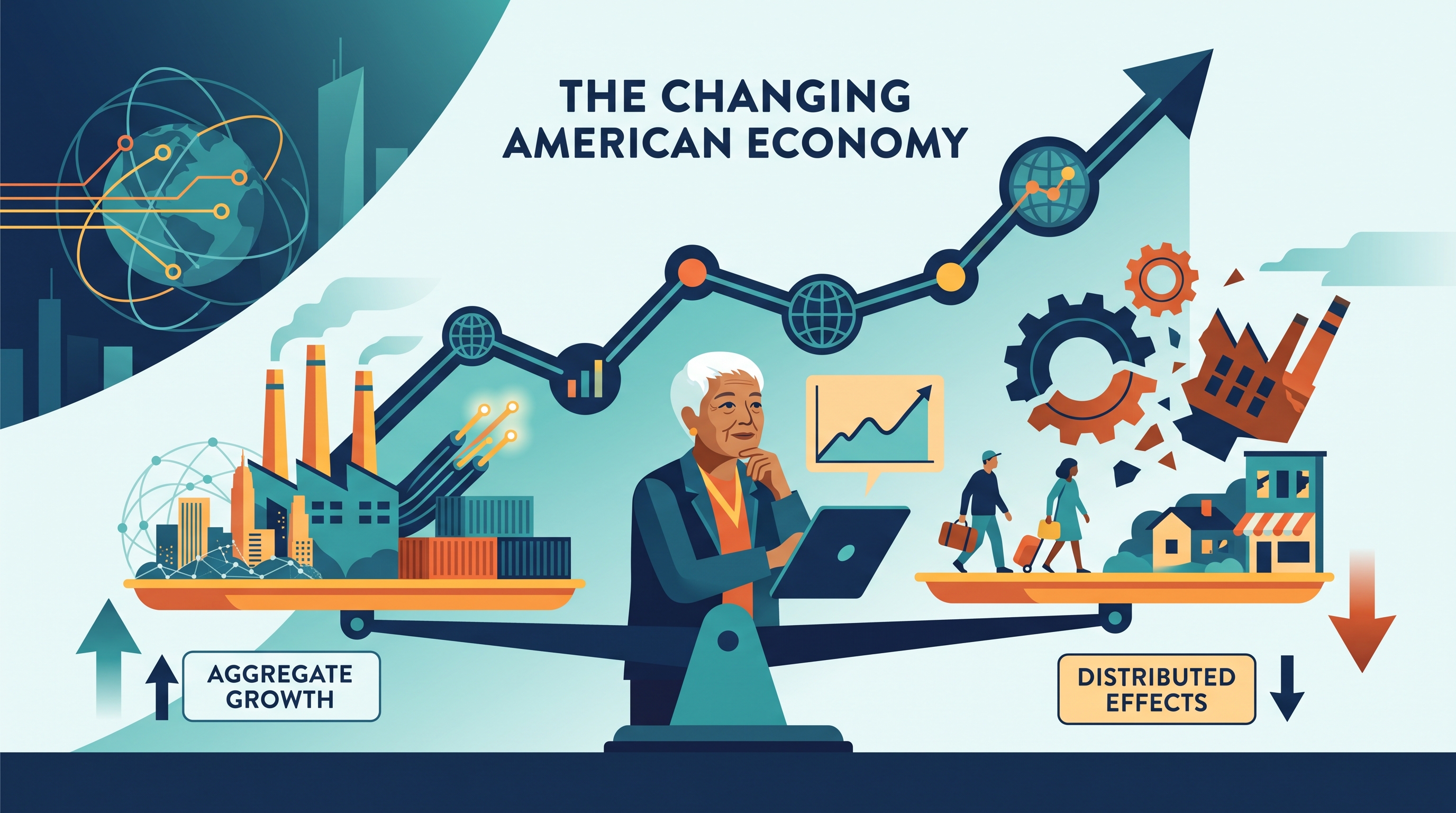
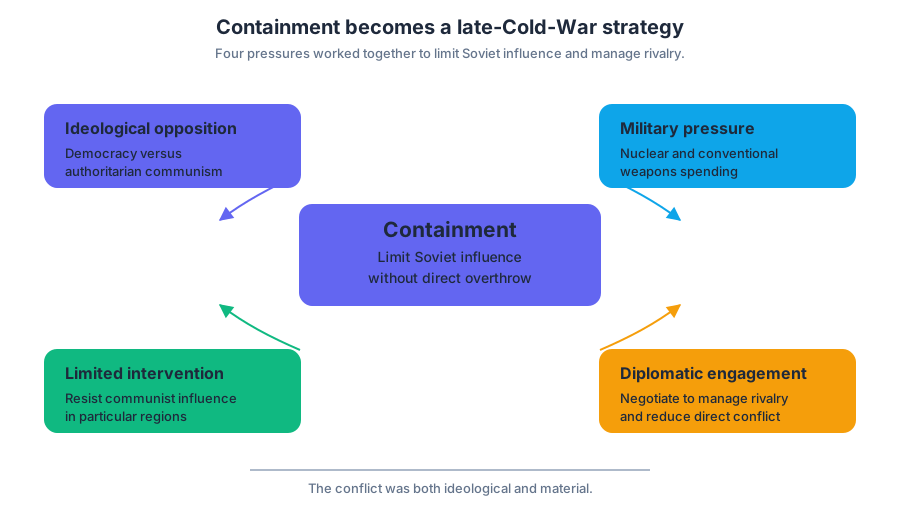
9.5 Migration and Immigration in the 1990s and 2000s · 9.6 Challenges of the 21st Century
Key concepts: Migration and immigration in the 1990s and 2000s · Challenges of the 21st century · International and domestic challenges after 1980 · Push and pull factors shaping society · Population shifts · The war on terrorism · Civil liberties and human rights · Conflicts in the Middle East · Climate change · U.S. dependence on fossil fuels and environmental impacts of economic consumption
After 1980, migration reshaped the American population while terrorism, energy dependence, climate change, and debates over civil liberties challenged the nation’s understanding of security and freedom.
9.5 Migration and Immigration in the 1990s and 2000s · 9.6 Challenges of the 21st Century
After 1980, migration reshaped the American population while terrorism, energy dependence, climate change, and debates over civil liberties challenged the nation’s understanding of security and freedom. The central question is not simply who moved and why, but how population movement and international crises changed American society and government.
Learning Objective 9.5.A: Explain the causes and effects of domestic and international migration over time.
Essential Knowledge KC-9.5.I: Economic, political, and social factors contributed to migration within and to the United States.
Migration: push, pull, and population change
A push factor is a condition that encourages people to leave a place; a pull factor is a condition that attracts people to a new place. In the 1990s and 2000s, migration to the United States reflected both: migrants could be pushed by political instability, violence, poverty, or limited employment and pulled by jobs, education, family reunification, and the expectation of greater security.
The effects were visible in population shifts. Immigration strengthened established communities and expanded new ones, especially in the Southwest, California, Florida, New York, and other metropolitan areas. These changes influenced labor markets, schools, language use, electoral politics, and debates over citizenship and immigration policy.
Worked contextual example: Suppose a manufacturing region loses jobs while a rapidly growing city gains construction and service employment. Workers may move domestically toward the city because employment is a pull factor. At the same time, an immigrant family may move internationally because economic opportunity pulls them toward the United States, while political violence pushes them away from their country of origin. A strong historical explanation connects the movement to both the cause and the effect: migration changes not only where people live but also the social and political concerns of receiving communities.
Misconception check — “Immigration is caused only by poverty.” Poverty can be a push factor, but migration usually has multiple causes. Political conditions, family networks, labor demand, education, war, and legal policy can operate together. Likewise, immigrants did not simply “replace” existing Americans; they entered a society whose economy, culture, and politics were already changing.
The war on terrorism: security versus liberty
The terrorist attacks of September 11, 2001, led the United States to make national security a central domestic and foreign-policy priority. The war on terrorism sought to reduce the danger of terrorist attacks through military action abroad, intelligence gathering, airport and border security, and expanded cooperation among government agencies.
These policies produced a lasting tension. Supporters argued that extraordinary threats required stronger surveillance, detention powers, and preventive measures. Critics warned that such policies could weaken constitutional protections, privacy, due process, and human rights—especially when government action treated broad groups as suspicious rather than focusing on individual evidence.
The historical issue is therefore a conflict between two goals rather than a simple choice between “security” and “freedom.” A policy may improve security in one dimension while creating civil-liberties costs in another. This distinction is essential when evaluating government responses after 2001.
Learning Objective 9.6.A: Explain the causes and effects of the domestic and international challenges the United States has faced in the 21st century.
Essential Knowledge KC-9.6.I: The United States faced international and domestic challenges after 1980.
Energy, climate, and consumption
Conflicts in the Middle East contributed to continuing debates about U.S. dependence on fossil fuels. Because oil was economically important and heavily connected to international politics, instability abroad could raise concerns about energy prices, national security, and the limits of American foreign policy.
At the same time, concerns about climate change focused attention on the environmental effects of economic consumption. Americans debated whether economic growth should depend on high levels of fossil-fuel use and whether the federal government should regulate emissions, promote alternative energy, or leave decisions primarily to markets and individuals.
These debates connected domestic policy to international conditions: energy consumption affected the environment, while foreign conflicts affected the perceived security of energy supplies. The resulting arguments continued older disputes about the proper role of the federal government, but applied them to distinctly twenty-first-century problems.
Source analysis: evidence has limits
Historical Thinking Skill 2.A — Identify a source’s point of view, purpose, historical situation, and/or audience. When analyzing a source about immigration, terrorism, energy, or climate, ask four questions: Who created it? Why? What events shaped it? Who was expected to read or hear it?
Historical Thinking Skill 2.B — Explain how a source’s point of view, purpose, historical situation, and/or audience may affect the reliability of that source. A government security report may reveal official priorities but minimize criticism. An immigrant-rights organization may document discrimination effectively but emphasize evidence supporting reform. A business publication may explain labor demand while giving less attention to environmental costs.
The key distinction is between usefulness and complete neutrality. A source’s perspective does not automatically make it false; it helps determine what the source can and cannot prove.
Retrieval check: Name one push factor and one pull factor affecting migration after 1980. Then explain one tension created by the war on terrorism. Finally, identify why a source’s audience might limit its usefulness as evidence.
Answer: A push factor could be political violence; a pull factor could be employment. The war on terrorism created tension between improving security and protecting civil liberties and human rights. A source’s audience may shape what its creator emphasizes, so the source may be strong evidence for one perspective but insufficient evidence for the entire historical issue.

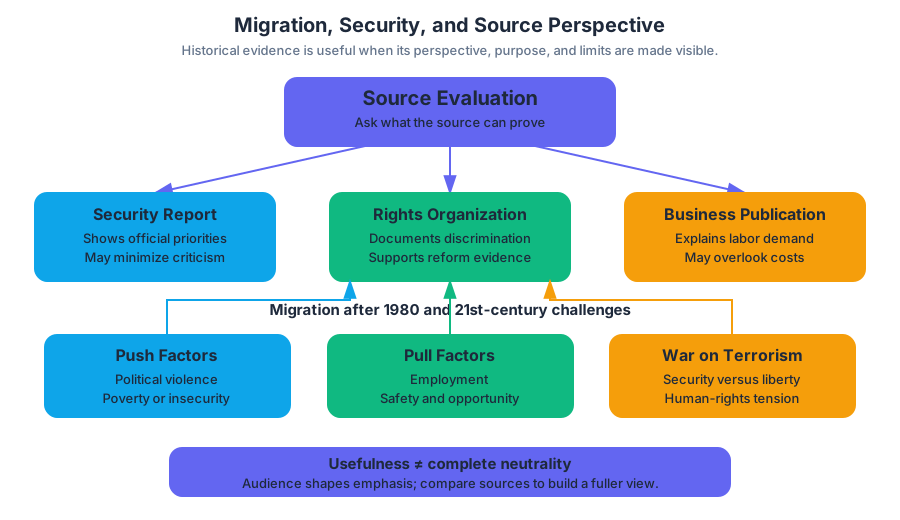
9.7 Causation in Period 9
The major changes after 1980 did not come from one event or one president. They resulted from interacting causes: conservative political mobilization, economic restructuring, the end of the Cold War, immigration, technological change, and new social movements.
9.7 Causation in Period 9
The major changes after 1980 did not come from one event or one president. They resulted from interacting causes: conservative political mobilization, economic restructuring, the end of the Cold War, immigration, technological change, and new social movements. The central historical question is therefore: How did these developments produce both change and continuity in the United States from 1980 to the present?
Learning Objective 9.7.A: Explain the causes and effects of economic and social changes in the period from 1980 to the present.
The official historical reasoning process here is causation: identifying the factors that produced a development, distinguishing short-term triggers from long-term conditions, and explaining the consequences that followed. A strong causal explanation does not merely place events in chronological order. It shows how one development increased, limited, or redirected the effects of another.
The causal chain: from political shift to social change
A useful way to organize Period 9 is as a chain with feedback loops:
The conservative movement gained strength partly because many Americans reacted against perceived failures of liberal government, inflation, crime, social unrest, and cultural changes associated with the 1960s and 1970s. Religious conservatives, business groups, and advocates of lower taxes formed an influential political coalition. Ronald Reagan’s election in 1980 gave this coalition national power, although the federal government did not simply disappear: military spending increased, and many existing programs remained.
At the same time, the economy shifted away from the manufacturing-heavy pattern of the mid-twentieth century. Deindustrialization, automation, globalization, and the growth of service and information industries changed where Americans worked and how securely they were employed. These developments produced economic growth for some Americans while widening inequality and weakening many unionized industrial communities.
Causal distinction: A policy can be a cause without being the only cause. Deregulation and tax changes affected economic inequality, but technological change, international competition, corporate decisions, and the decline of unions also mattered.
Connecting foreign policy and domestic change
The end of the Cold War transformed the international setting in which the United States operated. The collapse of the Soviet Union removed the chief rival that had shaped American foreign policy since 1945. The United States emerged as the world’s dominant military and economic power, but the post–Cold War period also brought new challenges, including terrorism, regional conflicts, and debates over the proper use of American military force.
This change had domestic consequences. Government spending and national security priorities remained important, while debates over globalization, trade, immigration, and America’s responsibilities abroad became connected to arguments about national identity at home. Period 9 therefore demonstrates that foreign affairs and domestic politics are not separate tracks: international changes can reshape elections, economic policy, public fears, and ideas about citizenship.
Migration, technology, and contested identity
Immigration from Latin America and Asia increased the nation’s cultural and demographic diversity, especially in the South and West. Immigrants contributed labor, entrepreneurship, and cultural influence, while immigration also generated political disputes over border enforcement, legal status, language, and national belonging. The result was both continuity—recurring arguments over immigration—and change in the composition of American society.
Technological developments intensified these transformations. Computers, the internet, digital communications, and global networks accelerated the movement of information, money, and culture. They expanded access and productivity, but they also created new forms of inequality: people with reliable access, specialized education, and adaptable skills often benefited more than communities and workers left behind by economic restructuring.
Worked causal example: explaining rising inequality
Question: Explain one major cause of increasing economic inequality after 1980 and one effect of that inequality.
Step 1 — Identify a defensible cause: The decline of manufacturing employment and labor unions reduced the bargaining power and wages of many working-class Americans.
Step 2 — Explain the mechanism: As factories closed, automated, or moved production abroad, workers increasingly entered lower-paid service jobs. Because unions had historically negotiated wages and benefits, their decline made it harder for workers to secure a large share of economic growth.
Step 3 — Identify an effect: Regional inequality widened. Many older industrial communities experienced population loss and declining tax bases, while technology-centered metropolitan areas attracted investment and highly educated workers.
Step 4 — Add complexity: Economic restructuring was not caused by union decline alone. Automation, globalization, changing consumer demand, and policy choices operated together.
AP skills in action
This topic most directly develops 1. Developments and Processes, because students must identify major Period 9 developments and explain how they unfolded; 4. Contextualization, because causes must be placed within the political, economic, and international conditions of the late twentieth century; and 5. Making Connections, specifically causation, because students must connect developments across politics, economics, foreign affairs, migration, and society. A source-based question may also require 2. Sourcing and Situation and 3. Claims and Evidence in Sources.
Misconception check
Misconception: “The 1980s marked a complete break from the past.”
The period contained important changes, but also strong continuities. Political debates still revolved around the role of government; immigration remained contested; racial and economic inequalities persisted; and the federal government continued to regulate, spend, and intervene. The best answer explains both transformation and persistence rather than labeling the entire period simply “conservative” or “liberal.”
Retrieval and interpretation check
In two or three sentences, explain how one political development, one economic development, and one demographic or technological development interacted after 1980. Your response should use a causal verb—such as enabled, accelerated, limited, or provoked—and should identify at least one effect that was unequal across different groups or regions.

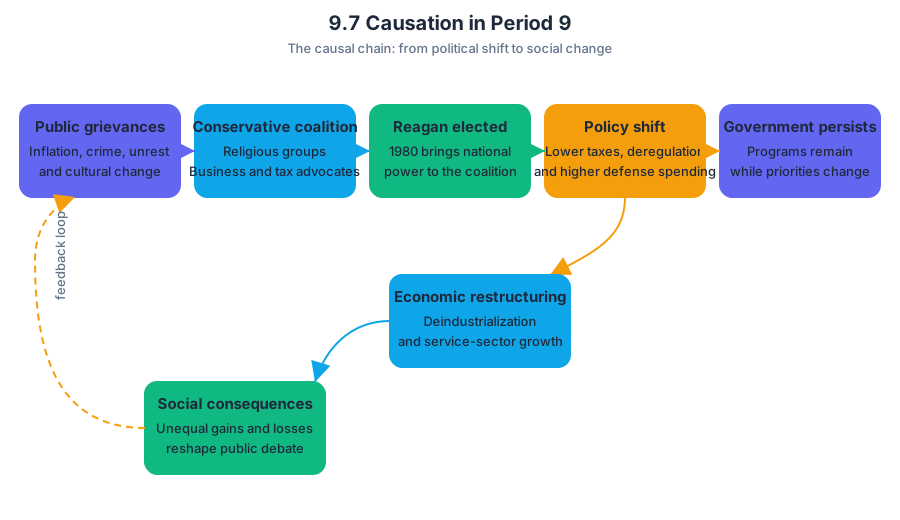
AP Practice 1
Key concepts: AP U.S. History course framework and exam preparation · Historical evidence and source credibility · Independent thinking and drawing evidence-based conclusions · Respectful debate and viewpoint diversity · Student and parent choice in AP enrollment · AP Course Audit and class-section setup · AP Classroom Progress Checks and feedback · Pre-Columbian North American societies and regional diversity · John Winthrop’s “A Model of Christian Charity” and the “city on a hill” idea · Virginia House of Burgesses and majority-rule debate
Historical study does not require everyone to reach the same conclusion; it requires each conclusion to be supported by credible evidence, historical context, and reasoning that another reader can evaluate.
AP Practice 1
Historical study does not require everyone to reach the same conclusion; it requires each conclusion to be supported by credible evidence, historical context, and reasoning that another reader can evaluate. That principle connects the AP U.S. History course framework to classroom debate, primary-source analysis, AP Classroom feedback, and the exam’s free-response tasks.
Core distinction: Evidence-based history asks, “What conclusion does the evidence justify?” It does not ask, “Which opinion is the class expected to repeat?”
The historian’s toolkit
The course repeatedly develops six official historical thinking skills: Skill 1: Developments and Processes, Skill 2: Sourcing and Situation, Skill 3: Claims and Evidence in Sources, Skill 4: Contextualization, Skill 5: Making Connections, and Skill 6: Argumentation. On an assessment, these skills work together: identify what changed, examine who produced a source and why, connect evidence to a claim, place events in a broader setting, relate developments across time or place, and defend a conclusion.
A useful mental model is:
$$ \text{Source} \rightarrow \text{Sourcing} \rightarrow \text{Evidence} \rightarrow \text{Context} \rightarrow \text{Claim} $$
A source is not automatically credible because it is old, famous, or official. Source credibility means judging how useful a source is for a particular question by considering its author, audience, purpose, situation, and relationship to the event described. A source can be limited for one question yet highly valuable for another: a political speech may reveal a leader’s public goals even if it does not provide a neutral account of events.
Worked source-based short-answer practice
Original, unofficial practice prompt
Read the descriptions below and answer all parts.
- In 1630, John Winthrop’s sermon “A Model of Christian Charity” described the Massachusetts Bay community as a “city on a hill,” a model Christian society formed through a covenant with God.
- In 1734, William Randolph, after being elected speaker of Virginia’s House of Burgesses, emphasized respectful debate and accepting the majority’s decision.
A. Identify one way the two sources reveal developing political or social expectations in British North America.
B. Explain one difference in the sources’ purposes or situations.
C. Explain one broader development from the period that helps place either source in context.
Model reasoning
A — Evidence and comparison: Both sources present community life as requiring shared obligations. Winthrop emphasizes a religious covenant and collective moral example; Randolph emphasizes orderly political disagreement and acceptance of a majority decision. This earns stronger reasoning than merely stating that both men “discussed society,” because it identifies the specific expectation each source reveals.
B — Sourcing and Situation: Winthrop spoke to Puritan migrants preparing to establish Massachusetts Bay, so his purpose was to encourage religious unity and mutual responsibility. Randolph spoke after a political election in Virginia, so his purpose was to establish norms for legislative debate and decision-making. The difference is not simply that they lived in different colonies; it is that their immediate audiences and political circumstances shaped what each speaker emphasized.
C — Contextualization: Both sources fit the development of distinct colonial societies shaped by migration, religion, local institutions, and regional conditions. Puritan Massachusetts developed around a covenant-centered religious community, while Virginia’s House of Burgesses reflected representative political institutions that had emerged in the Chesapeake. The contextual evidence must explain the source, not merely name “colonial America.”
Skills in action: Part A primarily uses Skill 3: Claims and Evidence in Sources and Skill 5: Making Connections. Part B uses Skill 2: Sourcing and Situation. Part C uses Skill 4: Contextualization. A response that connects all three parts also begins Skill 6: Argumentation by turning evidence into a defensible interpretation.
Debate without personal attacks
Historical interpretation often involves competing viewpoints. A classroom may ask students to defend different claims about a topic, such as which president was most significant, but the standard is evidence and reasoning—not personal loyalty. Respectful debate attacks neither the person nor the student’s identity; it tests the argument, asks what evidence supports it, and takes seriously perspectives shaped by students’ diverse backgrounds and experiences.
Misconception check: “Respectful debate means avoiding disagreement.”
Correction: Respectful debate permits strong disagreement while prohibiting personal attacks.
Choice, course design, and feedback
Students and parents freely choose AP coursework. The program welcomes students willing to undertake college-level academic challenges; enrollment is not an agreement to adopt a required political viewpoint. Teachers, meanwhile, must submit and obtain approval for their AP Course Audit course. Teachers or AP Coordinators establish class sections and order exams, while unit guides offer a possible instructional sequence that teachers may adopt or modify rather than requiring them to build a course from scratch.
At the end of a unit, AP Classroom Progress Checks can be assigned as homework or as an in-class task. Answer rationales provide question-level feedback, while the progress dashboard provides unit- and skill-level feedback; teachers can also create additional practice through the AP Question Bank. The most useful error review asks: What did I choose? What evidence did I overlook? Which skill failed—sourcing, contextualization, connection, or argumentation?
Retrieval check
In two sentences, explain why Winthrop’s sermon and Randolph’s speech should not be treated as interchangeable evidence. A strong answer identifies their different audiences, purposes, or situations and connects that difference to the historical claim being made. The AP U.S. History instructional framework and sample exam materials identified here become effective beginning in Fall 2026; exam updates beginning with the May 2027 exam change selected task formats, not the underlying course content.
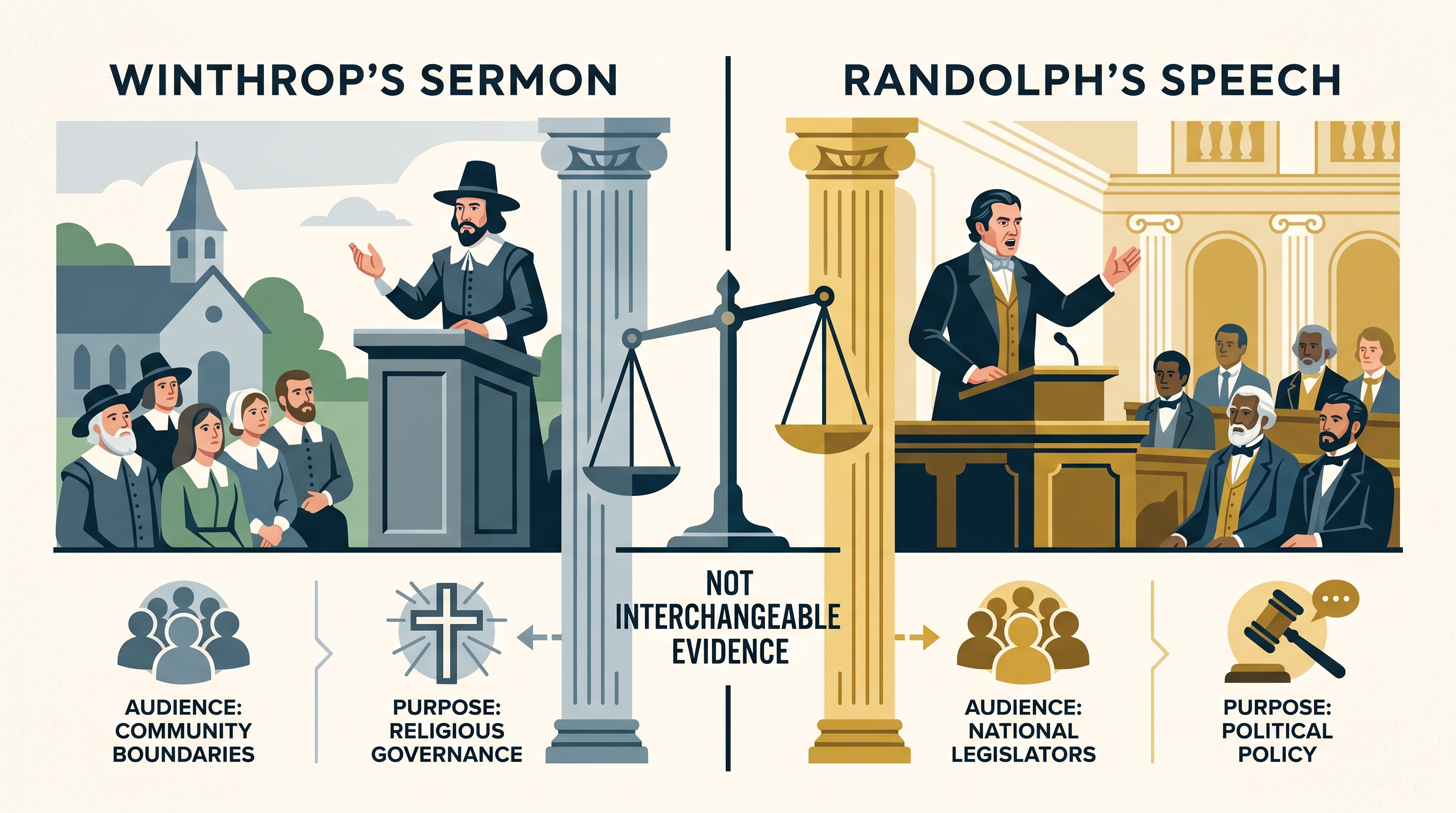
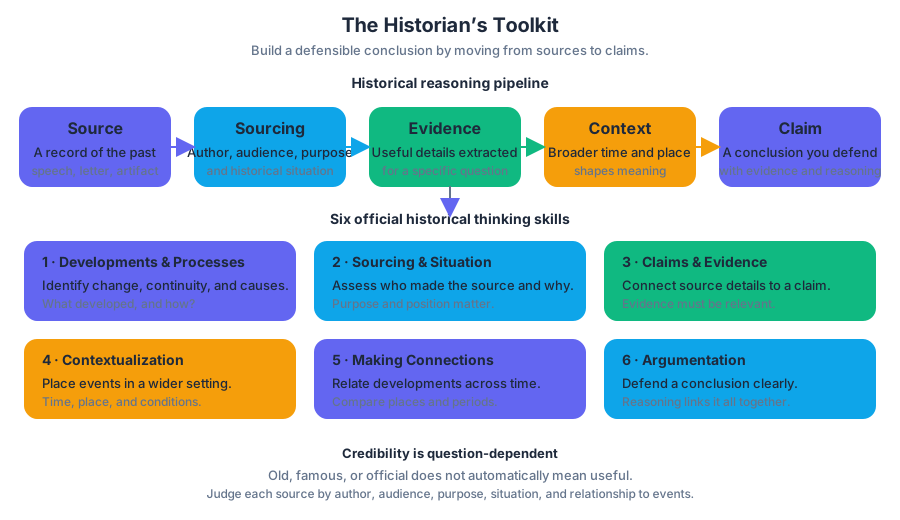
AP Practice 2
Key concepts: Columbian Exchange · Smallpox and other diseases introduced to the Americas · Horses and other animals introduced to the Americas · Enslavement laws in colonial New York · John Dickinson’s opposition to the Townshend Acts · Boston Massacre Oration by John Hancock · Identifying claims, reasons, and evidence in primary sources · Whiskey Rebellion and federal authority · Antebellum reform movements, including deaf education and mental-health reform · Transportation, immigration, and global trade in the nineteenth century
Task type: Short-Answer Questions (SAQs). On the current AP U.S. History exam, SAQs reward concise historical reasoning rather than extended essays.
AP Practice 2
Task type: Short-Answer Questions (SAQs). On the current AP U.S. History exam, SAQs reward concise historical reasoning rather than extended essays. A strong response usually does three things: identifies a historically accurate development, explains a connection or significance, and uses specific evidence rather than repeating the prompt.
Core skill: Distinguish an author’s claim—the position the author wants the audience to accept—from the reasons supporting that claim and the evidence used to make those reasons convincing.
Timing target: Allow about $13$ minutes for one three-part SAQ. Spend roughly $2$ minutes reading, $8$ minutes writing, and $3$ minutes checking whether each answer directly addresses its lettered task. Each part is scored independently, so a missed part does not erase points earned elsewhere.
SAQ 1 — Exchange, disease, animals, and colonial power
The Columbian Exchange connected the Americas, Europe, and Africa after the voyages of European explorers. Its effects included the introduction of smallpox and other diseases into the Americas, as well as the arrival of horses and other animals previously unfamiliar to many Native American societies.
A. Identify one major demographic consequence of the Columbian Exchange in the Americas.
B. Explain one way the introduction of horses changed interactions among Native American peoples or between Native Americans and Europeans.
C. Explain one reason the Columbian Exchange strengthened European conquest or colonization.
Worked reasoning
A — Earn the point by connecting smallpox to population change. Smallpox caused severe population decline among many Native American communities because they lacked previous exposure and therefore had limited immunity. Avoid saying simply that “disease spread”; identify the demographic effect.
B — Earn the point by explaining a mechanism. Horses increased mobility, hunting capacity, and military effectiveness for some Native American groups. A complete answer explains how horses mattered rather than merely naming them.
C — Earn the point by connecting disease to power. Population loss weakened communities’ ability to resist European invasion, disrupted political structures, and made conquest easier. European advantages therefore involved more than weapons: disease and ecological change also reshaped the balance of power.
Common misconception: The Columbian Exchange was not a balanced or equal exchange of benefits. Crops, animals, people, and diseases moved in multiple directions, but epidemic disease produced especially devastating consequences in the Americas.
SAQ 2 — Law, resistance, and revolutionary argument
A New York law in force from 1691 to 1718 legalized physical punishment of enslaved people by European New Yorkers, restricted gatherings of enslaved people, and limited their ability to testify in court. Decades later, John Dickinson’s Letters from a Farmer in Pennsylvania, Letter II, dated December 10, 1767, opposed the Townshend Acts. John Hancock delivered the Boston Massacre Oration in Boston on March 5, 1774, reflecting growing anti-British sentiment.
A. Explain one way the New York law illustrates the relationship between law and slavery in the British colonies.
B. Identify Dickinson’s central claim about the Townshend Acts and explain one reason he used to support it.
C. Explain one way Hancock’s oration could intensify colonial resistance to British rule.
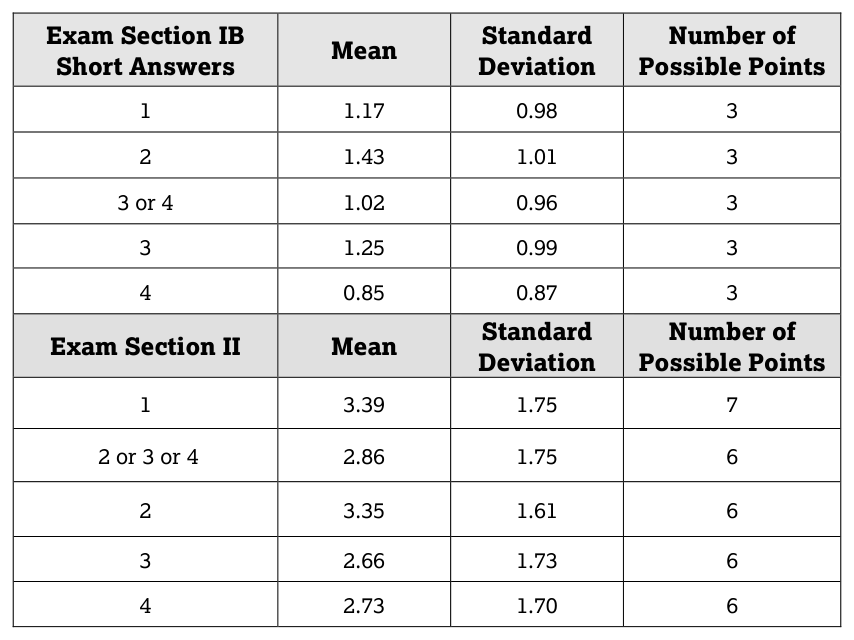
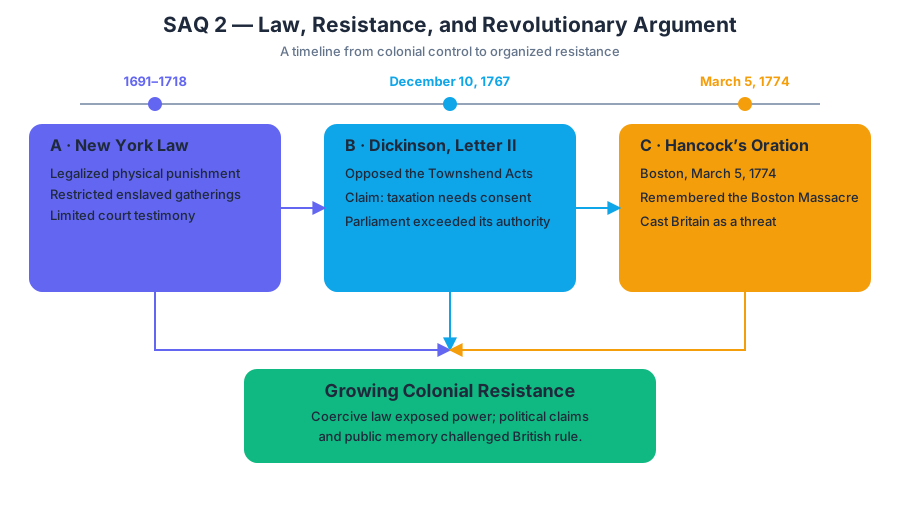
AP Practice 3
A strong Long Essay Question (LEQ) answer does more than remember facts: it turns historical knowledge into a defensible argument. The writer must interpret a broad prompt, establish historical context, use specific evidence, and apply a historical reasoning process such as comparison, causation, or continuity and…
AP Practice 3
A strong Long Essay Question (LEQ) answer does more than remember facts: it turns historical knowledge into a defensible argument. The writer must interpret a broad prompt, establish historical context, use specific evidence, and apply a historical reasoning process such as comparison, causation, or continuity and change.
This original, unofficial practice uses the causation skill to connect developments across the course’s chronological periods. The AP U.S. History framework identifies five historical thinking skills: 1. Developments and Processes, 2. Sourcing and Situation, 3. Claims and Evidence in Sources, 4. Contextualization, and 5. Making Connections. An LEQ most directly emphasizes 1. Developments and Processes, 4. Contextualization, and 5. Making Connections, because no source set is supplied.
The task
Practice prompt: Evaluate the extent to which economic developments contributed to changes in federal power in the United States from 1800 to 1860.
A useful first move is to convert the prompt into three questions:
| Prompt feature | Question to answer |
|---|---|
| Historical period | What was changing between 1800 and 1860? |
| Causal relationship | How did economic developments affect federal power? |
| “Evaluate the extent” | Were economic causes decisive, significant but limited, or less important than political or sectional causes? |
Build the argument before writing
A defensible thesis should make a judgment, not merely repeat the prompt. One possible thesis is:
Economic developments substantially expanded federal power between 1800 and 1860 because transportation improvements, national markets, and industrial growth encouraged federal support for infrastructure and economic regulation; however, economic change did not create a unified national policy, because sectional disagreements over tariffs, banking, and slavery repeatedly limited federal authority.
This thesis earns its force from qualification. It argues that economics mattered substantially, then identifies a limit: economic development expanded federal power unevenly because regional interests disagreed about which policies the federal government should pursue.
Contextualization: place the argument in motion
Before 1800, the new republic operated under political and economic uncertainty. The Constitution had created a stronger national government than the Articles of Confederation, but debates over the national bank, federal taxation, and the proper scope of federal authority showed that national power remained contested. After 1800, territorial expansion and increasing commercial connections created new pressure for the government to coordinate economic life across a much larger country.
Notice the difference between context and evidence. The Constitution and the Articles of Confederation establish the background, but the paragraph must still explain why that background matters: federal power was already a disputed issue before transportation, markets, and industry intensified the debate.
Worked evidence chain
Evidence 1: transportation and markets. The construction of roads, canals, and later railroads connected farmers, merchants, and manufacturers across regional boundaries. The Erie Canal, completed in 1825, linked the Great Lakes to the Atlantic trade through New York. This integration encouraged arguments that the federal government should promote internal improvements, although presidents and legislators disagreed over constitutional limits.
Evidence 2: national economic institutions. The Second Bank of the United States attempted to regulate credit and stabilize the national economy. Andrew Jackson’s opposition to the bank, culminating in the removal of federal deposits, demonstrated that economic policy could become a direct struggle over executive power and the authority of national institutions.
Evidence 3: tariffs and sectional interests. Protective tariffs aided some manufacturers in the Northeast but angered many southern planters, who feared higher prices and foreign retaliation. The Nullification Crisis showed that economic policy could provoke a constitutional confrontation over whether a state could resist federal law.
Each example does three jobs: it identifies a historical development, links that development to federal power, and advances the thesis. A list of the Erie Canal, the national bank, and tariffs without those explanations would be evidence mentioned, not evidence used.
Model body paragraph
Economic integration encouraged the federal government to take a more active role in national development. As canals, roads, and railroads connected previously separate markets, supporters of the American System argued that federal funding for transportation would promote commerce and national unity. The Second Bank also represented an expanded conception of federal authority because it regulated credit across state boundaries. These policies did not simply respond to economic growth; they attempted to organize and direct it, making the federal government a more visible participant in everyday economic life. At the same time, Jackson’s destruction of the bank revealed that expanded federal power was politically unstable rather than universally accepted.
The paragraph demonstrates 5. Making Connections through causation: economic integration encouraged national policies, while opposition to those policies produced conflict over federal authority. It also uses 1. Developments and Processes by explaining how several related developments formed a broader process rather than treating them as isolated events.
Complexity: explain the limit
The strongest responses avoid a one-directional story in which economic modernization automatically produced stronger federal power. Economic change expanded federal authority in some areas, but it also deepened sectional divisions. Tariffs and banking policy could strengthen national institutions while simultaneously provoking resistance from southern states. The result was not simply “more government”; it was an ongoing struggle over whose economic interests federal power would serve.
That qualification supplies a path toward the rubric’s complexity requirement. Complexity can appear through qualification, contrasting regional effects, multiple causes, or an explanation of both intended and unintended consequences. It must be woven into the argument, not appended as a sentence beginning “Although.”
Timing and scoring routine
For a timed LEQ, reserve approximately 5 minutes to read and plan, 30 minutes to write, and 5 minutes to revise. The exact timing should follow the current exam directions in effect for the test administration; College Board has announced that changes to AP history short-answer and long-essay formats begin with the May 2027 exam, while course content remains unchanged.
Use this self-check after writing:
- Thesis: Does the opening make a clear judgment and preview the reasoning?
- Contextualization: Does the background explain what was happening before or around the period?
- Evidence: Are at least two specific historical examples accurately explained?
- Reasoning: Does the essay consistently use causation rather than merely narrate events?
- Complexity: Does it explain a contradiction, limitation, regional difference, or alternative cause?
Named misconception check — “More economic activity always meant more federal power.” False. Economic growth created demands for national coordination, but it also generated resistance when federal policies appeared to favor one region. A historically accurate answer must distinguish between the expansion of economic connections and the contested political authority used to manage them.
Error-review routine: After scoring, underline every sentence that names evidence and circle every sentence that explains significance. If an example has no circle, revise it with a causal connector such as “because,” “therefore,” or “this mattered because.” Then write one sentence identifying the essay’s strongest limitation or counterargument. That final step tests whether the response makes a historical argument rather than presenting a chronology.
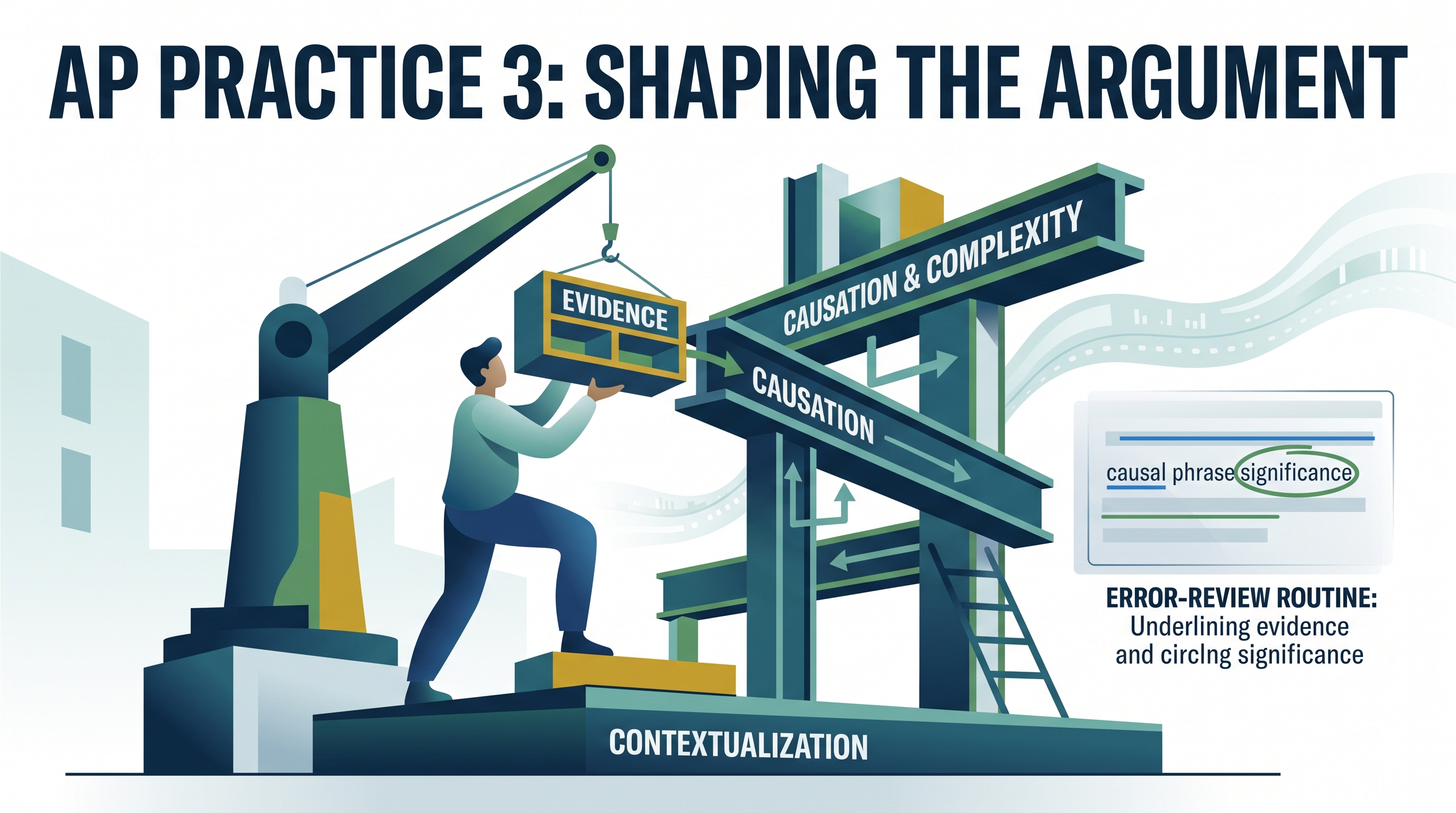
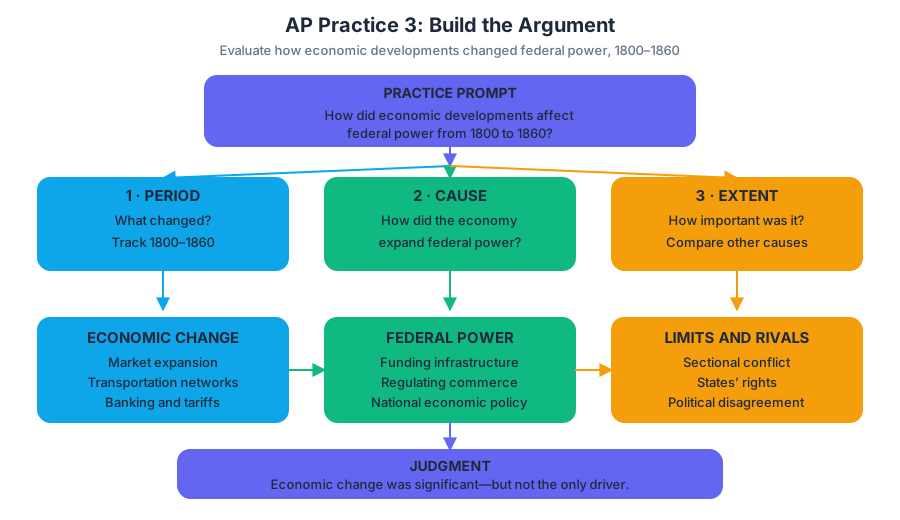
AP Practice 4
A Long Essay Question (LEQ) asks you to construct a defensible historical argument without being given documents to analyze. Success depends less on recalling every fact than on making a clear claim, placing the issue in context, selecting specific evidence, and explaining relationships through causation,…
AP Practice 4
A Long Essay Question (LEQ) asks you to construct a defensible historical argument without being given documents to analyze. Success depends less on recalling every fact than on making a clear claim, placing the issue in context, selecting specific evidence, and explaining relationships through causation, comparison, or continuity and change over time.
Core task: Turn historical knowledge into an argument—not a list of events.
The original practice prompt
Evaluate the extent to which debates over the role of the federal government changed between the ratification of the Constitution and the eve of the Civil War.
This prompt spans roughly 1787–1860 and asks for continuity and change over time. The phrase “evaluate the extent” requires a judgment: the strongest response will argue that federal-power debates changed in some ways but retained important continuities.
Decode the prompt before writing
| Prompt feature | What it requires |
|---|---|
| Evaluate | Make and defend a judgment, not merely describe events. |
| The extent to which | Weigh the degree of change: limited, substantial, or significant but incomplete. |
| Debates over the role of the federal government | Focus on arguments about federal authority, not every political disagreement. |
| Changed | Organize around developments over time while identifying continuities. |
| Between ratification and the eve of the Civil War | Use evidence from approximately 1787–1860. |
Historical Thinking Skill 5. Making Connections is central here, especially the reasoning process of continuity and change. Strong responses also use Skill 1. Developments and Processes to identify major political developments, Skill 4. Contextualization to place those developments in broader circumstances, and Skill 3. Claims and Evidence in Sources only when interpreting evidence supplied by a source-based task; because an LEQ provides no documents, the evidence must come from your own historical knowledge.
A workable argument
A defensible thesis might argue:
Debates over federal power changed substantially between ratification and 1860 because the federal government expanded its authority through constitutional interpretation, economic policy, and territorial governance; however, the central conflict remained continuous, since Americans repeatedly disagreed over whether national power threatened local self-government and slavery.
This thesis earns its force by doing three jobs: it answers the question, identifies categories of change, and establishes a qualification. It does not claim that the entire meaning of federal power transformed; instead, it distinguishes new policy conflicts from a persistent argument about sovereignty.
Build the historical argument
| Period or development | Specific evidence | How it supports the argument |
|---|---|---|
| Ratification era | Federalists defended the Constitution; Anti-Federalists feared centralized authority. | The original debate established a lasting conflict over national power. |
| Early republic | The Bank of the United States and the Necessary and Proper Clause produced disagreement between Hamilton and Jefferson. | Federal-power debates moved from constitutional design to concrete economic policy. |
| 1810s–1830s | The American System, the Bank War, and nullification intensified disputes over federal economic and constitutional authority. | National power became more visible in banking, tariffs, and internal improvements. |
| 1840s–1850s | The Wilmot Proviso, the Compromise of 1850, the Kansas-Nebraska Act, and Dred Scott v. Sandford connected federal authority to slavery’s expansion. | The federal-power debate changed in content and became inseparable from sectional conflict. |
| Continuity | States’ rights arguments persisted from Anti-Federalist criticism through nullification and secessionist thought. | The language of local sovereignty continued even as the issues changed. |
The logical chain should be explicit: constitutional disagreement → economic-policy disagreement → sectional disagreement. The federal government did not simply become “stronger” in a straight line; its authority was repeatedly contested, and the meaning of that authority shifted as the nation expanded.
Worked paragraph
During the early republic, debates over federal power increasingly concerned economic development rather than only the structure of the new government. Alexander Hamilton’s proposal for a national bank relied on a broad interpretation of federal authority, while Thomas Jefferson argued that Congress possessed only powers specifically listed in the Constitution. Later conflicts over the Bank of the United States, protective tariffs, and federally supported transportation projects made this disagreement practical for citizens and states. These controversies therefore represented a change in the application of federal power, even though they preserved the earlier fear that national authority could overwhelm state or individual independence.
Notice the paragraph’s pattern: claim → evidence → explanation → connection to continuity and change. Naming an event is not enough; the final sentences explain why the evidence matters.
Rubric-targeted writing plan
| Rubric criterion | What an examiner must see |
|---|---|
| Thesis/claim | A defensible answer that establishes a line of reasoning. |
| Contextualization | Broader circumstances before, during, or surrounding the period, such as the weaknesses of the Articles of Confederation, westward expansion, or sectional tensions. |
| Evidence: description | At least two specific, relevant examples. |
| Evidence: argument support | Evidence must be used to prove the thesis, not dropped into a timeline. |
| Analysis and reasoning | A sustained use of continuity-and-change reasoning. |
| Complex understanding | Explain multiple causes, consequences, perspectives, or both change and continuity with meaningful qualification. |
Timing guidance
For a standard LEQ session, reserve approximately 40 minutes: spend 5 minutes unpacking the prompt and outlining, 30 minutes drafting, and 5 minutes checking for missing rubric elements. Before submitting, underline your thesis mentally, mark each specific example, and ask whether every body paragraph explains how the evidence answers the prompt.
Common failure: the chronological dump
A chronological dump says, “The Bank was created, Jackson vetoed it, nullification occurred, and the Compromise of 1850 followed.” That may demonstrate recall, but it does not evaluate change. Repair it by adding an analytical sentence: These events show that federal-power disputes expanded from constitutional interpretation into economic regulation and finally into the federal government’s authority over slavery in the territories.
Error-review routine
After writing, classify each weakness:
- Knowledge error: the event, date, person, or policy is inaccurate.
- Relevance error: the evidence is true but does not answer the prompt.
- Reasoning error: the response describes change without explaining its extent.
- Argument error: the thesis and body paragraphs point in different directions.
- Complexity gap: the response mentions continuity or an opposing perspective but does not explain its significance.
Rewrite only the weakest paragraph. Add one sentence that connects a specific piece of evidence to the thesis and one sentence that qualifies the argument.
Retrieval check
In one sentence, explain the difference between a change in the issues surrounding federal power and a continuity in Americans’ concerns about federal power. A strong answer should distinguish the rise of slavery-related sectional conflict from the persistent fear that national authority threatened state or local autonomy.
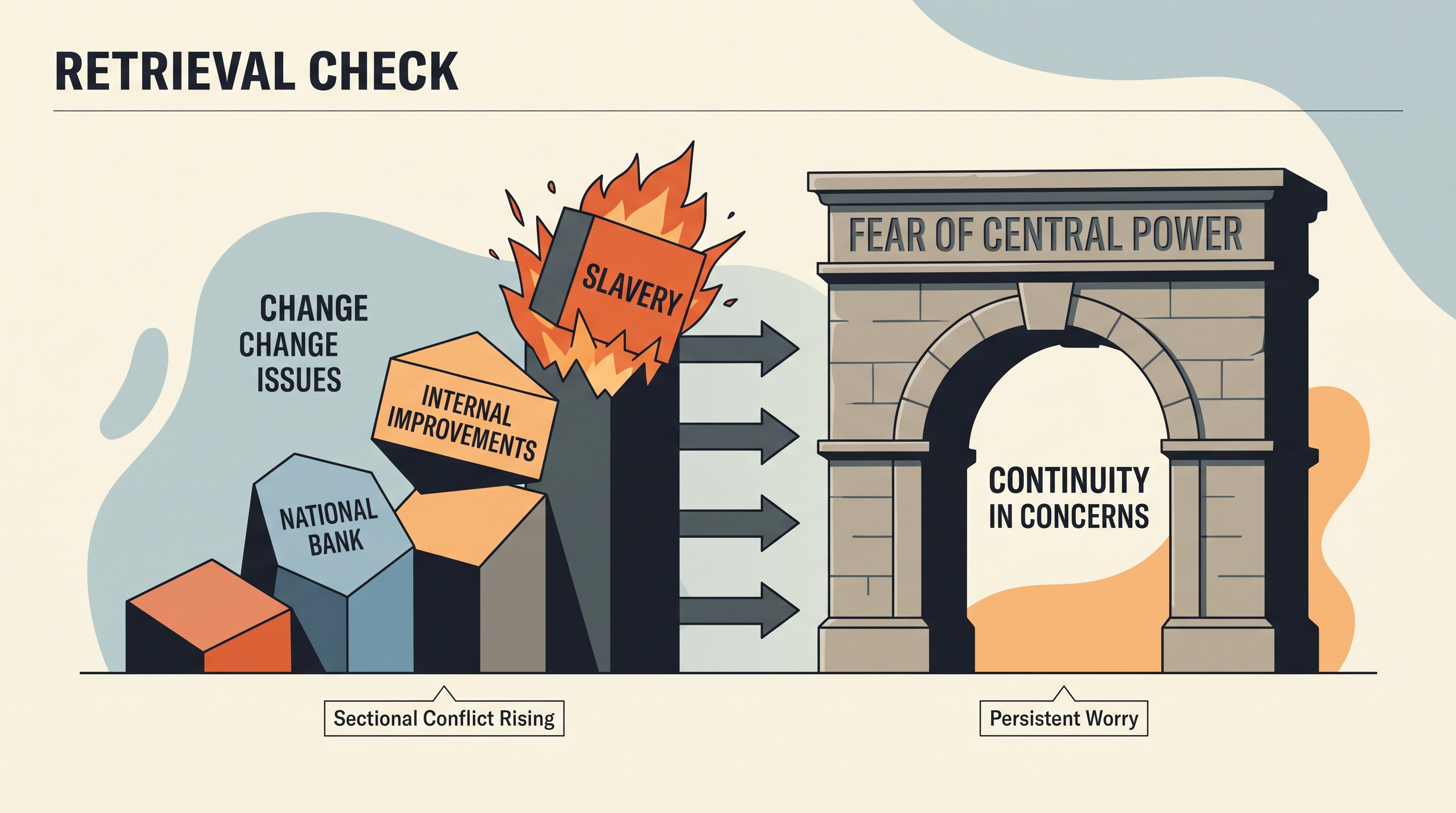
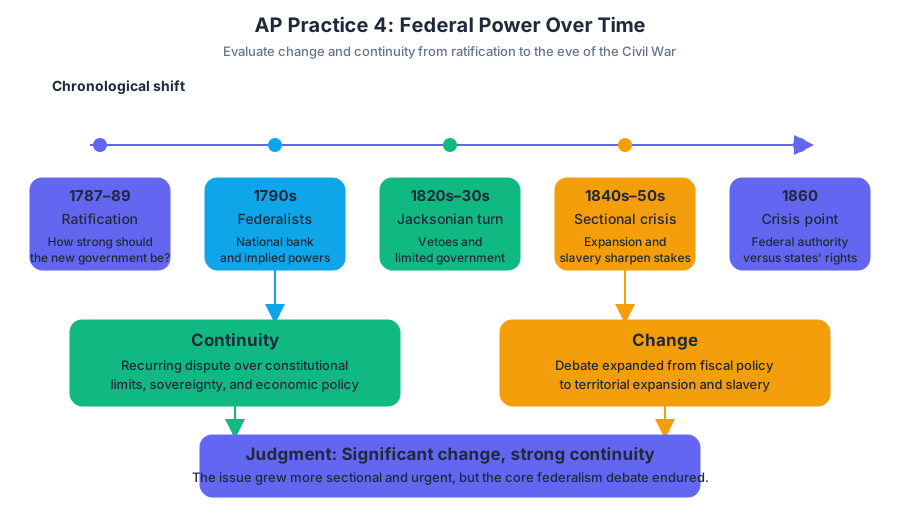
AP Practice 5
The Long Essay Question (LEQ) asks you to construct a historical argument from your own knowledge rather than analyze a packet of documents. A strong LEQ is not a list of facts: it is a defensible claim supported by specific evidence, placed in context, and explained through historical reasoning.
AP Practice 5
The Long Essay Question (LEQ) asks you to construct a historical argument from your own knowledge rather than analyze a packet of documents. A strong LEQ is not a list of facts: it is a defensible claim supported by specific evidence, placed in context, and explained through historical reasoning.
Task type: Long Essay Question
On the current AP United States History exam, the LEQ is a timed writing task. The prompt gives you a historical development, process, or period and asks you to evaluate it using one historical reasoning process: comparison, causation, or continuity and change over time.
This practice question is original and unofficial.
Evaluate the extent to which the Civil War and Reconstruction transformed the political and social position of African Americans in the United States between 1861 and 1877.
What the prompt is really asking
The command “evaluate the extent” requires a qualified judgment. You must decide whether the transformation was substantial, limited, or uneven—and then prove that judgment. The dates establish the boundaries: begin with wartime developments in 1861 and end with the political changes surrounding the withdrawal of federal protection in 1877.
The central tension is transformation versus limitation:
A useful thesis might argue that the period produced a major constitutional and political transformation—emancipation, citizenship, voting rights, and Black officeholding—but that social equality and long-term security remained limited because white resistance, economic dependence, and the end of Reconstruction weakened those gains.
Timing plan: 40 minutes
| Time | Action | Purpose |
|---|---|---|
| 5 minutes | Read, identify the reasoning task, and outline | Prevent a fact dump |
| 30 minutes | Write the response | Develop argument and evidence |
| 5 minutes | Check the thesis, evidence, and reasoning | Recover missed rubric points |
Before writing, create a three-column mental outline:
| Transformation | Evidence of change | Evidence of limits |
|---|---|---|
| Legal status | Emancipation Proclamation; Thirteenth Amendment | Freedom did not guarantee equality |
| Political status | Fourteenth and Fifteenth Amendments; Black officeholding | Violence and disfranchisement efforts |
| Social and economic position | Freedmen’s Bureau schools; family reunification | Sharecropping, debt, racial violence |
Worked reasoning
Skill 1. Developments and Processes requires identifying and explaining the historical developments that matter. Do not merely name the Fourteenth Amendment. Explain that it established birthright citizenship and equal protection, changing the federal government’s constitutional relationship to African Americans.
Skill 4. Contextualization requires connecting the argument to broader circumstances. Before 1861, slavery defined African Americans as property in much of the United States, while free Black people faced severe legal and political restrictions. The wartime destruction of slavery therefore represented a fundamental break with the earlier racial order.
Skill 5. Making Connections includes historical reasoning processes such as causation, comparison, and continuity and change. This prompt is primarily a continuity and change task: compare African Americans’ position before the Civil War with their position during and immediately after Reconstruction, while identifying important continuities.
Model response
Before the Civil War, slavery denied millions of African Americans control over their labor, family lives, movement, and legal identity, while even many free Black people lacked full citizenship and voting rights. Between 1861 and 1877, the Civil War and Reconstruction produced a substantial transformation in African Americans’ legal and political position through emancipation, constitutional amendments, and participation in government. However, the transformation was incomplete because economic dependence, white supremacist violence, and the collapse of federal enforcement limited African Americans’ ability to turn formal rights into lasting social equality.
The war began the transformation by making emancipation a national policy. The Emancipation Proclamation declared enslaved people in areas still rebelling against the Union to be free, and the Thirteenth Amendment abolished slavery throughout the country. These measures changed African Americans’ legal status from property to free people. The Union also recruited Black soldiers, including troops in the United States Colored Troops, whose military service strengthened African Americans’ claims to citizenship and equal treatment.
Reconstruction expanded these wartime changes into constitutional rights. The Fourteenth Amendment established birthright citizenship and equal protection, while the Fifteenth Amendment prohibited denying the vote on the basis of race. African Americans used these new opportunities to vote, participate in constitutional conventions, and hold local, state, and national offices. Reconstruction governments supported public education and other institutions, demonstrating that African Americans were not merely freed from slavery but were actively shaping public life.
Nevertheless, the period did not produce full social or economic equality. Many freedpeople lacked land and entered sharecropping arrangements that could leave them trapped in debt. White Southerners resisted Reconstruction through organizations such as the Ku Klux Klan, using terror to suppress Black voting and political participation. Although congressional Reconstruction Acts and federal enforcement temporarily challenged this violence, the Compromise of 1877 ended effective federal protection in the South. Thus, the period transformed African Americans’ formal legal and political position more dramatically than their economic security or protection from racial violence.
Rubric-aligned breakdown
| Rubric criterion | Where the model earns it |
|---|---|
| Thesis or claim | The opening makes a defensible judgment: transformation was substantial legally and politically but incomplete socially and economically |
| Contextualization | The response explains the prewar system of slavery and restrictions on free Black people |
| Evidence: description | It accurately describes the Emancipation Proclamation, Thirteenth, Fourteenth, and Fifteenth Amendments, Black military service, sharecropping, the Ku Klux Klan, and the Compromise of 1877 |
| Evidence: argument support | Each example is connected to the claim about transformation or limitation |
| Analysis and reasoning | The response uses continuity and change over time and qualifies its argument rather than treating the period as total success or total failure |
| Complex understanding | It distinguishes legal and political change from economic and social continuity |
Common misconception check
Misconception: “Emancipation ended racial oppression.” Emancipation ended slavery as a legal institution, but it did not automatically provide land, economic independence, physical safety, or equal access to political power. A precise LEQ separates freedom from slavery from equality in practice.
Another common error is treating Reconstruction as a single federal program with one result. Reconstruction changed over time: wartime emancipation, congressional constitutional reform, Black political participation, violent resistance, and the withdrawal of federal enforcement all belong in the argument.
Five-minute error review
After writing, mark each paragraph with one label: claim, context, evidence, or reasoning. If a paragraph contains facts but no explanation of how those facts prove the thesis, add a sentence beginning, “This demonstrates that…” Then verify that at least two specific examples support transformation and at least two support limitation.
Retrieval check: Why is the Fifteenth Amendment evidence of political transformation, while sharecropping is evidence that the transformation remained incomplete?
Answer: The Fifteenth Amendment expanded formal voting rights for Black men, while sharecropping often preserved economic dependence and restricted the practical independence that emancipation promised.
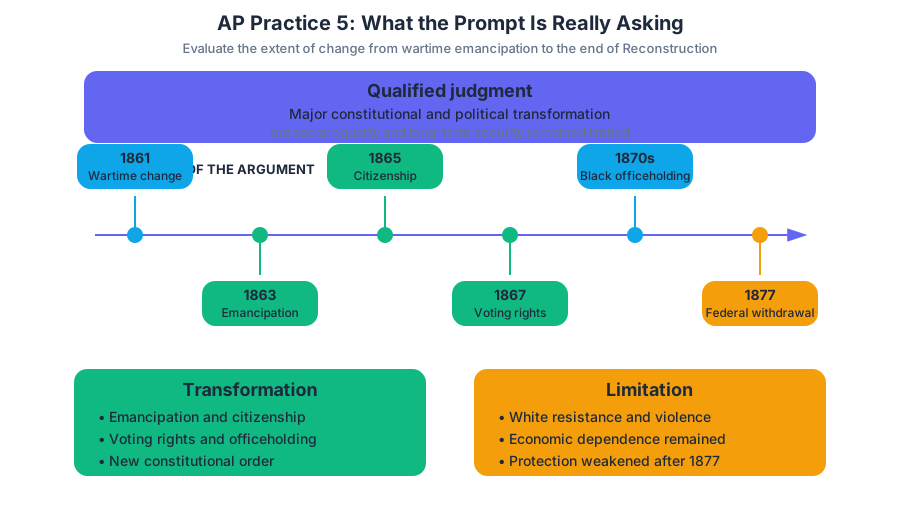
AP Practice 6
A strong Long Essay Question (LEQ) answer does more than remember events: it makes a defensible historical claim, places that claim in context, uses precise evidence, and explains relationships through historical reasoning.
AP Practice 6
A strong Long Essay Question (LEQ) answer does more than remember events: it makes a defensible historical claim, places that claim in context, uses precise evidence, and explains relationships through historical reasoning. The practice below is original and unofficial; it uses the Unit 8 conflict over economic policy, social change, and political conservatism as its historical setting.
The task
Prompt: Evaluate the relative importance of economic concerns and cultural conflicts in explaining the growth of conservative political influence in the United States from 1968 to 1980.
This is an evaluate-the-relative-importance prompt. It does not ask whether economics or culture mattered. It asks you to rank their importance and explain how they interacted. A defensible answer might argue that economic concerns created broad dissatisfaction, while cultural conflicts converted that dissatisfaction into an organized conservative political movement.
Timing plan
For an LEQ, reserve approximately 40 minutes: about 5 minutes to identify the task and plan, 30 minutes to write, and 5 minutes to check the argument. The goal is not to mention every event from the period; the goal is to select evidence that directly proves the thesis.
| Stage | Action | Time |
|---|---|---|
| Decode | Identify the period, issue, and required comparison of causes | 2 minutes |
| Plan | Choose a judgment, context, and evidence clusters | 3 minutes |
| Write | Develop an introduction, body paragraphs, and conclusion | 30 minutes |
| Review | Check thesis, evidence, reasoning, and complexity | 5 minutes |
The principal historical thinking skills are 1. Developments and Processes, 3. Claims and Evidence in Sources, 4. Contextualization, and 5. Making Connections. Because an LEQ supplies no documents, Skill 3 is used through the student’s selection and explanation of historical evidence rather than through sourcing a provided source.
Plan the argument before writing
A useful planning chain is:
$$ \text{Economic pressures} \rightarrow \text{public dissatisfaction} $$
$$ \text{Cultural conflicts} \rightarrow \text{political mobilization} $$
$$ \text{Election strategy} \rightarrow \text{conservative influence} $$
Possible economic evidence includes stagflation, the oil crisis, declining confidence in government economic management, criticism of welfare spending, and the appeal of tax reduction. Possible cultural evidence includes conflicts over racial equality, school desegregation, abortion, gender roles, religion, and the expansion of federal authority. Political evidence might include Barry Goldwater’s 1964 campaign as an earlier ideological foundation, Richard Nixon’s “silent majority,” and Ronald Reagan’s 1980 victory.
A defensible thesis
Economic concerns were important because inflation, energy shortages, and distrust of federal economic policy weakened support for liberal governance; however, cultural conflicts were more significant in transforming dissatisfaction into conservative political power, because they organized voters around emotionally charged questions of race, religion, family, and national identity. By 1980, conservative influence rested on the combination of economic discontent and cultural mobilization rather than on either cause alone.
This thesis earns the thesis or claim point because it answers the entire prompt, establishes a relative judgment, and previews a line of reasoning. It does not merely state that “both economics and culture mattered.”
Model evidence and reasoning
Contextualization: The conservative rise developed after the New Deal and Great Society had expanded the federal government’s role in economic security and civil rights. The civil rights movement, antiwar activism, and social movements of the 1960s also challenged older assumptions about authority and social order. This context explains why later disputes over government policy became connected to larger arguments about identity and national direction.
Economic paragraph: Inflation and unemployment during the 1970s damaged confidence in government. Stagflation appeared to contradict the expectation that federal economic management could reliably produce prosperity, while the oil crisis made economic insecurity visible in everyday life. Conservatives used these problems to argue for lower taxes, reduced regulation, and a smaller federal role. The evidence matters because it shows how material hardship created an opening for criticism of liberal policy.
Cultural paragraph: Cultural conflicts gave conservative politics a powerful organizing language. Resistance to school desegregation, opposition to abortion rights, concern about changing gender roles, and the growth of evangelical political activism connected federal policy to questions of community authority and moral order. These issues could mobilize voters even when they did not directly address inflation or unemployment, making cultural conflict more politically durable than economic frustration alone.
Synthesis: The two forces reinforced one another. A voter could oppose federal welfare programs as inefficient, view civil-rights enforcement as excessive federal intervention, and support a candidate promising both economic retrenchment and restored social order. Reagan’s 1980 coalition therefore reflected a fusion of economic conservatism, religious conservatism, and backlash against perceived cultural change.
What the rubric rewards
A high-scoring response should make its reasoning visible rather than expecting the reader to infer it.
| Rubric target | What to demonstrate in this essay |
|---|---|
| Thesis or claim | Rank economic and cultural causes and establish a defensible line of reasoning |
| Contextualization | Explain the New Deal/Great Society order and the upheavals of the 1960s |
| Evidence | Use at least two specific historical examples and connect them to the argument |
| Analysis and reasoning | Explain causation and relative significance, not just sequence events |
| Complexity | Show interaction, qualification, change over time, or limits to the argument |
For the evidence points, naming an event is not enough. “The oil crisis occurred” is identification; “the oil crisis intensified doubts about federal economic management and strengthened arguments for deregulation and tax reduction” is evidence used in support of an argument.
Named misconception check
Misconception: “Conservatism rose only because of the economy.” Economic problems mattered, but economic explanations alone cannot account for the role of evangelical organizing, racial backlash, debates over abortion, or opposition to perceived cultural liberalism. The strongest historical explanation shows how economic and cultural concerns overlapped and how political leaders combined them.
Final self-check
Before submitting, ask:
- Did I make a judgment about relative importance?
- Did I explain what changed from the 1960s to 1980?
- Did I use at least two precise examples?
- Did I connect every example to the thesis?
- Did I explain interaction or qualification rather than listing causes?
Error-review routine: After writing, underline the thesis, circle each specific piece of evidence, and draw an arrow from each example to the claim it proves. If an example has no arrow, either explain its significance or remove it. Finally, write one sentence beginning, “My argument would be stronger if I explained…” This turns a completed essay into targeted practice for the next LEQ.
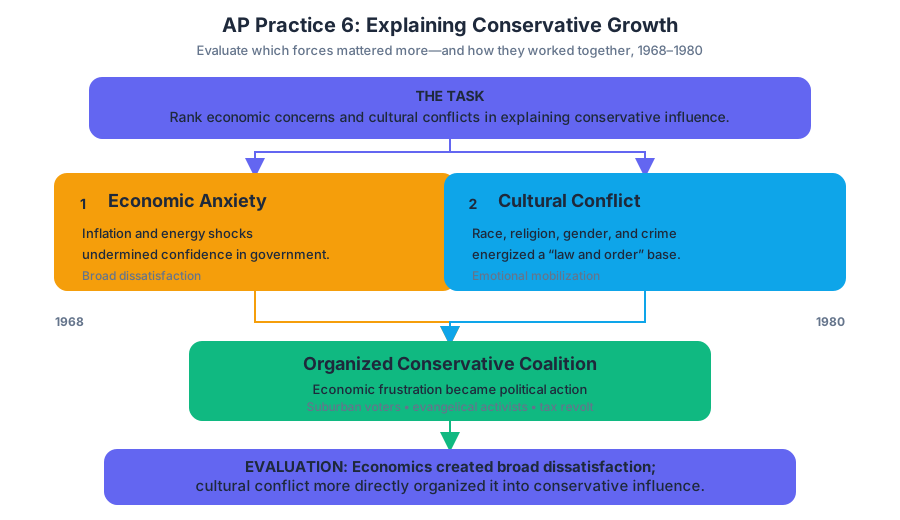
Source Materials
- AP U.S. History Course and Exam Description
- AP U.S. History Course and Exam Description Clarifications and Corrections
- AP U.S. History Course Overview
- AP U.S. History Course at a Glance
- AP United States History Course at a Glance Poster
- AP United States History
- AP United States History
- AP United States History Sample Syllabus 1
- © 2023 College Board
- © 2023 College Board
- © 2023 College Board
- © 2023 College Board
Study AP United States History with AI — Free on Lykke
Sign up for free to generate personalized flashcards, quizzes, and study guides from this course. Chat with an AI tutor that knows the material.
Get Started FreeView this course wiki on Lykke · Browse all public course wikis