From the free course AP United States History on Lykke
4.1 Contextualizing Period 4 · 4.2 The Rise of Political Parties and the Era of Jefferson
By 1800, the United States had won independence but had not yet agreed on what independence should produce: a powerful national government led by commercial elites, or a more decentralized republic centered on independent farmers.
4.1 Contextualizing Period 4 · 4.2 The Rise of Political Parties and the Era of Jefferson
By 1800, the United States had won independence but had not yet agreed on what independence should produce: a powerful national government led by commercial elites, or a more decentralized republic centered on independent farmers. The election of Thomas Jefferson exposed that disagreement—and then demonstrated that competing parties could transfer power without destroying the constitutional system.
4.1 Contextualizing Period 4
Period 4 covers $1800$–$1848, a time when the early republic expanded geographically, politically, economically, and socially. The Constitution had created a stronger federal government than the Articles of Confederation, but Americans continued to debate how much power that government should exercise.
Essential idea for 4.1: The early republic established constitutional institutions, but their meaning remained contested.
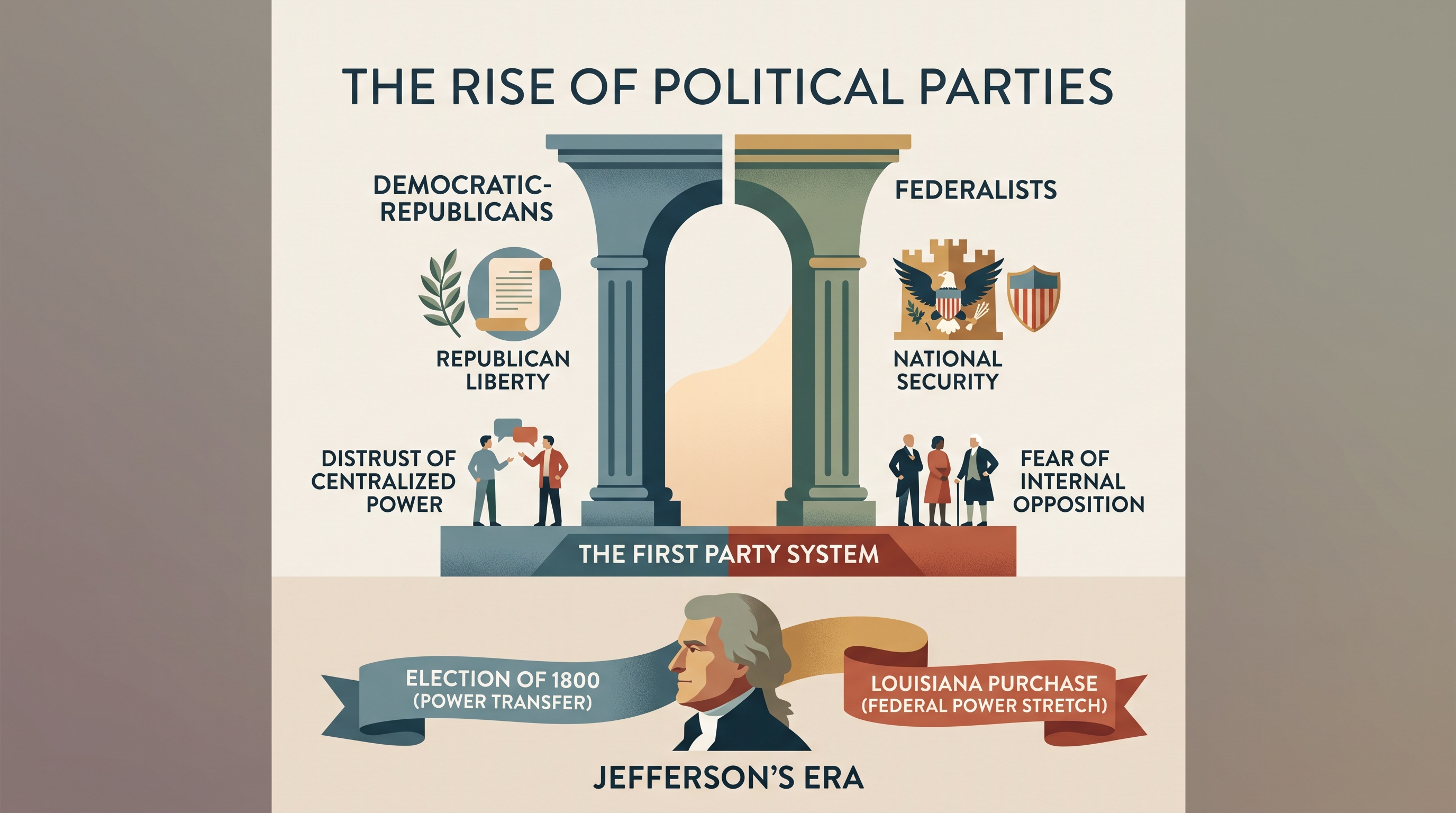
The critical background includes the ratification debates, the creation of the first party system, and the policies of George Washington and John Adams. Federalists such as Alexander Hamilton favored a vigorous national government, public credit, commercial development, and close ties with Britain. Democratic-Republicans such as Jefferson and James Madison emphasized agricultural independence, limited federal authority, and sympathy for revolutionary France.
A useful contextual chain is:
- Constitutional settlement → created a stronger federal structure.
- Hamiltonian economic program → expanded national financial power.
- Political disagreement → produced organized parties.
- Election of 1800 → tested whether parties could compete within the Constitution.
- Jeffersonian presidency → reinterpreted, rather than simply erased, federal power.
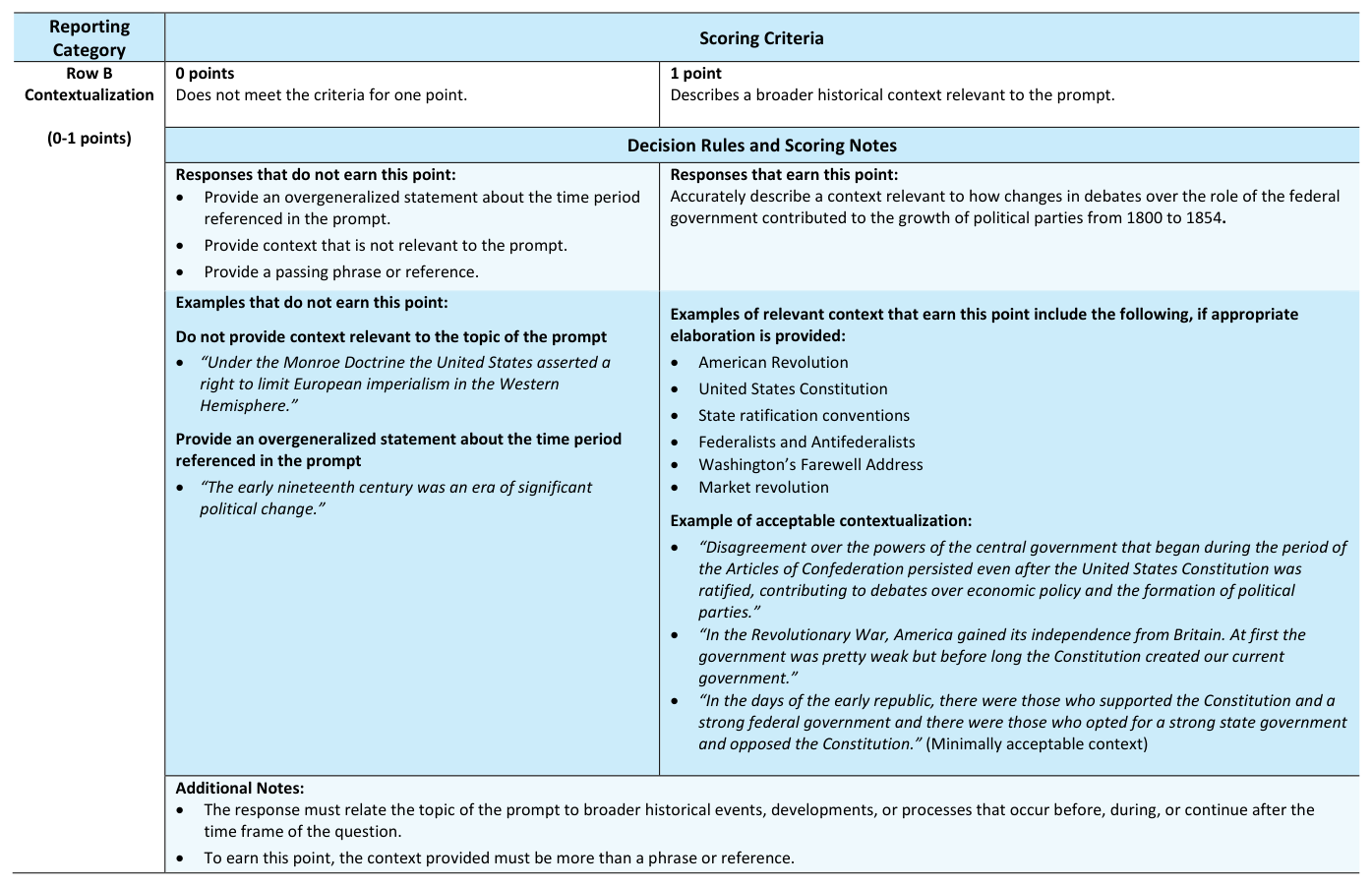
This is AP Historical Thinking Skill 4.A: Contextualization. To contextualize an event, connect it to broader developments before, during, or after it. For example, the election of 1800 makes little sense if treated as an isolated contest: it followed disputes over the national bank, taxation, foreign affairs, and the Federalist response to domestic dissent.
4.2 The Rise of Political Parties
Political parties were not explicitly described in the Constitution. They emerged because political leaders disagreed about how to interpret the new government’s powers. The first party system therefore reflected competing constitutional visions, not merely personal rivalries.
| Federalists | Democratic-Republicans |
|---|---|
| Favored stronger federal authority | Favored limited federal authority |
| Supported commerce, manufacturing, and public credit | Emphasized agriculture and the independent farmer |
| Accepted a broad interpretation of federal power | Preferred a strict interpretation of federal power |
| Generally admired Britain’s political stability | Generally sympathized with revolutionary France |
| Supported institutions such as the national bank | Feared concentrated financial and governmental power |
AP Historical Thinking Skill 2.A: Sourcing and Situation asks students to analyze how a source’s point of view, purpose, audience, and historical situation shape its meaning. A Federalist defense of the national bank, for instance, should be read in the context of post-Revolutionary financial instability; a Democratic-Republican criticism should be read in the context of fears that centralized finance would reproduce European-style aristocracy.
The crisis under John Adams
During John Adams’s presidency, conflict intensified. The Alien and Sedition Acts expanded federal authority over immigrants and punished some forms of criticism directed at the government. Democratic-Republicans argued that these laws violated freedom of speech and exceeded constitutional limits. The Virginia and Kentucky Resolutions responded by advancing the controversial idea that states could judge the constitutionality of federal actions.
The controversy revealed a central contradiction: Federalists claimed that national strength protected the republic, while Democratic-Republicans warned that national strength could become tyranny. Neither side simply opposed government; they disagreed about where legitimate power should reside and how constitutional liberty should be protected.
The election of 1800
The election of 1800 pitted Adams against Jefferson. Because Jefferson and Aaron Burr received the same number of electoral votes, the House of Representatives chose Jefferson after several ballots. The result became known as the “Revolution of 1800” because power passed from one party to another through constitutional procedures rather than military force.
Jefferson described his victory as a restoration of republican principles, but his administration did not dismantle the entire Federalist system. The national government remained, federal institutions continued operating, and Jefferson sometimes used powers that his earlier political arguments had questioned.
Jefferson’s governing paradox
Jefferson reduced some Federalist policies, including military spending and certain internal taxes, while presenting himself as a defender of limited government. Yet the Louisiana Purchase of 1803 dramatically enlarged the nation and relied on presidential action whose constitutional basis was not perfectly clear. The purchase doubled the territorial size of the United States and strengthened the long-term possibility of westward expansion.
This produces an exam-worthy paradox: Jefferson’s political language emphasized strict construction and limited federal authority, while his presidential decisions sometimes expanded national power. The key is not to label Jefferson simply “for” or “against” federal power; instead, explain how practical circumstances could produce tension between ideology and policy.
Named misconception check — “The election of 1800 ended political conflict.”
It did not. It established a peaceful precedent for partisan change, but disputes over constitutional interpretation, federal authority, civil liberties, and the nation’s economic direction continued.
Worked contextual example
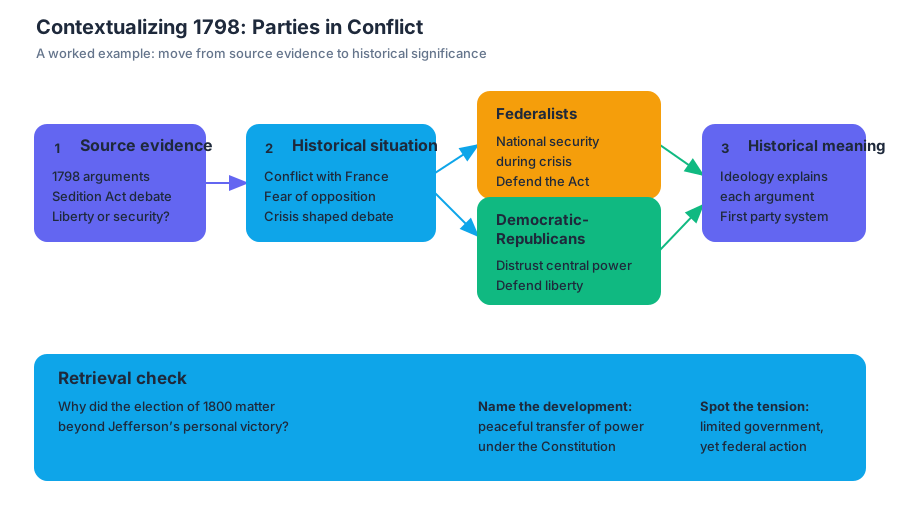
Suppose a source from $1798$ condemns the Sedition Act as an attack on republican liberty, while a Federalist source defends it as necessary during an international crisis. A strong analysis would first identify the historical situation: the United States faced conflict with revolutionary France and feared internal opposition. It would then connect each argument to party ideology—Democratic-Republican distrust of centralized power versus Federalist concern for national security—and conclude that the dispute helped define the first party system.
Retrieval check: Why did the election of 1800 matter beyond Jefferson’s personal victory? Name the constitutional development it demonstrated and one contradiction in Jefferson’s approach to federal power.
Source Materials
- AP U.S. History Course and Exam Description
- AP U.S. History Course and Exam Description Clarifications and Corrections
- AP U.S. History Course Overview
- AP U.S. History Course at a Glance
- AP United States History Course at a Glance Poster
- AP United States History
- AP United States History
- AP United States History Sample Syllabus 1
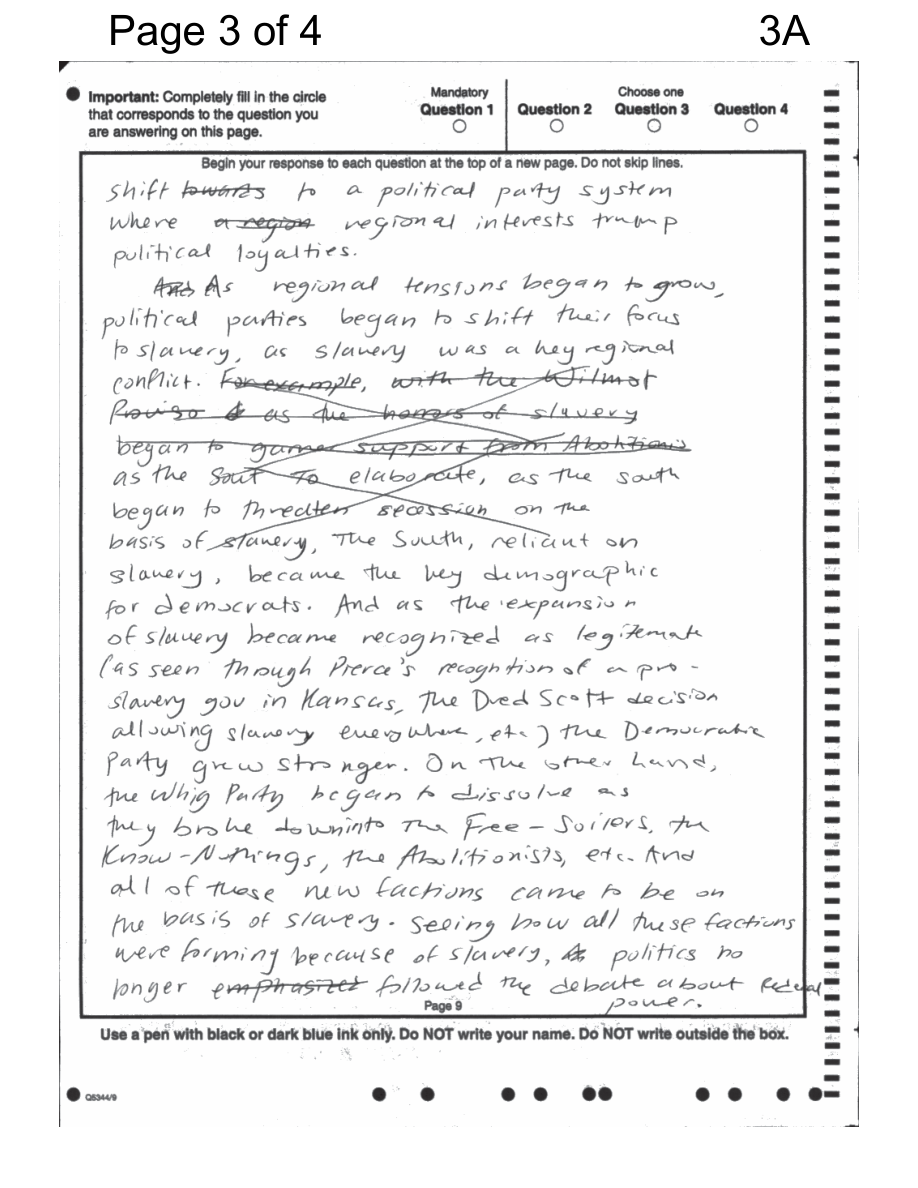
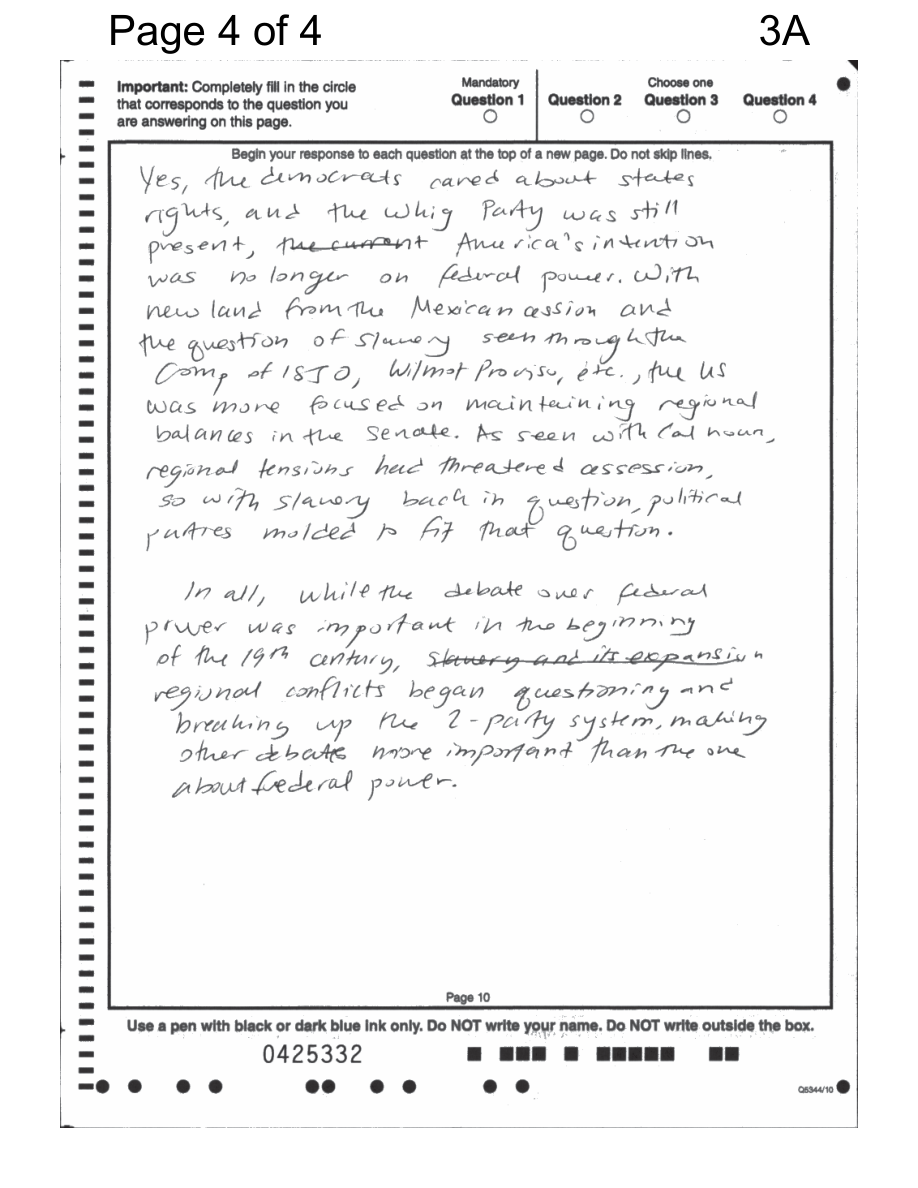
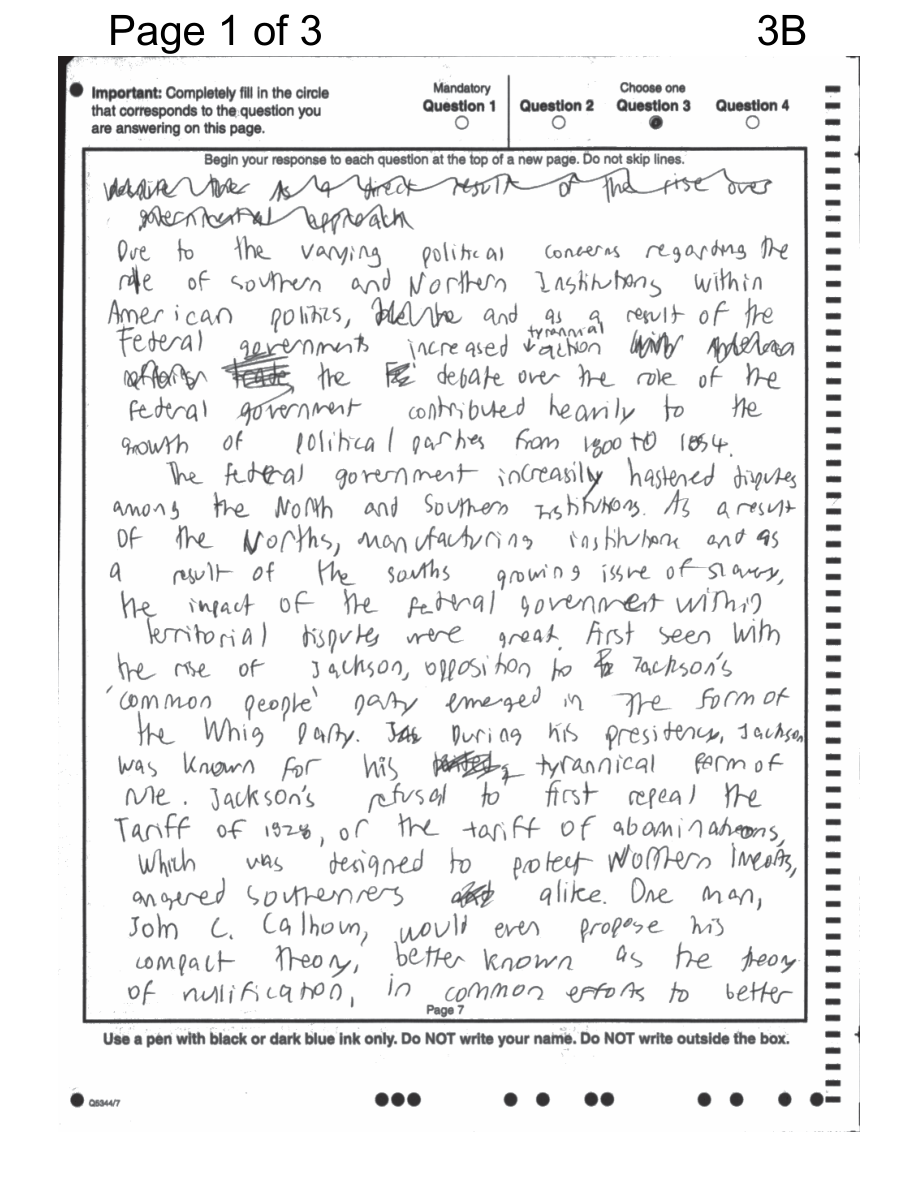
- Figure — Sample Responses - LEQ 3 - Set 2 (p. 4)
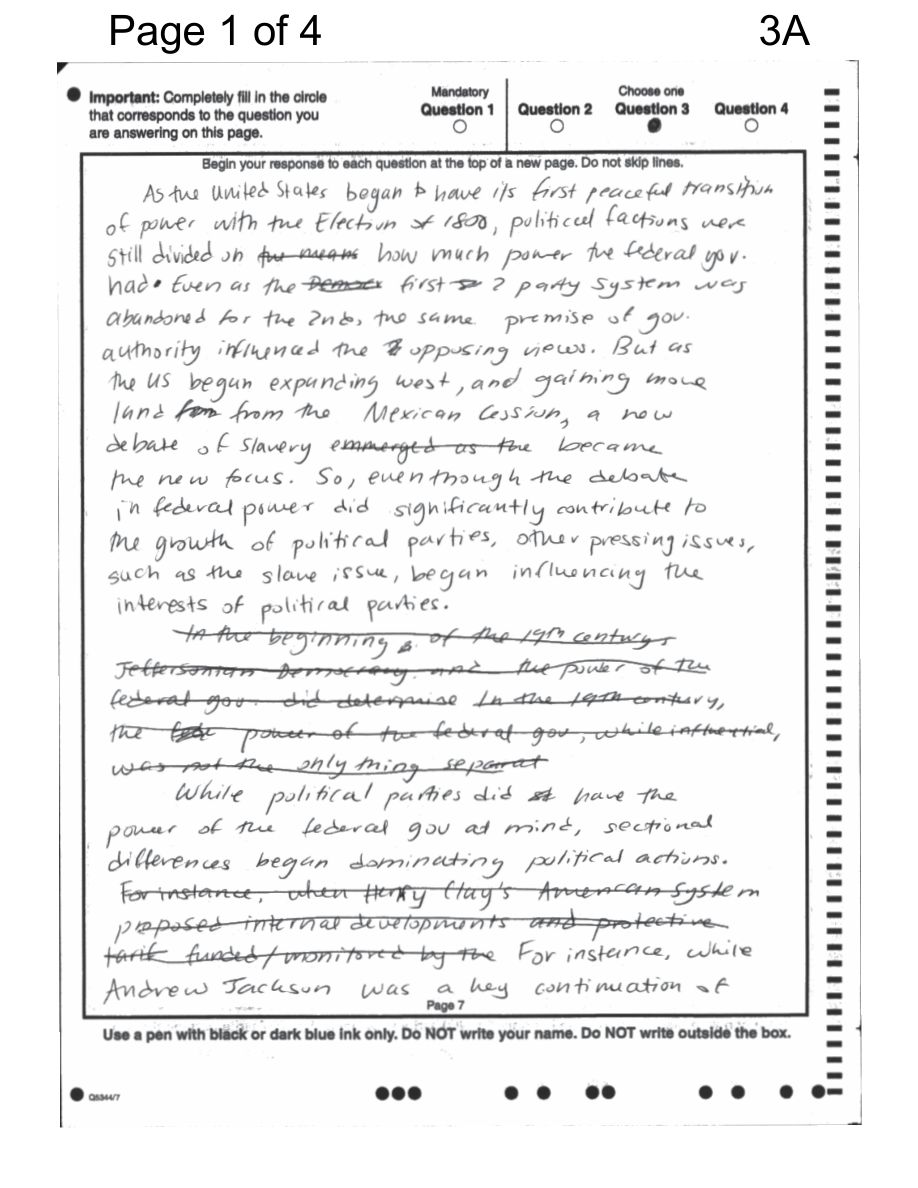
- Figure — Sample Responses - LEQ 3 - Set 2 (p. 7)
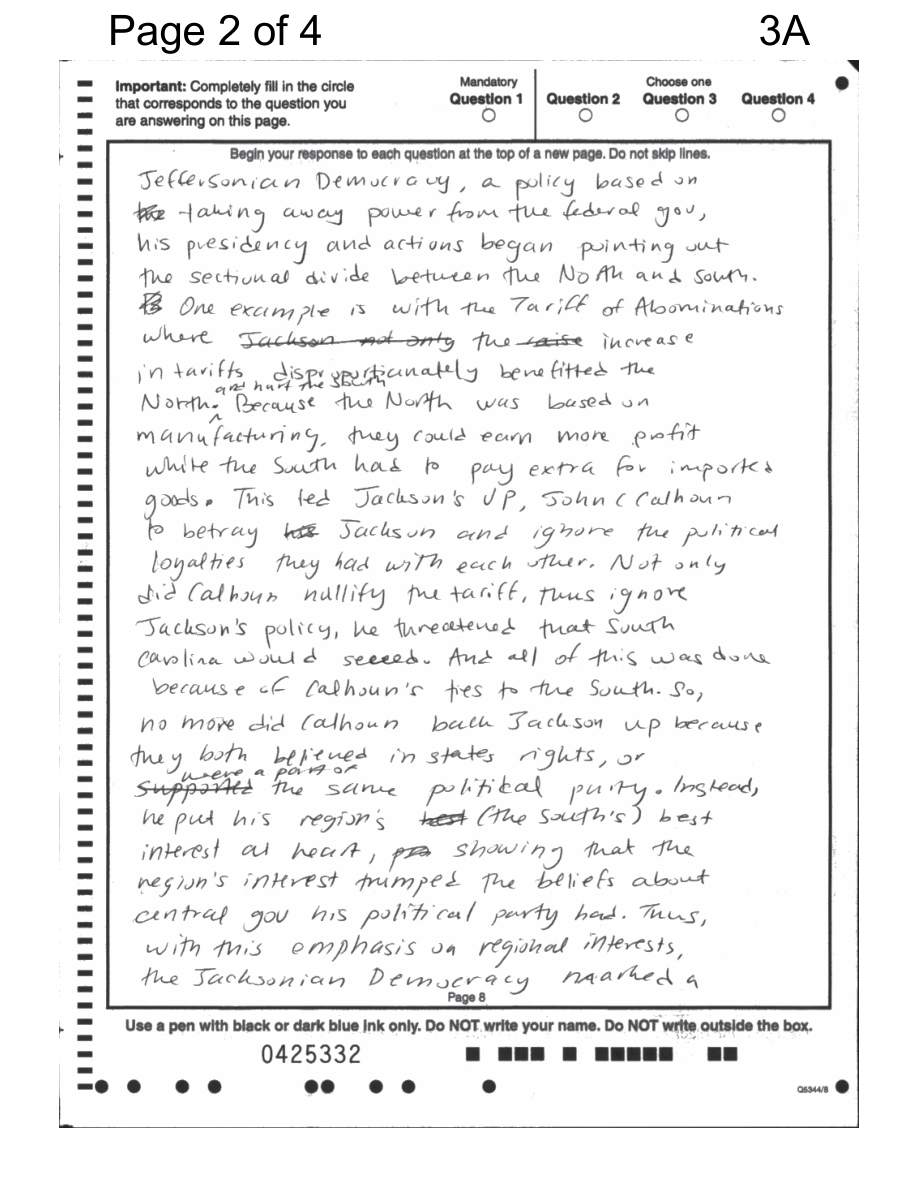
- Figure — Sample Responses - LEQ 3 - Set 2 (p. 8)
- Figure — Sample Responses - LEQ 3 - Set 2 (p. 9)