From the free course AP United States History on Lykke
7.7 1920s: Innovations in Communication and Technology · 7.8 1920s: Cultural and Political Controversies
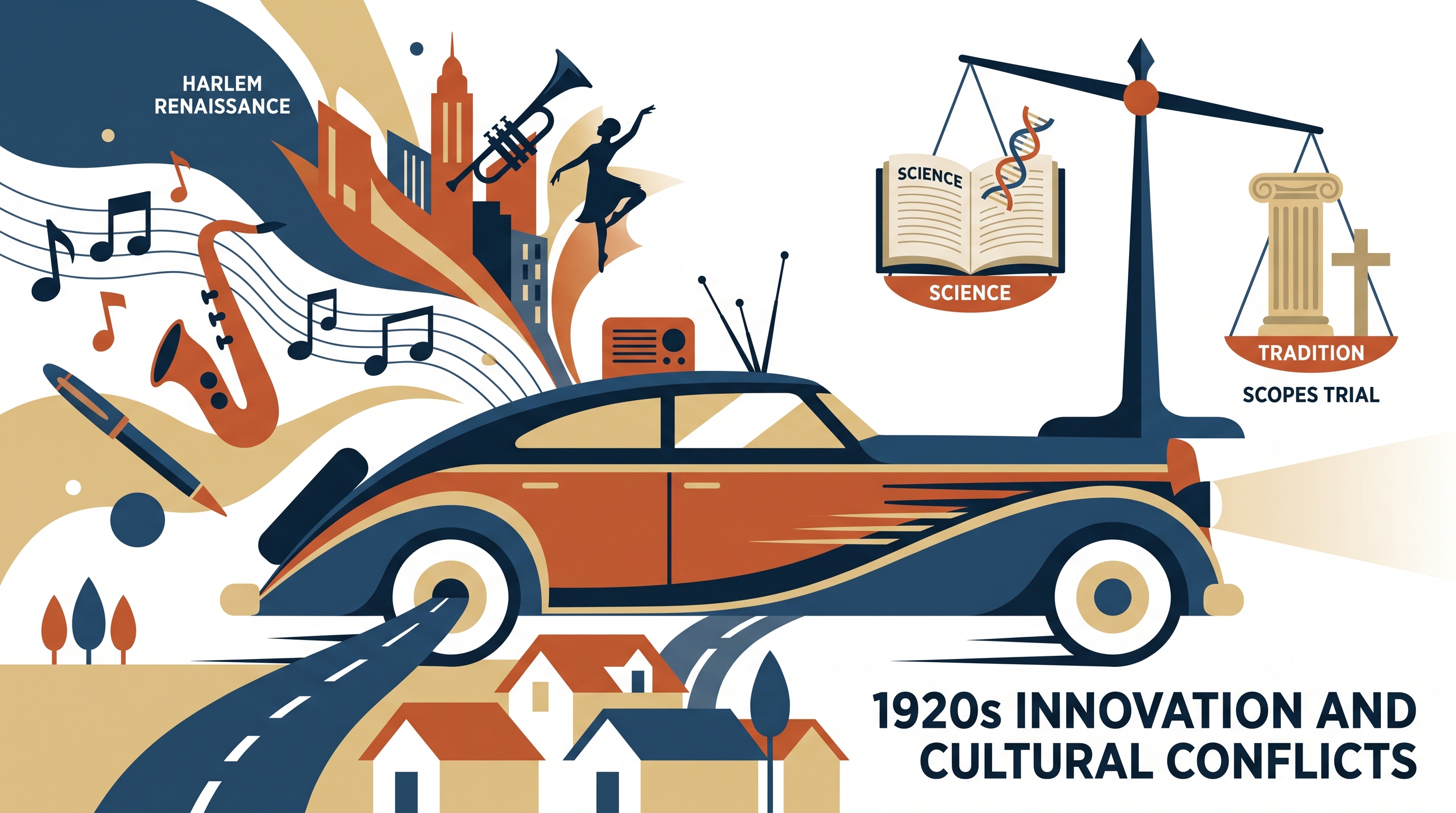
The 1920s transformed American life because new technologies made national culture faster, more commercial, and more connected—while the same changes intensified conflicts over race, religion, immigration, gender, and modernity.
7.7 1920s: Innovations in Communication and Technology · 7.8 1920s: Cultural and Political Controversies
The 1920s transformed American life because new technologies made national culture faster, more commercial, and more connected—while the same changes intensified conflicts over race, religion, immigration, gender, and modernity. The central tension was simple: who would benefit from a more modern America, and who would decide what “modern” meant?
7.7 — Technology creates a mass market
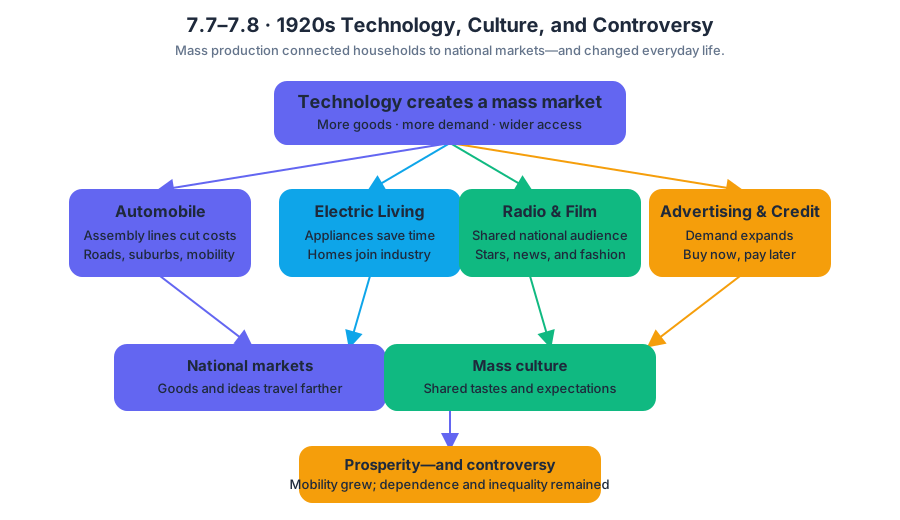
The automobile became the decade’s signature technology. Henry Ford’s moving assembly line lowered production costs and helped make the Model T affordable to many middle-class families. Cars did more than change transportation: they encouraged road construction, expanded suburbs, supported gasoline stations and roadside businesses, and gave young people and families greater mobility.
Electricity and consumer appliances also reshaped daily life. Radios, refrigerators, vacuum cleaners, and washing machines connected household life to industrial production. Installment buying—purchasing an item through a sequence of payments—allowed consumers to buy goods before they had saved the full price, expanding demand but also making household prosperity dependent on continued income.
Radio created a shared national audience. A family in a rural town could hear the same music, advertisements, political speeches, sporting events, and entertainment as listeners in a major city. Motion pictures performed a similar cultural function, spreading fashion, celebrity images, and social expectations across regional boundaries.
This relationship between technology and economic growth illustrates the WXT theme, Work, Exchange, and Technology: mass production increased the supply of consumer goods, advertising stimulated demand, and credit helped connect households to national markets. The result was not equal prosperity, however. Farmers, many workers, and people excluded from consumer opportunities did not experience the decade’s prosperity in the same way.
Key insight: Technology did not merely make existing habits more convenient. It reorganized markets, leisure, family life, transportation, and the circulation of ideas.
Worked contextual example: the automobile
Suppose a historian finds that automobile ownership rose sharply during the 1920s while paved-road construction expanded. The strongest explanation would connect several developments: assembly-line production reduced prices; installment credit broadened access; increased ownership created pressure for better roads; and improved roads encouraged suburban growth and commercial expansion. A response that says only “cars made travel easier” describes an effect but does not explain the broader historical process.
7.8 — Modernism meets cultural resistance
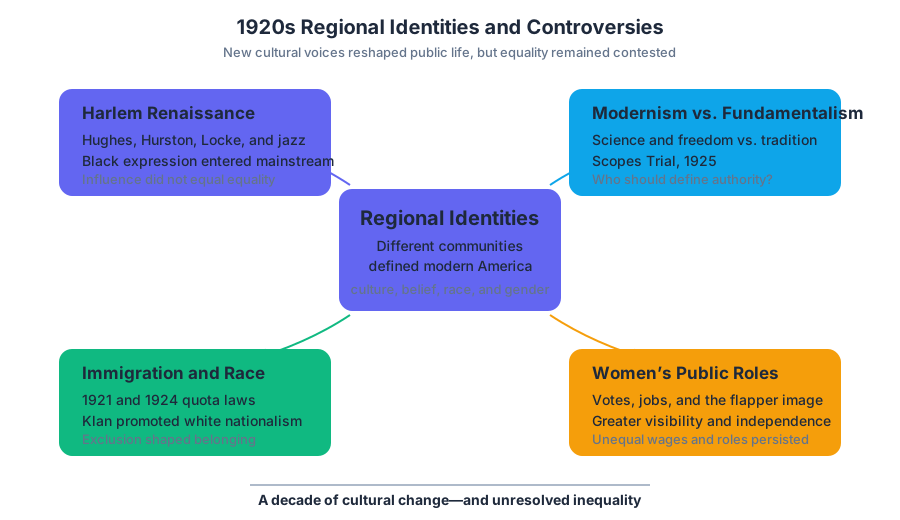
Mass communication helped create popular culture, shared entertainment and consumer habits experienced by large audiences. Yet national culture did not become uniform. Migration, especially the movement of African Americans from the rural South to northern cities, generated new artistic and literary expression. The Harlem Renaissance—a flowering of African American literature, music, art, and intellectual life—expressed ethnic and regional identities, directly reflecting KC-7.2.I.B.
The Harlem Renaissance included writers such as Langston Hughes and Zora Neale Hurston, musicians associated with jazz, and intellectuals such as Alain Locke. Jazz and other forms of Black cultural expression entered mainstream commercial culture, but this popularity existed alongside segregation, racial violence, and discrimination. Cultural influence did not equal political or economic equality.
The decade also produced sharp disputes between modernism, which emphasized new scientific ideas, individual freedom, and changing social practices, and fundamentalism, which defended traditional religious beliefs and literal interpretations of the Bible. The Scopes Trial of 1925 dramatized this conflict: the issue was formally the teaching of evolution, but the larger debate concerned science, religion, public education, and authority.
Immigration and race produced another contradiction. The Emergency Quota Act of 1921 and the Immigration Act of 1924 restricted immigration through national-origins quotas, favoring immigrants from northern and western Europe and sharply limiting others. The revived Ku Klux Klan promoted white Protestant nationalism, anti-Black racism, antisemitism, and hostility toward Catholics, immigrants, and radicals.
Women’s public roles changed after the Nineteenth Amendment, expanded employment, and the visibility of the “flapper,” a symbol of new consumer fashions and social independence. But the decade did not produce a complete gender revolution: most women continued to face unequal wages, restricted occupations, and pressure to center their lives on domestic responsibilities.
Misconception check
Misconception: “The 1920s were uniformly modern and prosperous.” In reality, the decade contained both innovation and reaction. Radio and automobiles expanded national consumer culture, while immigration restrictions and the Klan enforced exclusion; the Harlem Renaissance celebrated Black creativity while racial violence continued; and religious traditionalists resisted modern science.
AP reasoning in action
These topics most directly develop Historical Thinking Skill 1: Developments and Processes, especially explaining how technology and migration produced multiple effects; Historical Thinking Skill 4: Contextualization, by placing 1920s conflicts within postwar demographic and economic change; and Historical Thinking Skill 5: Making Connections, by linking consumer technology to culture, migration, and politics. They also support Historical Thinking Skill 6: Argumentation when evaluating whether the decade represented cultural liberation, cultural conflict, or both.
The governing learning objective is Unit 7: Learning Objective I, which asks students to explain the causes and effects of developments in American culture and politics over time. KC-7.2.I.D captures the broader controversy: Americans debated gender roles, modernism, science, religion, popular culture, race, and immigration. In a historical argument, the strongest answer connects a development to both its causes and its uneven consequences.
Retrieval check
- Why did automobiles affect more than transportation?
- How did the Harlem Renaissance express migration and identity?
- Why is the Scopes Trial evidence of a broader conflict rather than an isolated court case?
Answer check: Automobiles stimulated roads, suburbs, and related businesses; the Harlem Renaissance transformed migration into artistic and intellectual expression; and the Scopes Trial represented the national struggle between modern science and religious traditionalism.
Source Materials
- AP U.S. History Course and Exam Description
- AP U.S. History Course and Exam Description Clarifications and Corrections
- AP U.S. History Course Overview
- AP U.S. History Course at a Glance
- AP United States History Course at a Glance Poster
- AP United States History
- AP United States History
- AP United States History Sample Syllabus 1