From the free course AP United States History on Lykke
6.11 Reform in the Gilded Age · 6.12 Controversies over the Role of Government in the Gilded Age
Key concepts: Gilded Age reform movements · Industrial capitalism · Laissez-faire government policies · Economic competition · Government intervention during economic downturns · Political corruption and self-interest · Debates over citizenship and the proper role of government · Public reform efforts · Economic and social policy debates · Conflict over government aid to farmers
Explain and apply 6.11 Reform in the Gilded Age · 6.12 Controversies over the Role of Government in the Gilded Age.
6.11 Reform in the Gilded Age · 6.12 Controversies over the Role of Government in the Gilded Age
Industrial capitalism created enormous wealth while concentrating poverty, political power, and economic risk, prompting Americans to ask a difficult question: Should government protect competition and workers, or should it leave economic life largely alone?
Reform in a “Gilded” Society
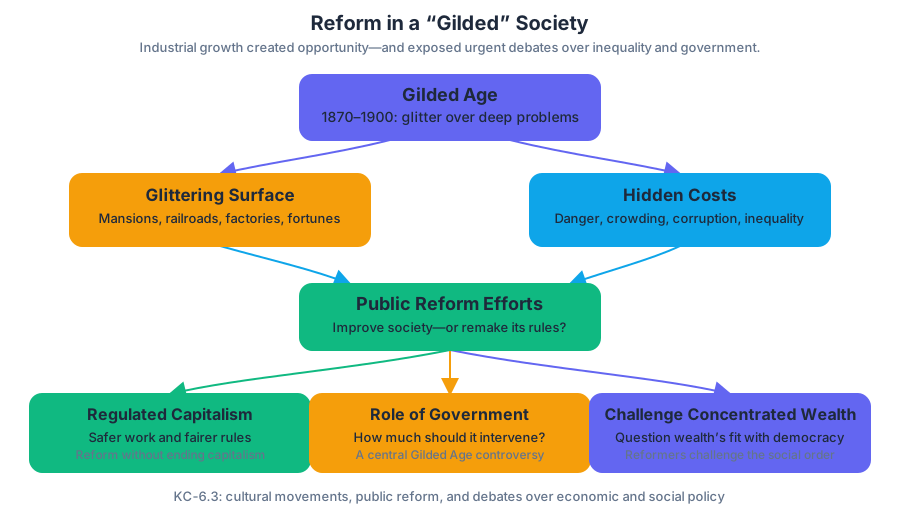
The term Gilded Age describes the period from roughly 1870 to 1900 as an era whose glittering surface—mansions, railroads, factories, and financial fortunes—covered serious problems beneath it. Industrial growth produced jobs and new opportunities, but also dangerous workplaces, overcrowded cities, political corruption, and sharp inequality.
This tension connects directly to KC-6.3, which identifies the Gilded Age as a period of “new cultural and intellectual movements, public reform efforts, and political debates over economic and social policies.” Under KC-6.3.I, reformers both buttressed and challenged the existing social order: some sought to improve industrial society without changing capitalism, while others questioned whether concentrated wealth was compatible with democracy.
Reform movements and their assumptions
Social Gospel reformers argued that Christian ethics required action against poverty, unsafe labor, and urban misery. Organizations such as settlement houses—most famously Jane Addams’s Hull House in Chicago—provided education, childcare, and social services while documenting the conditions faced by working-class and immigrant families.
Other reform efforts focused on temperance, public sanitation, education, women’s activism, and government corruption. The Woman’s Christian Temperance Union connected alcohol abuse to domestic violence and poverty, while reformers increasingly argued that women’s moral influence justified a larger public role, including voting rights.
Civil service reform attacked the spoils system, in which elected officials rewarded political supporters with government jobs. The assassination of President James Garfield by a disappointed office seeker in 1881 helped build support for the Pendleton Civil Service Reform Act of 1883, which introduced competitive examinations for some federal positions.
Key insight: Gilded Age reform did not form one unified movement. Reformers disagreed about whether the solution was charity, moral reform, professional administration, labor protection, regulation of corporations, or a fundamental restructuring of capitalism.
Laissez-faire and the Role of Government
Laissez-faire means allowing economic activity to operate with limited direct government interference. Many business leaders defended this approach by claiming that competition rewarded efficiency and that government regulation threatened individual liberty and economic growth.
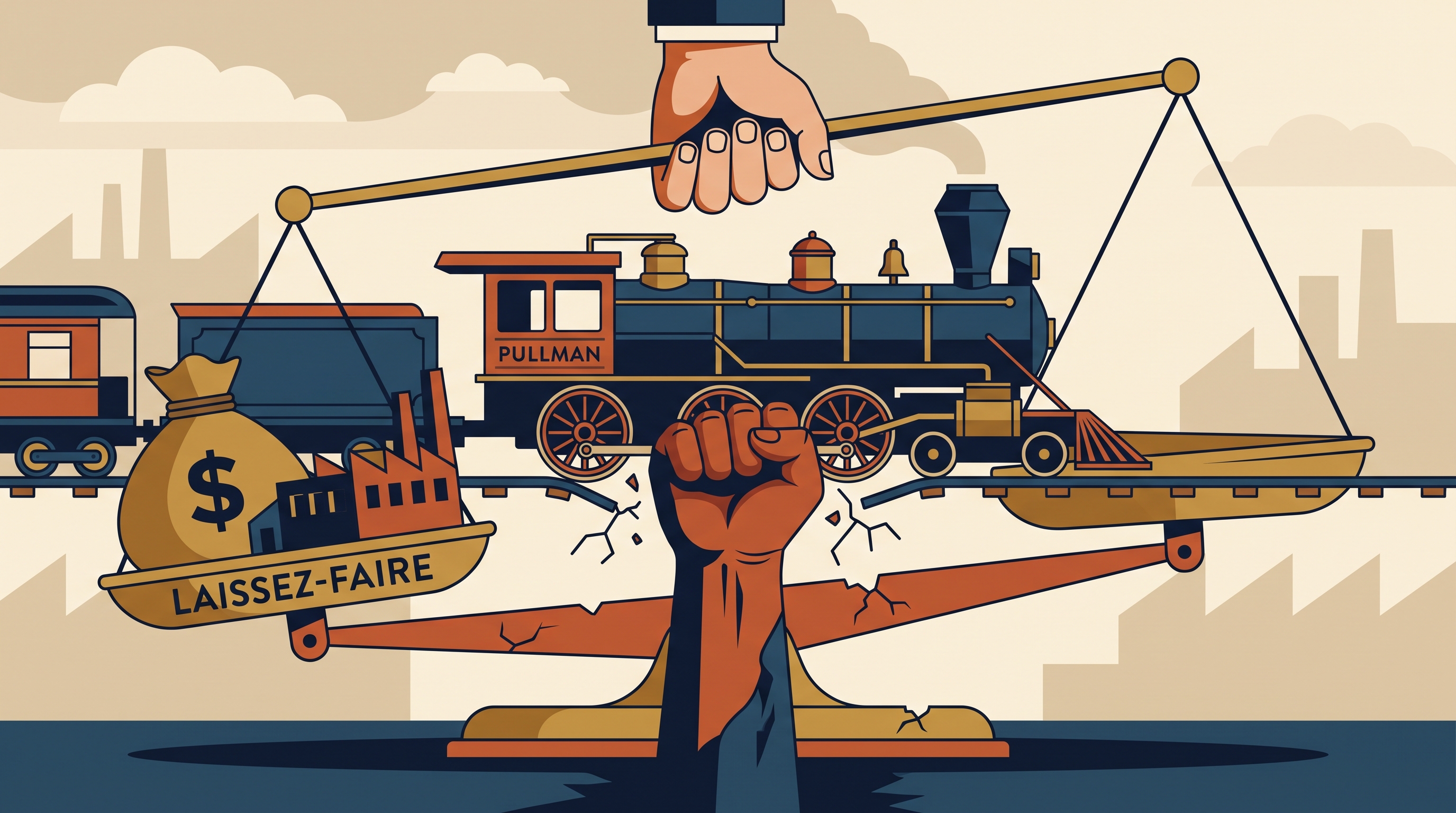
In practice, laissez-faire policies did not mean that government disappeared. Federal and state governments granted land to railroads, enforced contracts, used troops during labor conflicts, imposed tariffs, and sometimes regulated corporations. The central controversy was therefore not simply “government versus no government,” but which groups government would assist and what kinds of intervention it would permit.
Competing perspectives
Industrialists such as Andrew Carnegie defended unequal wealth through ideas associated with Social Darwinism. In this view, economic competition selected the most capable individuals, while extensive aid to the poor might interfere with what supporters described as natural competition.
Critics answered that competition was not fair when corporations controlled railroads, credit, markets, and political influence. Farmers and workers demanded regulation of railroad rates, protection from monopolies, and relief during economic downturns. The Interstate Commerce Act of 1887 and Sherman Antitrust Act of 1890 represented attempts to regulate corporate power, although early enforcement was weak and courts often interpreted these measures narrowly.
Economic crises intensified the debate. During the Panic of 1873 and the Panic of 1893, bank failures, business closures, unemployment, and falling prices exposed the human cost of an economy with limited public relief. Reformers increasingly supported government intervention, while defenders of laissez-faire feared that aid would reward failure or expand federal power.
Worked Contextual Example: The Pullman Strike
The Pullman Strike of 1894 demonstrates how reform, economic crisis, and government power collided. The Pullman Palace Car Company cut wages during a depression but did not proportionally reduce rents in its company town. Workers joined the American Railway Union, led by Eugene V. Debs, and refused to handle Pullman cars.
The federal government obtained an injunction against the strike and sent troops to keep the mail moving. The strike collapsed, Debs was imprisoned, and the episode suggested that government intervention often protected the uninterrupted operation of business more readily than workers’ bargaining power.
Reasoning chain: depression → wage cuts and unemployment → worker protest → federal intervention → public debate over whether government neutrality was genuine. This evidence supports KC-6.3.II, because social change generated arguments about corruption, citizenship, and the proper relationship between business and government.
AP Skills and Common Misconceptions
This topic most directly develops AP Historical Thinking Skill 1: Developments and Processes, especially 1.B Explain a historical development or process, by tracing how industrial inequality produced reform. It also uses Skill 4: Making Connections, including 4.B Explain how a specific historical development relates to another historical development, when connecting economic downturns to government intervention.
For documents or cartoons about monopolies, labor, or corruption, apply Skill 2: Sourcing and Situation, particularly 2.A Identify a source’s point of view, purpose, historical situation, and/or audience. A strong argument also uses Skill 5: Argumentation, including 5.A Make a historically defensible claim and 5.B Support an argument using specific and relevant evidence.
Misconception check: “Laissez-faire meant the government never intervened.”
Correction: Government intervened frequently, but intervention often favored property owners, railroads, and corporations. The debate concerned the direction and purpose of government power.
Retrieval Check
Explain, in two steps, why the Pullman Strike became evidence for critics of laissez-faire. Then identify one reform movement that sought to improve Gilded Age society and explain whether it mainly addressed economic inequality, political corruption, or social conditions.
Source Materials
- AP U.S. History Course and Exam Description
- AP U.S. History Course and Exam Description Clarifications and Corrections
- AP U.S. History Course Overview
- AP U.S. History Course at a Glance
- AP United States History Course at a Glance Poster
- AP United States History
- AP United States History
- AP United States History Sample Syllabus 1