From the free course AP United States History on Lykke
1.1 Contextualizing Period 1 · 1.2 Native American Societies Before European Contact
Key concepts: Contextualization · Native American societies before European contact · Maize cultivation · Geography and the environment · Economic development · Settlement patterns · Advanced irrigation · Social diversification · Algonquian societies · Historical source analysis
How did Native American societies turn environmental limits into different ways of living before 1607? The answer begins with geography: maize cultivation supported permanent settlements and social complexity in some regions, while aridity and grasslands encouraged mobility in others.
1.1 Contextualizing Period 1 · 1.2 Native American Societies Before European Contact
How did Native American societies turn environmental limits into different ways of living before 1607? The answer begins with geography: maize cultivation supported permanent settlements and social complexity in some regions, while aridity and grasslands encouraged mobility in others. Period 1, defined as 1491–1607, is not a story of one “Native American” society but of many societies adapting to distinct environments and interacting with one another.
Investigative question: How and why did various native populations in the period before European contact interact with the natural environment in North America?
The central pattern: environment shaped choices
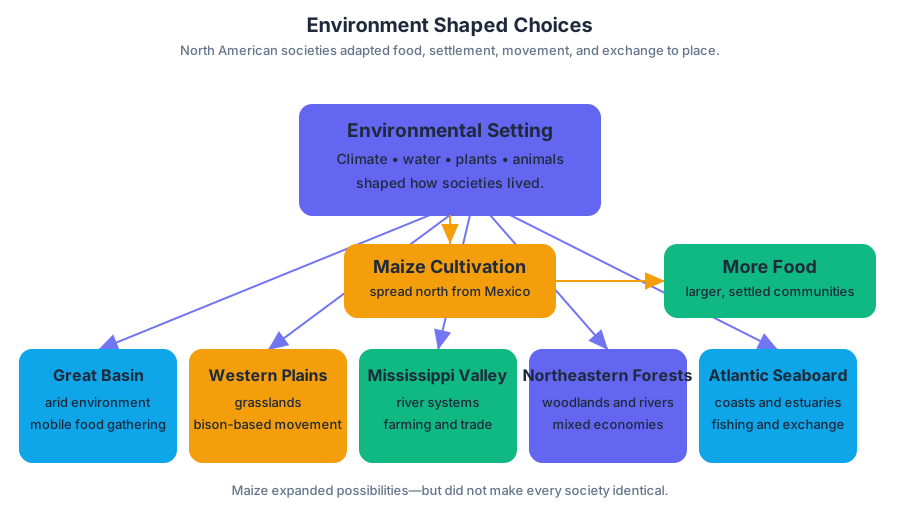
Contextualization means placing a historical development within the broader conditions that shaped it. For Topic 1.1, the essential context is that North America contained sharply different environments: the arid Great Basin, the grasslands of the western Great Plains, the river systems of the Mississippi Valley, the forests of the Northeast, and the Atlantic seaboard. These settings affected food production, settlement patterns, movement, economic development, and relationships among societies.
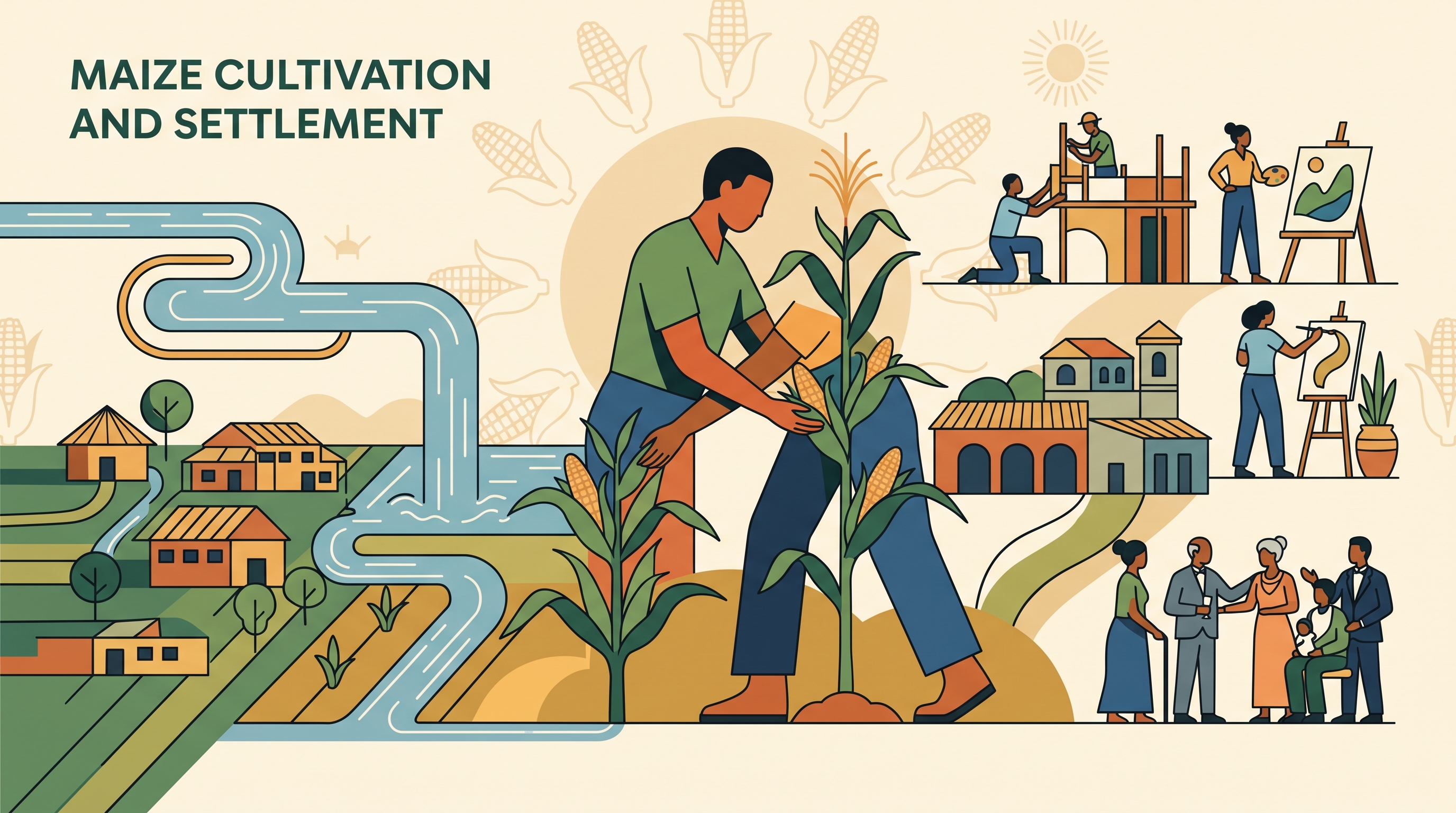
The most important development was the spread of maize cultivation, or the farming of corn, northward from present-day Mexico into the present-day American Southwest and beyond. Maize did not make every society identical. Instead, where climate and water permitted, it expanded the food supply and supported larger, more permanent communities.
Maize, irrigation, and social diversification
The causal chain is worth memorizing because it explains several required ideas at once:
- Maize spread northward from present-day Mexico.
- Reliable cultivation supported economic development, because communities could produce and store agricultural surpluses.
- Surpluses encouraged settlement, including permanent villages.
- In dry regions, farming required advanced irrigation systems to direct scarce water to fields.
- Larger, more settled communities became increasingly socially diversified, meaning that people performed different economic, political, and religious roles.
This development is identified in KC-1.1.I.A and is tied to Unit 1: Learning Objective B: explain how and why various native populations before European contact interacted with the natural environment in North America. The key is not merely to state that maize existed. A strong historical explanation shows how agriculture changed population size, settlement, technology, and social organization.
Worked contextual example
Suppose a historian compares an irrigated agricultural community in the Southwest with a society living in the Great Basin. The Southwest community could use canals or other irrigation techniques to move water toward maize fields. That food system could support a permanent settlement and specialized roles such as farming, construction, leadership, or religious activity. By contrast, the Great Basin’s aridity made intensive agriculture more difficult, so societies often developed largely mobile lifestyles, moving to make use of seasonally available resources. The difference is not that one society was “advanced” and the other was not; each represented an adaptation to environmental conditions.
Regional adaptations and interaction
KC-1.1.I.B identifies the mobile lifestyles that developed in response to the aridity of the Great Basin and the grasslands of the western Great Plains. KC-1.1.I.C emphasizes that in the Northeast, the Mississippi River Valley, and along the Atlantic seaboard, some societies combined agriculture with hunting and gathering. This mixed economy favored permanent villages while allowing communities to draw on multiple food sources.
These regional differences shaped interaction. Societies exchanged goods, competed over resources, migrated, formed alliances, and responded to one another’s presence. The environment did not mechanically determine behavior; rather, it created opportunities and constraints within which people made decisions. This is the broader GEO (Geography and the Environment) theme: geography shapes human development, while human communities also reshape geography through farming, settlement, and irrigation.
Reading visual evidence: Roanoke
The Roanoke engravings by Theodor de Bry, based on John White’s work and published in 1590, depict Indigenous people and aspects of Algonquian life on the eve of colonial contact. A visual source can provide evidence about clothing, settlement, labor, tools, food production, and social activity—but historians must ask what the image shows, who created it, and when it was published. The image is evidence of Indigenous life as represented by European observers, not a perfectly neutral photograph.
Misconception check
Misconception: “Native American societies were either nomadic hunters or settled farmers.” The reality was more varied. Some communities were largely mobile; others lived in permanent villages; and some combined agriculture with hunting and gathering. Environmental adaptation produced diversity rather than a single universal pattern.
Retrieval check
Explain the relationship among maize cultivation, irrigation, settlement, and social diversification. Then identify one environmental reason a society in the Great Basin or western Great Plains might develop a largely mobile lifestyle. A complete answer should name the environmental condition, the adaptation, and the resulting settlement pattern.
Source Materials
- AP U.S. History Course and Exam Description
- AP U.S. History Course and Exam Description Clarifications and Corrections
- AP U.S. History Course Overview
- AP U.S. History Course at a Glance
- AP United States History Course at a Glance Poster
- AP United States History
- AP United States History
- AP United States History Sample Syllabus 1
- AP US History Past Exam Questions — AP Central
- Khan Academy — AP US History
- Gilder Lehrman Institute — AP US History Study Guide
- AP US History Units — Save My Exams