From the free course AP United States History on Lykke
7.13 World War II: Military · 7.14 Postwar Diplomacy
Key concepts: World War II military history · Postwar diplomacy · Allied victory · Postwar peace settlements · The Big Three: the United States, Britain, and the Soviet Union · U.S. emergence as the world’s most powerful nation · The postwar condition of Europe and Asia · U.S. involvement in World War II · Historical causation · America’s role in the world
By 1945, the United States had helped defeat the Axis powers while its own industrial base remained intact; Europe and much of Asia lay devastated.
7.13 World War II: Military · 7.14 Postwar Diplomacy
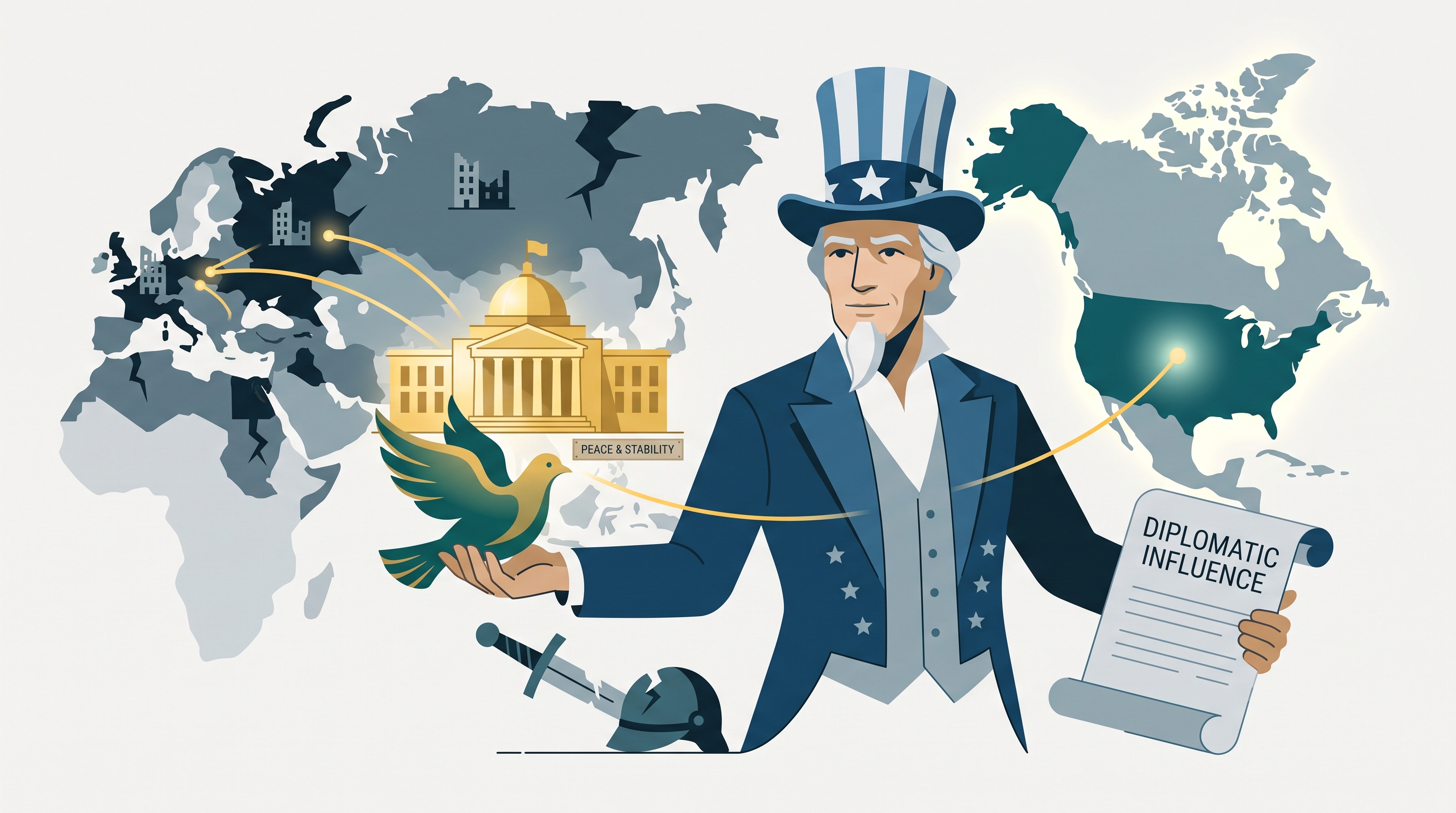
By 1945, the United States had helped defeat the Axis powers while its own industrial base remained intact; Europe and much of Asia lay devastated. That contrast transformed victory into power: the United States did not merely win the war—it helped shape the peace that followed.
Learning Objective — Unit 7: Learning Objective N: Explain the consequences of U.S. involvement in World War II.
Historical Development — KC-7.3.III.E: The war-ravaged condition of Asia and Europe, and the dominant U.S. role in the Allied victory and postwar peace settlements, allowed the United States to emerge from the war as the most powerful nation on Earth.
From military cooperation to Allied victory
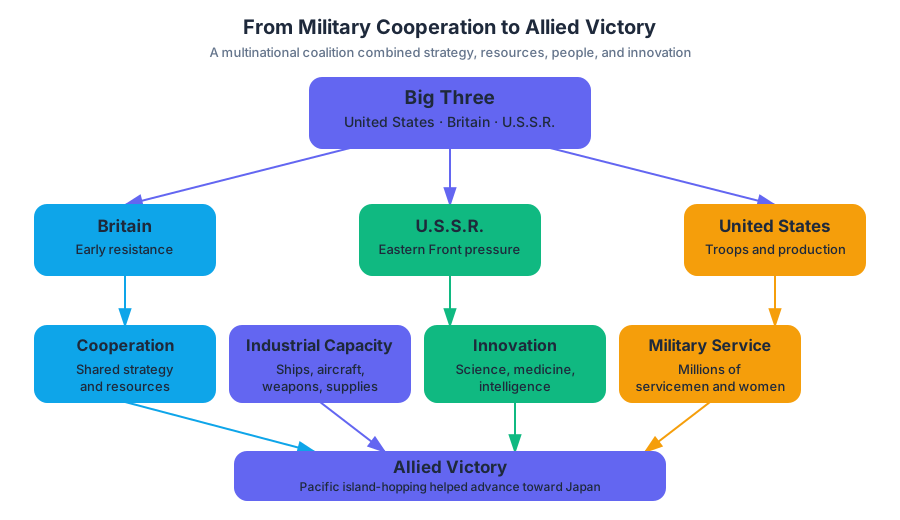
The central military coalition was the Big Three: the United States, Britain, and the U.S.S.R. They did not share identical political systems or postwar goals, but they cooperated against a common enemy. Britain resisted Germany from the war’s early stages, the Soviet Union absorbed enormous German pressure on the Eastern Front, and the United States supplied troops, equipment, technology, and industrial production across multiple theaters.
The Allied victory resulted from several interacting advantages rather than one isolated cause:
| Allied advantage | How it contributed to victory |
|---|---|
| Allied cooperation | Coordinated military strategy and shared resources across Europe and the Pacific |
| Industrial capacity | Produced ships, aircraft, vehicles, weapons, and supplies on a massive scale |
| Technological and scientific advances | Improved communication, medicine, weapons, intelligence, and transportation |
| Military service | Millions of servicemen and servicewomen supplied the personnel needed for global war |
| Pacific campaigns | “Island-hopping” bypassed some heavily fortified positions while moving U.S. forces toward Japan |
The United States played a dominant role, but “dominant” does not mean “alone.” Soviet forces made a decisive contribution by fighting Germany across the Eastern Front, while Britain provided essential resistance and strategic cooperation. A strong historical explanation therefore identifies U.S. leadership and resources while recognizing the multinational nature of the Allied victory.
Worked causal example
Suppose an argument claims that U.S. involvement mattered because it converted American economic strength into global military influence. The reasoning should proceed in a chain: U.S. factories produced war matériel → Allied forces could sustain campaigns in both Europe and the Pacific → the Axis powers were defeated → U.S. leaders gained greater authority in planning the postwar order. Each arrow explains how one development produced the next.
Military victory and the making of peace
Postwar diplomacy means more than ending combat. It includes the negotiations and peace settlements through which victorious powers establish political arrangements, security expectations, and international institutions after a war. The United States therefore expanded its influence twice: first through its military contribution to victory, and then through participation in deciding what the postwar world would look like.
The condition of the opposing regions made this influence especially powerful. Europe and Asia had suffered enormous destruction, including damaged cities, disrupted economies, displaced populations, and weakened governments. By contrast, the continental United States emerged with its productive capacity greatly strengthened, allowing it to provide aid, goods, loans, military protection, and diplomatic leadership.
The Big Three did not create a perfectly unified peace. Their cooperation during the war contained tensions over political systems, territorial control, and security. Nevertheless, U.S. participation in postwar settlements increased American international influence because the United States had both the resources to act and the military credibility to support its decisions.
Sourcing and Situation — Skill 2.B
Sourcing and Situation — Skill 2.B: Explain the point of view, purpose, historical situation, and/or audience of a source. To use a source as evidence about U.S. power after World War II, do not merely identify its author. Explain how the source’s circumstances make it useful.
Imagine a 1945 speech by a U.S. official urging Americans to help construct a stable international peace. Its historical situation—the recent Allied victory and the devastation of Europe and Asia—could explain why the speaker presents the United States as responsible for global leadership. Its purpose might be to persuade the public to support an active international role. The source would support the argument that military victory and peace-making combined to elevate U.S. power, although its official viewpoint might also encourage readers to overlook disagreements within the Allied coalition.
Strong sourcing sentence: Because the statement appeared immediately after a war that had weakened Europe and Asia, its appeal for U.S. leadership reflects a situation in which American officials possessed unusual economic and military influence; therefore, it supports the argument that postwar diplomacy expanded U.S. global power.
Misconception check
Misconception: “The United States became powerful only because other nations were destroyed.” The devastation of Europe and Asia created an opening, but it was not the whole explanation. U.S. power also rested on Allied military leadership, industrial production, scientific advances, military personnel, and participation in postwar settlements. The most complete claim connects relative weakness abroad with active American capacity and decision-making.
In-flow retrieval check
In one or two sentences, explain why the United States emerged from World War II as the most powerful nation on Earth. A complete answer should include all three links: the United States’ dominant contribution to Allied victory, the war-ravaged condition of Europe and Asia, and U.S. participation in postwar peace settlements.
Source Materials
- AP U.S. History Course and Exam Description
- AP U.S. History Course and Exam Description Clarifications and Corrections
- AP U.S. History Course Overview
- AP U.S. History Course at a Glance
- AP United States History Course at a Glance Poster
- AP United States History
- AP United States History
- AP United States History Sample Syllabus 1