From the free course AP United States History on Lykke
AP Practice 5
The Long Essay Question (LEQ) asks you to construct a historical argument from your own knowledge rather than analyze a packet of documents. A strong LEQ is not a list of facts: it is a defensible claim supported by specific evidence, placed in context, and explained through historical reasoning.
Task type: Long Essay Question
On the current AP United States History exam, the LEQ is a timed writing task. The prompt gives you a historical development, process, or period and asks you to evaluate it using one historical reasoning process: comparison, causation, or continuity and change over time.
This practice question is original and unofficial.
Evaluate the extent to which the Civil War and Reconstruction transformed the political and social position of African Americans in the United States between 1861 and 1877.
What the prompt is really asking
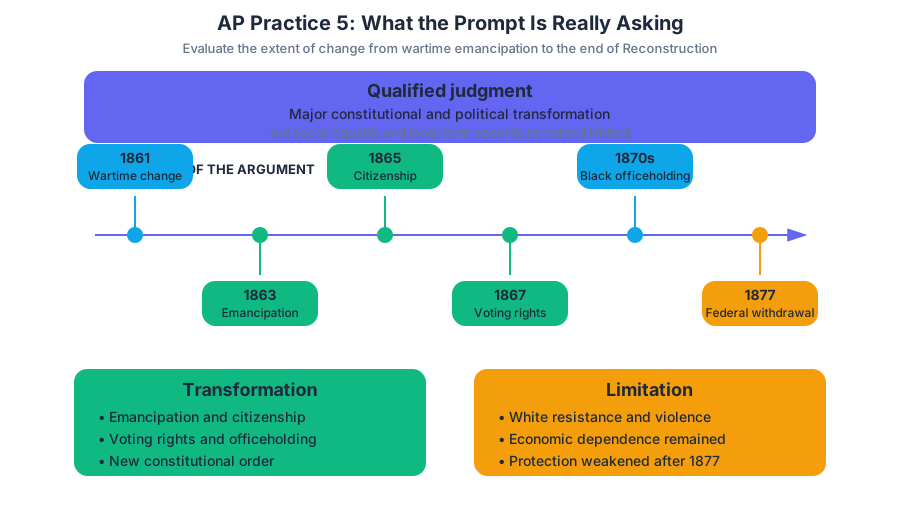
The command “evaluate the extent” requires a qualified judgment. You must decide whether the transformation was substantial, limited, or uneven—and then prove that judgment. The dates establish the boundaries: begin with wartime developments in 1861 and end with the political changes surrounding the withdrawal of federal protection in 1877.
The central tension is transformation versus limitation:
A useful thesis might argue that the period produced a major constitutional and political transformation—emancipation, citizenship, voting rights, and Black officeholding—but that social equality and long-term security remained limited because white resistance, economic dependence, and the end of Reconstruction weakened those gains.
Timing plan: 40 minutes
| Time | Action | Purpose |
|---|---|---|
| 5 minutes | Read, identify the reasoning task, and outline | Prevent a fact dump |
| 30 minutes | Write the response | Develop argument and evidence |
| 5 minutes | Check the thesis, evidence, and reasoning | Recover missed rubric points |
Before writing, create a three-column mental outline:
| Transformation | Evidence of change | Evidence of limits |
|---|---|---|
| Legal status | Emancipation Proclamation; Thirteenth Amendment | Freedom did not guarantee equality |
| Political status | Fourteenth and Fifteenth Amendments; Black officeholding | Violence and disfranchisement efforts |
| Social and economic position | Freedmen’s Bureau schools; family reunification | Sharecropping, debt, racial violence |
Worked reasoning
Skill 1. Developments and Processes requires identifying and explaining the historical developments that matter. Do not merely name the Fourteenth Amendment. Explain that it established birthright citizenship and equal protection, changing the federal government’s constitutional relationship to African Americans.
Skill 4. Contextualization requires connecting the argument to broader circumstances. Before 1861, slavery defined African Americans as property in much of the United States, while free Black people faced severe legal and political restrictions. The wartime destruction of slavery therefore represented a fundamental break with the earlier racial order.
Skill 5. Making Connections includes historical reasoning processes such as causation, comparison, and continuity and change. This prompt is primarily a continuity and change task: compare African Americans’ position before the Civil War with their position during and immediately after Reconstruction, while identifying important continuities.
Model response
Before the Civil War, slavery denied millions of African Americans control over their labor, family lives, movement, and legal identity, while even many free Black people lacked full citizenship and voting rights. Between 1861 and 1877, the Civil War and Reconstruction produced a substantial transformation in African Americans’ legal and political position through emancipation, constitutional amendments, and participation in government. However, the transformation was incomplete because economic dependence, white supremacist violence, and the collapse of federal enforcement limited African Americans’ ability to turn formal rights into lasting social equality.
The war began the transformation by making emancipation a national policy. The Emancipation Proclamation declared enslaved people in areas still rebelling against the Union to be free, and the Thirteenth Amendment abolished slavery throughout the country. These measures changed African Americans’ legal status from property to free people. The Union also recruited Black soldiers, including troops in the United States Colored Troops, whose military service strengthened African Americans’ claims to citizenship and equal treatment.
Reconstruction expanded these wartime changes into constitutional rights. The Fourteenth Amendment established birthright citizenship and equal protection, while the Fifteenth Amendment prohibited denying the vote on the basis of race. African Americans used these new opportunities to vote, participate in constitutional conventions, and hold local, state, and national offices. Reconstruction governments supported public education and other institutions, demonstrating that African Americans were not merely freed from slavery but were actively shaping public life.
Nevertheless, the period did not produce full social or economic equality. Many freedpeople lacked land and entered sharecropping arrangements that could leave them trapped in debt. White Southerners resisted Reconstruction through organizations such as the Ku Klux Klan, using terror to suppress Black voting and political participation. Although congressional Reconstruction Acts and federal enforcement temporarily challenged this violence, the Compromise of 1877 ended effective federal protection in the South. Thus, the period transformed African Americans’ formal legal and political position more dramatically than their economic security or protection from racial violence.
Rubric-aligned breakdown
| Rubric criterion | Where the model earns it |
|---|---|
| Thesis or claim | The opening makes a defensible judgment: transformation was substantial legally and politically but incomplete socially and economically |
| Contextualization | The response explains the prewar system of slavery and restrictions on free Black people |
| Evidence: description | It accurately describes the Emancipation Proclamation, Thirteenth, Fourteenth, and Fifteenth Amendments, Black military service, sharecropping, the Ku Klux Klan, and the Compromise of 1877 |
| Evidence: argument support | Each example is connected to the claim about transformation or limitation |
| Analysis and reasoning | The response uses continuity and change over time and qualifies its argument rather than treating the period as total success or total failure |
| Complex understanding | It distinguishes legal and political change from economic and social continuity |
Common misconception check
Misconception: “Emancipation ended racial oppression.” Emancipation ended slavery as a legal institution, but it did not automatically provide land, economic independence, physical safety, or equal access to political power. A precise LEQ separates freedom from slavery from equality in practice.
Another common error is treating Reconstruction as a single federal program with one result. Reconstruction changed over time: wartime emancipation, congressional constitutional reform, Black political participation, violent resistance, and the withdrawal of federal enforcement all belong in the argument.
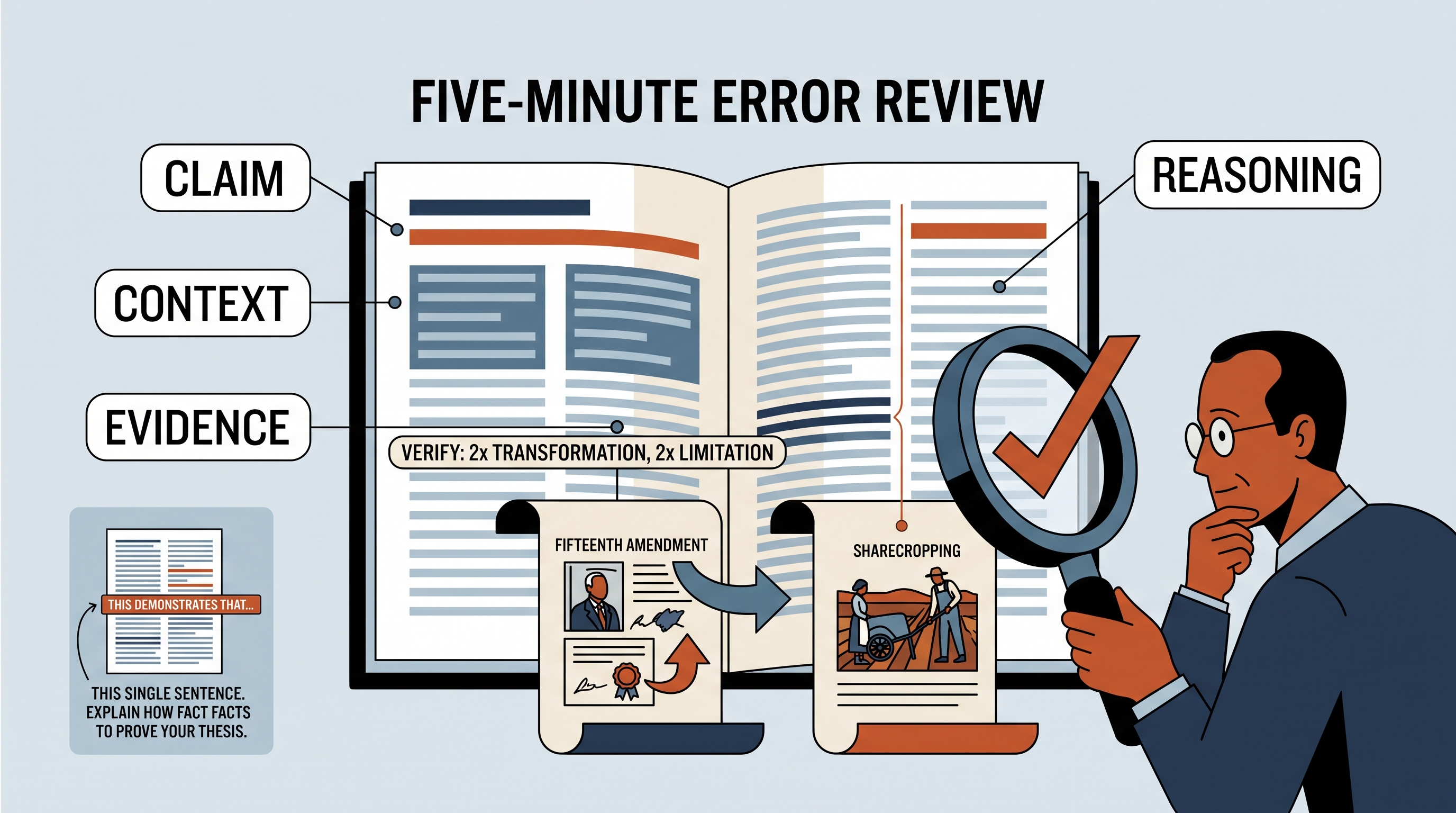
Five-minute error review
After writing, mark each paragraph with one label: claim, context, evidence, or reasoning. If a paragraph contains facts but no explanation of how those facts prove the thesis, add a sentence beginning, “This demonstrates that…” Then verify that at least two specific examples support transformation and at least two support limitation.
Retrieval check: Why is the Fifteenth Amendment evidence of political transformation, while sharecropping is evidence that the transformation remained incomplete?
Answer: The Fifteenth Amendment expanded formal voting rights for Black men, while sharecropping often preserved economic dependence and restricted the practical independence that emancipation promised.
Source Materials
- AP U.S. History Course and Exam Description
- AP U.S. History Course and Exam Description Clarifications and Corrections
- AP U.S. History Course Overview
- AP U.S. History Course at a Glance
- AP United States History Course at a Glance Poster
- AP United States History
- AP United States History
- AP United States History Sample Syllabus 1
- AP US History Past Exam Questions — AP Central
- Khan Academy — AP US History
- Gilder Lehrman Institute — AP US History Study Guide
- AP US History Units — Save My Exams