From the free course AP United States History on Lykke
8.5 Culture After 1945 · 8.6 Early Steps in the Civil Rights Movement, 1940s and 1950s
Key concepts: Post-1945 mass culture and entertainment · Radio broadcasting and the Grand Ole Opry · Television’s portrayal of family and gender roles · Continuing resistance to desegregation · Civil rights activism and debates over nonviolence · Social and political unrest during the civil rights movement · The long civil rights movement from the World Wars to the 1960s · The March on Washington · Psychological struggle and civil rights institutions · Supreme Court enforcement of desegregation
After World War II, American culture became increasingly national: a radio broadcast, television program, or protest campaign could reach millions of people at once. That shared culture created both a reassuring image of postwar life and a powerful stage on which Americans confronted racial inequality.
8.5 Culture After 1945 · 8.6 Early Steps in the Civil Rights Movement, 1940s and 1950s
After World War II, American culture became increasingly national: a radio broadcast, television program, or protest campaign could reach millions of people at once. That shared culture created both a reassuring image of postwar life and a powerful stage on which Americans confronted racial inequality.
Mass culture and the “normal” postwar family
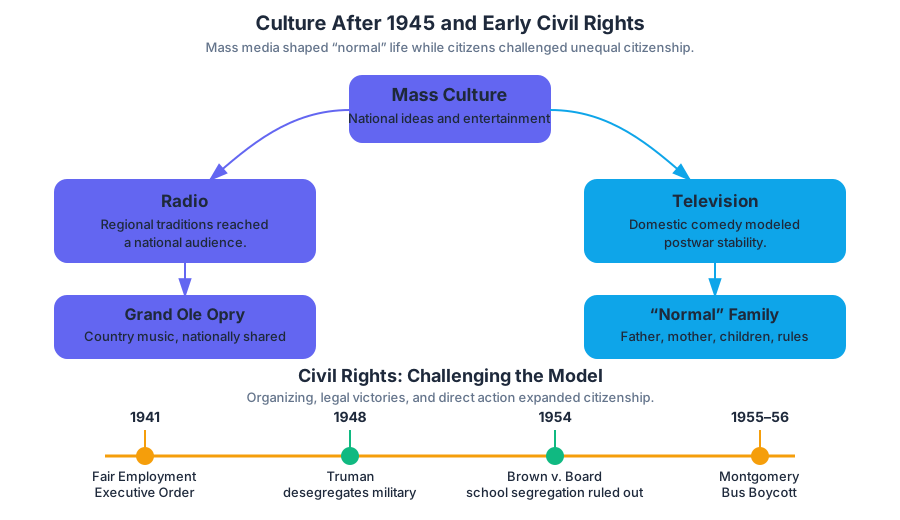
Mass culture means widely distributed entertainment and ideas produced for a large national audience. Radio remained influential after 1945, while television rapidly entered American homes. These media did not simply reflect society; they also presented models of what family life, gender behavior, and respectable citizenship supposedly looked like.
The Grand Ole Opry illustrates radio’s continuing cultural power. Broadcast from Nashville, the program turned country music into a national popular-culture institution. Its December 24, 1960, concert program shows how radio linked regional traditions to a broad American audience, carrying performances and images of rural identity into homes across the country.
Television often portrayed postwar stability through domestic comedy. Leave It to Beaver, for example, commonly presented the home as a secure suburban world organized around a breadwinning father, a homemaking mother, and children learning social rules under parental supervision. This image captured an important cultural ideal, but it did not describe every American family: women worked for wages, many families lived in poverty, and African American, immigrant, and working-class experiences were often minimized or excluded.
Key distinction: Popular media can reveal what a society valued or wanted to project without proving that everyone actually lived according to that image.
Civil rights activism: a longer movement
The civil rights movement did not suddenly begin in the 1960s. Its modern phase extended from the World Wars through the 1960s, as African American activists challenged discrimination through legal action, direct action, organizational work, and nonviolent protest. World War II intensified the contradiction between American claims about democracy and the reality of segregation, while postwar activism carried that contradiction into courts, workplaces, transportation systems, schools, and public spaces.
The CED identifies KC-8.2.I.A: during and after World War II, civil rights activists and leaders, especially Martin Luther King Jr., used several strategies against racial discrimination. Nonviolent protest means deliberately refusing physical violence while using marches, boycotts, sit-ins, prayer demonstrations, and related actions to expose injustice and pressure authorities. It was not passive acceptance; it required organization, discipline, publicity, and willingness to face arrest or violence without retaliating.
Law, resistance, and the limits of progress
Court victories could establish a constitutional principle, but local and state resistance often slowed its practical enforcement. Bailey v. Patterson (1962) held segregation in interstate bus terminals and related facilities unconstitutional. Because Bailey came after the central legal victories of the 1940s and 1950s, it is best understood as evidence of the continuing legal struggle: even after federal courts rejected transportation segregation, officials and institutions continued defending racial separation.
Resistance made desegregation uneven and dangerous. The CED’s KC-8.2.I.C explains that continuing resistance slowed desegregation and sparked social and political unrest nationwide. Violence, arrests, intimidation, and official obstruction convinced many activists that legal victories alone could not transform daily life.
The movement therefore contained strategic debates. Some activists supported nonviolence because it could expose the brutality of segregation, attract national attention, and build broad coalitions. Others increasingly questioned whether nonviolence produced results quickly enough, especially after 1965, when continued racial inequality and violence encouraged more militant approaches.
Worked connection: from protest to national unrest
Consider James Reeb, a minister and social worker who traveled to Selma, Alabama, to support the civil rights movement and was beaten there. His attack demonstrated that resistance was not merely an abstract disagreement over policy: people who entered the struggle could face deadly violence, and the violence itself could generate national outrage and political pressure.
Bayard Rustin’s account of the 1963 March on Washington emphasized a psychological struggle within the United States. The march sought not only legislation but also a change in how Americans understood citizenship, racial hierarchy, and national morality. In this sense, mass media and mass protest worked together: television and newspapers could make local injustice visible to a national audience, while public demonstrations challenged the comforting order portrayed by programs such as Leave It to Beaver.
AP historical reasoning
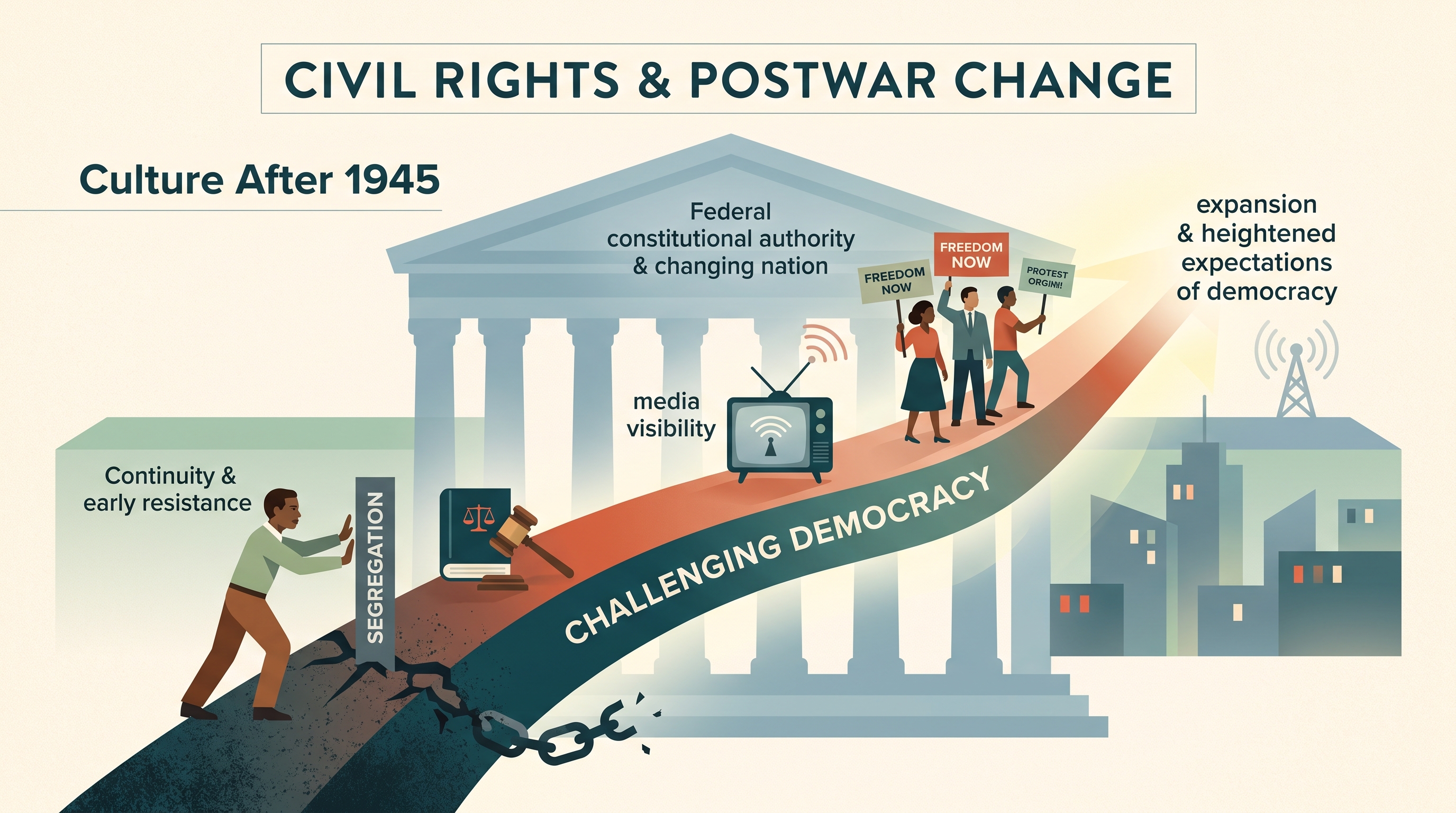
For Skill 4.B, Contextualization, connect postwar mass media and the civil rights movement to the larger setting of national expansion, federal constitutional authority, and heightened expectations of democracy after World War II. For Skill 5.A, Making Connections—Identify patterns of continuity and change, trace continuity in racial resistance alongside change in legal strategies, media visibility, and protest organization. The related Skill 5.B, Making Connections—Explain how a historical development or process relates to another historical development or process, is strongest when you explain the mechanism: resistance slowed desegregation, delayed equality, intensified protest, and contributed to wider social and political unrest.
Misconception check: The civil rights movement was not a single organization led by one person, and nonviolence did not mean that activists lacked anger or demands for structural change. It was a broad, evolving movement whose strategies and internal arguments changed as activists encountered legal victories, persistent resistance, and violence.
Retrieval check: Explain one way postwar mass culture created a shared national identity, then explain how civil rights activism challenged the racial assumptions hidden inside that identity. Include one legal strategy, one direct-action strategy, and one reason debates over nonviolence intensified after 1965.
Source Materials
- AP U.S. History Course and Exam Description
- AP U.S. History Course and Exam Description Clarifications and Corrections
- AP U.S. History Course Overview
- AP U.S. History Course at a Glance
- AP United States History Course at a Glance Poster
- AP United States History
- AP United States History
- AP United States History Sample Syllabus 1