From the free course AP United States History on Lykke
6.1 Contextualizing Period 6 · 6.2 Westward Expansion: Economic Development
Key concepts: Historical contextualization · Westward expansion · Economic development · Indigenous resistance · Westward migration · American identity · Land treaties and negotiation · Northwest Ordinance · Urban manufacturing · Rural agricultural innovation
Between 1865 and 1898, the United States expanded westward while transforming its economy: railroads, factories, farms, and new technologies tied distant regions into a national market.
6.1 Contextualizing Period 6 · 6.2 Westward Expansion: Economic Development
Between 1865 and 1898, the United States expanded westward while transforming its economy: railroads, factories, farms, and new technologies tied distant regions into a national market. The central historical question is not simply why did Americans move west? but how did economic development encourage expansion, and how did expansion reshape American power, identity, and conflict?
Historical contextualization: putting expansion in a larger pattern
Historical contextualization explains how broader political, economic, cultural, and social developments shaped a specific historical development or process. Context is the historical “weather system” surrounding an event: it does not replace the event itself, but it helps explain why that event became possible and why it mattered.
Contextualization means connecting a specific development to a broader pattern that came before or existed around it.
A reliable three-step method is:
- Identify a broad pattern. For example, the United States repeatedly expanded its territory and population after independence.
- Identify a specific example. The Northwest Ordinance created a process for organizing western territories and admitting new states.
- Explain the link. By establishing rules for territorial government and statehood, the ordinance helped make expansion appear orderly, lawful, and connected to national development.
This method matters because an isolated fact—such as a treaty, migration movement, or invention—does not yet demonstrate historical understanding. The explanation must show how the fact relates to a larger process.
From the early republic to Period 6
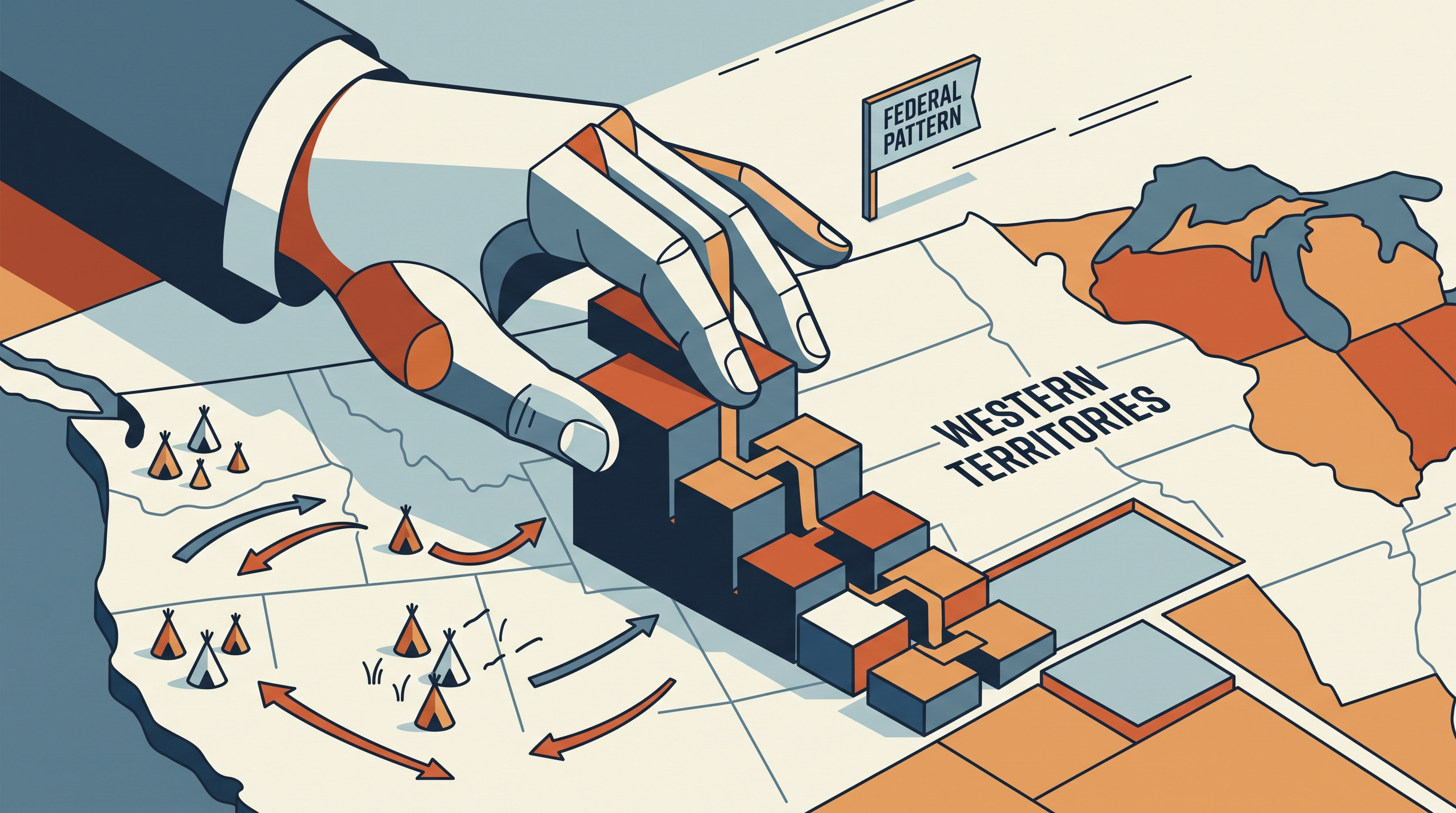
Period 6 begins in 1865, but its expansion story rests on earlier developments. From 1783 to 1800, the new nation confronted questions that remained important after the Civil War: Who controlled western land? How would Indigenous nations respond? Could treaties and negotiation settle competing claims? What did territorial growth mean for American identity?
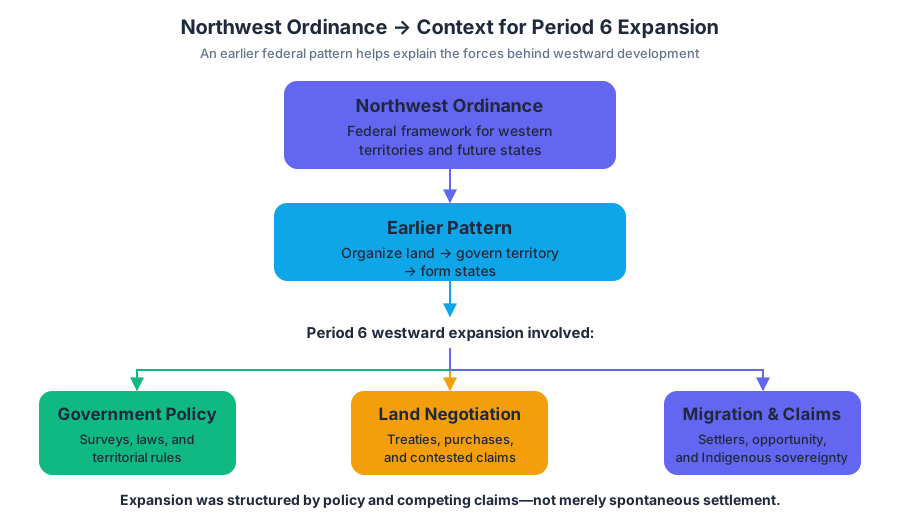
The Northwest Ordinance and later land treaties established precedents for federal involvement in western expansion. Yet these policies often treated Indigenous homelands as territories available for American settlement, producing recurring conflict. Indigenous resistance was therefore not an obstacle appearing suddenly in Period 6; it was part of a longer struggle over sovereignty, land, and the meaning of United States expansion.
A strong contextual chain looks like this:
| Broad pattern | Specific development | Historical connection |
|---|---|---|
| Territorial growth after independence | Northwest Ordinance | Federal procedures encouraged organized settlement and state formation |
| Persistent competition over land | Treaties and negotiation | Agreements attempted to transfer or define land claims, often under unequal pressure |
| Movement toward a continental nation | Westward migration | Settlers, farmers, workers, and businesses carried population and institutions into new regions |
| Expansion of national identity | “American” claims to western space | Territorial growth became associated with opportunity, independence, and national power |
Economic development and westward expansion
After the Civil War, expansion operated through two connected economic systems. Urban manufacturing, including textile mills and other factories, concentrated labor and investment in cities. Rural agriculture relied on improved tools and access to expanding markets. Westward expansion connected these systems: farms supplied food and raw materials, while cities produced goods, machinery, credit, and transportation services.
The steel plow allowed farmers to cut through tough prairie soil more effectively than earlier wooden or iron plows. The mechanical reaper increased the speed at which crops could be harvested. These technologies did not eliminate hardship—farmers still faced debt, falling prices, drought, and transportation costs—but they made large-scale agriculture more productive and tied rural producers to national and international markets.
Worked contextual example: Suppose a source shows a farmer using a mechanical reaper on the Great Plains. First, identify the broad pattern: postwar economic development expanded production and national markets. Next, identify the specific evidence: the reaper represents technological innovation in rural agriculture. Finally, explain the link: improved machinery made farming more commercially viable, encouraged settlement in western lands, increased demand for transportation, and connected rural production to urban manufacturing and markets.
Reading historical images and sources
A historical image can be analyzed as evidence rather than decoration. Ask:
- What professions or economic activities appear? Farming, factory labor, transportation, mining, or commerce may reveal the economy represented.
- Who is centered or left out? The image may celebrate settlers or industry while omitting Indigenous communities or exploited labor.
- What is the primary message? A scene may promote progress, abundance, national unity, or the promise of western opportunity.
These questions activate AP Historical Thinking Skill 4: Contextualization, especially when the image is linked to broader economic and geographic developments. They also support AP Historical Thinking Skill 5: Making Connections, because students must connect technology, labor, migration, land policy, and regional development rather than treating them as separate facts. When using a written or visual source, AP Historical Thinking Skill 3: Claims and Evidence in Sources requires identifying what the source actually supports.
Misconception check
Misconception: “Westward expansion was mainly individual movement by adventurous settlers.” Expansion also depended on government policy, land treaties, transportation systems, technological innovation, capital, labor, and markets. Settlers mattered, but expansion became powerful because public policy and private economic development reinforced one another—often at the expense of Indigenous sovereignty.
Retrieval and interpretation check
Prompt: How could the Northwest Ordinance help contextualize westward expansion in Period 6?
Answer: It established an earlier pattern of federal organization of western territories and state formation. That pattern helps explain why later expansion involved government policy, land negotiation, migration, and competing claims over Indigenous land—not merely spontaneous settlement.
Source Materials
- AP U.S. History Course and Exam Description
- AP U.S. History Course and Exam Description Clarifications and Corrections
- AP U.S. History Course Overview
- AP U.S. History Course at a Glance
- AP United States History Course at a Glance Poster
- AP United States History
- AP United States History
- AP United States History Sample Syllabus 1
- AP US History Past Exam Questions — AP Central
- Khan Academy — AP US History
- Gilder Lehrman Institute — AP US History Study Guide
- AP US History Units — Save My Exams