From the free course AP United States History on Lykke
6.3 Westward Expansion: Social and Cultural Development · 6.4 The “New South”
Key concepts: Manifest Destiny and westward expansion · Westward migration after the Civil War · Federal legislation promoting western transportation · Regional interdependence and transportation networks · The emergence of a national culture · The decline of open-range ranching and cattle drives · Mechanization and steam-powered agricultural equipment · The Oklahoma Land Rush · The economic and cultural development of the New South
Westward expansion after the Civil War was not simply a story of empty land being settled; it was a struggle over who could control land, labor, transportation, and regional identity.
6.3 Westward Expansion: Social and Cultural Development · 6.4 The “New South”
Westward expansion after the Civil War was not simply a story of empty land being settled; it was a struggle over who could control land, labor, transportation, and regional identity.
Unit 6: Learning Objective B: Explain the causes and effects of westward expansion from 1865 to 1898.
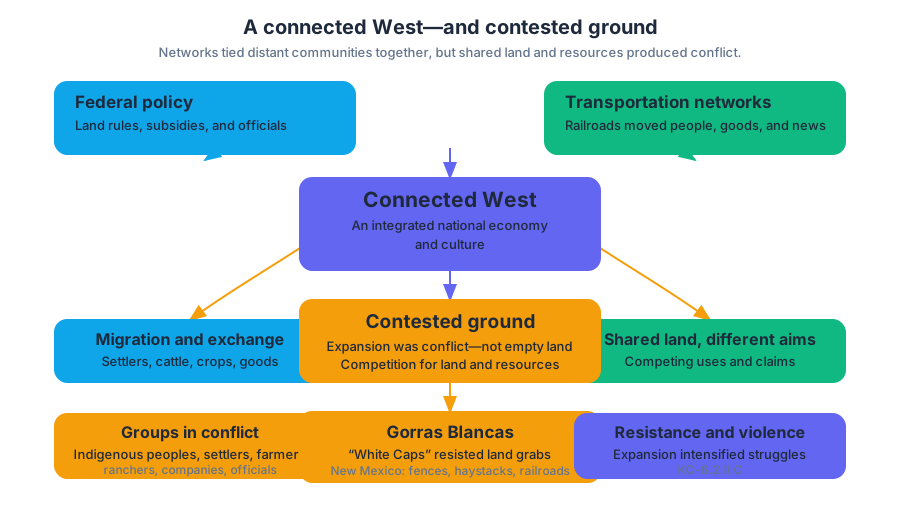
A connected West—and contested ground
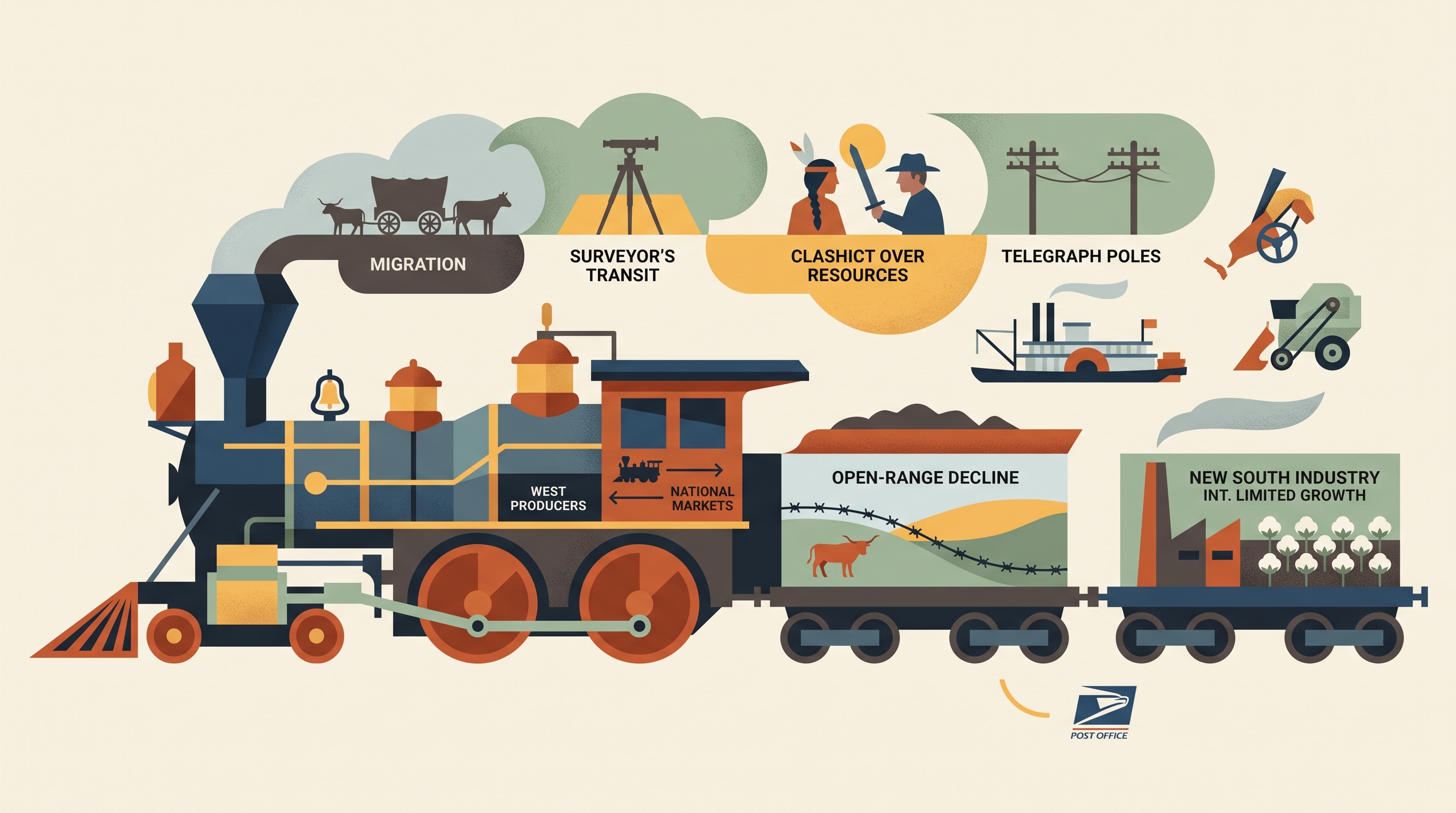
Federal policy and transportation networks tied distant communities together. Railroads carried settlers, cattle, crops, manufactured goods, and news across the continent, helping create a more integrated national economy and culture.
The same networks that encouraged migration also intensified conflict. Settlers, Indigenous peoples, Mexican Americans, ranchers, farmers, railroad companies, and federal officials often wanted the same land for different purposes. Competition for land and resources means that western expansion must be analyzed as a conflict among groups—not as a simple movement into unused territory.
KC-6.2.II.C connects this competition to resistance and violence. In New Mexico, the Gorras Blancas—“White Caps”—challenged settler land grabs by cutting fences, burning haystacks, and sabotaging railroads. Their actions reflected opposition to the enclosure of land that had previously been used more openly by local communities.
Migration, cultural exchange, and conflict
Western migration involved more than Anglo-American homesteaders. Mexican cultural influence remained visible in ranching, especially through the work and knowledge of vaqueros, or Mexican cowboys. The history of cattle ranching therefore demonstrates cultural exchange: practices associated with Mexican communities shaped the wider cattle industry, even as Mexican Americans frequently faced discrimination and loss of land.
The Oklahoma Land Rush of 1889 shows the contradictory character of western settlement. “Boomers” rushed to claim land, while accounts also recognized corruption and the effects on Indigenous people. The event could be celebrated by settlers as an opportunity for economic advancement while experienced by Native peoples as another stage of dispossession.
Worked contextual example: Suppose a historian compares a settler account of the Oklahoma Land Rush with a Gorras Blancas platform. The settler account might emphasize opportunity and movement; the Gorras Blancas document would reveal resistance to fencing and land seizure. A strong historical explanation would argue that westward expansion produced both mobility for some and dispossession for others. The evidence supports a cause-and-effect chain:
$$ \text{Federal support and transportation} \rightarrow \text{increased migration} \rightarrow \text{competition for land} \rightarrow \text{resistance and conflict} $$
Why the open range disappeared
The cattle industry first depended heavily on open-range ranching and long cattle drives. Ranchers moved herds across unfenced grasslands toward railroad towns, where cattle could be shipped to eastern markets. Railroads made the drives profitable, but railroads also helped transform the West in ways that eventually undermined them.
Farmers and ranchers increasingly used barbed wire to enclose land. Fencing blocked cattle routes, restricted access to water and grass, and turned shared or contested spaces into private property. Severe winters, drought, overgrazing, and the expansion of commercial agriculture further weakened the open range. Thus, the decline of cattle drives resulted from both environmental pressures and the growing privatization of western land.
Misconception check: The cowboy was not an exclusively Anglo-American figure. Mexican vaqueros deeply influenced cattle-ranching techniques, equipment, language, and labor practices.
The “New South”: industrial hopes, agricultural realities
After the Civil War, some southern leaders promoted a “New South”—a region that would diversify beyond cotton, attract factories, develop railroads, and participate more fully in national markets. The vision promised modernization and economic independence rather than continued dependence on one cash crop.
In practice, industrial growth remained limited and uneven. The South continued to rely heavily on agriculture, especially cotton, while systems such as sharecropping kept many African American and poor white farmers economically dependent. The region became more connected to national markets without becoming economically equal to the industrial North.
The New South therefore contained a central tension:
| Promised transformation | Continuing reality |
|---|---|
| Factories and railroads | Predominantly agricultural economy |
| Diversified production | Continued dependence on cotton |
| Economic opportunity | Debt and dependence through sharecropping |
| Modern regional identity | Persistent racial inequality |
Misconception check: “New South” did not mean that the South immediately became industrial or socially transformed. It described an aspiration promoted by regional boosters, not a complete economic reality.
AP historical reasoning: Developments and Processes
The most direct skill here is HSP-1: Developments and Processes, especially explaining how developments unfolded and produced consequences. To apply it, connect federal transportation policy, migration, land competition, cultural exchange, and changing economic systems rather than listing them separately.
A complete explanation might state: Federal support for transportation encouraged migration and connected western producers to national markets; this intensified conflicts over land and resources, contributed to the decline of open-range ranching, and helped produce a more nationally integrated culture. In the South, similar transportation and market connections supported limited industrial growth but did not displace agricultural dependence.
Retrieval check: Why did railroads both encourage cattle ranching and contribute to the decline of open-range cattle drives? Name one group that gained from western expansion and one group that resisted it, then explain why their interests collided.
Source Materials
- AP U.S. History Course and Exam Description
- AP U.S. History Course and Exam Description Clarifications and Corrections
- AP U.S. History Course Overview
- AP U.S. History Course at a Glance
- AP United States History Course at a Glance Poster
- AP United States History
- AP United States History
- AP United States History Sample Syllabus 1
- (A) Briefly describe one way in which economic development influenced migration within the United States from 1890 to 1945.
- (A) Briefly describe one way in which economic development influenced migration within the United States from 1890 to 1945.