From the free course AP United States History on Lykke
3.1 Contextualizing Period 3 · 3.2 The Seven Years’ War (French and Indian War)
Key concepts: Historical context · Colonial rivalry · British-French competition in North America · Indigenous diplomacy and resistance · Economic and political competition · Territorial expansion · The Seven Years’ War · The French and Indian War · Pontiac’s resistance · Negotiation over Indigenous space
By 1754, North America had become a crowded political map: British colonies were expanding westward, France was defending its trade networks, and diverse Indigenous nations were protecting their lands, economies, and political authority.
3.1 Contextualizing Period 3 · 3.2 The Seven Years’ War (French and Indian War)
By 1754, North America had become a crowded political map: British colonies were expanding westward, France was defending its trade networks, and diverse Indigenous nations were protecting their lands, economies, and political authority. The resulting conflict was not simply a European war transferred overseas. It was a struggle in which Britain and France competed for imperial power while Indigenous nations made differing choices—supporting France, supporting Britain, resisting both, or negotiating independently.
Unit 3: Learning Objective A: Explain the context in which America gained independence and developed a sense of national identity.
The central conflict: land, trade, and influence
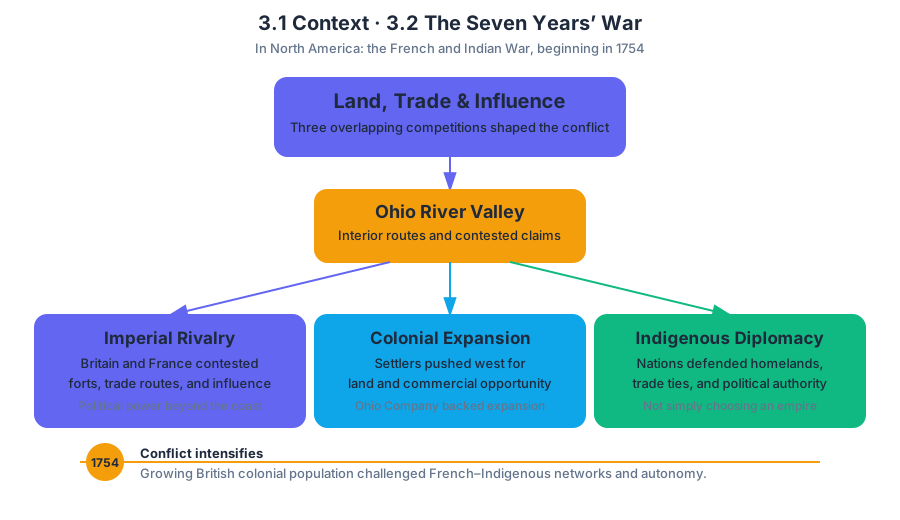
The Seven Years’ War was an international conflict that, in North America, is commonly called the French and Indian War. Its North American phase began in 1754, when British-French colonial rivalry intensified in the interior. The growing population of Britain’s North American colonies pushed beyond the Appalachian Mountains, threatening French–Indigenous trade networks and Indigenous autonomy.
A useful way to see the conflict is as three overlapping competitions:
| Competition | What was at stake |
|---|---|
| British–French imperial rivalry | Territory, trade routes, forts, and political influence |
| Colonial expansion | Access to western land and commercial opportunities |
| Indigenous diplomacy and resistance | Control of homelands, trade relationships, and political authority |
The Ohio River Valley became especially important because it connected interior trade routes and contained land claimed by multiple groups. The British-backed Ohio Company sought commercial and territorial opportunities there, while French forces built forts to defend their connection between Canada and the Mississippi Valley. Indigenous nations also claimed authority in the region; their interests cannot be reduced to choosing between two European empires.
Indigenous nations as political actors
Indigenous communities were active participants rather than bystanders. Some nations supported France because French trade relationships or military cooperation appeared useful; others supported Britain; still others attempted to preserve independent positions or shift alliances as circumstances changed. These decisions reflected diplomacy, security, economic interests, and efforts to protect land—not a single “American Indian” policy.
This distinction matters when interpreting the outcome. Britain defeated France and gained major territorial holdings, but that did not mean Indigenous nations uniformly supported France or that British victory established uncontested control. Indigenous resistance challenged European attempts to dominate North American lands, often forcing continued negotiation over territory and political authority.
A worked contextual example: from overlapping claims to resistance
Step 1 — Context: British colonial population growth encouraged movement into the interior. French efforts to defend trade networks and forts made that expansion a direct imperial threat.
Step 2 — Escalation: The Jumonville Glen Skirmish occurred within this environment of overlapping British, French, and Indigenous territorial claims. It illustrates how local disputes could ignite a much larger imperial war.
Step 3 — Outcome: Britain’s victory expanded its territorial holdings, but the war imposed tremendous financial costs. Imperial officials subsequently sought to raise revenue and consolidate control, while attempts to restrict colonial movement westward generated colonial opposition.
Step 4 — Indigenous response: After the war, resistance associated with Pontiac and other Indigenous communities challenged the assumption that Britain could simply replace France as the region’s governing power. Pontiac’s 1763 speech at Detroit emphasized the relationship between Indigenous communities and European colonists, revealing that diplomacy and political authority remained contested.
The historical conclusion is therefore more precise than “Britain defeated France and the Indians”: Britain defeated France, while Indigenous nations pursued varied alliances, resistance, and negotiations before, during, and after the war.
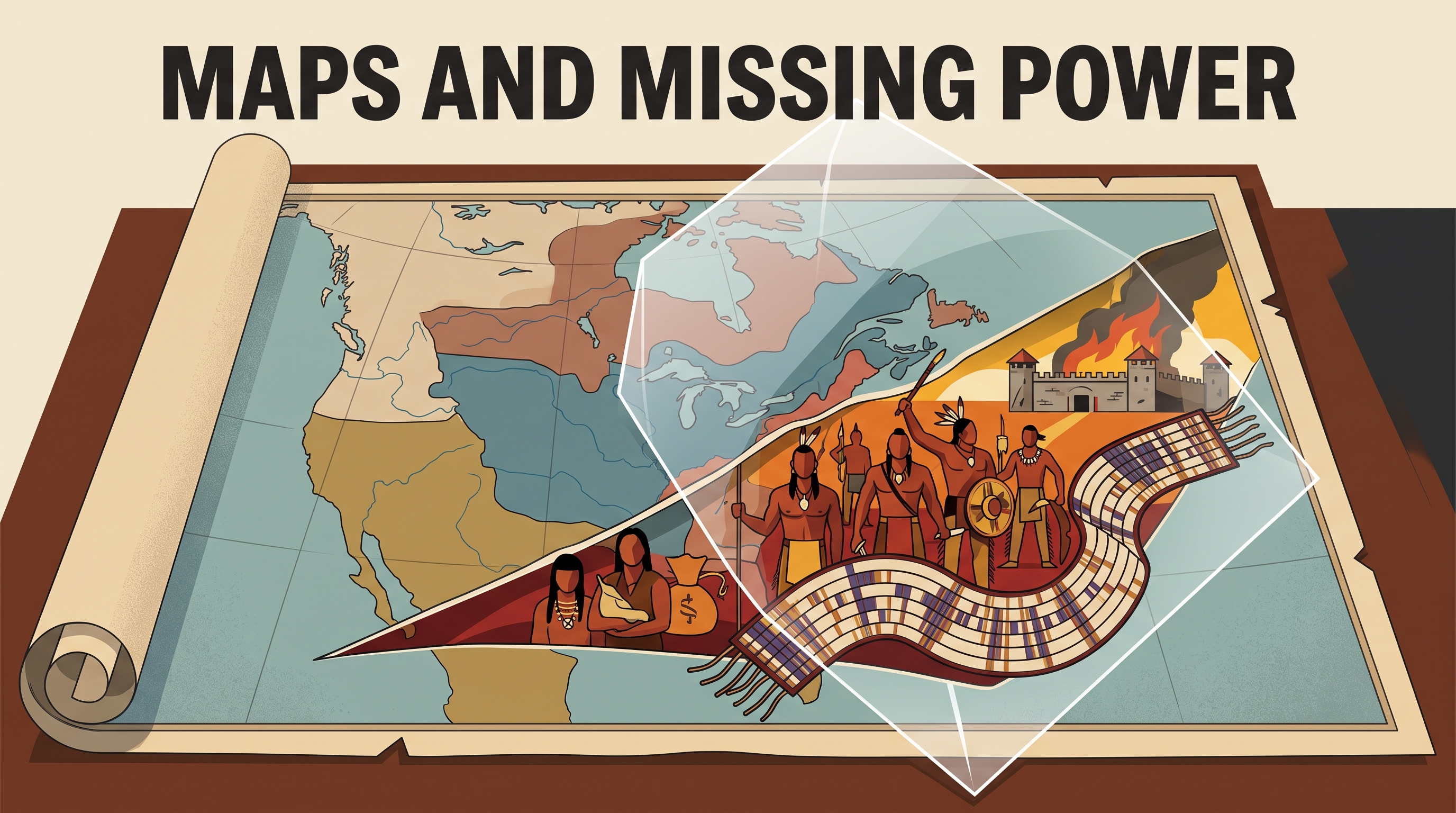
Reading what maps leave out
Maps showing European possessions in 1754 and 1763 are useful for tracking imperial boundaries, but they can create an incomplete picture. A map may show France losing territory and Britain gaining it while failing to show Indigenous homelands, independent political authority, trade relationships, or successful resistance.
Ask of any map: Whose claims are visible, and whose power is missing? The changes in European-controlled territory do not automatically measure the extent of Indigenous control, influence, or resistance. The Shawnee, Delaware, Seneca, Ojibwa, and Ottawa responses—including resistance often associated with Pontiac’s Rebellion—show that the postwar landscape involved continued negotiation over space rather than an instant transfer of authority.
Skill focus and misconception check
Skill 4.A — Contextualization: Identify and describe a historical context for a specific historical development or process. To contextualize the Seven Years’ War, connect it to British population growth, westward expansion, French efforts to protect trade networks, and Indigenous efforts to preserve autonomy.
Skill 1.B — Explain a historical concept, development, or process: Explain how economic and political competition produced conflict, and how the British victory created new territorial and financial pressures.
Misconception check: Indigenous nations were not a single French-aligned bloc. Different nations made different alliances, resisted European encroachment, and negotiated from their own political positions.
Retrieval check
Why would the Seven Years’ War be misrepresented by a map showing only British and French territorial changes? A strong answer identifies both the visible imperial rivalry and the omitted Indigenous diplomacy, resistance, and continuing negotiation over land and authority.
Source Materials
- AP U.S. History Course and Exam Description
- AP U.S. History Course and Exam Description Clarifications and Corrections
- AP U.S. History Course Overview
- AP U.S. History Course at a Glance
- AP United States History Course at a Glance Poster
- AP United States History
- AP United States History
- AP United States History Sample Syllabus 1
- (A) Briefly describe one way that agriculture influenced migration to North America from 1607 to 1776.
- (A) Briefly describe one way that agriculture influenced migration to North America from 1607 to 1776.
- AP US History Past Exam Questions — AP Central
- Khan Academy — AP US History